


 Скачать презентацию Toward Completing A Vision A Preview of Version
6f5b29d0f1480111b53f25fca5a7b693.ppt
- Количество слайдов: 89
 “Toward Completing A Vision” A Preview of Version 7 of the IBM Rational Software Model Driven Development Product Family William T. Smith (smithtw@us. ibm. com) Product Manager, Model Driven Development, IBM Rational Tendances Logicielles 19 septembre 2006
 Agenda • The Rational MDD Heritage • The New MDD Product Family: Vision and Current State (v 6) • The New MDD Product Family: Toward Completing The Vision (v 7) Tendances Logicielles 19 septembre 2006
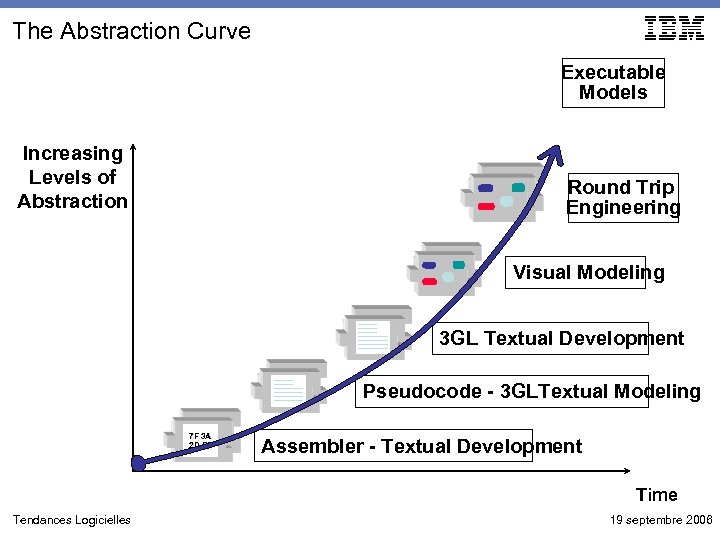 The Abstraction Curve Executable Models Increasing Levels of Abstraction Round Trip Engineering Visual Modeling 3 GL Textual Development Pseudocode - 3 GLTextual Modeling 7 F 3 A 2 D FF Assembler - Textual Development Time Tendances Logicielles 19 septembre 2006
 Market Landscape, 1995 -1997 • UML was new • C/C++ were dominant languages, Java just emerging • IDEs were not common • Frameworks and runtimes we take for granted today, did not exist Tendances Logicielles 19 septembre 2006
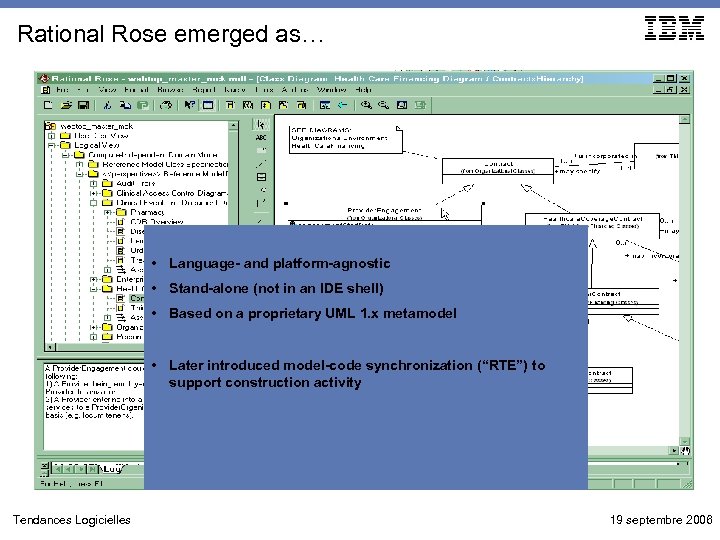 Rational Rose emerged as… • Language- and platform-agnostic • Stand-alone (not in an IDE shell) • Based on a proprietary UML 1. x metamodel • Later introduced model-code synchronization (“RTE”) to support construction activity Tendances Logicielles 19 septembre 2006
 Market Landscape, 1999 -2001 • Broad and enthusiastic adoption of Java • Emergence of J 2 EE framework and runtimes • Emergence of. NET • Introduction of Eclipse • IDEs became ubiquitous in the Java and. NET worlds • Rose began to face competition from code-centric, in-IDE modeling products Tendances Logicielles 19 septembre 2006
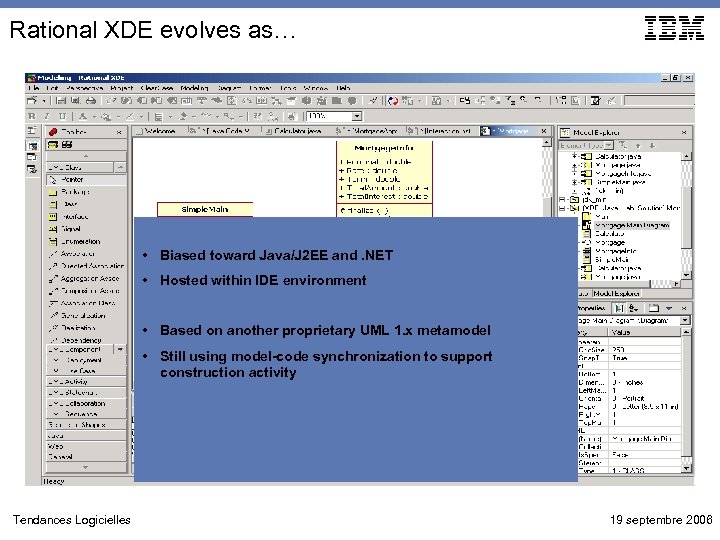 Rational XDE evolves as… • Biased toward Java/J 2 EE and. NET • Hosted within IDE environment • Based on another proprietary UML 1. x metamodel • Still using model-code synchronization to support construction activity Tendances Logicielles 19 septembre 2006
 Market Landscape, 2002 -… • Limitations of model-code synchronization were showing • … Tendances Logicielles 19 septembre 2006
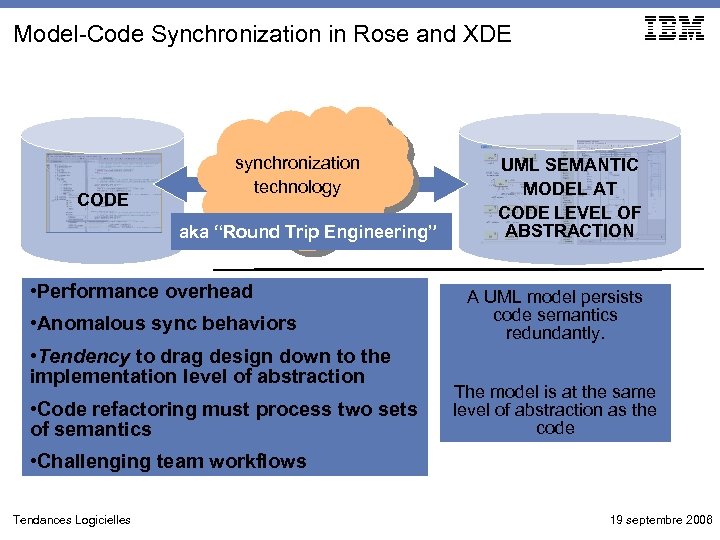 Model-Code Synchronization in Rose and XDE CODE synchronization technology aka “Round Trip Engineering” • Performance overhead • Anomalous sync behaviors • Tendency to drag design down to the implementation level of abstraction • Code refactoring must process two sets of semantics UML SEMANTIC MODEL AT CODE LEVEL OF ABSTRACTION A UML model persists code semantics redundantly. The model is at the same level of abstraction as the code • Challenging team workflows Tendances Logicielles 19 septembre 2006
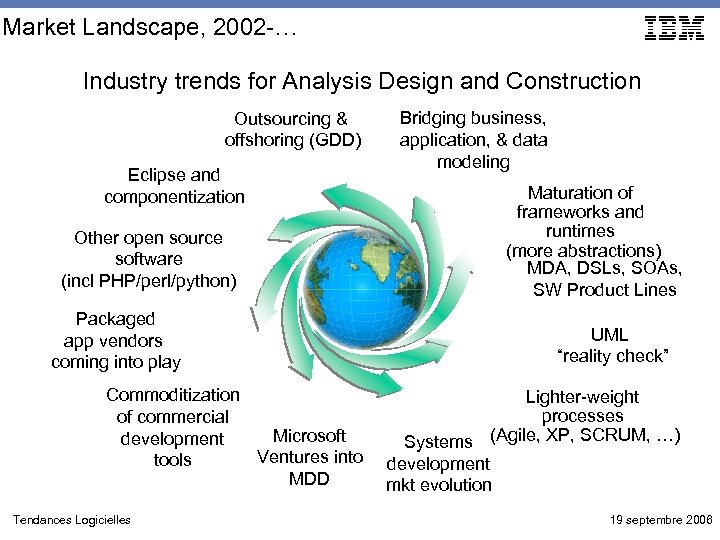 Market Landscape, 2002 -… Industry trends for Analysis Design and Construction Outsourcing & offshoring (GDD) Eclipse and componentization Other open source software (incl PHP/perl/python) Packaged app vendors coming into play Commoditization of commercial Microsoft development Ventures into tools MDD Tendances Logicielles Bridging business, application, & data modeling Maturation of frameworks and runtimes (more abstractions) MDA, DSLs, SOAs, SW Product Lines UML “reality check” Lighter-weight processes Systems (Agile, XP, SCRUM, …) development mkt evolution 19 septembre 2006
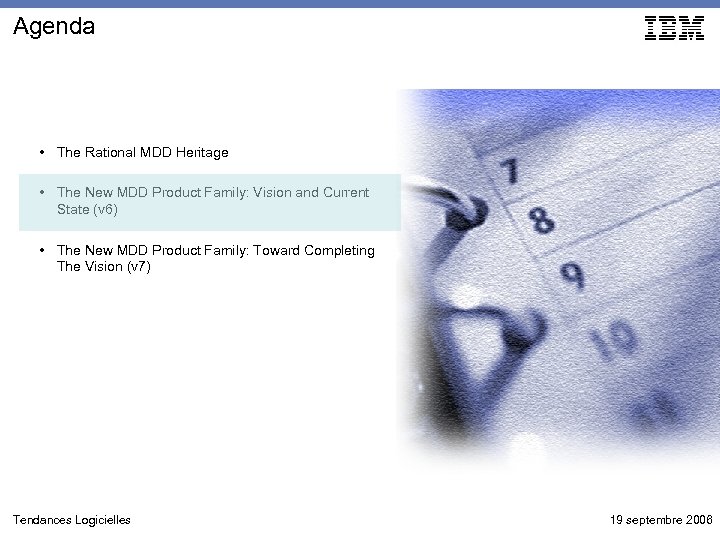 Agenda • The Rational MDD Heritage • The New MDD Product Family: Vision and Current State (v 6) • The New MDD Product Family: Toward Completing The Vision (v 7) Tendances Logicielles 19 septembre 2006
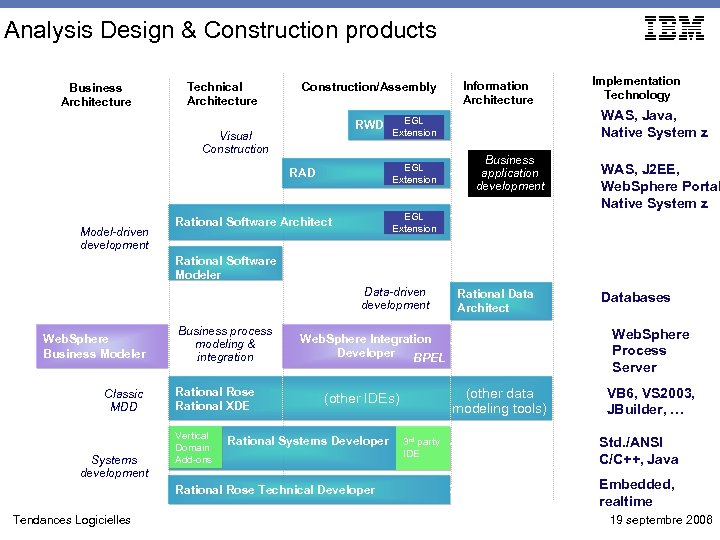 Analysis Design & Construction products Business Architecture Technical Architecture Construction/Assembly RWD Visual Construction Model-driven development Implementation Technology WAS, Java, Native System z EGL Extension RAD Information Architecture Business application development WAS, J 2 EE, Web. Sphere Portal Native System z EGL Extension Rational Software Architect Rational Software Modeler Data-driven development Web. Sphere Business Modeler Classic MDD Systems development Business process modeling & integration Rational Rose Rational XDE Vertical Domain Add-ons (other data modeling tools) (other IDEs) Rational Systems Developer 3 rd party IDE Databases Web. Sphere Process Server Web. Sphere Integration Developer BPEL Rational Rose Technical Developer Tendances Logicielles Rational Data Architect VB 6, VS 2003, JBuilder, … Std. /ANSI C/C++, Java Embedded, realtime 19 septembre 2006
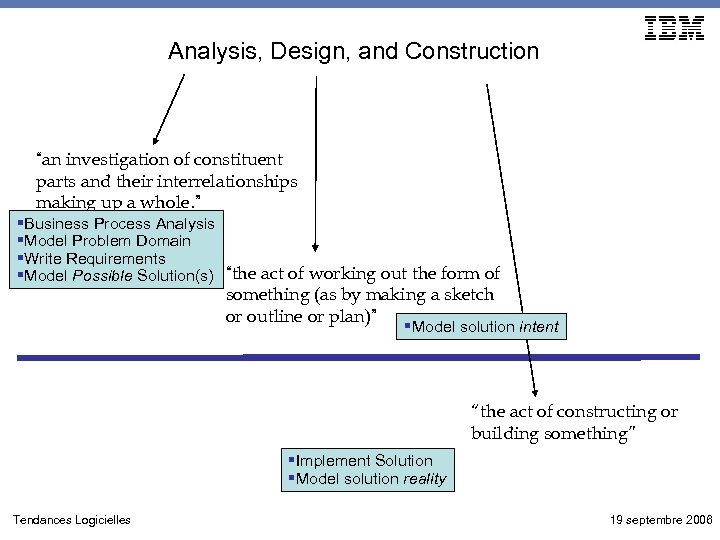 Analysis, Design, and Construction “an investigation of constituent parts and their interrelationships making up a whole. ” §Business Process Analysis §Model Problem Domain §Write Requirements §Model Possible Solution(s) “the act of working out the form of something (as by making a sketch or outline or plan)” §Model solution intent “the act of constructing or building something” §Implement Solution §Model solution reality Tendances Logicielles 19 septembre 2006
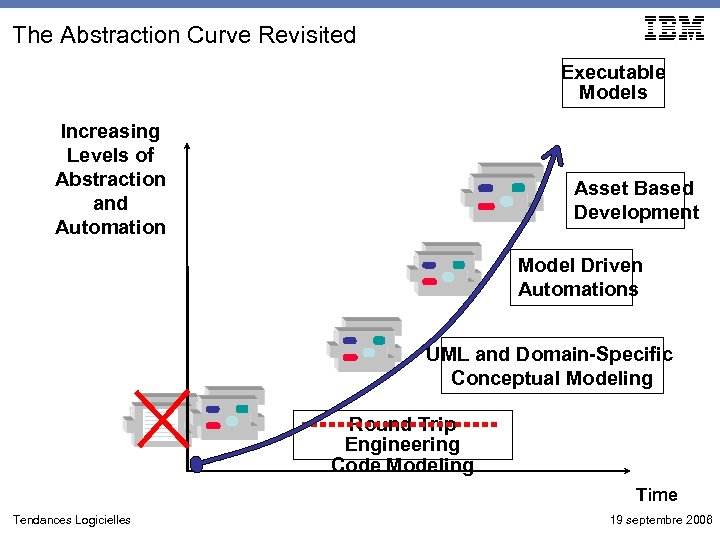 The Abstraction Curve Revisited Executable Models Increasing Levels of Abstraction and Automation Asset Based Development Model Driven Automations UML and Domain-Specific Conceptual Modeling Round Trip Engineering Code Modeling Time Tendances Logicielles 19 septembre 2006
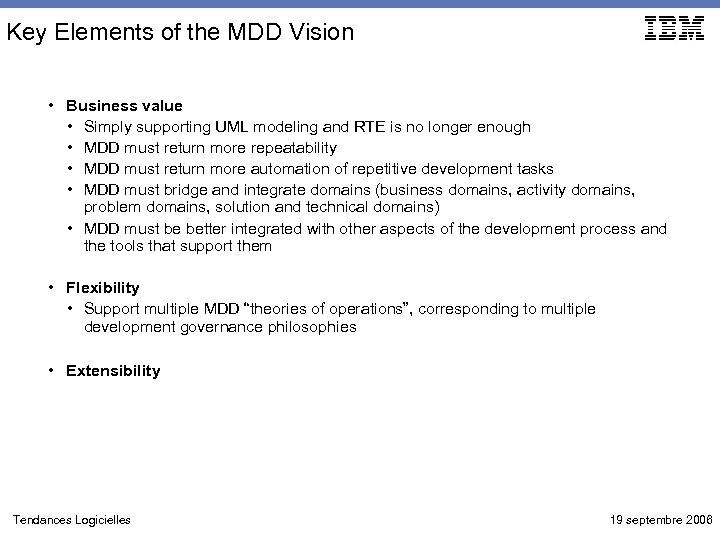 Key Elements of the MDD Vision • Business value • Simply supporting UML modeling and RTE is no longer enough • MDD must return more repeatability • MDD must return more automation of repetitive development tasks • MDD must bridge and integrate domains (business domains, activity domains, problem domains, solution and technical domains) • MDD must be better integrated with other aspects of the development process and the tools that support them • Flexibility • Support multiple MDD “theories of operations”, corresponding to multiple development governance philosophies • Extensibility Tendances Logicielles 19 septembre 2006
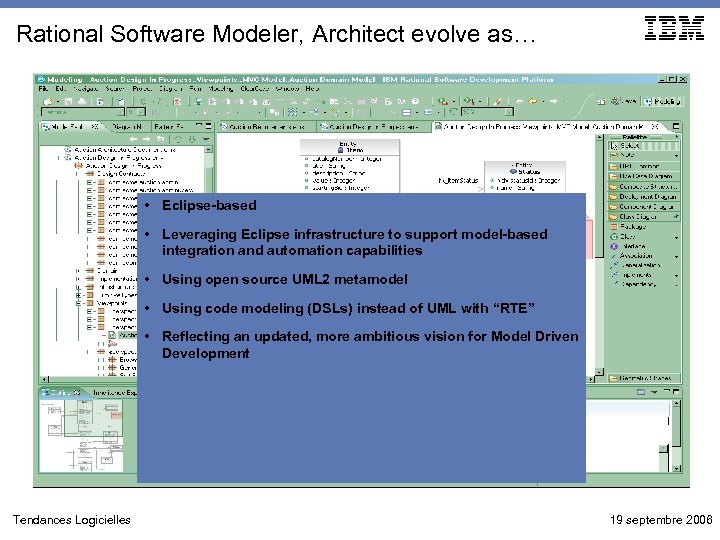 Rational Software Modeler, Architect evolve as… • Eclipse-based • Leveraging Eclipse infrastructure to support model-based integration and automation capabilities • Using open source UML 2 metamodel • Using code modeling (DSLs) instead of UML with “RTE” • Reflecting an updated, more ambitious vision for Model Driven Development Tendances Logicielles 19 septembre 2006
 Key Elements of the MDD Vision • Business value • Simply supporting UML modeling and RTE is no longer enough • MDD must return more repeatability • MDD must return more automation of repetitive development tasks • MDD must bridge and integrate domains (business domains, activity domains, problem domains, solution and technical domains) • MDD must be better integrated with other aspects of the development process and the tools that support them • Flexibility • Support multiple MDD “theories of operations”, corresponding to multiple development governance philosophies • Extensibility Tendances Logicielles 19 septembre 2006
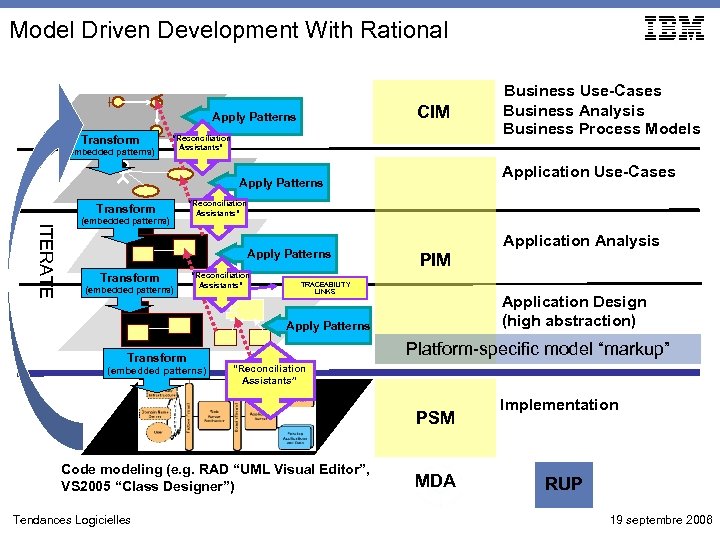 Model Driven Development With Rational CIM Apply Patterns Transform (embedded patterns) “Reconciliation Assistants” Application Use-Cases Apply Patterns Transform ITERATE (embedded patterns) “Reconciliation Assistants” Apply Patterns Transform (embedded patterns) “Reconciliation Assistants” Application Analysis PIM TRACEABILITY LINKS Application Design (high abstraction) Apply Patterns Transform (embedded patterns) Platform-specific model “markup” “Reconciliation Assistants” PSM Code modeling (e. g. RAD “UML Visual Editor”, VS 2005 “Class Designer”) Tendances Logicielles Business Use-Cases Business Analysis Business Process Models MDA Implementation RUP 19 septembre 2006
 Key Elements of the MDD Vision • Business value • Simply supporting UML modeling and RTE is no longer enough • MDD must return more repeatability • MDD must return more automation of repetitive development tasks • MDD must bridge and integrate domains (business domains, activity domains, problem domains, solution and technical domains) • MDD must be better integrated with other aspects of the development process and the tools that support them • Flexibility • Support multiple MDD “theories of operations”, corresponding to multiple development governance philosophies • Extensibility Tendances Logicielles 19 septembre 2006
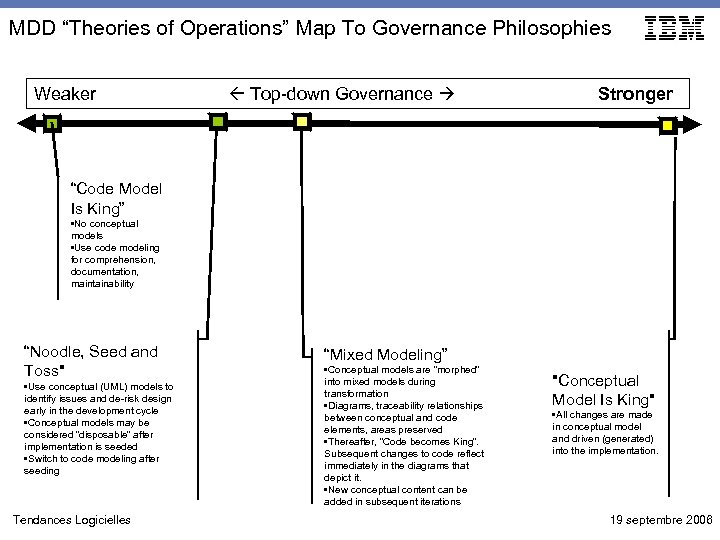 MDD “Theories of Operations” Map To Governance Philosophies Weaker Top-down Governance Stronger “Code Model Is King” • No conceptual models • Use code modeling for comprehension, documentation, maintainability “Noodle, Seed and Toss" • Use conceptual (UML) models to identify issues and de-risk design early in the development cycle • Conceptual models may be considered “disposable” after implementation is seeded • Switch to code modeling after seeding Tendances Logicielles “Mixed Modeling” • Conceptual models are “morphed” into mixed models during transformation • Diagrams, traceability relationships between conceptual and code elements, areas preserved • Thereafter, “Code becomes King”. Subsequent changes to code reflect immediately in the diagrams that depict it. • New conceptual content can be added in subsequent iterations "Conceptual Model Is King" • All changes are made in conceptual model and driven (generated) into the implementation. 19 septembre 2006
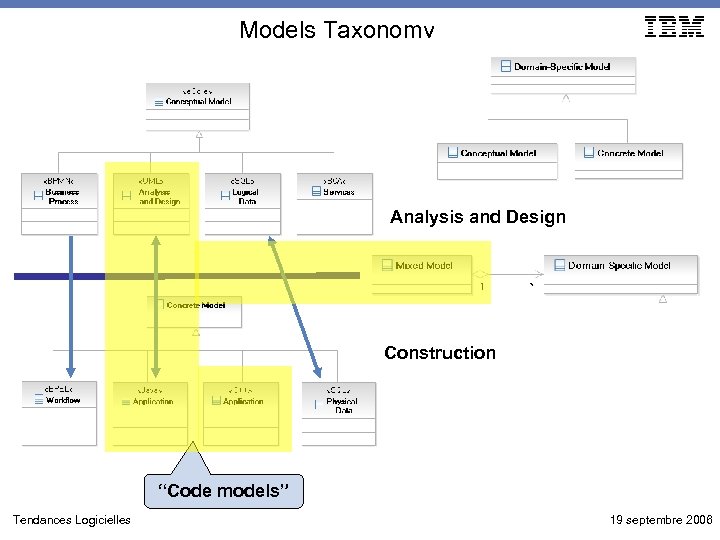 Models Taxonomy Analysis and Design Construction “Code models” Tendances Logicielles 19 septembre 2006
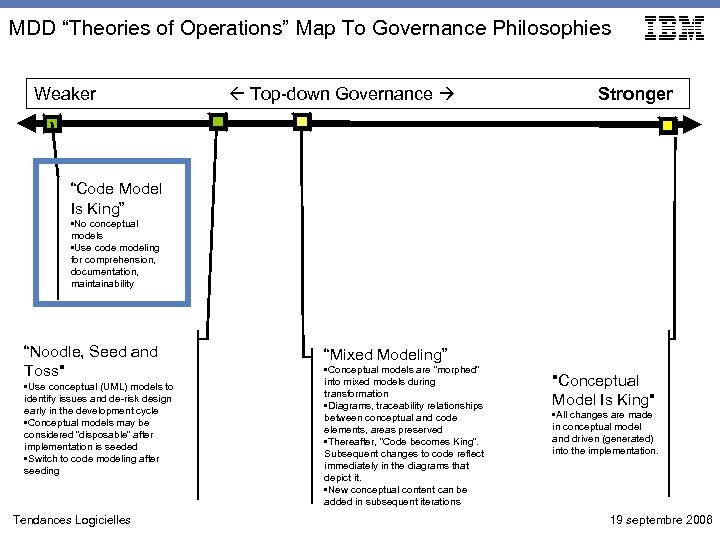 MDD “Theories of Operations” Map To Governance Philosophies Weaker Top-down Governance Stronger “Code Model Is King” • No conceptual models • Use code modeling for comprehension, documentation, maintainability “Noodle, Seed and Toss" • Use conceptual (UML) models to identify issues and de-risk design early in the development cycle • Conceptual models may be considered “disposable” after implementation is seeded • Switch to code modeling after seeding Tendances Logicielles “Mixed Modeling” • Conceptual models are “morphed” into mixed models during transformation • Diagrams, traceability relationships between conceptual and code elements, areas preserved • Thereafter, “Code becomes King”. Subsequent changes to code reflect immediately in the diagrams that depict it. • New conceptual content can be added in subsequent iterations "Conceptual Model Is King" • All changes are made in conceptual model and driven (generated) into the implementation. 19 septembre 2006
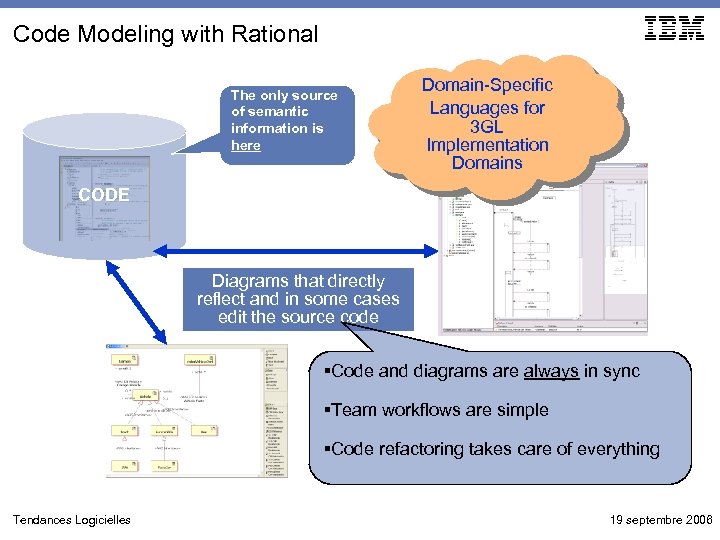 Code Modeling with Rational The only source of semantic information is here Domain-Specific Languages for 3 GL Implementation Domains CODE Diagrams that directly reflect and in some cases edit the source code §Code and diagrams are always in sync §Team workflows are simple §Code refactoring takes care of everything Tendances Logicielles 19 septembre 2006
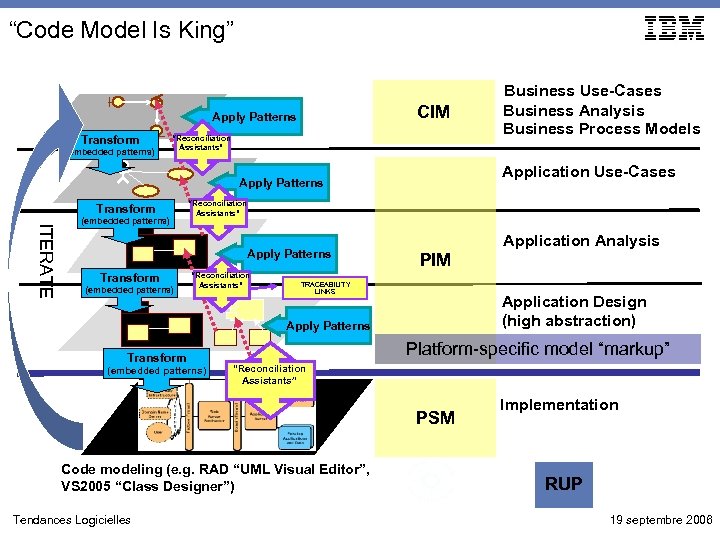 “Code Model Is King” CIM Apply Patterns Transform (embedded patterns) “Reconciliation Assistants” Application Use-Cases Apply Patterns Transform ITERATE (embedded patterns) “Reconciliation Assistants” Apply Patterns Transform (embedded patterns) “Reconciliation Assistants” Application Analysis PIM TRACEABILITY LINKS Application Design (high abstraction) Apply Patterns Transform (embedded patterns) Platform-specific model “markup” “Reconciliation Assistants” PSM Code modeling (e. g. RAD “UML Visual Editor”, VS 2005 “Class Designer”) Tendances Logicielles Business Use-Cases Business Analysis Business Process Models Implementation RUP 19 septembre 2006
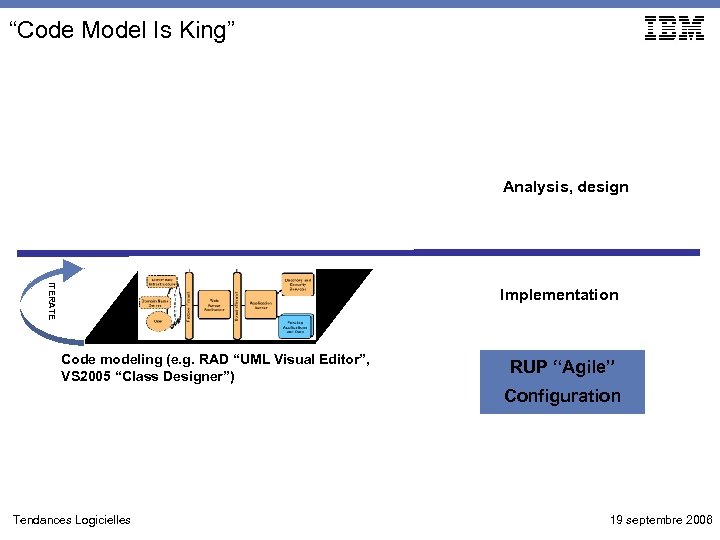 “Code Model Is King” Analysis, design ITERATE Implementation Code modeling (e. g. RAD “UML Visual Editor”, VS 2005 “Class Designer”) RUP “Agile” Configuration Tendances Logicielles 19 septembre 2006
 Demo: “Code Model is King” Tendances Logicielles 19 septembre 2006
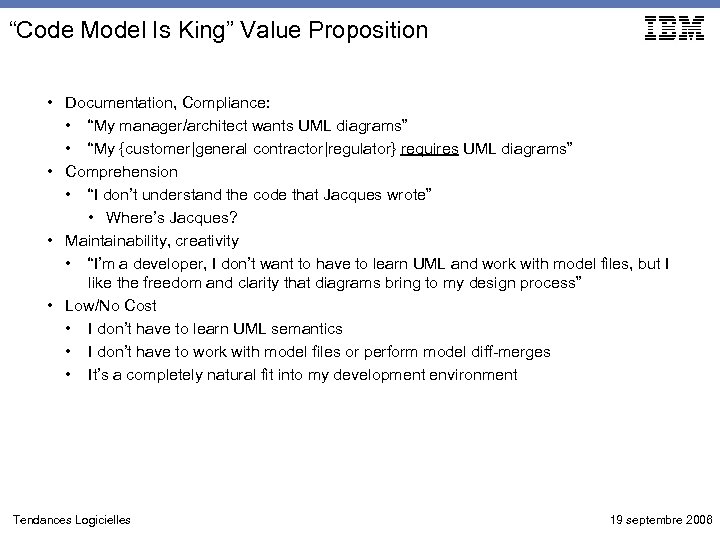 “Code Model Is King” Value Proposition • Documentation, Compliance: • “My manager/architect wants UML diagrams” • “My {customer|general contractor|regulator} requires UML diagrams” • Comprehension • “I don’t understand the code that Jacques wrote” • Where’s Jacques? • Maintainability, creativity • “I’m a developer, I don’t want to have to learn UML and work with model files, but I like the freedom and clarity that diagrams bring to my design process” • Low/No Cost • I don’t have to learn UML semantics • I don’t have to work with model files or perform model diff-merges • It’s a completely natural fit into my development environment Tendances Logicielles 19 septembre 2006
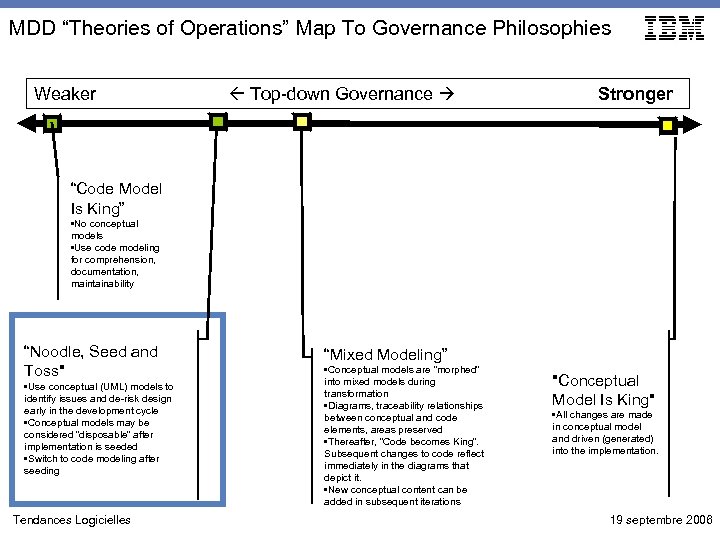 MDD “Theories of Operations” Map To Governance Philosophies Weaker Top-down Governance Stronger “Code Model Is King” • No conceptual models • Use code modeling for comprehension, documentation, maintainability “Noodle, Seed and Toss" • Use conceptual (UML) models to identify issues and de-risk design early in the development cycle • Conceptual models may be considered “disposable” after implementation is seeded • Switch to code modeling after seeding Tendances Logicielles “Mixed Modeling” • Conceptual models are “morphed” into mixed models during transformation • Diagrams, traceability relationships between conceptual and code elements, areas preserved • Thereafter, “Code becomes King”. Subsequent changes to code reflect immediately in the diagrams that depict it. • New conceptual content can be added in subsequent iterations "Conceptual Model Is King" • All changes are made in conceptual model and driven (generated) into the implementation. 19 septembre 2006
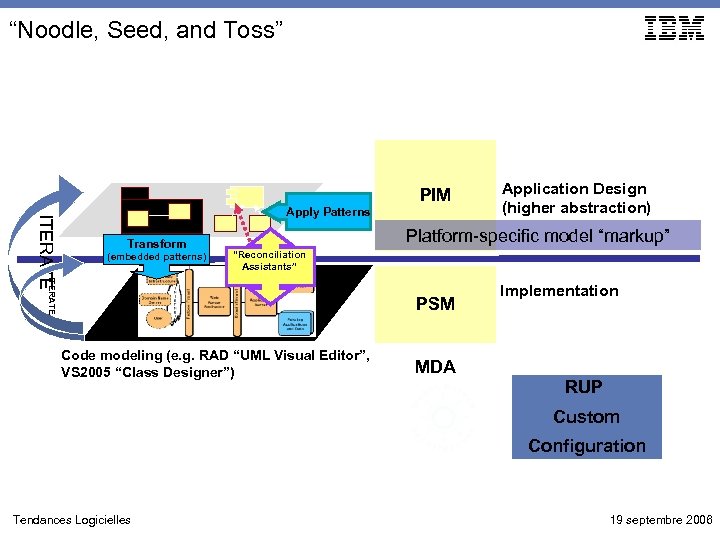 “Noodle, Seed, and Toss” PIM Transform (embedded patterns) Platform-specific model “markup” “Reconciliation Assistants” ITERATE Apply Patterns Application Design (higher abstraction) PSM Code modeling (e. g. RAD “UML Visual Editor”, VS 2005 “Class Designer”) Implementation MDA RUP Custom Configuration Tendances Logicielles 19 septembre 2006
 Demo: “Noodle, Seed, and Toss” Tendances Logicielles 19 septembre 2006
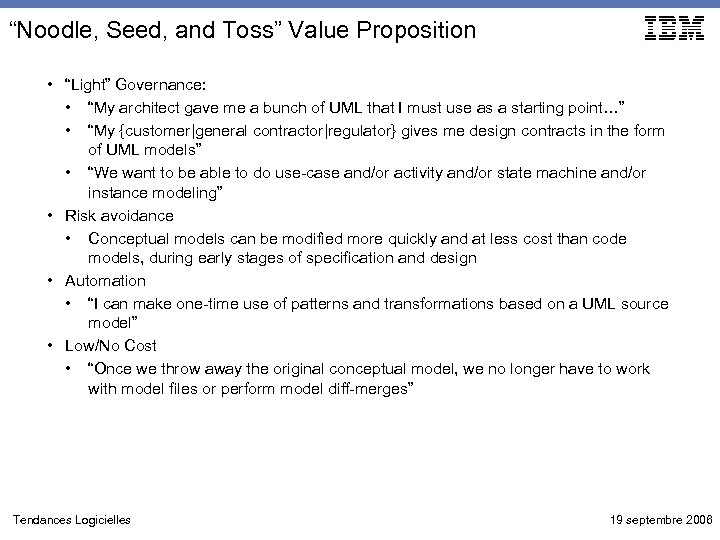 “Noodle, Seed, and Toss” Value Proposition • “Light” Governance: • “My architect gave me a bunch of UML that I must use as a starting point…” • “My {customer|general contractor|regulator} gives me design contracts in the form of UML models” • “We want to be able to do use-case and/or activity and/or state machine and/or instance modeling” • Risk avoidance • Conceptual models can be modified more quickly and at less cost than code models, during early stages of specification and design • Automation • “I can make one-time use of patterns and transformations based on a UML source model” • Low/No Cost • “Once we throw away the original conceptual model, we no longer have to work with model files or perform model diff-merges” Tendances Logicielles 19 septembre 2006
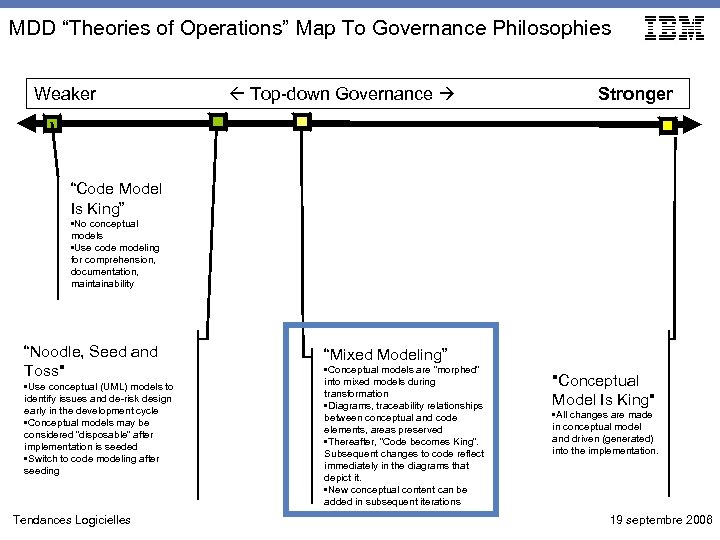 MDD “Theories of Operations” Map To Governance Philosophies Weaker Top-down Governance Stronger “Code Model Is King” • No conceptual models • Use code modeling for comprehension, documentation, maintainability “Noodle, Seed and Toss" • Use conceptual (UML) models to identify issues and de-risk design early in the development cycle • Conceptual models may be considered “disposable” after implementation is seeded • Switch to code modeling after seeding Tendances Logicielles “Mixed Modeling” • Conceptual models are “morphed” into mixed models during transformation • Diagrams, traceability relationships between conceptual and code elements, areas preserved • Thereafter, “Code becomes King”. Subsequent changes to code reflect immediately in the diagrams that depict it. • New conceptual content can be added in subsequent iterations "Conceptual Model Is King" • All changes are made in conceptual model and driven (generated) into the implementation. 19 septembre 2006
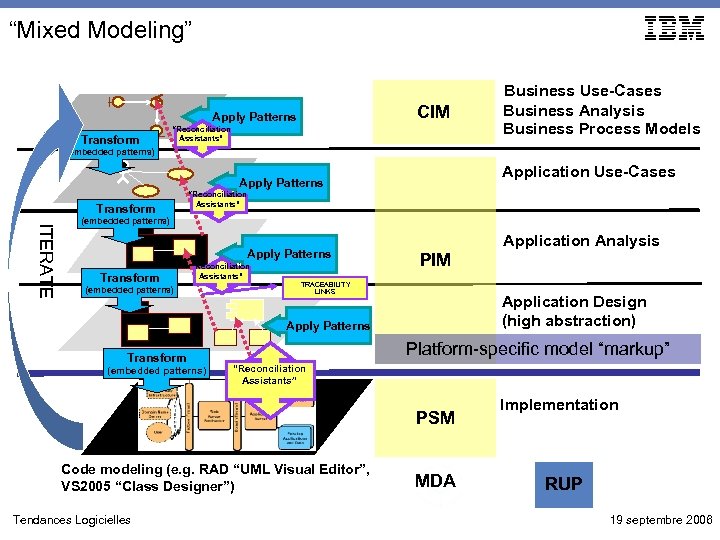 “Mixed Modeling” CIM Apply Patterns Transform “Reconciliation Assistants” Business Use-Cases Business Analysis Business Process Models (embedded patterns) Application Use-Cases Apply Patterns Transform “Reconciliation Assistants” ITERATE (embedded patterns) Apply Patterns Transform “Reconciliation Assistants” (embedded patterns) Application Analysis PIM TRACEABILITY LINKS Application Design (high abstraction) Apply Patterns Transform (embedded patterns) Platform-specific model “markup” “Reconciliation Assistants” PSM Code modeling (e. g. RAD “UML Visual Editor”, VS 2005 “Class Designer”) Tendances Logicielles MDA Implementation RUP 19 septembre 2006
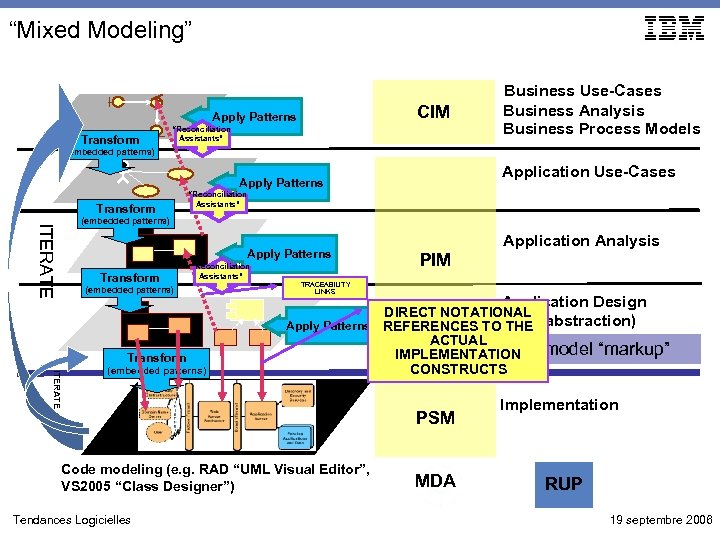 “Mixed Modeling” CIM Apply Patterns Transform “Reconciliation Assistants” Business Use-Cases Business Analysis Business Process Models (embedded patterns) Application Use-Cases Apply Patterns Transform “Reconciliation Assistants” ITERATE (embedded patterns) Apply Patterns Transform “Reconciliation Assistants” (embedded patterns) Transform ITERATE (embedded patterns) PIM TRACEABILITY LINKS Application Design DIRECT NOTATIONAL Apply Patterns REFERENCES TO(high abstraction) THE ACTUAL Platform-specific model “markup” IMPLEMENTATION CONSTRUCTS Code modeling (e. g. RAD “UML Visual Editor”, VS 2005 “Class Designer”) Tendances Logicielles Application Analysis PSM MDA Implementation RUP 19 septembre 2006
 Demo: “Mixed Modeling” Tendances Logicielles 19 septembre 2006
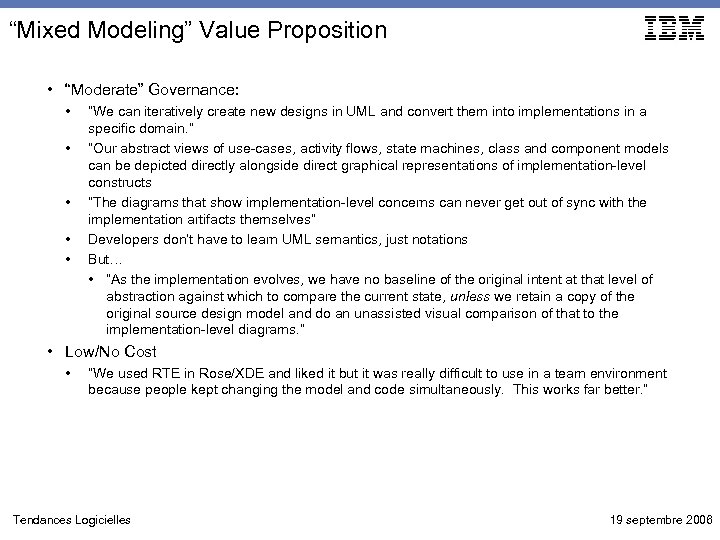 “Mixed Modeling” Value Proposition • “Moderate” Governance: • • • “We can iteratively create new designs in UML and convert them into implementations in a specific domain. ” “Our abstract views of use-cases, activity flows, state machines, class and component models can be depicted directly alongside direct graphical representations of implementation-level constructs “The diagrams that show implementation-level concerns can never get out of sync with the implementation artifacts themselves” Developers don’t have to learn UML semantics, just notations But… • “As the implementation evolves, we have no baseline of the original intent at that level of abstraction against which to compare the current state, unless we retain a copy of the original source design model and do an unassisted visual comparison of that to the implementation-level diagrams. ” • Low/No Cost • “We used RTE in Rose/XDE and liked it but it was really difficult to use in a team environment because people kept changing the model and code simultaneously. This works far better. ” Tendances Logicielles 19 septembre 2006
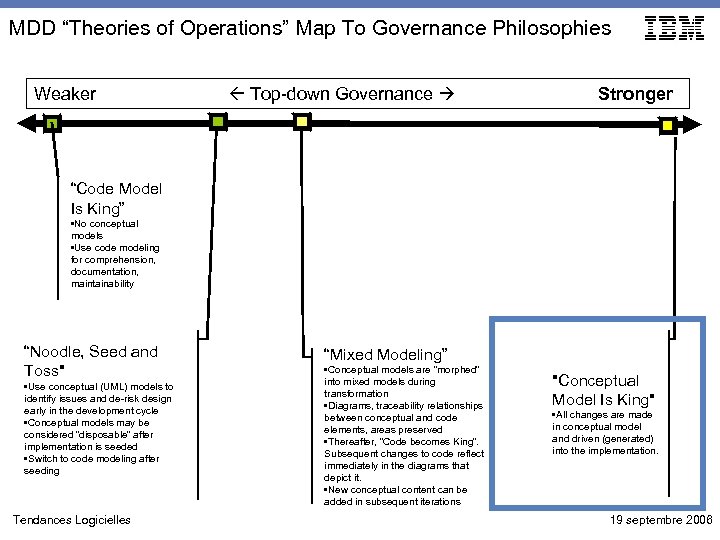 MDD “Theories of Operations” Map To Governance Philosophies Weaker Top-down Governance Stronger “Code Model Is King” • No conceptual models • Use code modeling for comprehension, documentation, maintainability “Noodle, Seed and Toss" • Use conceptual (UML) models to identify issues and de-risk design early in the development cycle • Conceptual models may be considered “disposable” after implementation is seeded • Switch to code modeling after seeding Tendances Logicielles “Mixed Modeling” • Conceptual models are “morphed” into mixed models during transformation • Diagrams, traceability relationships between conceptual and code elements, areas preserved • Thereafter, “Code becomes King”. Subsequent changes to code reflect immediately in the diagrams that depict it. • New conceptual content can be added in subsequent iterations "Conceptual Model Is King" • All changes are made in conceptual model and driven (generated) into the implementation. 19 septembre 2006
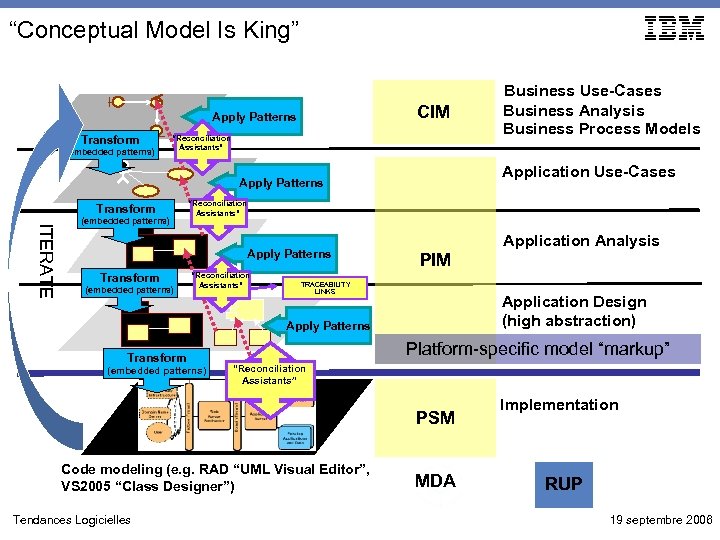 “Conceptual Model Is King” CIM Apply Patterns Transform (embedded patterns) “Reconciliation Assistants” Application Use-Cases Apply Patterns Transform ITERATE (embedded patterns) “Reconciliation Assistants” Apply Patterns Transform (embedded patterns) “Reconciliation Assistants” Application Analysis PIM TRACEABILITY LINKS Application Design (high abstraction) Apply Patterns Transform (embedded patterns) Platform-specific model “markup” “Reconciliation Assistants” PSM Code modeling (e. g. RAD “UML Visual Editor”, VS 2005 “Class Designer”) Tendances Logicielles Business Use-Cases Business Analysis Business Process Models MDA Implementation RUP 19 septembre 2006
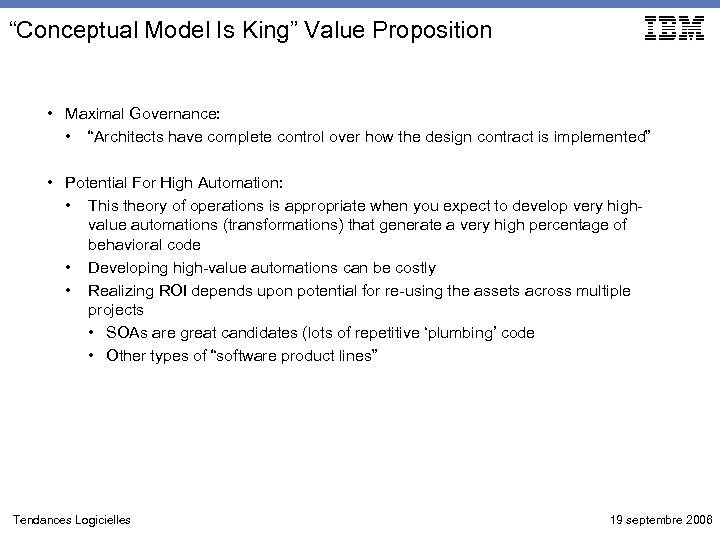 “Conceptual Model Is King” Value Proposition • Maximal Governance: • “Architects have complete control over how the design contract is implemented” • Potential For High Automation: • This theory of operations is appropriate when you expect to develop very highvalue automations (transformations) that generate a very high percentage of behavioral code • Developing high-value automations can be costly • Realizing ROI depends upon potential for re-using the assets across multiple projects • SOAs are great candidates (lots of repetitive ‘plumbing’ code • Other types of “software product lines” Tendances Logicielles 19 septembre 2006
 Agenda • The Rational MDD Heritage • The New MDD Product Family: Vision, Overview, and Current State (v 6) • The New MDD Product Family: Toward Completing The Vision (v 7) Tendances Logicielles 19 septembre 2006
 Key Elements of the MDD Vision • Business value • Simply supporting UML modeling and RTE is no longer enough • MDD must return more repeatability • MDD must return more automation of repetitive development tasks • MDD must bridge and integrate domains (business domains, activity domains, problem domains, solution and technical domains) • MDD must be better integrated with other aspects of the development process and the tools that support them • Flexibility • Support multiple MDD “theories of operations”, corresponding to multiple development governance philosophies • Extensibility Tendances Logicielles 19 septembre 2006
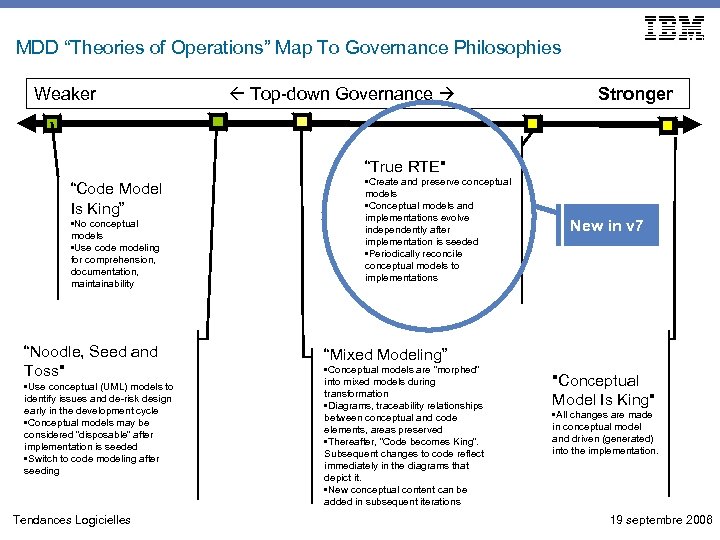 MDD “Theories of Operations” Map To Governance Philosophies Weaker Top-down Governance Stronger “True RTE" “Code Model Is King” • No conceptual models • Use code modeling for comprehension, documentation, maintainability “Noodle, Seed and Toss" • Use conceptual (UML) models to identify issues and de-risk design early in the development cycle • Conceptual models may be considered “disposable” after implementation is seeded • Switch to code modeling after seeding Tendances Logicielles • Create and preserve conceptual models • Conceptual models and implementations evolve independently after implementation is seeded • Periodically reconcile conceptual models to implementations New in v 7 “Mixed Modeling” • Conceptual models are “morphed” into mixed models during transformation • Diagrams, traceability relationships between conceptual and code elements, areas preserved • Thereafter, “Code becomes King”. Subsequent changes to code reflect immediately in the diagrams that depict it. • New conceptual content can be added in subsequent iterations "Conceptual Model Is King" • All changes are made in conceptual model and driven (generated) into the implementation. 19 septembre 2006
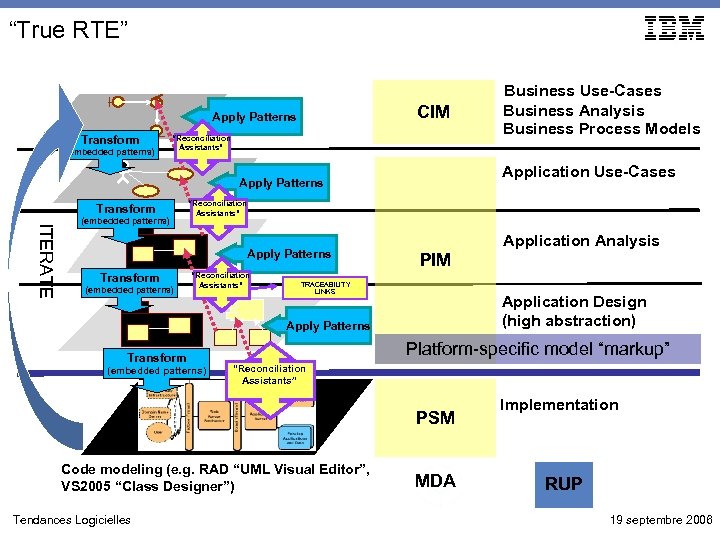 “True RTE” CIM Apply Patterns Transform (embedded patterns) “Reconciliation Assistants” Application Use-Cases Apply Patterns Transform ITERATE (embedded patterns) “Reconciliation Assistants” Apply Patterns Transform (embedded patterns) “Reconciliation Assistants” Application Analysis PIM TRACEABILITY LINKS Application Design (high abstraction) Apply Patterns Transform (embedded patterns) Platform-specific model “markup” “Reconciliation Assistants” PSM Code modeling (e. g. RAD “UML Visual Editor”, VS 2005 “Class Designer”) Tendances Logicielles Business Use-Cases Business Analysis Business Process Models MDA Implementation RUP 19 septembre 2006
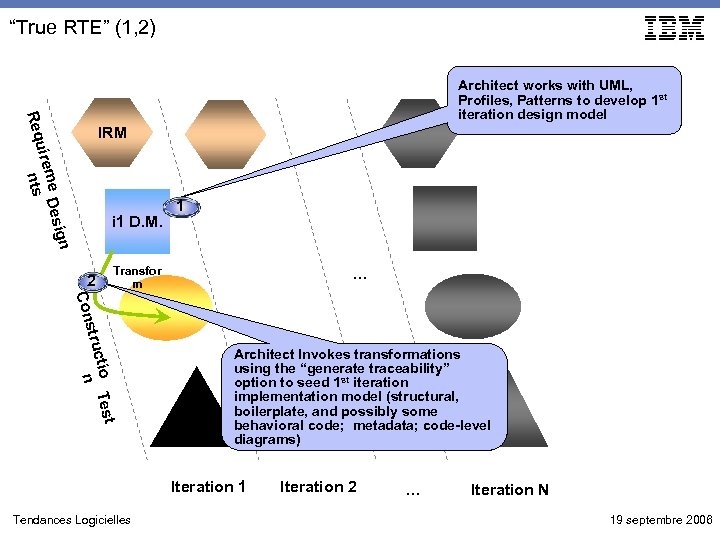 “True RTE” (1, 2) Req Architect works with UML, Profiles, Patterns to develop 1 st iteration design model IRM ig me Des uire ts n i 1 D. M. 1 n 2 Transfor m … Con stru st ctio Te n Architect Invokes transformations using the “generate traceability” option to seed 1 st iteration implementation model (structural, boilerplate, and possibly some behavioral code; metadata; code-level diagrams) Iteration 1 Tendances Logicielles Iteration 2 … Iteration N 19 septembre 2006
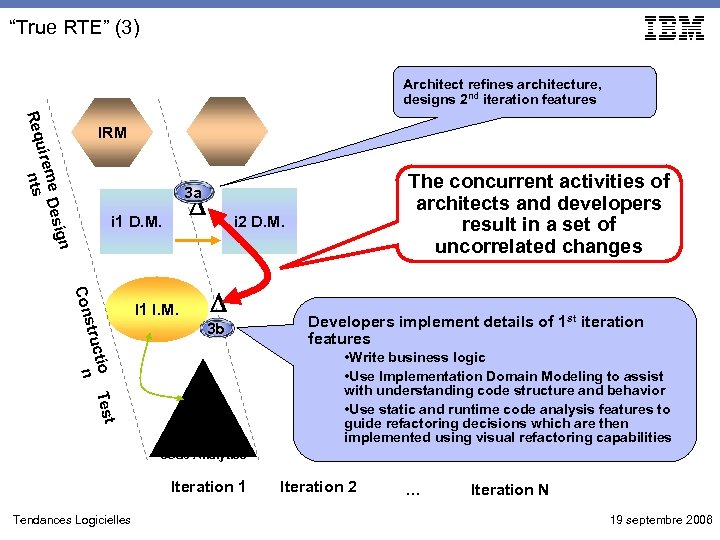 “True RTE” (3) Architect refines architecture, designs 2 nd iteration features Req IRM ig me Des uire ts n The concurrent activities of architects and developers result in a set of uncorrelated changes 3 a i 1 D. M. i 2 D. M. n st ctio Te n stru Con I 1 I. M. 3 b Test Automations and Code Analytics Iteration 1 Tendances Logicielles Developers implement details of 1 st iteration features • Write business logic • Use Implementation Domain Modeling to assist with understanding code structure and behavior • Use static and runtime code analysis features to guide refactoring decisions which are then implemented using visual refactoring capabilities Iteration 2 … Iteration N 19 septembre 2006
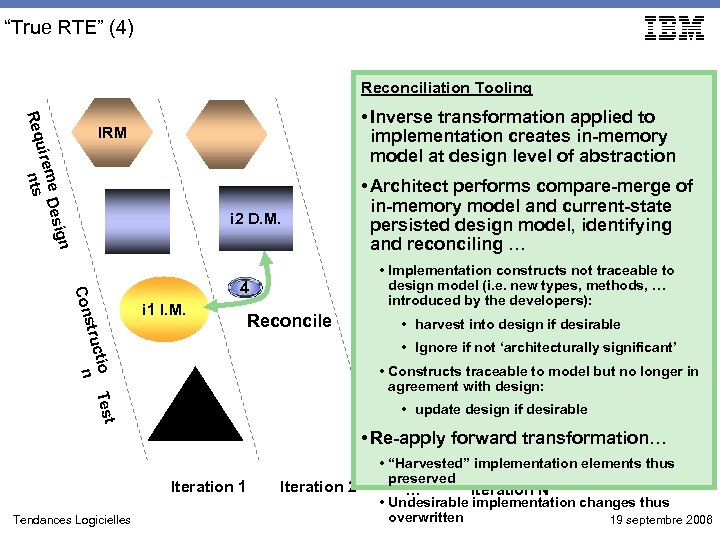 “True RTE” (4) Reconciliation Tooling Req • Inverse transformation applied to implementation creates in-memory model at design level of abstraction IRM ig me Des uire ts n i 2 D. M. n Con • Implementation constructs not traceable to design model (i. e. new types, methods, … introduced by the developers): 4 stru i 1 I. M. • Architect performs compare-merge of in-memory model and current-state persisted design model, identifying and reconciling … Reconcile • harvest into design if desirable st ctio Te n • Ignore if not ‘architecturally significant’ • Constructs traceable to model but no longer in agreement with design: • update design if desirable • Re-apply forward transformation… Iteration 1 Tendances Logicielles Iteration 2 • “Harvested” implementation elements thus preserved … Iteration N • Undesirable implementation changes thus overwritten 19 septembre 2006
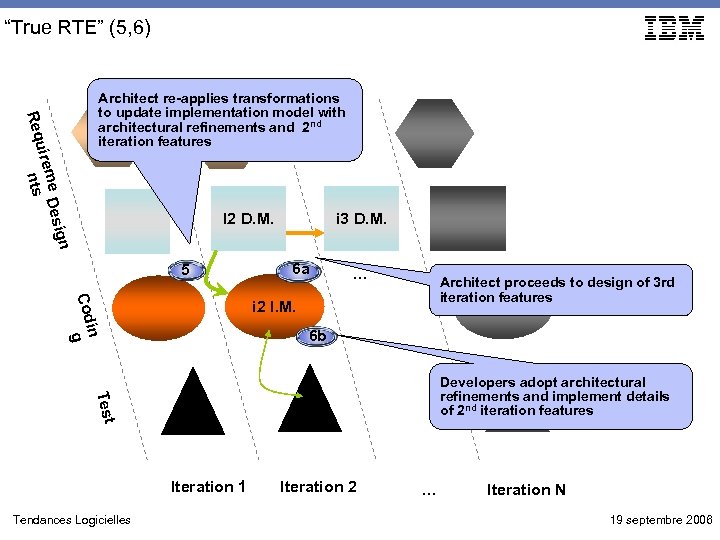 “True RTE” (5, 6) ig me Des uire ts n Req Architect re-applies transformations to update implementation model with architectural refinements and 2 nd IRM iteration features I 2 D. M. i 3 D. M. n 5 6 a … in Cod g Architect proceeds to design of 3 rd iteration features i 2 I. M. 6 b Test Developers adopt architectural refinements and implement details of 2 nd iteration features Iteration 1 Tendances Logicielles Iteration 2 … Iteration N 19 septembre 2006
 Demo: “True RTE” Tendances Logicielles 19 septembre 2006
 “True RTE” Value Proposition • “Flexible” Governance: • • • “We can iteratively create new designs in UML and convert them into implementations in a specific domain. ” “Our abstract views of use-cases, activity flows, state machines, class and component models can be depicted directly alongside direct graphical representations of implementation-level constructs “The diagrams that show implementation-level concerns can never get out of sync with the implementation artifacts themselves” Developers don’t have to learn UML semantics, just notations But… • “As the implementation evolves, we have no baseline of the original intent at that level of abstraction against which to compare the current state, unless we retain a copy of the original source design model and do an unassisted visual comparison of that to the implementation-level diagrams. ” • Low/No Cost • “We used RTE in Rose/XDE and liked it but it was really difficult to use in a team environment because people kept changing the model and code simultaneously. This works far better. ” Tendances Logicielles 19 septembre 2006
 Key Elements of the MDD Vision • Business value • Simply supporting UML modeling and RTE is no longer enough • MDD must return more repeatability • MDD must return more automation of repetitive development tasks • MDD must bridge and integrate domains (business domains, activity domains, problem domains, solution and technical domains) • MDD must be better integrated with other aspects of the development process and the tools that support them • Flexibility • Support multiple MDD “theories of operations”, corresponding to multiple development governance philosophies • Extensibility Tendances Logicielles 19 septembre 2006
 Java Modeling in v 7 • Java 5 support (annotations, generics, enums, static import, varargs…) • Operation signature preference (UML or Java) • Ability to depict classes in external jars Screen shot(s), prune and format enhancements… • Java developer tools available from diagram context menus (source, open type) • Inline editing of java fields and methods (with optional invocation of refactoring) • Many additional properties added to properties view • Properties view tabs for s of packages, classes, interfaces, fields & methods • Option to create field’s type using import statement instead of fully qualified name • Improved collection support Tendances Logicielles 19 septembre 2006
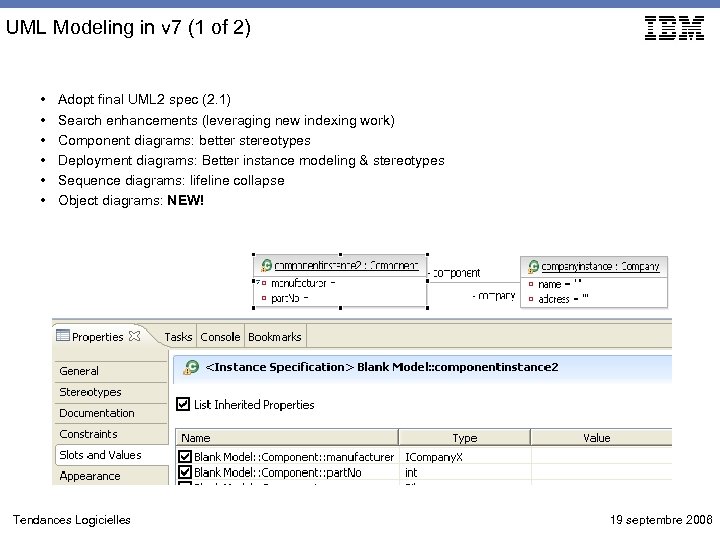 UML Modeling in v 7 (1 of 2) • • • Adopt final UML 2 spec (2. 1) Search enhancements (leveraging new indexing work) Component diagrams: better stereotypes Deployment diagrams: Better instance modeling & stereotypes Sequence diagrams: lifeline collapse Object diagrams: NEW! Tendances Logicielles 19 septembre 2006
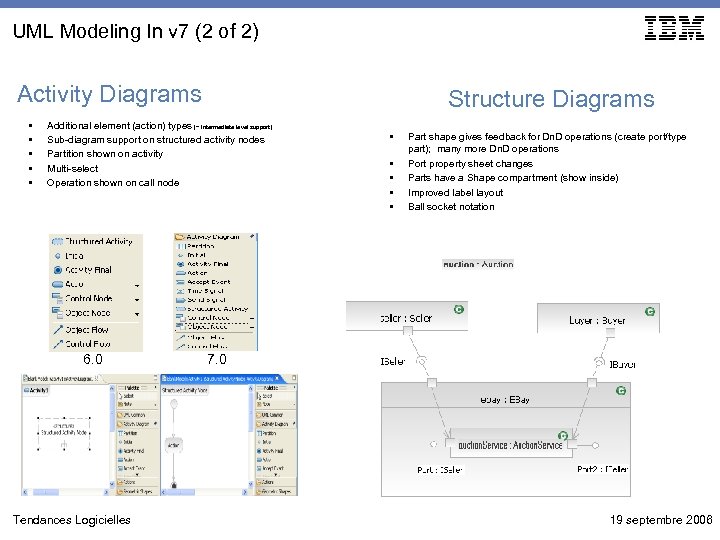 UML Modeling In v 7 (2 of 2) Activity Diagrams • • • Structure Diagrams Additional element (action) types (~ intermediate level support) Sub-diagram support on structured activity nodes Partition shown on activity Multi-select Operation shown on call node 6. 0 Tendances Logicielles • • • Part shape gives feedback for Dn. D operations (create port/type part); many more Dn. D operations Port property sheet changes Parts have a Shape compartment (show inside) Improved label layout Ball socket notation 7. 0 19 septembre 2006
 Key Elements of the MDD Vision • Business value • Simply supporting UML modeling and RTE is no longer enough • MDD must return more repeatability • MDD must return more automation of repetitive development tasks • MDD must bridge and integrate domains (business domains, activity domains, problem domains, solution and technical domains) • MDD must be better integrated with other aspects of the development process and the tools that support them • Flexibility • Support multiple MDD “theories of operations”, corresponding to multiple development governance philosophies • Extensibility Tendances Logicielles 19 septembre 2006
 Team Modeling (UML) • Sub-units (independence of physical structure from logical structure) • Diff-merge enhancements Screen shots – consult w/ Kim re: what would be effective Tendances Logicielles 19 septembre 2006
 Key Elements of the MDD Vision • Business value • Simply supporting UML modeling and RTE is no longer enough • MDD must return more repeatability • MDD must return more automation of repetitive development tasks • MDD must bridge and integrate domains (business domains, activity domains, problem domains, solution and technical domains) • MDD must be better integrated with other aspects of the development process and the tools that support them • Flexibility • Support multiple MDD “theories of operations”, corresponding to multiple development governance philosophies • Extensibility Tendances Logicielles 19 septembre 2006
 Further Unification of Conceptual and Code Modeling • Better Integration of • Search • “Type” • “Show related elements” • Support use of code model elements in conceptual UML Structure diagrams • Common Modeling Infrastructure Improvements • • • Common explorer Pan tool Paste into diagrams from external apps Improved layout algorithms Better diagram work area management Tendances Logicielles 19 septembre 2006
 Key Elements of the MDD Vision • Business value • Simply supporting UML modeling and RTE is no longer enough • MDD must return more repeatability • MDD must return more automation of repetitive development tasks • MDD must bridge and integrate domains (business domains, activity domains, problem domains, solution and technical domains) • MDD must be better integrated with other aspects of the development process and the tools that support them • Flexibility • Support multiple MDD “theories of operations”, corresponding to multiple development governance philosophies • Extensibility Tendances Logicielles 19 septembre 2006
 Packaged Transformations in v 7 • • • WSDL improved and productized XSD improved and productized Java updated (Java 5) Java inverse / reconciliation C++ updated (fuller support, non-destructive re-apply, inverse / reconciliation) • EGL • Later… • C# forward / inverse / reconciliation • Gen from state machines • BPEL, further improvements to WSDL and XSD Tendances Logicielles 19 septembre 2006
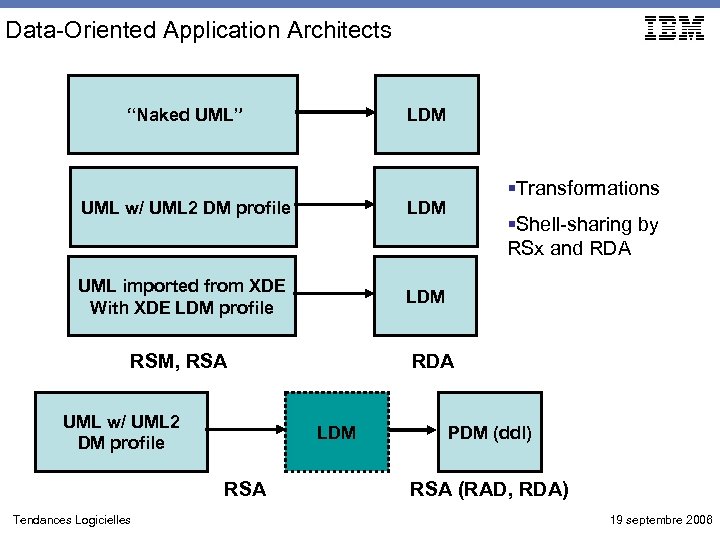 Data-Oriented Application Architects “Naked UML” LDM UML w/ UML 2 DM profile LDM UML imported from XDE With XDE LDM profile §Transformations LDM RSM, RSA UML w/ UML 2 DM profile Tendances Logicielles RDA LDM RSA §Shell-sharing by RSx and RDA PDM (ddl) RSA (RAD, RDA) 19 septembre 2006
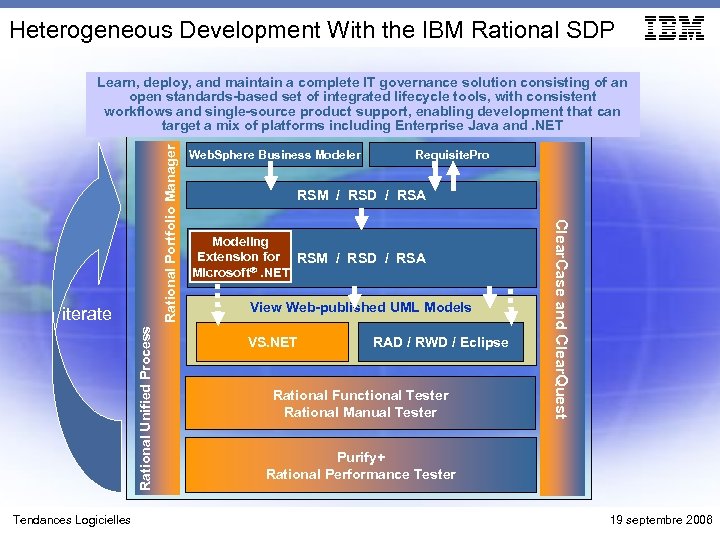 Heterogeneous Development With the IBM Rational SDP Rational Unified Process iterate Tendances Logicielles Web. Sphere Business Modeler Requisite. Pro RSM / RSD / RSA Modeling Extension for RSM / RSD / RSA Microsoft®. NET View Web-published UML Models VS. NET RAD / RWD / Eclipse Rational Functional Tester Rational Manual Tester Clear. Case and Clear. Quest Rational Portfolio Manager Learn, deploy, and maintain a complete IT governance solution consisting of an open standards-based set of integrated lifecycle tools, with consistent workflows and single-source product support, enabling development that can target a mix of platforms including Enterprise Java and. NET Purify+ Rational Performance Tester 19 septembre 2006
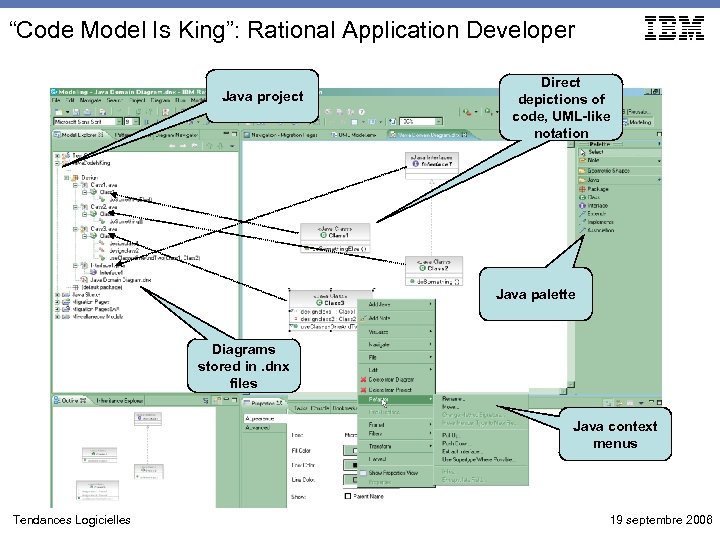 “Code Model Is King”: Rational Application Developer Java project Direct depictions of code, UML-like notation Java palette Diagrams stored in. dnx files Java context menus Tendances Logicielles 19 septembre 2006
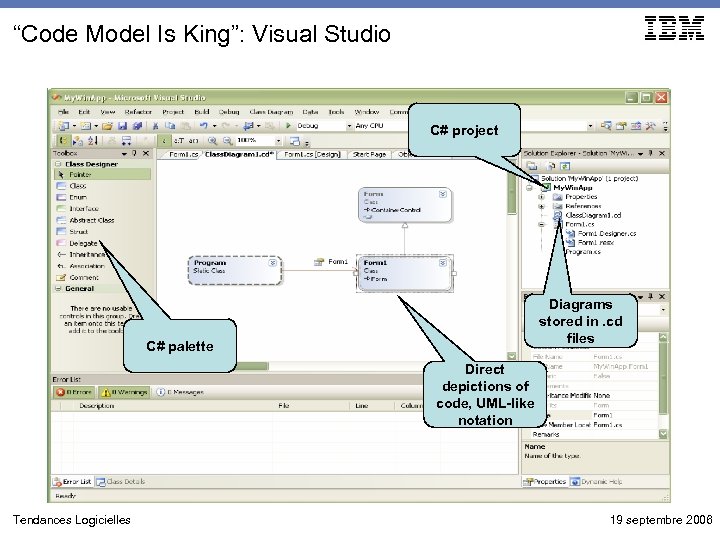 “Code Model Is King”: Visual Studio C# project Diagrams stored in. cd files C# palette Direct depictions of code, UML-like notation Tendances Logicielles 19 septembre 2006
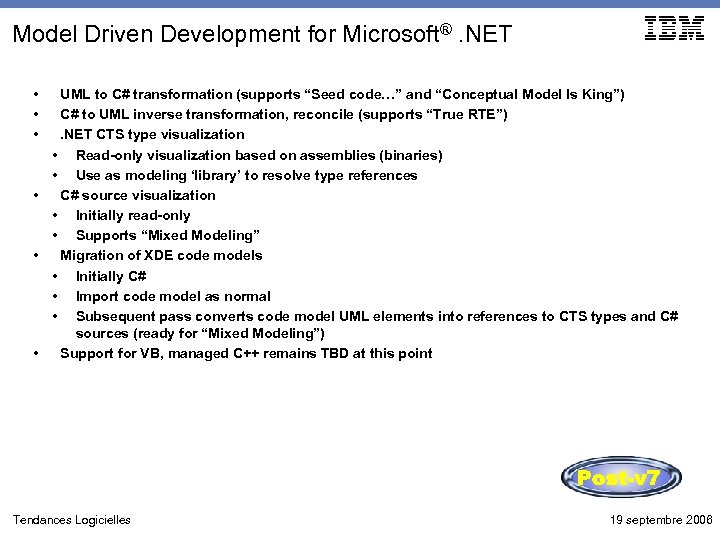 Model Driven Development for Microsoft®. NET • • • UML to C# transformation (supports “Seed code…” and “Conceptual Model Is King”) C# to UML inverse transformation, reconcile (supports “True RTE”). NET CTS type visualization • Read-only visualization based on assemblies (binaries) • Use as modeling ‘library’ to resolve type references • C# source visualization • Initially read-only • Supports “Mixed Modeling” • Migration of XDE code models • Initially C# • Import code model as normal • Subsequent pass converts code model UML elements into references to CTS types and C# sources (ready for “Mixed Modeling”) • Support for VB, managed C++ remains TBD at this point Tendances Logicielles 19 septembre 2006
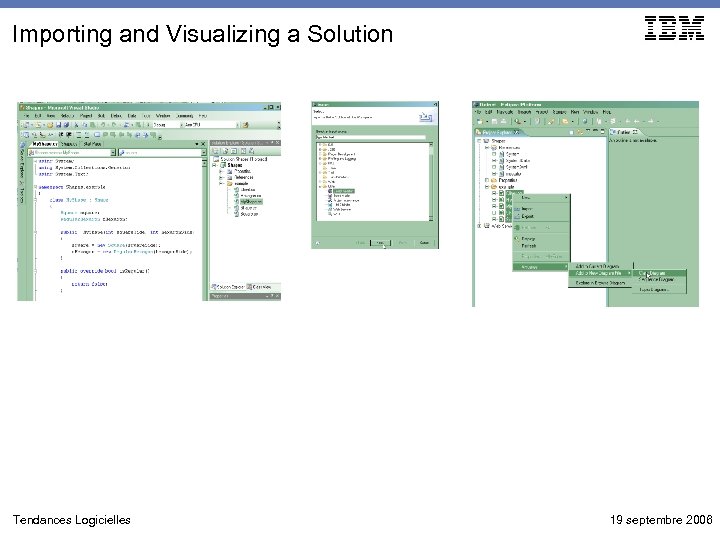 Importing and Visualizing a Solution Tendances Logicielles 19 septembre 2006
 “Mixed Modeling”: RSx with. NET Extension Screen shot Tendances Logicielles 19 septembre 2006
 “True RTE”: RSx with. NET Extension Screen shot Tendances Logicielles 19 septembre 2006
 Demo: MDD for. NET Tendances Logicielles 19 septembre 2006
 Key Elements of the MDD Vision • Business value • Simply supporting UML modeling and RTE is no longer enough • MDD must return more repeatability • MDD must return more automation of repetitive development tasks • MDD must bridge and integrate domains (business domains, activity domains, problem domains, solution and technical domains) • MDD must be better integrated with other aspects of the development process and the tools that support them • Flexibility • Support multiple MDD “theories of operations”, corresponding to multiple development governance philosophies • Extensibility Tendances Logicielles 19 septembre 2006
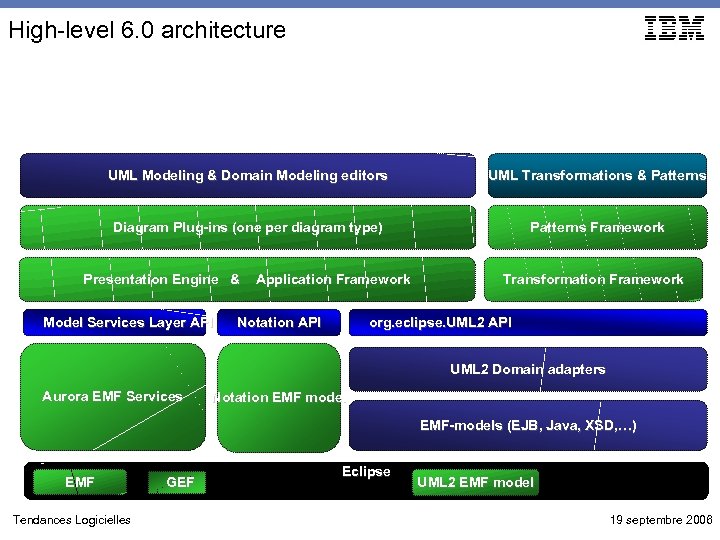 High-level 6. 0 architecture UML Modeling & Domain Modeling editors UML Transformations & Patterns Diagram Plug-ins (one per diagram type) Patterns Framework Presentation Engine & Model Services Layer API Application Framework Notation API Transformation Framework org. eclipse. UML 2 API UML 2 Domain adapters Aurora EMF Services Notation EMF model EMF-models (EJB, Java, XSD, …) EMF Tendances Logicielles GEF Eclipse UML 2 EMF model 19 septembre 2006
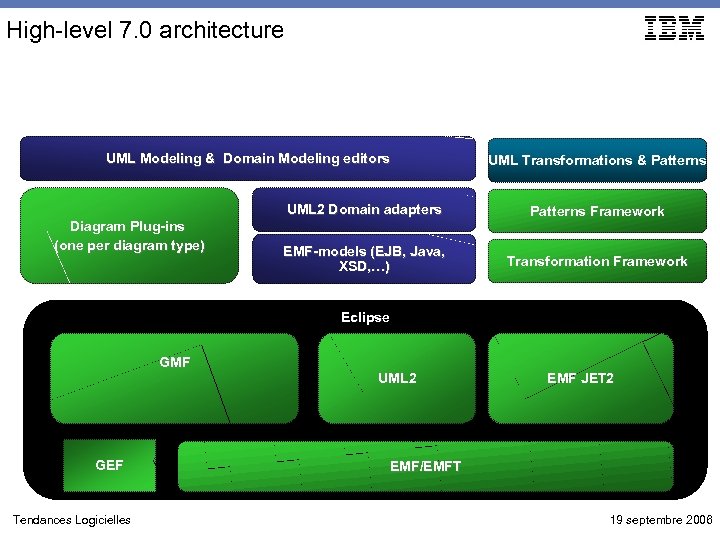 High-level 7. 0 architecture UML Modeling & Domain Modeling editors UML Transformations & Patterns UML 2 Domain adapters Diagram Plug-ins (one per diagram type) Patterns Framework EMF-models (EJB, Java, XSD, …) Transformation Framework Eclipse GMF GEF Tendances Logicielles UML 2 EMF JET 2 EMF/EMFT 19 septembre 2006
 Model-to-Model Transform Authoring Screen shot Tendances Logicielles 19 septembre 2006
 Exemplar-Driven Authoring for JET 2 Model-Text (Code) Screen shot Tendances Logicielles 19 septembre 2006
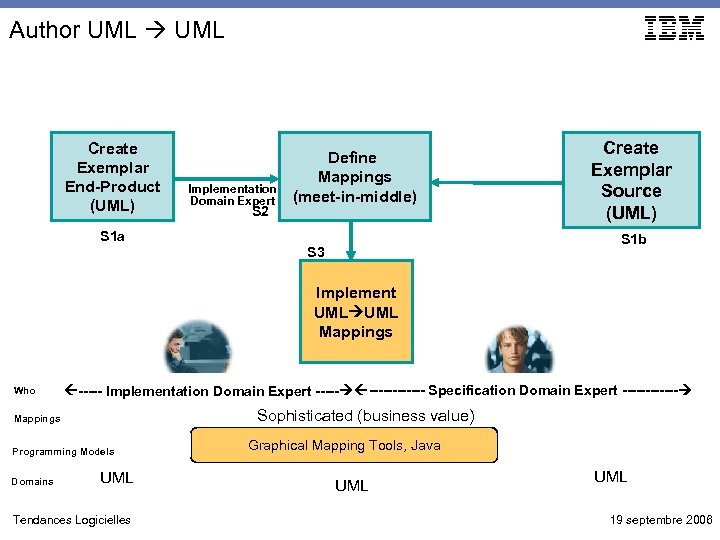 Author UML Create Exemplar End-Product (UML) S 1 a Implementation Domain Expert S 2 Define Mappings (meet-in-middle) Create Exemplar Source (UML) S 1 b S 3 Implement UML Mappings Who ----- Implementation Domain Expert ------ Specification Domain Expert ------ Sophisticated (business value) Mappings Programming Models Domains UML Tendances Logicielles Graphical Mapping Tools, Java UML 19 septembre 2006
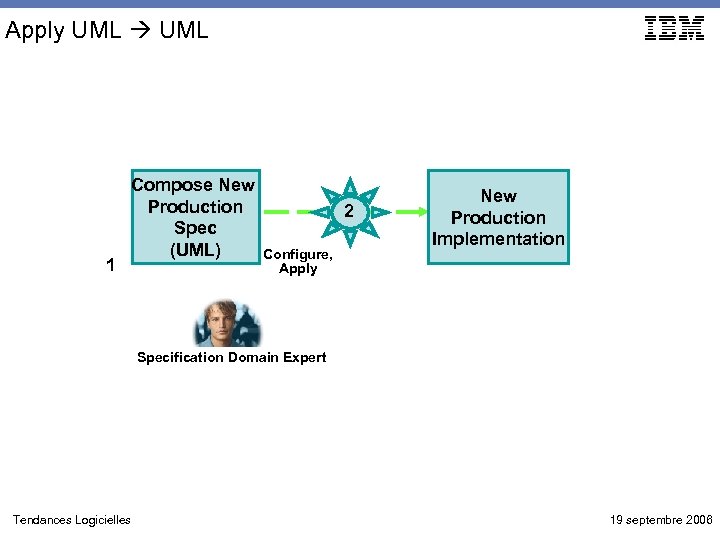 Apply UML 1 Compose New Production Spec (UML) 2 Configure, Apply New Production Implementation Specification Domain Expert Tendances Logicielles 19 septembre 2006
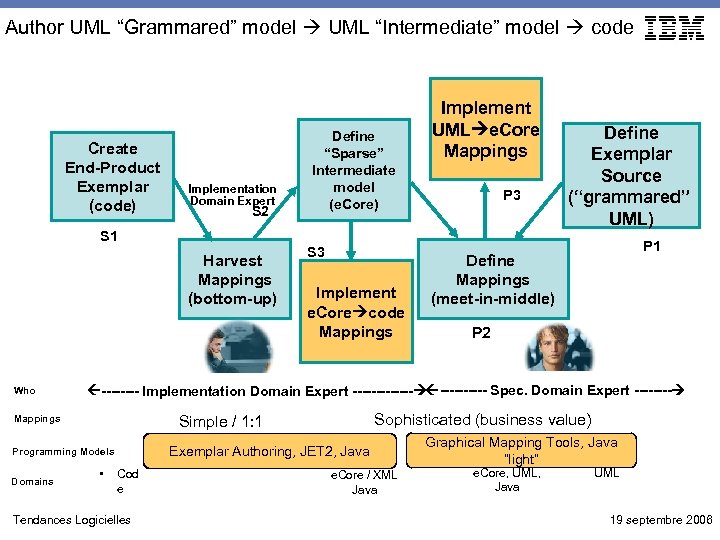 Author UML “Grammared” model UML “Intermediate” model code Create End-Product Exemplar (code) Implementation Domain Expert S 2 S 1 Harvest Mappings (bottom-up) Who S 3 Implement e. Core code Mappings P 3 Define Exemplar Source (“grammared” UML) P 1 Define Mappings (meet-in-middle) P 2 ---- Implementation Domain Expert ------- Spec. Domain Expert ---- Sophisticated (business value) Simple / 1: 1 Mappings Exemplar Authoring, JET 2, Java Programming Models Domains Define “Sparse” Intermediate model (e. Core) Implement UML e. Core Mappings • Cod e Tendances Logicielles e. Core / XML Java Graphical Mapping Tools, Java “light” e. Core, UML, Java UML 19 septembre 2006
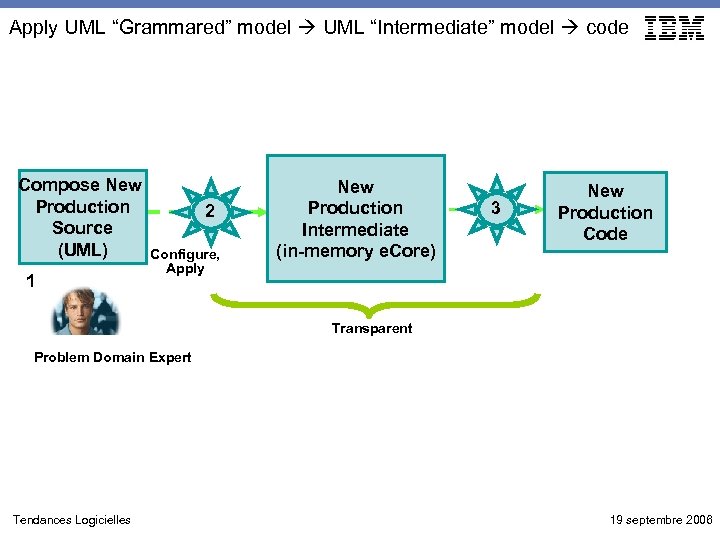 Apply UML “Grammared” model UML “Intermediate” model code Compose New Production Source (UML) 1 2 Configure, Apply New Production Intermediate (in-memory e. Core) 3 New Production Code Transparent Problem Domain Expert Tendances Logicielles 19 septembre 2006
 Agenda • The Rational MDD Heritage • The New MDD Product Family: Vision, Overview, and Current State (v 6) • The New MDD Product Family: Toward Completing The Vision (v 7) • Listening To Our Customers Tendances Logicielles 19 septembre 2006
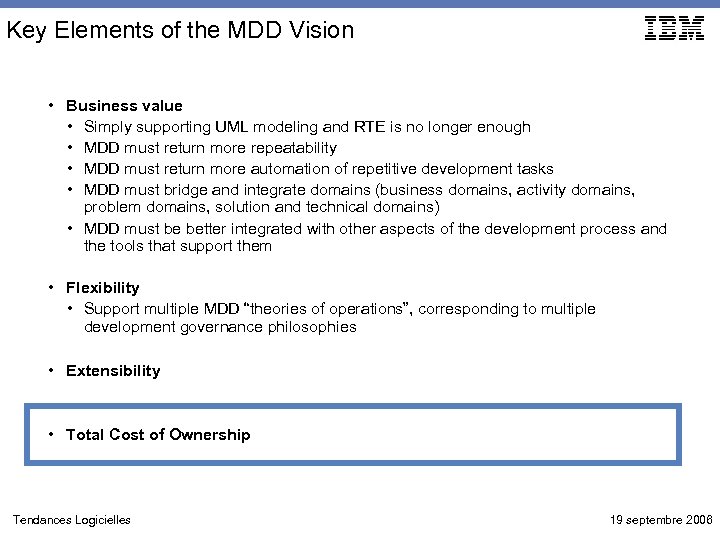 Key Elements of the MDD Vision • Business value • Simply supporting UML modeling and RTE is no longer enough • MDD must return more repeatability • MDD must return more automation of repetitive development tasks • MDD must bridge and integrate domains (business domains, activity domains, problem domains, solution and technical domains) • MDD must be better integrated with other aspects of the development process and the tools that support them • Flexibility • Support multiple MDD “theories of operations”, corresponding to multiple development governance philosophies • Extensibility • Total Cost of Ownership Tendances Logicielles 19 septembre 2006
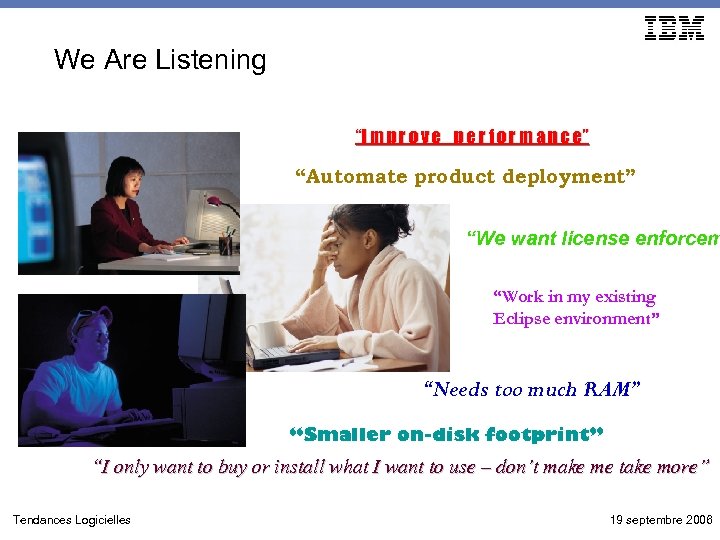 We Are Listening “I m p r o v e p e r f o r m a n c e” “Automate product deployment” “We want license enforcem “Work in my existing Eclipse environment” “Needs too much RAM” “Smaller on-disk footprint” “I only want to buy or install what I want to use – don’t make me take more” Tendances Logicielles 19 septembre 2006
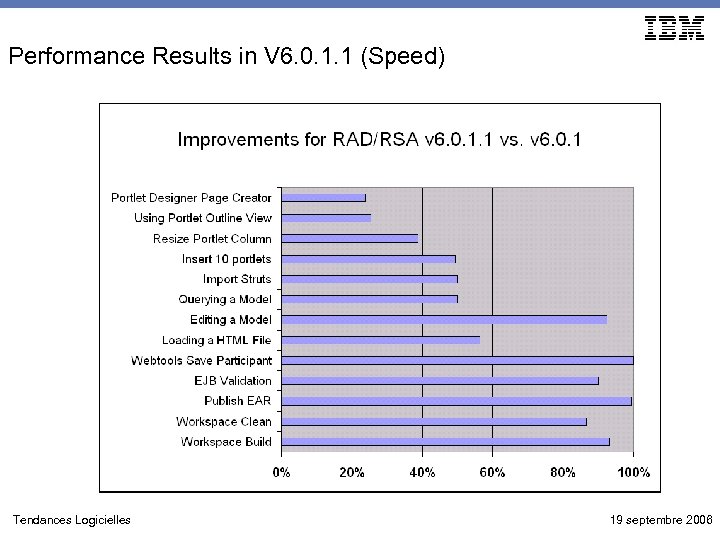 Performance Results in V 6. 0. 1. 1 (Speed) Tendances Logicielles 19 septembre 2006
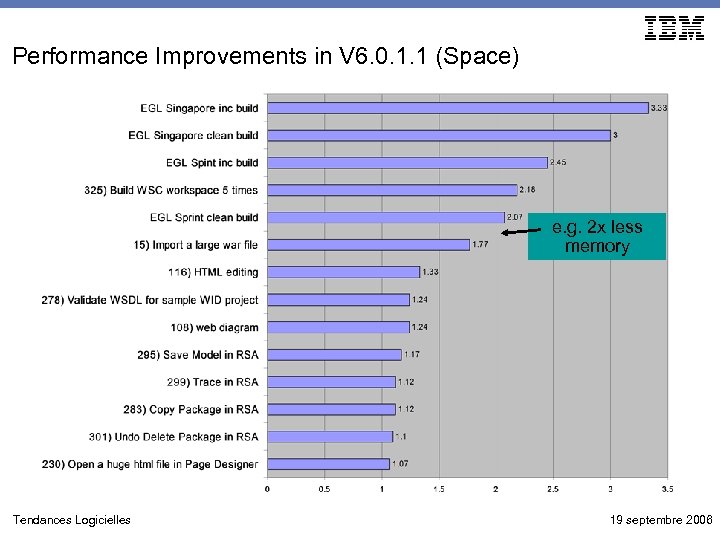 Performance Improvements in V 6. 0. 1. 1 (Space) e. g. 2 x less memory Tendances Logicielles 19 septembre 2006
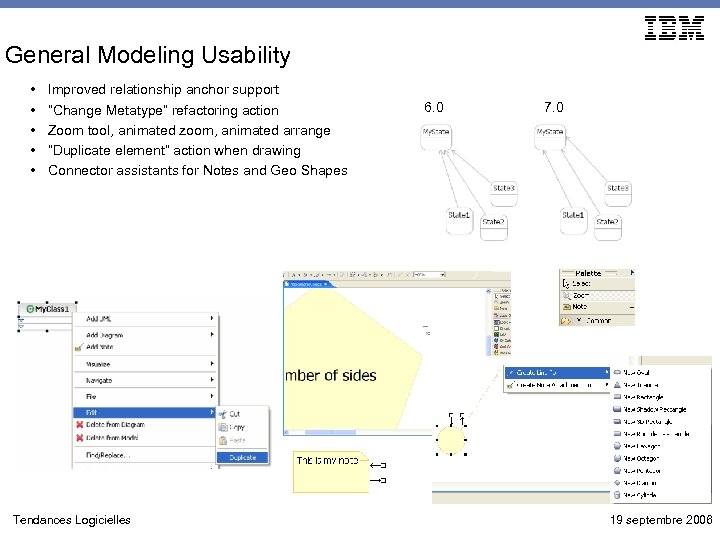 General Modeling Usability • • • Improved relationship anchor support “Change Metatype” refactoring action Zoom tool, animated zoom, animated arrange “Duplicate element” action when drawing Connector assistants for Notes and Geo Shapes Tendances Logicielles 6. 0 7. 0 19 septembre 2006
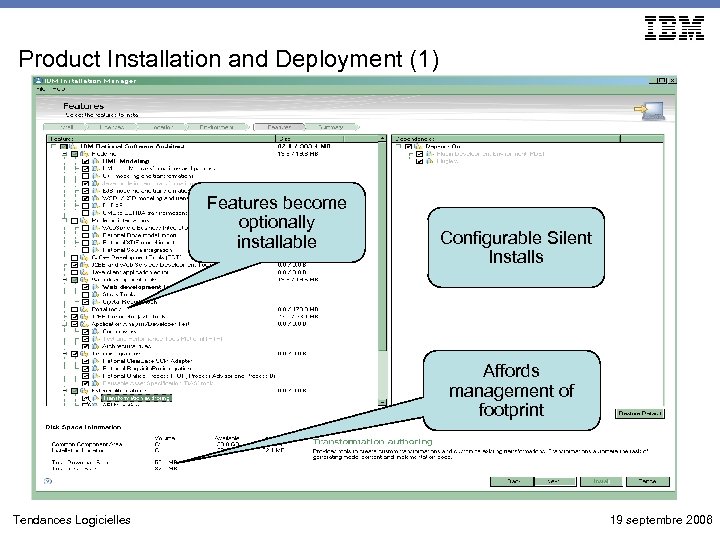 Product Installation and Deployment (1) Features become optionally installable Configurable Silent Installs Affords management of footprint Tendances Logicielles 19 septembre 2006
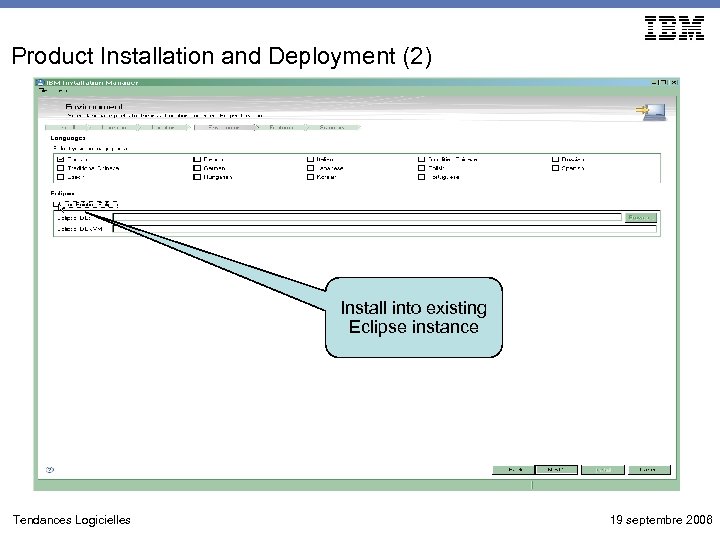 Product Installation and Deployment (2) • Option to install into existing Eclipse environment • Install will check plug-in versions for compatibility • More choices to optionally install features • Configurable silent install Install into existing Eclipse instance Tendances Logicielles 19 septembre 2006
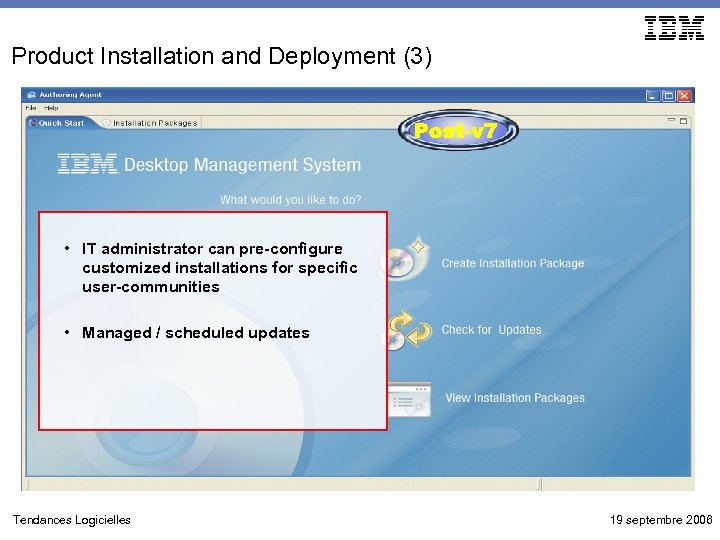 Product Installation and Deployment (3) • IT administrator can pre-configure customized installations for specific user-communities • Managed / scheduled updates Tendances Logicielles 19 septembre 2006
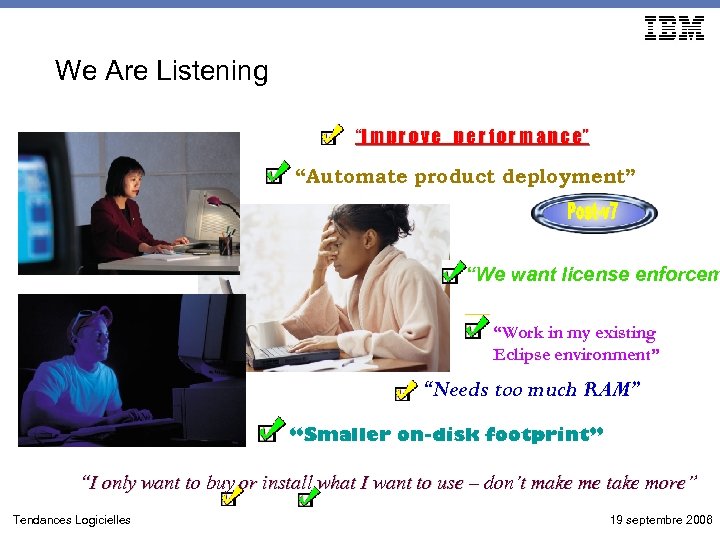 We Are Listening “I m p r o v e p e r f o r m a n c e” “Automate product deployment” “We want license enforcem “Work in my existing Eclipse environment” “Needs too much RAM” “Smaller on-disk footprint” “I only want to buy or install what I want to use – don’t make me take more” Tendances Logicielles 19 septembre 2006
 Questions Tendances Logicielles 19 septembre 2006
 Thank You Presenter: William T. Smith smithtw@us. ibm. com Tendances Logicielles 19 septembre 2006