


 Скачать презентацию Toward Classical Political Economy History of Economic Thought
3ca95692434031ccf684f4c39c45c6d9.ppt
- Количество слайдов: 22
 Toward Classical Political Economy History of Economic Thought Boise State University Fall 2015 Prof. D. Allen Dalton
 Background to French Political Economy of the 18 th Century • Descartes – deductive natural law rationalism • Colbert – systematic regulation of the economy • Cantillon – the economy as a naturally regulated interdependent system • French Enlightenment – Voltaire, Diderot, d’Alembert
 French Political Economy • Physiocrats (les Économistes) – François Quesnay (1694 -1774) – Victor de Riqueti, Marquis de Mirabeau (1715 -1789) – Paul Pierre le Mercier de la Rivière (1720 -1793) – Pierre Samuel Du. Pont de Nemours (1739 -1817) • “Liberals” – – Vincent de Gournay (1712 -1759) Abbé (André) Morellet (1727 -1819) Anne Robert Jacques Turgot (1727 -1781) Marquis de Condorcet (1743 -1794)
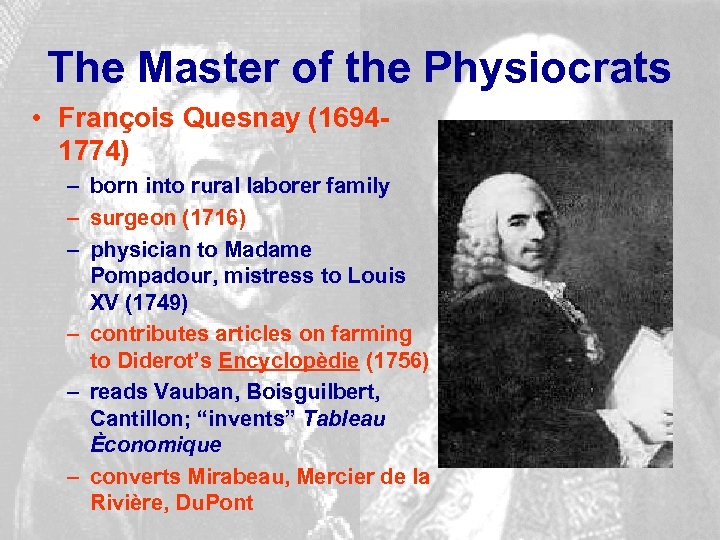 The Master of the Physiocrats • François Quesnay (16941774) – born into rural laborer family – surgeon (1716) – physician to Madame Pompadour, mistress to Louis XV (1749) – contributes articles on farming to Diderot’s Encyclopèdie (1756) – reads Vauban, Boisguilbert, Cantillon; “invents” Tableau Èconomique – converts Mirabeau, Mercier de la Rivière, Du. Pont
 The Physiocratic Literature • • Mirabeau, L’ami des hommes (1756) Quesnay, Le Tableau Èconomique (1758) Mirabeau, La philosophie rurale (1763) Quesnay, Analyse de la formule arithmétique du Tableau Èconomique de la distribution des dépenses annuelles d’une Nation agricole (1766) • de la Rivière, L’ordre naturel et essentiel des societes politiques (1767) • Du. Pont de Nemours, La Physiocratie (1767)
 The Physiocratic System • fundamental axioms – agriculture is the only source of produit net -net product (surplus of output over cost) – manufacturing and commerce are sterile (value of ouput equals value of inputs) – nation’s wealth equals value of net product • stylized presentation of the interdependent economy - Le Tableau Èconomique
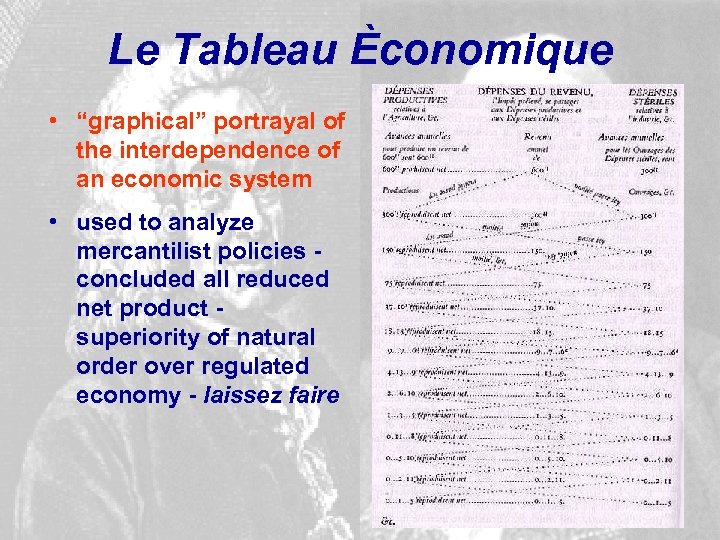 Le Tableau Èconomique • “graphical” portrayal of the interdependence of an economic system • used to analyze mercantilist policies concluded all reduced net product superiority of natural order over regulated economy - laissez faire
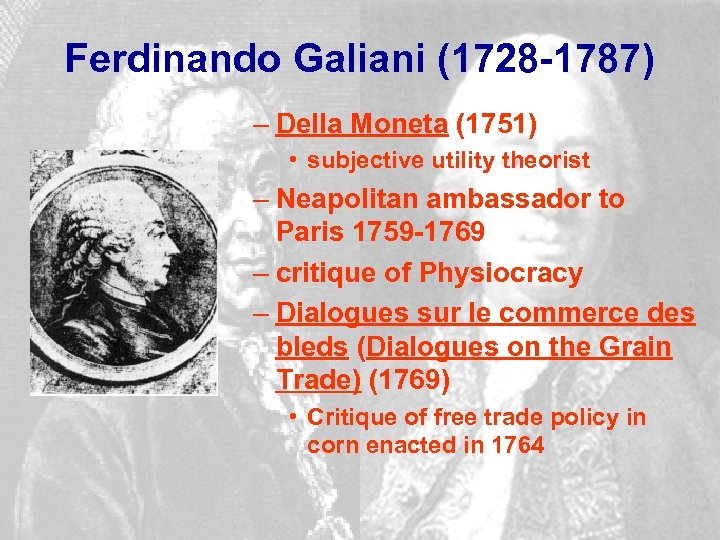 Ferdinando Galiani (1728 -1787) – Della Moneta (1751) • subjective utility theorist – Neapolitan ambassador to Paris 1759 -1769 – critique of Physiocracy – Dialogues sur le commerce des bleds (Dialogues on the Grain Trade) (1769) • Critique of free trade policy in corn enacted in 1764
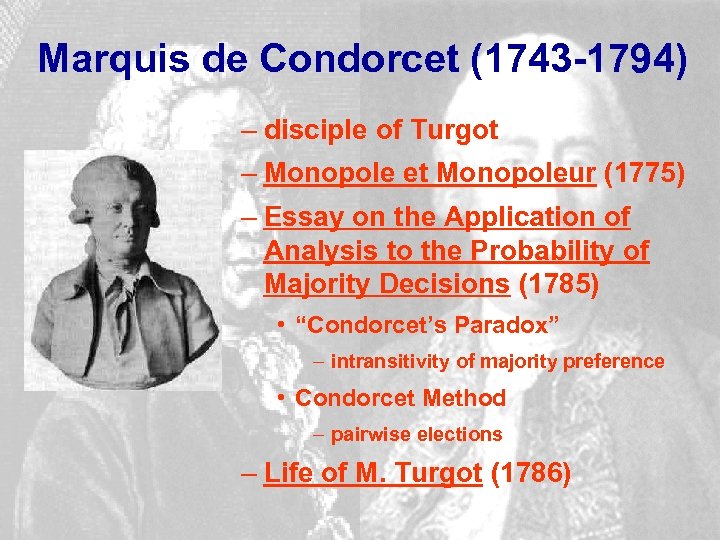 Marquis de Condorcet (1743 -1794) – disciple of Turgot – Monopole et Monopoleur (1775) – Essay on the Application of Analysis to the Probability of Majority Decisions (1785) • “Condorcet’s Paradox” – intransitivity of majority preference • Condorcet Method – pairwise elections – Life of M. Turgot (1786)
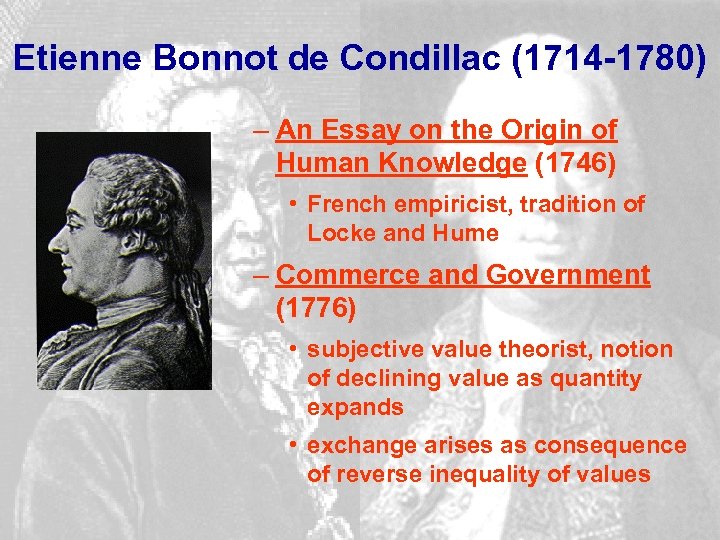 Etienne Bonnot de Condillac (1714 -1780) – An Essay on the Origin of Human Knowledge (1746) • French empiricist, tradition of Locke and Hume – Commerce and Government (1776) • subjective value theorist, notion of declining value as quantity expands • exchange arises as consequence of reverse inequality of values
 Background to British Political Economy in the 18 th Century • Act of Settlement 1701 – parliamentary supremacy; establishes House of Hanover • Act of Union 1707 – join Scotland England; Scottish parliament dissolved; free Church of Scotland (Presbyterian) • The Jacobite Uprisings of 1715 and 1745 – James VIII and Bonnie Prince Charlie attempt to restore House of Stuart to thrones of Scotland/England
 Background to British Political Economy in the 18 th Century • The Scottish Enlightenment – Gershom Carmichael (1672 -1729) – Francis Hutcheson (1694 -1746) – Adam Ferguson (1723 -1816) • The Rise of Methodism (1738) – brothers John and Charles Wesley – denied absolute predestination; denied that the grace of God is irresistible; and affirmed that a believer may fall from grace • Problems in the American Colonies
 Bernard Mandeville (1670? -1733) • Dutch, settled in England in 1699 • The Grumbling Hive: or Knaves Turn’d Honest (1705) • The Fable of the Bees: or Private Vices, Public Benefits (1714) – Argues that “vices” animate the economy and that if people were virtuous the economy would stagnate – Shock to moral philosophy of the Scottish Enlightenment – Problematic nature of his economics • If people don’t spend on vices won’t they spend on virtues? • Commits broken-window fallacy and also confuses saving with hoarding
 The Scottish Enlightenment • Remarkable flourishing of intellectual activity at time such activity is moribund in England • Gershom Carmichael (1672 -1729) – first Professor of Moral Philosophy, University of Glasgow – brought natural law views of Pufendorf, Grotius, and Locke to Scotland – Natural Rights: Observations upon Pufendorf’s On the Duty of Man and Citizen (1724)
 The Scottish Enlightenment • Francis Hutcheson (1694 -1746) – Professor of Moral Philosophy, University of Glasgow – Essay on the Nature and Conduct of the Passions and Affections (1728) • opposed hedonism of Hobbes and Hume with notion of moral benevolence; opposed Mandeville’s argument that private vices lead to public benefits; arrived at “greatest happiness” principle as moral commandment – Adam Smith’s teacher (“the incomparable Hutcheson”)
 The Scottish Enlightenment • Adam Ferguson (1723 -1816) – Professor of Moral Philosophy, University of Edinburgh – An Essay on the History of Civil Society (1767) – Principles of Moral and Political Science (1792)
 The Scottish Enlightenment • Features of the Scottish Enlightenment – – secular scientific objectivity clear social and historical focus constancy of human nature within changing environments and institutional settings – social order as the consequence of human action, but not of human design – belief in progress – belief in historical relativism
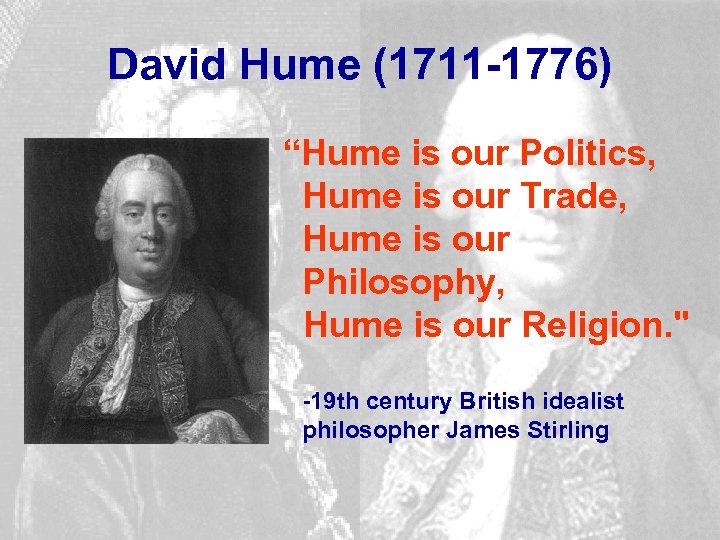 David Hume (1711 -1776) “Hume is our Politics, Hume is our Trade, Hume is our Philosophy, Hume is our Religion. " -19 th century British idealist philosopher James Stirling
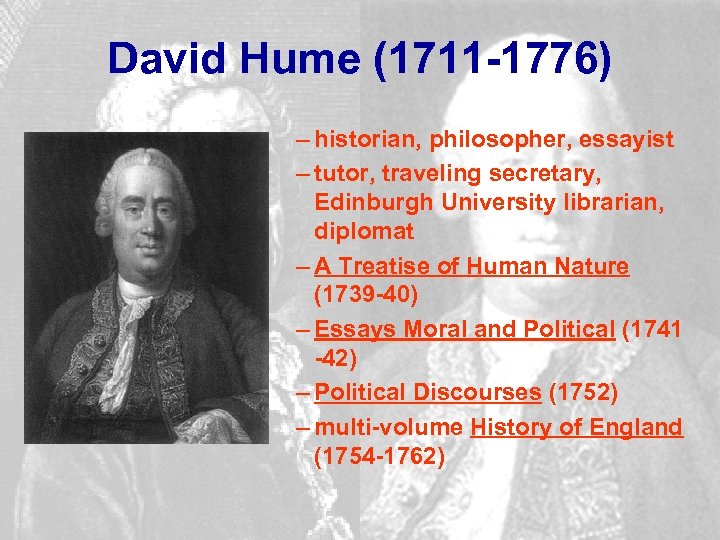 David Hume (1711 -1776) – historian, philosopher, essayist – tutor, traveling secretary, Edinburgh University librarian, diplomat – A Treatise of Human Nature (1739 -40) – Essays Moral and Political (1741 -42) – Political Discourses (1752) – multi-volume History of England (1754 -1762)
 Hume’s Economics • Political Discourses (1752) – Three essays: “Of Money, ” “Of Interest, ” and “Of the Balance of Trade” • Contributions – mutual gains of international trade (not zero-sum) – price-specie flow mechanism (first publication) – long-run neutrality of money (first explicit statement); crude simplification of quantity theory – short-run non-neutrality of money due to price inertia; relationship to booms and depressions – interest rate function of demand for and supply of real capital (savings)
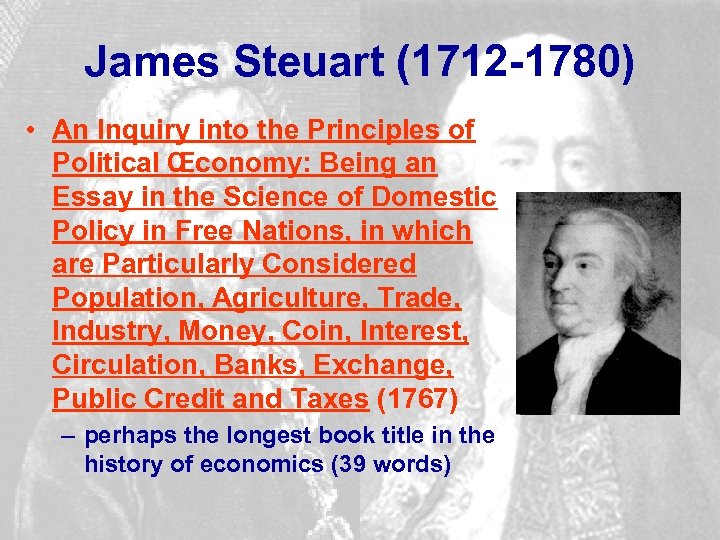 James Steuart (1712 -1780) • An Inquiry into the Principles of Political Œconomy: Being an Essay in the Science of Domestic Policy in Free Nations, in which are Particularly Considered Population, Agriculture, Trade, Industry, Money, Coin, Interest, Circulation, Banks, Exchange, Public Credit and Taxes (1767) – perhaps the longest book title in the history of economics (39 words)
 James Steuart • Principles of Political Œconomy – English introduction of term “political economy” – first to specifically use phrase “supply and demand” – superior analysis of competition • “double competition”- competition on both sides of market – moderate mercantilist – concentration on employment and public works – rejects quantity theory • demand determines prices (real-bills doctrine? )