


 Скачать презентацию toward a programmatic semantics for natural language hugo
aa62c0ba64dce7f56d3b9c75931ea1bf.ppt
- Количество слайдов: 9
 toward a programmatic semantics for natural language hugo liu and henry lieberman mit media lab VL/HCC’ 04 presentation
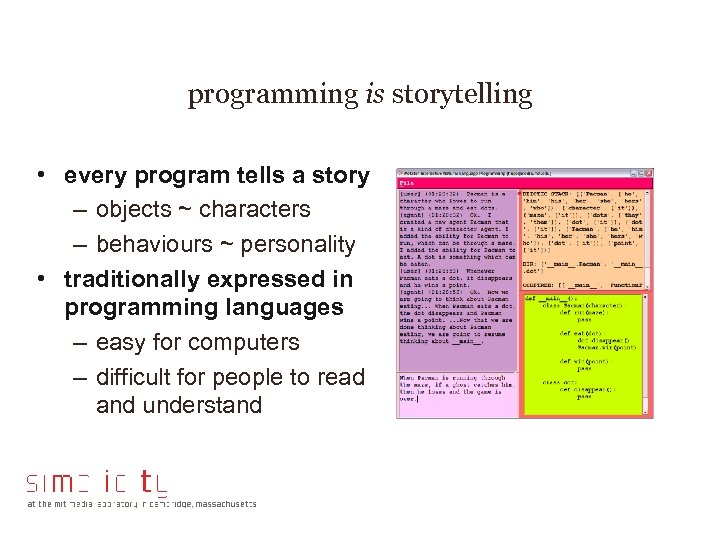 programming is storytelling • every program tells a story – objects ~ characters – behaviours ~ personality • traditionally expressed in programming languages – easy for computers – difficult for people to read and understand
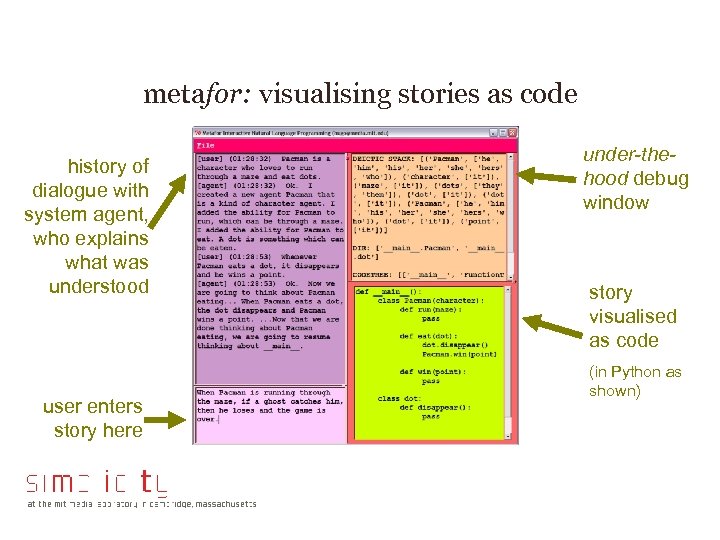 metafor: visualising stories as code history of dialogue with system agent, who explains what was understood user enters story here • under-thehood debug window story visualised as code (in Python as shown)
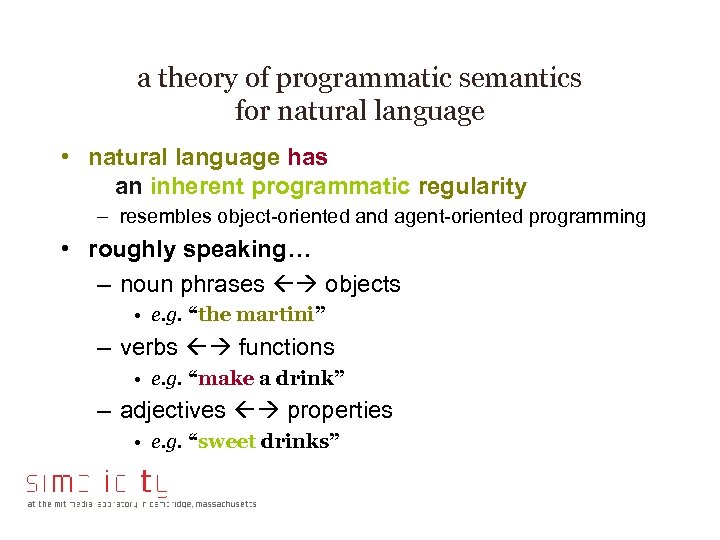 a theory of programmatic semantics for natural language • natural language has an inherent programmatic regularity – resembles object-oriented and agent-oriented programming • roughly speaking… – noun phrases objects • e. g. “the martini” – verbs functions • e. g. “make a drink” – adjectives properties • e. g. “sweet drinks”
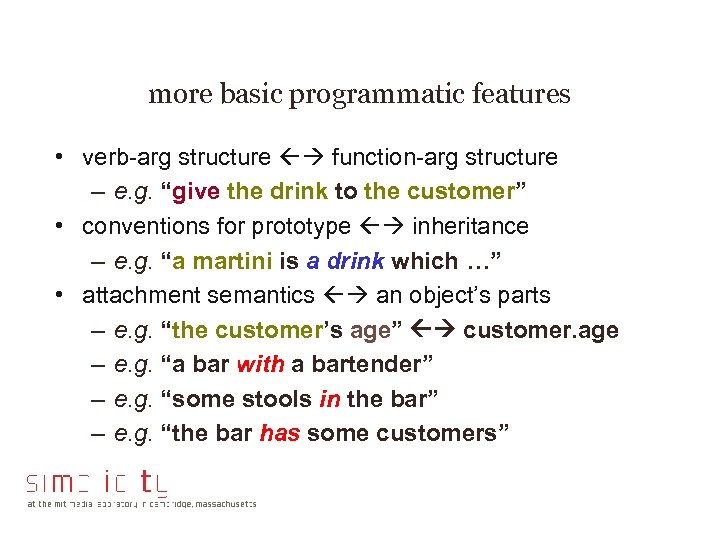 more basic programmatic features • verb-arg structure function-arg structure – e. g. “give the drink to the customer” • conventions for prototype inheritance – e. g. “a martini is a drink which …” • attachment semantics an object’s parts – e. g. “the customer’s age” customer. age – e. g. “a bar with a bartender” – e. g. “some stools in the bar” – e. g. “the bar has some customers”
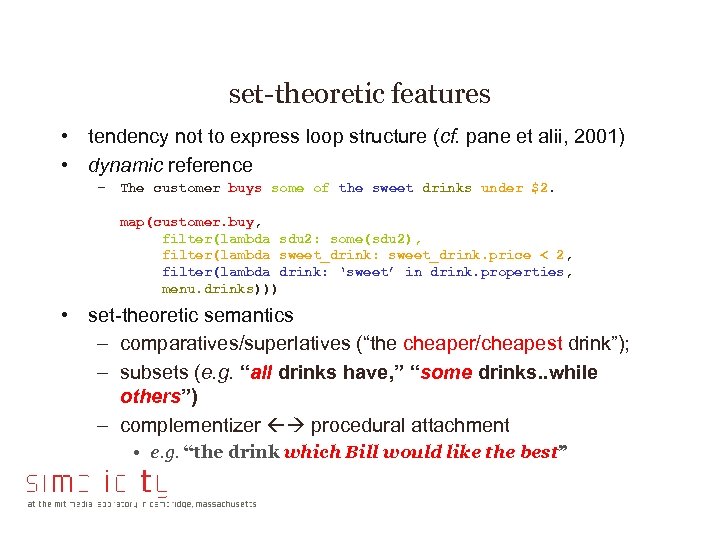 set-theoretic features • tendency not to express loop structure (cf. pane et alii, 2001) • dynamic reference – The customer buys some of the sweet drinks under $2. map(customer. buy, filter(lambda sdu 2: some(sdu 2), filter(lambda sweet_drink: sweet_drink. price < 2, filter(lambda drink: ‘sweet’ in drink. properties, menu. drinks))) • set-theoretic semantics – comparatives/superlatives (“the cheaper/cheapest drink”); – subsets (e. g. “all drinks have, ” “some drinks. . while others”) – complementizer procedural attachment • e. g. “the drink which Bill would like the best”
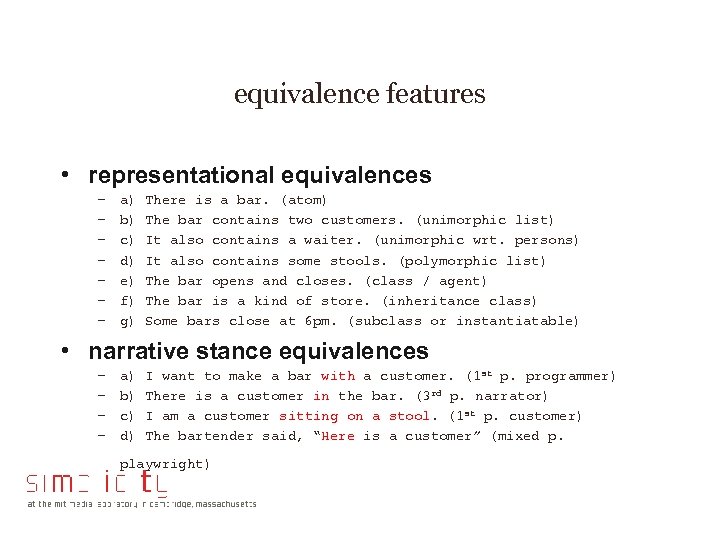 equivalence features • representational equivalences – – – – a) b) c) d) e) f) g) There is a bar. (atom) The bar contains two customers. (unimorphic list) It also contains a waiter. (unimorphic wrt. persons) It also contains some stools. (polymorphic list) The bar opens and closes. (class / agent) The bar is a kind of store. (inheritance class) Some bars close at 6 pm. (subclass or instantiatable) • narrative stance equivalences – – a) b) c) d) I want to make a bar with a customer. (1 st p. programmer) There is a customer in the bar. (3 rd p. narrator) I am a customer sitting on a stool. (1 st p. customer) The bartender said, “Here is a customer” (mixed p. playwright)
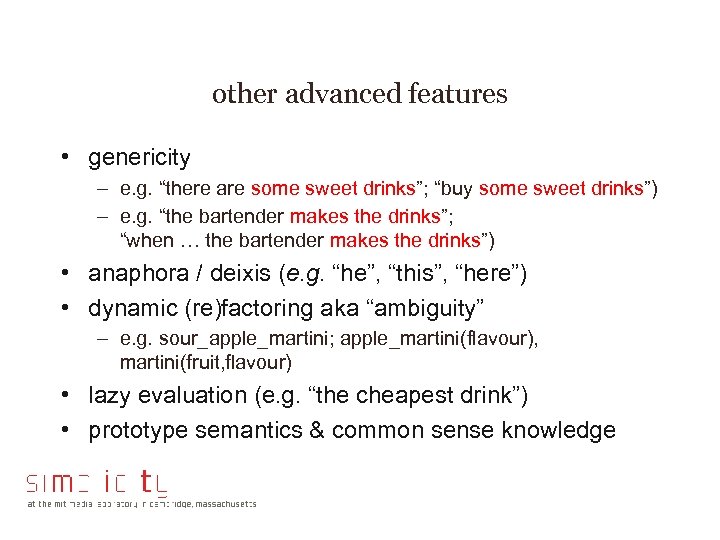 other advanced features • genericity – e. g. “there are some sweet drinks”; “buy some sweet drinks”) – e. g. “the bartender makes the drinks”; “when … the bartender makes the drinks”) • anaphora / deixis (e. g. “he”, “this”, “here”) • dynamic (re)factoring aka “ambiguity” – e. g. sour_apple_martini; apple_martini(flavour), martini(fruit, flavour) • lazy evaluation (e. g. “the cheapest drink”) • prototype semantics & common sense knowledge
 stepping out • scope & limitations – cannot convert arbitrary English into fully specified code – hope: sufficiently large coverage as to be usable – hope: users can adapt to interpreter • goals – brainstorming / outlining tool for programmers – create nl interfaces to MOOs (cf. Bruckman, ‘ 97) – educational tool for novice-programmers – hypothesis: “precise storytelling” requisite for programming – influence usability features in future programming languages