


 Скачать презентацию Tourism Strategy Part 2 Lecture 4 The external
96609d29a6a0c48a14d5232d3faab82c.ppt
- Количество слайдов: 31
 Tourism Strategy Part 2, Lecture 4 The external environment: PEST analysis Professor John Tribe
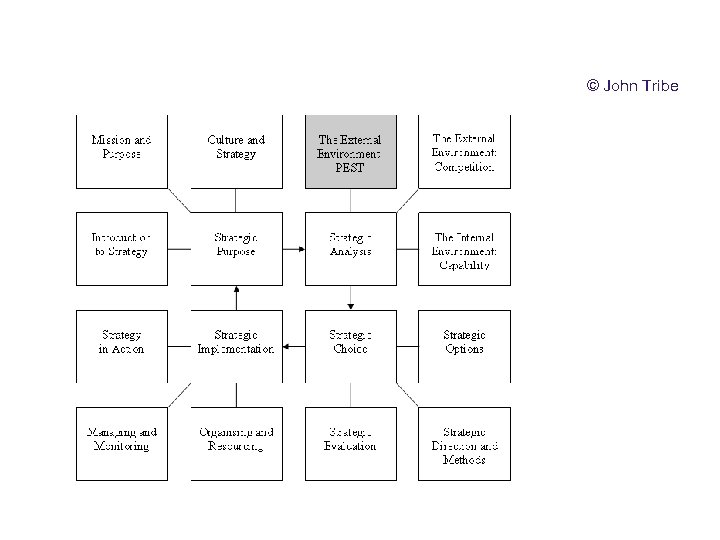
 Part 2: Strategic Analysis © John Tribe ¡ Strategic analysis utilises techniques for situational analysis. This involves reporting on the current and future opportunities and threats and strengths and weaknesses facing the organisation. ¡ Opportunities and threats summarise the external environmental factors that a tourism organisation faces. The key elements of the external environment may be summarised as C-PEST factors which refer to the l l l competitive political economic socio-cultural, and, technological environments. ¡ Of these, PEST factors are analysed in lecture 4, whilst the competitive environment is considered in lecture 5. ¡ Strengths and weaknesses analysis summarises the state of the internal resources of an organisation. Resource analysis is undertaken in lecture 6. ¡ All these factors are brought together in a comprehensive SWOT analysis at the end of chapter 6, thus concluding strategic analysis and part 2.
 Learning Outcomes © John Tribe ¡After this lecture and studying related materials you should be able to understand: l the political environment l the economic environment l the socio-cultural environment l the technological environment ¡and critically evaluate, explain and apply the above concepts.
 © John Tribe
 Case Study 4: Tourism and the 2008 Economic Crisis © John Tribe ¡ 2008 can be added to the list of significant economic crises which include the Great Depression (1929 -35) and the Asian Economic Crisis of 1997 -8. ¡ By 2007 an unsustainable set of economic conditions were developing.
 Tourism and the 2008 Economic Crisis © John Tribe l Property price inflation was particularly evident, fuelled by optimistic expectations and cheap and easy availability of loans. l But the property boom faltered in the USA and was soon followed by banking crises in Freddie Mac and Fanny Mae, the Northern Rock and Lehman Bros. In the tourism sector XL Holidays collapsed in UK. A domino effect occurred and the root cause of the subsequent economic crisis is easy to trace.
 Tourism and the 2008 Economic Crisis © John Tribe l The causes can be attributed to: ¡Market madness and unrealistic optimism. . ¡Overpriced assets – particularly property prices. . ¡Bad debt. . ¡Deregulation of the banks. . ¡A change in banking culture from the conservative to the risky. . ¡Short-term pay incentives overshadowing long-term sustainability in the banking. . sector. ¡High oil prices. . ¡Globalization and international connectivity enabling the crisis to spread. . . ¡ The economic crisis caused a run on the banks, followed by their nationalisation /partial nationalisation in the UK and elsewhere.
 Tourism and the 2008 Economic Crisis © John Tribe ¡ Two quarters of falling output in 2008 confirmed the arrival of a recession in both the UK and the US. ¡ For tourism, the UNWTO predicted stagnation (0% growth) or even slight decline (-1% to -2%) throughout 2009. Amongst those most affected were the Americas and Europe as most of their source markets were affected by recession.
 The political environment © John Tribe ¡Since tourism entities are affected by current and new government legislation, it is important to understand the location of political power, how political power may change in the future and the likely effects of this on policy (Burns & Novelli, 2009). ¡The next slide distinguishes between policy objectives of typical democratic political parties of the left and of the right.
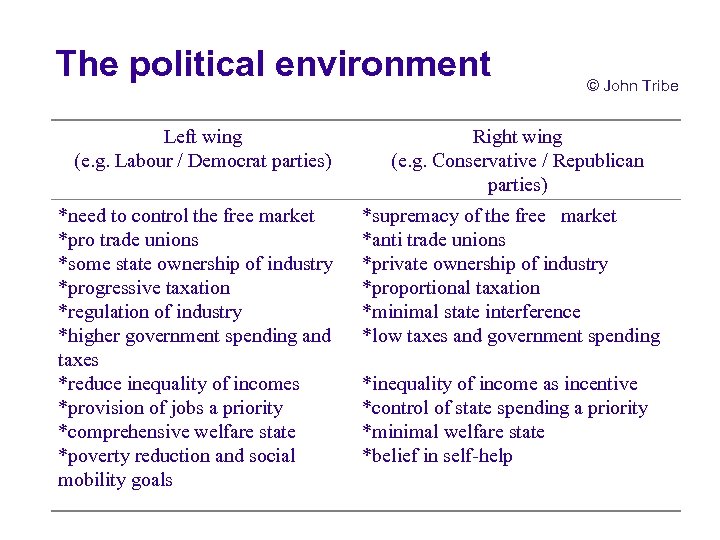 The political environment Left wing (e. g. Labour / Democrat parties) *need to control the free market *pro trade unions *some state ownership of industry *progressive taxation *regulation of industry *higher government spending and taxes *reduce inequality of incomes *provision of jobs a priority *comprehensive welfare state *poverty reduction and social mobility goals © John Tribe Right wing (e. g. Conservative / Republican parties) *supremacy of the free market *anti trade unions *private ownership of industry *proportional taxation *minimal state interference *low taxes and government spending *inequality of income as incentive *control of state spending a priority *minimal welfare state *belief in self-help
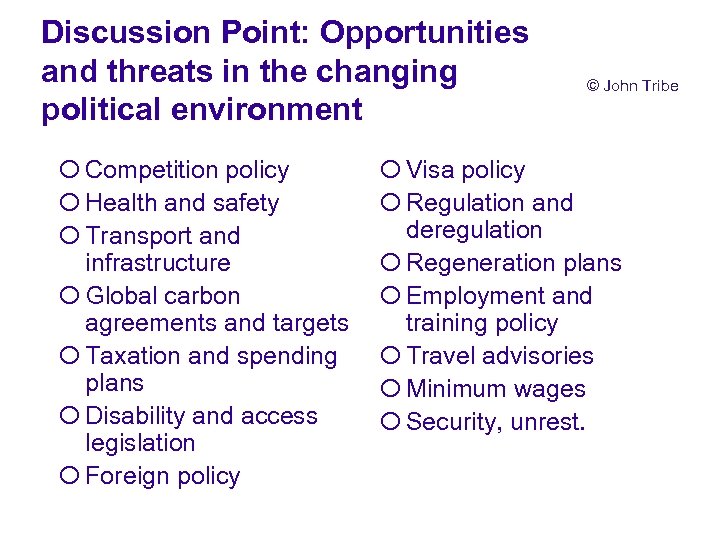 Discussion Point: Opportunities and threats in the changing political environment ¡ Competition policy ¡ Health and safety ¡ Transport and infrastructure ¡ Global carbon agreements and targets ¡ Taxation and spending plans ¡ Disability and access legislation ¡ Foreign policy © John Tribe ¡ Visa policy ¡ Regulation and deregulation ¡ Regeneration plans ¡ Employment and training policy ¡ Travel advisories ¡ Minimum wages ¡ Security, unrest.
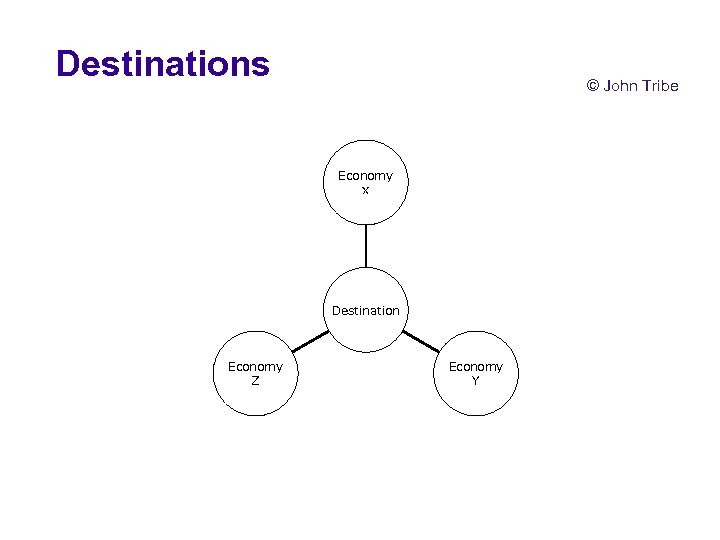
 The Economic Environment © John Tribe ¡ The economic environment (Tribe, 2016) affects different types of tourism entities in different ways. l The success of an international tourism destination such as Mallorca, Spain, will be affected by economic fluctuations in those countries which supply the majority of its visitors (tourism generating countries), as well as its economic attractiveness compared to competitive resorts. l Tour operators such as Kuoni (Switzerland ) and TUI (Germany/UK), face a number of economic environments. First, domestic economic environments affect the expenditure patterns of their clients. Second, the variety of different international economic environments in which their tourism product is located affects the supply of the tourism package. l Providers of tourism services will find the international economic environment affects the demand for their services and the costs of supplying those services.
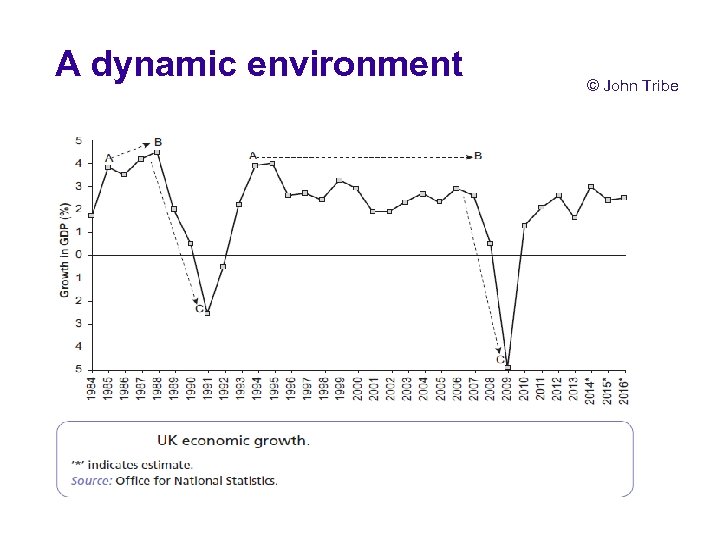 A dynamic environment © John Tribe
 What are the key variables? © John Tribe ¡The economic environment affects organizations in the leisure and tourism sector in two main ways. l Changes in the economic environment can affect the demand for an organization’s products l Changes may affect an organization’s costs. ¡These are set out in the next sections ¡ Additionally background factors such as share and property prices may affect organizations.
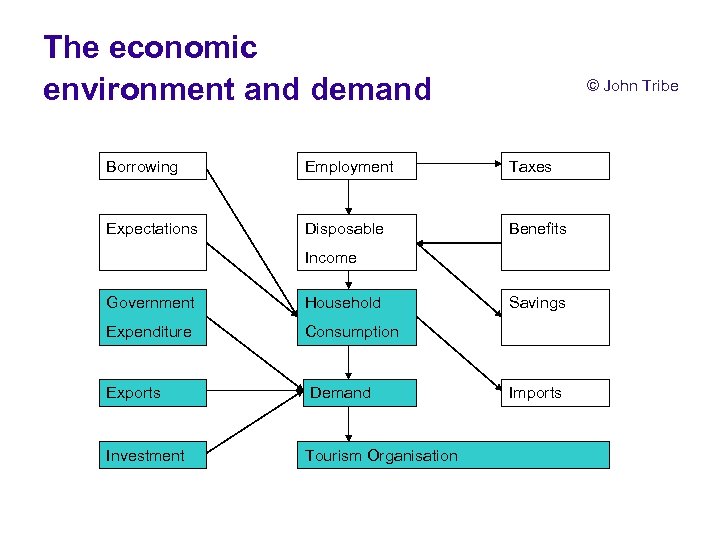 The economic environment and demand © John Tribe Borrowing Employment Taxes Expectations Disposable Benefits Income Government Household Expenditure Consumption Exports Investment Demand Tourism Organisation Savings Imports
 The economic environment and demand © John Tribe ¡The key macroeconomic factors affecting demand for tourism industries are: l household consumption l export and import demand l government expenditure l investment
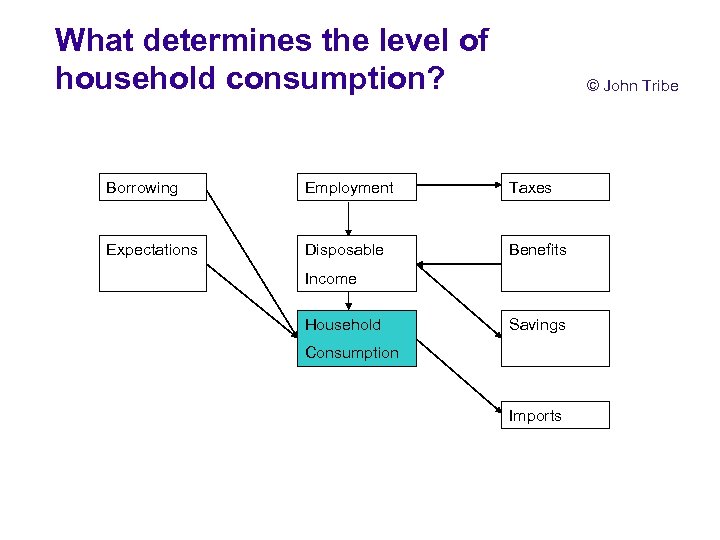 What determines the level of household consumption? © John Tribe Borrowing Employment Taxes Expectations Disposable Benefits Income Household Savings Consumption Imports
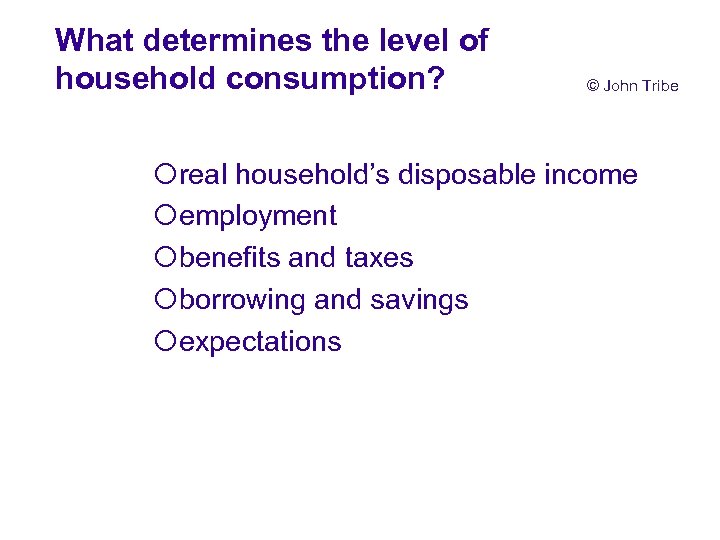 What determines the level of household consumption? © John Tribe ¡real household’s disposable income ¡employment ¡benefits and taxes ¡borrowing and savings ¡expectations
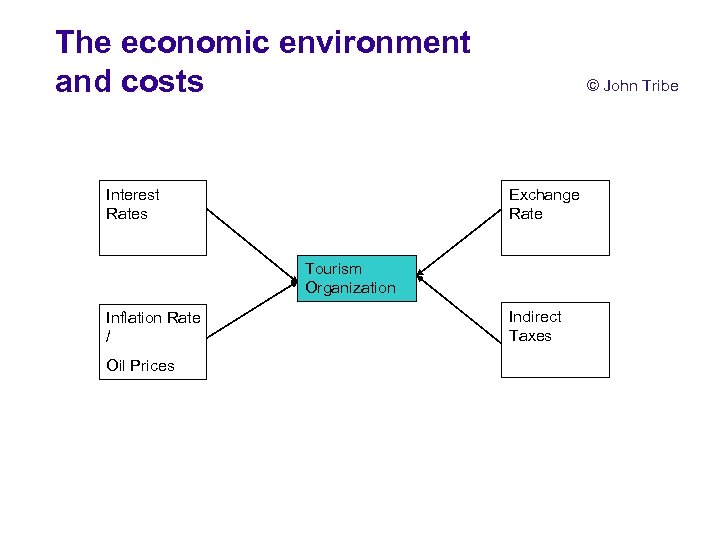 The economic environment and costs Interest Rates © John Tribe Exchange Rate Tourism Organization Inflation Rate / Oil Prices Indirect Taxes
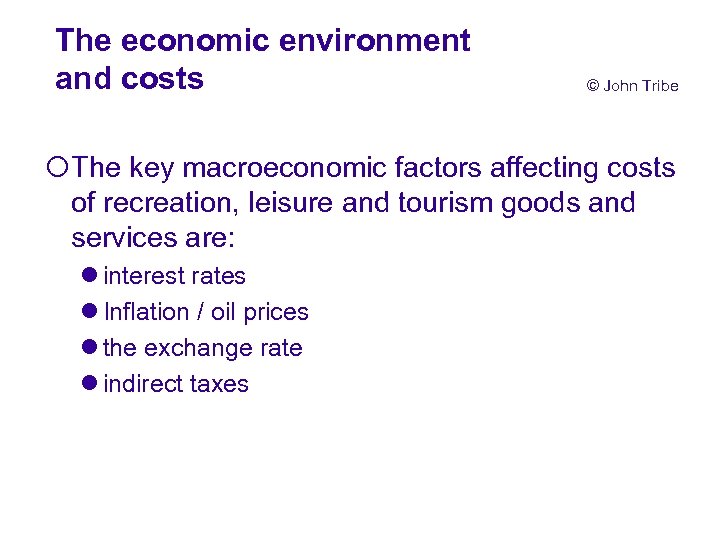 The economic environment and costs © John Tribe ¡The key macroeconomic factors affecting costs of recreation, leisure and tourism goods and services are: l interest rates l Inflation / oil prices l the exchange rate l indirect taxes
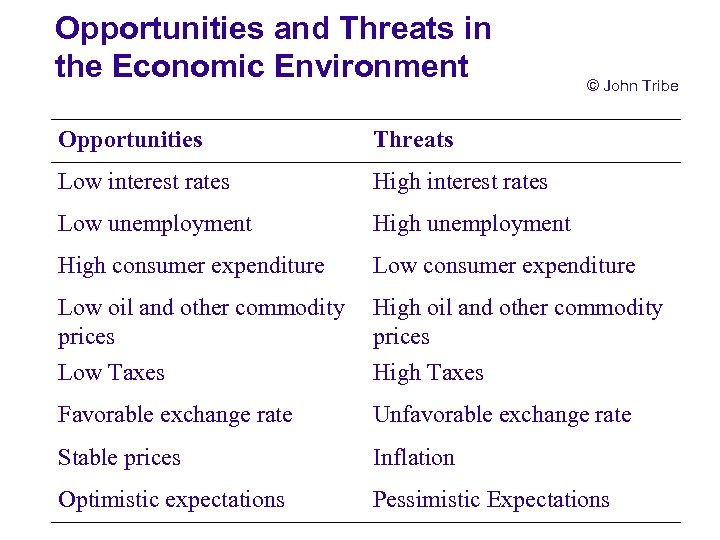 Opportunities and Threats in the Economic Environment © John Tribe Opportunities Threats Low interest rates High interest rates Low unemployment High consumer expenditure Low oil and other commodity prices Low Taxes High oil and other commodity prices High Taxes Favorable exchange rate Unfavorable exchange rate Stable prices Inflation Optimistic expectations Pessimistic Expectations
 Destinations © John Tribe Economy x Destination Economy Z Economy Y
 The sociocultural environment © John Tribe ¡Factors in the socio-cultural environment of tourism entities include l the size and structure of the population l lifestyles and inter-cultural differences l other factors (including attitudes and values about travel, availability of paid leave and unemployment) l tourist motivations l attitudes to the environment
 The technological environment © John Tribe ¡The technological environment offers both opportunities and threats: l Opportunities may be found in cheaper provision, or improvements in goods and services, in better marketing or easier distribution. l However technology may result in an organisation's product or service becoming obsolete, or subject to new forms of competition. ¡The technological environment may be divided into Information Communication Technology and other technology.
 Information Communication Technology © John Tribe ¡ ICT relevant to tourism encompasses information search, purchase of services, post travel engagement and networking. ¡ It includes information and reservation systems for airlines, hotels and attractions, timetables for transport systems, search engines (e. g. Google) online travel services (e. g. Expedia, Orbitz, Lastminute. com, Opodo, Travelocity and edreams), destination management systems (e. g. visitbritain. com), networking and web 2. 0 portals (e. g. tripadvisor. com) and price comparison sites (e. g. travelsupermarket. com).
 Other Technology © John Tribe ¡ Other areas where technologies have had a significant impact on tourism include: l Construction techniques - allowing faster erection of buildings. l Bridge technology – extending access and cutting journey times. l Materials – lighter and more durable materials. l Glass – especially with better insulation properties. l Fuels – e. g. biofuels/hybrids l Energy – especially alternative sources of energy such as wind and solar power. l Security scanning – which enables quicker and more accurate passenger checking at airports.
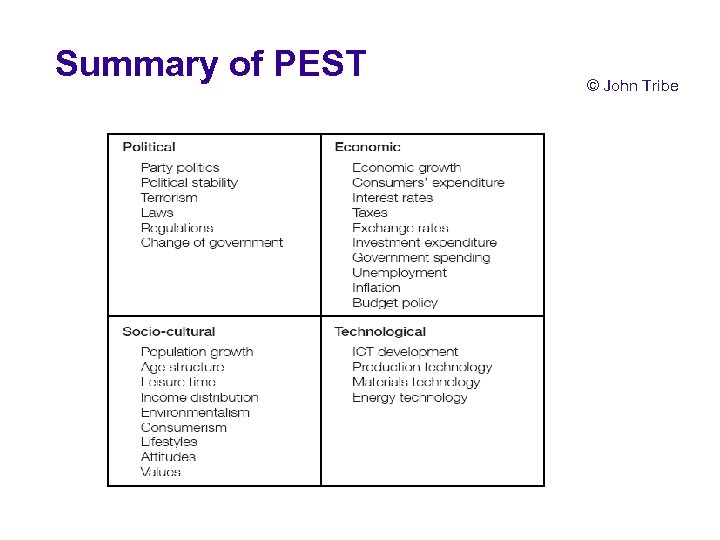 Summary of PEST © John Tribe
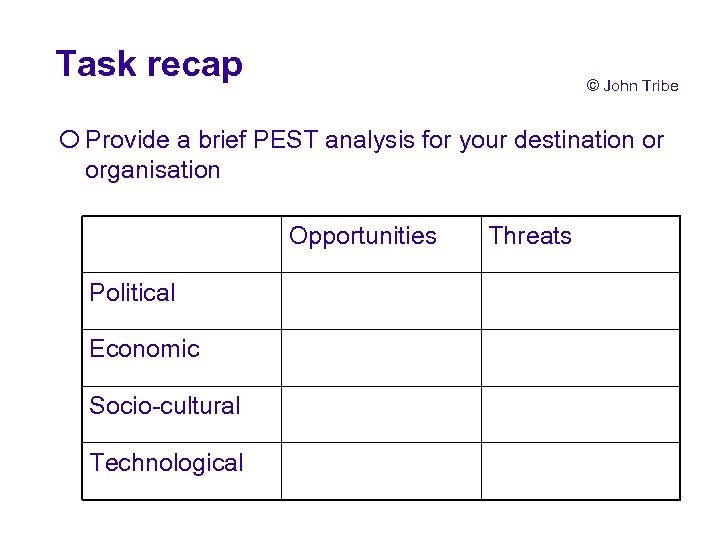 Task recap © John Tribe ¡ Provide a brief PEST analysis for your destination or organisation Opportunities Political Economic Socio-cultural Technological Threats
 Review of Key Terms © John Tribe ¡ Political analysis: The effects of government policy and laws. ¡ Economic analysis: Understanding what economic factors will affect tourism entities and how these economic factors are changing. ¡ Consumers' expenditure: The amount of money consumers actually spend. ¡ Exchange rates: The value of a country's currency in terms of other currencies. ¡ Interest rates - The cost of borrowing. ¡ Expectations: The way people feel about future economic prospects (optimistic or pessimistic). ¡ Socio-cultural analysis: Understanding changes in population size and structure as well as changes in consumer tastes, preferences and broader cultural shifts. ¡ Technological analysis: Analysing changes in science and technology to understand how these will impact on tourism entities. ¡ ICT: Information and Communication Technology
 Discussion Questions © John Tribe 1. Explain how changes in government or government policy might affect a named tourism entity. 2. Evaluate the economic environment for a named destination 3. Explain how changes in ¡ ¡ exchange rates consumers' expenditure taxation, and interest rates may affect the business of a named airline. What other economic factors might be relevant to your analysis? 4. What opportunities and threats are destinations facing from changes in ICT? 5. Provide a PEST analysis for the provider of a major theme park, distinguishing between opportunities and threats.
 Tourism Strategy Part 2, Lecture 4 The external environment: PEST analysis The End