



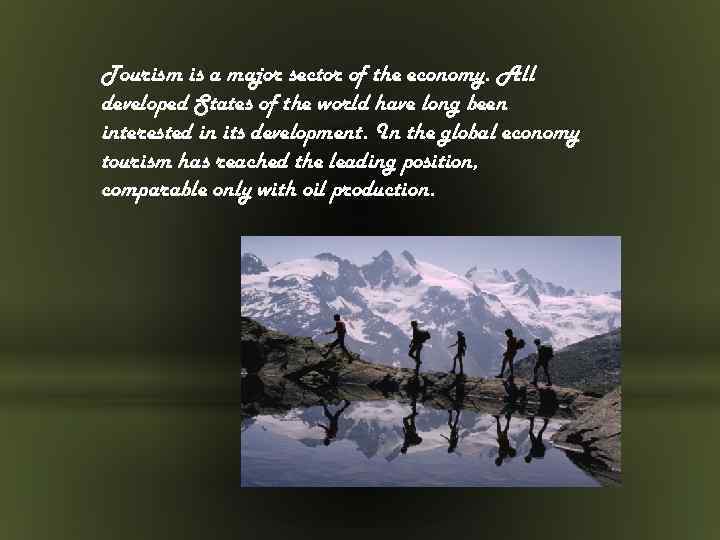
 Tourism is a major sector of the economy. All developed States of the world have long been interested in its development. In the global economy tourism has reached the leading position, comparable only with oil production.
 The history of development of tourism Mass tourism is a phenomenon of the XX century, as has acquired a modern look mainly at the expense of cars and jet engines. However, people traveled from time immemorial, mainly in order to avoid hunger or danger. The remains of the first human beings (Homo erectus) were found in Western Europe, Africa, China, and Java. This fact indicates the remarkable ability of ancient people to travel long distances without any means of transportation. The invention of money by the Phoenicians and the development of trade that began in the 4 th Millennium BC, can be defined as the beginning of the modern era of travel. The Phoenicians also invented writing and the wheel, so that they can rightly be considered the founders of the "tourist business".
 The first travelers The Inhabitants Of Oceania. Among the earliest were travelling in Oceania. The small Shuttle Canoeing, no more than 40 feet long, was used for travel from South-East Asia through Micronesia and the Pacific ocean to the Marquises Islands, the Tuamotu archipelago and the United Islands. In 500 BC Polynesians with joint Islands traveled to Hawaii for a distance of over 2 thousand miles. Navigation is carried out by observing the position of the sun and stars, the excitement of ocean clouds and flying birds. Unsolved remains the problem of replenishment of fresh water and food.
 The Inhabitants Of The Mediterranean. In the ancient cradle of Western civilization's travel with the purpose of trade, Commerce, religion, treatment or training was done for a long time. In the old Testament, there are numerous references about traveling merchants at the caravans. To explore new territories were set out on the long journey of ancient Greek scientists (Herodotus, V century BC) and researchers from other countries (PYTHEAS, IV century BC).
 Since 776 BC annually to the Olympic games flocked thousands of sports fans and admirers of art from Greece, and other Mediterranean States. To this period belongs the construction of special large houses, which could accommodate and entertain the athletes and spectators. Accumulated by the beginning of our era geographical information about various countries more fully outlined the ancient geographer Strabo (63 BC - 20 BC) and Claudius Ptolemy (90168, ad).
 Ancient Rome contributed to the history of tourism: wealth, abundance, and the huge territory of the Empire were of periostat-governmental components required for tourism. The Romans built a magnificent network of roads that they could travel on horseback for a distance of over 100 miles a day to see the famous temples in the Mediterranean region, especially the pyramids and monuments of Egypt. In the heyday of the Roman Empire to the Romans from wealthy families trip to Greece was often connected with the necessity to Supplement their education. Later travel to Greece began to get entertainment: country attracted tourists festivals, athletic competitions and other kinds of amusements and entertainment. Moving rich puteshestvieworkers demanded the proper organization of their leisure. Especially willingly visited places with warm mineral springs.
 Geographical discoveries of the Russian seafarers and travelers A significant contribution to the study of the little-known regions, countries and continents has made Russian seafarers and travelers. In 1639 were reached the shores of the Pacific ocean. First crossed Siberia and reached the sea of Okhotsk Ivan Moskvi-tin. In 16431646, the journey from Yakutsk to the Pacific coast committed C. D. Poyarkov. In 1648 Semyon Dezhnev was by sea from the mouth of the Kolyma river through the Strait between Asia and America at the mouth of the river Anadyr. In 1697 such as Atlases opened the Kamchatka, and in 1711 Russians visited on the Kuril Islands.
 In 1732, the expedition Ivan Fedorov was at the shores of Alaska near Cape Prince of Wales. During the trip Century Bering (17251743, ) were opened Aleutian Islands, Bering island, North-West Bank of America, paved path through the Strait between Asia and America made shooting the coast of the sea of Okhotsk, Kamchatka, Kuril Islands, and the Northern part of Japan. Among the names of famous Russian travelers of the XVIII century - the Century Procesi, D. L. Ovtsyn, D. I. Laptev and X. P. Laptev, S. I. Chelyuskin, S. P. Krashenki Cove. "Russian Columbus" is called, I. Shelikhov.
 By the beginning of the XIX century was essentially completed the process of opening the inhabited continents. Have been investigated in whole or in most part of its flow all big rivers, mapped large lake, established the main features of the reliefs of the inhabited areas. In the XIX and XX centuries was developed circumpolar space, was carried out of the land of the research studied the interior of the Asian continent and Oceanographic surveys. For Russian travelers beginning of XIX century was marked by the first round-the-world voyages undertaken by the captains N. F. Kruzenshtern and Y. F. Lisyansky (1803 -1804), which opened in the Pacific new Islands. Mariners M. P. Lazarev, F. F. Bellingshausen visited Australia, Polynesia and opened Antarctica (1821). Traveler N. N. Miklukho-Maklay studied in detail New Guinea (70 -ies of the XIX century), Russian researchers have made a huge contribution to the development of Central Asia. They shone through Tien Shan, Pamir and Mongolia. A prominent place in the study of this region belongs to p. P. Semenov-Tyan-Shansky and N. M. Przevalsky.
 By the beginning of XX century the Russian travelers and sailors mastered one-sixth of the surface of the land occupied by Russia, was studied by many cross-border geographical areas and the vast area of Asia, all banks in Europe and Asia: from the Varanger fjord to Korea, the shore of a significant part of North America, made a number of remarkable discoveries in other areas of the globe.
 The first sights Since ancient times the sights were the main goal of tourists. Many of us have heard about the seven miracles of light, which include: 1. Egyptian pyramids, including the Sphinx (the only miracle, preserved to our days); 2. The hanging gardens of Babylon (now Iraq); 3. The mausoleum of Halicarnassus (Turkey); 4. The statue of Zeus at Olympia (Greece); 5. Statue of Ginosa, the so-called Colossus of Rhodes (Rhodes island, adjacent to Greece); 6. The lighthouse of Alexandria (Egypt); 7. Artemis temple, or the Temple of Diana at Ephesus (Turkey).
 To world famous attractions include: - Taj Mahal (India); - The great wall of China; Petra (Jordan); - giant icons (Peru); - ruins Masha-Piese (Peru); - complex of Buddhist temples of Borobudur (Java island).
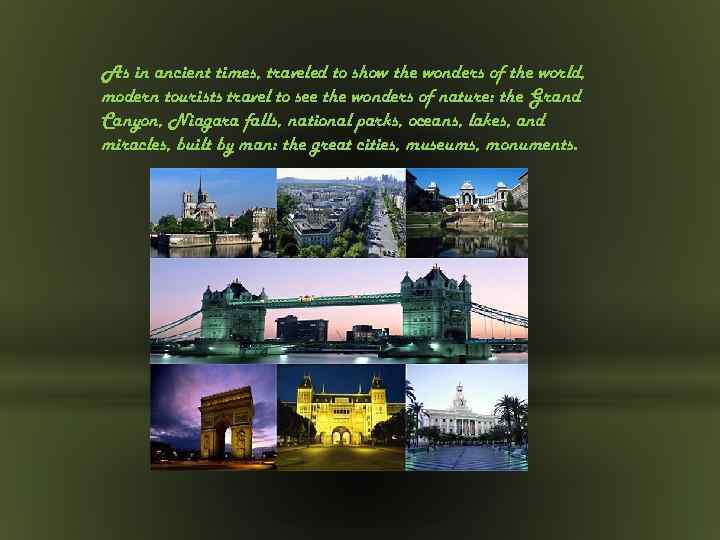 As in ancient times, traveled to show the wonders of the world, modern tourists travel to see the wonders of nature: the Grand Canyon, Niagara falls, national parks, oceans, lakes, and miracles, built by man: the great cities, museums, monuments.