


 Скачать презентацию Tourette Syndrome TS TS is a neurodevelopmental
84ca00dd868a10fa5a4f827a8ca2a802.ppt
- Количество слайдов: 5
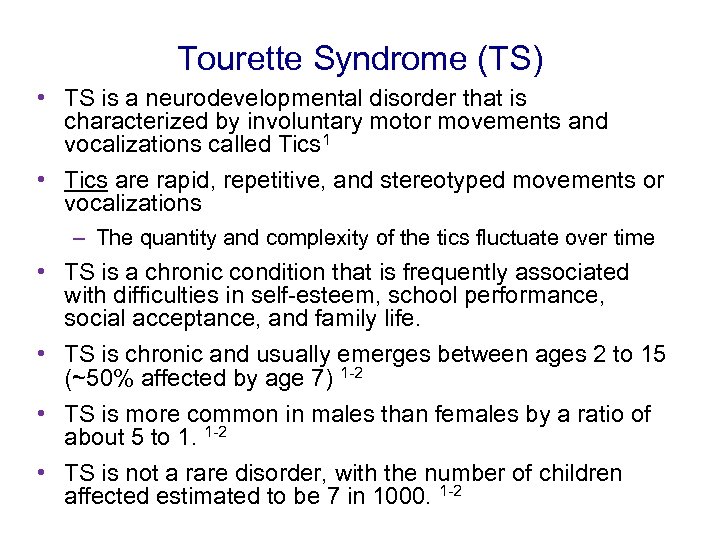 Tourette Syndrome (TS) • TS is a neurodevelopmental disorder that is characterized by involuntary motor movements and vocalizations called Tics 1 • Tics are rapid, repetitive, and stereotyped movements or vocalizations – The quantity and complexity of the tics fluctuate over time • TS is a chronic condition that is frequently associated with difficulties in self-esteem, school performance, social acceptance, and family life. • TS is chronic and usually emerges between ages 2 to 15 (~50% affected by age 7) 1 -2 • TS is more common in males than females by a ratio of about 5 to 1. 1 -2 • TS is not a rare disorder, with the number of children affected estimated to be 7 in 1000. 1 -2
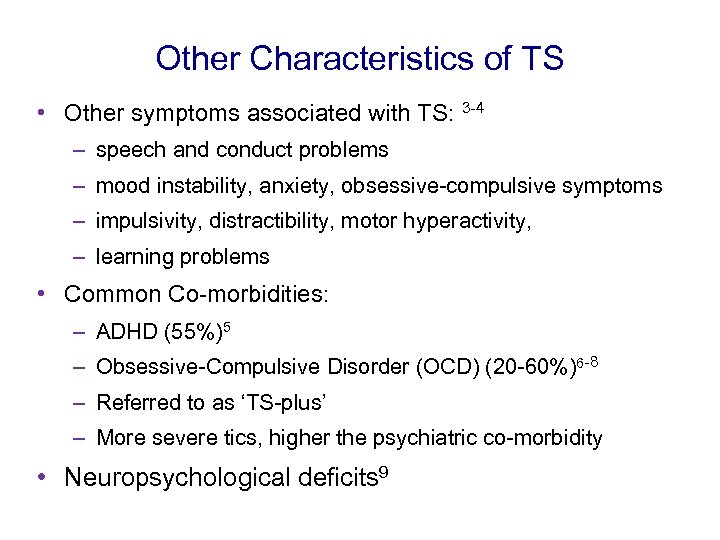 Other Characteristics of TS • Other symptoms associated with TS: 3 -4 – speech and conduct problems – mood instability, anxiety, obsessive-compulsive symptoms – impulsivity, distractibility, motor hyperactivity, – learning problems • Common Co-morbidities: – ADHD (55%)5 – Obsessive-Compulsive Disorder (OCD) (20 -60%)6 -8 – Referred to as ‘TS-plus’ – More severe tics, higher the psychiatric co-morbidity • Neuropsychological deficits 9
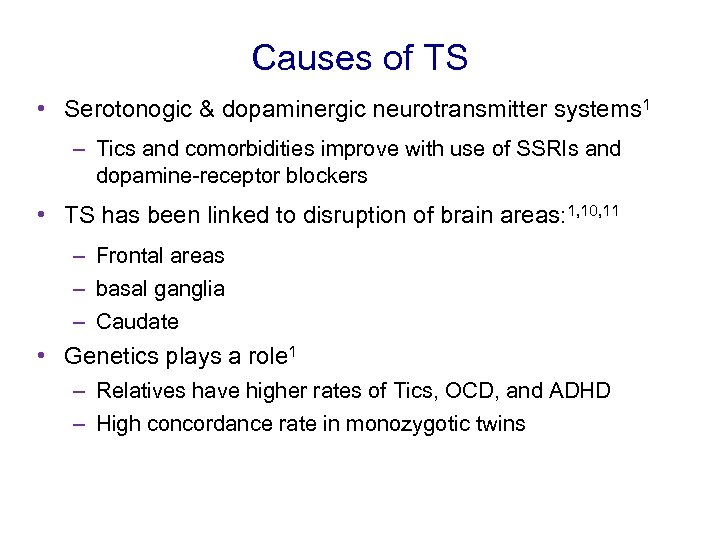 Causes of TS • Serotonogic & dopaminergic neurotransmitter systems 1 – Tics and comorbidities improve with use of SSRIs and dopamine-receptor blockers • TS has been linked to disruption of brain areas: 1, 10, 11 – Frontal areas – basal ganglia – Caudate • Genetics plays a role 1 – Relatives have higher rates of Tics, OCD, and ADHD – High concordance rate in monozygotic twins
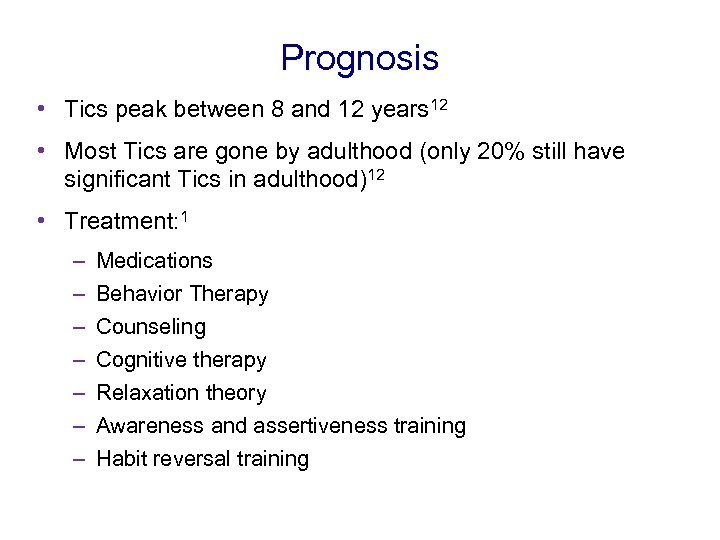 Prognosis • Tics peak between 8 and 12 years 12 • Most Tics are gone by adulthood (only 20% still have significant Tics in adulthood)12 • Treatment: 1 – – – – Medications Behavior Therapy Counseling Cognitive therapy Relaxation theory Awareness and assertiveness training Habit reversal training
 References 1. 2. 3. 4. 5. 6. 7. 8. 9. 10. 11. 12. Kenney C, Kuo S, Jimenez-Shahed J. Tourette's Syndrome. Am Fam Physician. 2008; 77: 651 -658. Hirtz D, Thurman D, Gwinn-Hardy K, Mohamed M, Chaudhuri A, Zalutsky R. How common are the "Common" Neurologic disorders? Neurology. 2007; 68: 326 -337. Lekman J, Yeh C, Lombroso P. Neurobiology of tic disorders, including Tourette's Syndrome. Pediatric Psychopharmacology: Oxford University Press. 2003; 164 -174. Shapiro A, Shapiro E, Young J, Feinberg T, eds. Gilles de la Tourette Syndrome, 2 nd ed. New York: Raven Press; 1988. Freeman R. Tic disorders and ADHD: Answers from a world-wide clinical dataset on Tourette Syndrome. Eur Child Adolesc Psychiatry. 2007; 16(Suppl 1): 15 -23. Apter A, Pauls D, Bleich A, et al. An epidemiologic study of Gilles de la Tourette's Syndrome in Israel. Arch Gen Psychiatry. 1993; 50: 734 -738. Cath D, Spinhoven P, van Woerkom T, et al. Gilles de la Tourette's Syndrome with and without obsessivecompulsive disorder compared with obsessive-compulsive disorder without tics: Which symptoms discriminate? J Nerv Ment Dis. 2001; 189: 219 -228. Pitman R, Green R, Jenike M, Mesulam M. Clinical comparison of Tourette's disorder and obsessivecompulsive disorder. Am J Psychiatry. 1987; 144: 1166 -1171. Bornstein R, King G, Carroll A. Neuropsychological abnormalities in Gilles de la Tourette's Syndrome. J Nerv Ment Dis. 1983; 171: 497 -502. Robertson M. Tourette Syndrome, associated conditions and the complexities of treatment. Brain. 2000; 123(Pt 3): 425 -462. Mink JW. Neurobiology of basal ganglia circuits in Tourette Syndrome: Faulty inhibition of unwanted motor patterns? Adv Neurol. 2001; 85: 113 -122. Leckman, JF. , Bloch, M. , Scahill, L. , & King, R. (2006). Tourette Syndrome: The self under siege, Journal of Child Neurology, 21.