


 Скачать презентацию TOUR OF NIST MANUFACTURED RESEARCH HOUSE Andy
66162293d0c6c95d597d9a5d0da487c4.ppt
- Количество слайдов: 21
 TOUR OF NIST MANUFACTURED RESEARCH HOUSE • Andy Persily, Steve Nabinger, Steve Emmerich, Cindy Howard Reed • Building and Fire Research Laboratory • National Institute of Standards and Technology • Michael Lubliner • Washington State University • October 2, 2002
 SCHEDULE FOR MORNING • Background on NIST manufactured house ventilation and IAQ research – NIST Modeling study for HUD • Mike Lubliner on DOE/EPA/HUD activities • Tour of research house
 A MODELING STUDY OF VENTILATION IN MANUFACTURED HOUSES • • Andrew K. Persily, Samuel R. Martin Building and Fire Research Laboratory National Institute of Standards and Technology Gaithersburg, Maryland USA • ASHRAE/BETEC/CIBSE/ORNL/DOE/NRCC Performance of Exterior Envelopes of Whole Buildings VIII • December 2001 • Funded by US Dept of Housing and Urban Development
 BACKGROUND u US manufactured homes built to HUD Manufactured Homes Construction and Safety Standards u MHCSS Requirements u Minimum air change rate of 0. 35 h-1 u Mechanical or passive system to provide 0. 1 h-1 u (assumes infiltration rate of 0. 25 h-1) u Variety of systems being used to meet standard u Outdoor air intake on forced-air furnace return u Whole house exhaust fan with or without inlet vents
 STUDY QUESTIONS u Validity of 0. 25 h-1 assumption for infiltration u Ventilation rates, air distribution and energy use of systems being used to meet the MHCSS standard: u Outdoor air inlet on furnace return u Whole house exhaust fan with passive inlet vents u Whole house exhaust fan without passive inlet vents
 SIMULATION APPROACH u CONTAM multizone airflow model: u Exterior envelope leakage, interior partitions, forced-air distribution and duct leakage, exhaust fan operation, and outdoor weather u Steady-state airflow simulations for different systems u Annual simulations for different systems: Miami (hot/humid), Albany (cold/mixed), Seattle (temperate)
 Albany: Forced-air intake controlled by heating & cooling demand
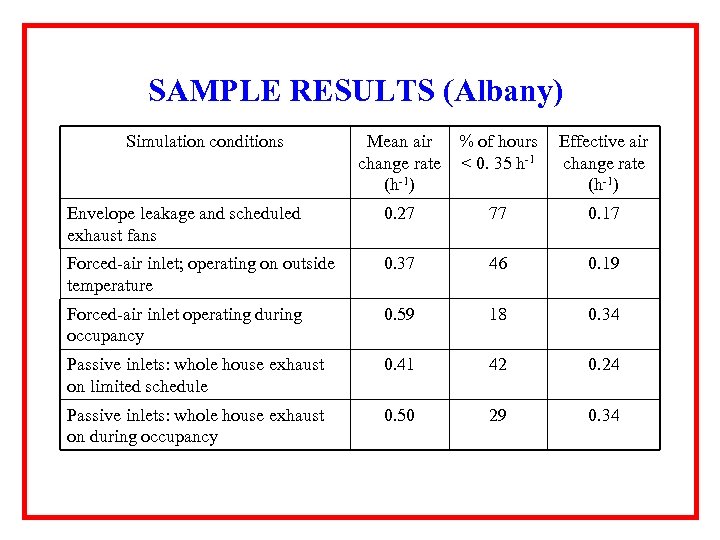 SAMPLE RESULTS (Albany) Simulation conditions Mean air change rate (h-1) % of hours < 0. 35 h-1 Effective air change rate (h-1) Envelope leakage and scheduled exhaust fans 0. 27 77 0. 17 Forced-air inlet; operating on outside temperature 0. 37 46 0. 19 Forced-air inlet operating during occupancy 0. 59 18 0. 34 Passive inlets: whole house exhaust on limited schedule 0. 41 42 0. 24 Passive inlets: whole house exhaust on during occupancy 0. 50 29 0. 34
 ENERGY CONSUMPTION (Albany)
 CONCLUSIONS u 0. 25 h-1 assumption for infiltration u Ignores weather; < 0. 25 h-1 for much of the year u Outdoor air inlet on furnace return u Provides sufficient ventilation and good distribution, but impact depends on operating strategy; potential for both under- and overventilation u Whole house exhaust fan with passive inlet vents u Sufficient ventilation and good distribution, but depends on operation; potential for under- and over-ventilation; make more sense in tight buildings
 RECOMMENDATIONS u Modify infiltration assumption in standard to account for weather-induced variation u Standards need to address operation of mechanical ventilation systems u “Optimize” by tightening ducts and building envelope, then assess systems u Verify findings through field studies u Investigate pollutant impacts of ventilation
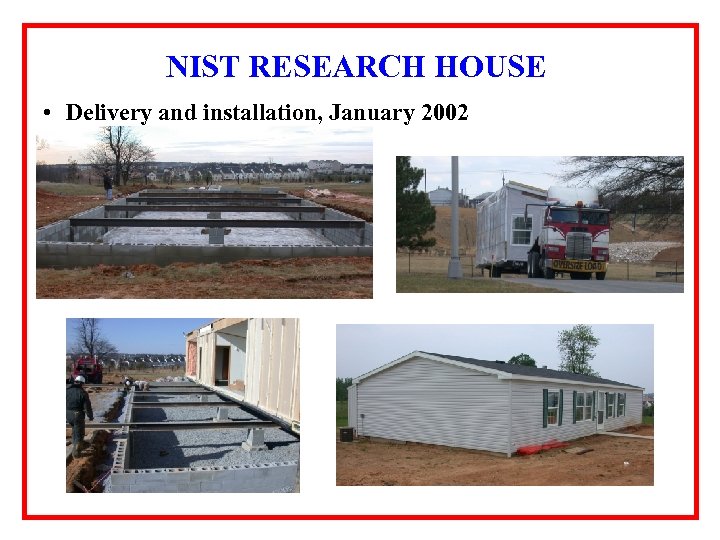 NIST RESEARCH HOUSE • Delivery and installation, January 2002
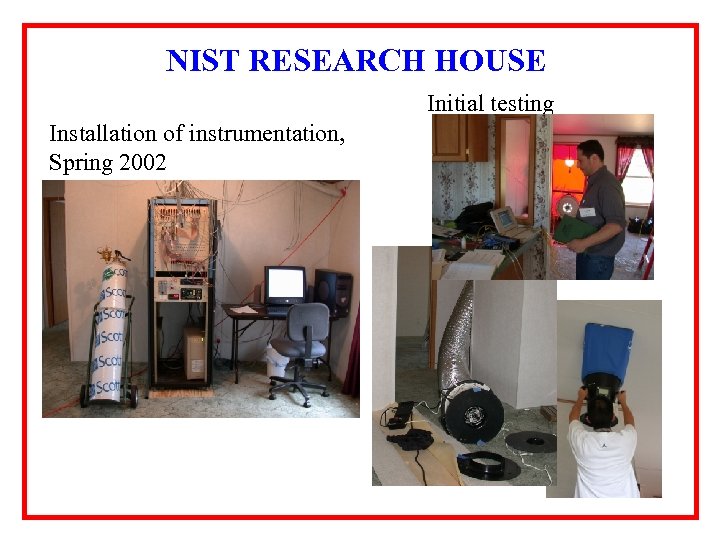 NIST RESEARCH HOUSE Initial testing Installation of instrumentation, Spring 2002
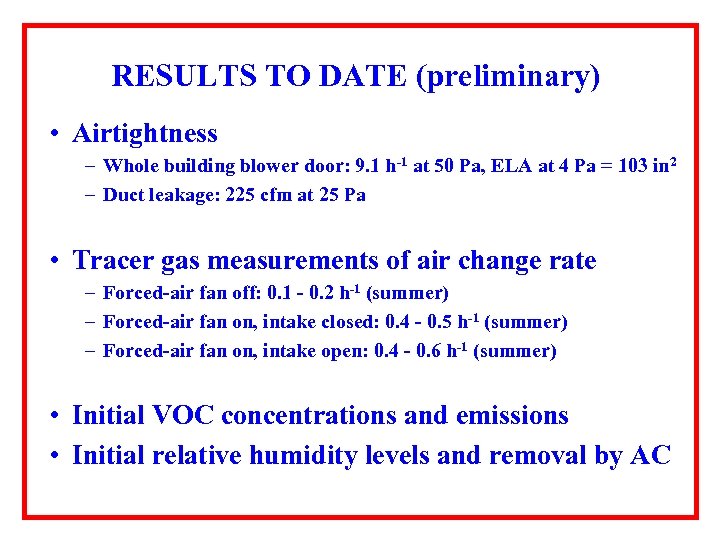 RESULTS TO DATE (preliminary) • Airtightness – Whole building blower door: 9. 1 h-1 at 50 Pa, ELA at 4 Pa = 103 in 2 – Duct leakage: 225 cfm at 25 Pa • Tracer gas measurements of air change rate – Forced-air fan off: 0. 1 - 0. 2 h-1 (summer) – Forced-air fan on, intake closed: 0. 4 - 0. 5 h-1 (summer) – Forced-air fan on, intake open: 0. 4 - 0. 6 h-1 (summer) • Initial VOC concentrations and emissions • Initial relative humidity levels and removal by AC
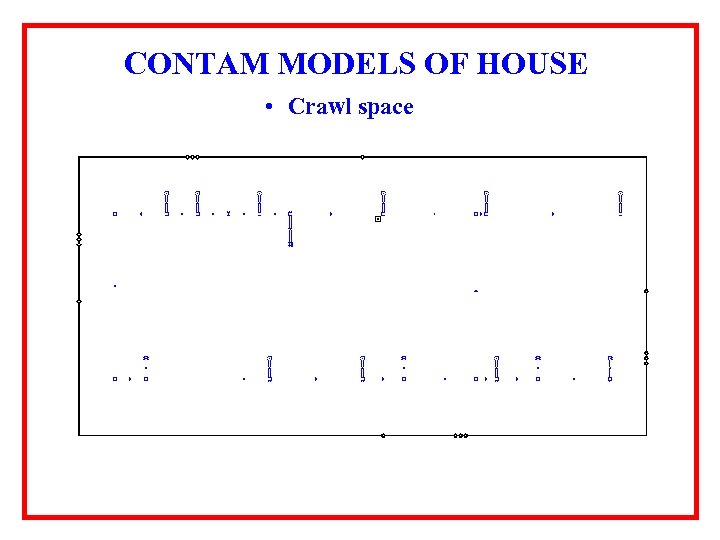 CONTAM MODELS OF HOUSE • Crawl space
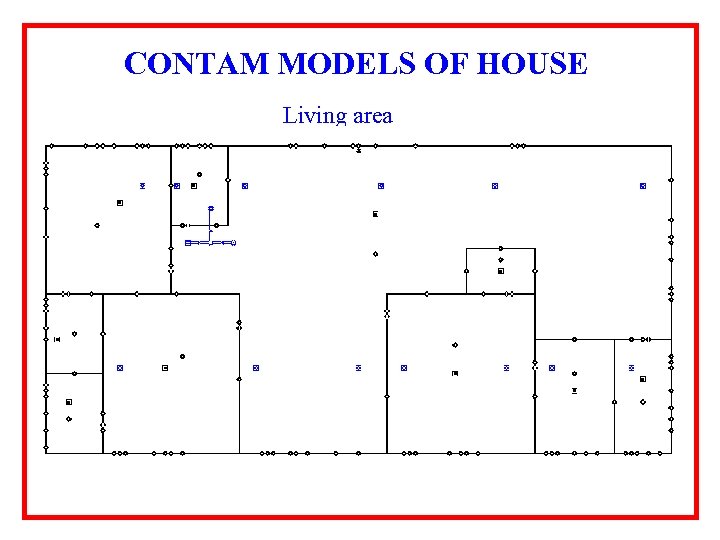 CONTAM MODELS OF HOUSE Living area
 SYSTEM AIRFLOWS (preliminary) Measured and predicted with CONTAM
 EXHAUST AND INTAKE AIRFLOWS (preliminary) Design and measured values
 INDOOR VOC LEVELS (preliminary)
 RESEARCH PLANS § § Complete initial characterization, fall ‘ 02 Air change rates under different operating modes § § § § Fans off, infiltration only Forced-air operating on thermostat, with intake open/sealed Forced-air operating, bath & kitchen exhaust fans on schedule Forced-air operating, whole house exhaust, window vents open/sealed Compare measured and predicted (CONTAM) air change rates Characterization of humidity performance, water vapor storage in materials and furnishings Performance of gaseous air cleaners VOC/formaldehyde emissions over time (LBNL)
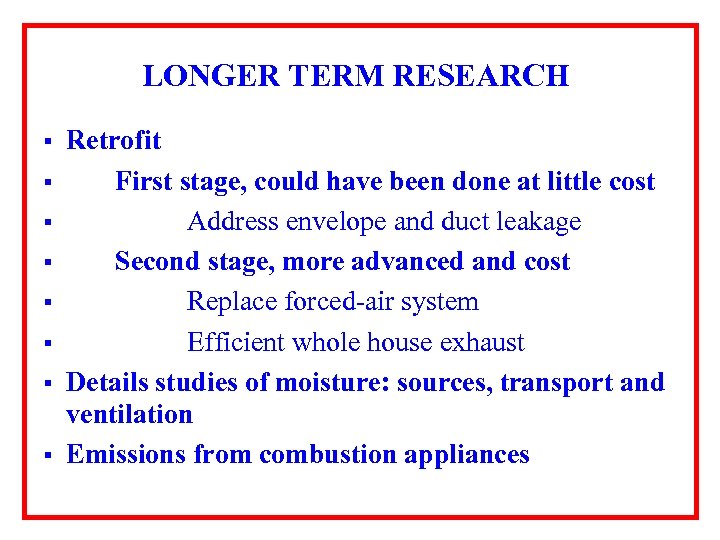 LONGER TERM RESEARCH § § § § Retrofit First stage, could have been done at little cost Address envelope and duct leakage Second stage, more advanced and cost Replace forced-air system Efficient whole house exhaust Details studies of moisture: sources, transport and ventilation Emissions from combustion appliances