

Tour by Layout of Victory Square


Tour by Layout of Victory Square Khatyn memorial Belavezhskaya Pushcha
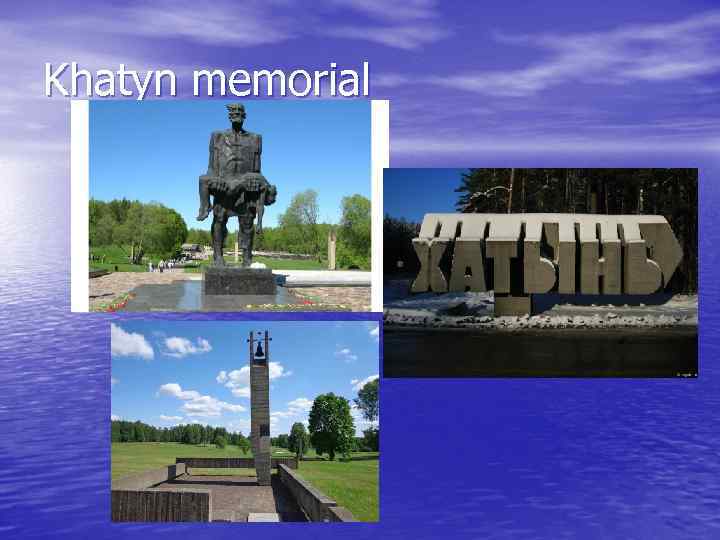
Khatyn memorial
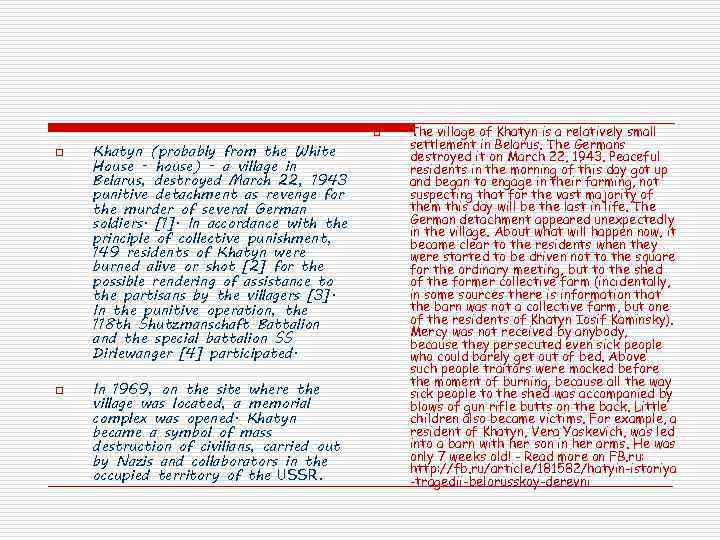
o The village of Khatyn is a relatively small settlement in Belarus. The Germans o Khatyn (probably from the White destroyed it on March 22, 1943. Peaceful House - house) - a village in residents in the morning of this day got up Belarus, destroyed March 22, 1943 and began to engage in their farming, not punitive detachment as revenge for suspecting that for the vast majority of the murder of several German them this day will be the last in life. The soldiers. [1]. In accordance with the German detachment appeared unexpectedly principle of collective punishment, in the village. About what will happen now, it became clear to the residents when they 149 residents of Khatyn were were started to be driven not to the square burned alive or shot [2] for the ordinary meeting, but to the shed possible rendering of assistance to of the former collective farm (incidentally, the partisans by the villagers [3]. in some sources there is information that In the punitive operation, the barn was not a collective farm, but one 118 th Shutzmanschaft Battalion of the residents of Khatyn Iosif Kaminsky). Mercy was not received by anybody, and the special battalion SS because they persecuted even sick people Dirlewanger [4] participated. who could barely get out of bed. Above such people traitors were mocked before the moment of burning, because all the way o In 1969, on the site where the sick people to the shed was accompanied by village was located, a memorial blows of gun rifle butts on the back. Little complex was opened. Khatyn children also became victims. For example, a became a symbol of mass resident of Khatyn, Vera Yaskevich, was led destruction of civilians, carried out into a barn with her son in her arms. He was by Nazis and collaborators in the only 7 weeks old! - Read more on FB. ru: http: //fb. ru/article/181582/hatyin-istoriya occupied territory of the USSR. -tragedii-belorusskoy-derevni
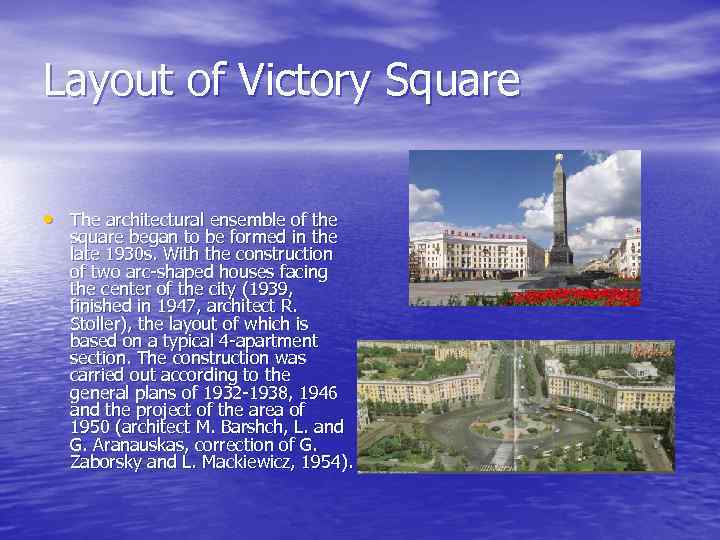
Layout of Victory Square • The architectural ensemble of the square began to be formed in the late 1930 s. With the construction of two arc-shaped houses facing the center of the city (1939, finished in 1947, architect R. Stoller), the layout of which is based on a typical 4 -apartment section. The construction was carried out according to the general plans of 1932 -1938, 1946 and the project of the area of 1950 (architect M. Barshch, L. and G. Aranauskas, correction of G. Zaborsky and L. Mackiewicz, 1954).
Hiatory o Until November 1958 was called the Round Square. o July 1, 1984 in the square were installed pedestals with capsules with the land of Hero-cities: Moscow, Leningrad, Stalingrad, Kiev, Odessa, Sevastopol, Kerch, Novorossiysk, Tula, Brest Fortress. In 1985 - capsules with the land of hero cities of Smolensk and Murmansk.
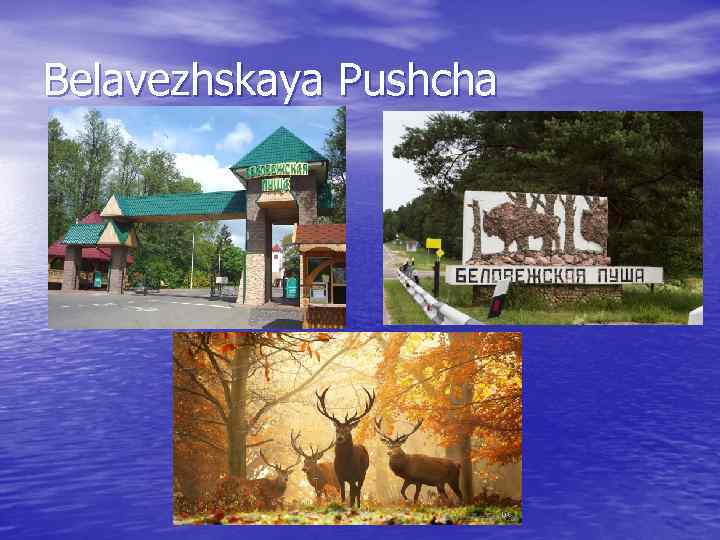
Belavezhskaya Pushcha
Hiatory o Belovezhskaya Pushcha is the oldest nature reserve in Europe. The old virgin forests of these places are mentioned in the Ipatiev Chronicle under the year 983 [10]. In the 12 th century, before these forests became known as the Belovezhskaya Pushcha, Vladimir Monomakh lived here for a long time, hunting for tours, bisons and deer. [11]. In 1276, Prince Vladimir Volynsky founded here the fortified city of Kamenets. At the end of the 13 th century, Belovezhskaya Pushcha became the property of the Grand Dukes of Lithuania, and since the reign of Jagiello - under the control of the Kingdom of Poland [10]. In 1409, Jagiello published grafts according to which hunting for a large beast in the Pushcha was forbidden to everyone, except for the king and his cousin Vitovt [the source is not specified 349 days]. Pushcha became a protected area, but the grand dukes and royal hunts caused considerable damage to the large animals:

End
