 Скачать презентацию Total Resource Cost Effectiveness Test Utility Brown Bag
ce08c742ca39914c4a930f1fce9aa371.ppt
- Количество слайдов: 12



Total Resource Cost Effectiveness Test Utility Brown Bag Series by Tom Eckman, NWPCC Ken Keating, BPA October 4, 2006 1

The Plan’s Definition of Resource Cost. Effectiveness Comes From the Regional Act • "Cost-effective, ” means that a measure or resource must be forecast: – to be reliable and available within the time it is needed – to meet or reduce the electric power demand of the consumers at an estimated incremental system cost no greater than that of the least-cost similarly reliable and available alternative measure or resource, or any combination thereof. 2

Under the Act the term "system cost" means: • An estimate of all direct costs of a measure or resource over its effective life, including: – the cost of distribution and transmission to the consumer – waste disposal costs – end-of-cycle costs – fuel costs (including projected increases) – and such quantifiable environmental costs and benefits as are directly attributable to such measure or resource 3
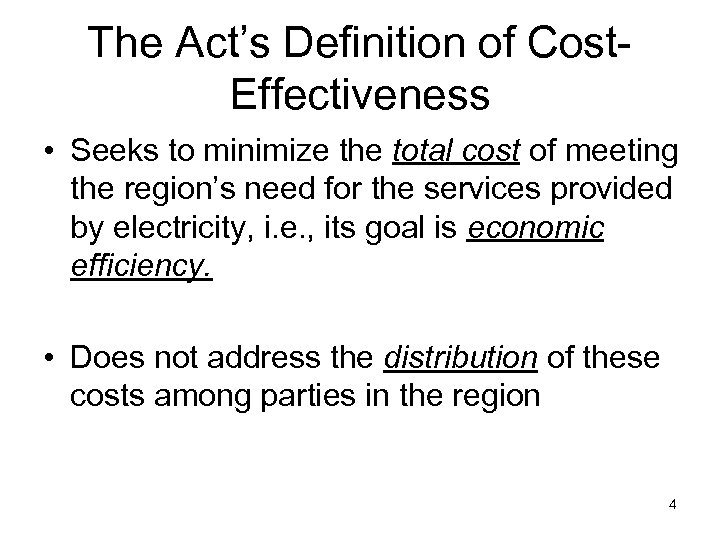
The Act’s Definition of Cost. Effectiveness • Seeks to minimize the total cost of meeting the region’s need for the services provided by electricity, i. e. , its goal is economic efficiency. • Does not address the distribution of these costs among parties in the region 4
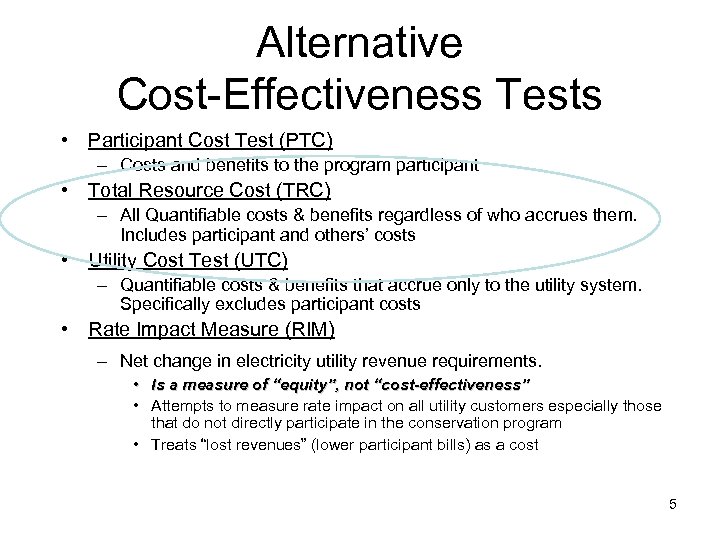
Alternative Cost-Effectiveness Tests • Participant Cost Test (PTC) – Costs and benefits to the program participant • Total Resource Cost (TRC) – All Quantifiable costs & benefits regardless of who accrues them. Includes participant and others’ costs • Utility Cost Test (UTC) – Quantifiable costs & benefits that accrue only to the utility system. Specifically excludes participant costs • Rate Impact Measure (RIM) – Net change in electricity utility revenue requirements. • Is a measure of “equity”, not “cost-effectiveness” • Attempts to measure rate impact on all utility customers especially those that do not directly participate in the conservation program • Treats “lost revenues” (lower participant bills) as a cost 5
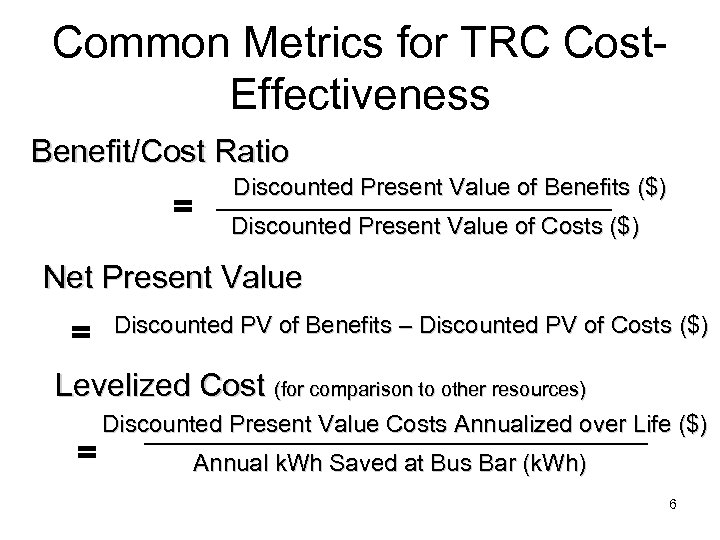
Common Metrics for TRC Cost. Effectiveness Benefit/Cost Ratio = Discounted Present Value of Benefits ($) Discounted Present Value of Costs ($) Net Present Value = Discounted PV of Benefits – Discounted PV of Costs ($) Levelized Cost (for comparison to other resources) = Discounted Present Value Costs Annualized over Life ($) Annual k. Wh Saved at Bus Bar (k. Wh) 6
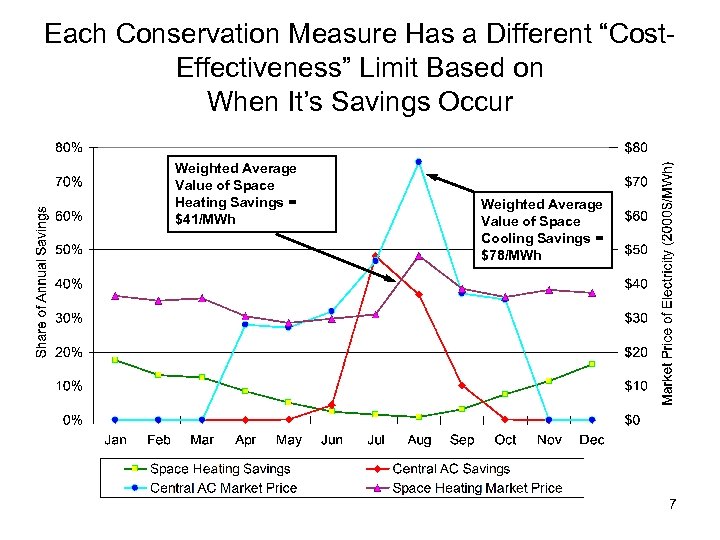
Each Conservation Measure Has a Different “Cost. Effectiveness” Limit Based on When It’s Savings Occur Weighted Average Value of Space Heating Savings = $41/MWh Weighted Average Value of Space Cooling Savings = $78/MWh 7
Plan Uses Total Resource Cost (& Benefits) Perspective • Best meets the requirements of the Regional Act • Considers all quantifiable costs & benefits regardless of who accrues them • Ensures that conservation expenditures are good for the power system, the customer and society • Allows conservation to be compared to other resources considered for development by including all quantifiable costs & benefits • Was strongly recommended by utilities in first Council Plan • Plan conservation targets would be significantly higher if Council had used only “Utility Cost” 8
Why Council Uses TRC (1) Avoids Potential Double Counting of the Savings • Utility invest $2500 in efficient motor to acquire 5000 k. Wh/yr savings – Levelized Cost = 3. 4 cents/k. Wh – B/C = 1. 32 • Customer matches $2500 utility investment to save the same 5000 k. Wh/yr – Simple payback = 10 years, motor last 20 years • Total of all direct cost is $5000 for 5000 k. Wh/yr of savings – Levelized cost = 6. 8 cents/k. Wh – B/C ratio = 0. 66 9
Why Council Uses TRC (2) Directs Funds Toward Measures That Optimize Total Utility and Customer Investments • Utility invest $600 toward cost of $6000 solar PV system that saves 1200 k. Wh/yr – Alternatively utility and consumer could: • Invest $160 in 40 CFLs to save 1200 k. Wh, reducing cost $440 • Invest $600 to buy 150 CFLs, saving 5000 k. Wh, quadrupling savings • Especially important when budgets are limited 10

Care Must Be Used in Applying The Plan’s Cost-Effectiveness Results “Prescriptively” • Not all measures are in the Plan – Plan contains over 1000 applications of specific EE technologies – NOT an exhaustive list of all possible measures & applications • Plan assumes administrative costs = 20% of capital – Administrative cost vary widely by measure & by program design • Measure cost-effectiveness in Plan is an estimate – Measures in Chapter 3 are based on a single estimate of “avoided costs” for the next 20 years – But Plan targets are based on full portfolio model analysis, about 750 estimates of “avoided costs” – Measure costs and savings are a single point estimate, but vary widely in practice 11
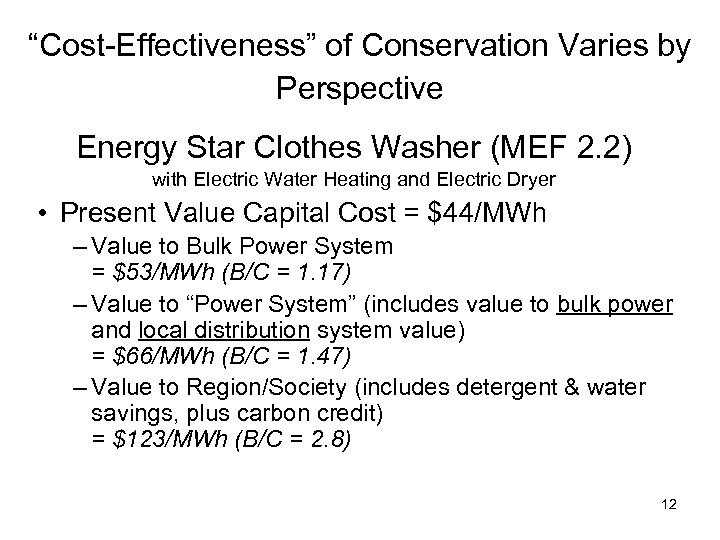
“Cost-Effectiveness” of Conservation Varies by Perspective Energy Star Clothes Washer (MEF 2. 2) with Electric Water Heating and Electric Dryer • Present Value Capital Cost = $44/MWh – Value to Bulk Power System = $53/MWh (B/C = 1. 17) – Value to “Power System” (includes value to bulk power and local distribution system value) = $66/MWh (B/C = 1. 47) – Value to Region/Society (includes detergent & water savings, plus carbon credit) = $123/MWh (B/C = 2. 8) 12
Скачать презентацию Total Resource Cost Effectiveness Test Utility Brown Bag
ce08c742ca39914c4a930f1fce9aa371.ppt