


 Скачать презентацию TORIC TRANSP simulations of ICRH heating of JET plasmas
8463eafe47867ba3faeab2b4d091d7e7.ppt
- Количество слайдов: 22
 TORIC/TRANSP simulations of ICRH heating of JET plasmas Summary of TORIC runs for JET (I. Voitsekhovitch) and discussion with TRANSP and ICRH experts (Yu. Baranov, J. Conboy, I. Jenkins, T. Johnson, D. Keeling, E. Lerche) Outline 1. Brief information about TORIC 2. TORIC namelist in TRANSP and TORIC related post-processing 3. Benchmarking of old and new TORIC versions 4. Benchmarking between TORIC and SPRUCE for minority heating 5. Fundamental D heating with TORIC 6. Mode Conversion simulations: comparison with TOMCAT & PION TRANSP user meeting, JET, 11/01/2008 1
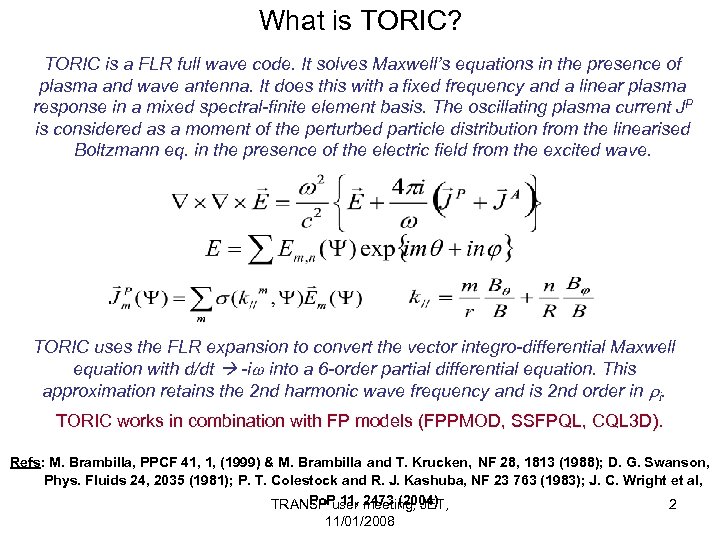 What is TORIC? TORIC is a FLR full wave code. It solves Maxwell’s equations in the presence of plasma and wave antenna. It does this with a fixed frequency and a linear plasma response in a mixed spectral-finite element basis. The oscillating plasma current JP is considered as a moment of the perturbed particle distribution from the linearised Boltzmann eq. in the presence of the electric field from the excited wave. TORIC uses the FLR expansion to convert the vector integro-differential Maxwell equation with d/dt -i into a 6 -order partial differential equation. This approximation retains the 2 nd harmonic wave frequency and is 2 nd order in i. TORIC works in combination with FP models (FPPMOD, SSFPQL, CQL 3 D). Refs: M. Brambilla, PPCF 41, 1, (1999) & M. Brambilla and T. Krucken, NF 28, 1813 (1988); D. G. Swanson, Phys. Fluids 24, 2035 (1981); P. T. Colestock and R. J. Kashuba, NF 23 763 (1983); J. C. Wright et al, Po. P 11, 2473 (2004) TRANSP user meeting, JET, 2 11/01/2008
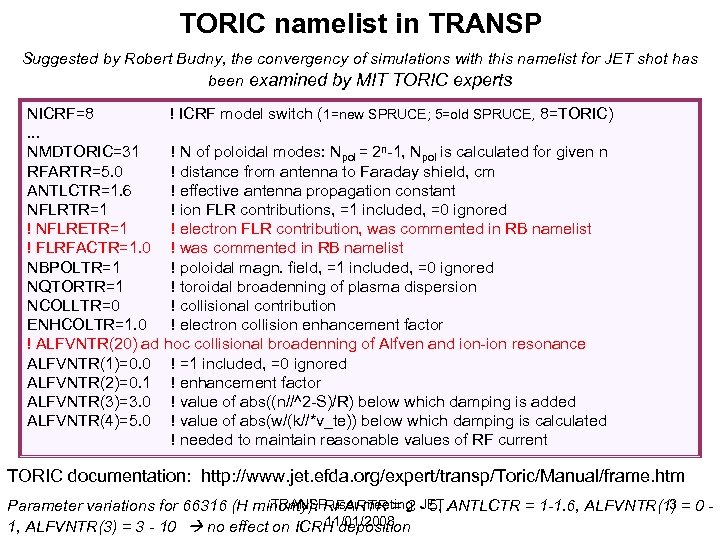 TORIC namelist in TRANSP Suggested by Robert Budny, the convergency of simulations with this namelist for JET shot has been examined by MIT TORIC experts NICRF=8 ! ICRF model switch (1=new SPRUCE; 5=old SPRUCE, 8=TORIC). . . NMDTORIC=31 ! N of poloidal modes: Npol = 2 n-1, Npol is calculated for given n RFARTR=5. 0 ! distance from antenna to Faraday shield, cm ANTLCTR=1. 6 ! effective antenna propagation constant NFLRTR=1 ! ion FLR contributions, =1 included, =0 ignored ! NFLRETR=1 ! electron FLR contribution, was commented in RB namelist ! FLRFACTR=1. 0 ! was commented in RB namelist NBPOLTR=1 ! poloidal magn. field, =1 included, =0 ignored NQTORTR=1 ! toroidal broadenning of plasma dispersion NCOLLTR=0 ! collisional contribution ENHCOLTR=1. 0 ! electron collision enhancement factor ! ALFVNTR(20) ad hoc collisional broadenning of Alfven and ion-ion resonance ALFVNTR(1)=0. 0 ! =1 included, =0 ignored ALFVNTR(2)=0. 1 ! enhancement factor ALFVNTR(3)=3. 0 ! value of abs((n//^2 -S)/R) below which damping is added ALFVNTR(4)=5. 0 ! value of abs(w/(k//*v_te)) below which damping is calculated ! needed to maintain reasonable values of RF current TORIC documentation: http: //www. jet. efda. org/expert/transp/Toric/Manual/frame. htm TRANSP user meeting, JET, 3 Parameter variations for 66316 (H minority): RFARTR = 2 - 5, ANTLCTR = 1 -1. 6, ALFVNTR(1) = 0 11/01/2008 1, ALFVNTR(3) = 3 - 10 no effect on ICRH deposition
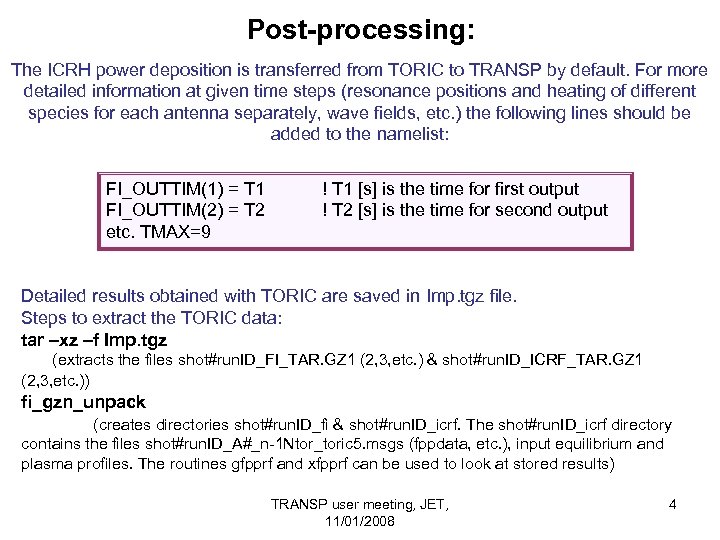 Post-processing: The ICRH power deposition is transferred from TORIC to TRANSP by default. For more detailed information at given time steps (resonance positions and heating of different species for each antenna separately, wave fields, etc. ) the following lines should be added to the namelist: FI_OUTTIM(1) = T 1 FI_OUTTIM(2) = T 2 etc. TMAX=9 ! T 1 [s] is the time for first output ! T 2 [s] is the time for second output Detailed results obtained with TORIC are saved in Imp. tgz file. Steps to extract the TORIC data: tar –xz –f Imp. tgz (extracts the files shot#run. ID_FI_TAR. GZ 1 (2, 3, etc. ) & shot#run. ID_ICRF_TAR. GZ 1 (2, 3, etc. )) fi_gzn_unpack (creates directories shot#run. ID_fi & shot#run. ID_icrf. The shot#run. ID_icrf directory contains the files shot#run. ID_A#_n-1 Ntor_toric 5. msgs (fppdata, etc. ), input equilibrium and plasma profiles. The routines gfpprf and xfpprf can be used to look at stored results) TRANSP user meeting, JET, 11/01/2008 4
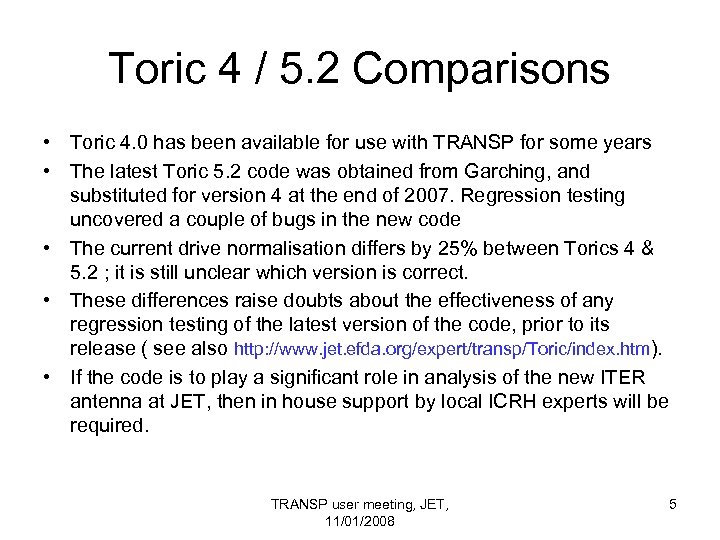 Toric 4 / 5. 2 Comparisons • Toric 4. 0 has been available for use with TRANSP for some years • The latest Toric 5. 2 code was obtained from Garching, and substituted for version 4 at the end of 2007. Regression testing uncovered a couple of bugs in the new code • The current drive normalisation differs by 25% between Torics 4 & 5. 2 ; it is still unclear which version is correct. • These differences raise doubts about the effectiveness of any regression testing of the latest version of the code, prior to its release ( see also http: //www. jet. efda. org/expert/transp/Toric/index. htm). • If the code is to play a significant role in analysis of the new ITER antenna at JET, then in house support by local ICRH experts will be required. TRANSP user meeting, JET, 11/01/2008 5
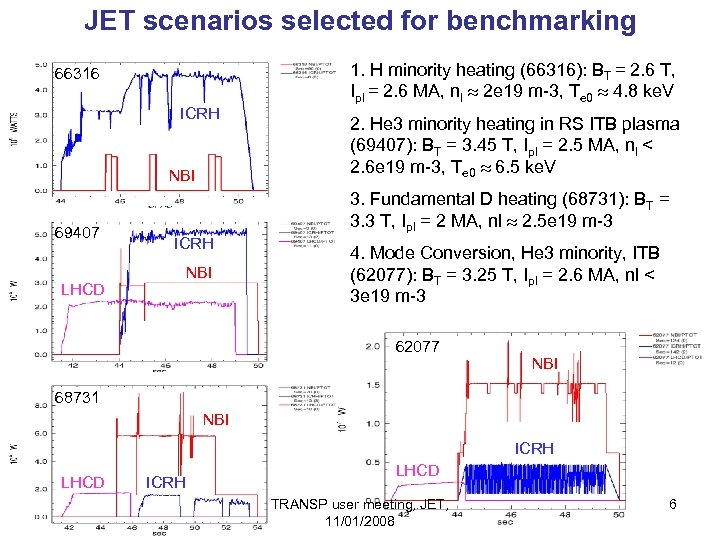 JET scenarios selected for benchmarking 1. H minority heating (66316): BT = 2. 6 T, Ipl = 2. 6 MA, nl 2 e 19 m-3, Te 0 4. 8 ke. V 66316 ICRH NBI 69407 2. He 3 minority heating in RS ITB plasma (69407): BT = 3. 45 T, Ipl = 2. 5 MA, nl < 2. 6 e 19 m-3, Te 0 6. 5 ke. V 3. Fundamental D heating (68731): BT = 3. 3 T, Ipl = 2 MA, nl 2. 5 e 19 m-3 ICRH NBI LHCD 4. Mode Conversion, He 3 minority, ITB (62077): BT = 3. 25 T, Ipl = 2. 6 MA, nl < 3 e 19 m-3 62077 NBI 68731 NBI ICRH LHCD TRANSP user meeting, JET, 11/01/2008 6
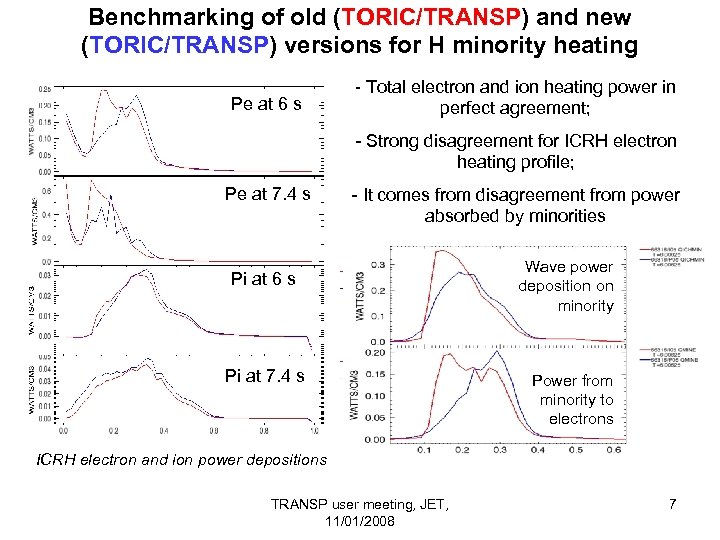 Benchmarking of old (TORIC/TRANSP) and new (TORIC/TRANSP) versions for H minority heating Pe at 6 s - Total electron and ion heating power in perfect agreement; - Strong disagreement for ICRH electron heating profile; Pe at 7. 4 s - It comes from disagreement from power absorbed by minorities Pi at 6 s Pi at 7. 4 s Wave power deposition on minority Power from minority to electrons ICRH electron and ion power depositions TRANSP user meeting, JET, 11/01/2008 7
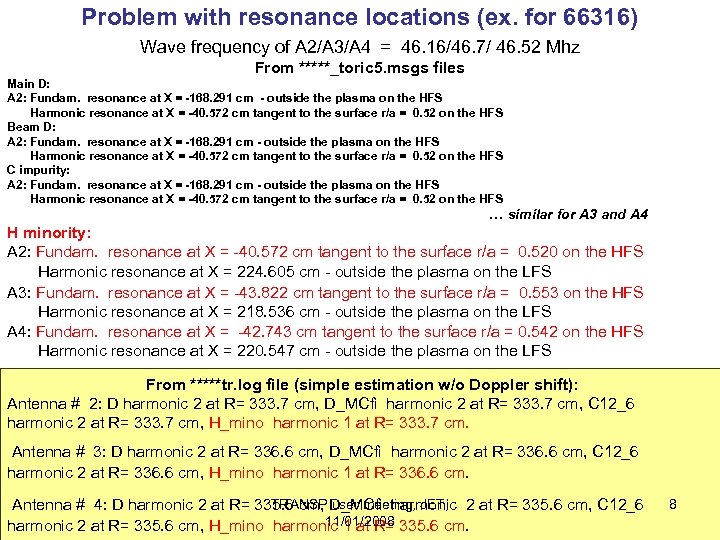 Problem with resonance locations (ex. for 66316) Wave frequency of A 2/A 3/A 4 = 46. 16/46. 7/ 46. 52 Mhz From *****_toric 5. msgs files Main D: A 2: Fundam. resonance at X = -168. 291 cm - outside the plasma on the HFS Harmonic resonance at X = -40. 572 cm tangent to the surface r/a = 0. 52 on the HFS Beam D: A 2: Fundam. resonance at X = -168. 291 cm - outside the plasma on the HFS Harmonic resonance at X = -40. 572 cm tangent to the surface r/a = 0. 52 on the HFS C impurity: A 2: Fundam. resonance at X = -168. 291 cm - outside the plasma on the HFS Harmonic resonance at X = -40. 572 cm tangent to the surface r/a = 0. 52 on the HFS … similar for A 3 and A 4 H minority: A 2: Fundam. resonance at X = -40. 572 cm tangent to the surface r/a = 0. 520 on the HFS Harmonic resonance at X = 224. 605 cm - outside the plasma on the LFS A 3: Fundam. resonance at X = -43. 822 cm tangent to the surface r/a = 0. 553 on the HFS Harmonic resonance at X = 218. 536 cm - outside the plasma on the LFS A 4: Fundam. resonance at X = -42. 743 cm tangent to the surface r/a = 0. 542 on the HFS Harmonic resonance at X = 220. 547 cm - outside the plasma on the LFS From *****tr. log file (simple estimation w/o Doppler shift): Antenna # 2: D harmonic 2 at R= 333. 7 cm, D_MCfi harmonic 2 at R= 333. 7 cm, C 12_6 harmonic 2 at R= 333. 7 cm, H_mino harmonic 1 at R= 333. 7 cm. Antenna # 3: D harmonic 2 at R= 336. 6 cm, D_MCfi harmonic 2 at R= 336. 6 cm, C 12_6 harmonic 2 at R= 336. 6 cm, H_mino harmonic 1 at R= 336. 6 cm. TRANSP user meeting, JET, Antenna # 4: D harmonic 2 at R= 335. 6 cm, D_MCfi harmonic 2 at R= 335. 6 cm, C 12_6 11/01/2008 harmonic 2 at R= 335. 6 cm, H_mino harmonic 1 at R= 335. 6 cm. 8
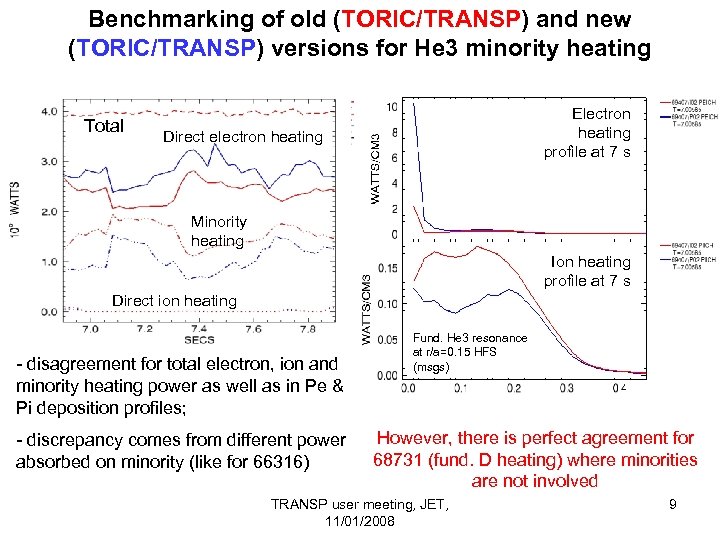 Benchmarking of old (TORIC/TRANSP) and new (TORIC/TRANSP) versions for He 3 minority heating Total Electron heating profile at 7 s Direct electron heating Minority heating Ion heating profile at 7 s Direct ion heating - disagreement for total electron, ion and minority heating power as well as in Pe & Pi deposition profiles; - discrepancy comes from different power absorbed on minority (like for 66316) Fund. He 3 resonance at r/a=0. 15 HFS (msgs) However, there is perfect agreement for 68731 (fund. D heating) where minorities are not involved TRANSP user meeting, JET, 11/01/2008 9
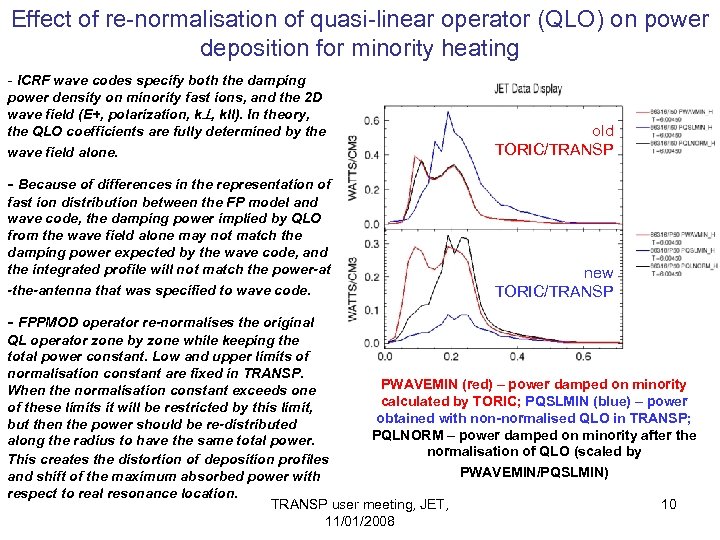 Effect of re-normalisation of quasi-linear operator (QLO) on power deposition for minority heating - ICRF wave codes specify both the damping power density on minority fast ions, and the 2 D wave field (E+, polarization, k , kll). In theory, the QLO coefficients are fully determined by the wave field alone. old TORIC/TRANSP - Because of differences in the representation of fast ion distribution between the FP model and wave code, the damping power implied by QLO from the wave field alone may not match the damping power expected by the wave code, and the integrated profile will not match the power-at -the-antenna that was specified to wave code. new TORIC/TRANSP - FPPMOD operator re-normalises the original QL operator zone by zone while keeping the total power constant. Low and upper limits of normalisation constant are fixed in TRANSP. PWAVEMIN (red) – power damped on minority When the normalisation constant exceeds one calculated by TORIC; PQSLMIN (blue) – power of these limits it will be restricted by this limit, obtained with non-normalised QLO in TRANSP; but then the power should be re-distributed PQLNORM – power damped on minority after the along the radius to have the same total power. normalisation of QLO (scaled by This creates the distortion of deposition profiles PWAVEMIN/PQSLMIN) and shift of the maximum absorbed power with respect to real resonance location. TRANSP user meeting, JET, 10 11/01/2008
 Update of FPPMOD routine Warning: user should check the normalisation of QLO (gfpprf xfpprf (last plot) or multigraph RFHMIN_H (or _HE)) and compare original profile of TORIC wave power deposited on minority, non-normalised QL operator profile and normalised QL operator by TRANSP FP module fppmod. The profiles FWAVMIN and FQLNORM should coincide. Immediate action: Doug added the minimum and maximum renormalization factors "min_qlnorm" and "max_qlnorm" in the FPPMOD namelist and raised the upper limit on the QL re-normalisation from 3 to 20. To change these in the FPPMOD namelist when running xfpprf from data saved with FI_OUTTIM(. . . ): in addition to the values themselves one have to set mstate=1 to prevent the namelist changes from being overwritten by the "state file" which is used when xfpprf is run in this mode. Long-term action: include the limits for the normalisation constants in the TRANSP namelist TRANSP user meeting, JET, 11/01/2008 11
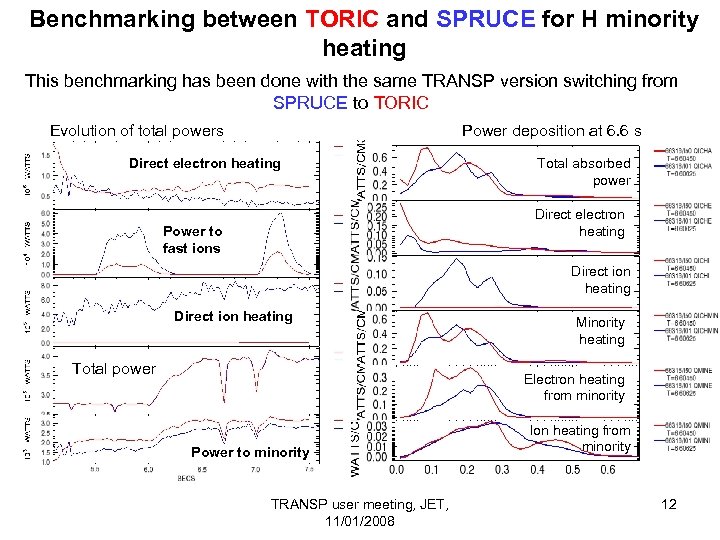 Benchmarking between TORIC and SPRUCE for H minority heating This benchmarking has been done with the same TRANSP version switching from SPRUCE to TORIC Evolution of total powers Power deposition at 6. 6 s Direct electron heating Total absorbed power Direct electron heating Power to fast ions Direct ion heating Total power Minority heating Electron heating from minority Power to minority TRANSP user meeting, JET, 11/01/2008 Ion heating from minority 12
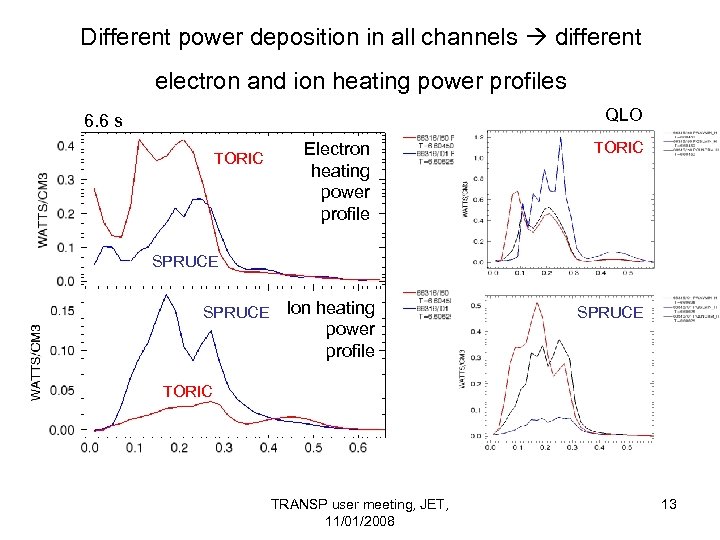 Different power deposition in all channels different electron and ion heating power profiles QLO 6. 6 s TORIC Electron heating power profile TORIC SPRUCE Ion heating power profile SPRUCE TORIC TRANSP user meeting, JET, 11/01/2008 13
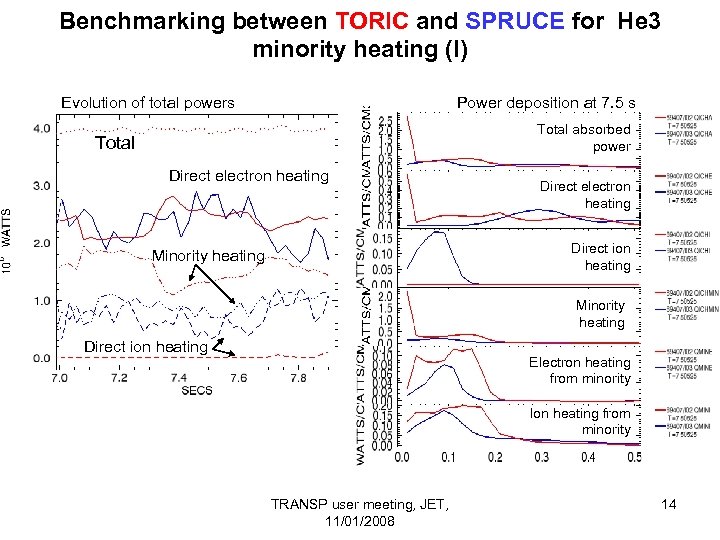 Benchmarking between TORIC and SPRUCE for He 3 minority heating (I) Evolution of total powers Power deposition at 7. 5 s Total absorbed power Total Direct electron heating Direct ion heating Minority heating Direct ion heating Electron heating from minority Ion heating from minority TRANSP user meeting, JET, 11/01/2008 14
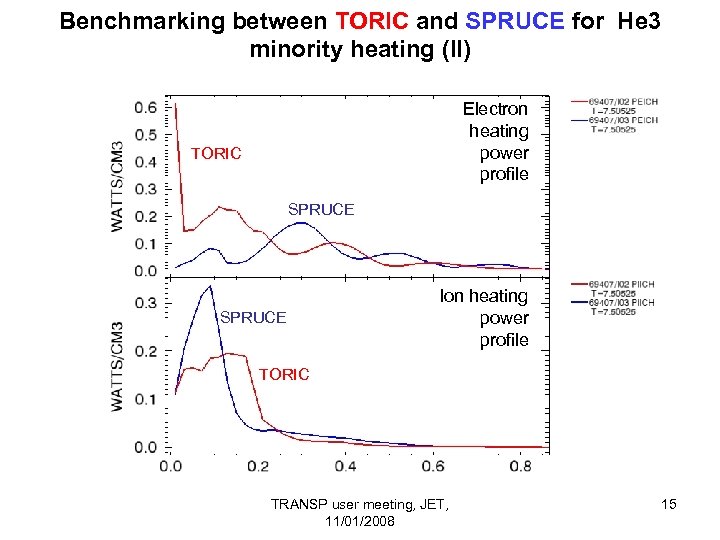 Benchmarking between TORIC and SPRUCE for He 3 minority heating (II) Electron heating power profile TORIC SPRUCE Ion heating power profile TORIC TRANSP user meeting, JET, 11/01/2008 15
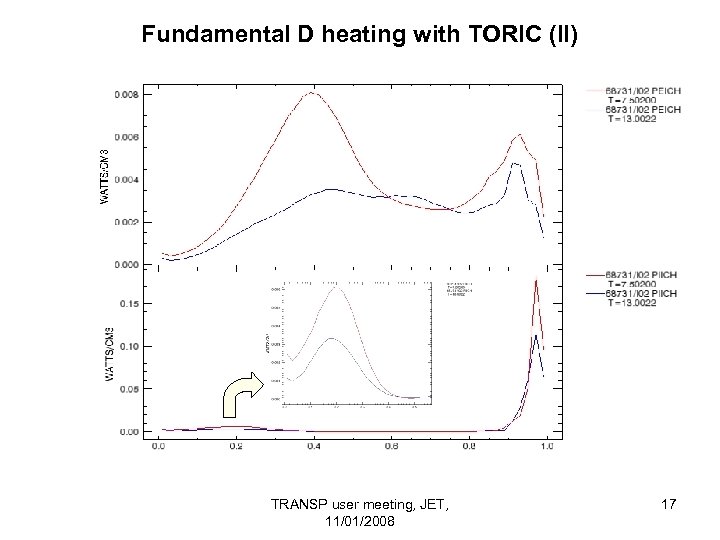
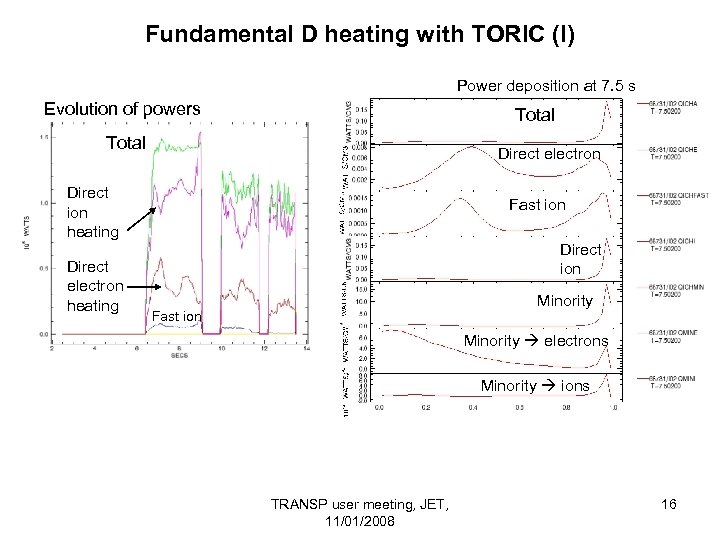 Fundamental D heating with TORIC (I) Power deposition at 7. 5 s Evolution of powers Total Direct electron Direct ion heating Direct electron heating Fast ion Direct ion Minority Fast ion Minority electrons Minority ions TRANSP user meeting, JET, 11/01/2008 16
 Fundamental D heating with TORIC (II) TRANSP user meeting, JET, 11/01/2008 17
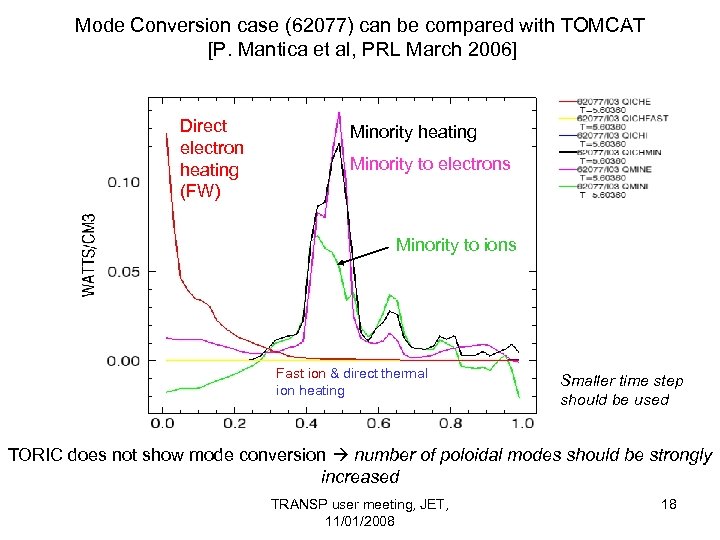 Mode Conversion case (62077) can be compared with TOMCAT [P. Mantica et al, PRL March 2006] Direct electron heating (FW) Minority heating Minority to electrons Minority to ions Fast ion & direct thermal ion heating Smaller time step should be used TORIC does not show mode conversion number of poloidal modes should be strongly increased TRANSP user meeting, JET, 11/01/2008 18
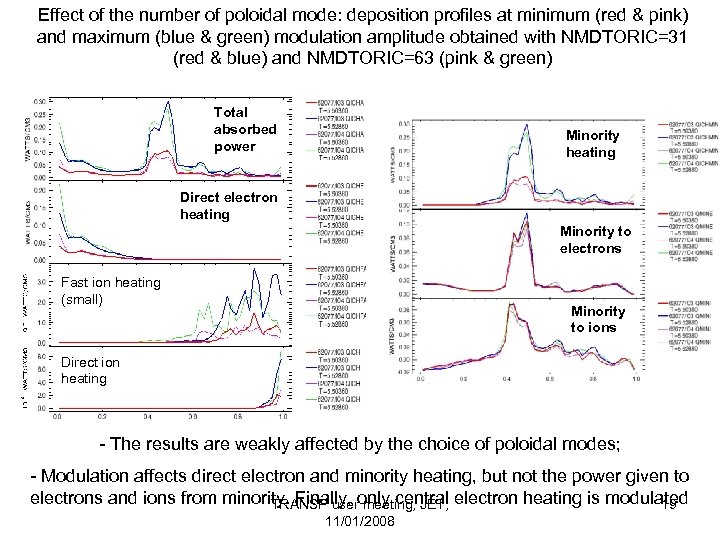 Effect of the number of poloidal mode: deposition profiles at minimum (red & pink) and maximum (blue & green) modulation amplitude obtained with NMDTORIC=31 (red & blue) and NMDTORIC=63 (pink & green) Total absorbed power Minority heating Direct electron heating Minority to electrons Fast ion heating (small) Minority to ions Direct ion heating - The results are weakly affected by the choice of poloidal modes; - Modulation affects direct electron and minority heating, but not the power given to electrons and ions from minority. Finally, only central electron heating is modulated TRANSP user meeting, JET, 19 11/01/2008
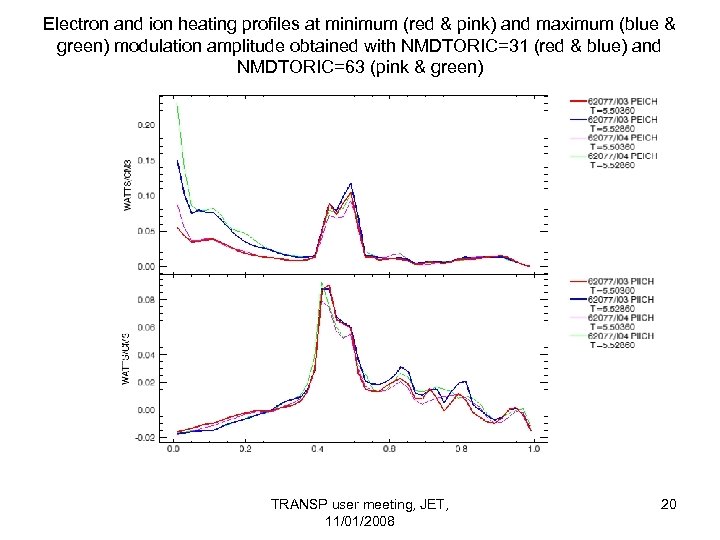 Electron and ion heating profiles at minimum (red & pink) and maximum (blue & green) modulation amplitude obtained with NMDTORIC=31 (red & blue) and NMDTORIC=63 (pink & green) TRANSP user meeting, JET, 11/01/2008 20
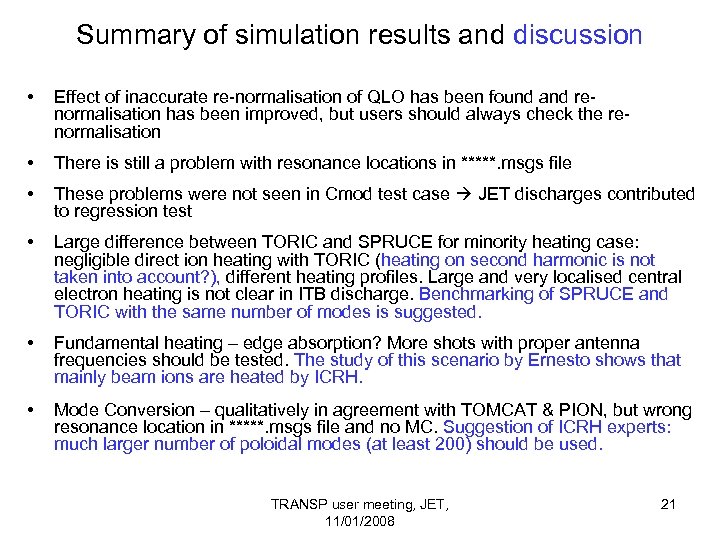 Summary of simulation results and discussion • Effect of inaccurate re-normalisation of QLO has been found and renormalisation has been improved, but users should always check the renormalisation • There is still a problem with resonance locations in *****. msgs file • These problems were not seen in Cmod test case JET discharges contributed to regression test • Large difference between TORIC and SPRUCE for minority heating case: negligible direct ion heating with TORIC (heating on second harmonic is not taken into account? ), different heating profiles. Large and very localised central electron heating is not clear in ITB discharge. Benchmarking of SPRUCE and TORIC with the same number of modes is suggested. • Fundamental heating – edge absorption? More shots with proper antenna frequencies should be tested. The study of this scenario by Ernesto shows that mainly beam ions are heated by ICRH. • Mode Conversion – qualitatively in agreement with TOMCAT & PION, but wrong resonance location in *****. msgs file and no MC. Suggestion of ICRH experts: much larger number of poloidal modes (at least 200) should be used. TRANSP user meeting, JET, 11/01/2008 21
 Conclusion of TRANSP and ICRH experts: TORIC does not provide an ‘off the shelf’ solution to analysing JET RF pulses. At present we cannot explain or solve the problems found in TORIC simulations of JET plasmas, or the observed differences between the ICRH codes In the opinion of those present, development of ICRH modelling for JET will require the full time attention of an ICRH expert. TRANSP user meeting, JET, 11/01/2008 22