


 Скачать презентацию Topical Workshop on Neutrino Factories and Muon Colliders
629c8001e88a976874352293ba074f30.ppt
- Количество слайдов: 29
 Topical Workshop on Neutrino Factories and Muon Colliders Bunch Recombination and Acceleration Robert Abrams Muons, Inc. 23/10/2007 Topical Workshop on NF/MC at Cosener's House 1
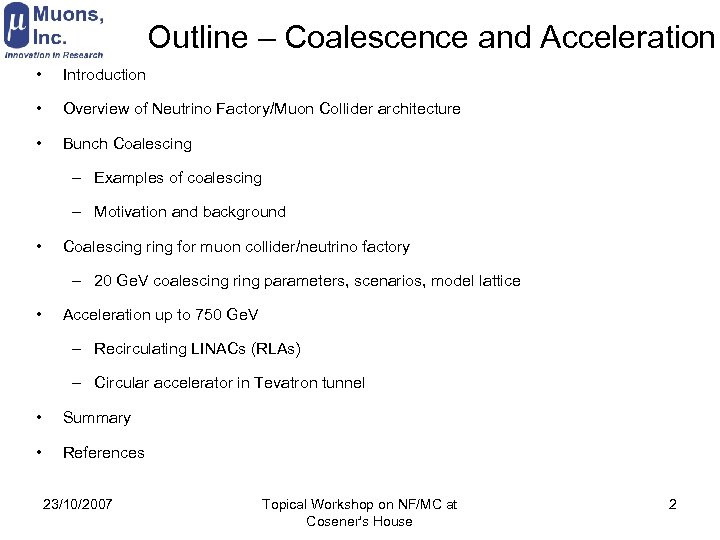 Outline – Coalescence and Acceleration • Introduction • Overview of Neutrino Factory/Muon Collider architecture • Bunch Coalescing – Examples of coalescing – Motivation and background • Coalescing ring for muon collider/neutrino factory – 20 Ge. V coalescing ring parameters, scenarios, model lattice • Acceleration up to 750 Ge. V – Recirculating LINACs (RLAs) – Circular accelerator in Tevatron tunnel • Summary • References 23/10/2007 Topical Workshop on NF/MC at Cosener's House 2
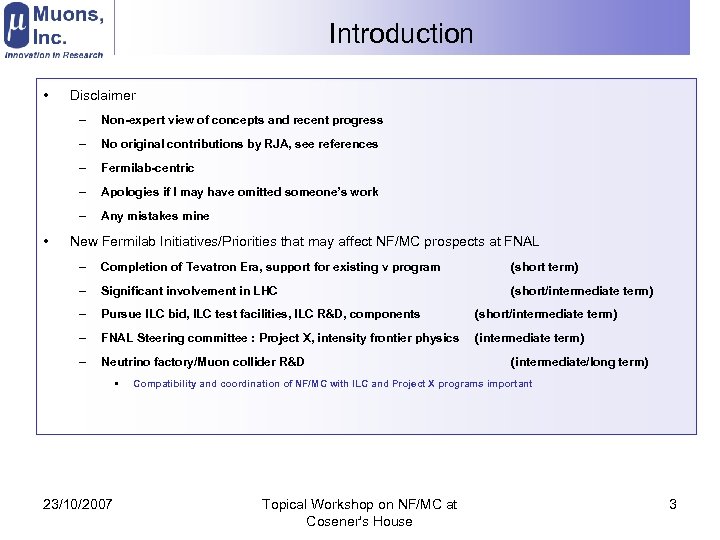 Introduction • Disclaimer – – No original contributions by RJA, see references – Fermilab-centric – Apologies if I may have omitted someone’s work – • Non-expert view of concepts and recent progress Any mistakes mine New Fermilab Initiatives/Priorities that may affect NF/MC prospects at FNAL – Completion of Tevatron Era, support for existing ν program (short term) – Significant involvement in LHC (short/intermediate term) – Pursue ILC bid, ILC test facilities, ILC R&D, components (short/intermediate term) – FNAL Steering committee : Project X, intensity frontier physics (intermediate term) – Neutrino factory/Muon collider R&D • 23/10/2007 (intermediate/long term) Compatibility and coordination of NF/MC with ILC and Project X programs important Topical Workshop on NF/MC at Cosener's House 3
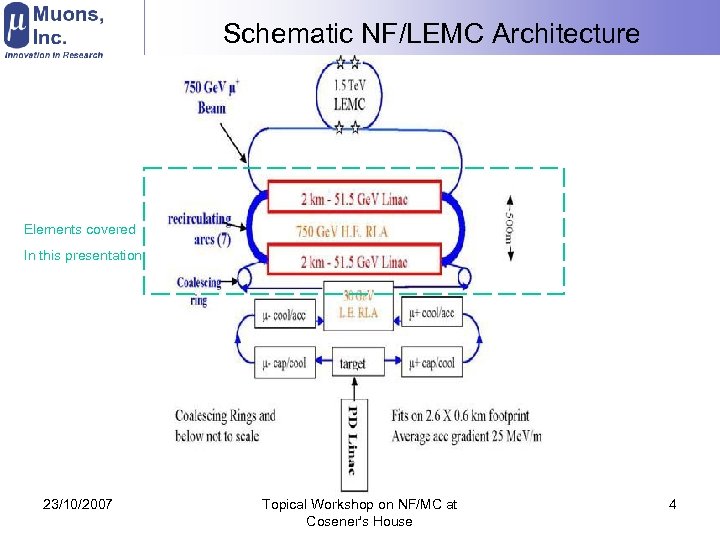 Schematic NF/LEMC Architecture Elements covered In this presentation 23/10/2007 Topical Workshop on NF/MC at Cosener's House 4
 Bunch Coalescing: An Existing Technology • Some Previous Applications – BNL AGS/RHIC • Coalesced 4 AGS bunches into single bunch for injection to RHIC main ring – FNAL Main Injector (MI) • Coalesce up to 16 bunches into single bunches in Main Injector to improve Tevatron Run II luminosity (C. Bhat) • Application to Muon Collider – Increase luminosity and provide a better time structure for experiments 23/10/2007 Topical Workshop on NF/MC at Cosener's House 5
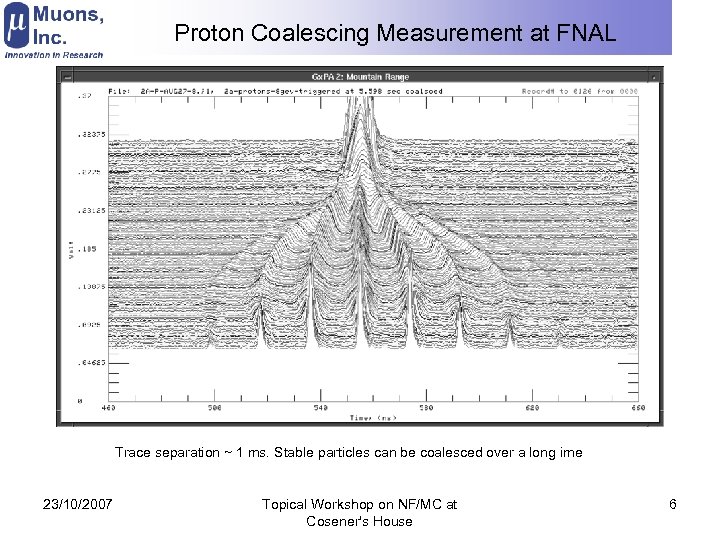 Proton Coalescing Measurement at FNAL Trace separation ~ 1 ms. Stable particles can be coalesced over a long ime 23/10/2007 Topical Workshop on NF/MC at Cosener's House 6
 Bunch Coalescing • How to do bunch recombination (coalescing)? Scenario: – Capture short bunches in high frequency RF buckets – Capture bunch train in lower frequency RF bucket – Manipulate bunch train: rotate of bunches within larger RF bucket by applying lower frequency RF – Coalesce sub-bunches into a single, larger bunch (adiabatically) • At what point in the acceleration should bunches be coalesced? – In LINAC at relatively low energy? – In dedicated coalescing ring(s) after LINAC at higher energy? 23/10/2007 Topical Workshop on NF/MC at Cosener's House 7
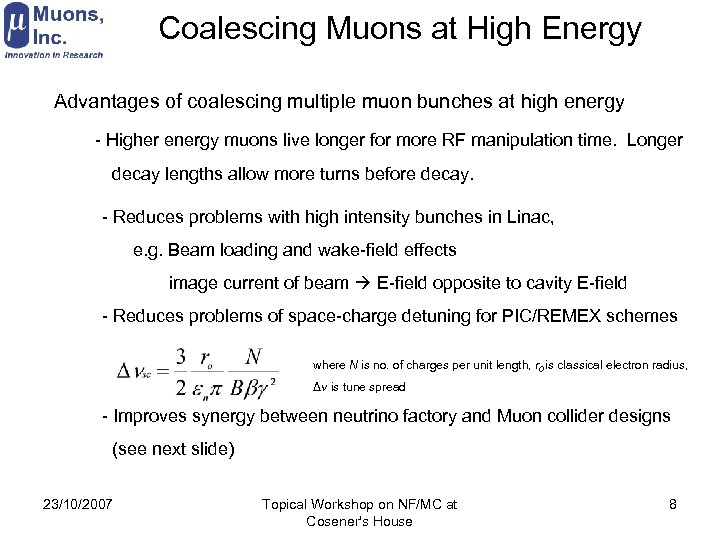 Coalescing Muons at High Energy Advantages of coalescing multiple muon bunches at high energy - Higher energy muons live longer for more RF manipulation time. Longer decay lengths allow more turns before decay. - Reduces problems with high intensity bunches in Linac, e. g. Beam loading and wake-field effects image current of beam E-field opposite to cavity E-field - Reduces problems of space-charge detuning for PIC/REMEX schemes where N is no. of charges per unit length, r 0 is classical electron radius, Δν is tune spread - Improves synergy between neutrino factory and Muon collider designs (see next slide) 23/10/2007 Topical Workshop on NF/MC at Cosener's House 8
 Coalescing at ~20 Ge. V: NF/MC Synergy • At ~ 20 Ge. V muons have been accelerated one stage beyond LINAC to energy range that is useful for neutrino factory – The components for the NF can be reused for a muon collider front end – The additional components for the muon collider, coalescing rings and additional accelerators, collider ring, may be added as extensions of NF – The high frequency time structure is suitable for neutrino experiments – The coalesced bunches are suited to acceleration to full energy in the MC 23/10/2007 Topical Workshop on NF/MC at Cosener's House 9
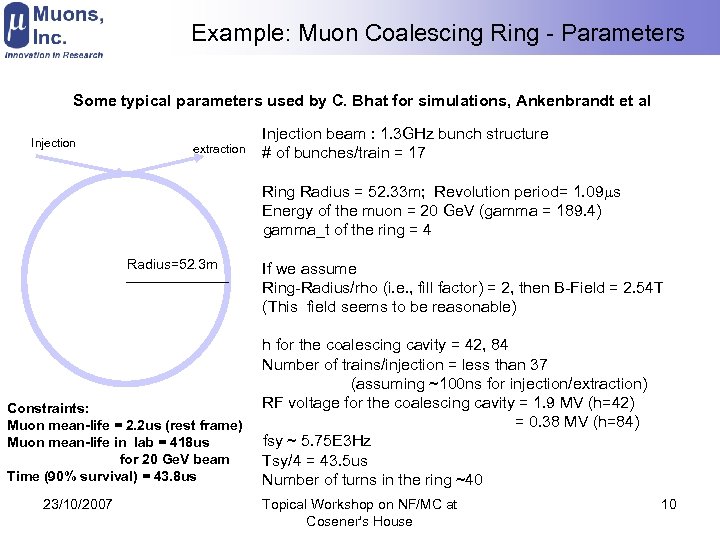 Example: Muon Coalescing Ring - Parameters Some typical parameters used by C. Bhat for simulations, Ankenbrandt et al Injection beam : 1. 3 GHz bunch structure extraction # of bunches/train = 17 Ring Radius = 52. 33 m; Revolution period= 1. 09 s Energy of the muon = 20 Ge. V (gamma = 189. 4) gamma_t of the ring = 4 Radius=52. 3 m If we assume Ring-Radius/rho (i. e. , fill factor) = 2, then B-Field = 2. 54 T (This field seems to be reasonable) h for the coalescing cavity = 42, 84 Number of trains/injection = less than 37 (assuming ~100 ns for injection/extraction) RF voltage for the coalescing cavity = 1. 9 MV (h=42) Constraints: Muon mean-life = 2. 2 us (rest frame) = 0. 38 MV (h=84) fsy ~ 5. 75 E 3 Hz Muon mean-life in lab = 418 us for 20 Ge. V beam Tsy/4 = 43. 5 us Time (90% survival) = 43. 8 us Number of turns in the ring ~40 23/10/2007 Topical Workshop on NF/MC at Cosener's House 10
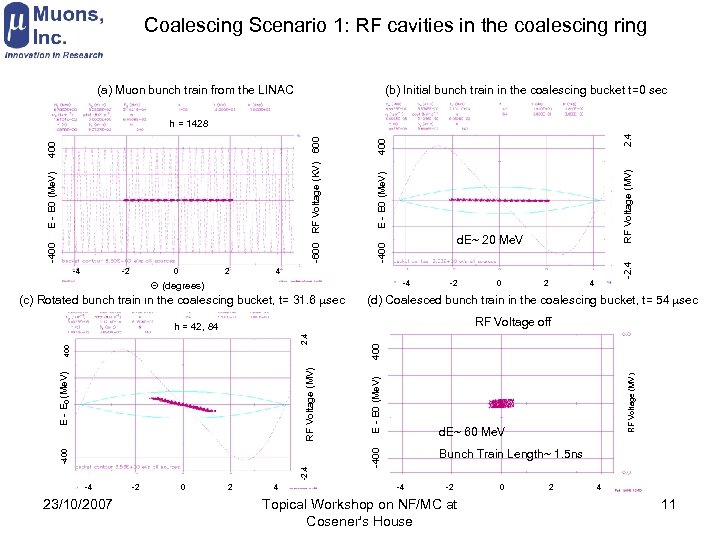 Coalescing Scenario 1: RF cavities in the coalescing ring (a) Muon bunch train from the LINAC (b) Initial bunch train in the coalescing bucket t=0 sec 2. 4 -4 -2 0 2 4 -4 -2 0 2 4 Θ (degrees) (c) Rotated bunch train in the coalescing bucket, t= 31. 6 sec (d) Coalesced bunch train in the coalescing bucket, t= 54 sec -400 E - E 0 (Me. V) 400 2. 4 -2. 4 RF Voltage (MV) -400 E - E 0 (Me. V) 400 -4 -2 0 2 4 d. E~ 60 Me. V RF Voltage (MV) RF Voltage off h = 42, 84 23/10/2007 RF Voltage (MV) d. E~ 20 Me. V -2. 4 -400 E - E 0 (Me. V) 400 -600 RF Voltage (KV) 600 h = 1428 Bunch Train Length~ 1. 5 ns -4 -2 0 2 4 Topical Workshop on NF/MC at Cosener's House 11
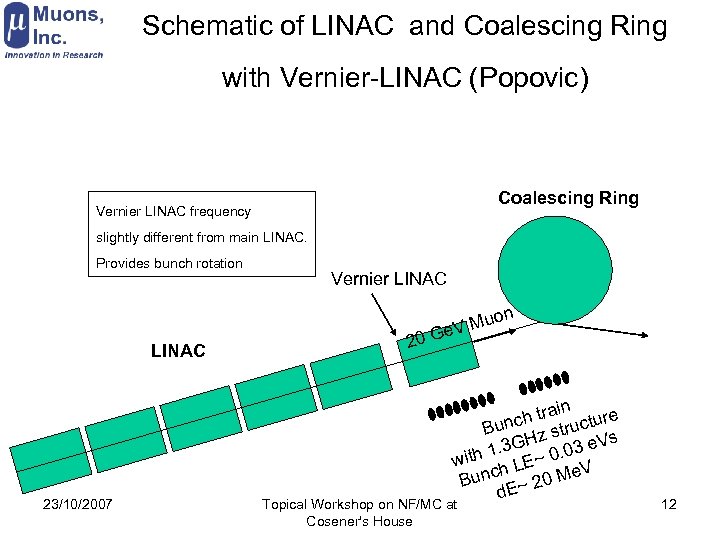 Schematic of LINAC and Coalescing Ring with Vernier-LINAC (Popovic) Coalescing Ring Vernier LINAC frequency slightly different from main LINAC. Provides bunch rotation Vernier LINAC on LINAC 23/10/2007 u e. V M G 20 ain ch tr ructure Bun z st H Vs 1. 3 G ~ 0. 03 e with h LE e. V Bunc ~ 20 M d. E Topical Workshop on NF/MC at Cosener's House 12
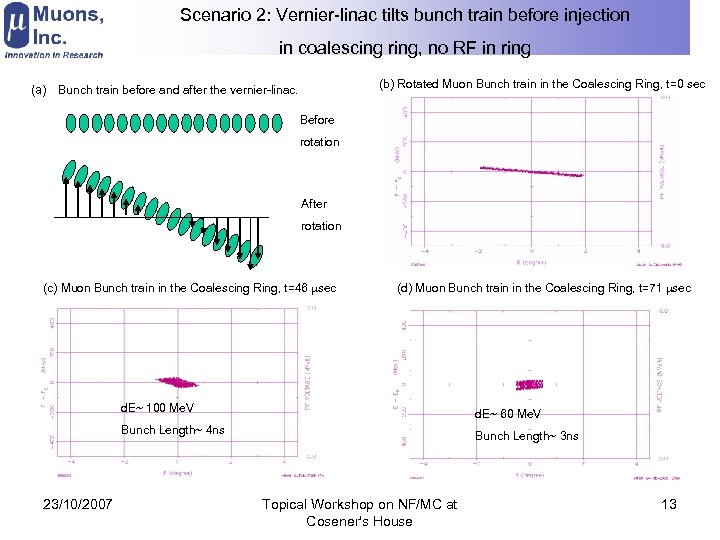 Scenario 2: Vernier-linac tilts bunch train before injection in coalescing ring, no RF in ring (a) Bunch train before and after the vernier-linac. (b) Rotated Muon Bunch train in the Coalescing Ring, t=0 sec Before rotation After rotation (c) Muon Bunch train in the Coalescing Ring, t=46 sec (d) Muon Bunch train in the Coalescing Ring, t=71 sec d. E~ 100 Me. V Bunch Length~ 4 ns 23/10/2007 d. E~ 60 Me. V Bunch Length~ 3 ns Topical Workshop on NF/MC at Cosener's House 13
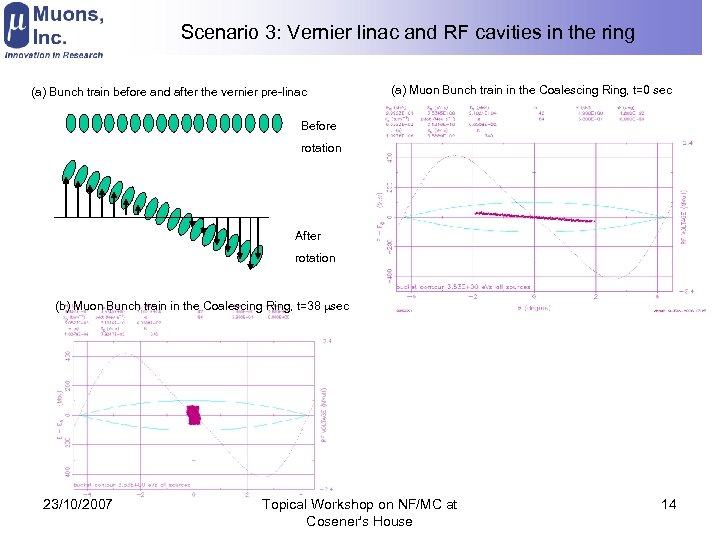 Scenario 3: Vernier linac and RF cavities in the ring (a) Bunch train before and after the vernier pre-linac (a) Muon Bunch train in the Coalescing Ring, t=0 sec Before rotation After rotation (b) Muon Bunch train in the Coalescing Ring, t=38 sec 23/10/2007 Topical Workshop on NF/MC at Cosener's House 14
 Model Lattice for Coalescing Ring (A. Bogacz) • Requirements and objectives – Large momentum compaction – Minimize muon decay losses – Maintain small betas • Low transition gamma • Large radial aperture 23/10/2007 Topical Workshop on NF/MC at Cosener's House 15
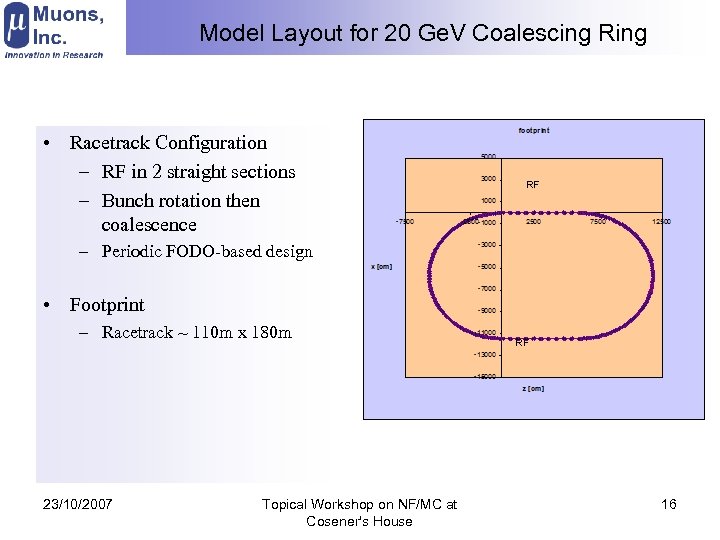 Model Layout for 20 Ge. V Coalescing Ring • Racetrack Configuration – RF in 2 straight sections – Bunch rotation then coalescence RF – Periodic FODO-based design • Footprint – Racetrack ~ 110 m x 180 m 23/10/2007 Topical Workshop on NF/MC at Cosener's House RF 16
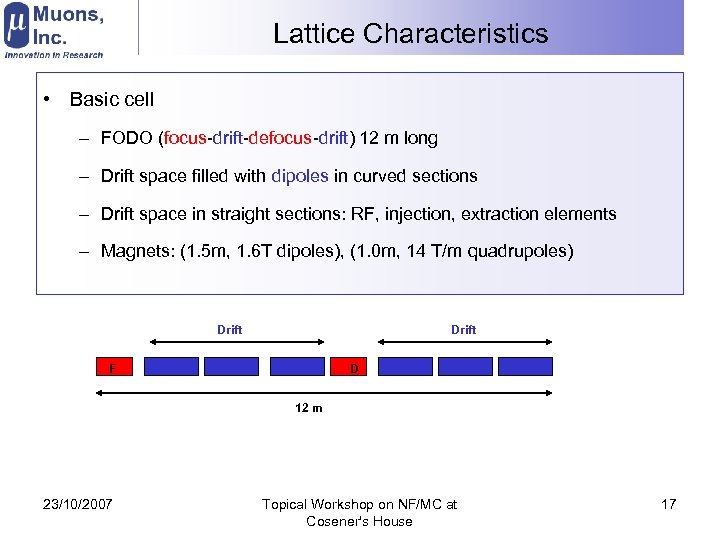 Lattice Characteristics • Basic cell – FODO (focus-drift-defocus-drift) 12 m long – Drift space filled with dipoles in curved sections – Drift space in straight sections: RF, injection, extraction elements – Magnets: (1. 5 m, 1. 6 T dipoles), (1. 0 m, 14 T/m quadrupoles) Drift F D 12 m 23/10/2007 Topical Workshop on NF/MC at Cosener's House 17
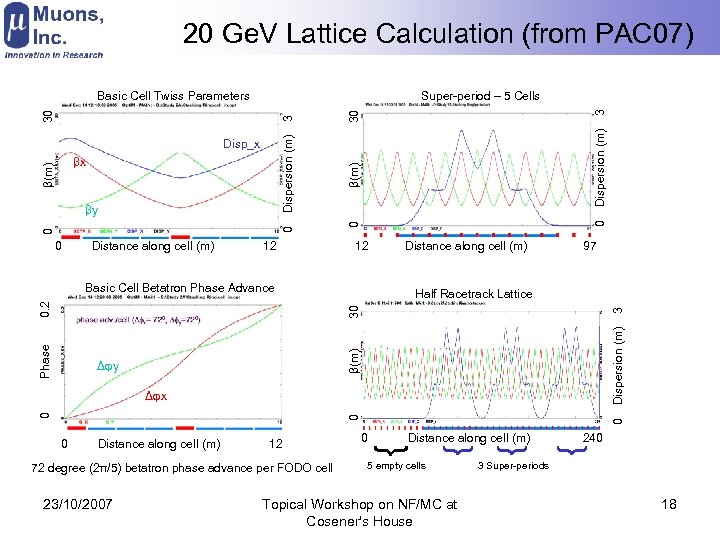 20 Ge. V Lattice Calculation (from PAC 07) βx βy 0 Distance along cell (m) 12 0 β(m) 30 Disp_x 0 Dispersion (m) 3 Super-period – 5 Cells 0 Dispersion (m) 3 12 Distance along cell (m) 97 72 degree (2π/5) betatron phase advance per FODO cell 0 Dispersion (m) 3 0 Distance along cell (m) 240 { 0 Distance along cell (m) 12 { Δφx { Δφy 23/10/2007 Half Racetrack Lattice 0 β(m) 30 0 Phase 0. 2 Basic Cell Betatron Phase Advance { 0 β(m) 30 Basic Cell Twiss Parameters 5 empty cells 3 Super-periods Topical Workshop on NF/MC at Cosener's House 18
 Coalescing Rings: For Further Study • Continue investigation of vernier LINAC rotator concept • Refine RF manipulation to achieve optimization of bunch width and coalescing time • Investigate single coalescing ring for both µ+ and µ-. 23/10/2007 Topical Workshop on NF/MC at Cosener's House 19
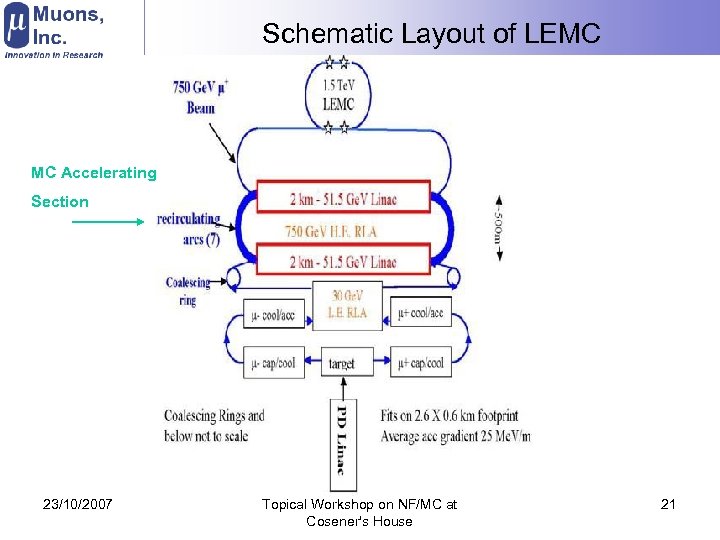
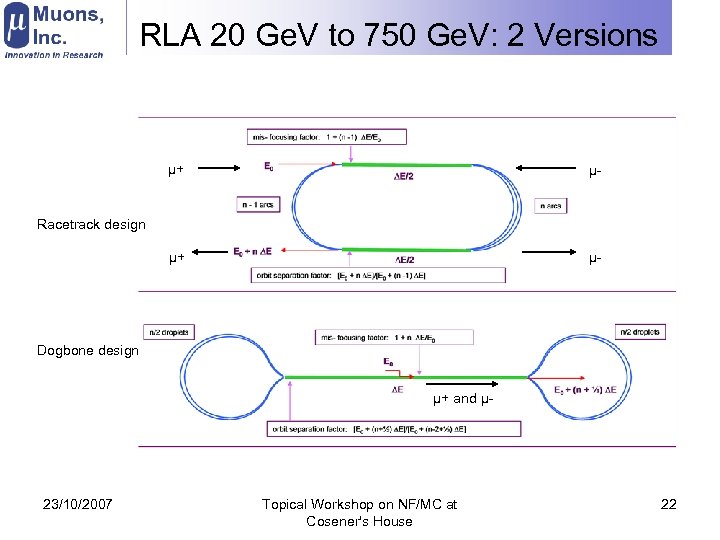
 Acceleration from ~20 Ge. V to ≥ 750 Ge. V • Why 750? Fermilab Directorate urged focusing on 1. 5 Te. V muon collider (instead of maximum energy muon collider ring within FNAL site). Also, theoretical reasons for > 500 Ge. V (Eichten, this conference) • Two acceleration schemes presented here: – Recirculating Linear Accelerators (RLA), JLab, FNAL, Muons. Inc study – Muon collider inside Te. Vatron tunnel, U. Miss. , BNL et al study 23/10/2007 Topical Workshop on NF/MC at Cosener's House 20
 Schematic Layout of LEMC MC Accelerating Section 23/10/2007 Topical Workshop on NF/MC at Cosener's House 21
 RLA 20 Ge. V to 750 Ge. V: 2 Versions µ+ µ- Racetrack design Dogbone design µ+ and µ- 23/10/2007 Topical Workshop on NF/MC at Cosener's House 22
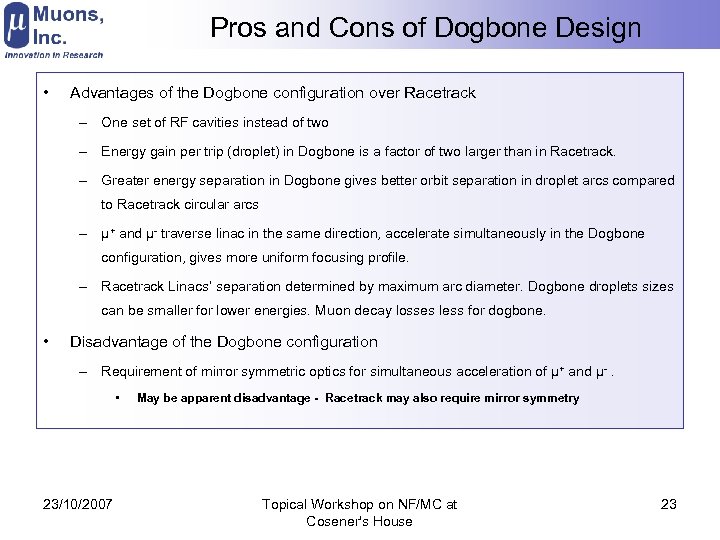 Pros and Cons of Dogbone Design • Advantages of the Dogbone configuration over Racetrack – One set of RF cavities instead of two – Energy gain per trip (droplet) in Dogbone is a factor of two larger than in Racetrack. – Greater energy separation in Dogbone gives better orbit separation in droplet arcs compared to Racetrack circular arcs – µ+ and µ- traverse linac in the same direction, accelerate simultaneously in the Dogbone configuration, gives more uniform focusing profile. – Racetrack Linacs’ separation determined by maximum arc diameter. Dogbone droplets sizes can be smaller for lower energies. Muon decay losses less for dogbone. • Disadvantage of the Dogbone configuration – Requirement of mirror symmetric optics for simultaneous acceleration of µ+ and µ-. • 23/10/2007 May be apparent disadvantage - Racetrack may also require mirror symmetry Topical Workshop on NF/MC at Cosener's House 23
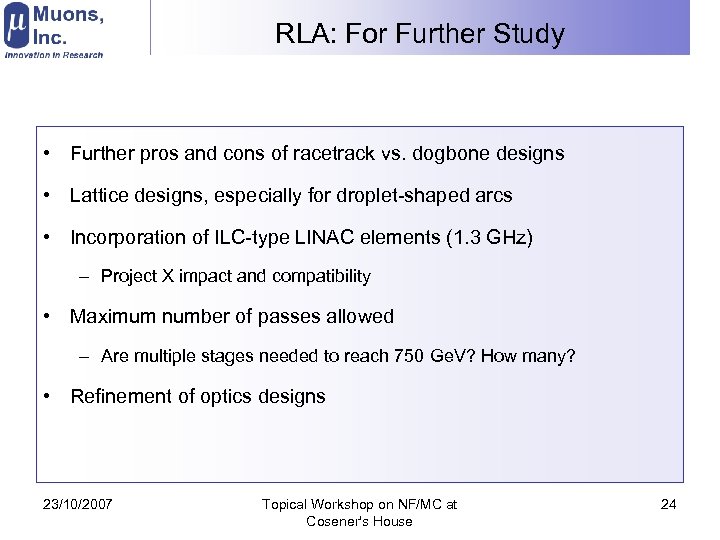 RLA: For Further Study • Further pros and cons of racetrack vs. dogbone designs • Lattice designs, especially for droplet-shaped arcs • Incorporation of ILC-type LINAC elements (1. 3 GHz) – Project X impact and compatibility • Maximum number of passes allowed – Are multiple stages needed to reach 750 Ge. V? How many? • Refinement of optics designs 23/10/2007 Topical Workshop on NF/MC at Cosener's House 24
 Scheme for Muon Acceleration in Tevatron Tunnel • Summers, et al paper (PAC 07 THPMS 082) • Use existing FNAL Tevatron tunnel with 2 rings, 1000 m radii – Reduces construction costs – Estimate of radiation produced appears to be within acceptable limits • Assume muons produced, cooled, coalesced, accelerated up to 30 Ge. V • !st ring accelerates from 30 Ge. V to 400 Ge. V – – • 28 orbits, 0. 59 msec, muon survival during acceleration = 80%. 14 GV SRF at 1. 3 GHz, 31 MV/m SRF cavities, 42 stations spaced equally along ring. Lattice and magnets for 1 st ring – FODO Lattice 30. 45 m long half cell, similar to FNAL lattice. – 1. 7 m, 400 Hz, 30 T/m Quadrupoles (conventional). – 6. 3 m, 400 Hz, 1. 8 Tesla Dipoles (conventional), bore 30 mm x 6 mm, 8 dipoles per cell, 800 total. – Magnets on for half cycle, 13 times per second (reduces power consumption) – Grain Oriented 3% Silicon Steel EI Transformer Laminations for rapid ramping – Other magnet characteristics have been calculated 23/10/2007 Topical Workshop on NF/MC at Cosener's House 25
 Muon Acceleration in Tevatron Tunnel (2 nd Ring) • 2 nd ring accelerates from 400 Ge. V to 750 Ge. V, 44 orbits (0. 92 ms), 92% muon survival • 8 GV RF at 1. 3 GHz , 12 RF stations along ring. • Hybrid ring consists of conventional and superconducting dipoles • Lattice half cell, FODO 30. 45 m long, 5 dipoles (F B 1 B 2 B 3 B 2 B 1 D) – B 1 are ramping magnets 3. 75 m long, +/-1. 8 T, 550 Hz, 5 mm x 50 mm bore – B 2 are DC magnets 4. 2 m long, 8 T superconducting – B 3 are ramping magnets 7. 5 m long, +/-1. 8 T, 550 Hz • At injection (400 Ge. V) ramping dipoles oppose DC dipoles • At extraction (750 Ge. V) ramping dipoles act along with DC dipoles • Quadrupoles are 3. 2 m long, also ramp: 16 to 37 T/m (no sign change) 23/10/2007 Topical Workshop on NF/MC at Cosener's House 26
 Tevatron-Tunnel Muon Collider: Further Study • Fitting into 1. 3 GHz RF, 5 mm or 10 mm bunch length? • Longitudinal dynamics, head/tail. . . • Wakefields with 8% beam loading. • Momentum compaction of the 400 to 750 Ge. V hybrid ring. • Momentum acceptance and magnet apertures. • Design complete lattices. • Multipole B fields from eddy currents in the pole faces. • Magnetic field quality with small aperture magnets. • Forces on fast ramping magnet pole faces. • Build a short prototype fast ramping dipole. 23/10/2007 Topical Workshop on NF/MC at Cosener's House 27
 Summary • Described schemes for bunch coalescing at ~20 Ge. V – Acceptable coalescing times demonstrated by simulations • Described 2 types of accelerators for acceleration of muons from ~20 Ge. V to 750 Ge. V – RLAs with RF in long straight section(s) – Circular ring with RF distributed along ring that fits in Tevatron tunnel 23/10/2007 Topical Workshop on NF/MC at Cosener's House 28
 References 1. C. Bhat and C. Ankenbrandt et al , 2006 LEMC Workshop: Muon Coalescing 2. C. Bhat et al, Phys. Rev. ST 10, 034403 (2007): Use of dual RF systems to accelerate large longitudinal emittance intense beam in a synchrotron 3. R. Johnson, et al, PAC 07 THPMN 095: Muon Bunch Coalescing, 4. M. Popovic, Vernier LINAC 5. A. Bogacz, this conference, PAC 07 THPMN 095 and others: Lattice simulations 6. D. Summers, et al, PAC 07 THPMS 0825: Muon Acceleration to 750 Ge. V in the Tevatron Tunnel for a 1. 5 Te. V Mu+ Mu- Collider 23/10/2007 Topical Workshop on NF/MC at Cosener's House 29