 Скачать презентацию Topical Meeting on LHC Physics HRI Allahabad Dec
18d53029f69c774b5ba129883e498f09.ppt
- Количество слайдов: 41



Topical Meeting on LHC Physics, HRI, Allahabad, Dec 2006 Evolution Hands-on-sessions: First day Hands-on-sessions: Now Event Generators – Advanced Topics Peter Z. Skands Fermilab Theoretical Physics Department (Significant parts adapted from T. Sjöstrand (Lund U & CERN) ) Peter Skands Event Generators - Advanced
Recent Topics BR: Beam Remnant CR: Colour Reconnection FSR: Final-State Radiation ISR: Initial-State Radiation Matching: Combining PS & ME consistently (e. g. CKKW, MLM) ME: Matrix Element MI: Multiple parton-parton Interactions (not pile-up) NLO: Next-to. Leading Order ► First Lecture state of the art a few years ago ► Many ‘hot’ recent developments: • Towards a theory of the Underlying Event • Parton Shower – Matrix Element matching • Next-to-Leading-Order Monte Carlo • Additional non-perturbative phenomena? ► Also more technical developments • The future – Towards C++ (HERWIG++, PYTHIA 8, SHERPA) PS: Parton Shower Tune: A set of generator parameters UE: Underlying Event Peter Skands Helper: I’ll try to avoid acronyms, but this list will be on all slides and may help when I fail. It is ordered alphabetically. Event Generators - Advanced Topics 2
Matching Combining Matrix Elements and Parton Showers ! Peter Skands Event Generators - Advanced
Q C uantum BR: Beam Remnant CR: Colour Reconnection FSR: Final-State Radiation ISR: Initial-State Radiation Matching: Combining PS & ME consistently (e. g. CKKW, MLM) ME: Matrix Element MI: Multiple parton-parton Interactions (not pile-up) D hromo ynamics ► Known Gauge Group and Lagrangian ► Rich variety of dynamical phenomena ► Large coupling constant also means perturbative expansion tricky. ► To calculate higher perturbative orders, 2 approaches: • Feynman Diagrams • Complete matrix elements (ME) order by order • Complexity rapidly increases + unstable in soft/collinear region • Resummation NLO: Next-to. Leading Order • In certain limits, we are able to sum the entire perturbative series to infinite order e. g. parton showers (PS) PS: Parton Shower • Exact only in the relevant limits Tune: A set of generator parameters Marriage desirable! UE: Underlying Event Peter Skands Event Generators - Advanced Topics 4
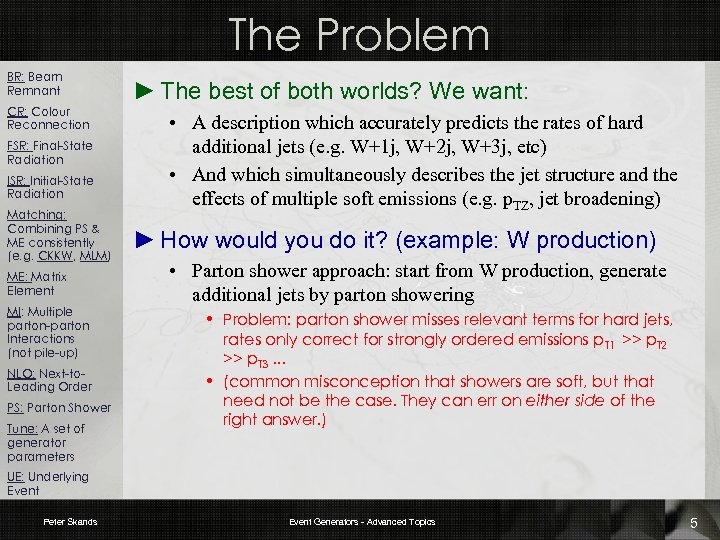
The Problem BR: Beam Remnant CR: Colour Reconnection FSR: Final-State Radiation ISR: Initial-State Radiation Matching: Combining PS & ME consistently (e. g. CKKW, MLM) ME: Matrix Element MI: Multiple parton-parton Interactions (not pile-up) NLO: Next-to. Leading Order PS: Parton Shower Tune: A set of generator parameters ► The best of both worlds? We want: • A description which accurately predicts the rates of hard additional jets (e. g. W+1 j, W+2 j, W+3 j, etc) • And which simultaneously describes the jet structure and the effects of multiple soft emissions (e. g. p. TZ, jet broadening) ► How would you do it? (example: W production) • Parton shower approach: start from W production, generate additional jets by parton showering • Problem: parton shower misses relevant terms for hard jets, rates only correct for strongly ordered emissions p T 1 >> p. T 2 >> p. T 3. . . • (common misconception that showers are soft, but that need not be the case. They can err on either side of the right answer. ) UE: Underlying Event Peter Skands Event Generators - Advanced Topics 5
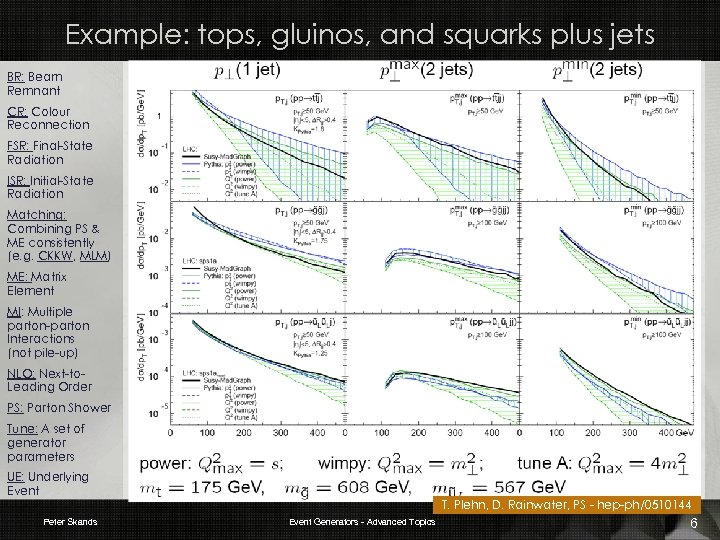
Example: tops, gluinos, and squarks plus jets BR: Beam Remnant CR: Colour Reconnection FSR: Final-State Radiation ISR: Initial-State Radiation Matching: Combining PS & ME consistently (e. g. CKKW, MLM) ME: Matrix Element MI: Multiple parton-parton Interactions (not pile-up) NLO: Next-to. Leading Order PS: Parton Shower Tune: A set of generator parameters UE: Underlying Event Peter Skands T. Plehn, D. Rainwater, PS - hep-ph/0510144 Event Generators - Advanced Topics 6
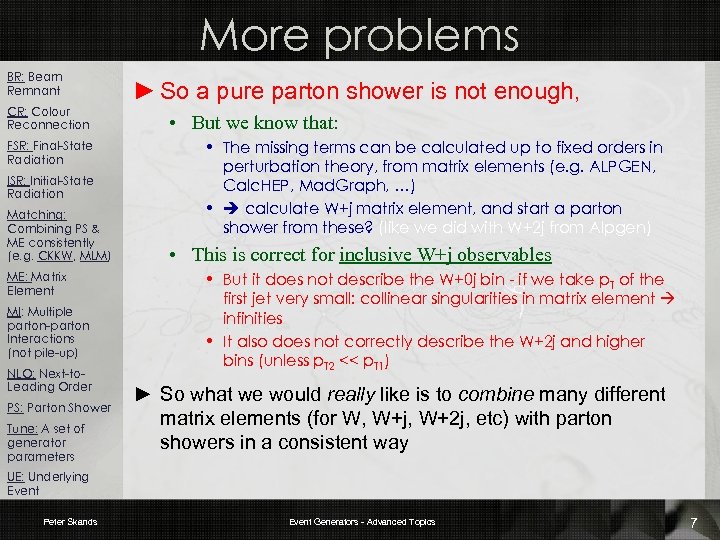
More problems BR: Beam Remnant CR: Colour Reconnection FSR: Final-State Radiation ISR: Initial-State Radiation Matching: Combining PS & ME consistently (e. g. CKKW, MLM) ME: Matrix Element MI: Multiple parton-parton Interactions (not pile-up) NLO: Next-to. Leading Order PS: Parton Shower Tune: A set of generator parameters ► So a pure parton shower is not enough, • But we know that: • The missing terms can be calculated up to fixed orders in perturbation theory, from matrix elements (e. g. ALPGEN, Calc. HEP, Mad. Graph, …) • calculate W+j matrix element, and start a parton shower from these? (like we did with W+2 j from Alpgen) • This is correct for inclusive W+j observables • But it does not describe the W+0 j bin - if we take p. T of the first jet very small: collinear singularities in matrix element infinities • It also does not correctly describe the W+2 j and higher bins (unless p. T 2 << p. T 1) ► So what we would really like is to combine many different matrix elements (for W, W+j, W+2 j, etc) with parton showers in a consistent way UE: Underlying Event Peter Skands Event Generators - Advanced Topics 7
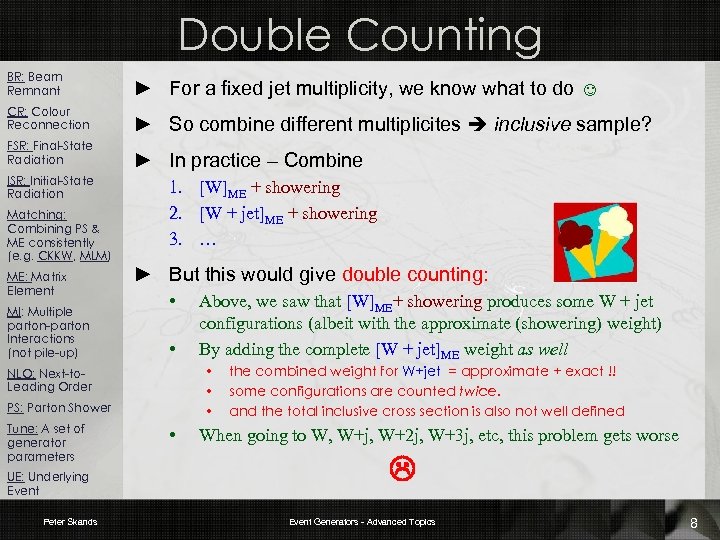
Double Counting BR: Beam Remnant ► For a fixed jet multiplicity, we know what to do ☺ CR: Colour Reconnection ► So combine different multiplicites inclusive sample? FSR: Final-State Radiation ► In practice – Combine ISR: Initial-State Radiation Matching: Combining PS & ME consistently (e. g. CKKW, MLM) ME: Matrix Element MI: Multiple parton-parton Interactions (not pile-up) 1. [W]ME + showering 2. [W + jet]ME + showering 3. … ► But this would give double counting: • • • NLO: Next-to. Leading Order PS: Parton Shower Tune: A set of generator parameters UE: Underlying Event Peter Skands Above, we saw that [W]ME+ showering produces some W + jet configurations (albeit with the approximate (showering) weight) By adding the complete [W + jet]ME weight as well • the combined weight for W+jet = approximate + exact !! some configurations are counted twice. and the total inclusive cross section is also not well defined When going to W, W+j, W+2 j, W+3 j, etc, this problem gets worse Event Generators - Advanced Topics 8
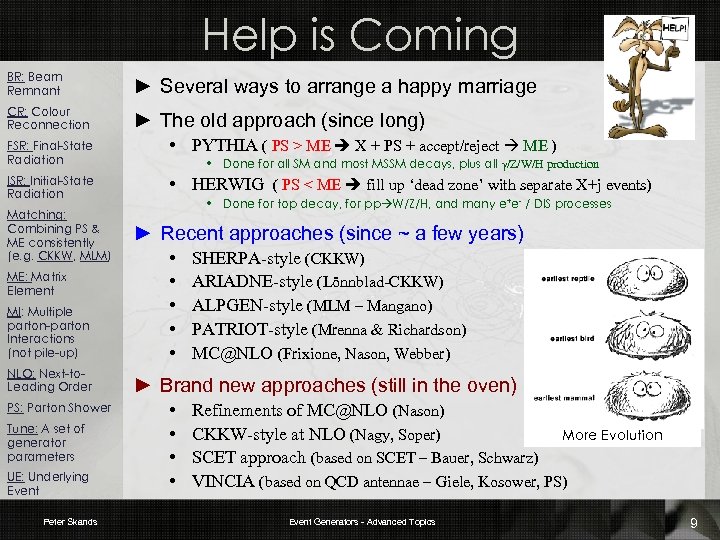
Help is Coming BR: Beam Remnant ► Several ways to arrange a happy marriage CR: Colour Reconnection ► The old approach (since long) FSR: Final-State Radiation • PYTHIA ( PS > ME X + PS + accept/reject ME ) ISR: Initial-State Radiation • HERWIG ( PS < ME fill up ‘dead zone’ with separate X+j events) Matching: Combining PS & ME consistently (e. g. CKKW, MLM) ME: Matrix Element MI: Multiple parton-parton Interactions (not pile-up) NLO: Next-to. Leading Order PS: Parton Shower Tune: A set of generator parameters UE: Underlying Event Peter Skands • Done for all SM and most MSSM decays, plus all γ/Z/W/H production • Done for top decay, for pp W/Z/H, and many e+e- / DIS processes ► Recent approaches (since ~ a few years) • • • SHERPA-style (CKKW) ARIADNE-style (Lönnblad-CKKW) ALPGEN-style (MLM – Mangano) PATRIOT-style (Mrenna & Richardson) MC@NLO (Frixione, Nason, Webber) ► Brand new approaches (still in the oven) • • Refinements of MC@NLO (Nason) CKKW-style at NLO (Nagy, Soper) More Evolution SCET approach (based on SCET – Bauer, Schwarz) VINCIA (based on QCD antennae – Giele, Kosower, PS) Event Generators - Advanced Topics 9
SHERPA and ARIADNE L. L¨onnblad, JHEP 05 (2002) 046 S. Catani, F. Krauss, R. Kuhn, B. R. Webber, JHEP 0111 (2001) 063 BR: Beam Remnant ► The CKKW algorithm • CR: Colour Reconnection • uses matrix elements to describe the distribution of particles with a phase-space separation p. T > p. Tcut • uses parton showers to describe particles with a smaller separation FSR: Final-State Radiation ISR: Initial-State Radiation 1. [W]ME |p. T>p. Tcut * Wveto(p. Tcut) + showeringp. T<p. Tcut 2. [W + j]ME|p. T>p. Tcut * Wveto(p. Tcut) + showeringp. T<p. Tcut 3. … Matching: Combining PS & ME consistently (e. g. CKKW, MLM) ME: Matrix Element MI: Multiple parton-parton Interactions (not pile-up) NLO: Next-to. Leading Order PS: Parton Shower Tune: A set of generator parameters UE: Underlying Event Peter Skands Slices phase space – two regions: • Where Wveto < 1 is there to get rid of the “double counting” • Wveto is in fact the Sudakov factor (see talk 1), the probability that no parton shower emission happened above p. Tcut. SHERPA uses an approximate analytical formula • Lönnblad’s ARIADNE-style is to run a ‘trial’ or ‘pseudo’ shower, vetoing those events which branch above p. Tcut ► This gets rid of double counting since those events that would have caused it are precisely those which do branch above p. Tcut Event Generators - Advanced Topics 10
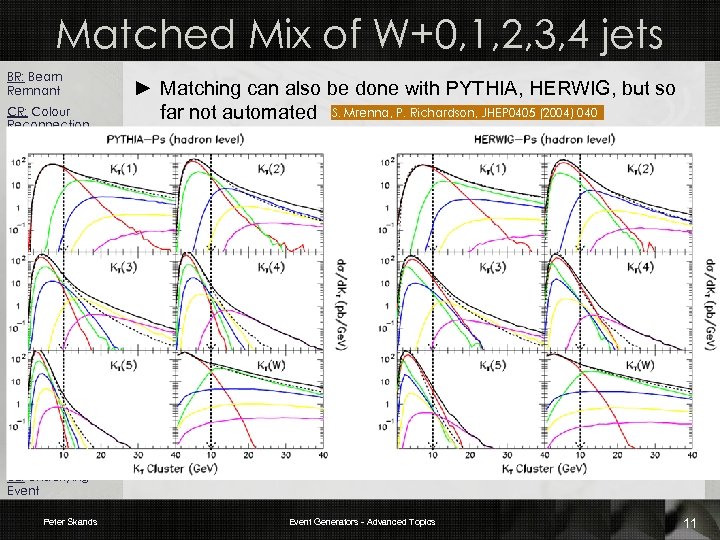
Matched Mix of W+0, 1, 2, 3, 4 jets BR: Beam Remnant CR: Colour Reconnection ► Matching can also be done with PYTHIA, HERWIG, but so far not automated S. Mrenna, P. Richardson, JHEP 0405 (2004) 040 FSR: Final-State Radiation ISR: Initial-State Radiation Matching: Combining PS & ME consistently (e. g. CKKW, MLM) ME: Matrix Element MI: Multiple parton-parton Interactions (not pile-up) NLO: Next-to. Leading Order PS: Parton Shower Tune: A set of generator parameters UE: Underlying Event Peter Skands Event Generators - Advanced Topics 11
ALPGEN BR: Beam Remnant CR: Colour Reconnection FSR: Final-State Radiation ISR: Initial-State Radiation Matching: Combining PS & ME consistently (e. g. CKKW, MLM) ME: Matrix Element MI: Multiple parton-parton Interactions (not pile-up) NLO: Next-to. Leading Order PS: Parton Shower Tune: A set of generator parameters UE: Underlying Event Peter Skands ► “MLM” matching (Mangano) • Simpler but similar in spirit to CKKW ► First generate events the “stupid” way: 1. [W]ME + showering 2. [W + jet]ME + showering 3. … ► a set of fully showered events, with double counting. To get rid of the excess, accept/reject each event based on: • • • (cone-)cluster showered event njets match partons from the ME to the clustered jets If all partons are matched, keep event. Else discard it. ► Roughly equivalent to the pseudoshower approach above • Virtue: can be done without knowledge of the internal workings of the generator. Only the fully showered final events are needed Event Generators - Advanced Topics 12
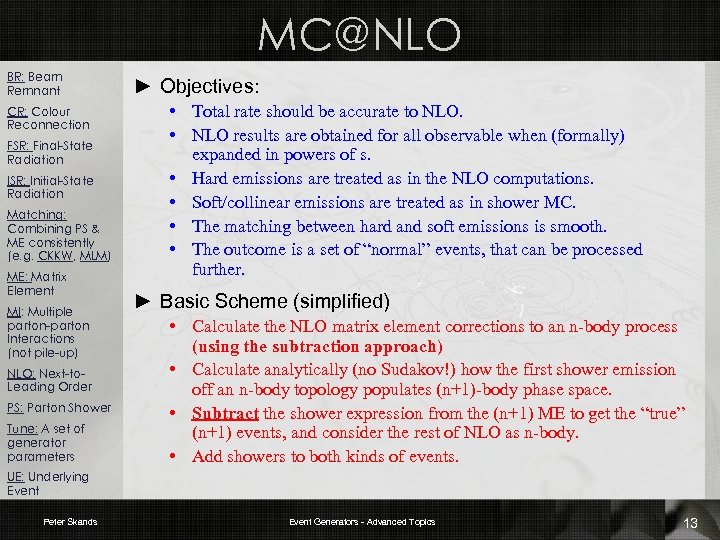
MC@NLO BR: Beam Remnant CR: Colour Reconnection FSR: Final-State Radiation ISR: Initial-State Radiation Matching: Combining PS & ME consistently (e. g. CKKW, MLM) ME: Matrix Element MI: Multiple parton-parton Interactions (not pile-up) NLO: Next-to. Leading Order PS: Parton Shower Tune: A set of generator parameters ► Objectives: • Total rate should be accurate to NLO. • NLO results are obtained for all observable when (formally) expanded in powers of s. • Hard emissions are treated as in the NLO computations. • Soft/collinear emissions are treated as in shower MC. • The matching between hard and soft emissions is smooth. • The outcome is a set of “normal” events, that can be processed further. ► Basic Scheme (simplified) • Calculate the NLO matrix element corrections to an n-body process (using the subtraction approach) • Calculate analytically (no Sudakov!) how the first shower emission off an n-body topology populates (n+1)-body phase space. • Subtract the shower expression from the (n+1) ME to get the “true” (n+1) events, and consider the rest of NLO as n-body. • Add showers to both kinds of events. UE: Underlying Event Peter Skands Event Generators - Advanced Topics 13
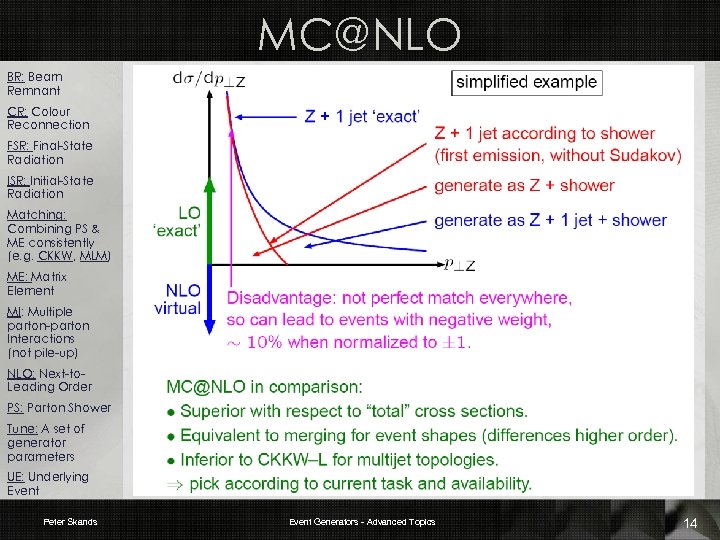
MC@NLO BR: Beam Remnant CR: Colour Reconnection FSR: Final-State Radiation ISR: Initial-State Radiation Matching: Combining PS & ME consistently (e. g. CKKW, MLM) ME: Matrix Element MI: Multiple parton-parton Interactions (not pile-up) NLO: Next-to. Leading Order PS: Parton Shower Tune: A set of generator parameters UE: Underlying Event Peter Skands Event Generators - Advanced Topics 14
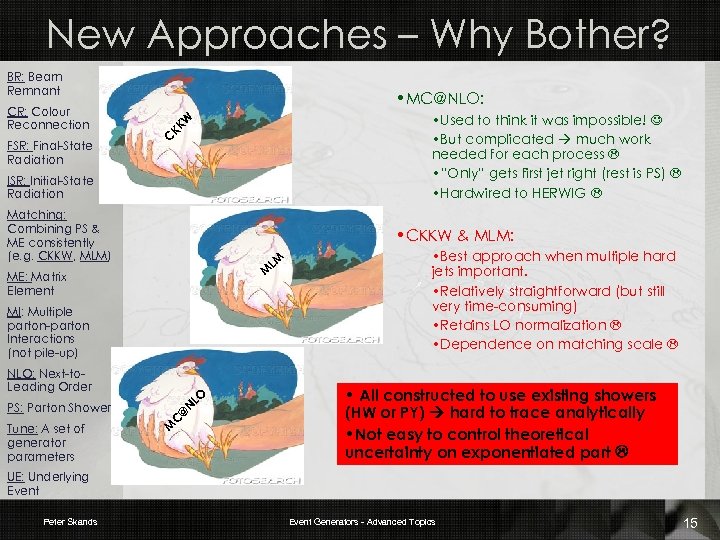
New Approaches – Why Bother? BR: Beam Remnant FSR: Final-State Radiation • MC@NLO: KK W • Used to think it was impossible! • But complicated much work needed for each process • “Only” gets first jet right (rest is PS) • Hardwired to HERWIG C CR: Colour Reconnection ISR: Initial-State Radiation Matching: Combining PS & ME consistently (e. g. CKKW, MLM) M LM • CKKW & MLM: ME: Matrix Element MI: Multiple parton-parton Interactions (not pile-up) @ N C Tune: A set of generator parameters M PS: Parton Shower LO NLO: Next-to. Leading Order • Best approach when multiple hard jets important. • Relatively straightforward (but still very time-consuming) • Retains LO normalization • Dependence on matching scale • All constructed to use existing showers (HW or PY) hard to trace analytically • Not easy to control theoretical uncertainty on exponentiated part UE: Underlying Event Peter Skands Event Generators - Advanced Topics 15
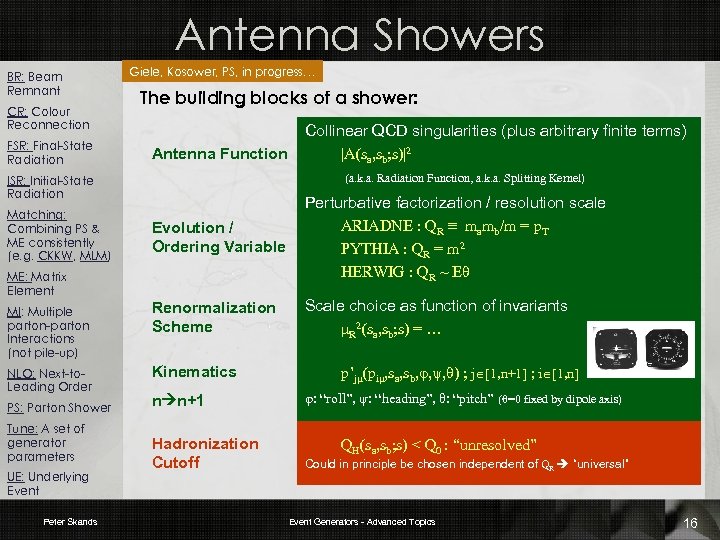
Antenna Showers BR: Beam Remnant CR: Colour Reconnection FSR: Final-State Radiation Giele, Kosower, PS, in progress… The building blocks of a shower: Antenna Function Collinear QCD singularities (plus arbitrary finite terms) |A(sa, sb; s)|2 (a. k. a. Radiation Function, a. k. a. Splitting Kernel) ISR: Initial-State Radiation Evolution / Ordering Variable Perturbative factorization / resolution scale ARIADNE : QR ≡ mamb/m = p. T PYTHIA : QR = m 2 HERWIG : QR ~ Eθ MI: Multiple parton-parton Interactions (not pile-up) Renormalization Scheme Scale choice as function of invariants μR 2(sa, sb; s) = … NLO: Next-to. Leading Order Kinematics Matching: Combining PS & ME consistently (e. g. CKKW, MLM) ME: Matrix Element PS: Parton Shower Tune: A set of generator parameters UE: Underlying Event Peter Skands n n+1 Hadronization Cutoff p’jμ(piμ, sa, sb, φ, ψ, θ) ; j [1, n+1] ; i [1, n] φ: “roll”, ψ: “heading”, θ: “pitch” (θ=0 fixed by dipole axis) QH(sa, sb; s) < Q 0 : “unresolved” Could in principle be chosen independent of QR “universal” Event Generators - Advanced Topics 16
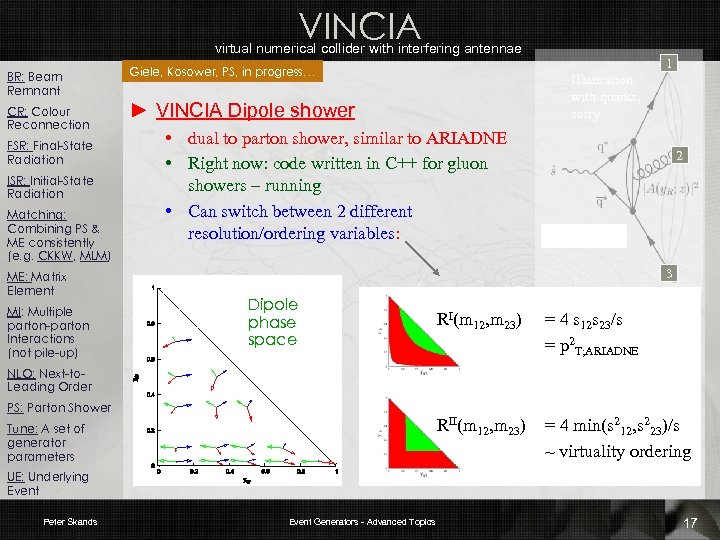
VINCIA virtual numerical collider with interfering antennae BR: Beam Remnant CR: Colour Reconnection FSR: Final-State Radiation ISR: Initial-State Radiation Matching: Combining PS & ME consistently (e. g. CKKW, MLM) ME: Matrix Element MI: Multiple parton-parton Interactions (not pile-up) Giele, Kosower, PS, in progress… 1 Illustration with quarks, sorry ► VINCIA Dipole shower • dual to parton shower, similar to ARIADNE • Right now: code written in C++ for gluon showers – running • Can switch between 2 different resolution/ordering variables: 2 3 Dipole phase space RI(m 12, m 23) = 4 s 12 s 23/s = p 2 T; ARIADNE RII(m 12, m 23) = 4 min(s 212, s 223)/s ~ virtuality ordering NLO: Next-to. Leading Order PS: Parton Shower Tune: A set of generator parameters UE: Underlying Event Peter Skands Event Generators - Advanced Topics 17
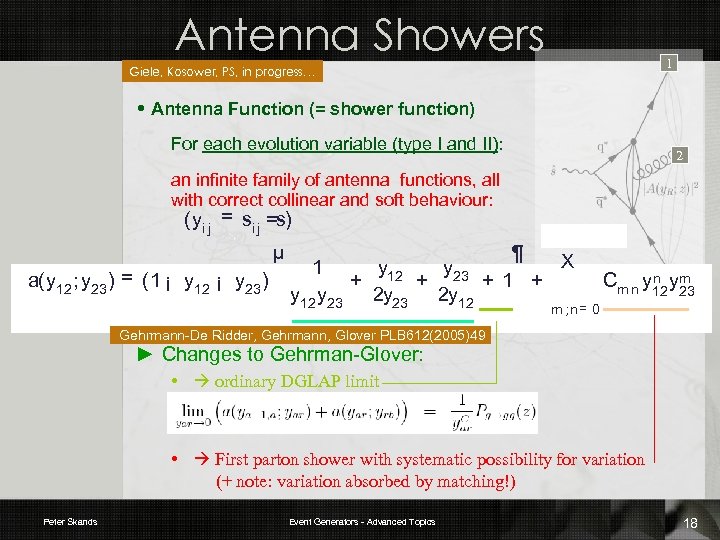
Antenna Showers BR: Beam Remnant CR: Colour Reconnection 1 Giele, Kosower, PS, in progress… • Antenna Function (= shower function) FSR: Final-State Radiation For each evolution variable (type I and II): ISR: Initial-State Radiation an infinite family of antenna functions, all with correct collinear and soft behaviour: Matching: Combining PS & ME consistently (e. g. CKKW, MLM) (yi j = si j =s) µ a(y ; y 23 ) = (1 ¡ y 12 ¡ y 23 ) ME: Matrix Element 12 MI: Multiple parton-parton Interactions (not pile-up) NLO: Next-to. Leading Order 2 1 y y + 12 + 23 y 12 y 23 2 y 12 ¶ X + 1 + n m Cm n y 123 y 23 m ; n = 0 Gehrmann-De Ridder, Gehrmann, Glover PLB 612(2005)49 ► Changes to Gehrman-Glover: • ordinary DGLAP limit PS: Parton Shower Tune: A set of generator parameters UE: Underlying Event Peter Skands • First parton shower with systematic possibility for variation (+ note: variation absorbed by matching!) Event Generators - Advanced Topics 18
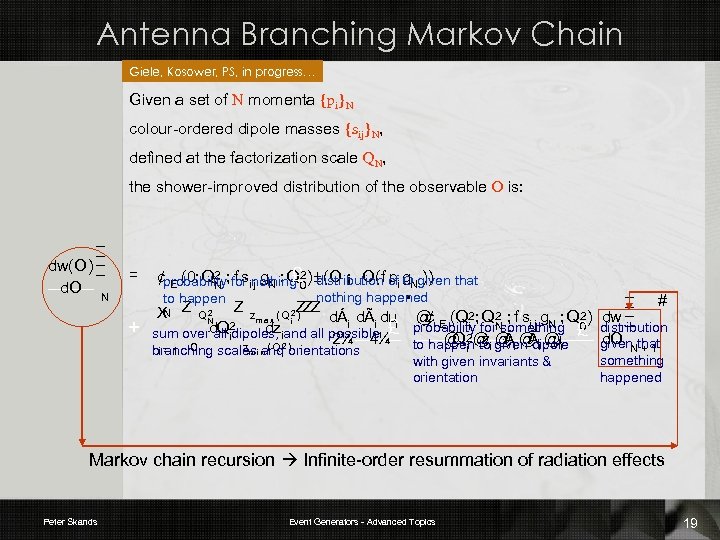
Antenna Branching Markov Chain Giele, Kosower, PS, in progress… BR: Beam Remnant Given a set of N momenta {pi}N CR: Colour Reconnection colour-ordered dipole masses {sij}N, FSR: Final-State Radiation defined at the factorization scale QN, ISR: Initial-State Radiation the shower-improved distribution of the observable O is: Matching: Combining PS & ME consistently ¯ (e. g. CKKW, MLM) dw(O) ¯ ¯ ¯ ME: Matrix Element d. O N MI: Multiple parton-parton Interactions (not pile-up) NLO: Next-to. Leading Order £ ¢probability; for inothing 2 )±(O ¡ O(f ofi g. Ngiven that (0; Q 2 f s j g. N ; Q 0 distribution p O )) E N nothing happened to happen " Z Q 2 Z z ( Q 2 ZZZ N X ) dÁi dÃi dµi @ E (Qi 2 ; Q 2 ; f si j g. N ; Q 2 ) ¢ m ax i 0 d. Qidipoles, + sum over. Nall 2 dziand all possible £ probability for. Nsomething £ 2@ @ 2¼ 4¼ to happen toi givenÃi µi @ i z Ái dipole Q 0 z (Q 2) = branching scales i n i orientations m and i= 1 with given invariants & orientation # ¯ ¯ dw ¯ distribution d. O ¯ given that N+1 something happened PS: Parton Shower Tune: A set of generator parameters Markov chain recursion Infinite-order resummation of radiation effects UE: Underlying Event Peter Skands Event Generators - Advanced Topics 19
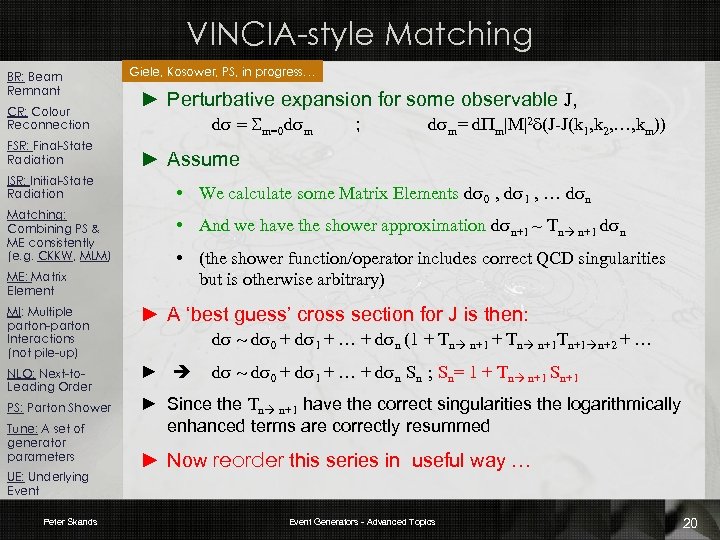
VINCIA-style Matching BR: Beam Remnant CR: Colour Reconnection FSR: Final-State Radiation ISR: Initial-State Radiation Matching: Combining PS & ME consistently (e. g. CKKW, MLM) ME: Matrix Element MI: Multiple parton-parton Interactions (not pile-up) NLO: Next-to. Leading Order PS: Parton Shower Tune: A set of generator parameters UE: Underlying Event Peter Skands Giele, Kosower, PS, in progress… ► Perturbative expansion for some observable J, ds = Sm=0 dsm ; dsm= d. Pm|M|2 d(J-J(k 1, k 2, …, km)) ► Assume • We calculate some Matrix Elements ds 0 , ds 1 , … dsn • And we have the shower approximation dsn+1 ~ Tn n+1 dsn • (the shower function/operator includes correct QCD singularities but is otherwise arbitrary) ► A ‘best guess’ cross section for J is then: ds ~ ds 0 + ds 1 + … + dsn (1 + Tn n+1 Tn+1 n+2 + … ► ds ~ ds 0 + ds 1 + … + dsn Sn ; Sn= 1 + Tn n+1 Sn+1 ► Since the Tn n+1 have the correct singularities the logarithmically enhanced terms are correctly resummed ► Now reorder this series in useful way … Event Generators - Advanced Topics 20
VINCIA-style matching BR: Beam Remnant ► The VINCIA algorithm CR: Colour Reconnection • 1. 2. 3. • FSR: Final-State Radiation ISR: Initial-State Radiation Matching: Combining PS & ME consistently (e. g. CKKW, MLM) Subtracts showering off n-parton state from n+1 -parton ME: [W]ME + showeringp. T<p. Tcut ([W + j]ME – [W] * WPS: W W+j) + showering … There is no cut or slicing scale and hence no dependence on it. The double counting is smoothly eliminated over all of phase space There is no clustering of events either at the matrix element level or at the showered level no dependence on arbitrary clustering schemes • ME: Matrix Element MI: Multiple parton-parton Interactions (not pile-up) NLO: Next-to. Leading Order PS: Parton Shower Tune: A set of generator parameters UE: Underlying Event Peter Skands • The subtraction function WPS: W W+j is the antenna function used in the shower • • • Full analytical control Procedure works both at tree-level and at one loop (NLO) Antenna functions already known even to NNLO tempting to hope the method might be extendable also beyond NLO (would require “NLL” showers though … whole new can of worms) Event Generators - Advanced Topics 21
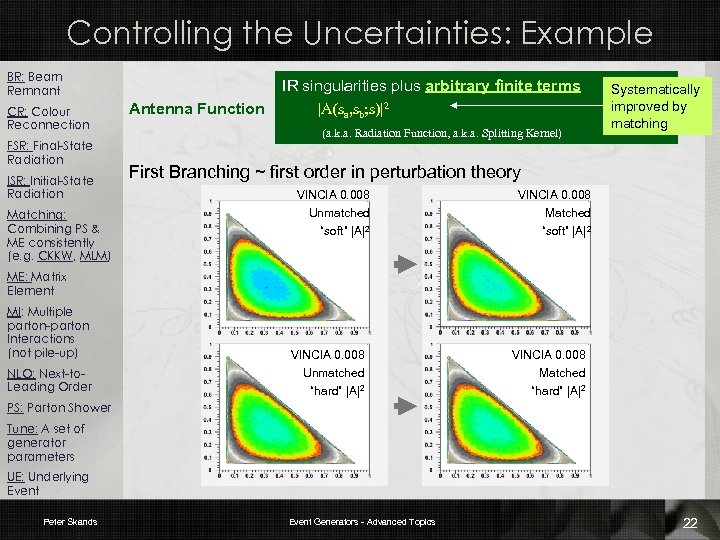
Controlling the Uncertainties: Example BR: Beam Remnant CR: Colour Reconnection FSR: Final-State Radiation ISR: Initial-State Radiation Matching: Combining PS & ME consistently (e. g. CKKW, MLM) Antenna Function IR singularities plus arbitrary finite terms |A(sa, sb; s)|2 (a. k. a. Radiation Function, a. k. a. Splitting Kernel) Systematically improved by matching First Branching ~ first order in perturbation theory VINCIA 0. 008 Unmatched VINCIA 0. 008 Matched “soft” |A|2 ME: Matrix Element MI: Multiple parton-parton Interactions (not pile-up) NLO: Next-to. Leading Order VINCIA 0. 008 Unmatched VINCIA 0. 008 Matched “hard” |A|2 PS: Parton Shower Tune: A set of generator parameters UE: Underlying Event Peter Skands Event Generators - Advanced Topics 22
VINCIA BR: Beam Remnant CR: Colour Reconnection FSR: Final-State Radiation ISR: Initial-State Radiation Matching: Combining PS & ME consistently (e. g. CKKW, MLM) ME: Matrix Element MI: Multiple parton-parton Interactions (not pile-up) NLO: Next-to. Leading Order PS: Parton Shower Tune: A set of generator parameters UE: Underlying Event Peter Skands ► Hope to have paper out soon: Giele, Kosower, PS, in progress… • QCD antenna formalism for NLO calculations • Shower algorithm. Standalone (i. e. separate from matching) already contains several new features • • • Systematic variation of evolution variable Systematic variation of finite parts of splitting kernels Systematic match to hadronization models (not touched on here) Systematic variation of kinematic map (not touched on here) + preparing it as both standalone and plug-in for Pythia 8 • Matching • Variations of finite parts explicitly absorbed by matching at the next order in perturbation theory • Variations of evolution variable and kinematic map absorbed at following orders • No cutoff dependence (except at non-matched orders) • High efficiency since subtracted matrix elements fairly flat over phase space. Event Generators - Advanced Topics 23
The VINCIA Code BR: Beam Remnant CR: Colour Reconnection FSR: Final-State Radiation ISR: Initial-State Radiation Matching: Combining PS & ME consistently (e. g. CKKW, MLM) ME: Matrix Element MI: Multiple parton-parton Interactions (not pile-up) NLO: Next-to. Leading Order PS: Parton Shower Tune: A set of generator parameters UE: Underlying Event Peter Skands Event Generators - Advanced Topics 24
The Future Pythia PYTHIA 8 and the move to C++ Peter Skands Event Generators - Advanced
On to C++ BR: Beam Remnant CR: Colour Reconnection FSR: Final-State Radiation ISR: Initial-State Radiation Matching: Combining PS & ME consistently (e. g. CKKW, MLM) ME: Matrix Element MI: Multiple parton-parton Interactions (not pile-up) NLO: Next-to. Leading Order PS: Parton Shower Tune: A set of generator parameters UE: Underlying Event Peter Skands ► Currently HERWIG and PYTHIA are successfully being used, also in new LHC environments, using C++ wrappers Q: Why rewrite? ► A 1: Need to clean up! ► A 2: Fortran 77 is limiting Q: Why C++? ► A 1: All the reasons for ROOT, Geant 4, . . . • (“a better language”, industrial standard, . . . ) ► A 2: Young experimentalists will expect C++ • (educational and professional continuity) ► A 3: Only game in town! Fortran 90 So far mixed experience: ► Conversion effort: everything takes longer and costs more • (as for LHC machine, detectors and software) ► The physics hurdle is as steep as the C++ learning curve Event Generators - Advanced Topics 26
C++ Players BR: Beam Remnant CR: Colour Reconnection FSR: Final-State Radiation ISR: Initial-State Radiation Matching: Combining PS & ME consistently (e. g. CKKW, MLM) ME: Matrix Element MI: Multiple parton-parton Interactions (not pile-up) NLO: Next-to. Leading Order PS: Parton Shower Tune: A set of generator parameters ► PYTHIA 7 project The. PEG • Toolkit for High Energy Physics Event Generation • (L. Lönnblad; S. Gieseke, A. Ribon, P. Richardson) ► HERWIG++: complete reimplementation • (B. R. Webber; S. Gieseke, D. Grellscheid, A. Ribon, P. Richardson, M. Seymour, P. Stephens, . . . ) ► ARIADNE/LDC: to do ISR/FSR showers, multiple interactions • (L. Lönnblad; N. Lavesson) ► SHERPA: partly wrappers to PYTHIA Fortran; has CKKW • (F. Krauss; T. Fischer, T. Gleisberg, S. Hoeche, T. Laubrich, A. Schaelicke, S. Schumann, C. Semmling, J. Winter) ► PYTHIA 8: restart to write complete event generator • (T. Sjöstrand, (S. Mrenna? , P. Skands? )) UE: Underlying Event Peter Skands Event Generators - Advanced Topics 27
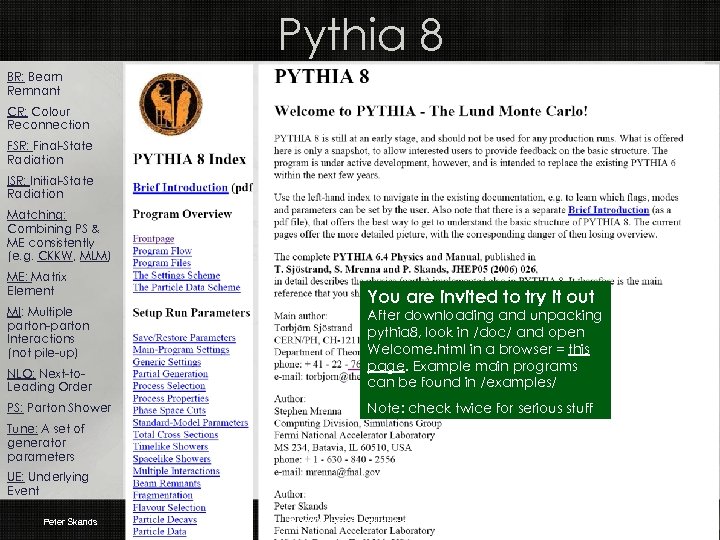
Pythia 8 BR: Beam Remnant CR: Colour Reconnection FSR: Final-State Radiation ISR: Initial-State Radiation Matching: Combining PS & ME consistently (e. g. CKKW, MLM) ME: Matrix Element MI: Multiple parton-parton Interactions (not pile-up) You are invited to try it out NLO: Next-to. Leading Order After downloading and unpacking pythia 8, look in /doc/ and open Welcome. html in a browser = this page. Example main programs can be found in /examples/ PS: Parton Shower Note: check twice for serious stuff Tune: A set of generator parameters UE: Underlying Event Peter Skands Event Generators - Advanced Topics 28
The Generator Outlook BR: Beam Remnant CR: Colour Reconnection FSR: Final-State Radiation ► Generators in state of continuous development: ► Better & more user-friendly general-purpose matrix element calculators+integrators ISR: Initial-State Radiation ► New libraries of physics processes, also to NLO Matching: Combining PS & ME consistently (e. g. CKKW, MLM) ► More precise parton showers ME: Matrix Element MI: Multiple parton-parton Interactions (not pile-up) NLO: Next-to. Leading Order PS: Parton Shower Tune: A set of generator parameters UE: Underlying Event Peter Skands ► Better matching matrix elements showers ► Improved models for underlying events / minimum bias ► Upgrades of hadronization and decays ► Moving to C++ always better, but never enough But what are the alternatives, when event structures are complicated analytical methods inadequate? Event Generators - Advanced Topics 29
Words of Warning BR: Beam Remnant CR: Colour Reconnection FSR: Final-State Radiation ISR: Initial-State Radiation Matching: Combining PS & ME consistently (e. g. CKKW, MLM) ME: Matrix Element MI: Multiple parton-parton Interactions (not pile-up) NLO: Next-to. Leading Order PS: Parton Shower Tune: A set of generator parameters UE: Underlying Event Peter Skands ► […] The Monte Carlo simulation has become the major means of visualization of not only detector performance but also of physics phenomena. So far so good. But it often happens that the physics simulations provided by the Monte Carlo generators carry the authority of data itself. They look like data and feel like data, and if one is not careful they are accepted as if they were data. ► […] They do allow one to look at, indeed visualize, the problems in new ways. But I also fear a kind of “terminal illness”, perhaps traceable to the influence of television at an early age. There the way one learns is simply to passively stare into a screen and wait for the truth to be delivered. A number of physicists nowadays seem to do just this. J. D. Bjorken from a talk given at the 75 th anniversary celebration of the Max-Planck Institute of Physics, Munich, Germany, December 10 th, 1992. As quoted in: Beam Line, Winter 1992, Vol. 22, No. 4 Event Generators - Advanced Topics 30
“New Physics” in the underlying event? • An extremely fast introduction to the underlying event • The underlying event and colour • String-string interactions and effects on the top mass Peter Skands Event Generators - Advanced
Additional Sources of Particle Production BR: Beam Remnant CR: Colour Reconnection FSR: Final-State Radiation ISR: Initial-State Radiation Matching: Combining PS & ME consistently (e. g. CKKW, MLM) ME: Matrix Element MI: Multiple parton-parton Interactions (not pile-up) NLO: Next-to. Leading Order PS: Parton Shower Tune: A set of generator parameters UE: Underlying Event Peter Skands ► Domain of fixed order and parton shower calculations: hard partonic scattering, and bremsstrahlung associated with it. ► But hadrons are not elementary ► QCD diverges at low p. T ► multiple perturbative parton-parton collisions should occur e. g. 4 4, 3 3, 3 2 ► Normally omitted in explicit perturbative expansions ► + Remnants from the incoming beams ► + additional (non-perturbative) phenomena? • • Bose-Einstein Correlations Non-perturbative gluon exchanges String-string interactions Interactions with “background” vacuum Event Generators - Advanced Topics 32
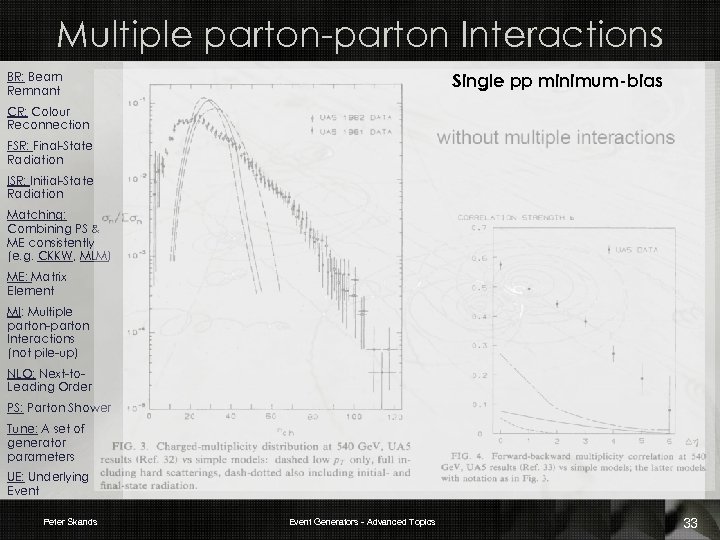
Multiple parton-parton Interactions Single pp minimum-bias BR: Beam Remnant CR: Colour Reconnection FSR: Final-State Radiation ISR: Initial-State Radiation Matching: Combining PS & ME consistently (e. g. CKKW, MLM) ME: Matrix Element MI: Multiple parton-parton Interactions (not pile-up) NLO: Next-to. Leading Order PS: Parton Shower Tune: A set of generator parameters UE: Underlying Event Peter Skands Event Generators - Advanced Topics 33
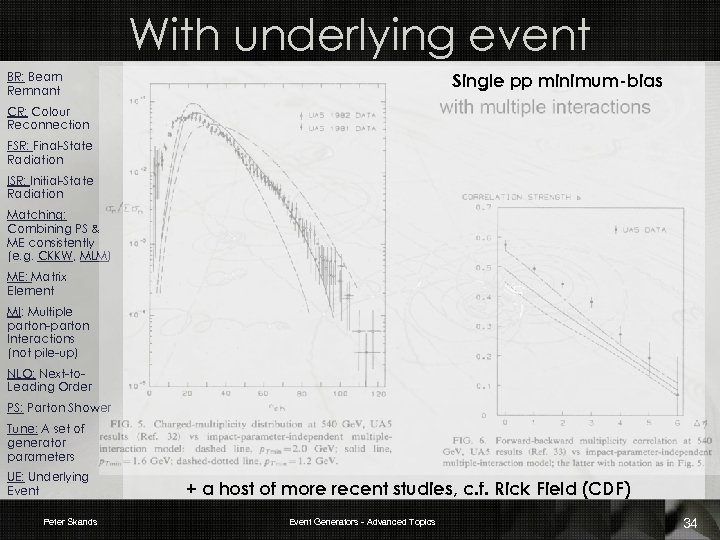
With underlying event Single pp minimum-bias BR: Beam Remnant CR: Colour Reconnection FSR: Final-State Radiation ISR: Initial-State Radiation Matching: Combining PS & ME consistently (e. g. CKKW, MLM) ME: Matrix Element MI: Multiple parton-parton Interactions (not pile-up) NLO: Next-to. Leading Order PS: Parton Shower Tune: A set of generator parameters UE: Underlying Event Peter Skands + a host of more recent studies, c. f. Rick Field (CDF) Event Generators - Advanced Topics 34
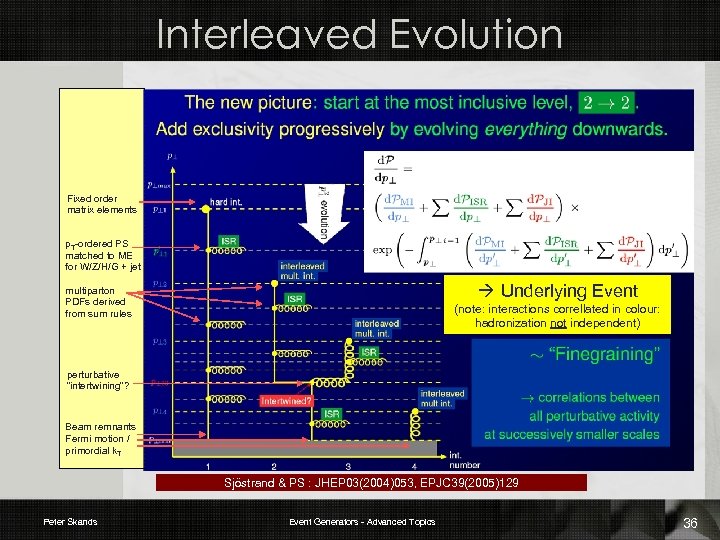
Interleaved Evolution BR: Beam Remnant CR: Colour Reconnection FSR: Final-State Radiation ISR: Initial-State Radiation Fixed order Matching: matrix elements Combining PS & ME consistently p. T-ordered PS matched to (e. g. CKKW, MLM) ME for W/Z/H/G + jet ME: Matrix Element multiparton Underlying Event PDFs derived Multiple sum rules from (note: interactions correllated in colour: hadronization not independent) MI: parton-parton Interactions (not pile-up) perturbative NLO: Next-to“intertwining”? Leading Order PS: Parton Shower Beam Tune: A set of remnants generator. Fermi motion / primordial k. T parameters UE: Underlying Event Peter Skands Sjöstrand & PS : JHEP 03(2004)053, EPJC 39(2005)129 Event Generators - Advanced Topics 36
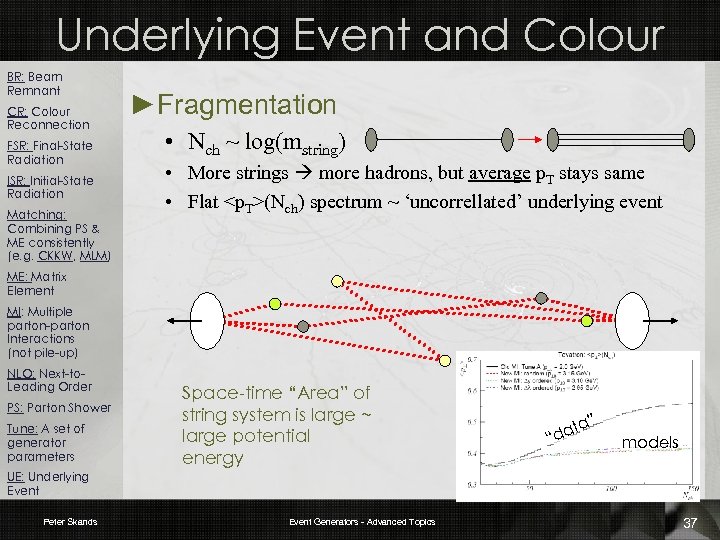
Underlying Event and Colour BR: Beam Remnant CR: Colour Reconnection FSR: Final-State Radiation ISR: Initial-State Radiation Matching: Combining PS & ME consistently (e. g. CKKW, MLM) ►Fragmentation • Nch ~ log(mstring) • More strings more hadrons, but average p. T stays same • Flat <p. T>(Nch) spectrum ~ ‘uncorrellated’ underlying event ME: Matrix Element MI: Multiple parton-parton Interactions (not pile-up) NLO: Next-to. Leading Order PS: Parton Shower Tune: A set of generator parameters Space-time “Area” of string system is large ~ large potential energy ” ata “d models UE: Underlying Event Peter Skands Event Generators - Advanced Topics 37
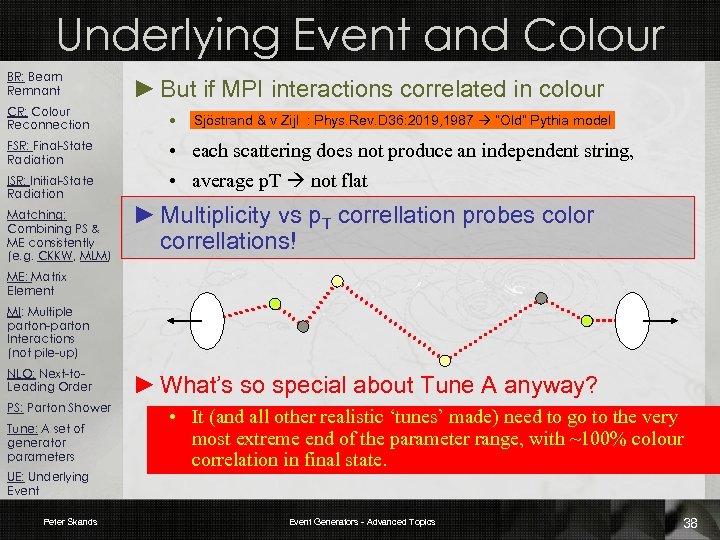
Underlying Event and Colour BR: Beam Remnant CR: Colour Reconnection FSR: Final-State Radiation ISR: Initial-State Radiation Matching: Combining PS & ME consistently (e. g. CKKW, MLM) ► But if MPI interactions correlated in colour • Sjöstrand & v Zijl : Phys. Rev. D 36: 2019, 1987 “Old” Pythia model • each scattering does not produce an independent string, • average p. T not flat ► Multiplicity vs p. T correllation probes color correllations! ME: Matrix Element MI: Multiple parton-parton Interactions (not pile-up) NLO: Next-to. Leading Order PS: Parton Shower Tune: A set of generator parameters UE: Underlying Event Peter Skands ► What’s so special about Tune A anyway? • It (and all other realistic ‘tunes’ made) need to go to the very most extreme end of the parameter range, with ~100% colour correlation in final state. Event Generators - Advanced Topics 38
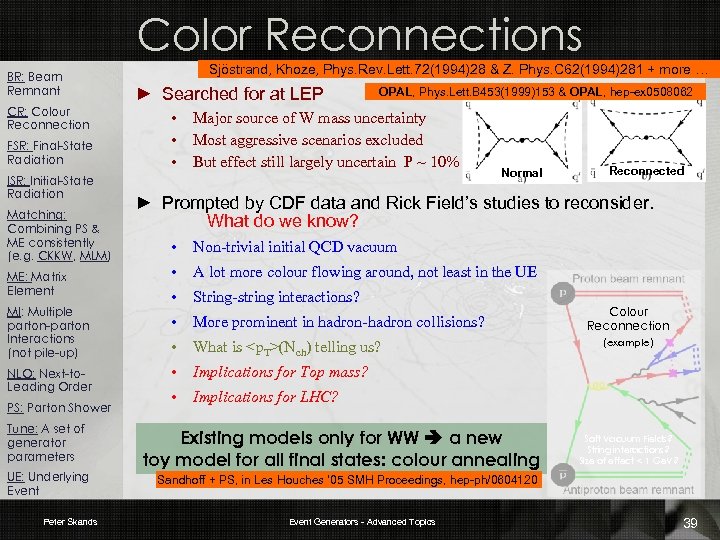
Color Reconnections BR: Beam Remnant CR: Colour Reconnection FSR: Final-State Radiation ISR: Initial-State Radiation Matching: Combining PS & ME consistently (e. g. CKKW, MLM) ME: Matrix Element MI: Multiple parton-parton Interactions (not pile-up) NLO: Next-to. Leading Order PS: Parton Shower Tune: A set of generator parameters UE: Underlying Event Peter Skands Sjöstrand, Khoze, Phys. Rev. Lett. 72(1994)28 & Z. Phys. C 62(1994)281 + more … ► Searched for at LEP • • • OPAL, Phys. Lett. B 453(1999)153 & OPAL, hep-ex 0508062 Major source of W mass uncertainty Most aggressive scenarios excluded But effect still largely uncertain P ~ 10% W W Normal W W Reconnected ► Prompted by CDF data and Rick Field’s studies to reconsider. What do we know? • Non-trivial initial QCD vacuum • A lot more colour flowing around, not least in the UE • String-string interactions? • More prominent in hadron-hadron collisions? • What is <p. T>(Nch) telling us? • Implications for Top mass? • Implications for LHC? Existing models only for WW a new toy model for all final states: colour annealing Colour Reconnection (example) Soft Vacuum Fields? String interactions? Size of effect < 1 Ge. V? Sandhoff + PS, in Les Houches ’ 05 SMH Proceedings, hep-ph/0604120 Event Generators - Advanced Topics 39
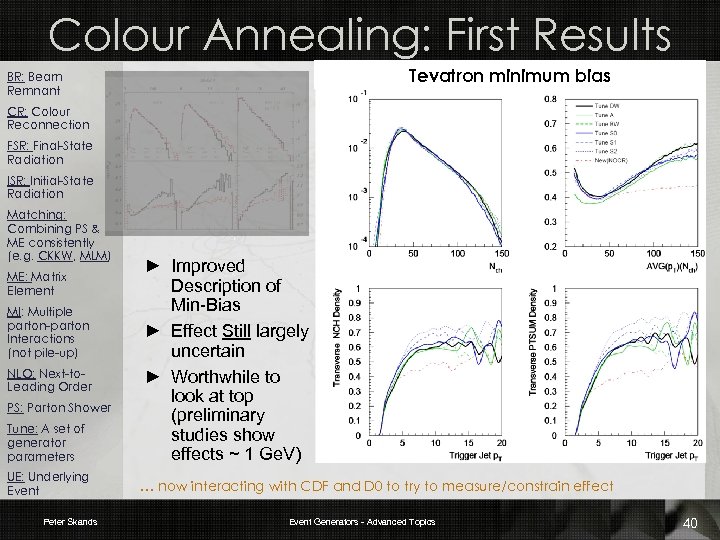
Colour Annealing: First Results Tevatron minimum bias BR: Beam Remnant CR: Colour Reconnection FSR: Final-State Radiation ISR: Initial-State Radiation Matching: Combining PS & ME consistently (e. g. CKKW, MLM) Tune: A set of generator parameters ► Improved Description of Min-Bias ► Effect Still largely uncertain ► Worthwhile to look at top (preliminary studies show effects ~ 1 Ge. V) UE: Underlying Event … now interacting with CDF and D 0 to try to measure/constrain effect ME: Matrix Element MI: Multiple parton-parton Interactions (not pile-up) NLO: Next-to. Leading Order PS: Parton Shower Peter Skands Event Generators - Advanced Topics 40
Outlook BR: Beam Remnant CR: Colour Reconnection ► We are looking towards a historic point FSR: Final-State Radiation ISR: Initial-State Radiation Matching: Combining PS & ME consistently (e. g. CKKW, MLM) ME: Matrix Element MI: Multiple parton-parton Interactions (not pile-up) NLO: Next-to. Leading Order PS: Parton Shower ► There are rumours of strange things there … Tune: A set of generator parameters UE: Underlying Event Peter Skands Event Generators - Advanced Topics 41
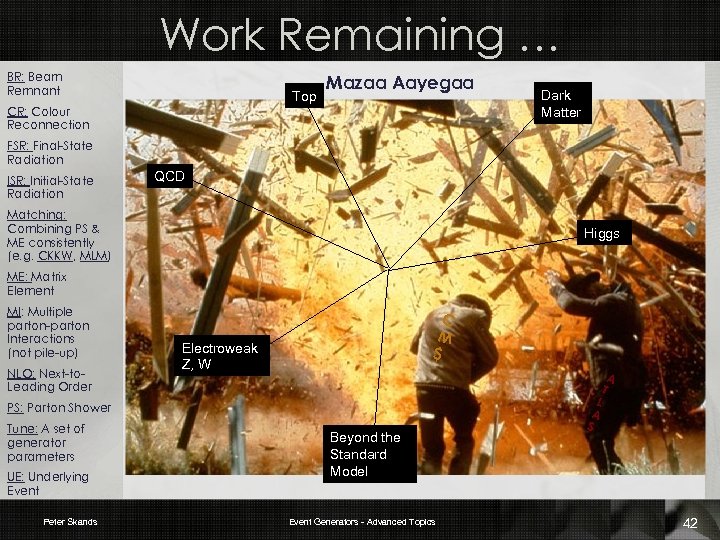
Work Remaining … BR: Beam Remnant Top Mazaa Aayegaa CR: Colour Reconnection Dark Matter FSR: Final-State Radiation ISR: Initial-State Radiation QCD Matching: Combining PS & ME consistently (e. g. CKKW, MLM) Higgs ME: Matrix Element MI: Multiple parton-parton Interactions (not pile-up) NLO: Next-to. Leading Order C M $ Electroweak Z, W PS: Parton Shower Tune: A set of generator parameters UE: Underlying Event Peter Skands Beyond the Standard Model Event Generators - Advanced Topics L A $ T A 42
Скачать презентацию Topical Meeting on LHC Physics HRI Allahabad Dec
18d53029f69c774b5ba129883e498f09.ppt