


 Скачать презентацию Topic Models for Morphologically Rich Languages Michael Elhadad
dcc943fb6b7ecc97682785e27a2b7690.ppt
- Количество слайдов: 64
 Topic Models for Morphologically Rich Languages Michael Elhadad, Meni Adler, Yoav Goldberg, Rafi Cohen 23 Jan 2011, Haifa Machine Translation and Morphologically-rich Languages
 Topic Models n n Unsupervised discovery of topics in text collection Useful to browse/explore large corpora by theme q q n Difficult to evaluate / Task-based evaluations help q q n Topic evolution over time Author-topic models WSD Summarization IR Sentiment analysis Multilingual LDA could help as feature for MT Topic Models
 Topic Models and Rich Morphology n Topic Models from text in Hebrew q q q n Halakhic Domain (Jewish Religious Law) q q q n Mixture of languages (Hebrew / Aramaic) Various Historical / Geographical / Subdomains Existing metadata / Can we exploit it? Medical Domain q q q n Rich morphology High number of distinct word forms High ambiguity Patient letters / e. Health QA site High level of mixture English/Hebrew (transliterations) Existing metadata (UMLS) / Can we exploit it? Work in progress Topic Models
 Outline n n n Topic Analysis with LDA Domain: Halakhic Sources / Medical dataset Combining LDA and Morphological Analysis Combining Semantic Priors and LDA Multilingual Topic Models Evaluating Topic Models Outline
 Objectives n Input: q q n Domain specific text corpus in Hebrew Metadata on documents (tags, alignment to English tags) Output: q Topic model: n n q n Discover “topics” discussed in the corpus Recognize topics in unseen text Index text collection by topic Task: q Something where topics help: n n WSD, IR, Text categorization, clustering Some part of MT? Objectives
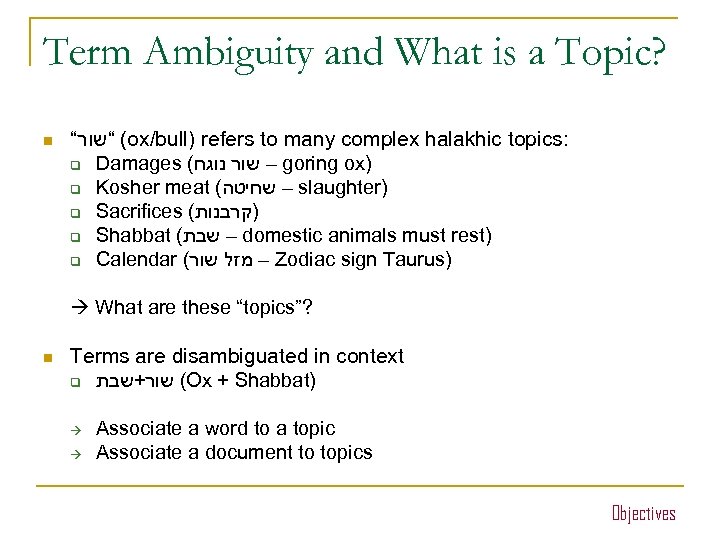 Term Ambiguity and What is a Topic? n “ ( “שור ox/bull) refers to many complex halakhic topics: q Damages ( – שור נוגח goring ox) q Kosher meat ( – שחיטה slaughter) q Sacrifices ( )קרבנות q Shabbat ( – שבת domestic animals must rest) q Calendar ( – מזל שור Zodiac sign Taurus) What are these “topics”? n Terms are disambiguated in context q ( שור+שבת Ox + Shabbat) Associate a word to a topic Associate a document to topics Objectives
 Discovering Topic Models: LDA n Latent Dirichlet Allocation q n n n Blei and Jordan 2003 Discover (unsupervised) topic structures in a document collection Topics are modeled as distributions of words Probabilistic generative model of text LDA
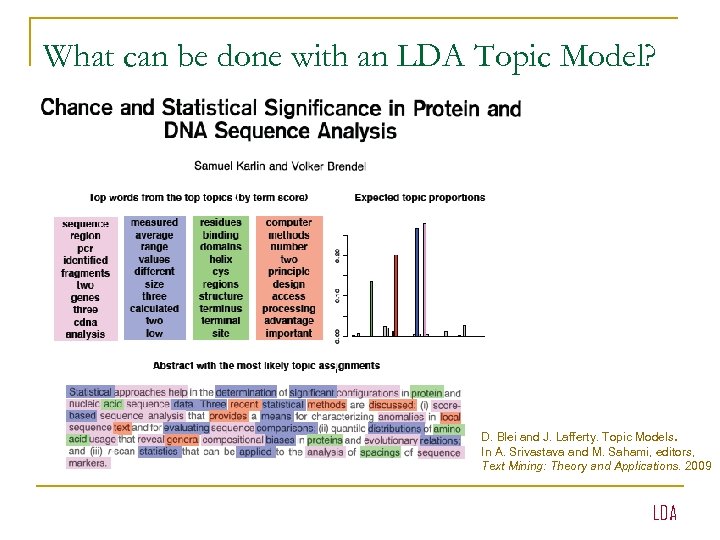 What can be done with an LDA Topic Model? D. Blei and J. Lafferty. Topic Models. In A. Srivastava and M. Sahami, editors, Text Mining: Theory and Applications. 2009 LDA
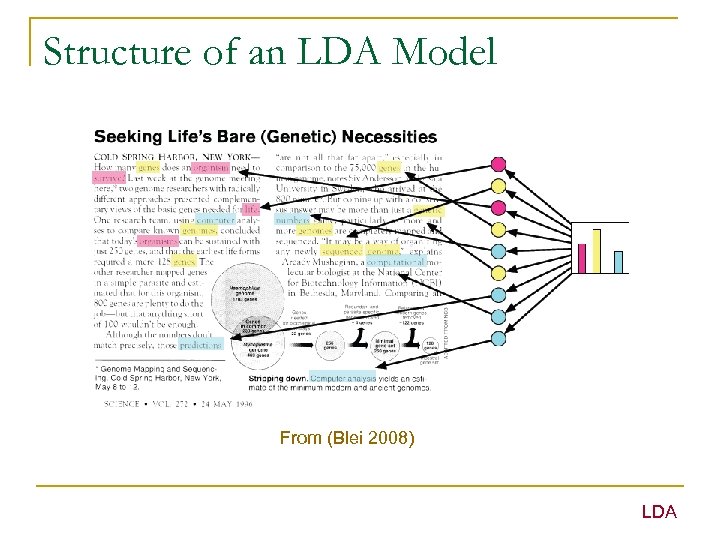 Structure of an LDA Model From (Blei 2008) LDA
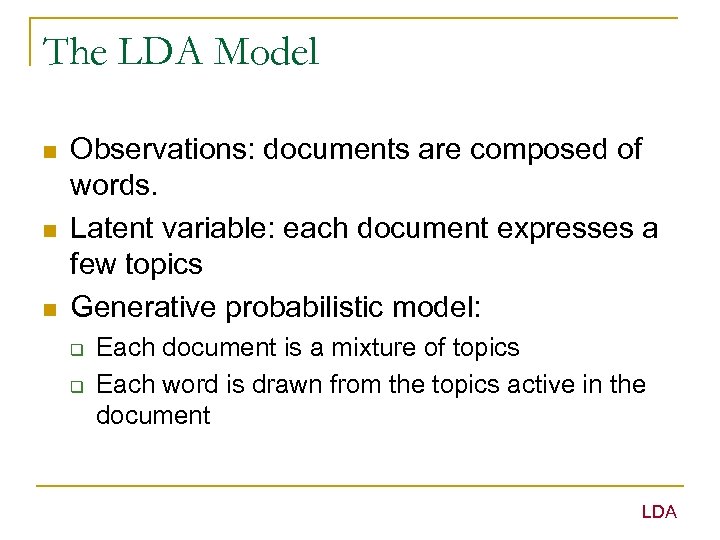 The LDA Model n n n Observations: documents are composed of words. Latent variable: each document expresses a few topics Generative probabilistic model: q q Each document is a mixture of topics Each word is drawn from the topics active in the document LDA
 LDA Graphical Model (Blei 2008) LDA
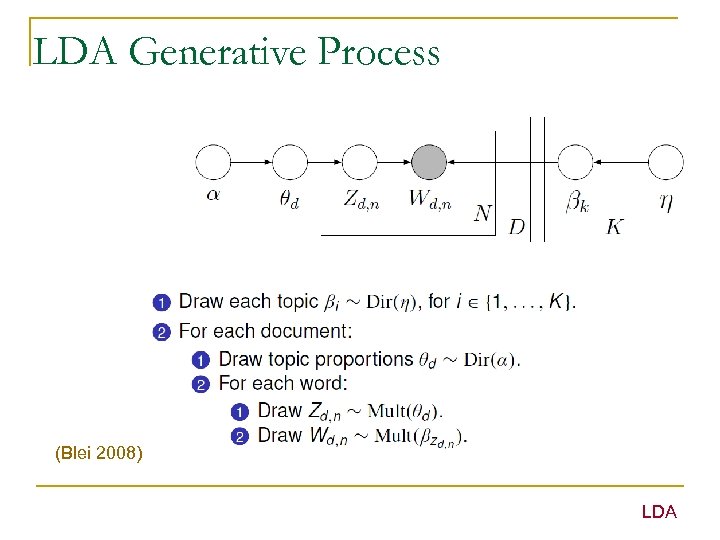 LDA Generative Process (Blei 2008) LDA
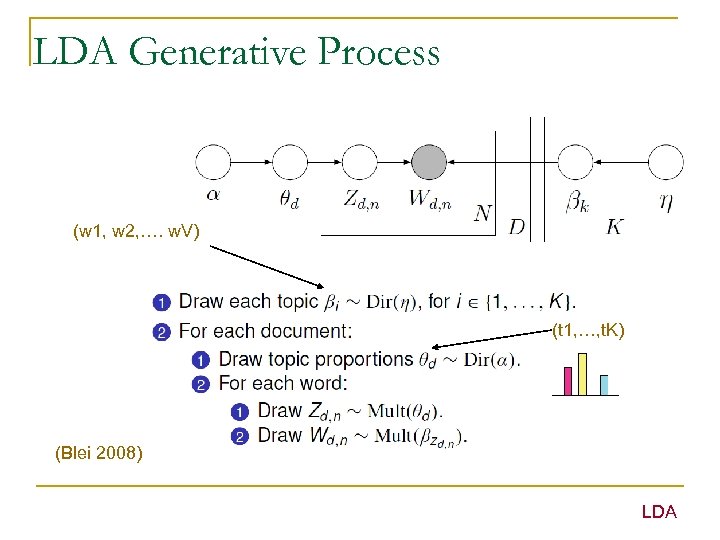 LDA Generative Process (w 1, w 2, …. w. V) (t 1, …, t. K) (Blei 2008) LDA
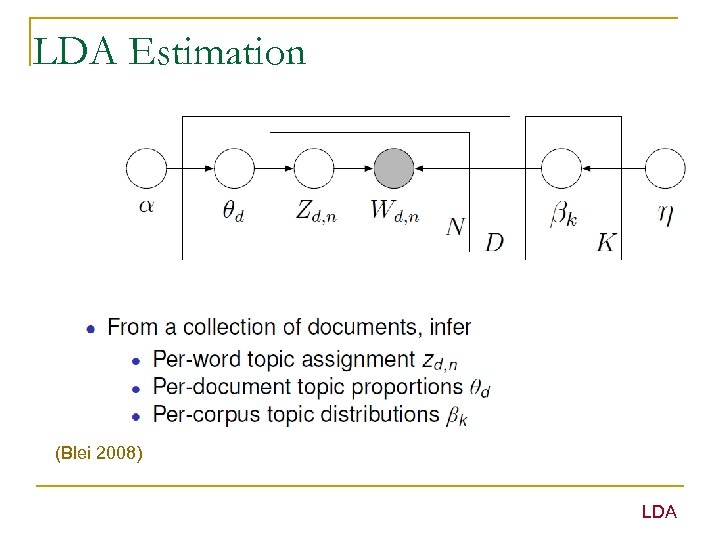 LDA Estimation (Blei 2008) LDA
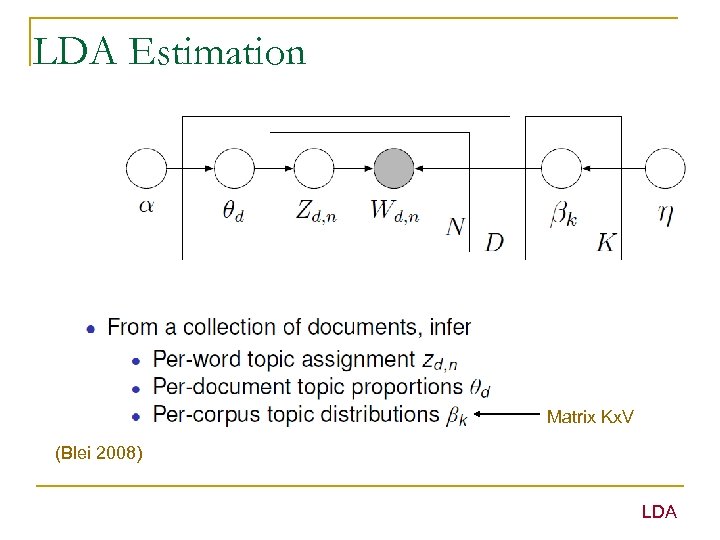 LDA Estimation Matrix Kx. V (Blei 2008) LDA
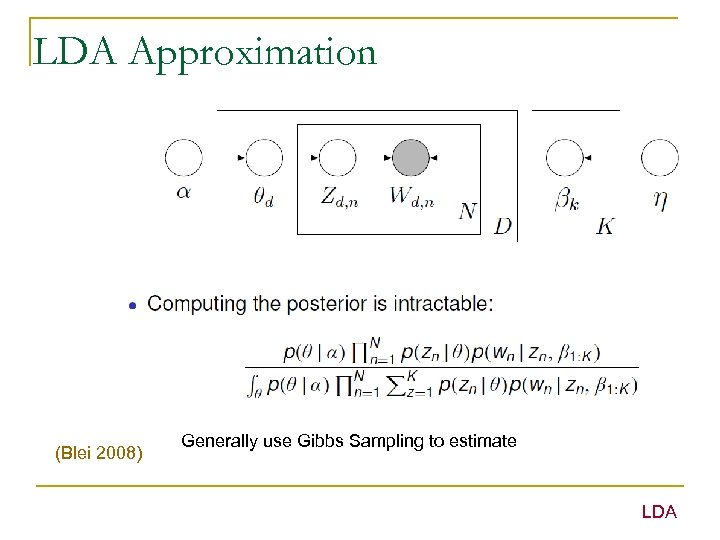 LDA Approximation (Blei 2008) Generally use Gibbs Sampling to estimate LDA
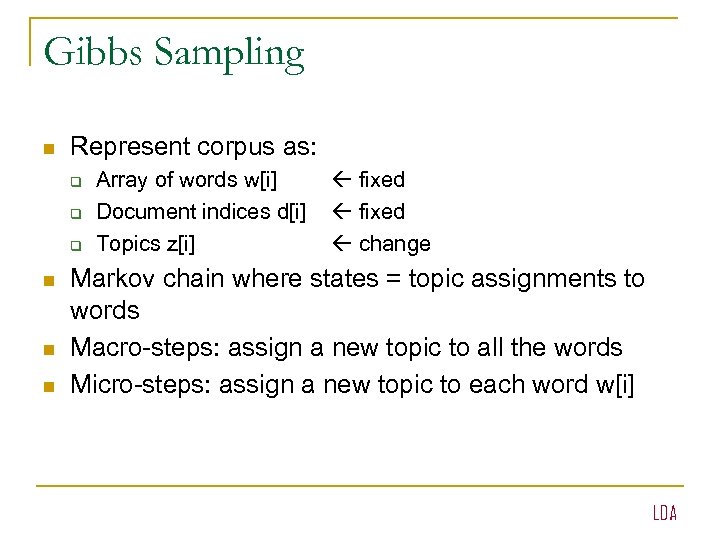 Gibbs Sampling n Represent corpus as: q q q n n n Array of words w[i] fixed Document indices d[i] fixed Topics z[i] change Markov chain where states = topic assignments to words Macro-steps: assign a new topic to all the words Micro-steps: assign a new topic to each word w[i] LDA
 Outline n n n Topic Analysis with LDA Domain: Halakhic Sources / Medical dataset Combining LDA and Morphological Analysis Combining Semantic Priors and LDA Multilingual Topic Models Evaluating Topic Models Outline
 LDA in Hebrew n n Explore various datasets in Hebrew How well does LDA work on Hebrew? Domain
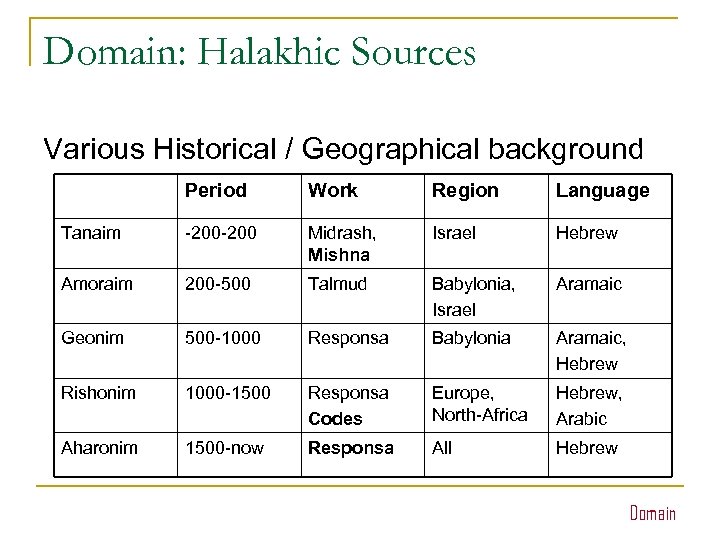 Domain: Halakhic Sources Various Historical / Geographical background Period Work Region Language Tanaim -200 Midrash, Mishna Israel Hebrew Amoraim 200 -500 Talmud Babylonia, Israel Aramaic Geonim 500 -1000 Responsa Babylonia Aramaic, Hebrew Rishonim 1000 -1500 Responsa Codes Europe, North-Africa Hebrew, Arabic Aharonim 1500 -now Responsa All Hebrew Domain
 The Mishna n Mishna (Tanaim) q q Exhaustive code of Jewish Law Written by R. Yehuda Hanasi (220 CE) 6 orders, 63 tractates, 524 chapters, 6 K paragraphs, 350 K words. Hierarchical thematic organization by topics Domain
 Rambam’s Mishne Torah n Corpus of Mishne Torah (Rishonim) q q q Exhaustive code of Halakha Written by Maimonides 1170 -1180 14 books, 85 sections, 1, 000 chapters, 15 K articles, 600 K words. Domain
 Responsa Corpus We manually constructed a reference corpus for testing purposes. Team of 5 Jewish Law experts with metadata associated to each QA document. n Documents q q q n Ontology of Halakha q q n 8, 000 responsa from 35 distinct books of various origins (geographical, historical) 3. 6 M words (avg 450 tokens per document) On average 4. 5 tags per document (from the ontology) ~2, 000 concepts ~5, 000 relations among concepts of 14 distinct types Metadata q q Per book: Author, Location, Publication Date Per document: n n n Topics from index References to "sources" (Bavli, Yerushalmi, Mishna, Tanakh, Shulhan 'arukh) (In progress) References to other responsa (In progress) Domain
 Halakhic Corpus Specificity n Language q q q n n Wide variety of domains / historical background Various Genres q q q n Mixture (Hebrew + Aramaic) Semitic languages: rich morphology Many acronyms / abbreviations Codes (hierarchical, synthetic) Commentaries (segmented, linear) Responsa (implicitly hypertextual – complex citations) Layers of corpus (derivation, authority) q Mishna Gmara Mishne Tora Responsa Domain
 Medical Corpus n Infomed. co. il q q q Popular QA Health site 2 M words / 4 K documents Annotated by site categories n n 6, 000 concepts / 3, 000 mapped to UMLS Hospital Patient release letters q q q Neurology department 150 K words / 1 K documents Manual UMLS concept annotation (in progress) Domain
 Medical Corpus Specificity n n n Many unknown words (~20% token types) Many transliterations (Rafi’s talk) Many named entities Domain
 Outline n n n Topic Analysis with LDA Domain: Halakhic Sources / Medical dataset Combining LDA and Morphological Analysis Combining Semantic Priors and LDA Multilingual Topic Models Evaluating Topic Models Outline
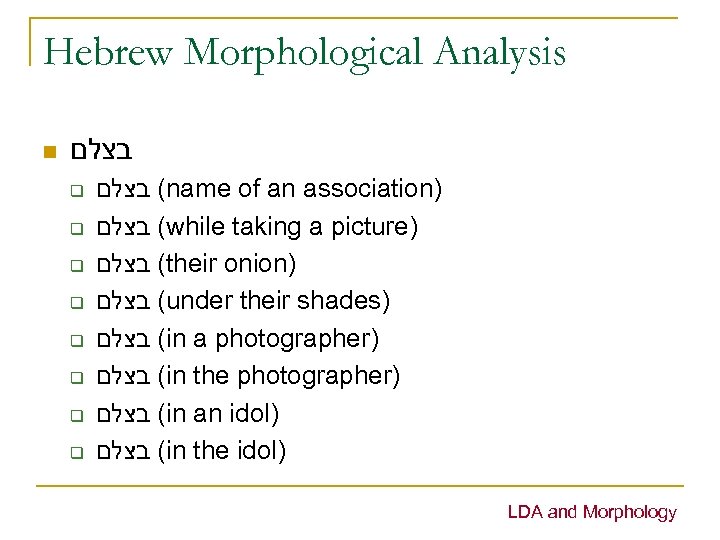 Hebrew Morphological Analysis n בצלם q q q q ( בצלם name of an association) ( בצלם while taking a picture) ( בצלם their onion) ( בצלם under their shades) ( בצלם in a photographer) ( בצלם in the photographer) ( בצלם in an idol) ( בצלם in the idol) LDA and Morphology
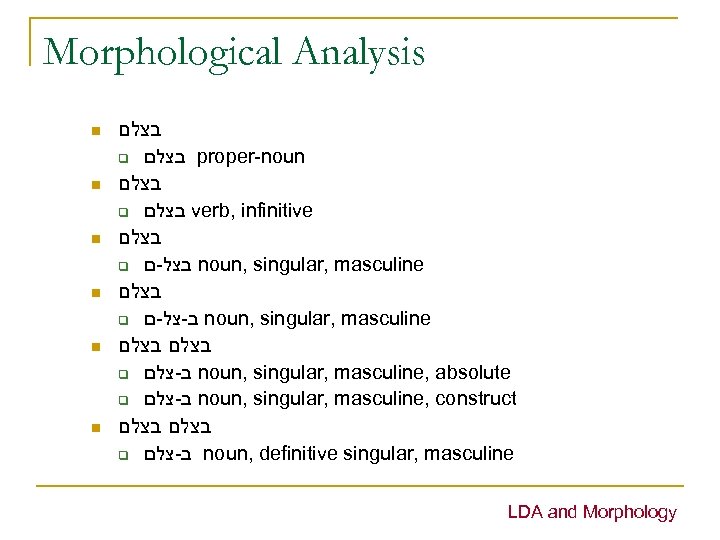 Morphological Analysis n n n בצלם q בצלם proper-noun בצלם q בצלם verb, infinitive בצלם q בצל-ם noun, singular, masculine בצלם q ב-צל-ם noun, singular, masculine בצלם q ב-צלם noun, singular, masculine, absolute q ב-צלם noun, singular, masculine, construct בצלם q ב-צלם noun, definitive singular, masculine LDA and Morphology
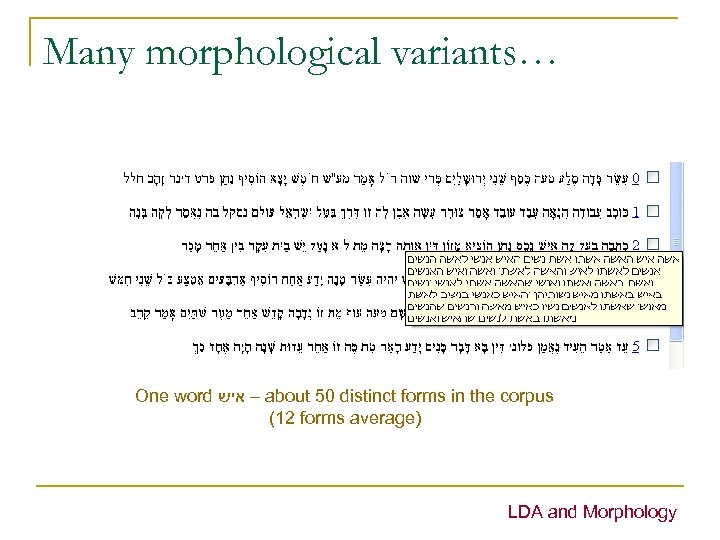 Many morphological variants… One word – איש about 50 distinct forms in the corpus (12 forms average) LDA and Morphology
 Combining LDA and Morphology n n LDA picks up patterns of word co-occurrence in documents. Heavy variations in Hebrew could mean we “miss” co-occurrence if we do not first analyze morphology. What is the best method to combine LDA and Morphological analysis? LDA and Morphology
 Combining LDA and Morphology 3 options: n Ignore morphology – token-based LDA q n Pipeline – resolve morphological ambiguities, then learn LDA. q n English LDA: stemming, filter POS (nouns) Morphology Lemma is ambiguous Joint – learn LDA on distributions of lemma conditioned by morphological analysis LDA and Morphology
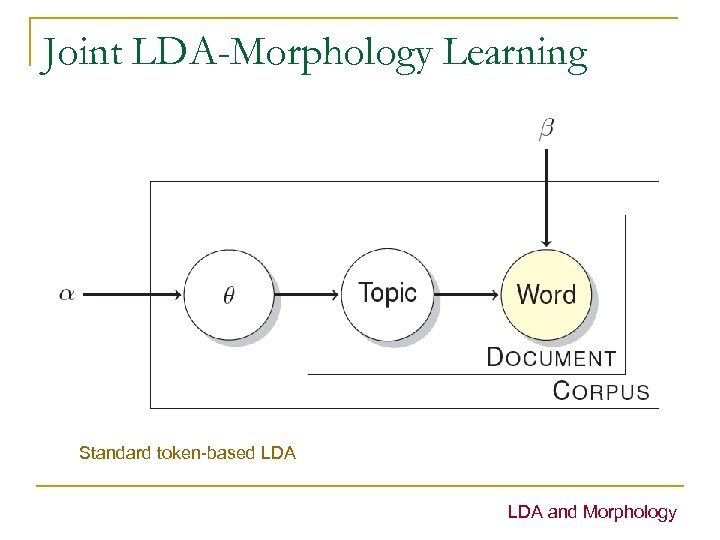 Joint LDA-Morphology Learning Standard token-based LDA and Morphology
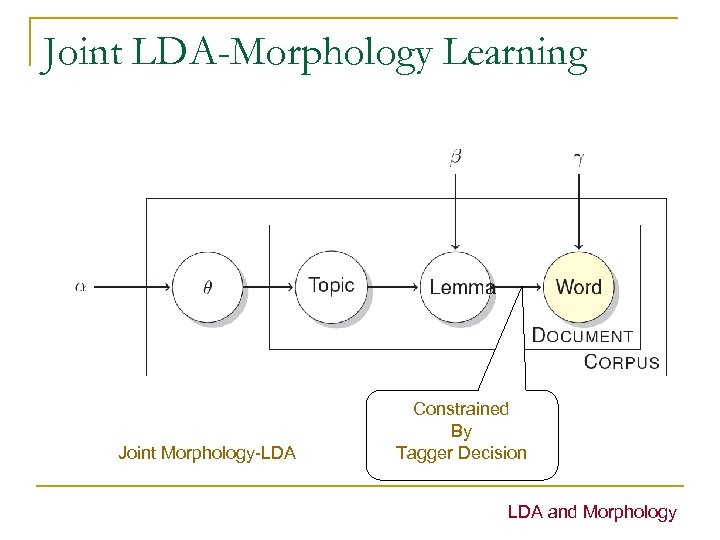 Joint LDA-Morphology Learning Joint Morphology-LDA Constrained By Tagger Decision LDA and Morphology
 Joint LDA-Morphology works n Token-based LDA in Hebrew gives no useful topics: q q n No semantic coherence (less than 1/3 topics) No alignment with semantic annotations LDA-Morphology “works” q q Semantic coherence More on evaluation… LDA and Morphology
 Morphology Variants n Semantic Coherence Evaluation q q Ask experts if they recognize a topic as coherent and to label it. Test on Rambam 128 topics 108 coherent topics with short label n 20 unrecognized [2 taggers / high agreement] n q Test on Medical Data 128 topics n q 115 coherent topics Test on Mishna 128 topics n 60 coherent topics LDA and Morphology
 Morphology Variants n Variant models on Mishna Dataset q q n Semantic coherence only for Compound model q q n LDA on Nouns only LDA on Nouns and Compound nouns (smixut) 80 coherent topics / 128 topics Unstable: 75 coherent / 150 topics Marked Compounds q q 45 compounds appear as top terms in topics (out of 6, 500 distinct compounds) All recognized as key concepts by domain experts More evaluation needed on term extraction Why such a difference with Rambam? LDA and Morphology
 Outline n n n Topic Analysis with LDA Domain: Halakhic Sources / Medical dataset Combining LDA and Morphological Analysis Evaluating Topic Models Combining Semantic Priors and LDA Multilingual Topic Models Outline
 How Good are Discovered Topics? n Difficult to evaluate LDA topics q q q n Many parameters Each run gives slightly different results How to compare topic models? Methods q q Data-oriented evaluation Semantic Coherence Ontology alignment evaluation Task-based evaluation Evaluation
 Topic Evaluation Methods 1 n Data-oriented: q q n Measure fit between dataset and generative model seen as language model (perplexity) Seems to “miss” what is “good” about topics Semantic coherence q Subjective judgment n n q Individual topics meaningful? Can be labeled? Assignments topic/docs meaningful? Find the intruder tests n Rank best word / worst word – find the intruder word Evaluation
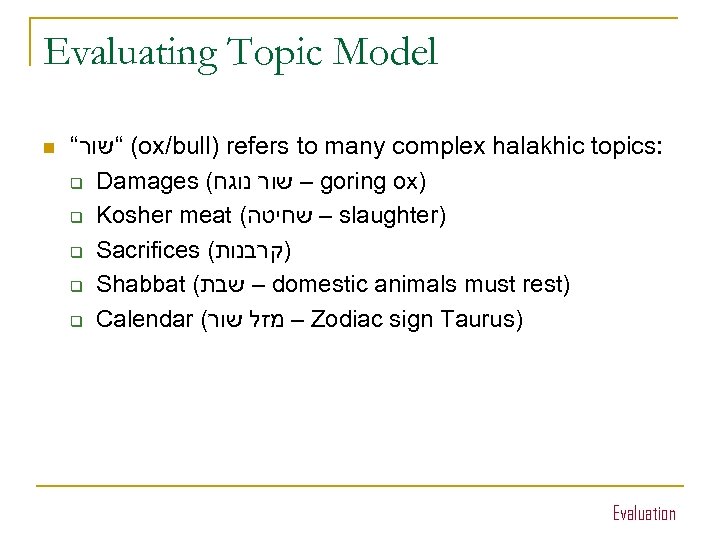 Evaluating Topic Model n “ ( “שור ox/bull) refers to many complex halakhic topics: q Damages ( – שור נוגח goring ox) q Kosher meat ( – שחיטה slaughter) q Sacrifices ( )קרבנות q Shabbat ( – שבת domestic animals must rest) q Calendar ( – מזל שור Zodiac sign Taurus) Evaluation
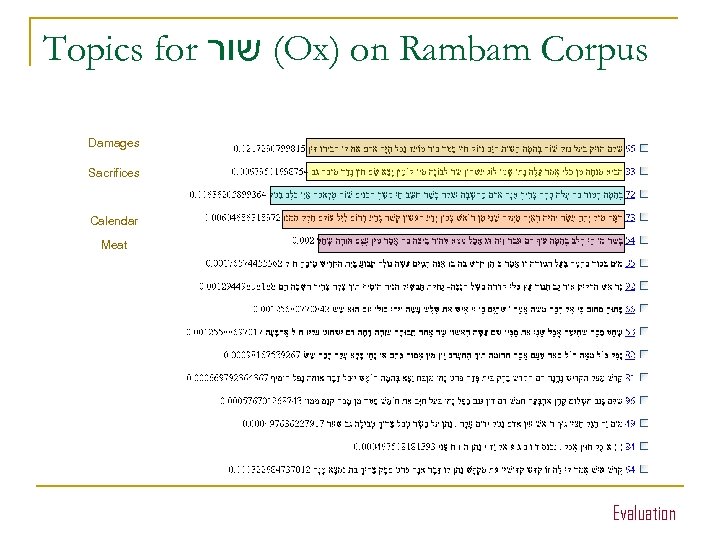 Topics for ( שור Ox) on Rambam Corpus Damages Sacrifices Calendar Meat Evaluation
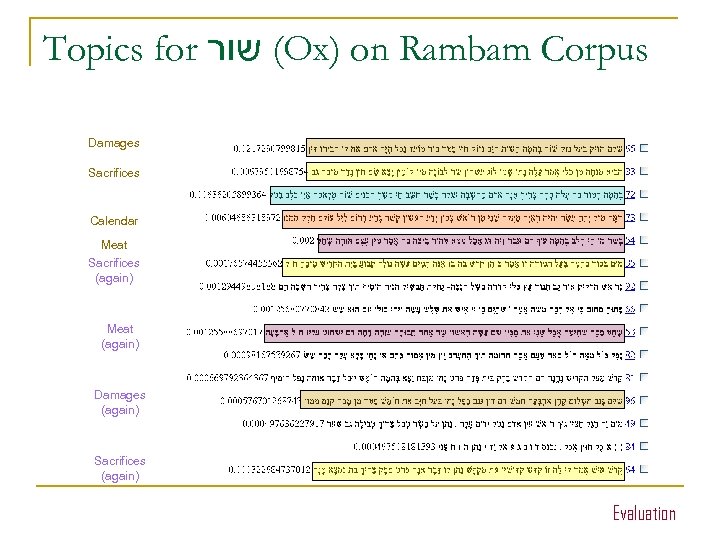 Topics for ( שור Ox) on Rambam Corpus Damages Sacrifices Calendar Meat Sacrifices (again) Meat (again) Damages (again) Sacrifices (again) Evaluation
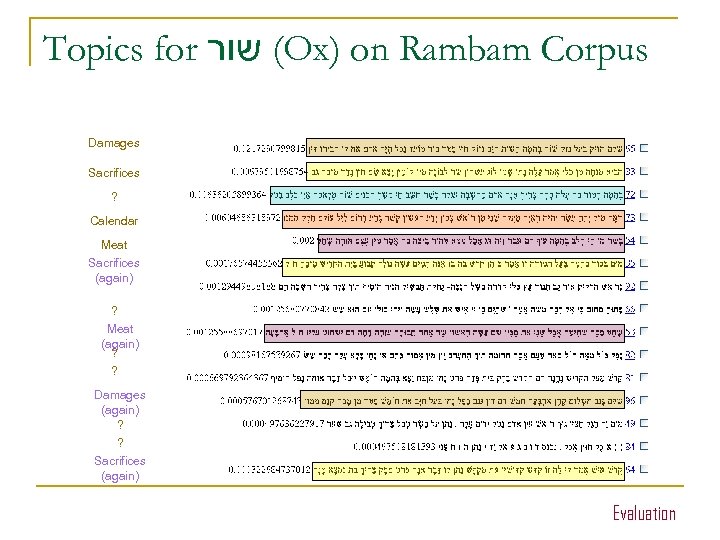 Topics for ( שור Ox) on Rambam Corpus Damages Sacrifices ? Calendar Meat Sacrifices (again) ? Meat (again) ? ? Damages (again) ? ? Sacrifices (again) Evaluation
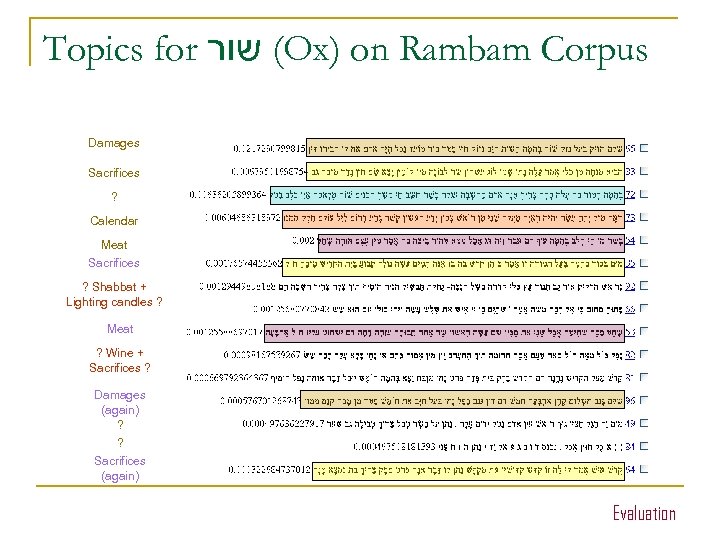 Topics for ( שור Ox) on Rambam Corpus Damages Sacrifices ? Calendar Meat Sacrifices ? Shabbat + Lighting candles ? Meat ? Wine + Sacrifices ? Damages (again) ? ? Sacrifices (again) Evaluation
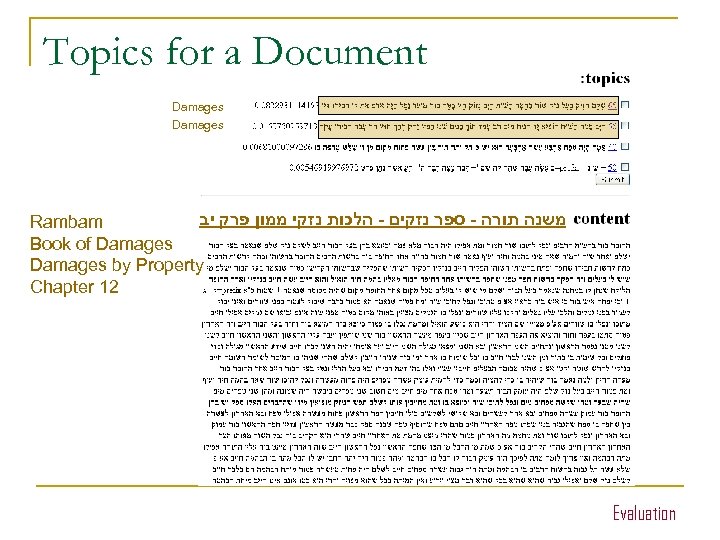 Topics for a Document Damages משנה תורה - ספר נזקים - הלכות נזקי ממון פרק יב Rambam Book of Damages by Property Chapter 12 Evaluation
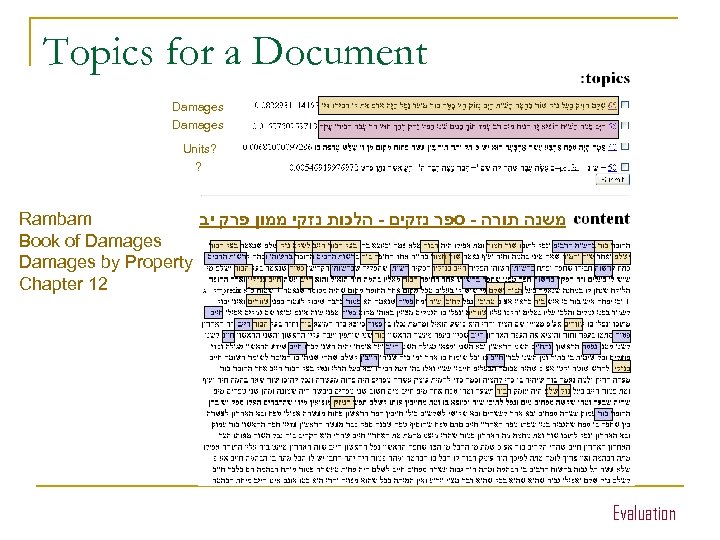 Topics for a Document Damages Units? ? Rambam משנה תורה - ספר נזקים - הלכות נזקי ממון פרק יב Book of Damages by Property Chapter 12 Evaluation
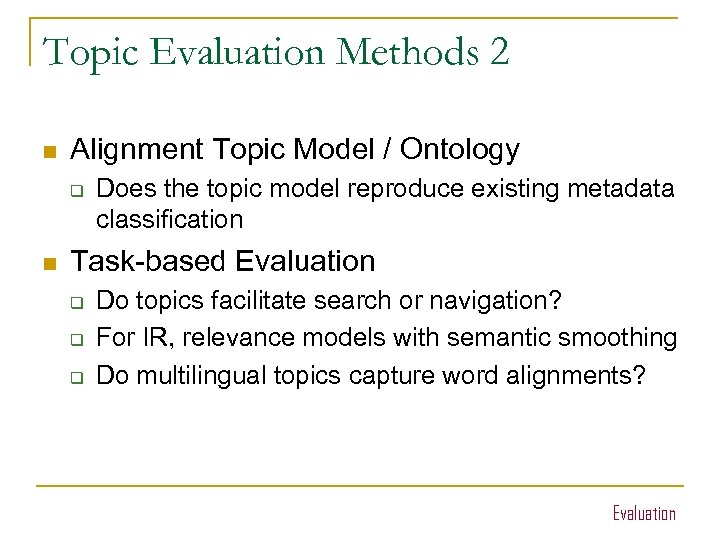 Topic Evaluation Methods 2 n Alignment Topic Model / Ontology q n Does the topic model reproduce existing metadata classification Task-based Evaluation q q q Do topics facilitate search or navigation? For IR, relevance models with semantic smoothing Do multilingual topics capture word alignments? Evaluation
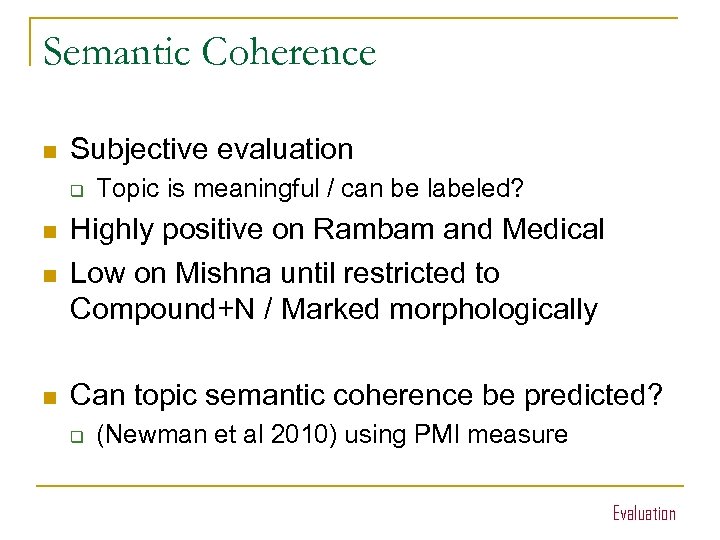 Semantic Coherence n Subjective evaluation q Topic is meaningful / can be labeled? n Highly positive on Rambam and Medical Low on Mishna until restricted to Compound+N / Marked morphologically n Can topic semantic coherence be predicted? n q (Newman et al 2010) using PMI measure Evaluation
 Ontology Alignment n Rambam Mishne Torah has existing structure q n Hierarchy of Book/Section/Chapter We find good alignment Topic/Book q Some topics are “cross-concern” (witnesses) Evaluation
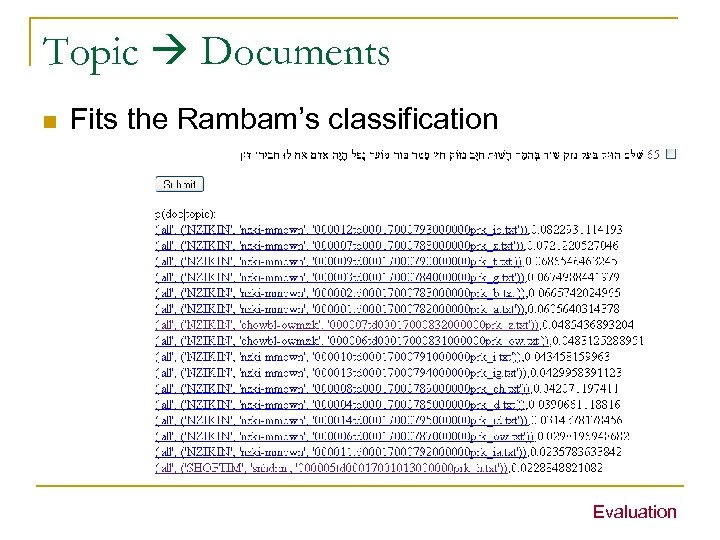 Topic Documents n Fits the Rambam’s classification Evaluation
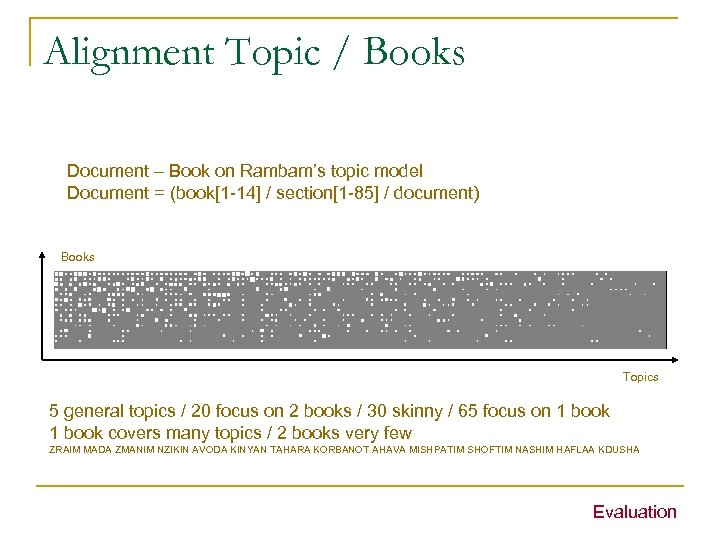 Alignment Topic / Books Document – Book on Rambam’s topic model Document = (book[1 -14] / section[1 -85] / document) Books Topics 5 general topics / 20 focus on 2 books / 30 skinny / 65 focus on 1 book covers many topics / 2 books very few ZRAIM MADA ZMANIM NZIKIN AVODA KINYAN TAHARA KORBANOT AHAVA MISHPATIM SHOFTIM NASHIM HAFLAA KDUSHA Evaluation
 Outline n n n Topic Analysis with LDA Domain: Halakhic Sources / Medical dataset Combining LDA and Morphological Analysis Evaluating Topic Models Combining Semantic Priors and LDA Multilingual Topic Models Outline
 Semantics and LDA n n n LDA is fully unsupervised Learn better models with underlying semantic knowledge? Active field of research q Excellent survey: Incorporating domain knowledge in latent topic models (Andrzejewski 2010) Semantics and LDA
 Semantics and LDA: 3 Types of Approaches n n n LDA+X: q Model additional observed data (Document+Tag) q Supervised. LDA, Author-Topic, Topic-Link LDA Word-Topic Constraints q Prior constraints on word-topic association q Syntax: Syntactic Topic Model, HMM-LDA q Concept-Topic Model (semantic fields), LDAWN, Dirichlet Forest, Topic-in-Set Document-Topic Constraints q Prior constraints on document-topic association and among topics q Topic relations: h. LDA, Correlated Topic Models, PAM q Document-Topic: Dirichlet Multinomial Regression, labeled LDA, Logic LDA q Topics over time: DTM, TOT Semantics and LDA
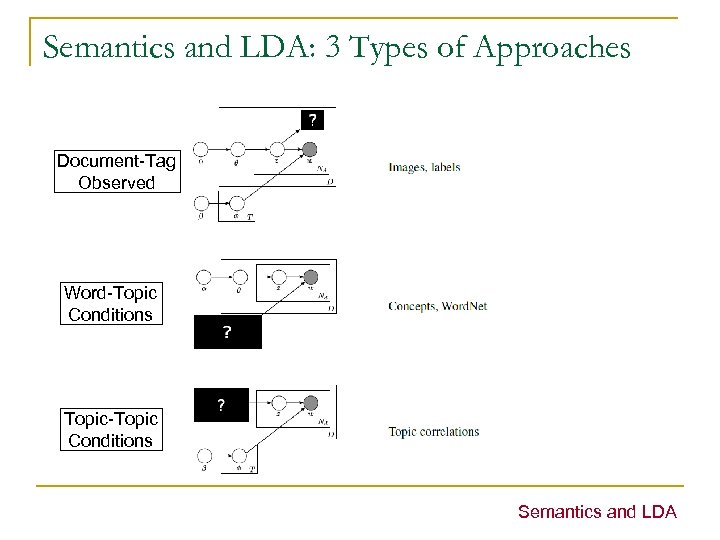 Semantics and LDA: 3 Types of Approaches Document-Tag Observed Word-Topic Conditions Topic-Topic Conditions Semantics and LDA
 Which Method for our domain n Document-Tags are available q q n Hyperlinks exist but are difficult to extract q n Labeled LDA and DMR Hierarchical topic models (PAM) Link. LDA Currently experimenting with Labeled-LDA on our datasets. Semantics and LDA
 Outline n n n Topic Analysis with LDA Domain: Halakhic Sources / Medical dataset Combining LDA and Morphological Analysis Evaluating Topic Models Combining Semantic Priors and LDA Multilingual Topic Models Outline
 Multilingual Topic Models n n Assume bilingual document set (di, li) Can we catch patterns of word co-occurrence across languages? MUTO (Boyd-Graber & Blei 2009) n Combine 2 aspects in one generative model: q q Align words across languages Group words into topics Multilingual LDA
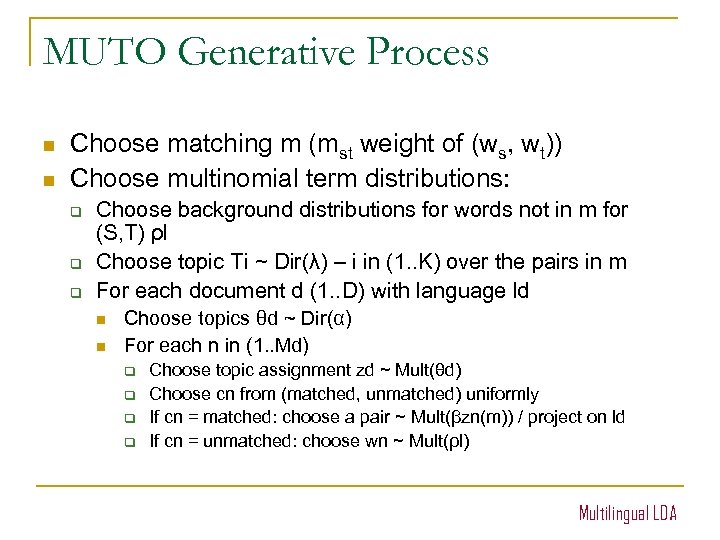 MUTO Generative Process n n Choose matching m (mst weight of (ws, wt)) Choose multinomial term distributions: q q q Choose background distributions for words not in m for (S, T) ρl Choose topic Ti ~ Dir(λ) – i in (1. . K) over the pairs in m For each document d (1. . D) with language ld n n Choose topics θd ~ Dir(α) For each n in (1. . Md) q q Choose topic assignment zd ~ Mult(θd) Choose cn from (matched, unmatched) uniformly If cn = matched: choose a pair ~ Mult(βzn(m)) / project on ld If cn = unmatched: choose wn ~ Mult(ρl) Multilingual LDA
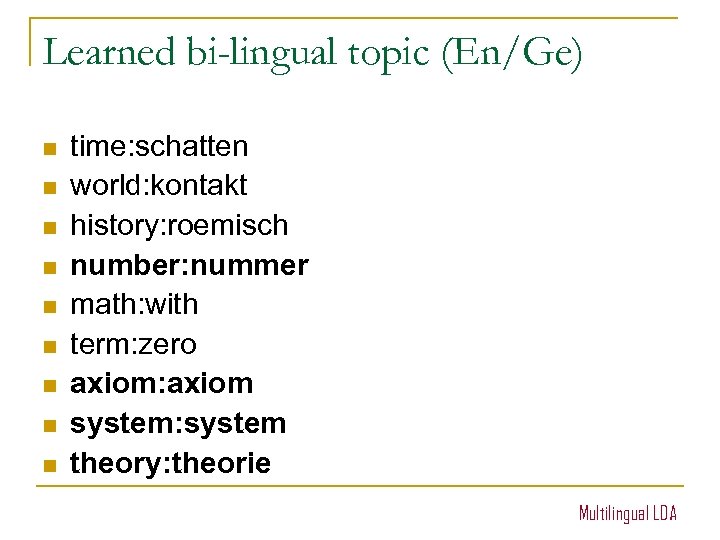 Learned bi-lingual topic (En/Ge) n n n n n time: schatten world: kontakt history: roemisch number: nummer math: with term: zero axiom: axiom system: system theory: theorie Multilingual LDA
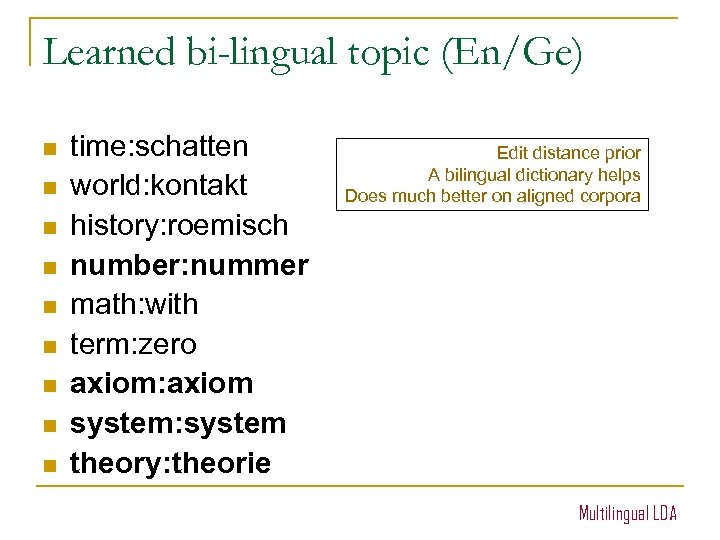 Learned bi-lingual topic (En/Ge) n n n n n time: schatten world: kontakt history: roemisch number: nummer math: with term: zero axiom: axiom system: system theory: theorie Edit distance prior A bilingual dictionary helps Does much better on aligned corpora Multilingual LDA
 n Could topic models over documents help MT with document level features? Multilingual LDA
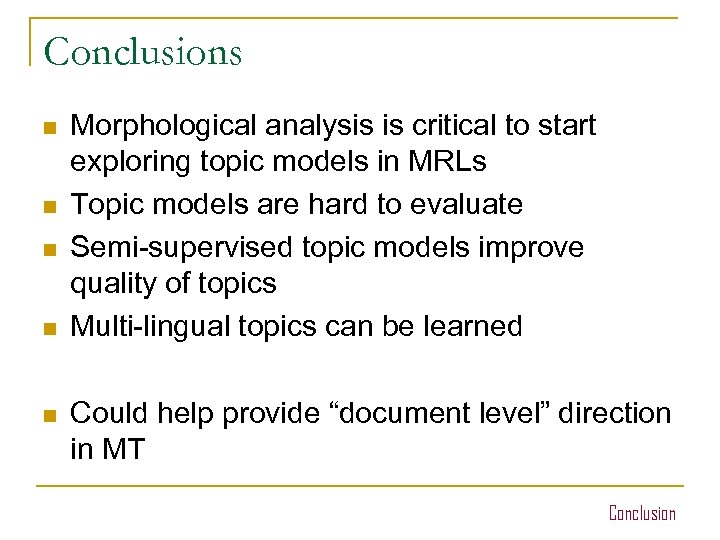 Conclusions n n n Morphological analysis is critical to start exploring topic models in MRLs Topic models are hard to evaluate Semi-supervised topic models improve quality of topics Multi-lingual topics can be learned Could help provide “document level” direction in MT Conclusion