 Скачать презентацию TOPIC 9 REGULATION OF LABOUR STAFF 9 1
TOPIC 9. Regulation.ppt
- Количество слайдов: 27



TOPIC 9. REGULATION OF LABOUR STAFF 9. 1. Regulation control. The labor collective and the social responsibility of the organization 9. 2. Collective contracts and agreements: content, operation and scope of their conclusions. Contracted form of recruitment 9. 3. The regulation of the workplace
9. 1. Regulation control. The labor collective and the social responsibility of the organization The regulation in the personnel management is a set of rules that determines the order of the activities of state employees, enterprises, institutions and organizations. Existing rules can be presented in the form of classification, which depends on the type of ownership, size and activities of the enterprise: the regulations that govern the activities of the enterprise as a single legal entity (articles of association, collective bargaining, internal regulations) the regulations that govern the work of the staff, which is defined as a set of interrelated groups of employees (the position of the units, models jobs, job descriptions, contracts, etc. ) the rules on information requirements (paperwork, documents, glossaries, common databases, etc. ) the regulations that govern the operation of equipment (accommodation, passports, manuals, etc. ) the regulations that govern the management (the matrix of distribution functions, graphics, processes, process maps, etc. )
The labor collective of an enterprise (organization) consists on all the employees that, through functional responsibilities involved in its activities on the basis of an employment contract, as well as other organizations that regulate the employment relationship of an employee with the company.
The moral climate of the organization is determined by its organizational culture. Formal, legally fixed position in the form of statutory objectives, mission, values must comply with the objectives and content validity of the nature of relationships within the organization, but in some cases there are some variations in this line. This is a formal, legitimate organizational culture and a shadow, one which is implemented in the organization. The moral climate of the organization is determined by a social and moral values that are inherent to the members of the organization. In state institutions these are formally adopted laws and regulations, which must comply with state employees. In commercial organizations, goals are achieved through the formation of highly motivated employees - members of the organization.
Organizations need a solution of different social problems: • to improving the quality of life of employed workers; • environmental protection; • charity; • to improving the quality of life for all citizens of the society.

Socially oriented policy in respect of the staff can be effectively implemented with the participation of trade unions. Trade union (union) is a voluntary non-profit organization, which unites people who share common interests for a native professional (work) activities (training). Trade unions are formed for the purpose of representation and protection of labor, social and economic rights and interests of union members. Activities of trade unions are based on the principles of legality and transparency. Citizens of Ukraine have the right to their own free will without any resolution to form unions, to join them and leave them to the conditions and order determined by their charter, to take part in trade unions.
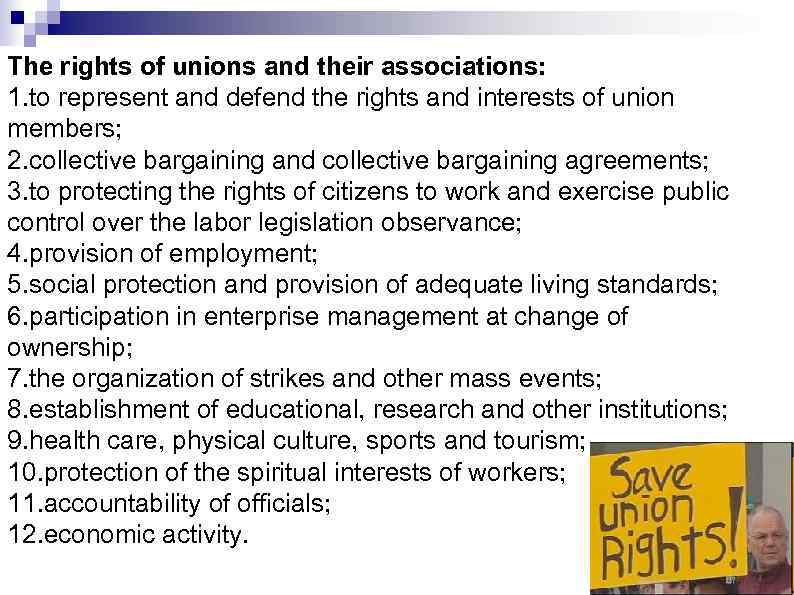
The rights of unions and their associations: 1. to represent and defend the rights and interests of union members; 2. collective bargaining and collective bargaining agreements; 3. to protecting the rights of citizens to work and exercise public control over the labor legislation observance; 4. provision of employment; 5. social protection and provision of adequate living standards; 6. participation in enterprise management at change of ownership; 7. the organization of strikes and other mass events; 8. establishment of educational, research and other institutions; 9. health care, physical culture, sports and tourism; 10. protection of the spiritual interests of workers; 11. accountability of officials; 12. economic activity.
Issues that takes place between employers and trade union representatives: 1. The contractual terms of employment or the physical conditions in the workplace. 2. Provision of employment or denial of it, interruption or suspension of employment or certain obligations under the contract of employment with respect to one or more employees. 3. Allocation of work or duties under the contract of employment between workers or groups of employees 4. Discipline issues. 5. Employee membership in the union or its absence. 6. Mechanisms for consultation, negotiation or other procedures, including the recognition by employers or employers' associations of trade union rights to represent workers in such negotiation or consultation or in the course of such procedures.

9. 2. Collective contracts and agreements: content, operation and scope of their conclusions. Contracted form of recruitment The collective agreement is concluded at enterprises regardless the form of ownership and management that use the hired labor and have the right of a legal entity.
A collective contract determines the mutual obligations of the parties regarding the regulation of production, labor, social and economic relations: 1. change in the organization of activities; 2. provision of productive employment; 3. standardization of wages, the establishment of forms, systems, wages and other employment benefits (additional payments, allowances, bonuses, etc. ) 4. establishment of safeguards, compensation, benefits, 5. workforce participation in staff, distribution and use of company profits (if not provided by the statute); 6. mode, working time and rest; 7. working conditions and labor protection; 8. provision of housing and community, corporate culture, medical care, rehabilitation and recreation of staff; 9. guarantees for the trade union or other representative organizations of workers.
Contract in the form of an employment contract differs from the traditional employment contract because the parties to bargain, show a greater autonomy in determining the terms of the transaction (in the period of validity, in the organization and pay, the rights, duties and responsibilities of the parties, etc. ). However, it should be emphasized that the modern interpretation of the employment contract within the meaning of the contract is close to the form of an employment contract, which removes the contradiction in the use of the designated categories as synonyms. Contract is an agreement of the two parties, each of which has equal rights under the establishment of contractual terms. The employer should provide the employee in accordance with the contract salary not lower than guaranteed by the law the minimum wage and with the favorable working conditions and social protection of workers, regardless of ownership and legal forms of ownership and organization.
Parties of the contract are: 1. as an employer it is the enterprise of any form of ownership, institution or organization represented by the Director; 2. as an employee are citizens from 16 years; 3. students with 14 years under the conditions defined by lthe law.
The contract should be eligible. The necessary peculiarities should be consider: 1. person with whom the employment contract is signed is 16 years of age (except the defined by the law) 2. agreement signed by authorized persons; 3. terms of the contract are lawful and not contrary to law; 4. contract clauses provide for execution of rights and obligations of both parties, for example, the employee's right to timely and full payment of wages by the employer and the faithful execution of work functions of the employee.
The contract, which is sighed with an employee, in terms of its legal nature may be submitted to: • in the form of labor; • in the form of internat agreement is signed by the management of the enterprise and by the employee, the group of employees, division of the enterprise or between employees, groups of employees, divisions among themselves to perform specific jobs or duties; • in the form of civil law is signed and fulfilled in accordance with civil law. They consist of enterprise employees and other persons.
To systematize the conditions of the contract is proposed to focus on five key elements that are inherent in every contract. 1. Labor function. The contents of the contract labor function can be represented by as the characteristics of the work process and the results of labor. This creates two main types of employment contracts: a contract to implement functional specific work process and subordinating the contract, aimed at obtaining a result of a certain quality. 2. The subject of the contract. By the nature of the subject contract also identified two basic types of contracts that result can be: a) material production, which is an essential property of the customer after the end of the contract, b) the product of intellectual scientific and technical activities, which the customer is not able to assign, and performer physically not can pass it completely to the customer.
3. The parties of the contract. As an employer (customer) advocates the owner or administration of the owner. At the other side may be considered employees of the company or employees of other organizations. 4. The terms of the contract may be of three types: a) the price of working time is a contract that reflects his professional capacity, and b) the price of labor, taking into account the situation on the labor market, c) the price of scientific and technical products that are produced with the participation of the employee. 5. Payment of the employee shall be determined by agreement between the parties. Sections of the contract is not connected any fixed form and content, except for certain law of certain positions. Employment contract consists of the main text of the treaty, and applications that are an integral part of the contract.
9. 3. The regulation of the workplace Professiograme is a list and description of common and special skills needed to perform certain professional activities. Any professiograme consists of two parts: a psychological the description of the professional work itself and psychogram as a description of the requirements for the human psyches a certain profession, activity. Psychogram contains primarily a list of necessary qualities and abilities of a person. It is clear that the manager mental qualities are important organizational and communication skills, for the operator - sensorimotor qualities for an accountant - attention and memory, for the artist and the director — developed imagination.
When making professiograme it is not worth to duplicate, which define the qualifications of the employee. Professiograme has forecasting operacter, it can help to determine the abilities self-improvement to success full action by on the in a particular workplace. It can take into account the "bottleneck" of the organization in terms of human factors. Professiograme may contain a description of the skills and knowlige that have contributed to success in a variety of critical situations that are inherent in this type of activity.
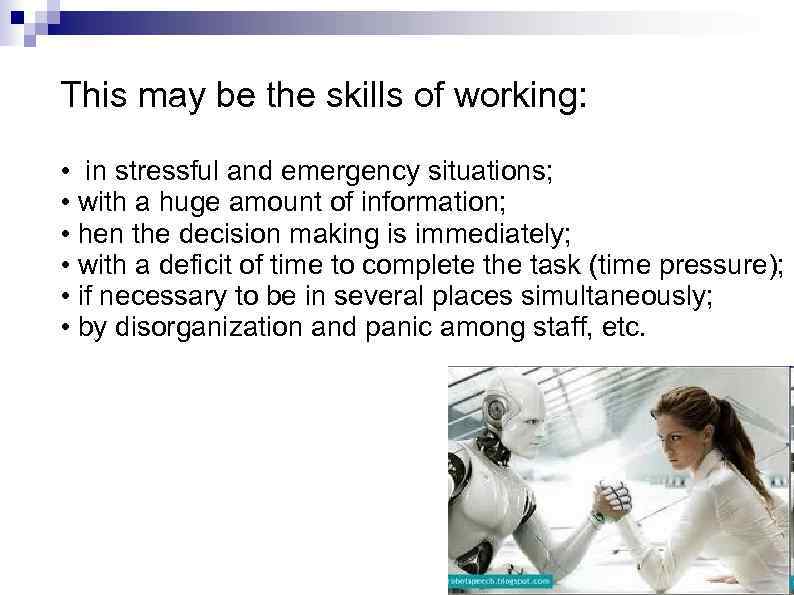
This may be the skills of working: • in stressful and emergency situations; • with a huge amount of information; • hen the decision making is immediately; • with a deficit of time to complete the task (time pressure); • if necessary to be in several places simultaneously; • by disorganization and panic among staff, etc.
The essence of techniques and features of its holding are the following. Group of 3 -5 experts who know the constant labour activity is given a questionnaire by D. Lipman. There is a list of qualities necessary for a variety of activities. The experts when reading the list should compare any of these qualities with the peculiarities of the activity which is analyzed, and to evaluate three parameters: 1) the quality is it necessary for the profession or desirable or neutral; 2) if the quality it is a necessary for a given profession (specialty), then when: always, sometimes or never; 3) whether the development or improvement of the quality of the age or through vocational training - to a large extent, not more important the development is impossible at all of development or even impossible psycophysiological.
Then the experts agree on their assessment of the known procedure. But the selection quality with the help of Lipmann technical is insufficient for folding psychogram because it does not give any idea of personality, its psychological characteristics and the person's attitudes. Therefore, for this purpose it is expedient to use an additional method of generalizations of independent characteristics, developed by Platonov. The method consists of the compilation of experts opinions about personal qualities and personnel attitude on the base of "modified maps of personality".
Map of personality is a list of various qualities, built on the principle of the polar profiles, namely quality, which is characterized, defined by two diametrically opposed meanings. For example, "stable - impulsive, " and so on. Each expert should demonstrate his vision, noting the figure on the ten-point scale, located between the polar characteristics that most closely matches his view of the importance of quality. After several trials, expert assessments of the importance and necessity of this or that quality are compiled and averaged. Determining the suitability of a particular kind of activity on the basis of professiogram may not be final. Specific conditions may require the use of certain special techniques.
Requirements to professional and personal abilities of employees are also represented in the job description and a description (specification) of the workplace. The specification describes a technology on a particular job in this area and the requirements imposed to each employee. Job description may contain a record of basic and additional job duties. If the new employee is hired to the position, the issue of his qualifications is always solves. If you are a candidate with a higher skill level, then it may be determined by additional responsibilities, which are recorded in the job description. Description of the workplace does not involve this having. Represented several additional duties to the employee, the company can more effectively use their human resources, but remember that in the future, such a worker may have problem of disqualification if his background and experience do not meet the content of the work.
The most common structure of the "job description" can be considered the following: 1. General provisions. This page lets you post, establishes the scope of this specialist, his absence: by the qualification requirements, ets. The section lists the legal acts and regulations to guide employees in their work. 2. The function. This section defines the position, the sphere of activity direction of employee's activity. 3. Duties. Lists the specific responsibilities that must be met by employee. This is the most difficult section to write a job description. All other sections, one way or another, derived from the duties of the employee.

4. Rights. The rights given to the granted to the employee, granted to the employee for the perform duties. Because the law - it is a tool duties, it is necessary to determine exactly what you need to do this or that duty. 5. Responsibility. Types of responsibility for failure and poor performance of employee duties and not for use granted him the rights are established. 6. Relations and connection within the office. This section provides a list of officials with whom the employee comes into service relation, and shares information, specify the form and terms of obtaining and providing information, the order of signing, approval of documents is determinal. From a legal point of view we can recommend the inclusion of another section - "Procedure for approval and changes in the job description".
At present the basis for changes in job description is, as a rule, the order of the head of the organization. Such order should be issued if necessary reallocation of functions and duties, reorganization, downsizing at, etc. In addition, job descriptions need to be replaced in the following cases: 1) when change the name of the organization or its is changed units; 2) when change the job title; 3) when change of surname of the employee who occupies this position, if instruction was nominal, and contained a specific name.
 Скачать презентацию TOPIC 9 REGULATION OF LABOUR STAFF 9 1
TOPIC 9. Regulation.ppt