


 Скачать презентацию TOPIC 6 LANGUAGE DEVELOPMENT 1 PUNCTUATION MARKS
b88e6268084a2cdf3e116fac70380bd0.ppt
- Количество слайдов: 16
 TOPIC 6 LANGUAGE DEVELOPMENT
 1. PUNCTUATION MARKS Full stop . To end a sentence e. g. Tom is running. He is running towards the shop. To indicate an abbreviation: U. S. P. , govt. , dept. Inverted Commas “Quotes“, ‘Titles‘ • To mark a quotation, or the actual words of the speaker. e. g. He said: “Where are you going? ”
 Comma , Stops reader from connecting words that do not belong together. e. g. I insist on eating, grandfather, before we begin our long journey. Separate items in a list or series. e. g. It was a large, white, cement building. Mark off words and phrases in apposition. Mark a mild parenthesis. e. g. Many accidents, especially on country roads, are caused by excessive speed. Introduce a short quotation, actual words of a speaker. e. g. The auditor said, “This is a very serious error. ” To separate figures or groups of figures e. g. 2 nd November, 2006.
 Semi-Colon ; • Shows the relationship between ideas in a sentence. • A stop halfway between a comma and a full stop. • Used as little as possible, comma used instead. • Between similar clauses not joined by a conjunction. e. g. The house was old and dilapidated; the other buildings were falling to pieces; the roadway was covered with weeds. • Before a clause or sentence which the writer wishes to emphasize. e. g. We knew that the scheme was a failure; but we did not know until now that it had not been honestly carried out.
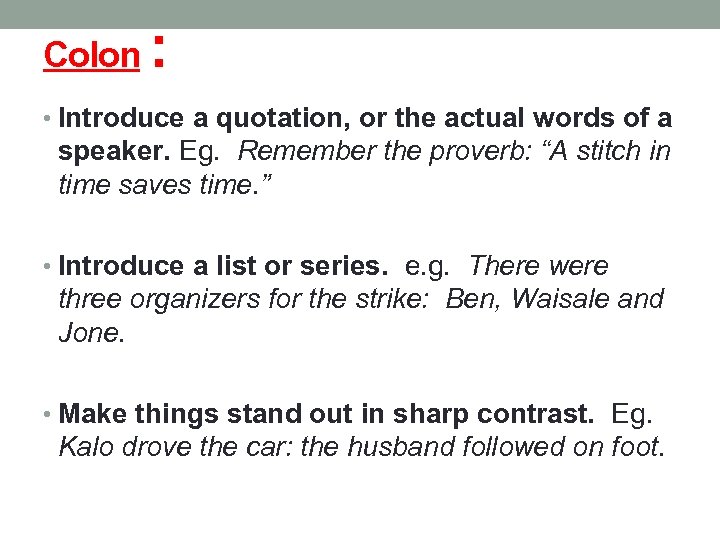 : Colon • Introduce a quotation, or the actual words of a speaker. Eg. Remember the proverb: “A stitch in time saves time. ” • Introduce a list or series. e. g. There were three organizers for the strike: Ben, Waisale and Jone. • Make things stand out in sharp contrast. Eg. Kalo drove the car: the husband followed on foot.
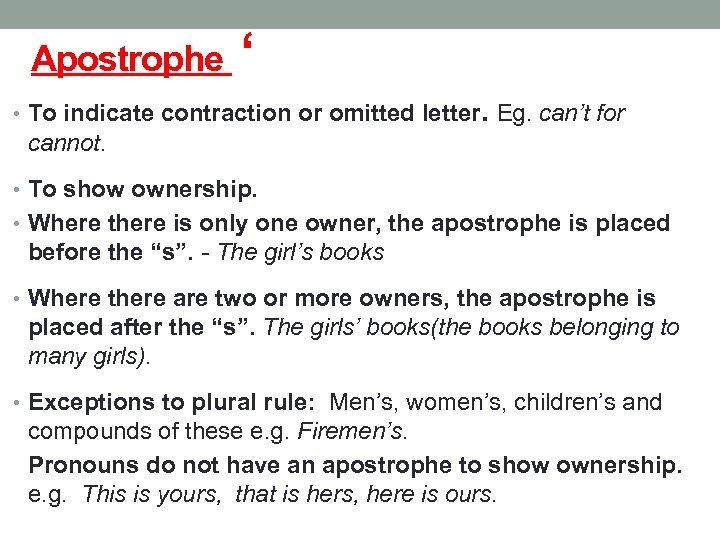 Apostrophe ‘ • To indicate contraction or omitted letter. Eg. can’t for cannot. • To show ownership. • Where there is only one owner, the apostrophe is placed before the “s”. - The girl’s books • Where there are two or more owners, the apostrophe is placed after the “s”. The girls’ books(the books belonging to many girls). • Exceptions to plural rule: Men’s, women’s, children’s and compounds of these e. g. Firemen’s. Pronouns do not have an apostrophe to show ownership. e. g. This is yours, that is hers, here is ours.
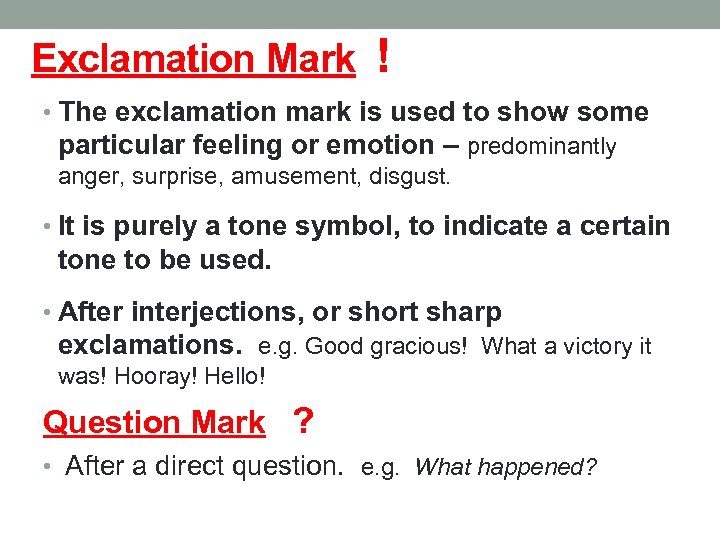 Exclamation Mark ! • The exclamation mark is used to show some particular feeling or emotion – predominantly anger, surprise, amusement, disgust. • It is purely a tone symbol, to indicate a certain tone to be used. • After interjections, or short sharp exclamations. e. g. Good gracious! What a victory it was! Hooray! Hello! Question Mark ? • After a direct question. e. g. What happened?
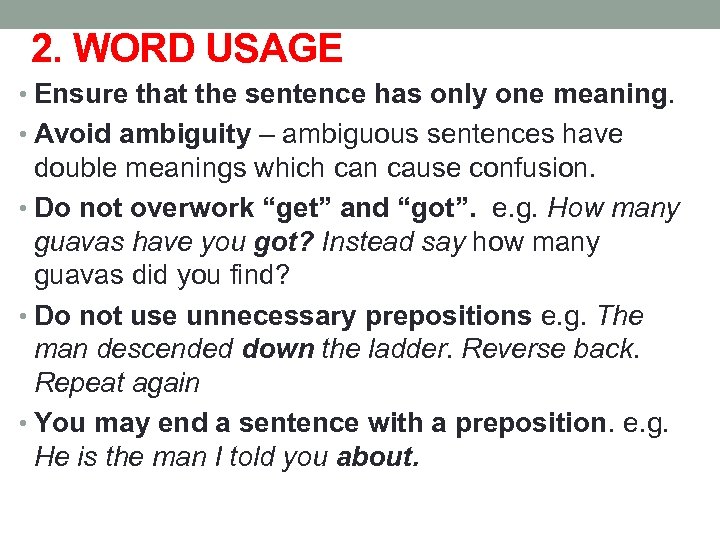 2. WORD USAGE • Ensure that the sentence has only one meaning. • Avoid ambiguity – ambiguous sentences have double meanings which can cause confusion. • Do not overwork “get” and “got”. e. g. How many guavas have you got? Instead say how many guavas did you find? • Do not use unnecessary prepositions e. g. The man descended down the ladder. Reverse back. Repeat again • You may end a sentence with a preposition. e. g. He is the man I told you about.
 • Do not use “Also” to begin a sentence. • Avoid the use of “was when”. • Use “and” to connect similar ideas or things, “but” when things are not similar - not sentence beginners. • Subject-Verb Agreement. • Avoid using “ the reason…. . was because” together in the same sentence. • Pronoun-Antecedent Agreement – who and whom are used to refer to people. That and which refer to everything else. The boy who ran 400 m. The dog that bit him. Cars which are expensive are difficult to buy.
 3. PARTS OF SPEECH • Noun – names a thing, person, place, idea or action. • Pronoun – replaces a noun. • Adjective – modifies a noun/pronoun. • Adverb – modifies a verb. • Verb – action word. • Conjunctions – joining words e. g. and, but, neither, although, if, however etc. • Prepositions –words which are used to join phrases/clauses in a sentence.
 4. TENSE & VERB FORMS • Present Tense - present simple – write, writes, goes, sings - present continuous – is writing, are writing - present perfect- has written, have written, has sung - present future – will write, will go, will sing • Past Tense - past simple – wrote, went, sang, danced, walked - past continuous – was driving, were driving - past perfect – had written, had gone, had rung - past future – would go, would write, would sing
 5. PARTS OF THE SENTENCE • Two main parts : i) Subject – tells us what or who being talked about (person, animal, place, thing) ii) Predicate – the part of a sentence or clause containing a verb and stating about the subject (what we are saying about the subject. ) Eg. The dog(sub) is barking loudly(pred). The shirts(sub) are dirty(pred). The children(sub) have not done their work (pred).
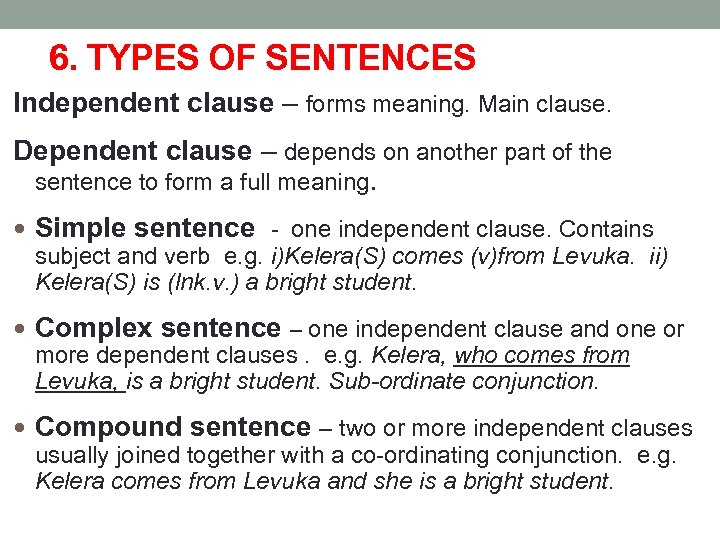 6. TYPES OF SENTENCES Independent clause – forms meaning. Main clause. Dependent clause – depends on another part of the sentence to form a full meaning. Simple sentence - one independent clause. Contains subject and verb e. g. i)Kelera(S) comes (v)from Levuka. ii) Kelera(S) is (lnk. v. ) a bright student. Complex sentence – one independent clause and one or more dependent clauses. e. g. Kelera, who comes from Levuka, is a bright student. Sub-ordinate conjunction. Compound sentence – two or more independent clauses usually joined together with a co-ordinating conjunction. e. g. Kelera comes from Levuka and she is a bright student.
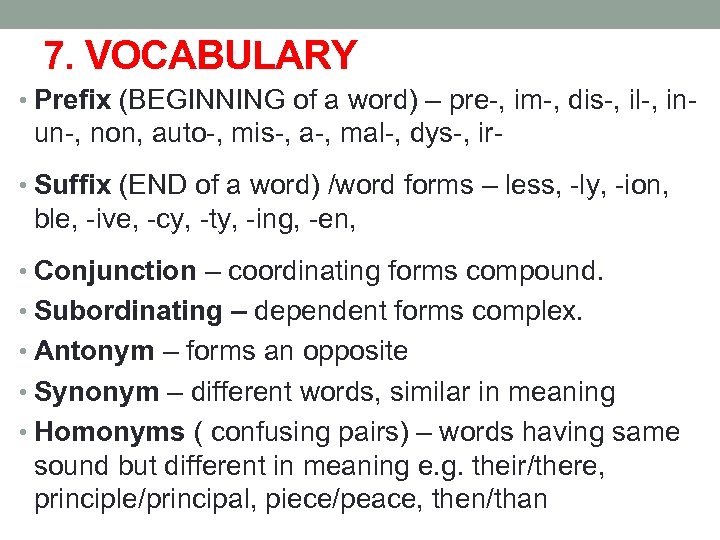 7. VOCABULARY • Prefix (BEGINNING of a word) – pre-, im-, dis-, il-, in- un-, non, auto-, mis-, a-, mal-, dys-, ir • Suffix (END of a word) /word forms – less, -ly, -ion, ble, -ive, -cy, -ty, -ing, -en, • Conjunction – coordinating forms compound. • Subordinating – dependent forms complex. • Antonym – forms an opposite • Synonym – different words, similar in meaning • Homonyms ( confusing pairs) – words having same sound but different in meaning e. g. their/there, principle/principal, piece/peace, then/than
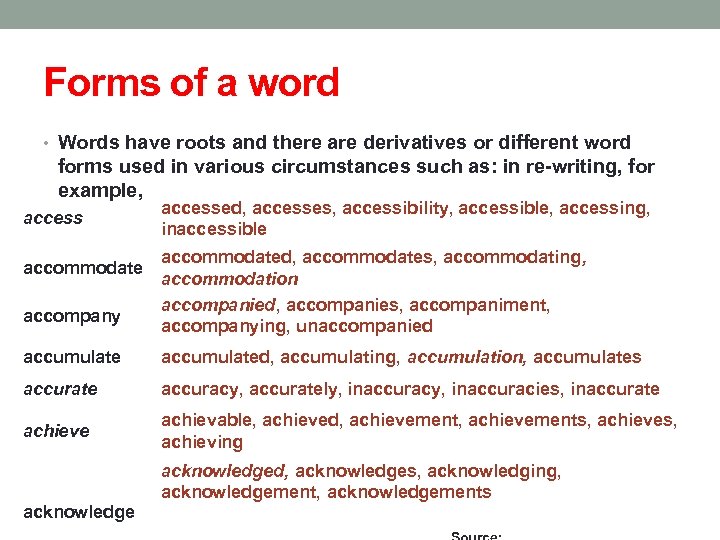 Forms of a word • Words have roots and there are derivatives or different word forms used in various circumstances such as: in re-writing, for example, access accommodate accompany accessed, accesses, accessibility, accessible, accessing, inaccessible accommodated, accommodates, accommodating, accommodation accompanied, accompanies, accompaniment, accompanying, unaccompanied accumulated, accumulating, accumulation, accumulates accurate accuracy, accurately, inaccuracies, inaccurate achievable, achieved, achievements, achieves, achieving acknowledged, acknowledges, acknowledging, acknowledgement, acknowledgements
 CONCLUSION • Basic language and grammar are important in both written and spoken communication. • If the basics of language and grammar are understood and used correctly, communication will take place effectively in all spheres of life, i. e. personally, socially, academically and professionally. • Have a great day. THE END