


 Скачать презентацию Topic 6 International Trade Imports Exports Trade
6a4bd198ad579cf3ffb64bb0283394ad.ppt
- Количество слайдов: 54
 Topic 6: International Trade Imports & Exports Trade Policy Foreign Exchange Markets Fiscal & Monetary Policy with Trade
 Imports Final Goods – Wine from France, Ferraris from Italy, Shirts from China, DVD players from Taiwan Intermediate Goods – Microchips from Japan, Engines from Germany, Steel from China Is it an import? Depends where it was produced.
 Exports California Wine Detroit Cars Financial Services Meat and Potatoes Made in the USA, sold outside of the USA
 Comparative Advantage If a country has a comparative advantage in microchips but not in pickles, it is most efficient for that country to export microchips and imports pickles. Without trade, this isn’t possible. Trade increases efficiency.
 World Market Think of a small country, with production and consumption that is insignificant compared to total worldwide production and consumption. Without trade, prices in that economy are determined by domestic supply and demand With trade, prices equal the world-price The small country takes the world-prices as given.
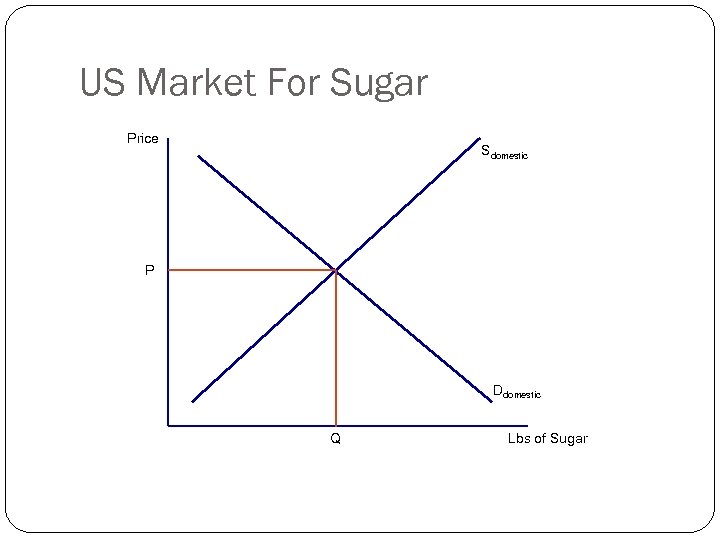 US Market For Sugar Price Sdomestic P Ddomestic Q Lbs of Sugar
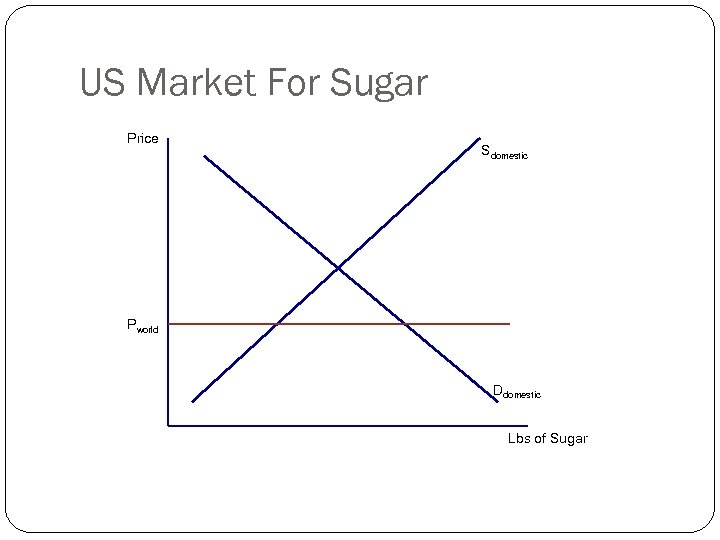 US Market For Sugar Price Sdomestic Pworld Ddomestic Lbs of Sugar
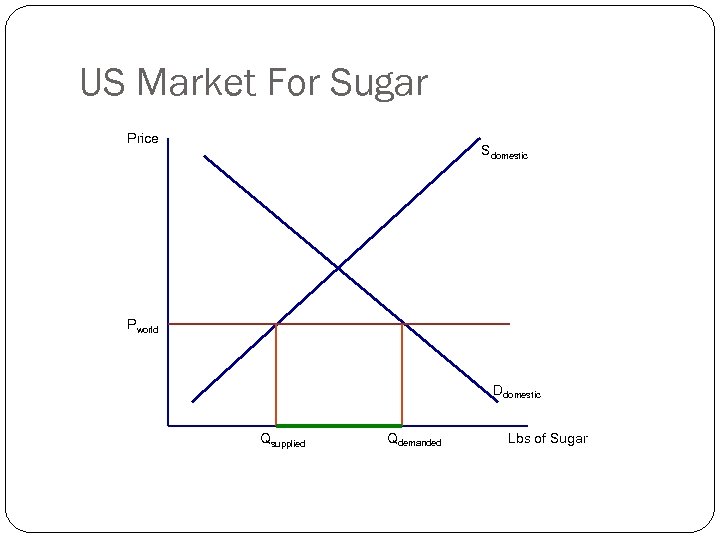 US Market For Sugar Price Sdomestic Pworld Ddomestic Qsupplied Qdemanded Lbs of Sugar
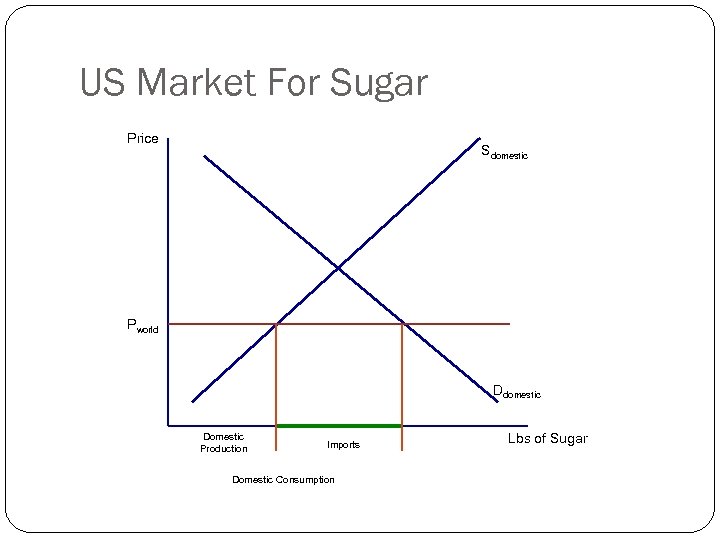 US Market For Sugar Price Sdomestic Pworld Ddomestic Domestic Production Imports Domestic Consumption Lbs of Sugar
 Market for Sugar US does not have a comparative advantage in sugar If US engages in free trade: Less expensive, and more sugar consumption in the US Lower prices and less production for US producers US Consumers Win US Produces Lose
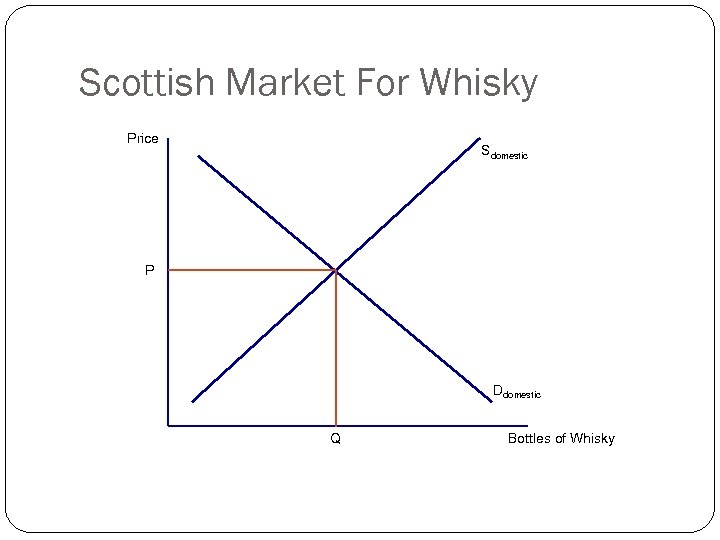 Scottish Market For Whisky Price Sdomestic P Ddomestic Q Bottles of Whisky
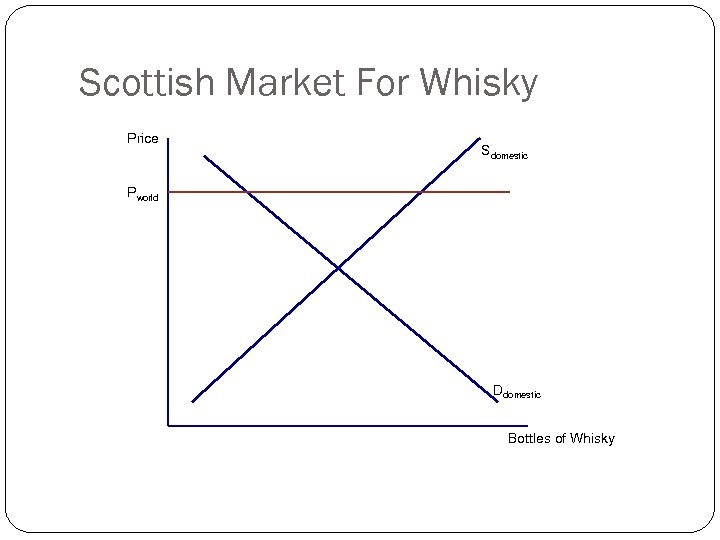 Scottish Market For Whisky Price Sdomestic Pworld Ddomestic Bottles of Whisky
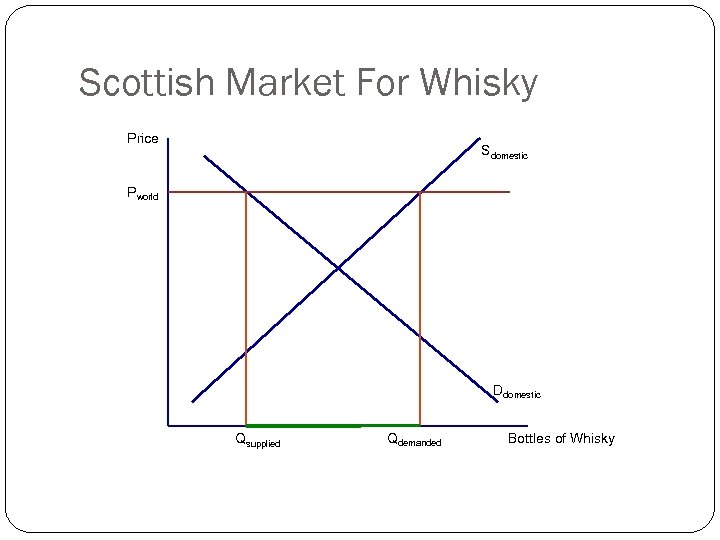 Scottish Market For Whisky Price Sdomestic Pworld Ddomestic Qsupplied Qdemanded Bottles of Whisky
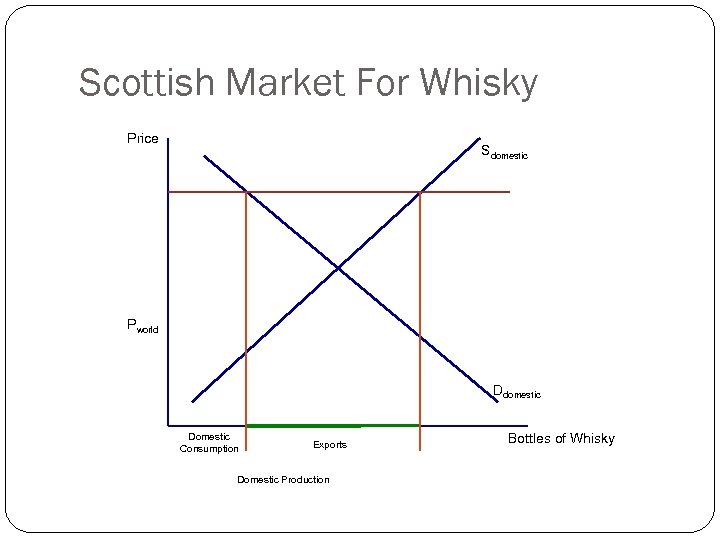 Scottish Market For Whisky Price Sdomestic Pworld Ddomestic Domestic Consumption Exports Domestic Production Bottles of Whisky
 Market for Whisky Scotland has a comparative advantage is whisky If Scotland engages in free trade: More expensive, and less whisky consumption in Scotland Higher prices and more production for Scottish producers Scottish Consumers Lose Scottish Producers Win
 Trade Restriction No Trade – closed borders, etc. Tariffs – Taxes imposed on imports Export Subsidies – Payments to producers to export Import Quotas – Limits to the quantity of imports
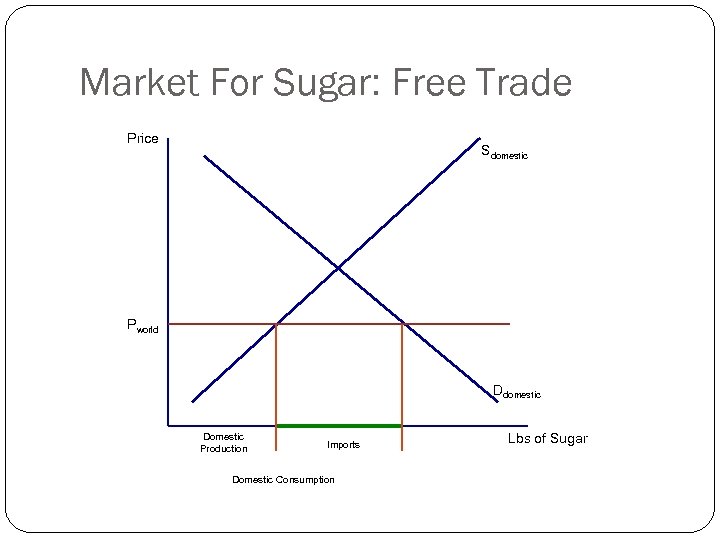 Market For Sugar: Free Trade Price Sdomestic Pworld Ddomestic Domestic Production Imports Domestic Consumption Lbs of Sugar
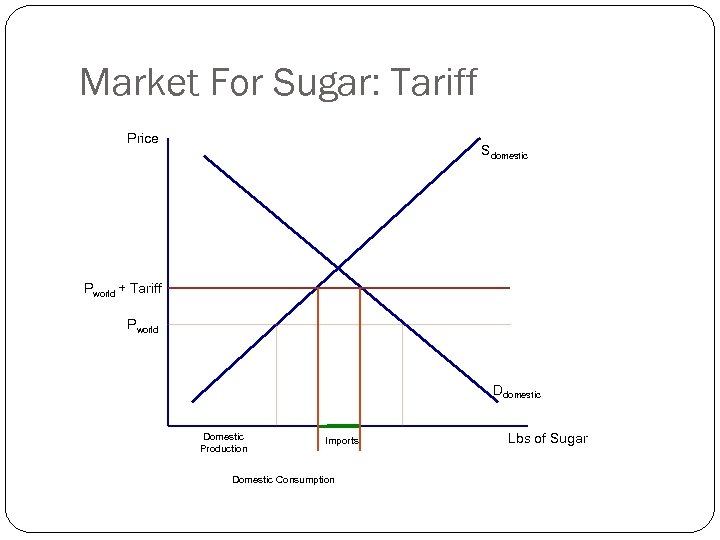 Market For Sugar: Tariff Price Sdomestic Pworld + Tariff Pworld Ddomestic Domestic Production Imports Domestic Consumption Lbs of Sugar
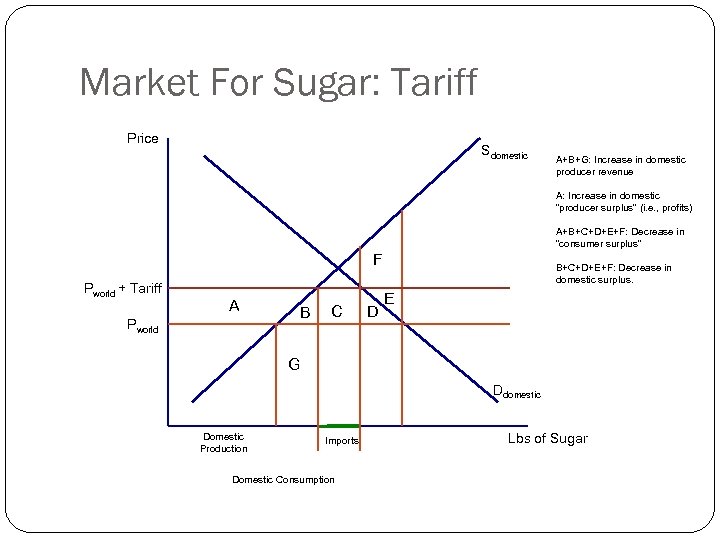 Market For Sugar: Tariff Price Sdomestic A+B+G: Increase in domestic producer revenue A: Increase in domestic “producer surplus” (i. e. , profits) A+B+C+D+E+F: Decrease in “consumer surplus” F Pworld + Tariff A B Pworld C D B+C+D+E+F: Decrease in domestic surplus. E G Ddomestic Domestic Production Imports Domestic Consumption Lbs of Sugar
 Impact of Tariff When world price is less than domestic (no-trade) price Compared to Free Trade: Tariff keeps domestic price artificially high Less domestic consumption More domestic production Consumers lose Domestic Producers win
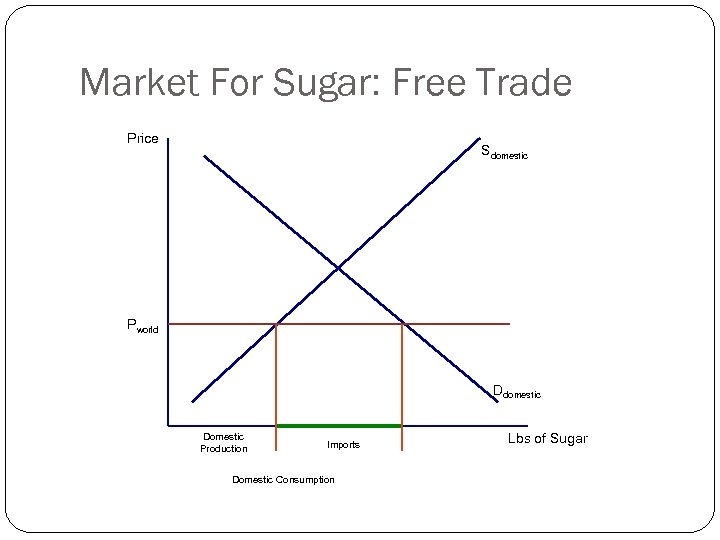 Market For Sugar: Free Trade Price Sdomestic Pworld Ddomestic Domestic Production Imports Domestic Consumption Lbs of Sugar
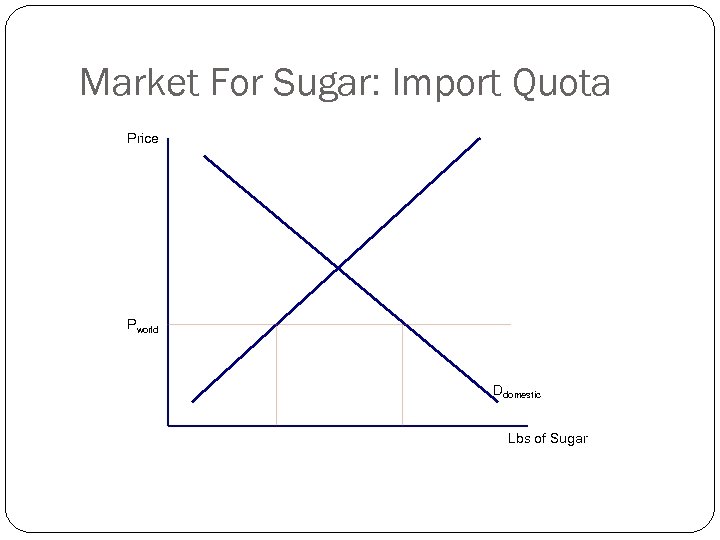 Market For Sugar: Import Quota Price Pworld Ddomestic Lbs of Sugar
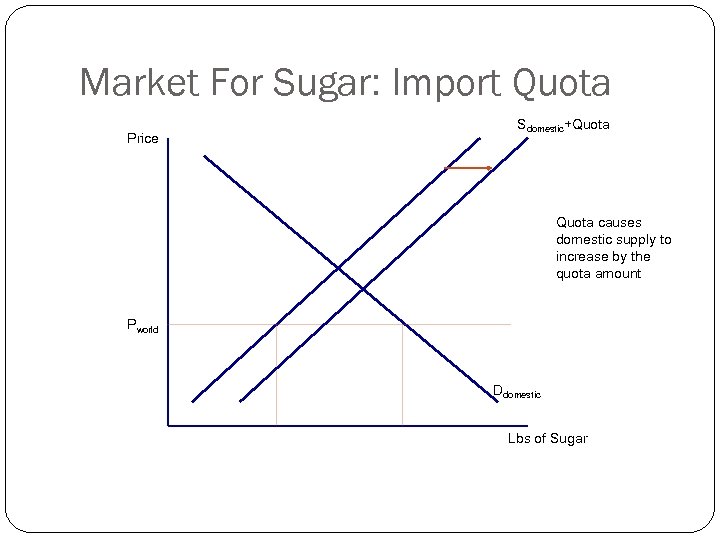 Market For Sugar: Import Quota Price Sdomestic+Quota causes domestic supply to increase by the quota amount Pworld Ddomestic Lbs of Sugar
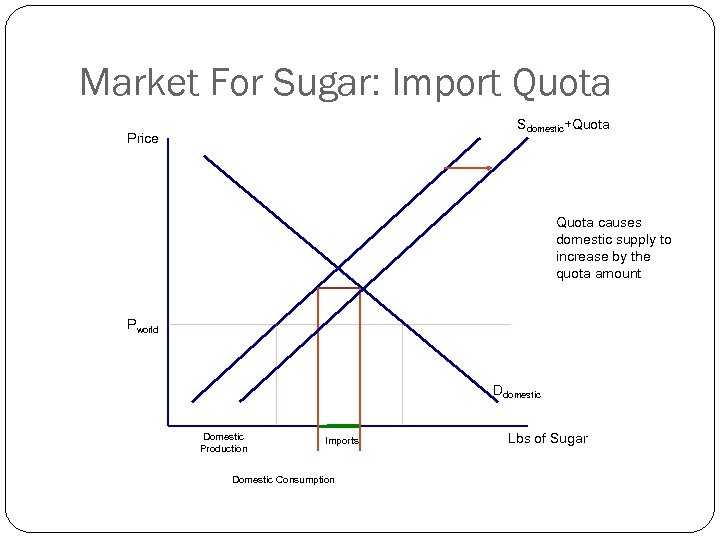 Market For Sugar: Import Quota Sdomestic+Quota Price Quota causes domestic supply to increase by the quota amount Pworld Ddomestic Domestic Production Imports Domestic Consumption Lbs of Sugar
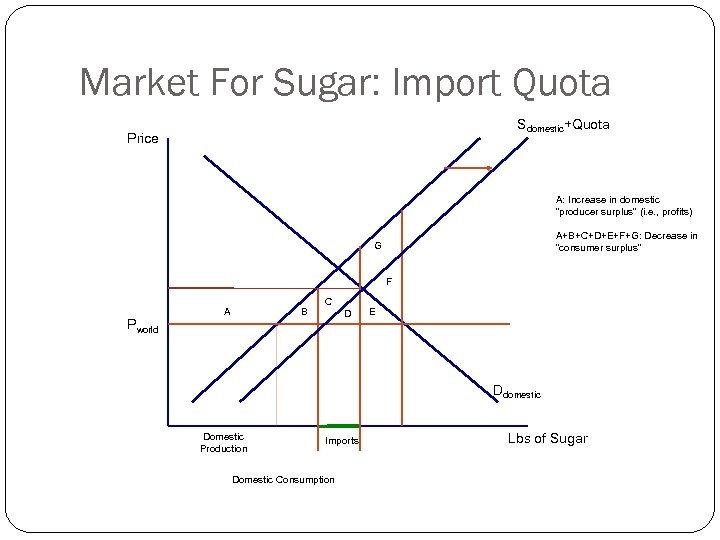 Market For Sugar: Import Quota Sdomestic+Quota Price A: Increase in domestic “producer surplus” (i. e. , profits) A+B+C+D+E+F+G: Decrease in “consumer surplus” G F Pworld A B C D E Ddomestic Domestic Production Imports Domestic Consumption Lbs of Sugar
 Impact of Import Quota When world price is less than domestic (no-trade) price Compared to Free Trade: Quota keeps domestic price artificially high Less domestic consumption More domestic production Consumers lose Domestic Producers win
 Which people benefit from free trade? Steel workers in Pittsburg? Sugar farmers in Florida? Garment industry workers in South Carolina? Software engineers in San Francisco? Employees at Boeing in Seattle? Financial Analysts in NYC? Professors at Harvard? Autoworkers in Detroit or Alabama?
 Implementing Free Trade Some groups of people are hurt by free trade agreements, even if the country as a whole benefits. Free trade agreements are often politically infeasible. There are still significant trade barriers, especially in some industries: Sugar, Steel, much manufacturing, etc. Who polices free trade agreements? World Trade Organization (WTO)
 Other arguments against free trade: Infant industry argument Some domestic industries need time to develop, before they can compete internationally Defense Some industries are essential for national defense, and should be supported domestically even if we don’t have a comparative advantage.
 Other arguments against free trade: Environment & Human Rights Domestic environmental and human rights standards may be higher than other places, increasing domestic cost of production, but also making the more expensive goods better for social welfare
 Fiscal Policy With Trade
 Economic Model Y=C+I+G+X–M X = Exports M = Imports US Income = US Output = Production purchased by US & Foreign consumers, investors and governments + X: Allows for purchases by foreigners - M: Removes any C or I or G that was directed abroad
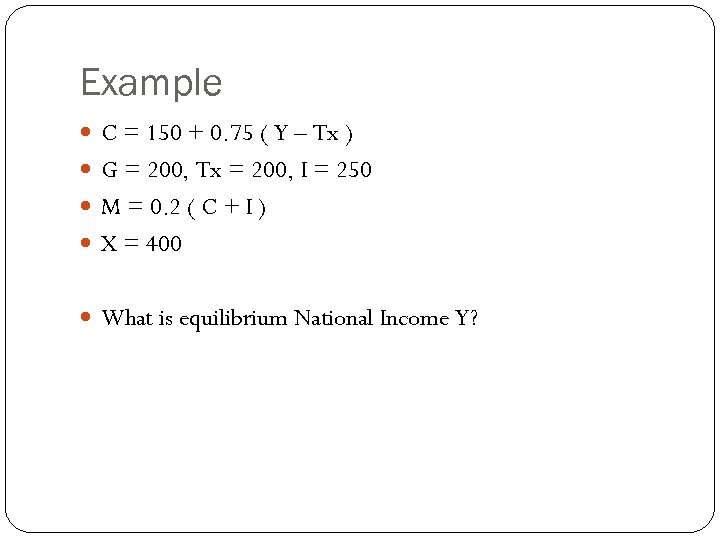 Example C = 150 + 0. 75 ( Y – Tx ) G = 200, Tx = 200, I = 250 M = 0. 2 ( C + I ) X = 400 What is equilibrium National Income Y?
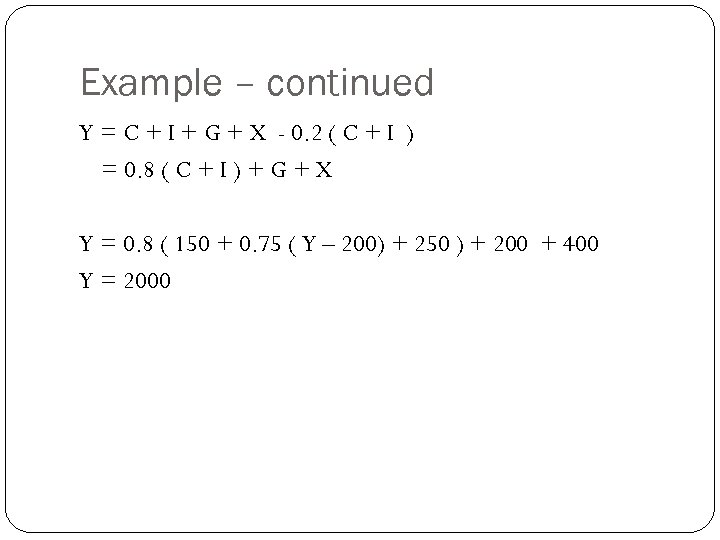 Example – continued Y = C + I + G + X - 0. 2 ( C + I ) = 0. 8 ( C + I ) + G + X Y = 0. 8 ( 150 + 0. 75 ( Y – 200) + 250 ) + 200 + 400 Y = 2000
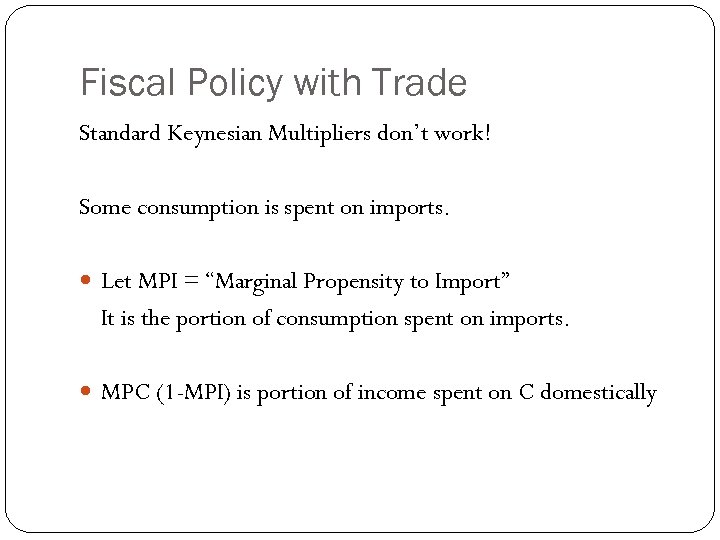 Fiscal Policy with Trade Standard Keynesian Multipliers don’t work! Some consumption is spent on imports. Let MPI = “Marginal Propensity to Import” It is the portion of consumption spent on imports. MPC (1 -MPI) is portion of income spent on C domestically
 Keynesian Multipliers With Trade
 Keynesian Multipliers With Trade Fiscal policy is less potent. With trade, a change in G or Tx brings a smaller change in Y
 Effects of Foreign Trade on Fiscal Policy Benefits of expansionary policy are no longer concentrated in domestic boarders. As spending increases, some of it is directed abroad. Need more aggressive policy to see same effects at home.
 Foreign Exchange
 Foreign Exchange Two countries: USA and UK USA currency: $ UK currency: £ Why would someone with dollars want to exchange them for pounds?
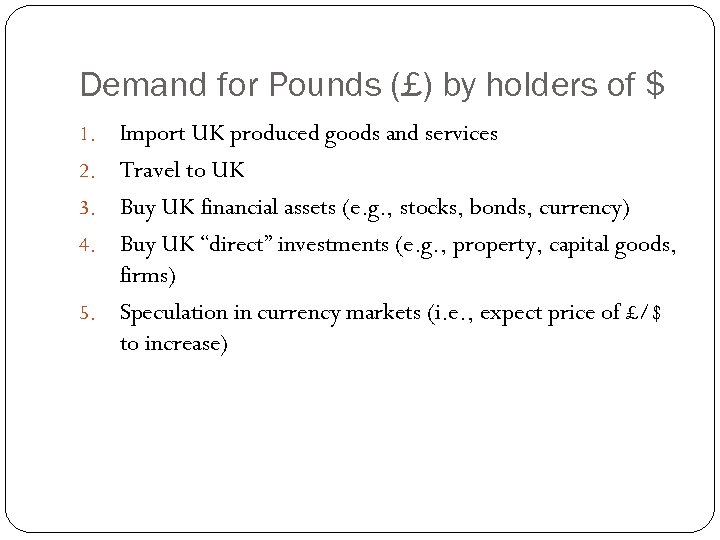 Demand for Pounds (£) by holders of $ 1. 2. 3. 4. 5. Import UK produced goods and services Travel to UK Buy UK financial assets (e. g. , stocks, bonds, currency) Buy UK “direct” investments (e. g. , property, capital goods, firms) Speculation in currency markets (i. e. , expect price of £/$ to increase)
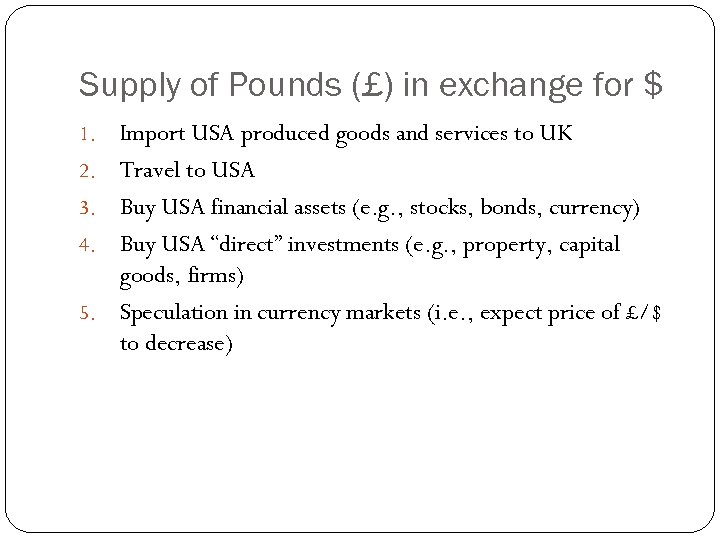 Supply of Pounds (£) in exchange for $ 1. 2. 3. 4. 5. Import USA produced goods and services to UK Travel to USA Buy USA financial assets (e. g. , stocks, bonds, currency) Buy USA “direct” investments (e. g. , property, capital goods, firms) Speculation in currency markets (i. e. , expect price of £/$ to decrease)
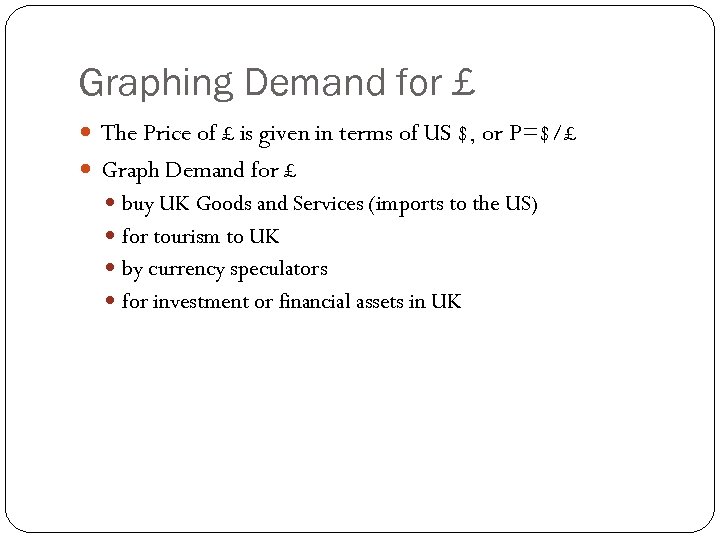 Graphing Demand for £ The Price of £ is given in terms of US $, or P=$/£ Graph Demand for £ buy UK Goods and Services (imports to the US) for tourism to UK by currency speculators for investment or financial assets in UK
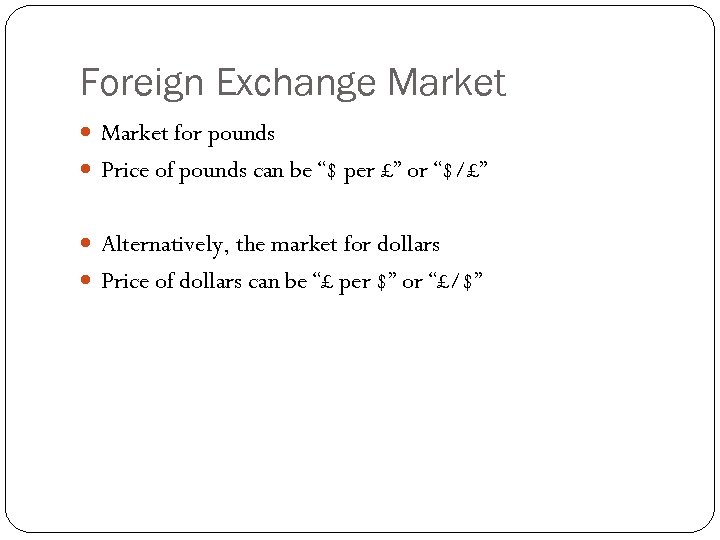 Foreign Exchange Market for pounds Price of pounds can be “$ per £” or “$/£” Alternatively, the market for dollars Price of dollars can be “£ per $” or “£/$”
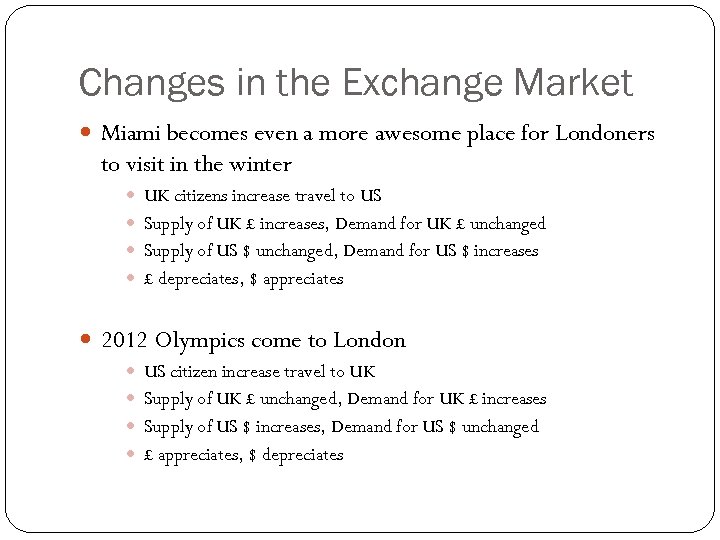 Changes in the Exchange Market Miami becomes even a more awesome place for Londoners to visit in the winter UK citizens increase travel to US Supply of UK £ increases, Demand for UK £ unchanged Supply of US $ unchanged, Demand for US $ increases £ depreciates, $ appreciates 2012 Olympics come to London US citizen increase travel to UK Supply of UK £ unchanged, Demand for UK £ increases Supply of US $ increases, Demand for US $ unchanged £ appreciates, $ depreciates
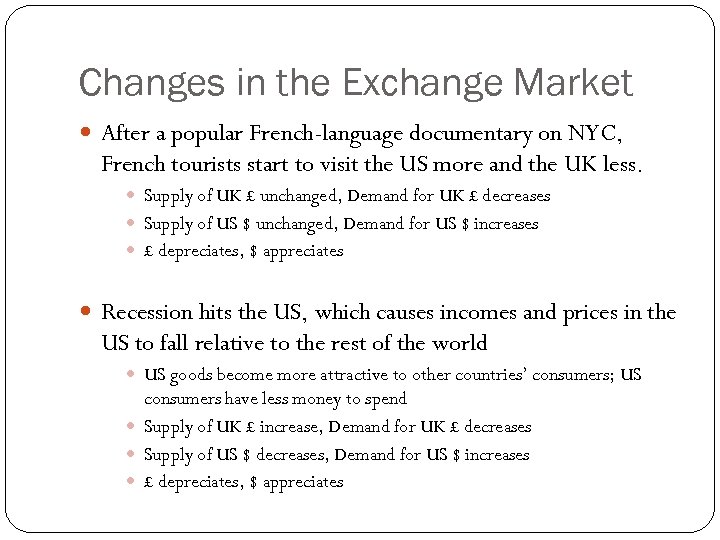 Changes in the Exchange Market After a popular French-language documentary on NYC, French tourists start to visit the US more and the UK less. Supply of UK £ unchanged, Demand for UK £ decreases Supply of US $ unchanged, Demand for US $ increases £ depreciates, $ appreciates Recession hits the US, which causes incomes and prices in the US to fall relative to the rest of the world US goods become more attractive to other countries’ consumers; US consumers have less money to spend Supply of UK £ increase, Demand for UK £ decreases Supply of US $ decreases, Demand for US $ increases £ depreciates, $ appreciates
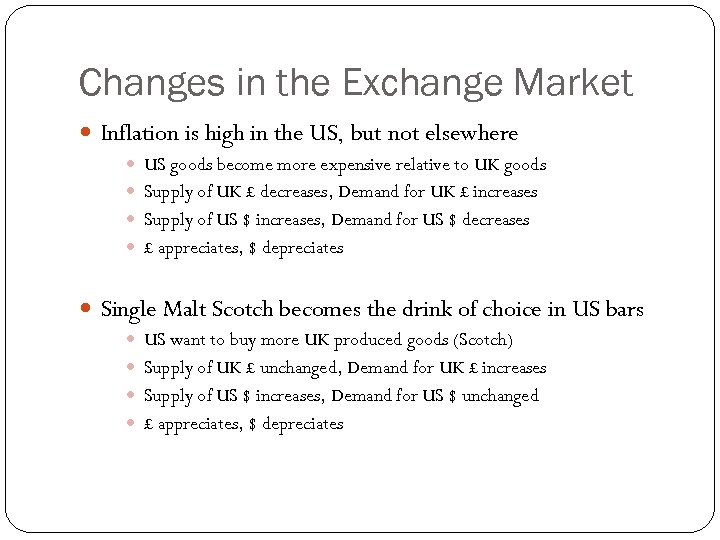 Changes in the Exchange Market Inflation is high in the US, but not elsewhere US goods become more expensive relative to UK goods Supply of UK £ decreases, Demand for UK £ increases Supply of US $ increases, Demand for US $ decreases £ appreciates, $ depreciates Single Malt Scotch becomes the drink of choice in US bars US want to buy more UK produced goods (Scotch) Supply of UK £ unchanged, Demand for UK £ increases Supply of US $ increases, Demand for US $ unchanged £ appreciates, $ depreciates
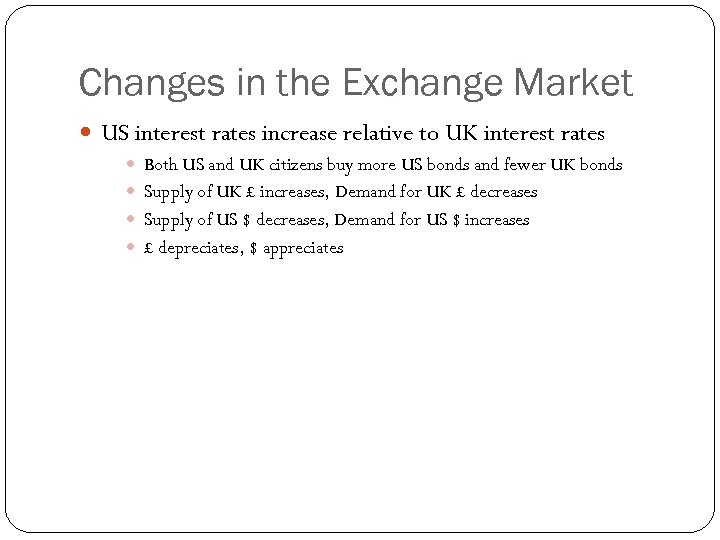 Changes in the Exchange Market US interest rates increase relative to UK interest rates Both US and UK citizens buy more US bonds and fewer UK bonds Supply of UK £ increases, Demand for UK £ decreases Supply of US $ decreases, Demand for US $ increases £ depreciates, $ appreciates
 Impact of Exchange Rate on Imports and Exports Keeping prices fixed, what happens to exports and imports when the dollar depreciates? US Exports go up, Imports go down. A dollar buys less in other countries. Other countries’ currencies buy more in the US. When the dollar appreciates? US Exports go down, Imports go up. A dollar buys more in other countries. Other countries’ currencies buy less in the US.
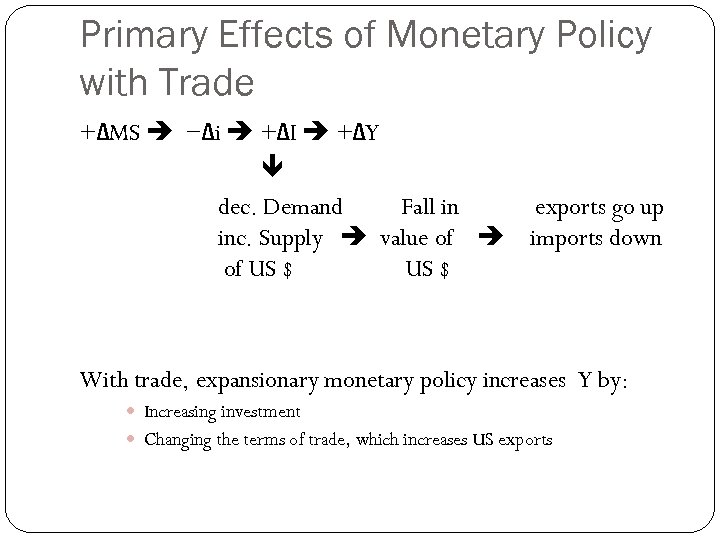 Primary Effects of Monetary Policy with Trade +ΔMS −Δi +ΔI +ΔY dec. Demand Fall in inc. Supply value of US $ exports go up imports down With trade, expansionary monetary policy increases Y by: Increasing investment Changing the terms of trade, which increases US exports
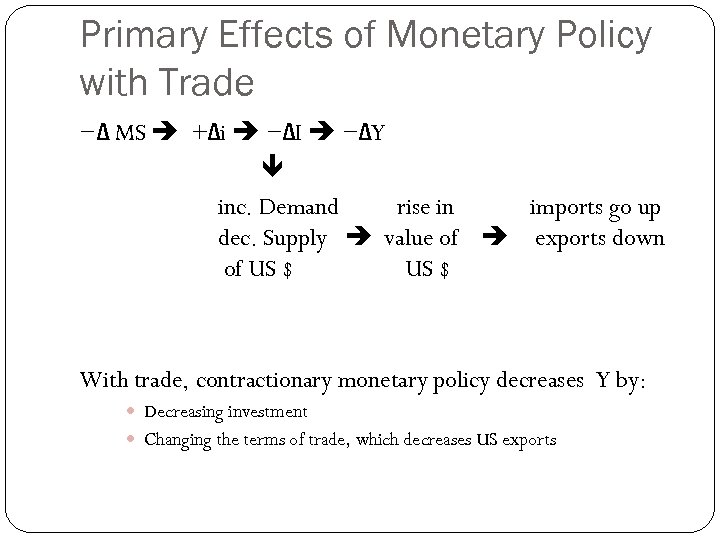 Primary Effects of Monetary Policy with Trade −Δ MS +Δi −ΔI −ΔY inc. Demand rise in imports go up dec. Supply value of exports down of US $ With trade, contractionary monetary policy decreases Y by: Decreasing investment Changing the terms of trade, which decreases US exports
 Circular Flow Draw a circular flow diagram for both the US and UK with trade between the countries. Fiscal Policy Monetary Policy
 Some questions: Are you personally made better off when the dollar is stronger? If you are from abroad and must convert currency to $ to pay tuition? If you earn US dollars and like to travel abroad? If you own a consulting company that typically does 75% of its business in other countries, but pay rent and salaries in the US? Like French wine? Build trucks in Detroit using imported steel?
 Some questions: Why do people care about foreign exchange markets? Prices of imports and travel Currency speculations and which financial assets to buy How could the Federal Reserve increase the “strength” of the dollar (make the price of dollars go up)? Contractionary monetary policy