

TOPIC #4 Writing and Managing Business & Emails

TOPIC #4 Writing and Managing Business & Emails Olga Myronova, PhD, Management and Business Department KhNUE MANAGER’S LABOR ORGANIZING
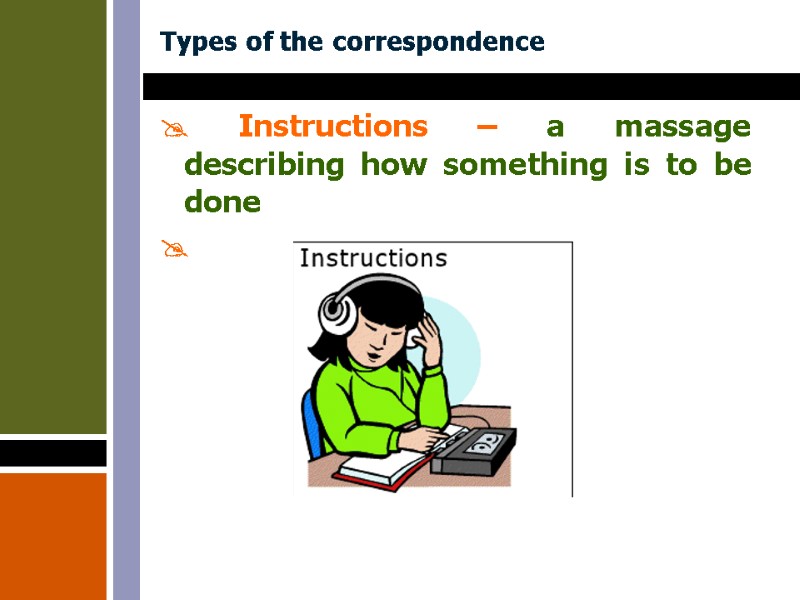
Types of the correspondence Instructions – a massage describing how something is to be done
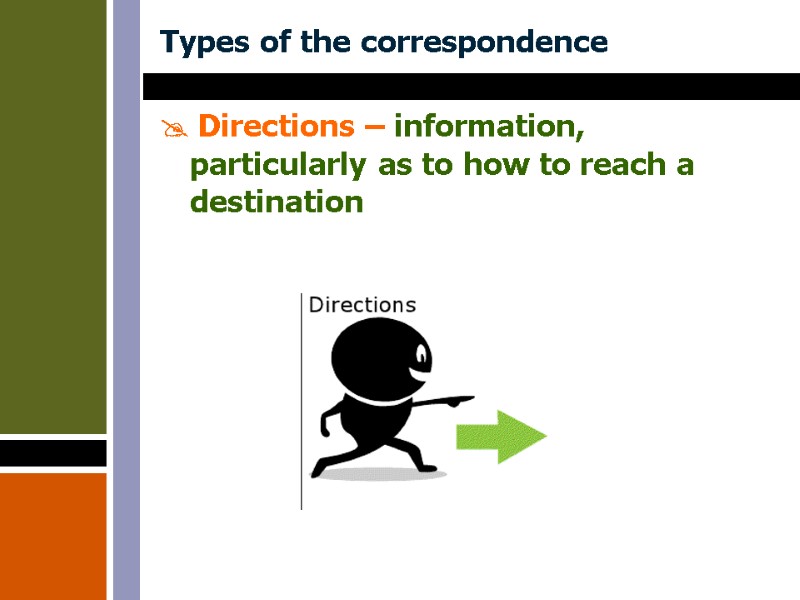
Types of the correspondence Directions – information, particularly as to how to reach a destination
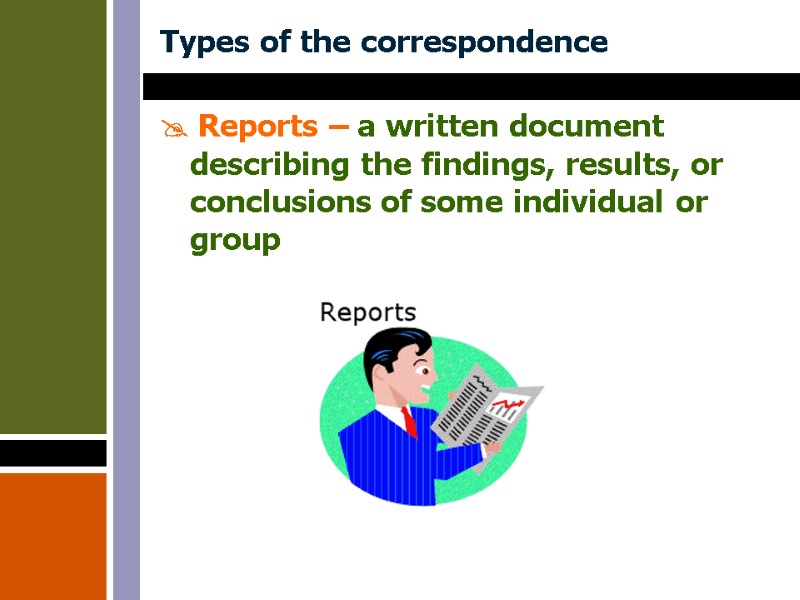
Types of the correspondence Reports – a written document describing the findings, results, or conclusions of some individual or group
Types of the correspondence Business Letter – is formal massage following specific formats.
Types of the correspondence Memo – is a document sent within a company. It is presented in short form, highlighting certain aspects.
Types of the correspondence Email – is a communication sent from one computer to another, usually via a network. It is the least formal method of written communication within a company.
Six Writing Rules 1. Answer the question that’s been asked. After you write your response, read the incoming letter again to make sure you answered the question (s). 2. Use clear language: write in the active voice, use words the reader knows, avoid in-house jargon and acronyms, take out unnecessary words.
Six Writing Rules 3. Summarize the background information. Don’t include every date and decision when you describe a problem or long-standing issue. A summary is better, unless you need documentation for legal reasons. 4. Organize your message: present information in a logical order, decide where to put the most important information, put details in an attachment or use a hyperlink to give the reader more information.
Six Writing Rules 5. Use a professional, yet empathetic tone. When you need to deliver bad news, comment on a sore subject, or clear up a misunderstanding, be firm, but polite and empathetic. Do not answer, point-by-point, every criticism the writer has leveled at you, the project, or the agency. 6. Write short sentences. Aim for a maximum of 17 to 20 words in a sentence.
Business Letters A business letter is more formal than a personal letter. It should have a margin of at least one inch on all four edges.
There are six parts to a business letter: 1. The Heading. This contains the return address (usually two or three lines) with the date on the last line. Sometimes it may be necessary to include a line after the address and before the date for a phone number, fax number, E-mail address, or something similar. Often a line is skipped between the address and date. That should always be done if the heading is next to the left margin. It is not necessary to type the return address if you are using stationery with the return address already imprinted. Always include the date
There are six parts to a business letter: 2. The Inside Address. This is the address you are sending your letter to. Make it as complete as possible. Include titles and names if you know them. This is always on the left margin. An inside address also helps the recipient route the letter properly and can help should the envelope be damaged and the address become unreadable. Skip a line after the heading before the inside address. Skip another line after the inside address before the greeting.
There are six parts to a business letter: 3. The Greeting. Also called the salutation. The greeting in a business letter is always formal. It normally begins with the word "Dear" and always includes the person's last name. It normally has a title. Use a first name only if the title is unclear--for example, you are writing to someone named "Leslie," but do not know whether the person is male or female. For more on the form of titles, see Titles with Names. The greeting in a business letter always ends in a colon. (You know you are in trouble if you get a letter from a boyfriend or girlfriend and the greeting ends in a colon--it is not going to be friendly.)
There are six parts to a business letter: 4. The Body. The body is written as text. A business letter is never hand written. Depending on the letter style you choose, paragraphs may be indented. Regardless of format, skip a line between paragraphs. Skip a line between the greeting and the body. Skip a line between the body and the close.
There are six parts to a business letter: 5. The Complimentary Close. This short, polite closing ends with a comma. It is either at the left margin or its left edge is in the center, depending on the Business Letter Style that you use. It begins at the same column the heading does. The block style is becoming more widely used because there is no indenting to bother with in the whole letter.
There are six parts to a business letter: 6. The Signature Line. Skip two lines (unless you have unusually wide or narrow lines) and type out the name to be signed. This customarily includes a middle initial, but does not have to. Women may indicate how they wish to be addressed by placing Miss, Mrs., Ms. or similar title in parentheses before their name. The signature line may include a second line for a title, if appropriate. The term "By direction" in the second line means that a superior is authorizing the signer. The signature should start directly above the first letter of the signature line in the space between the close and the signature line. Use blue or black ink. Business letters should not contain postscripts.
Common types of business letters: Acknowledgement Letter : This type of letter is written when you want to acknowledge some one for his help or support when you were in trouble. The letter can be used to just say thanks for something you have received from some one, which is of great help to you. Apology Letter : An apology letter is written for a failure in delivering the desired results. If the person has taken up a task and he fails to meet the target then he apologizes and asks for an opportunity to improve in this type of letter.
Common types of business letters: Appreciation Letter : An appreciation letter is written to appreciate some one's work in the organization. This type of letter is written by a superior to his junior. An organization can also write an appreciation letter to other organization, thanking the client for doing business with them. Complaint Letter : A complaint letter is written to show one that an error has occurred and that needs to be corrected as soon as possible. The letter can be used as a document that was used for warning the reader.
Common types of business letters: Inquiry Letter : The letter of inquiry is written to inquire about a product or service. If you have ordered a product and yet not received it then you can write a letter to inquire when you will be receiving it. Order Letter : This letter is as the name suggests is used for ordering products. This letter can be used as a legal document to show the transaction between the customer and vendor.
Common types of business letters: Letter of Recommendation : This type of letter is written to recommend a person for a job position. The letter states the positive aspects of the applicant's personality and how he/she would be an asset for the organization. This Letter is even used for promoting a person in the organization.
Business letter in three steps: 1. Introduction - the reason for writing. The introduction helps the reader understand in which context the letter should be considered. Possibilities include job interview inquires, business opportunity requests, complaints, and more. Each type of business letter has its own standard phrases.
Business letter in three steps: 2. Details. What you would like to accomplish The detail section of a business letter is extremely important. This is where you achieve your goals in writing a business letter.
Business letter in three steps: 3. Conclusion / Next Steps. What you would like to happen in the future Provide a call for future action. This can be a chance to talk in person, a follow-up letter or more. It's important and expected to make it clear what you would like for the next step from the person reading your business letter.
The Start The start of any business letter begins by addressing the recipient of the letter. Dear Personnel Director, Dear Sir or Madam: (use if you don't know who you are writing to) Dear Dr, Mr, Mrs, Miss or Ms Smith: (use if you know who you are writing to, and have a formal relationship with - VERY IMPORTANT use Ms for women unless asked to use Mrs or Miss) Dear Frank: (use if the person is a close business contact or friend) Note: If you are unsure how formal you should be, always choose a more formal form. Writing to a specific person is always preferred if at all possible.
The Reference Begin by referencing a specific conversation or other contact means. If this is the first letter in a conversation, you can also provide the reason for writing. With reference to your advertisement in the Times, your letter of 23 rd March, your phone call today, Thank you for your letter of March 5 th.
The Reason for Writing I am writing to... ... inquire about ... apologize for ... confirm ... comment on ... apply for
Requesting Once you have introduced the reason for writing your business letter, move on to stating more specifically the purpose of your letter. Could you possibly? I would be grateful if you could Agreeing to Requests I would be delighted to Giving Bad News Unfortunately I am afraid that
Questions?

Thank you
 Скачать презентацию TOPIC #4 Writing and Managing Business & Emails
14268-topic_4.ppt
- Количество слайдов: 30