


 Скачать презентацию Topic 4 Warehouse Management with OHS Procedures
7b797748a5b6cba8e748c790b9358b7f.ppt
- Количество слайдов: 42
 Topic 4 Warehouse Management with OHS Procedures
 Warehousing refers to the activities involving storage of goods on a large-scale in a systematic and orderly manner and making them available conveniently when needed. In other words, warehousing means holding or preserving goods in huge quantities from the time of their purchase or production till their actual use or sale.
 Reasons for warehousing To support the company’s customer policy. To maintain a source of supply without interruptions. To support changing market conditions and sudden changes in demand. To support any JIT programs. To provide customers with the right mix of products at all times and all locations. To ensure least logistics cost for a desired level of customer service.
 Warehouse Layout An inefficient layout of warehouse can have a negative effect on a business such as: ◦ ◦ Decreasing Productivity Creating Inventory Control Issues Errors in delivery Safety risks
 Strategies • To counter the above problems, the following is suggested: – Appropriate space in Receiving area. As this is the first point of receiving goods enough space must be allocated to ensure the safety of good and also proper recoding of goods through the use various technological practice such as scanning. Enough space must be given to allow for movement of logistics to avoid any accident that may give rise to legal issues
 Strategies • Segmentation To allow for fast and dynamic delivery of goods, warehouse must be segmented. Goods returned must be kept separate. Set up bin location for pick up Easy completing the formalities.
 Strategies Inventory ◦ Warehouse must be structure that goods are not moved more than one time. ◦ Packing area must be provided for. ◦ Dispatch area must be provided for.
 Technique 1. 2. 3. 4. 5. Storage area is enough to carry the load of the goods All space must be used to maximize return on investment Proper storage system to be introduced Storage structure. One point of receiving and one point of dispatching goods
 Technique 6. Appropriate Spacing between goods 7. Aisles Orientation 8. Structured Flow of goods 9. Efficient Loading and Unloading Area 10. Allows for expansion
 WAREHOUSING MANAGEMENT Gaurav Narkhede | Josue Servalis | Mike Macas | Praneetha Boda
 Part of firms logistics system that stores products at and between point of origin and point of consumption. Term “Warehousing” is referred as transportation at zero miles per hour Warehousing provides time and place utility for raw materials, industrial goods, and finished products, allowing firms to use customer service as a dynamic value-adding competitive tool.
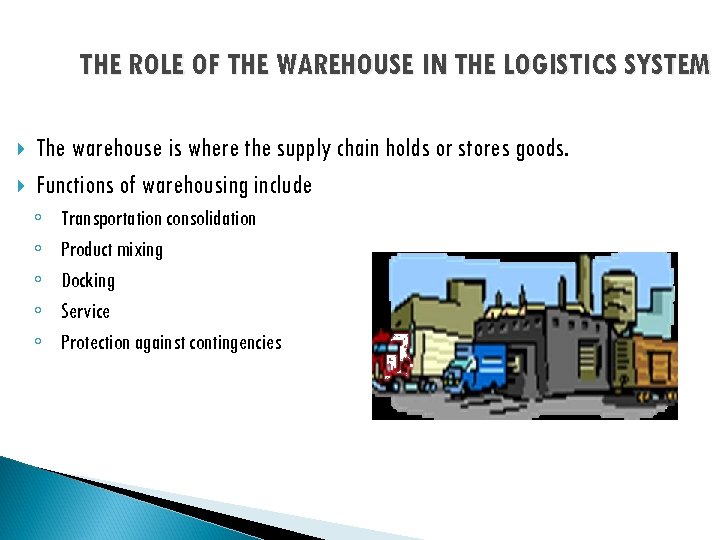 THE ROLE OF THE WAREHOUSE IN THE LOGISTICS SYSTEM The warehouse is where the supply chain holds or stores goods. Functions of warehousing include ◦ ◦ ◦ Transportation consolidation Product mixing Docking Service Protection against contingencies
 TYPE OF WAREHOUSING • Public Warehousing The warehouses which are run to store goods of the general public are known as public warehouses. Any one can store his goods in these warehouses on payment of rent. • Private Warehousing The warehouses which are owned and managed by the manufacturers or traders to store, exclusively, their own stock of goods are known as private warehouses.
 Contract Warehousing businesses that handle the shipping, receiving, and storage products on a contract basis. Contract warehouses generally require a client to commit to a specific period of time for the services.
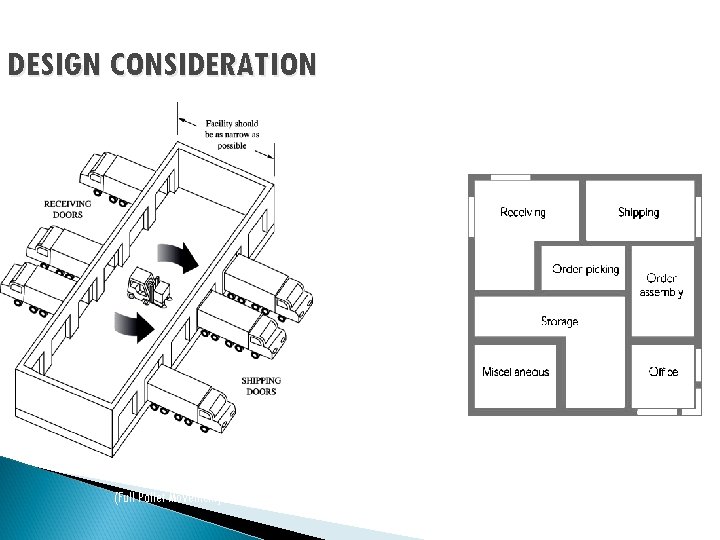 DESIGN CONSIDERATION Ideal Facility for Pure Supplier Consolidation (Full Pallet Movement) Warehouse Space Requirements
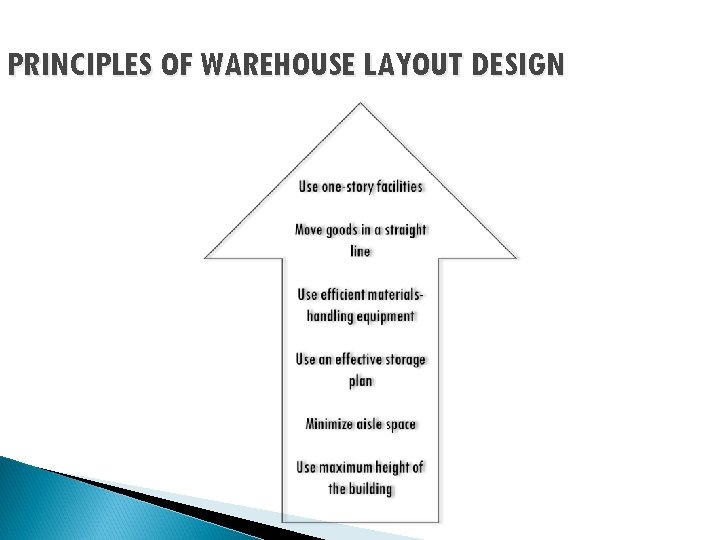 PRINCIPLES OF WAREHOUSE LAYOUT DESIGN
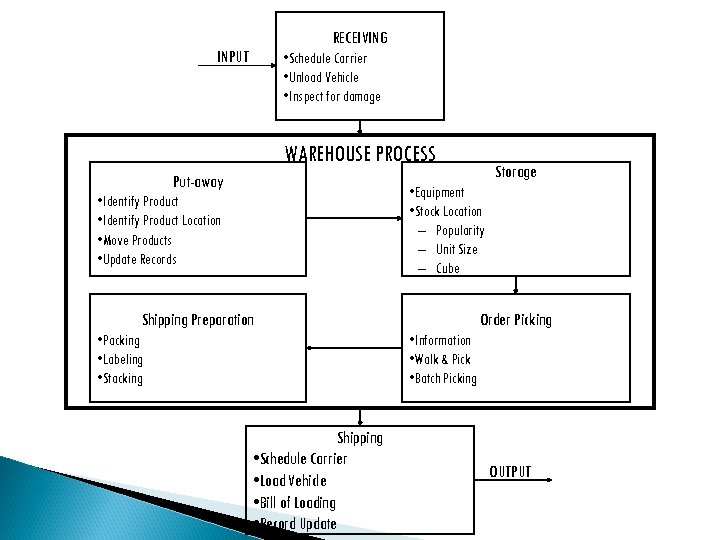 RECEIVING INPUT • Schedule Carrier • Unload Vehicle • Inspect for damage WAREHOUSE PROCESS Put-away Storage • Equipment • Stock Location – Popularity – Unit Size – Cube • Identify Product Location • Move Products • Update Records Shipping Preparation • Packing • Labeling • Stacking Order Picking • Information • Walk & Pick • Batch Picking Shipping • Schedule Carrier • Load Vehicle • Bill of Loading • Record Update OUTPUT
 OBJECTIVES OF EFFICIENT WAREHOUSE OPERATIONS • Provide timely customer service. • Keep track of items so they can be found readily & correctly. • Minimize the total physical effort & thus the cost of moving goods into & out of storage. • Provide communication links with customers
 Benefits of Warehouse Management ◦ Provide a place to store & protect inventory ◦ Reduce transportation costs ◦ Improve customer service levels Complexity of warehouse operation depends on the number of SKUs handled & the number of orders received & filled. Most activity in a warehouse is material handling.
 COSTS OF OPERATING A WAREHOUSE • Capital costs — Costs of space & materials handling equipment • Operating costs — Cost of labor — Measure of labor productivity is the number of units that an operator can move in a day
 WAREHOUSE ACTIVITIES Receive goods Identify the goods Dispatch goods to storage Hold goods Pick goods Marshal shipment Dispatch shipment Operate an information system
 Receive goods • Accepts goods from ‒ Outside transportation or attached factory & accepts responsibility • Check the goods against an order & the bill of loading • Check the quantities • Check for damage & fill out damage reports if necessary • Inspect goods if required
 Identify the goods ‒ items are identified with the appropriate stock-keeping unit (SKU) number (part number) & the quantity received recorded Dispatch goods to storage ‒ goods are sorted & put away Hold goods ‒ goods are kept in storage & under proper protection until needed
 Pick goods ‒ items required from stock must be selected from storage & brought to a marshalling area Marshal the shipment ‒ goods making up a single order are brought together & checked for omissions or errors; order records are updated
 Dispatch the shipment ‒ orders are packaged, shipping documents are prepared, & goods loaded on the vehicle Operate an information system ‒ a record must be maintained for each item in stock showing the quantity on hand, quantity received, quantity issued, & location in the warehouse
 Maximize productivity & minimize cost, warehouse management must work with the following • Maximize use of space – space is the largest capital cost • Effective use of labor & equipment – labor is the largest operating cost – material handling equipment is the second largest capital cost
 FACTORS INFLUENCING EFFECTIVE USE OF WAREHOUSES • Cube utilization and accessibility • Stock location • Order picking and assembly • Physical Control & Security - Elements
 Cube utilization and accessibility ‒ Goods stored not just on the floor, but in the cubic space of the warehouse; warehouse capacity depends on how high goods can be stored ‒ Accessibility means being able to get at the goods wanted with a minimum amount of work
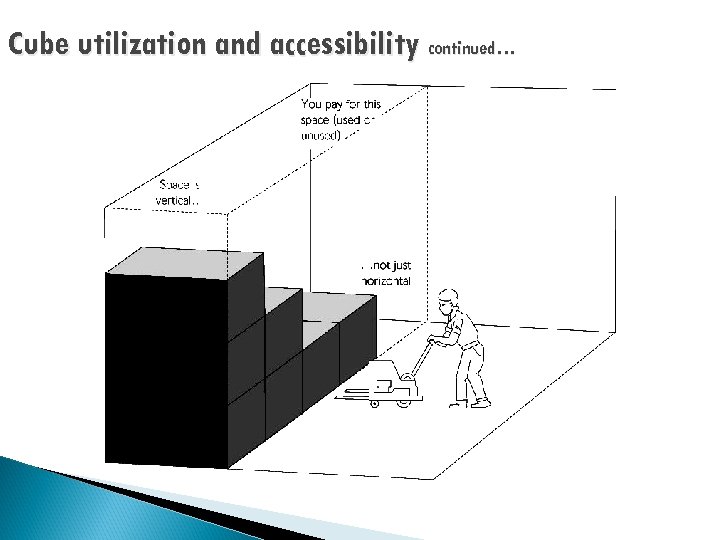 Cube utilization and accessibility continued…
 Stock Location • Objectives – To provide the required customer service – To keep track of where items are stored – To minimize effort to receive, put away, and retrieve items • Basic Stock Locating Systems – Group functionally related items together – Group fast-moving items together – Group physically similar items together – Locate working stock and reserve stock separately
 Stock Location continued… Fixed Location ◦ SKU assigned a permanent location, & no other items are stored there ◦ Fixed-location systems usually have poor cube utilization ◦ Usually used in small warehouses; throughput is small, & there are few SKUs Floating (Random) Location ◦ Goods stored wherever there is appropriate space ◦ Advantage is improved cube utilization ◦ It requires accurate and up-to-date information ◦ Warehouses using floating-location systems are usually computer-based
 Stock Location continued… • Two other systems sometimes used are – Point-of-use storage • Inventory stored close to where it will be needed • Used in repetitive manufacturing & JIT systems – Central storage • Contains all inventory in one central location
 Stock Location continued… Advantages of Point-of-use Storage ◦ Materials are readily accessible to users ◦ Material handling is reduced or eliminated ◦ Central storage costs are reduced ◦ Material is accessible all the time
 Stock Location continued… Advantages of Central Storage ◦ Ease of control ◦ Inventory record accuracy is easier to maintain ◦ Specialized storage can be used ◦ Reduced safety stock, since users do not need to carry their own safety stock
 Order Picking and Assembly • When an order is received, items must be obtained from the warehouse, grouped, & prepared for shipment, systems used – Area system – Zone system – Multi-order system
 Order Picking and Assembly continued… • Area system – Order picker circulates throughout warehouse selecting items on an order -- order is ready to ship when order picker is finished • Zone system – Warehouse is divided into zones, & each picker works only in an assigned zone -- order is divided by zone, & the items from each zone are sent to the marshaling area
 Order Picking and Assembly continued… • Multi-order system – Same as the zone system, except that each picker collects items for a number of orders at the same time
 PHYSICAL CONTROL & SECURITY - ELEMENTS • Good part numbering system • Simple, well-documented transaction system – – Identify the item Verify the quantity Record the transaction Physically execute the transaction • Limited access – Inventory must be kept in a safe, secure (locked) place with limited general access • Well-trained workforce
 Automated Housing System Machines and tools are used to facilitate order picking—e. g. , a storage carousel that rotates around a closed loop and delivers requested stock-keeping units (SKUs) to the order picker (horizontal carousel or vertical carousel).
 Benefits of using Automation in a Warehouse - Automation provide a wide range of benefits including: space savings, lower building costs, improved productivity, more efficient material flow, less people, safer operations,
 Benefits increased reliability, - reduced running costs, - It creates a more efficient use of space. With less floor space and building height taken up by storage, companies can dedicate the extra space for other functions. - can operate 24/7 and don’t rely on manpower, automated warehouses are much more efficient. - The machines used are designed for safety and will likely result in fewer -
 THANK YOU