


 Скачать презентацию Topic 3 Math Drugs Calculations IV Giving Sets
0d802bf4886b8f211ef0801dfd803d25.ppt
- Количество слайдов: 48
 Topic 3 Math/Drugs Calculations
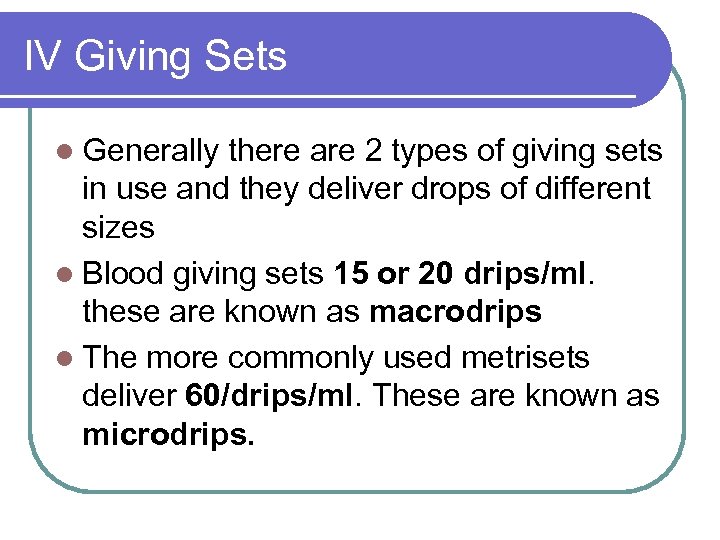 IV Giving Sets l Generally there are 2 types of giving sets in use and they deliver drops of different sizes l Blood giving sets 15 or 20 drips/ml. these are known as macrodrips l The more commonly used metrisets deliver 60/drips/ml. These are known as microdrips.
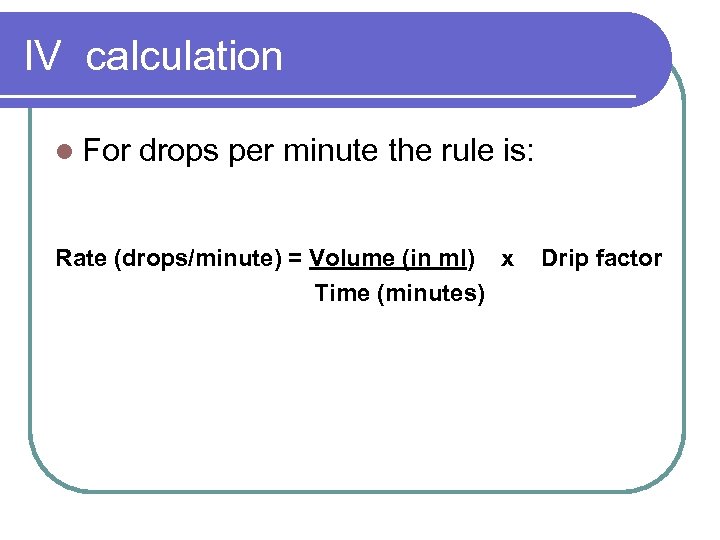 IV calculation l For drops per minute the rule is: Rate (drops/minute) = Volume (in ml) x Time (minutes) Drip factor
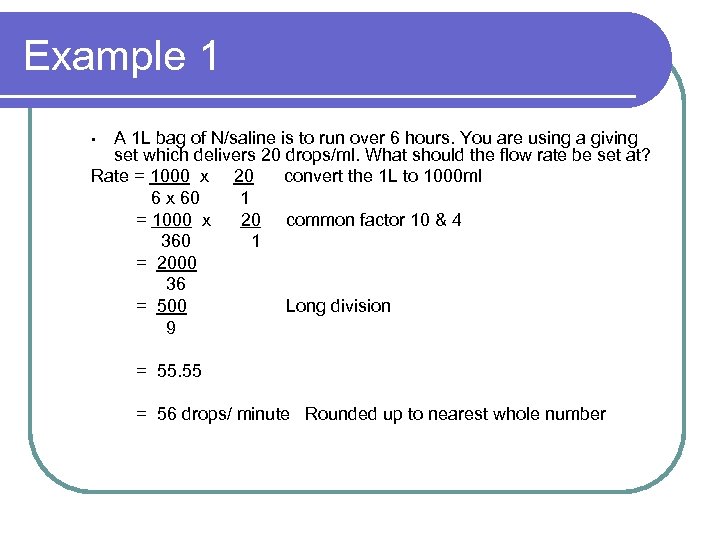 Example 1 A 1 L bag of N/saline is to run over 6 hours. You are using a giving set which delivers 20 drops/ml. What should the flow rate be set at? Rate = 1000 x 20 convert the 1 L to 1000 ml 6 x 60 1 = 1000 x 20 common factor 10 & 4 360 1 = 2000 36 = 500 Long division 9 • = 55. 55 = 56 drops/ minute Rounded up to nearest whole number
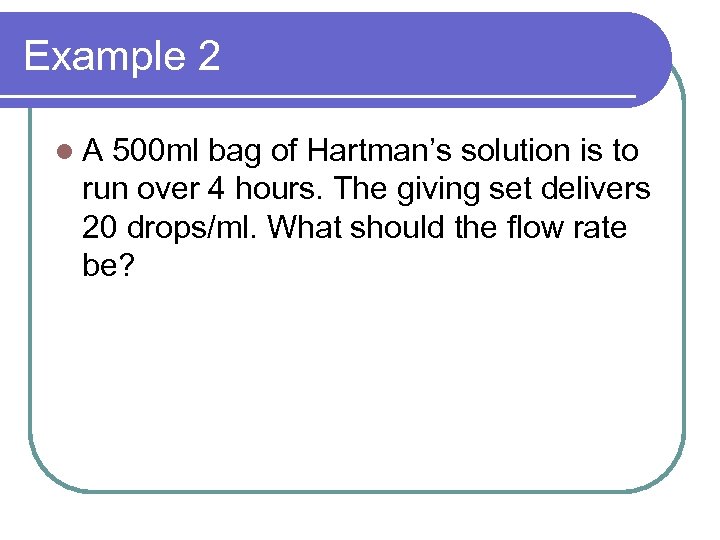 Example 2 l. A 500 ml bag of Hartman’s solution is to run over 4 hours. The giving set delivers 20 drops/ml. What should the flow rate be?
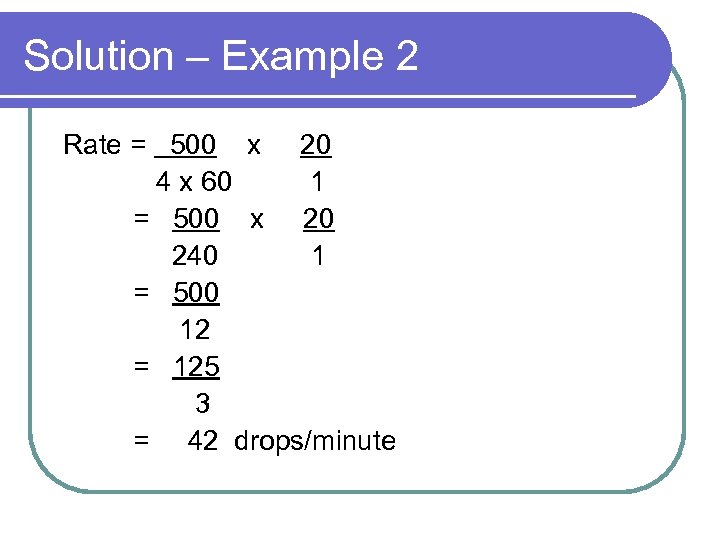 Solution – Example 2 Rate = 500 x 20 4 x 60 1 = 500 x 20 240 1 = 500 12 = 125 3 = 42 drops/minute
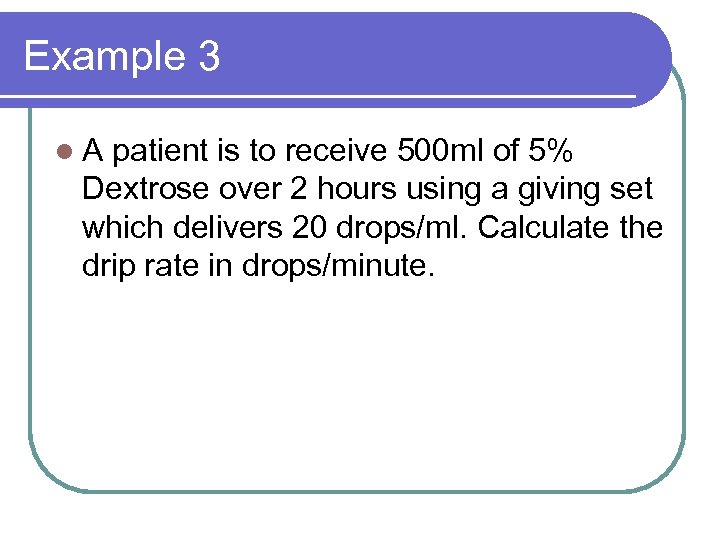 Example 3 l. A patient is to receive 500 ml of 5% Dextrose over 2 hours using a giving set which delivers 20 drops/ml. Calculate the drip rate in drops/minute.
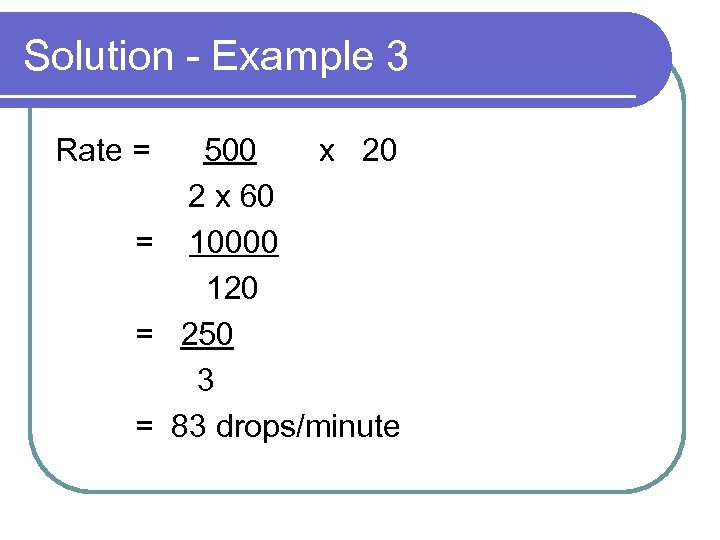 Solution - Example 3 Rate = 500 x 20 2 x 60 = 10000 120 = 250 3 = 83 drops/minute
 Example 4 l. A patient has to have an IV set up to deliver 1 L of fluid over 4 hours, using a metriset (60 drops/ml). What should the flow rate be?
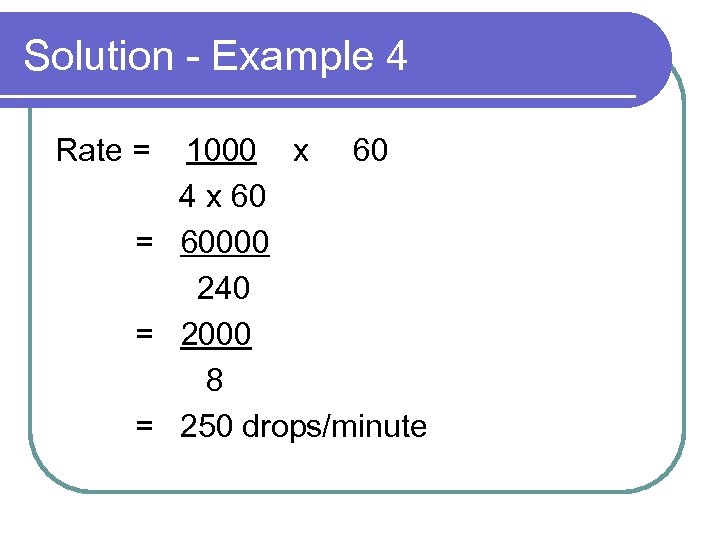 Solution - Example 4 Rate = 1000 x 60 4 x 60 = 60000 240 = 2000 8 = 250 drops/minute
 Example 5 l. A dehydrated adult is ordered 1 L of normal saline over 2 hours, using a macrodrip (20 drops/ml) IV giving set. Calculate the drip rate in drops/minute.
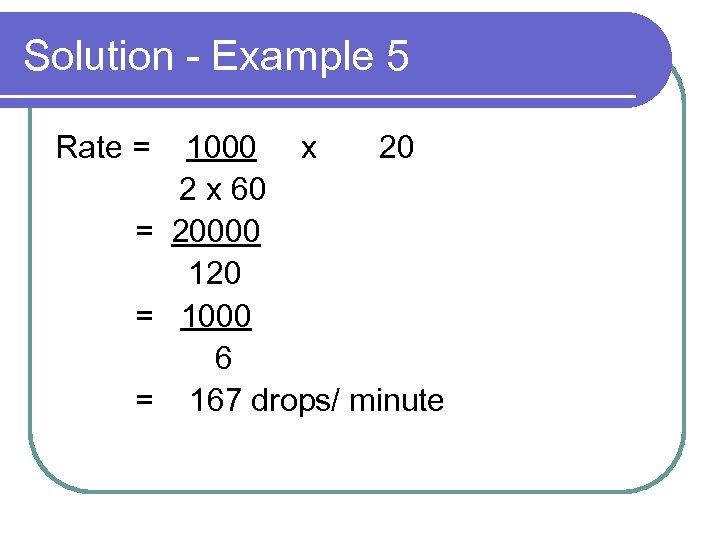 Solution - Example 5 Rate = 1000 x 20 2 x 60 = 20000 120 = 1000 6 = 167 drops/ minute
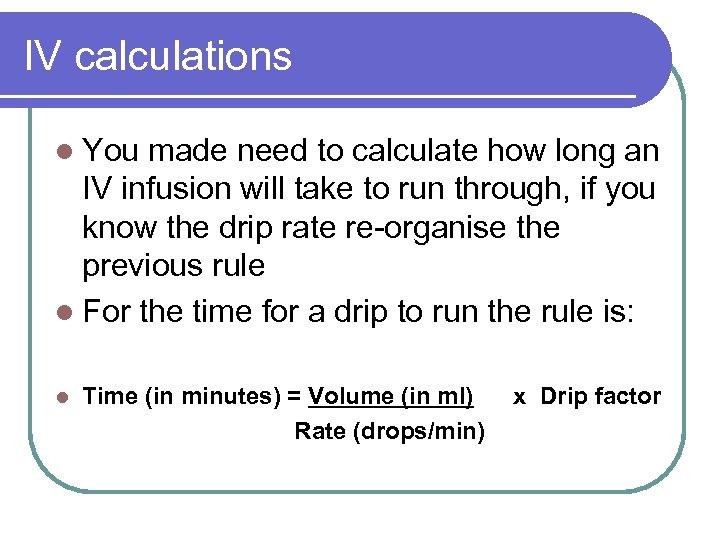 IV calculations l You made need to calculate how long an IV infusion will take to run through, if you know the drip rate re-organise the previous rule l For the time for a drip to run the rule is: l Time (in minutes) = Volume (in ml) Rate (drops/min) x Drip factor
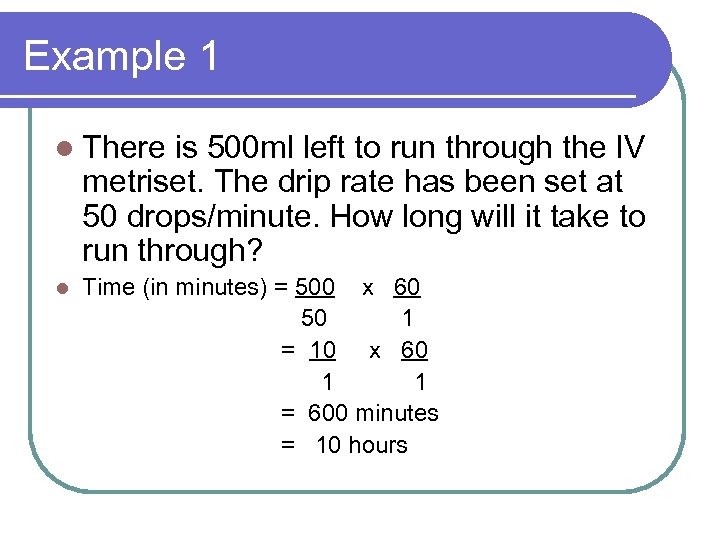 Example 1 l There is 500 ml left to run through the IV metriset. The drip rate has been set at 50 drops/minute. How long will it take to run through? l Time (in minutes) = 500 x 60 50 1 = 10 x 60 1 1 = 600 minutes = 10 hours
 Example 2 l There is 700 ml of N/saline left to run through the IV metriset. The drip rate is set at 40 drops/minute. How long will it take to complete?
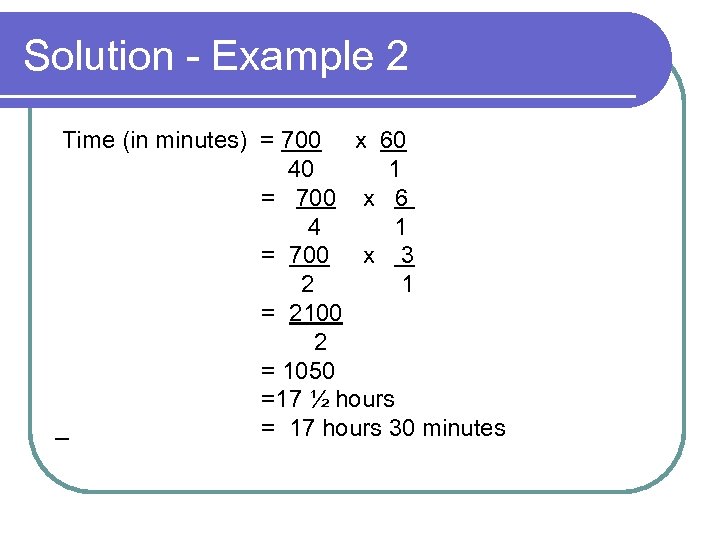 Solution - Example 2 Time (in minutes) = 700 x 60 40 1 = 700 x 6 4 1 = 700 x 3 2 1 = 2100 2 = 1050 =17 ½ hours = 17 hours 30 minutes
 Example 3 l How long will an IV take to run through if the drip rate is set at 80 drops/minute and there are 300 ml left using a drip factor of 20 drops/ml?
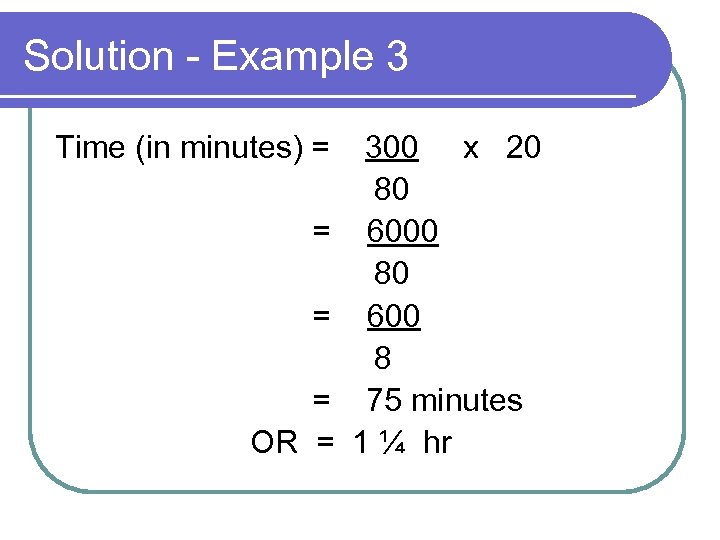 Solution - Example 3 Time (in minutes) = = OR = 300 x 20 80 600 8 75 minutes 1 ¼ hr
 Example 4 l How long will 300 ml of IV packed cells take to run through at 30 drops/minute using a blood giving set (15 drops/ml)?
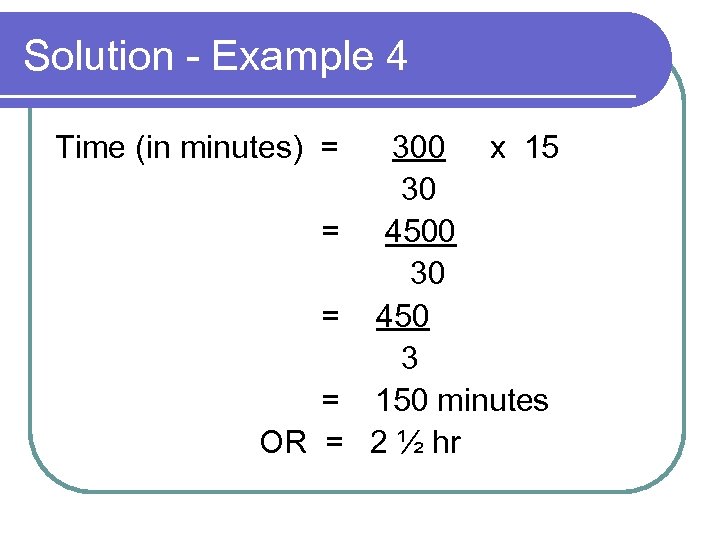 Solution - Example 4 Time (in minutes) = = OR = 300 x 15 30 4500 30 450 3 150 minutes 2 ½ hr
 Example 5 l How long will 2 l of Normal Saline take if it is running at 100 ml/hour using a metriset?
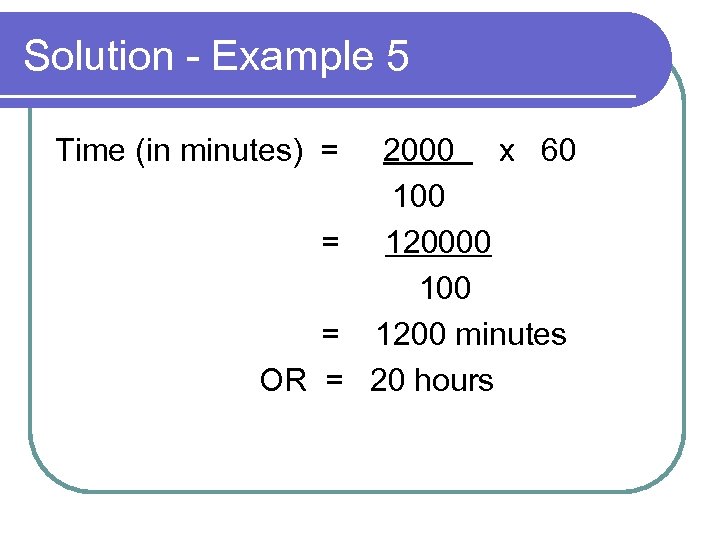 Solution - Example 5 Time (in minutes) = 2000 x 60 100 = 120000 100 = 1200 minutes OR = 20 hours
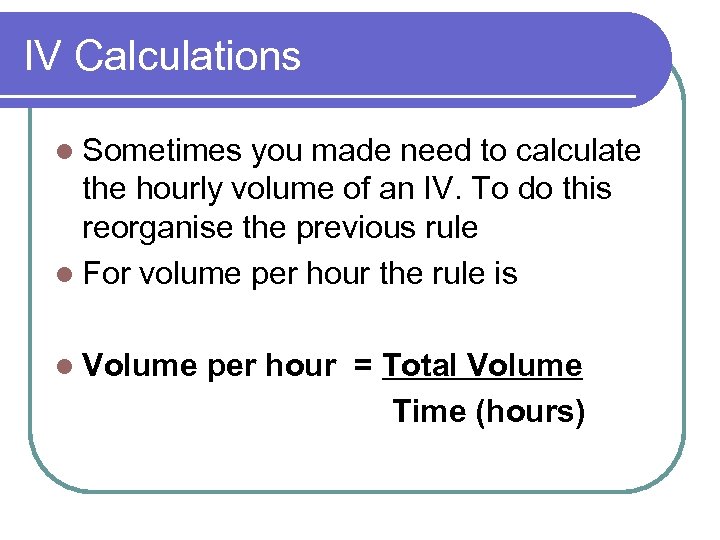 IV Calculations l Sometimes you made need to calculate the hourly volume of an IV. To do this reorganise the previous rule l For volume per hour the rule is l Volume per hour = Total Volume Time (hours)
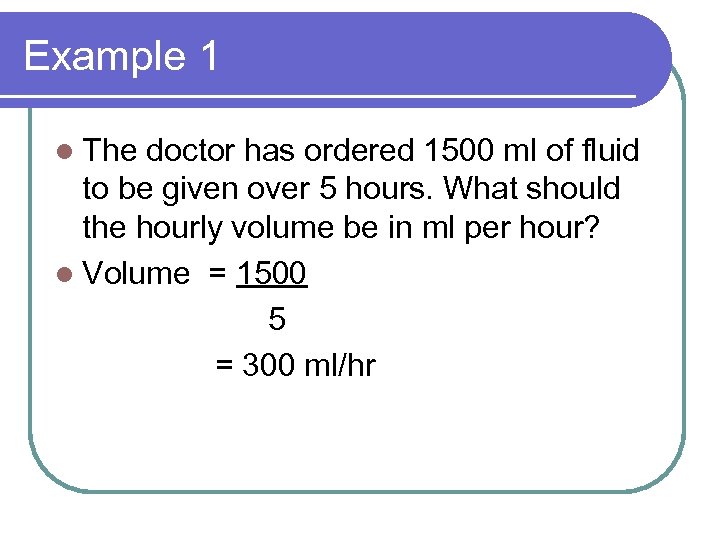 Example 1 l The doctor has ordered 1500 ml of fluid to be given over 5 hours. What should the hourly volume be in ml per hour? l Volume = 1500 5 = 300 ml/hr
 Example 2 l The client is ordered 1. 2 L of Hartmann’s solution over the next 6 hours. What should be the hourly volume in ml/hour?
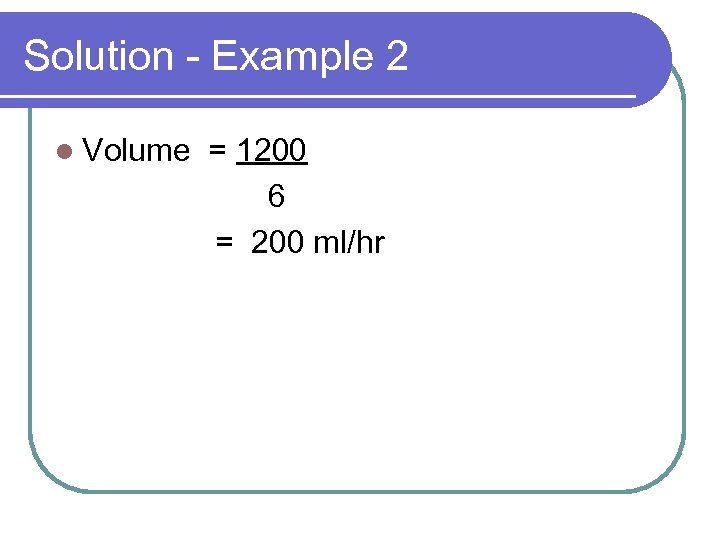 Solution - Example 2 l Volume = 1200 6 = 200 ml/hr
 Example 3 l An IV containing 600 ml has to run through in the next 4 hours. What volume needs to run through every hour?
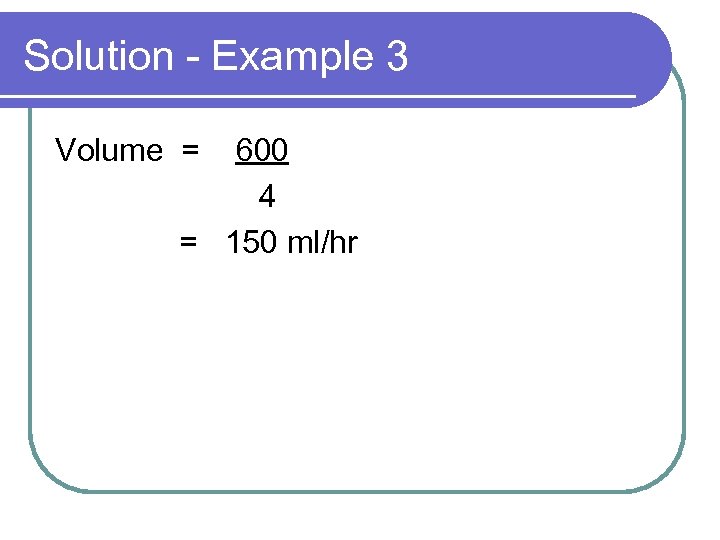 Solution - Example 3 Volume = 600 4 = 150 ml/hr
 Example 4 l. A client’s IV is commenced at 1000 HR. It contains 1 L and is to run through by 2000 HR. What should the hourly volume be (in ml per hour)?
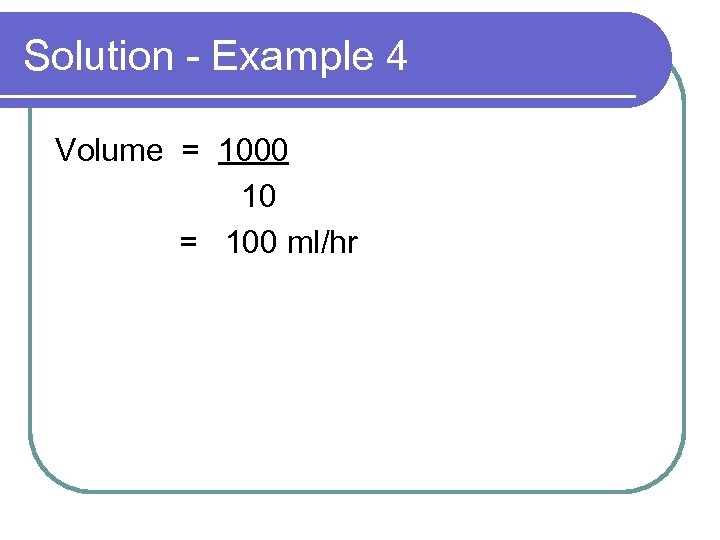 Solution - Example 4 Volume = 1000 10 = 100 ml/hr
 Example 5 l What volume is needed every hour if a client must have 700 ml in 10 hours?
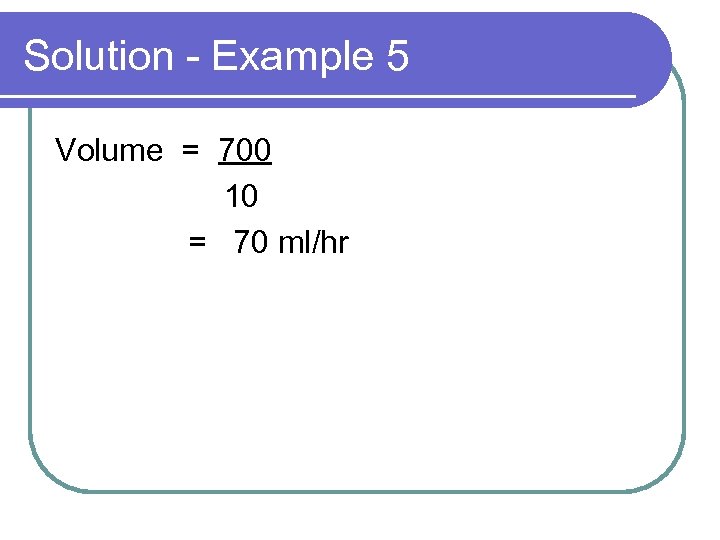 Solution - Example 5 Volume = 700 10 = 70 ml/hr
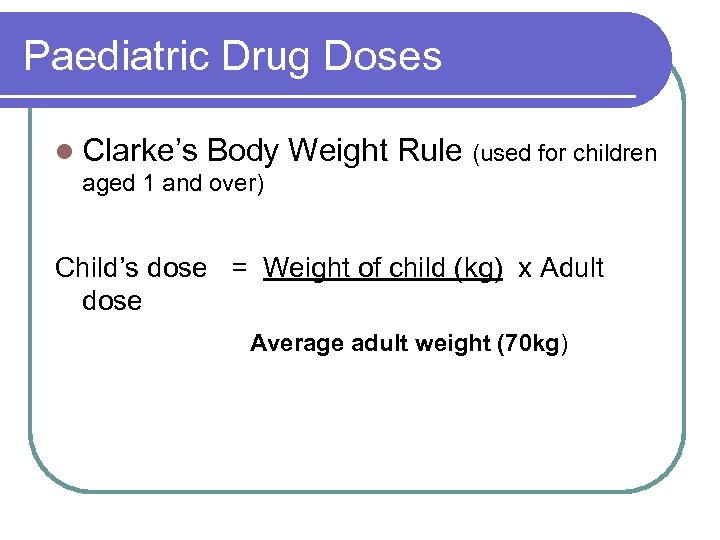 Paediatric Drug Doses l Clarke’s Body Weight Rule (used for children aged 1 and over) Child’s dose = Weight of child (kg) x Adult dose Average adult weight (70 kg)
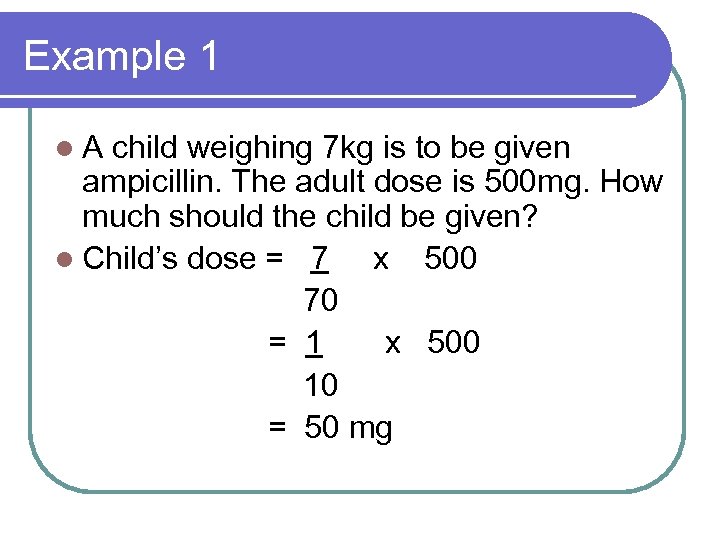 Example 1 l. A child weighing 7 kg is to be given ampicillin. The adult dose is 500 mg. How much should the child be given? l Child’s dose = 7 x 500 70 = 1 x 500 10 = 50 mg
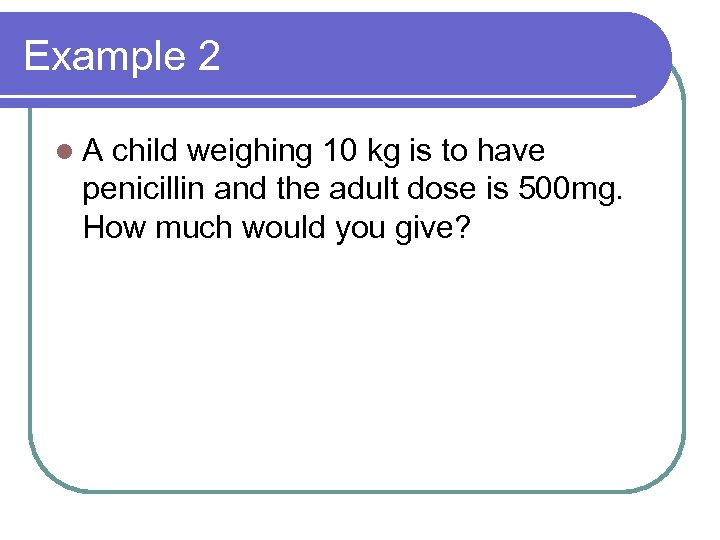 Example 2 l. A child weighing 10 kg is to have penicillin and the adult dose is 500 mg. How much would you give?
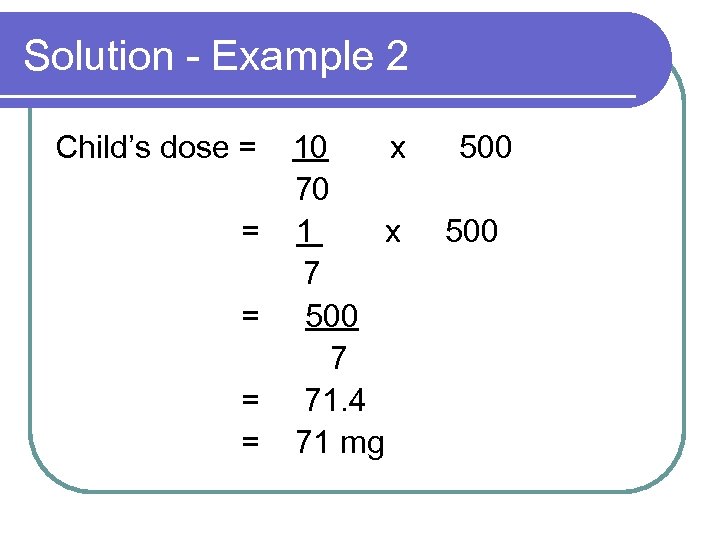 Solution - Example 2 Child’s dose = = = 10 x 70 1 x 7 500 7 71. 4 71 mg 500
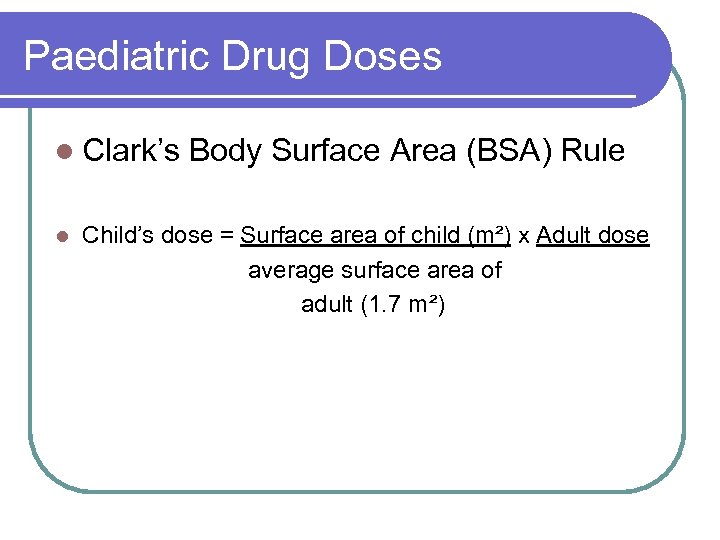 Paediatric Drug Doses l Clark’s l Body Surface Area (BSA) Rule Child’s dose = Surface area of child (m²) x Adult dose average surface area of adult (1. 7 m²)
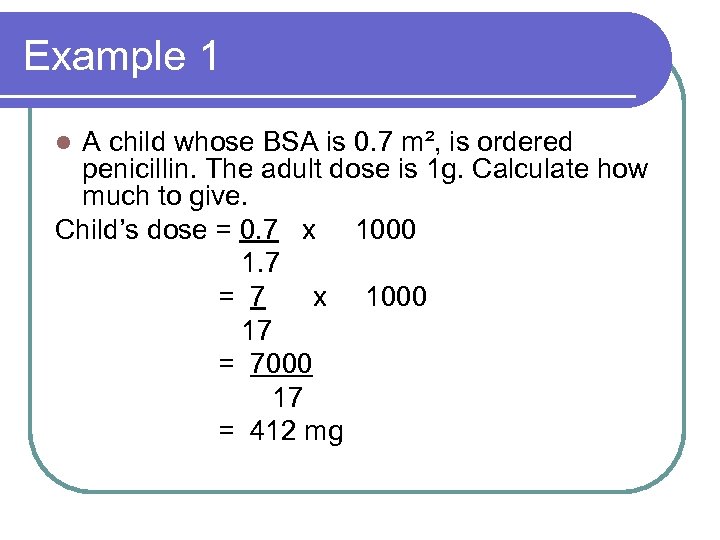 Example 1 A child whose BSA is 0. 7 m², is ordered penicillin. The adult dose is 1 g. Calculate how much to give. Child’s dose = 0. 7 x 1000 1. 7 = 7 x 1000 17 = 7000 17 = 412 mg l
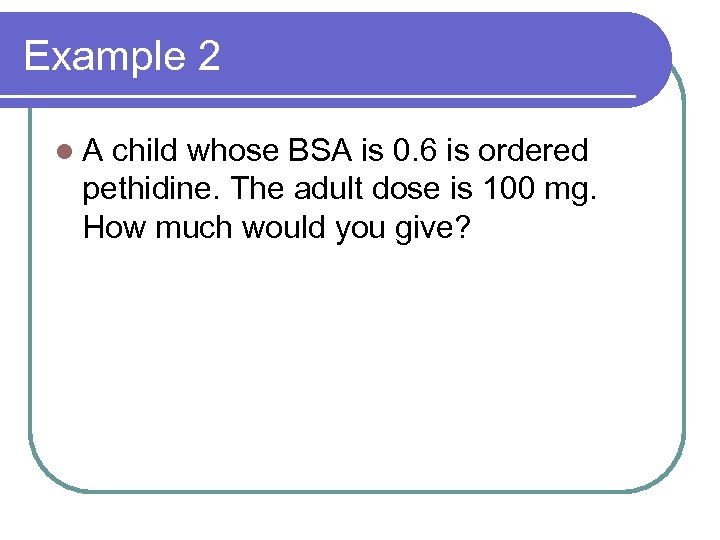 Example 2 l. A child whose BSA is 0. 6 is ordered pethidine. The adult dose is 100 mg. How much would you give?
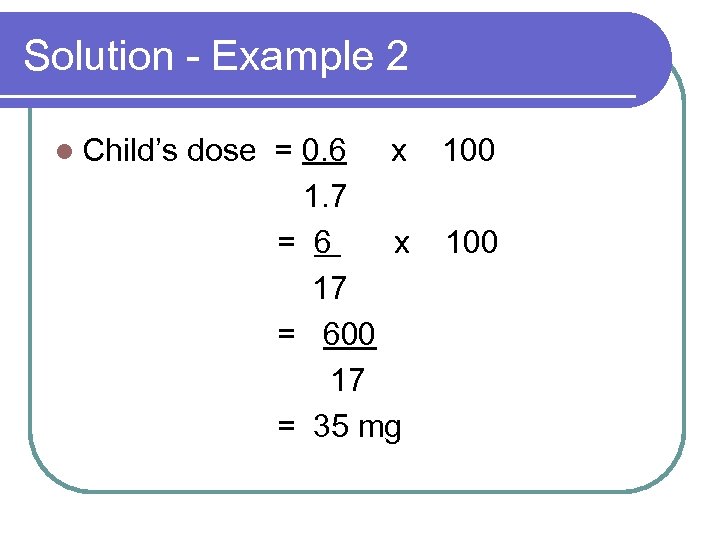 Solution - Example 2 l Child’s dose = 0. 6 x 1. 7 = 6 x 17 = 600 17 = 35 mg 100
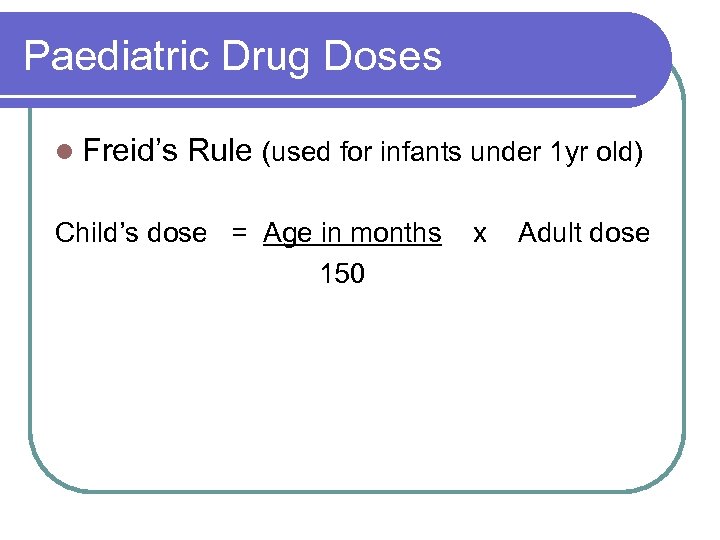 Paediatric Drug Doses l Freid’s Rule (used for infants under 1 yr old) Child’s dose = Age in months 150 x Adult dose
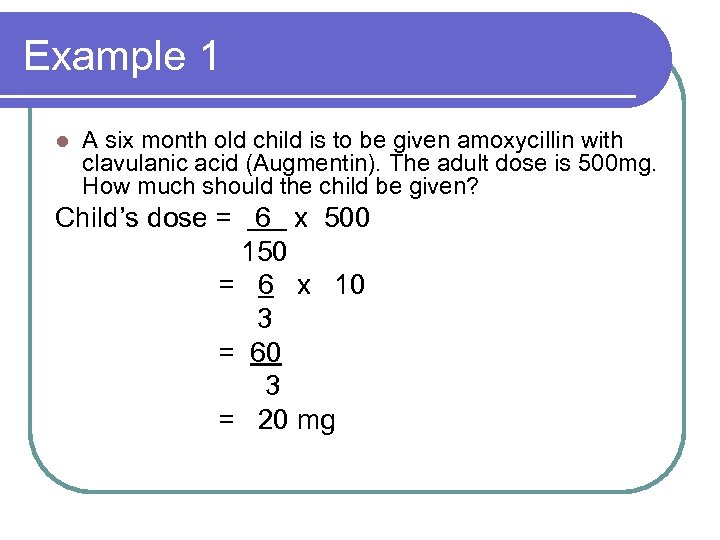 Example 1 l A six month old child is to be given amoxycillin with clavulanic acid (Augmentin). The adult dose is 500 mg. How much should the child be given? Child’s dose = 6 x 500 150 = 6 x 10 3 = 60 3 = 20 mg
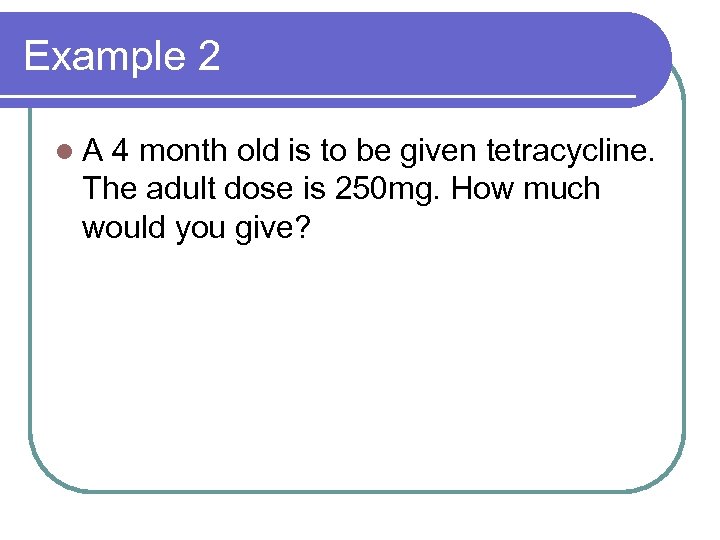 Example 2 l. A 4 month old is to be given tetracycline. The adult dose is 250 mg. How much would you give?
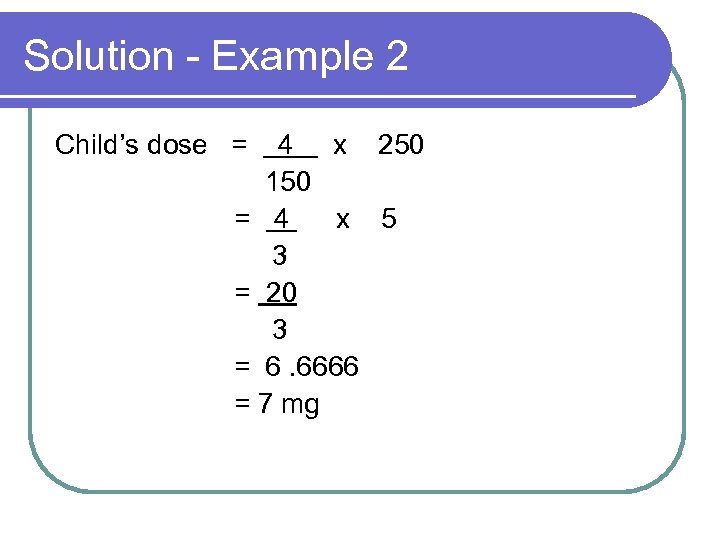 Solution - Example 2 Child’s dose = 4 x 250 150 = 4 x 5 3 = 20 3 = 6. 6666 = 7 mg
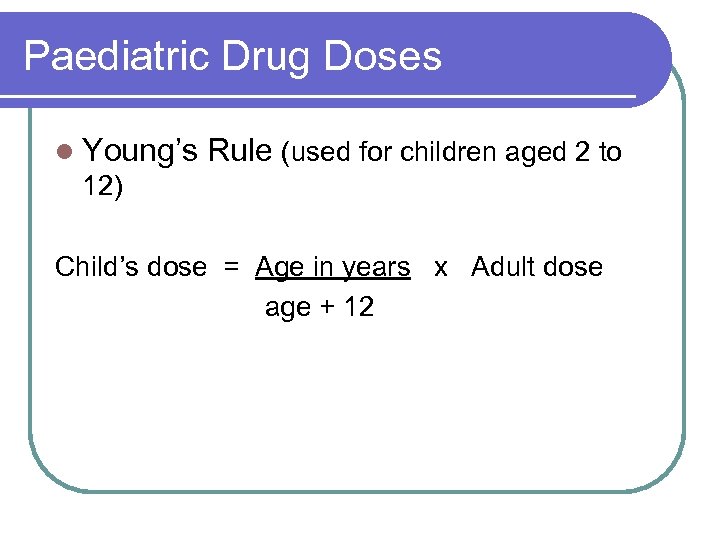 Paediatric Drug Doses l Young’s Rule (used for children aged 2 to 12) Child’s dose = Age in years x Adult dose age + 12
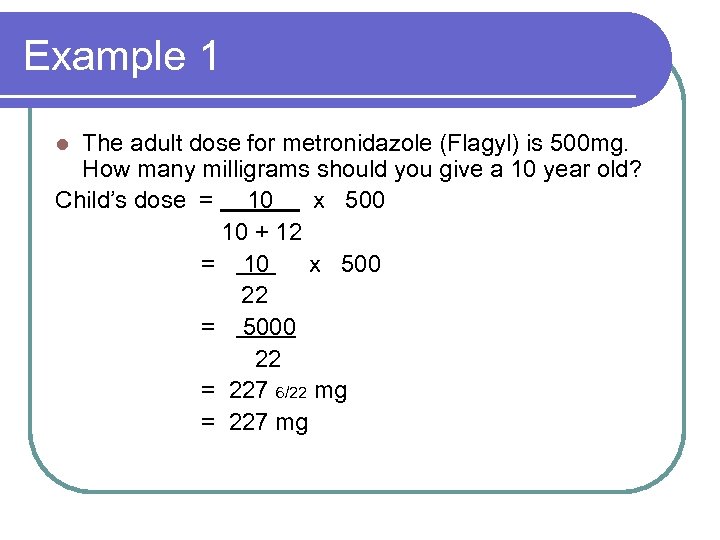 Example 1 The adult dose for metronidazole (Flagyl) is 500 mg. How many milligrams should you give a 10 year old? Child’s dose = 10 x 500 10 + 12 = 10 x 500 22 = 5000 22 = 227 6/22 mg = 227 mg l
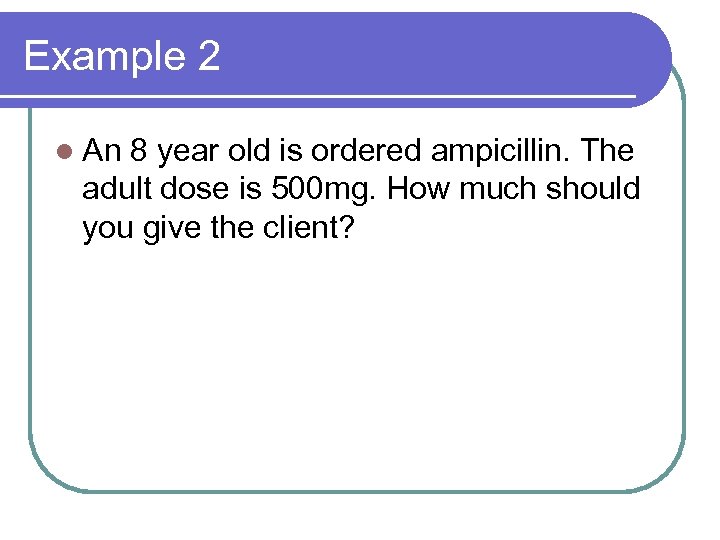 Example 2 l An 8 year old is ordered ampicillin. The adult dose is 500 mg. How much should you give the client?
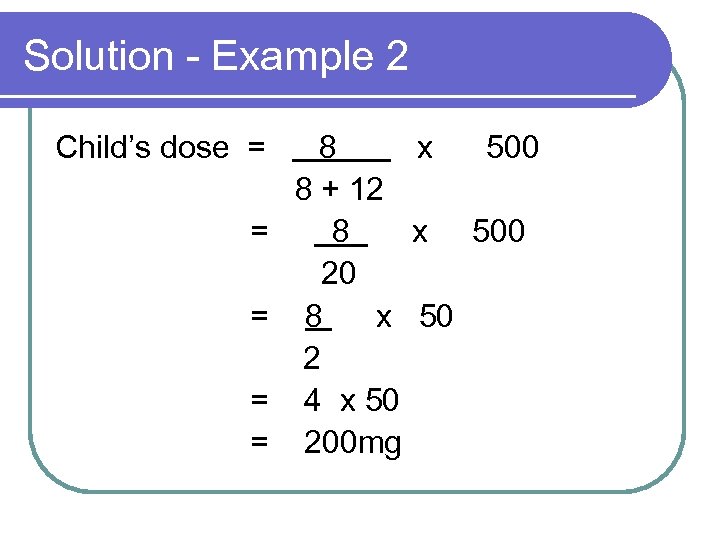 Solution - Example 2 Child’s dose = = = 8 x 500 8 + 12 8 x 500 20 8 x 50 2 4 x 50 200 mg