Topic 3. 3 D Objects General curves & surfaces in 3 D Polygonal Meshes Interpolation algorithms
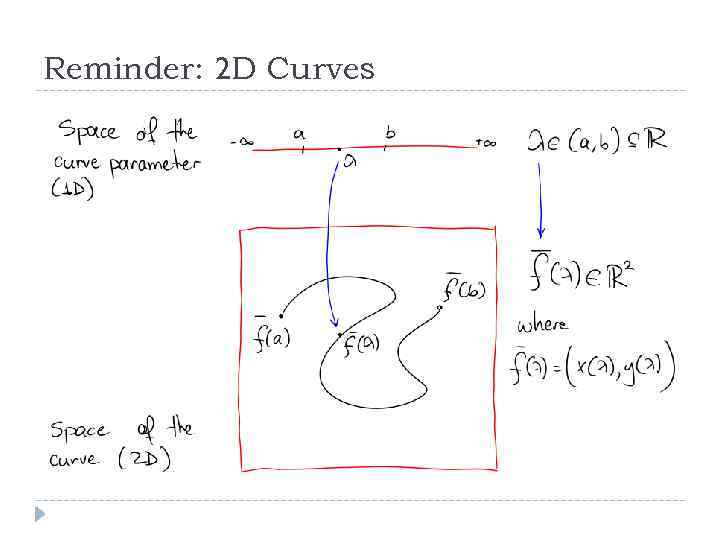
Reminder: 2 D Curves
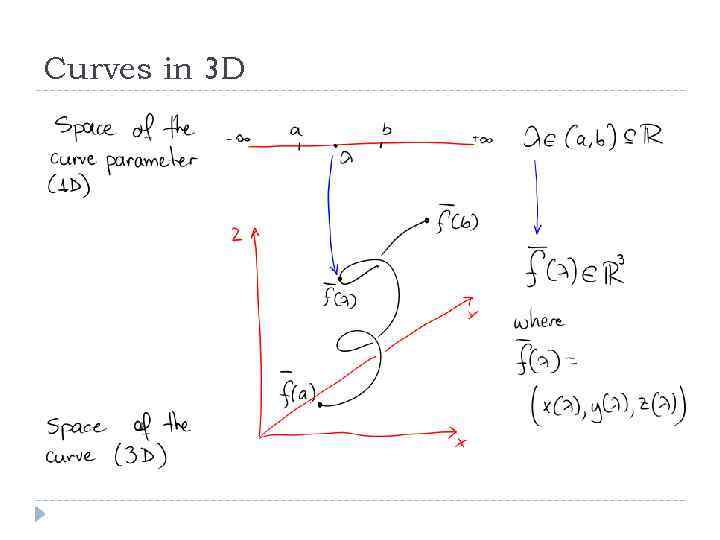
Curves in 3 D
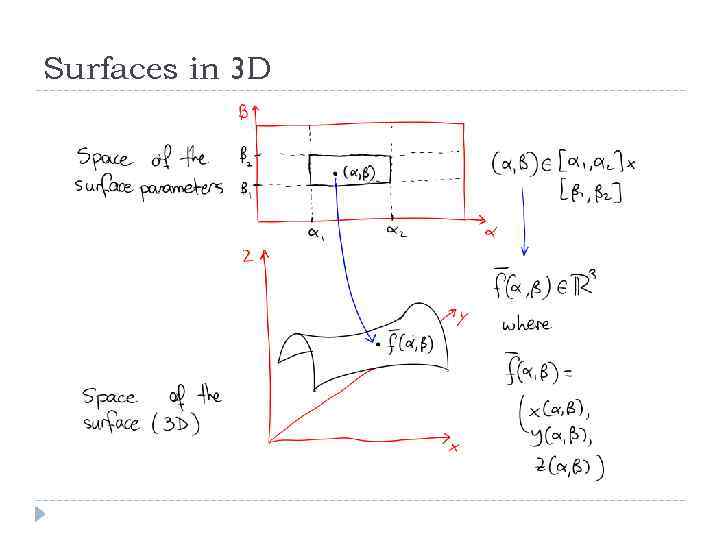
Surfaces in 3 D
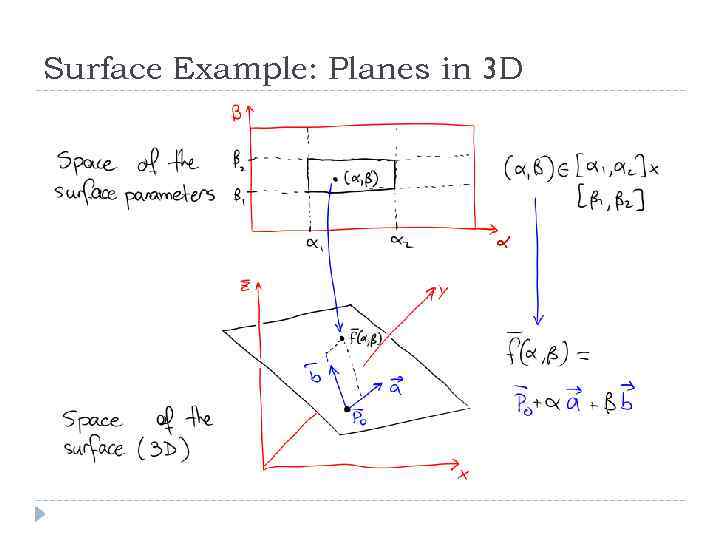
Surface Example: Planes in 3 D
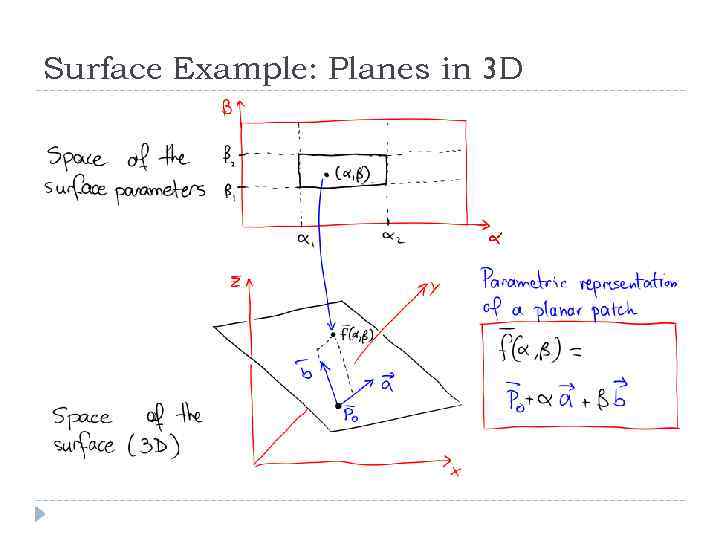
Surface Example: Planes in 3 D
Topic 3. 3 D Objects General curves & surfaces in 3 D Polygonal Meshes Interpolation algorithms
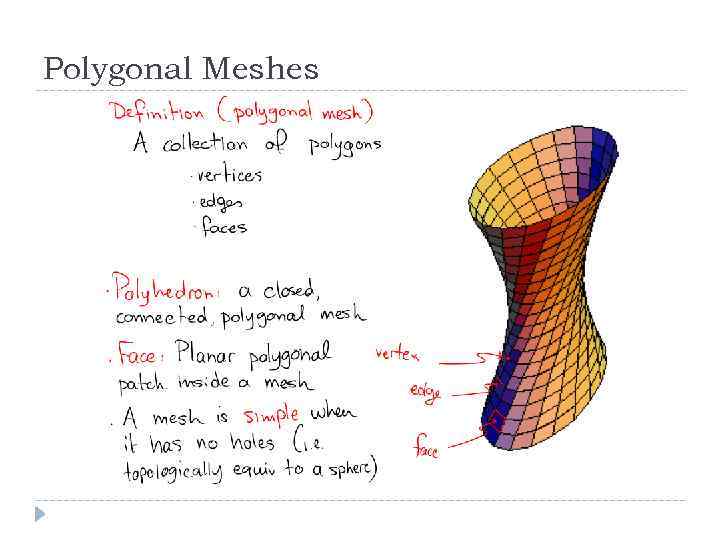
Polygonal Meshes
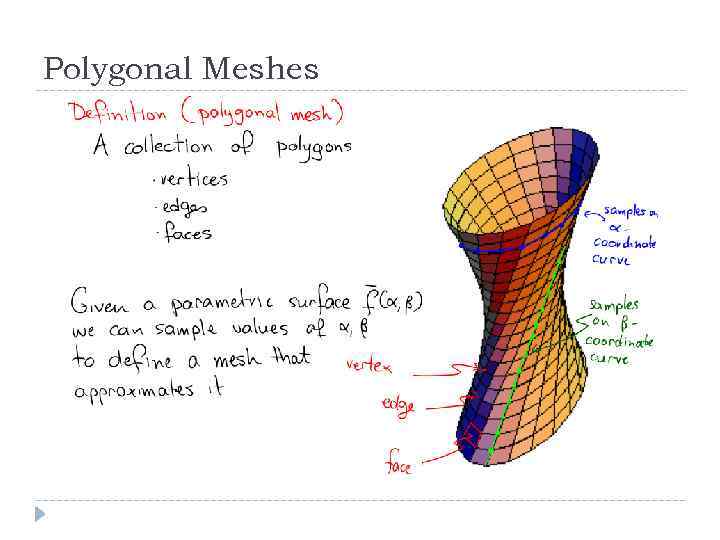
Polygonal Meshes
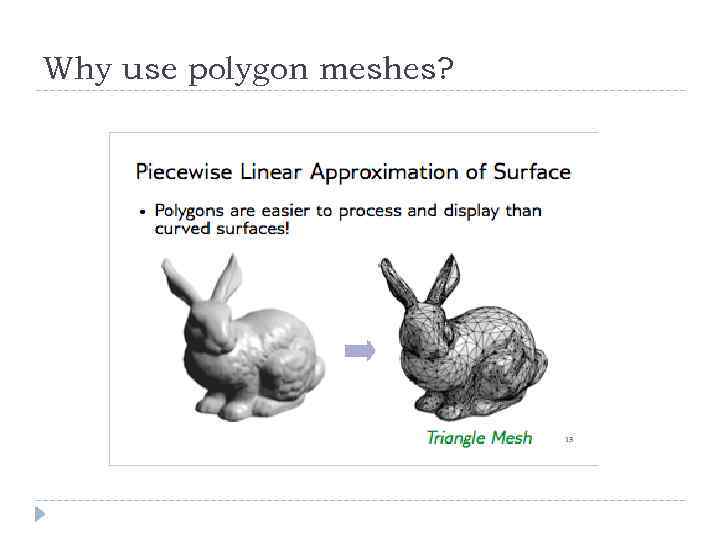
Why use polygon meshes?
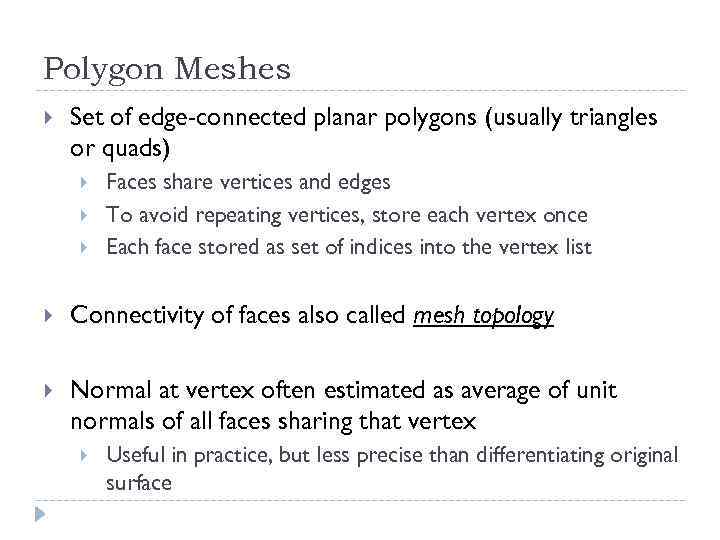
Polygon Meshes Set of edge-connected planar polygons (usually triangles or quads) Faces share vertices and edges To avoid repeating vertices, store each vertex once Each face stored as set of indices into the vertex list Connectivity of faces also called mesh topology Normal at vertex often estimated as average of unit normals of all faces sharing that vertex Useful in practice, but less precise than differentiating original surface
Topic 3. 3 D Objects General curves & surfaces in 3 D Polygonal Meshes Interpolation algorithms
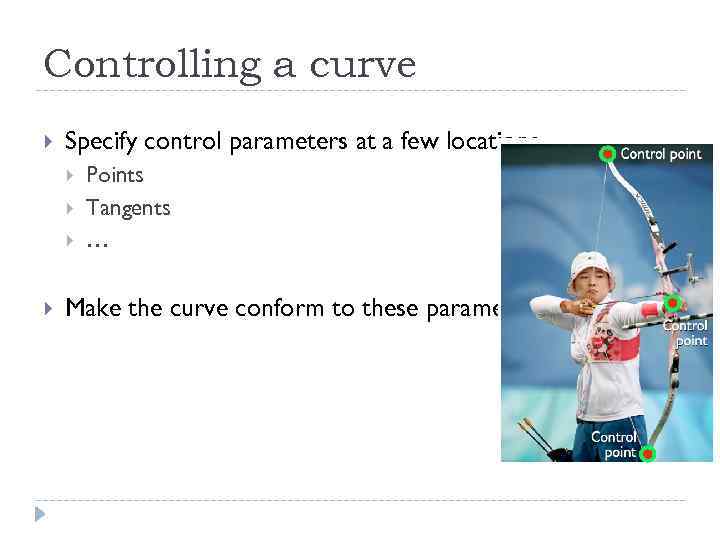
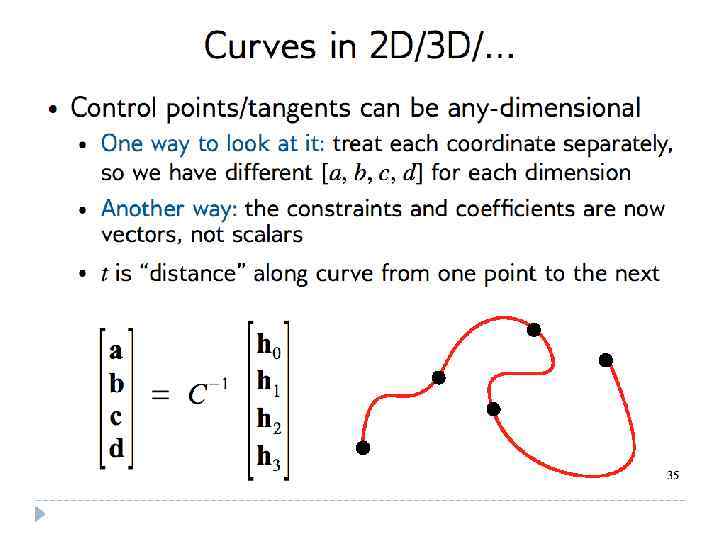
Controlling a curve Specify control parameters at a few locations Points Tangents … Make the curve conform to these parameters
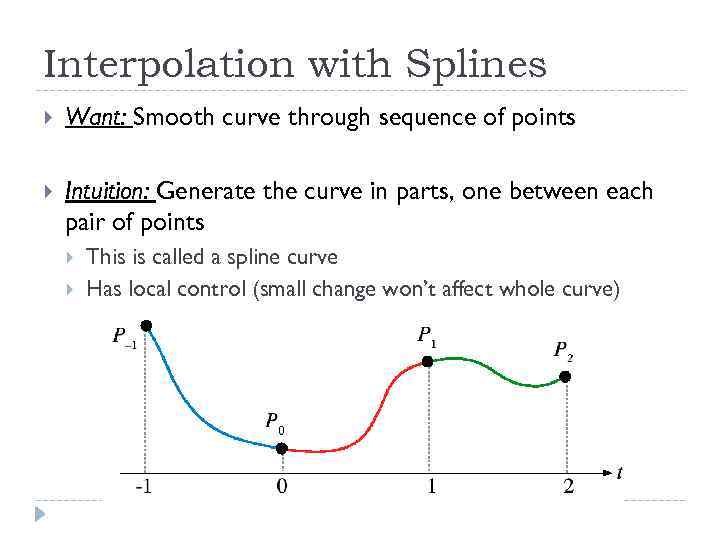
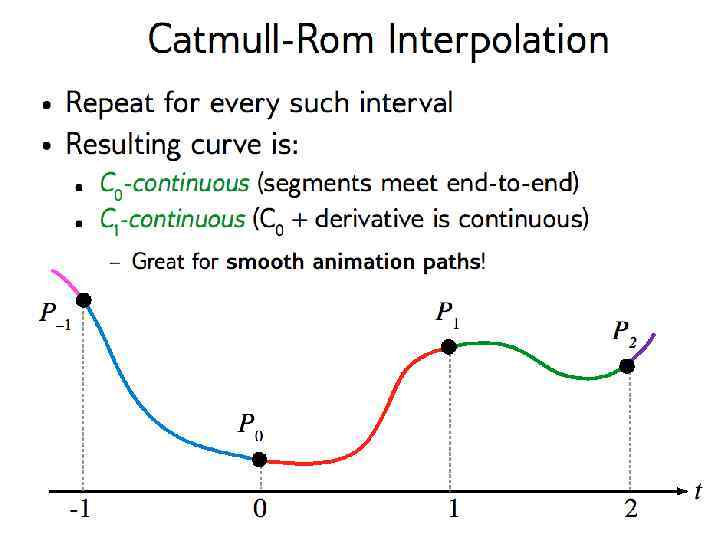
Interpolation with Splines Want: Smooth curve through sequence of points Intuition: Generate the curve in parts, one between each pair of points This is called a spline curve Has local control (small change won’t affect whole curve)
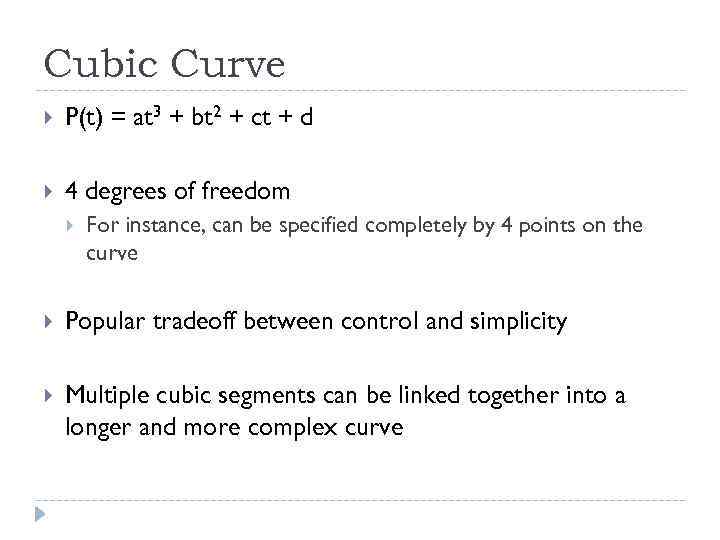
Cubic Curve P(t) = at 3 + bt 2 + ct + d 4 degrees of freedom For instance, can be specified completely by 4 points on the curve Popular tradeoff between control and simplicity Multiple cubic segments can be linked together into a longer and more complex curve
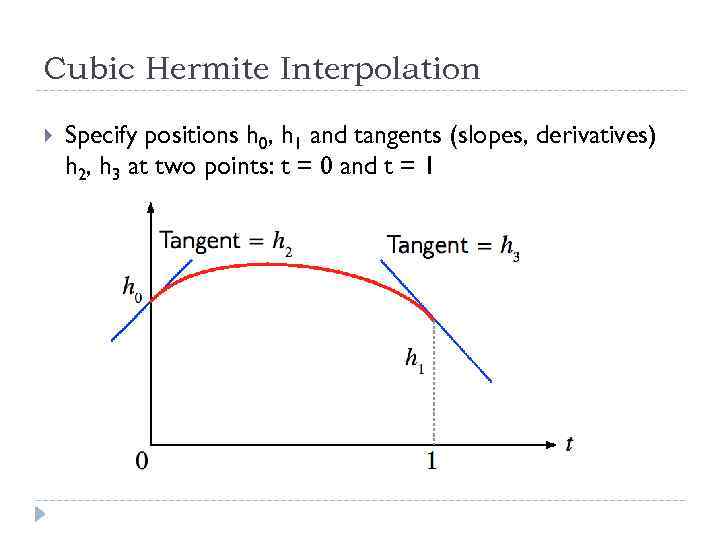
Cubic Hermite Interpolation Specify positions h 0, h 1 and tangents (slopes, derivatives) h 2, h 3 at two points: t = 0 and t = 1
Cubic Hermite interpolation Q: Why tangents and not two extra points? A: When we want two curve segments to link up smoothly, we can just require them to have a common tangent at the boundary
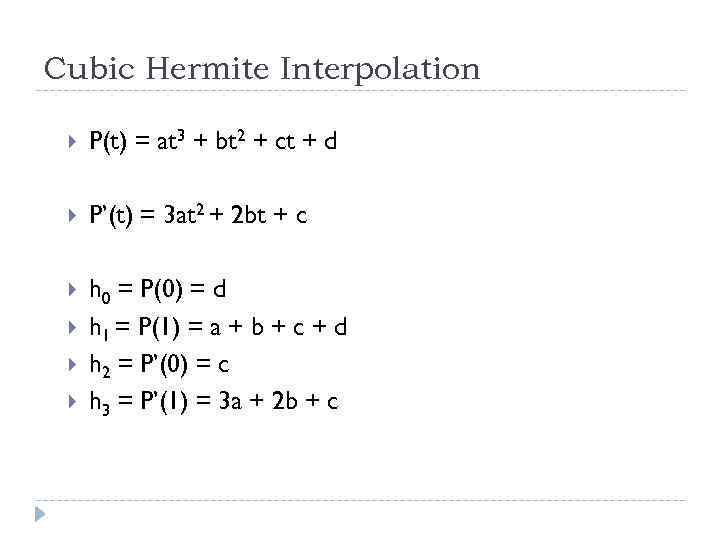
Cubic Hermite Interpolation P(t) = at 3 + bt 2 + ct + d P’(t) = 3 at 2 + 2 bt + c h 0 = P(0) = d h 1 = P(1) = a + b + c + d h 2 = P’(0) = c h 3 = P’(1) = 3 a + 2 b + c
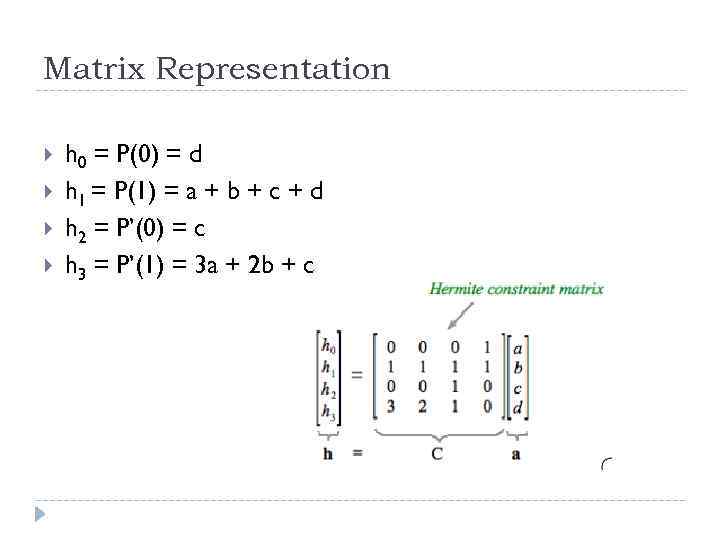
Matrix Representation h 0 = P(0) = d h 1 = P(1) = a + b + c + d h 2 = P’(0) = c h 3 = P’(1) = 3 a + 2 b + c
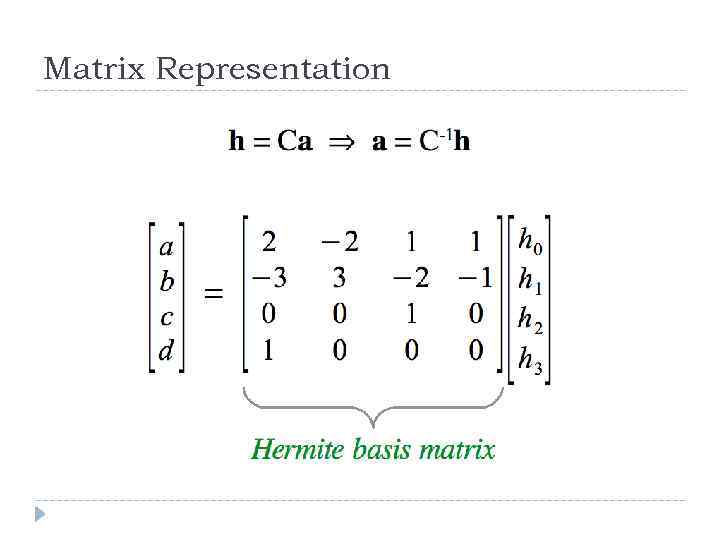
Matrix Representation
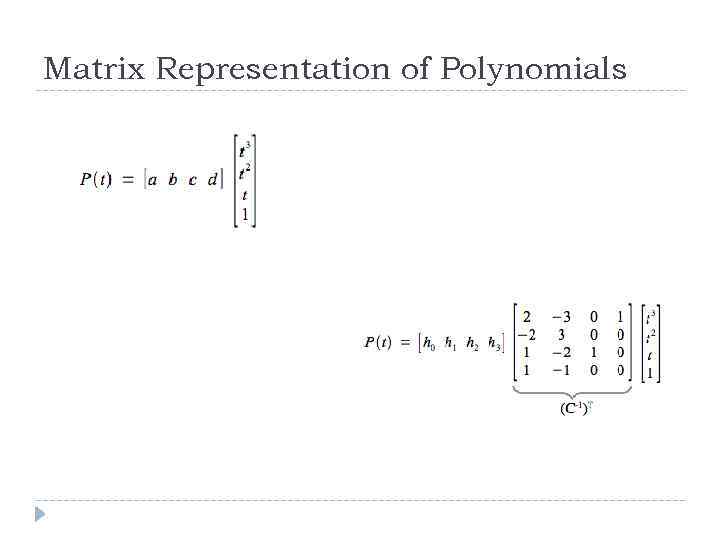
Matrix Representation of Polynomials
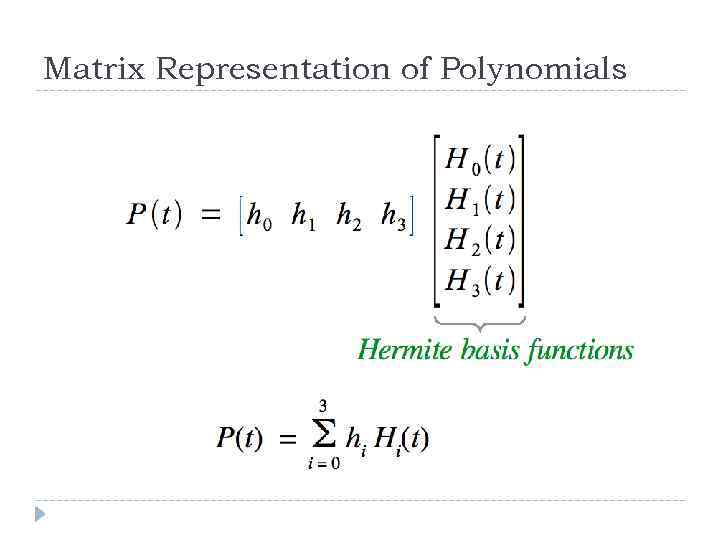
Matrix Representation of Polynomials
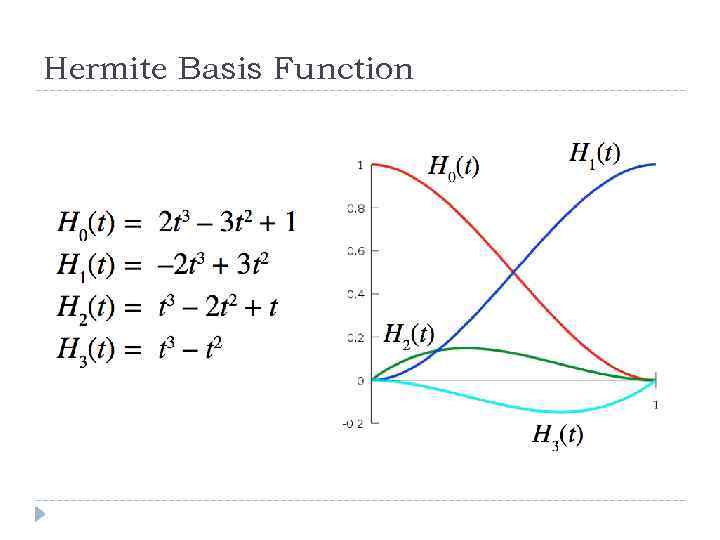
Hermite Basis Function
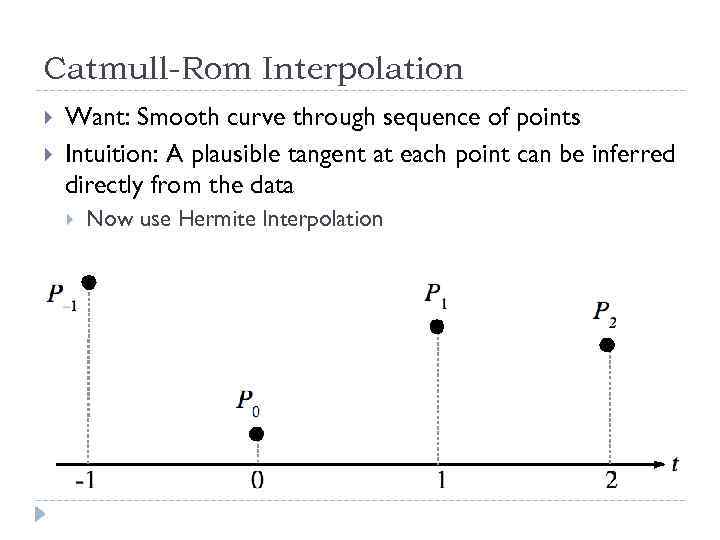
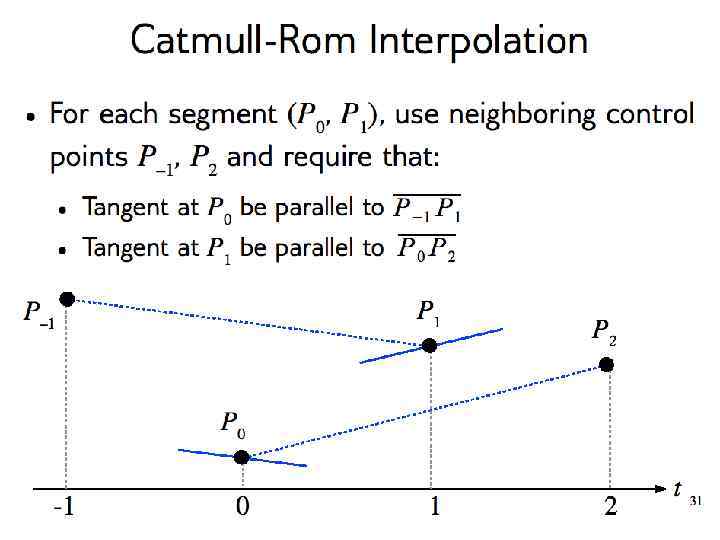
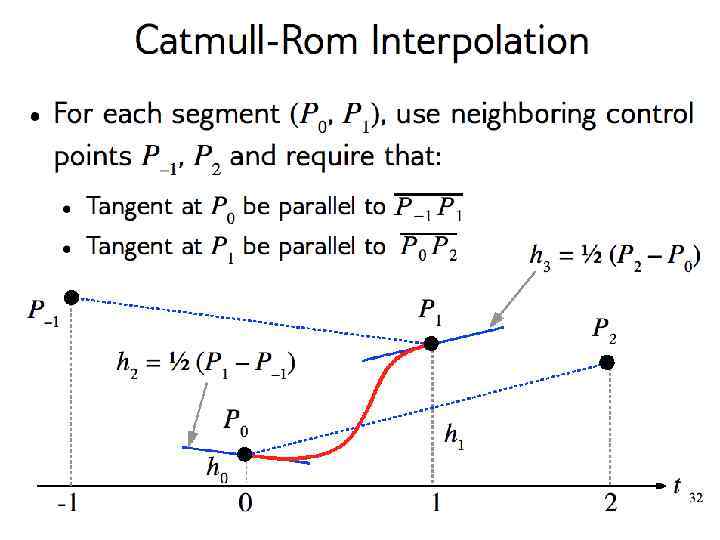
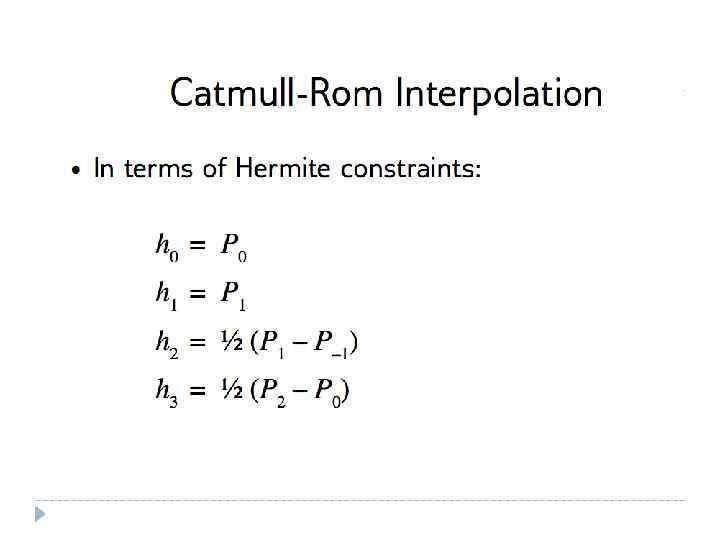
Catmull-Rom Interpolation Want: Smooth curve through sequence of points Intuition: A plausible tangent at each point can be inferred directly from the data Now use Hermite Interpolation