 Скачать презентацию Topic 27 Methods of Production By Zhu
938569fa336f7c208c18c98be1137849.ppt
- Количество слайдов: 25



Topic 27 : Methods of Production By Zhu Wenzhong Copyright © 2002 by Harcourt, Inc. All rights reserved.
LEARNING GOALS • • • State the definition of production Explain job production and its advantages and disadvantages Explain batch production and its advantages and disadvantages Explain flow production and its advantages and disadvantages State the factors that may affect the firm’s choice of production methods Copyright © 2002 by Harcourt, Inc. All rights reserved.
Definition of production • Production takes place when • resources such as raw materials or components, are changed into ‘products’. It refers to those activities that bring a product into being. © Photo. Disc Copyright © 2002 by Harcourt, Inc. All rights reserved.
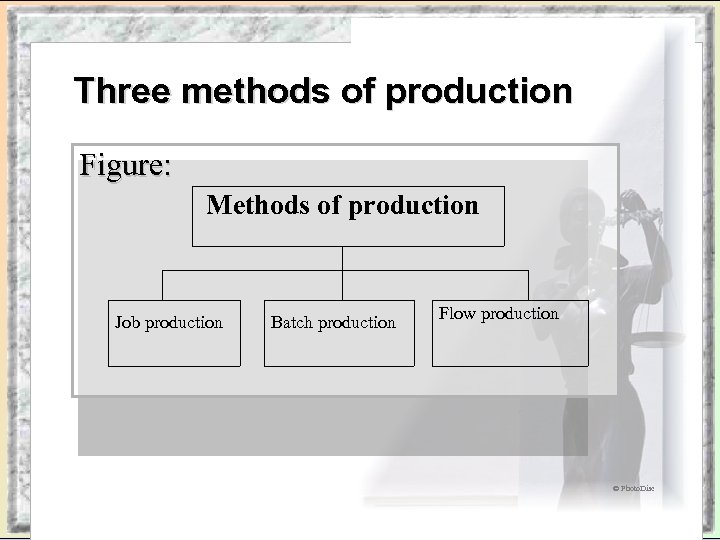
Three methods of production Figure: Methods of production Job production Batch production Flow production © Photo. Disc Copyright © 2002 by Harcourt, Inc. All rights reserved.
Three methods of production • It involves the production Job production of a single product at a time. Copyright © 2002 by Harcourt, Inc. All rights reserved.
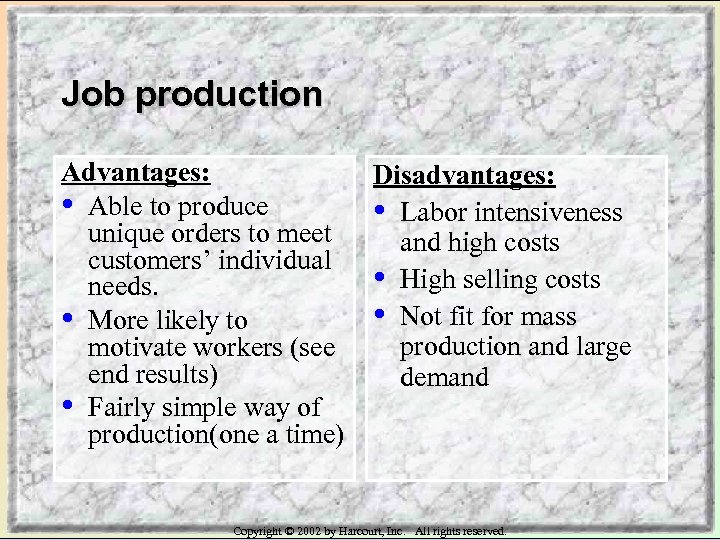
Job production Advantages: • Able to produce unique orders to meet customers’ individual needs. • More likely to motivate workers (see end results) • Fairly simple way of production(one a time) Disadvantages: • Labor intensiveness and high costs • High selling costs • Not fit for mass production and large demand Copyright © 2002 by Harcourt, Inc. All rights reserved.
Three methods of production • This involves dividing the Job production Batch production work into a number of different operations, or a method that involves completing one operation at a time on all units before performing the next. Copyright © 2002 by Harcourt, Inc. All rights reserved.
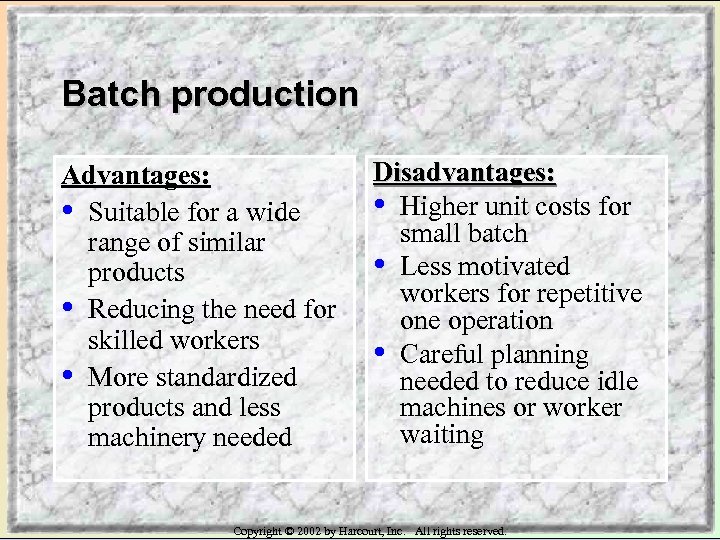
Batch production Advantages: • Suitable for a wide range of similar products • Reducing the need for skilled workers • More standardized products and less machinery needed Disadvantages: • Higher unit costs for small batch • Less motivated workers for repetitive one operation • Careful planning needed to reduce idle machines or worker waiting Copyright © 2002 by Harcourt, Inc. All rights reserved.
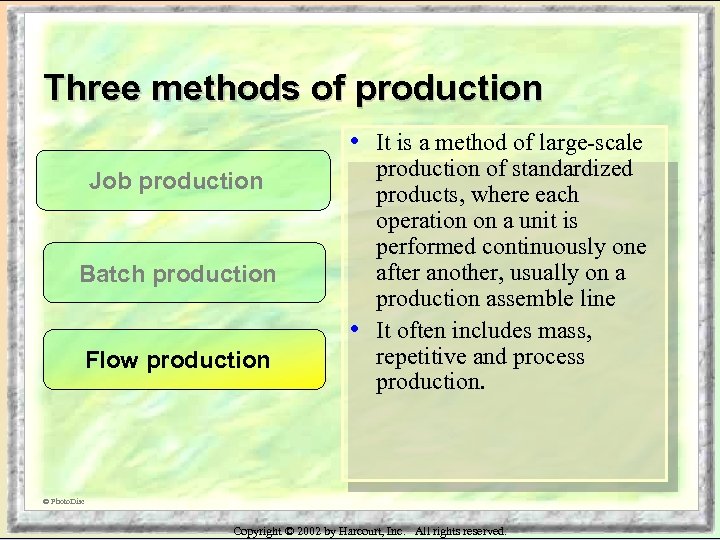
Three methods of production • Job production Batch production • Flow production It is a method of large-scale production of standardized products, where each operation on a unit is performed continuously one after another, usually on a production assemble line It often includes mass, repetitive and process production. © Photo. Disc Copyright © 2002 by Harcourt, Inc. All rights reserved.
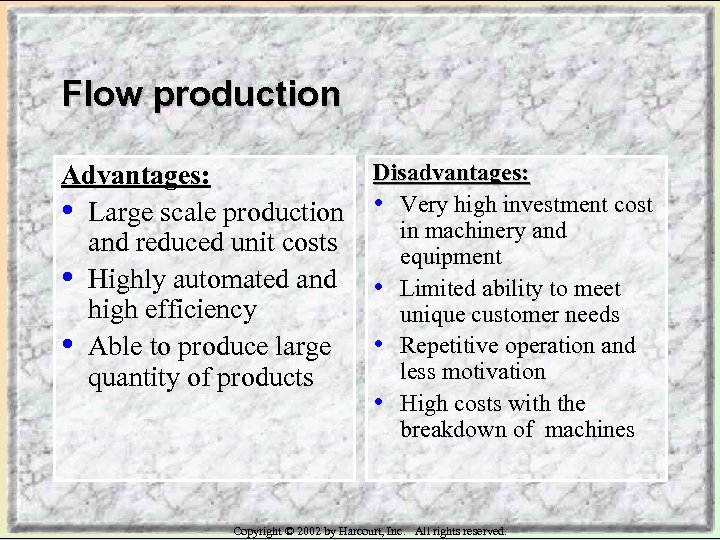
Flow production Advantages: • Large scale production and reduced unit costs • Highly automated and high efficiency • Able to produce large quantity of products Disadvantages: • Very high investment cost in machinery and equipment • Limited ability to meet unique customer needs • Repetitive operation and less motivation • High costs with the breakdown of machines Copyright © 2002 by Harcourt, Inc. All rights reserved.
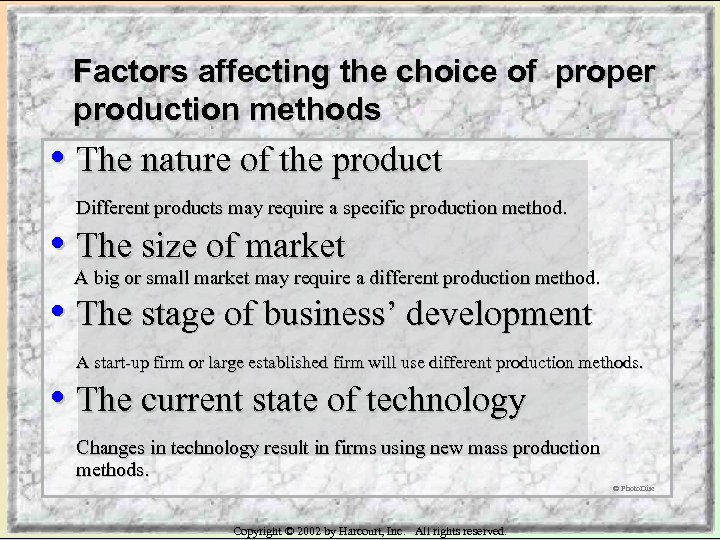
Factors affecting the choice of proper production methods • The nature of the product Different products may require a specific production method. • The size of market A big or small market may require a different production method. • The stage of business’ development A start-up firm or large established firm will use different production methods. • The current state of technology Changes in technology result in firms using new mass production methods. © Photo. Disc Copyright © 2002 by Harcourt, Inc. All rights reserved.
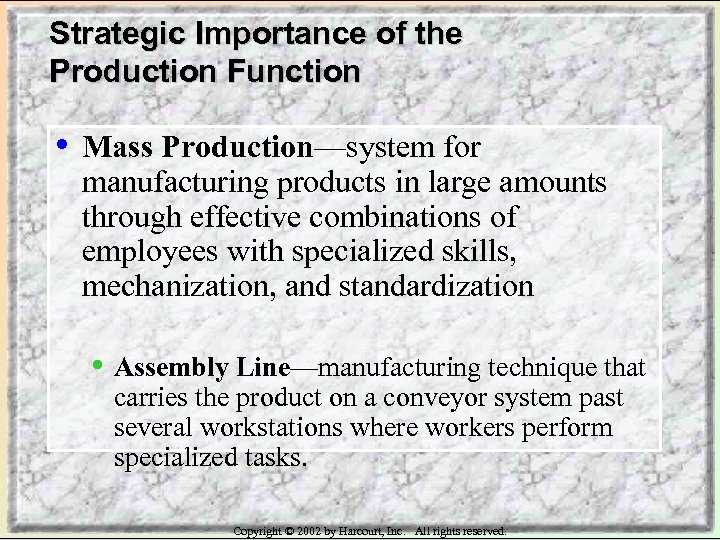
Strategic Importance of the Production Function • Mass Production—system for manufacturing products in large amounts through effective combinations of employees with specialized skills, mechanization, and standardization • Assembly Line—manufacturing technique that carries the product on a conveyor system past several workstations where workers perform specialized tasks. Copyright © 2002 by Harcourt, Inc. All rights reserved.
Strategic Importance of the Production Function • • • Flexible production—cost-effective system of producing small batches of similar items Customer-driven production—system that evaluates customer demands in order to link what a manufacture makes with what the customers want to buy Team concept production—combines employees from various departments and functions to work together in designing and building products Copyright © 2002 by Harcourt, Inc. All rights reserved.
Production Processes • • • Methods of production differ according to firms’ means of operating and time requirements Means of operating may involve either an analytic or a synthetic system Time requirements call for either a continuous or an intermittent process Copyright © 2002 by Harcourt, Inc. All rights reserved.
Technology and the Production Process • Robots—reprogrammable machine capable of performing numerous tasks that require manipulations of materials and tools. • Pick-and-place robots取放型机器人 • Field robots野外作业型机器人 • Service robots • Nanotechnology纳米技术 Copyright © 2002 by Harcourt, Inc. All rights reserved.
Technology and the Production Process • Computer-Aided Design and Computer Aided Manufacturing • Computer-aided design (CAD)—system for interactions between a designer and a computer to design a product, facility or part the meets predetermined specifications. Copyright © 2002 by Harcourt, Inc. All rights reserved.
Technology and the Production Process • Computer-Aided Design and Computer Aided Manufacturing • Computer-aided manufacturing (CAM)— electronic tools to analyze CAD output and determine necessary steps to implement the design, followed by electronic transmission of instructions to guide the activities of production equipment. Copyright © 2002 by Harcourt, Inc. All rights reserved.
The Job of Production Managers • Inventory Control • Requires balancing the need to keep stocks on • • hand to meet demand against the expenses of carrying the inventory Perpetual inventory: system that continuously monitors the amounts and location of inventory Vendor-managed inventory: system that hands over a firm’s inventory control functions to suppliers Copyright © 2002 by Harcourt, Inc. All rights reserved.
The Job of Production Managers • Implementing the Production Plan • Just-in-Time System—management philosophy aimed at improving profits and return on investment by minimizing costs and eliminating waste through cutting inventory on hand. Copyright © 2002 by Harcourt, Inc. All rights reserved.
The Job of Production Managers • Implementing the Production Plan • Material Requirement Planning (MRP)— computer-based production planning system by which a firm can ensure that it has needed parts and materials available at the right time and place in the correct amounts. Copyright © 2002 by Harcourt, Inc. All rights reserved.
The Job of Production Managers • Controlling the Production Process • Production planning—determines the amount • of resources (including raw materials and other components) a firm needs to produce a certain output Routing—determines the sequence of work throughout the facility and specifies who will perform each aspect of production at what location Copyright © 2002 by Harcourt, Inc. All rights reserved.
The Job of Production Managers • Controlling the Production Process • Scheduling—development of timetables that specify how long each operation in the production process takes and when workers should perform it. Copyright © 2002 by Harcourt, Inc. All rights reserved.
The Job of Production Managers • Controlling the Production Process • Gantt chart—tracks projected and actual work • progress over time PERT (Program Evaluation and Review Technique)—chart which seeks to minimize delays by coordinating all aspects of the production process • Critical Path—sequence of operations that requires the longest time for completion Copyright © 2002 by Harcourt, Inc. All rights reserved.
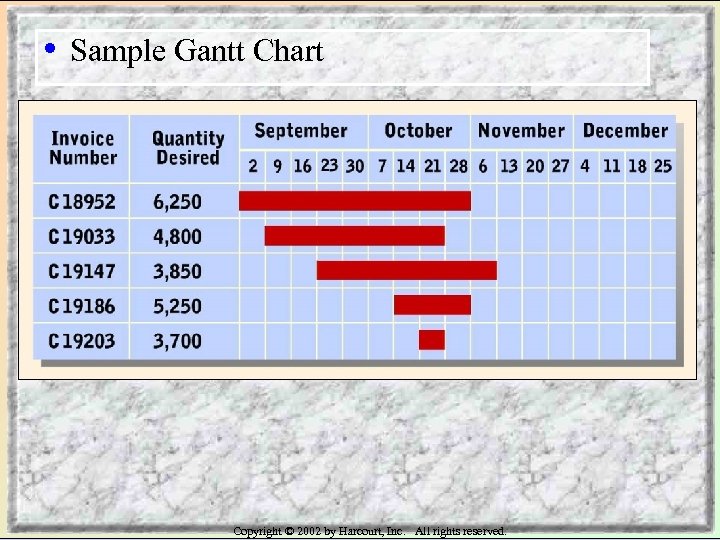
• Sample Gantt Chart Copyright © 2002 by Harcourt, Inc. All rights reserved.
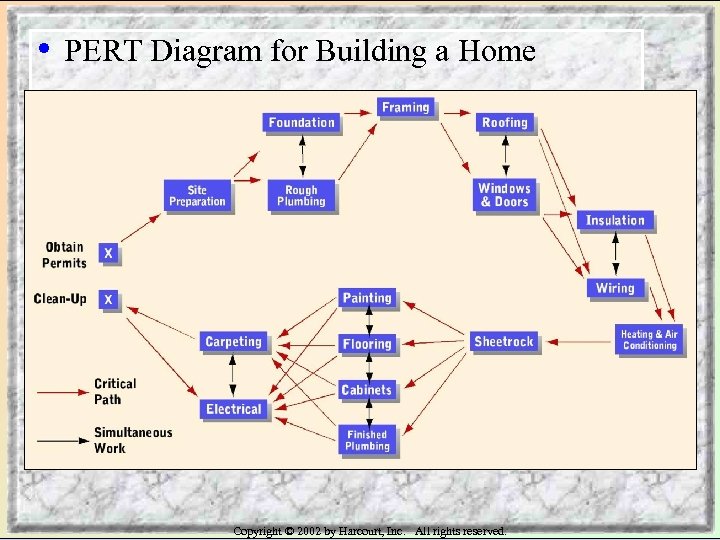
• PERT Diagram for Building a Home Copyright © 2002 by Harcourt, Inc. All rights reserved.
Скачать презентацию Topic 27 Methods of Production By Zhu
938569fa336f7c208c18c98be1137849.ppt