


 Скачать презентацию Topic 13 Dawn of the Industrial Age
a87eecf6a718cb4714330997b6144cda.ppt
- Количество слайдов: 50
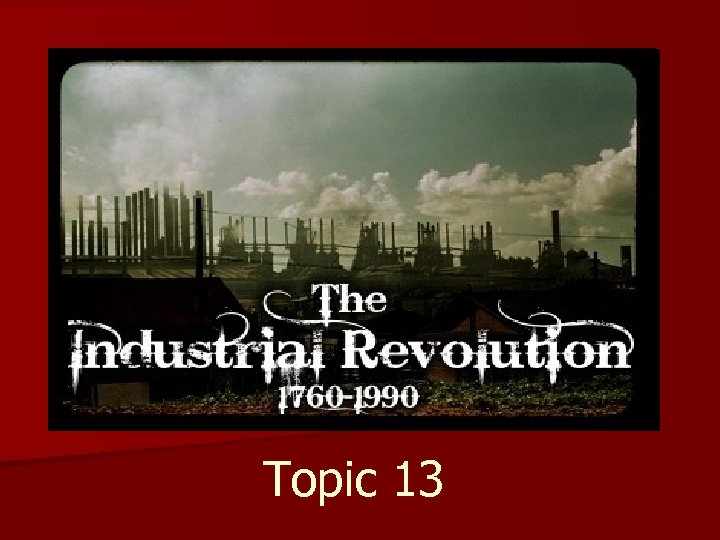 Topic 13
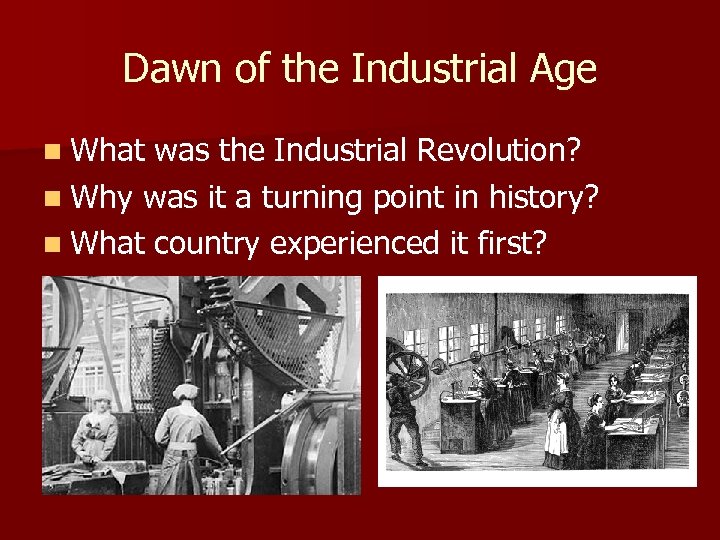 Dawn of the Industrial Age n What was the Industrial Revolution? n Why was it a turning point in history? n What country experienced it first?
 What Caused the Industrial Revolution? n 1. New Agricultural Revolution – What were some of the characteristics? § § Crop rotation Charles “Turnip” Townsend Jethro Tull’s seed drill Robert Bakewell’s selective breeding – What was the enclosure movement and why was it so important to the early revolution? – What was proto-industrialization or the putting out system (cottage industry)? Why important?
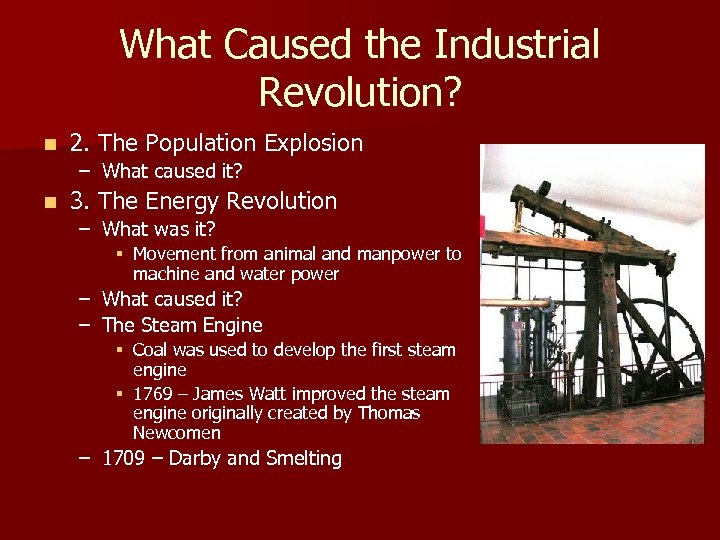 What Caused the Industrial Revolution? n 2. The Population Explosion – What caused it? n 3. The Energy Revolution – What was it? § Movement from animal and manpower to machine and water power – What caused it? – The Steam Engine § Coal was used to develop the first steam engine § 1769 – James Watt improved the steam engine originally created by Thomas Newcomen – 1709 – Darby and Smelting
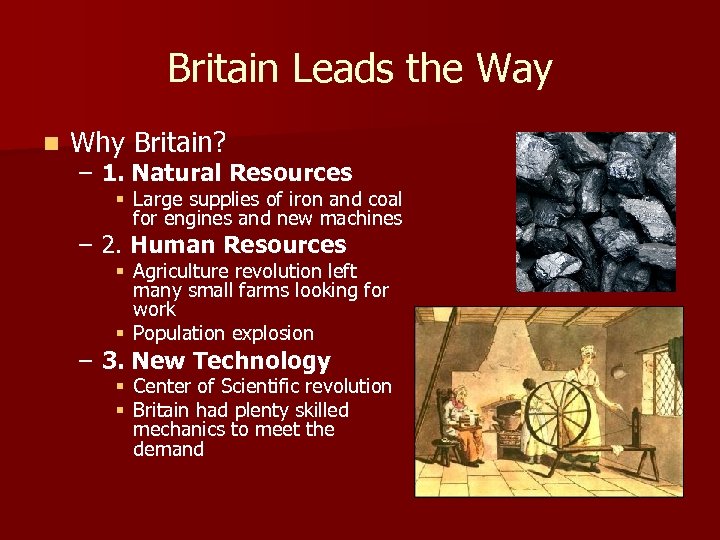 Britain Leads the Way n Why Britain? – 1. Natural Resources § Large supplies of iron and coal for engines and new machines – 2. Human Resources § Agriculture revolution left many small farms looking for work § Population explosion – 3. New Technology § Center of Scientific revolution § Britain had plenty skilled mechanics to meet the demand
 Britain Leads the Way n 4. Economic Conditions – Capital and Demand – Trade from overseas helped British economy – Business class accumulated capital to invest in enterprises such as mines, factories and railroads – Pop. Expl. Boosted demand for goods – General economic prosperity allowed people to buy more hence they demanded more n 5. Political and social conditions – – – Stable governments Support economic growth Strong Navy to support and protect overseas empire – such as Indian colony
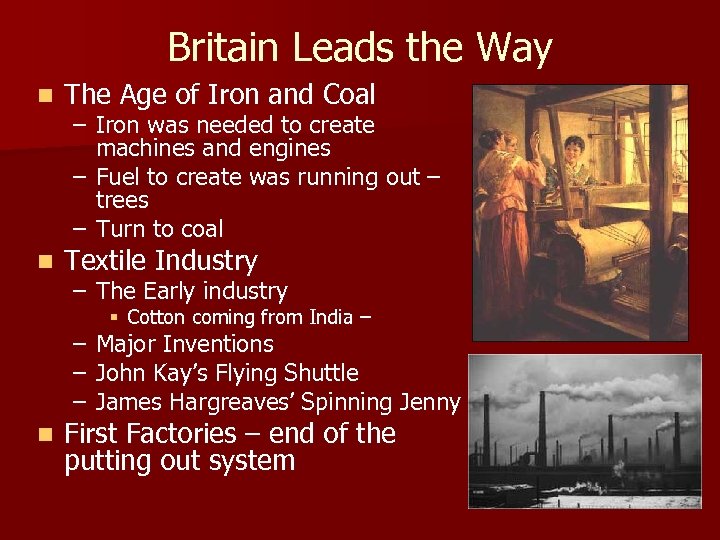 Britain Leads the Way n The Age of Iron and Coal n Textile Industry – Iron was needed to create machines and engines – Fuel to create was running out – trees – Turn to coal – The Early industry § Cotton coming from India – – Major Inventions – John Kay’s Flying Shuttle – James Hargreaves’ Spinning Jenny n First Factories – end of the putting out system
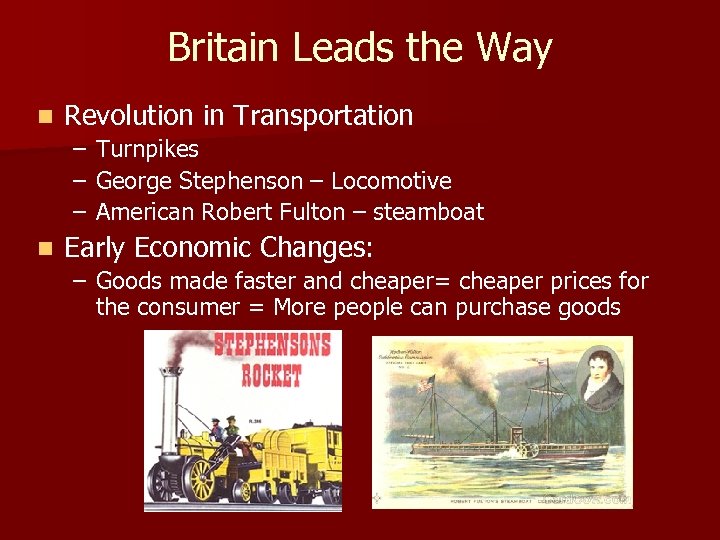 Britain Leads the Way n Revolution in Transportation – Turnpikes – George Stephenson – Locomotive – American Robert Fulton – steamboat n Early Economic Changes: – Goods made faster and cheaper= cheaper prices for the consumer = More people can purchase goods
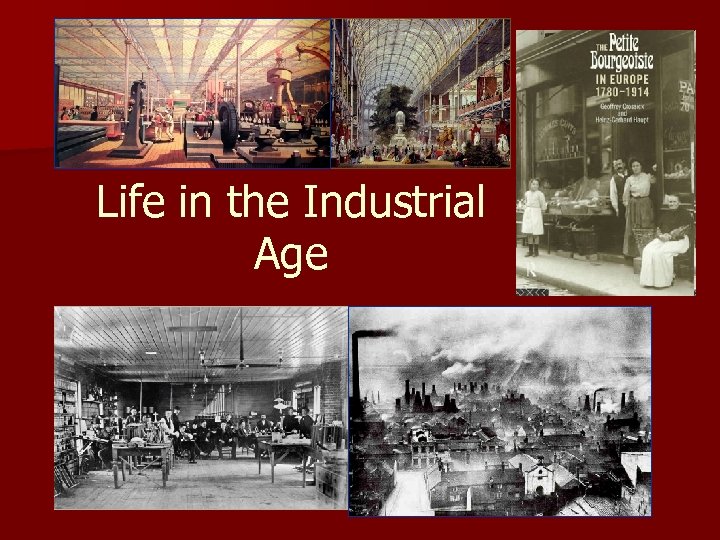
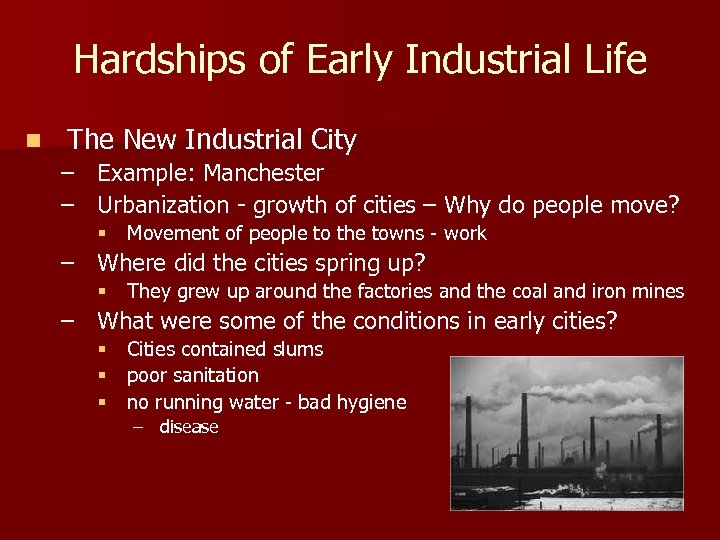 Hardships of Early Industrial Life n The New Industrial City – Example: Manchester – Urbanization - growth of cities – Why do people move? § Movement of people to the towns - work – Where did the cities spring up? § They grew up around the factories and the coal and iron mines – What were some of the conditions in early cities? § Cities contained slums § poor sanitation § no running water - bad hygiene – disease
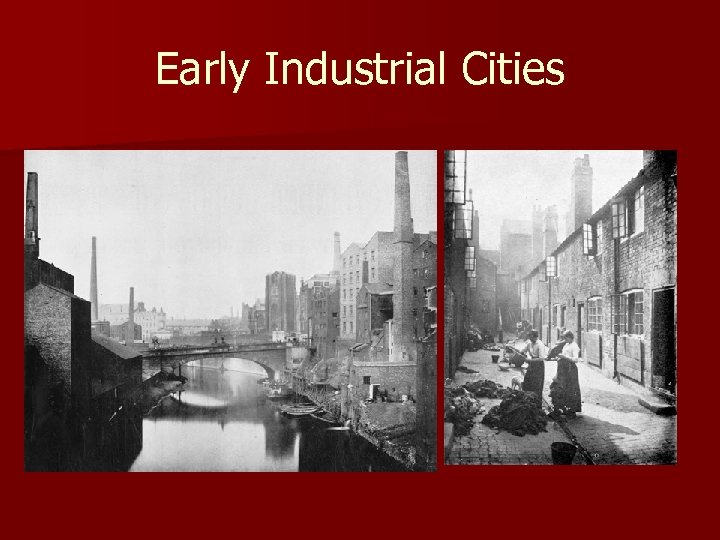 Early Industrial Cities
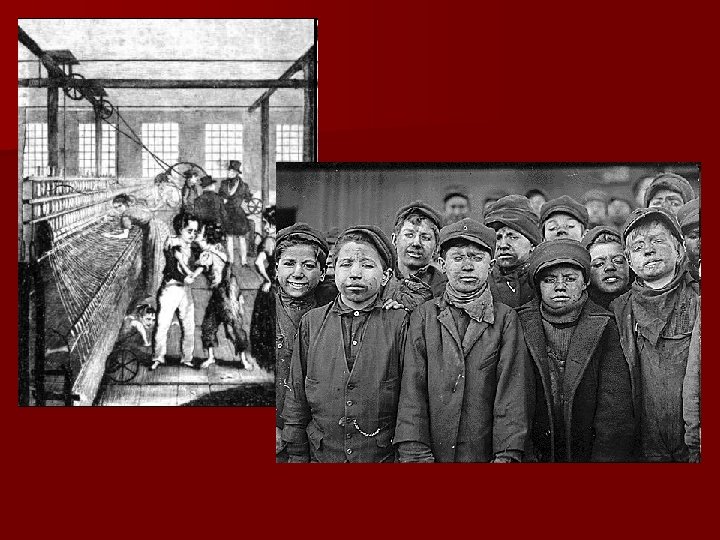
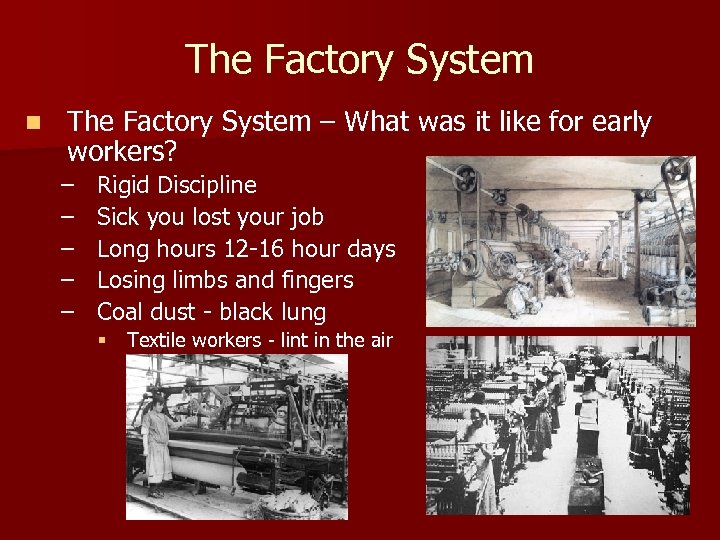 The Factory System n The Factory System – What was it like for early workers? – – – Rigid Discipline Sick you lost your job Long hours 12 -16 hour days Losing limbs and fingers Coal dust - black lung § Textile workers - lint in the air
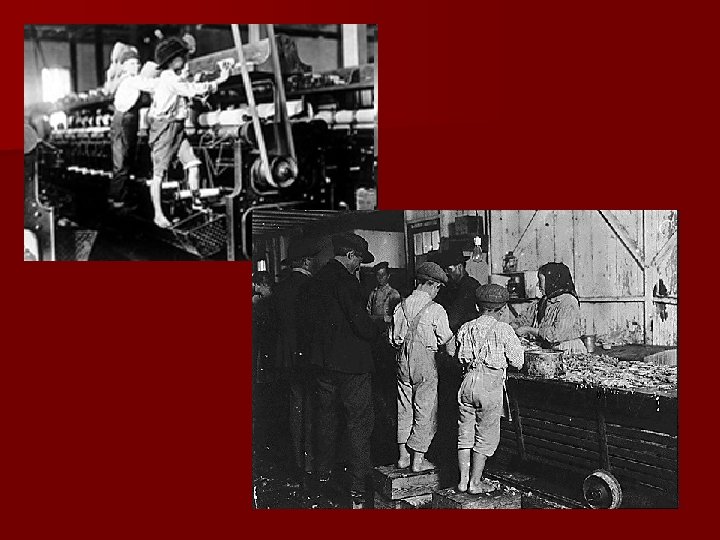
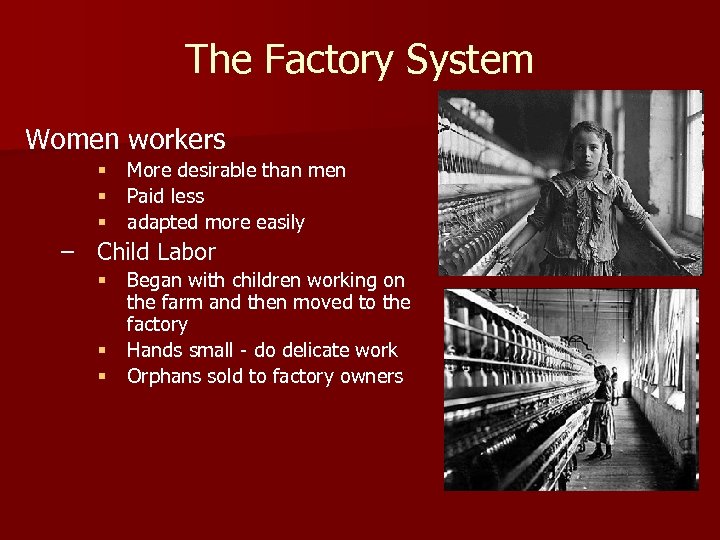 The Factory System Women workers § More desirable than men § Paid less § adapted more easily – Child Labor § Began with children working on the farm and then moved to the factory § Hands small - do delicate work § Orphans sold to factory owners
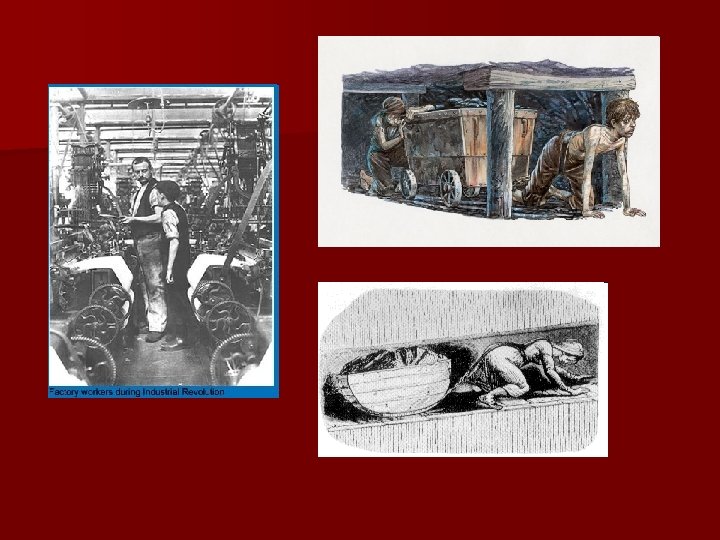
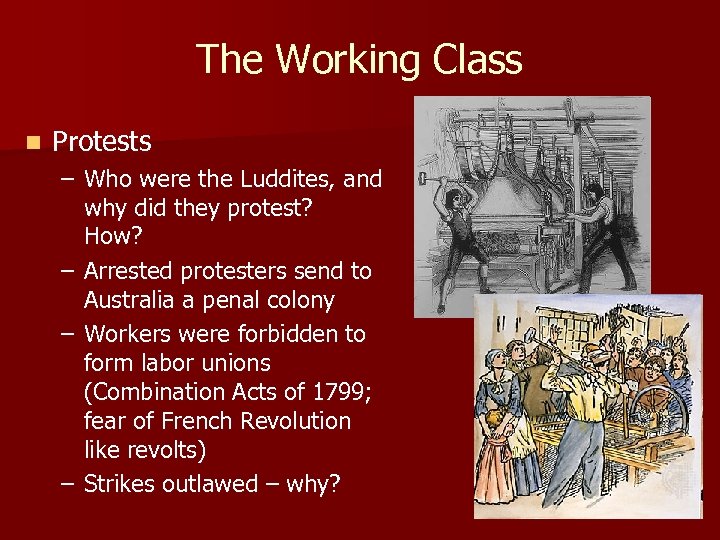 The Working Class n Protests – Who were the Luddites, and why did they protest? How? – Arrested protesters send to Australia a penal colony – Workers were forbidden to form labor unions (Combination Acts of 1799; fear of French Revolution like revolts) – Strikes outlawed – why?
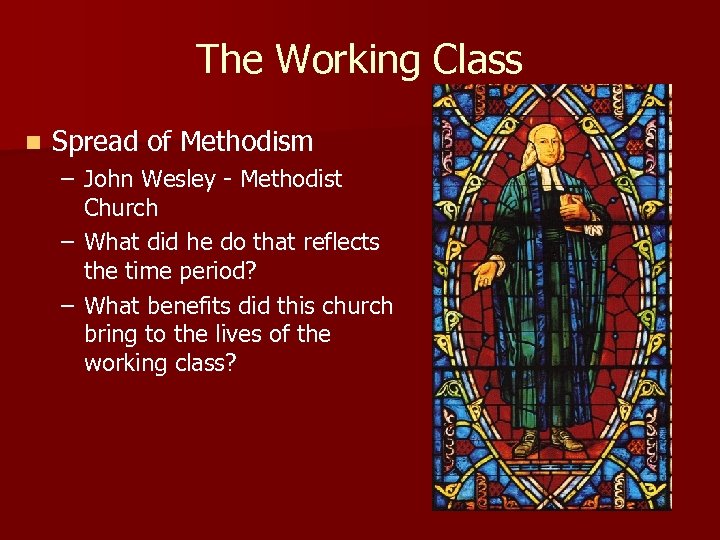 The Working Class n Spread of Methodism – John Wesley - Methodist Church – What did he do that reflects the time period? – What benefits did this church bring to the lives of the working class?
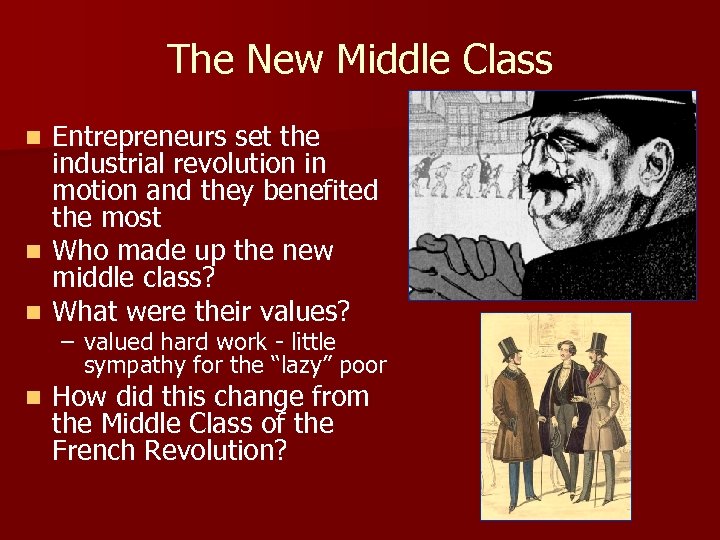 The New Middle Class Entrepreneurs set the industrial revolution in motion and they benefited the most n Who made up the new middle class? n What were their values? n – valued hard work - little sympathy for the “lazy” poor n How did this change from the Middle Class of the French Revolution?
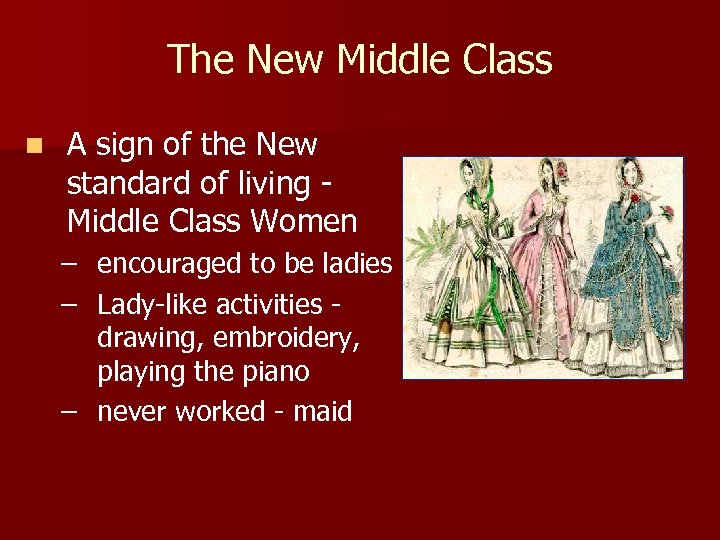 The New Middle Class n A sign of the New standard of living - Middle Class Women – encouraged to be ladies – Lady-like activities - drawing, embroidery, playing the piano – never worked - maid
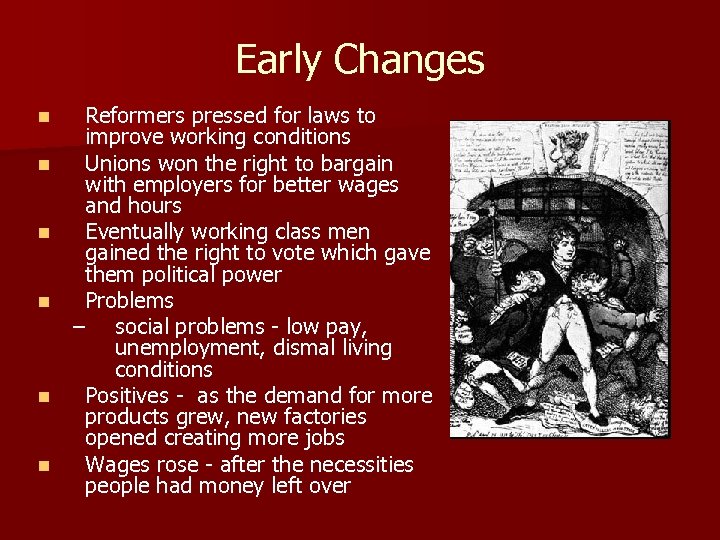 Early Changes n n n Reformers pressed for laws to improve working conditions Unions won the right to bargain with employers for better wages and hours Eventually working class men gained the right to vote which gave them political power Problems – social problems - low pay, unemployment, dismal living conditions Positives - as the demand for more products grew, new factories opened creating more jobs Wages rose - after the necessities people had money left over
 New Ways of Thinking n Laissez Faire Economics – Adam Smith - capitalist § Free Market – unregulated exchange of goods and services Eventually help everyone, not just the rich § FM -> produce more goods at lower prices making them affordable to everyone § A growing economy would encourage capitalists to reinvest profits into new ventures – Thomas Malthus - capitalist § Grimly predicted civilizations outcome – population would outpace food supply § Checks on population war, disease, and famine
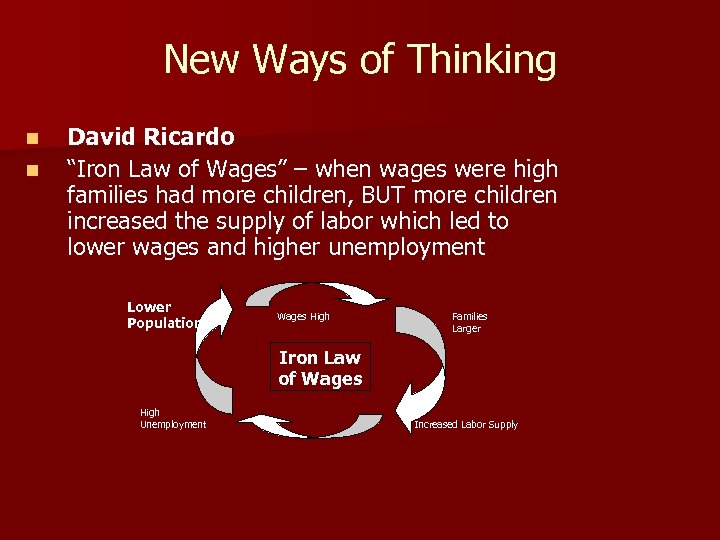 New Ways of Thinking n n David Ricardo “Iron Law of Wages” – when wages were high families had more children, BUT more children increased the supply of labor which led to lower wages and higher unemployment Lower Population Wages High Families Larger Iron Law of Wages High Unemployment Increased Labor Supply
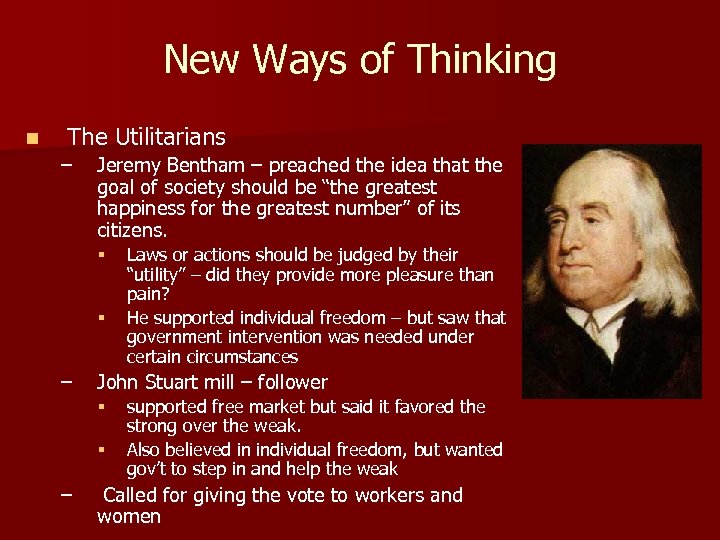 New Ways of Thinking n The Utilitarians – Jeremy Bentham – preached the idea that the goal of society should be “the greatest happiness for the greatest number” of its citizens. § § – John Stuart mill – follower § § – Laws or actions should be judged by their “utility” – did they provide more pleasure than pain? He supported individual freedom – but saw that government intervention was needed under certain circumstances supported free market but said it favored the strong over the weak. Also believed in individual freedom, but wanted gov’t to step in and help the weak Called for giving the vote to workers and women
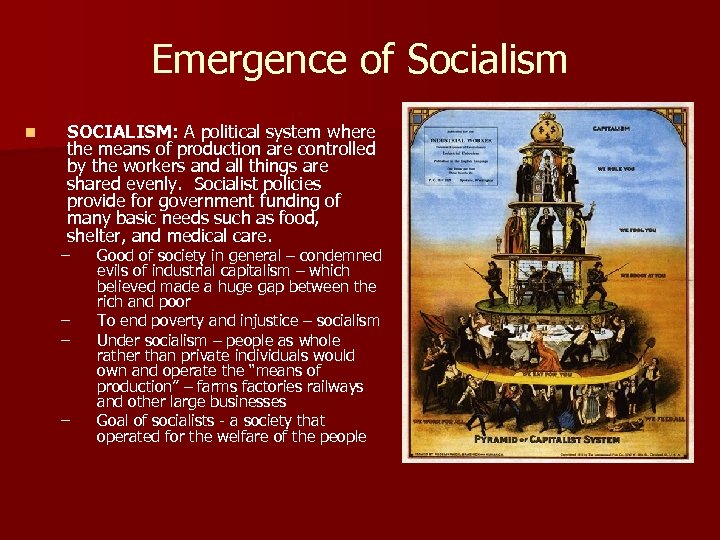 Emergence of Socialism n SOCIALISM: A political system where the means of production are controlled by the workers and all things are shared evenly. Socialist policies provide for government funding of many basic needs such as food, shelter, and medical care. – – Good of society in general – condemned evils of industrial capitalism – which believed made a huge gap between the rich and poor To end poverty and injustice – socialism Under socialism – people as whole rather than private individuals would own and operate the “means of production” – farms factories railways and other large businesses Goal of socialists - a society that operated for the welfare of the people
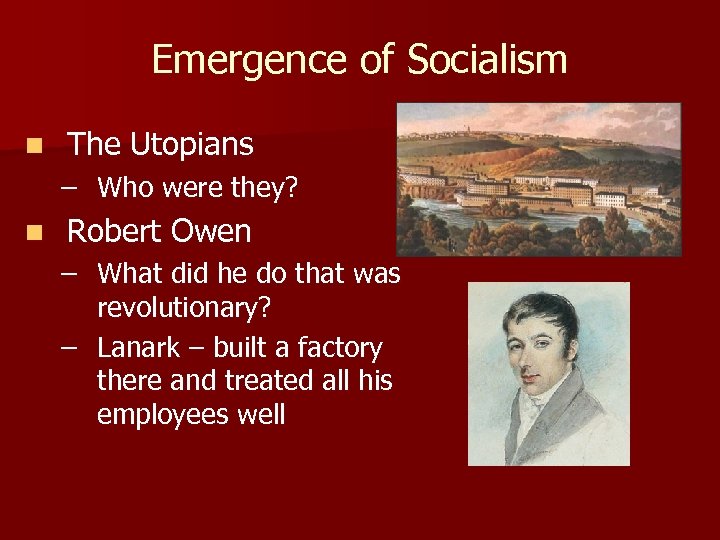 Emergence of Socialism n The Utopians – Who were they? n Robert Owen – What did he do that was revolutionary? – Lanark – built a factory there and treated all his employees well
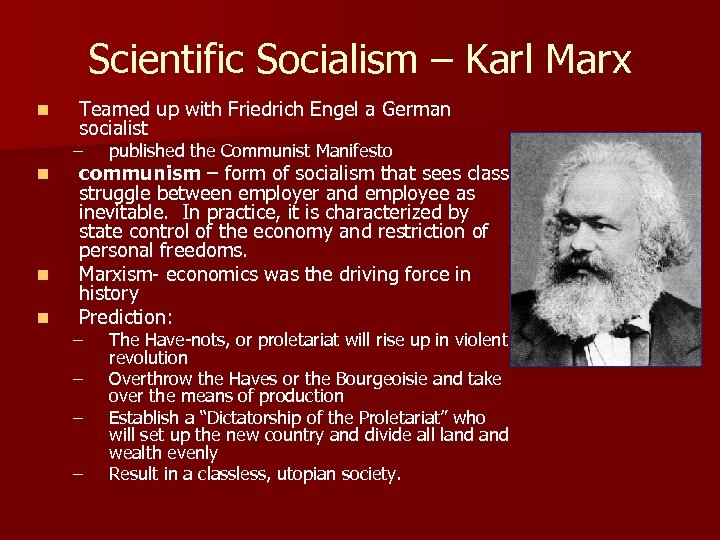 Scientific Socialism – Karl Marx n Teamed up with Friedrich Engel a German socialist – n n n published the Communist Manifesto – The Have-nots, or proletariat will rise up in violent revolution Overthrow the Haves or the Bourgeoisie and take over the means of production Establish a “Dictatorship of the Proletariat” who will set up the new country and divide all land wealth evenly Result in a classless, utopian society. communism – form of socialism that sees class struggle between employer and employee as inevitable. In practice, it is characterized by state control of the economy and restriction of personal freedoms. Marxism- economics was the driving force in history Prediction: – – –
 Life in the Industrial Age
 Industrial Ideas Spread n By mid 1800’s Industrial Revolution entered new phase – new industrial powers emerged – n “Second Industrial Revolution” – – – Germany (will unify in next chapter) United States What allowed these nations to industrialize quickly? Why did other nations, especially in Europe industrialize slowly? New Industrial Powers – § n Lacked natural resources and capital – lagging effect of the Napoleonic Wars and the failure of the Continental System Globally nations competed fiercely altering patterns of world trade
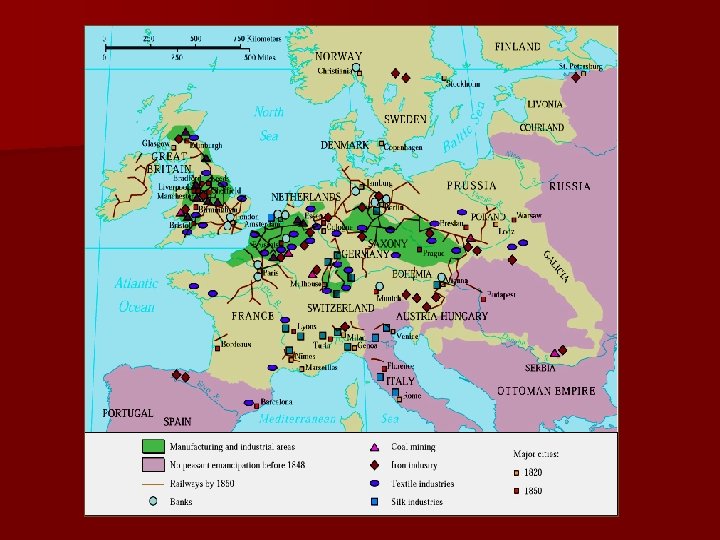
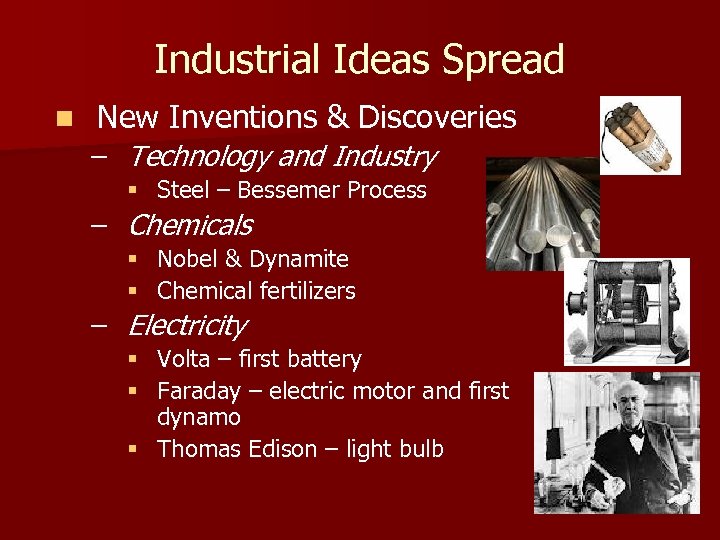 Industrial Ideas Spread n New Inventions & Discoveries – Technology and Industry § Steel – Bessemer Process – Chemicals § Nobel & Dynamite § Chemical fertilizers – Electricity Volta – first battery Faraday – electric motor and first dynamo § Thomas Edison – light bulb § §
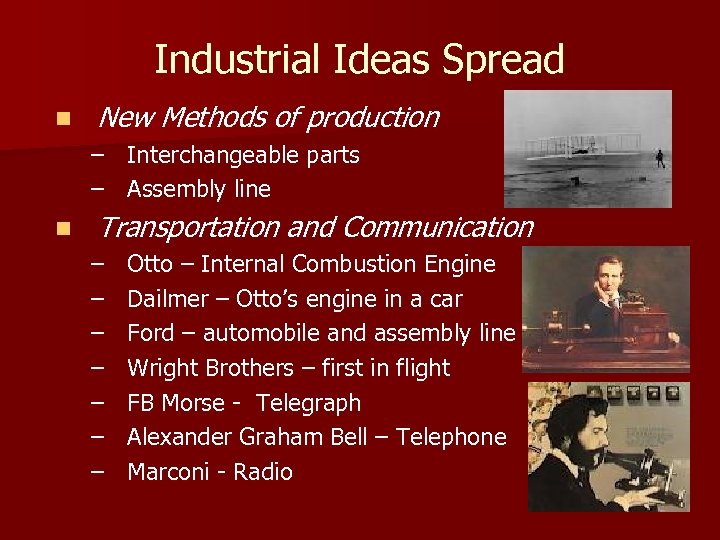 Industrial Ideas Spread n New Methods of production – Interchangeable parts – Assembly line n Transportation and Communication – – – – Otto – Internal Combustion Engine Dailmer – Otto’s engine in a car Ford – automobile and assembly line Wright Brothers – first in flight FB Morse - Telegraph Alexander Graham Bell – Telephone Marconi - Radio
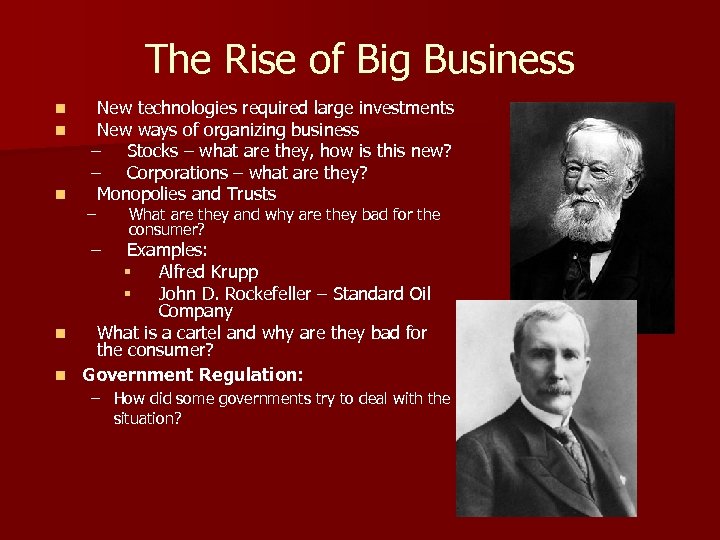 The Rise of Big Business n n n New technologies required large investments New ways of organizing business – Stocks – what are they, how is this new? – Corporations – what are they? Monopolies and Trusts – – What are they and why are they bad for the consumer? Examples: § Alfred Krupp § John D. Rockefeller – Standard Oil Company n What is a cartel and why are they bad for the consumer? n Government Regulation: – How did some governments try to deal with the situation?
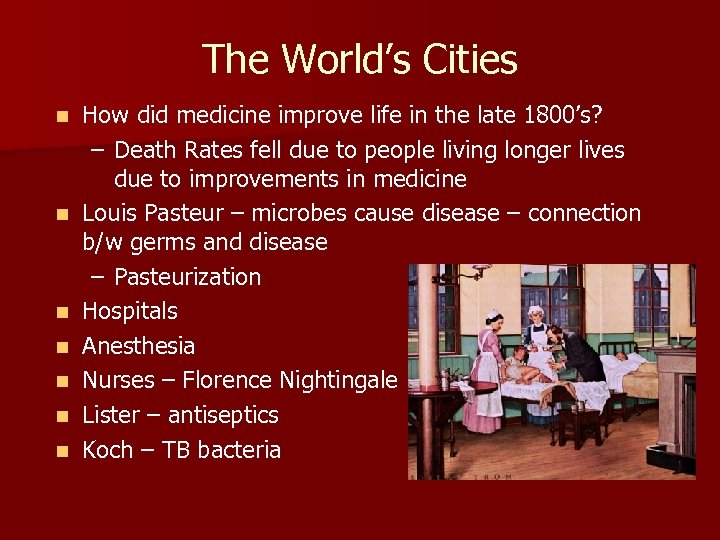 The World’s Cities n n n n How did medicine improve life in the late 1800’s? – Death Rates fell due to people living longer lives due to improvements in medicine Louis Pasteur – microbes cause disease – connection b/w germs and disease – Pasteurization Hospitals Anesthesia Nurses – Florence Nightingale Lister – antiseptics Koch – TB bacteria
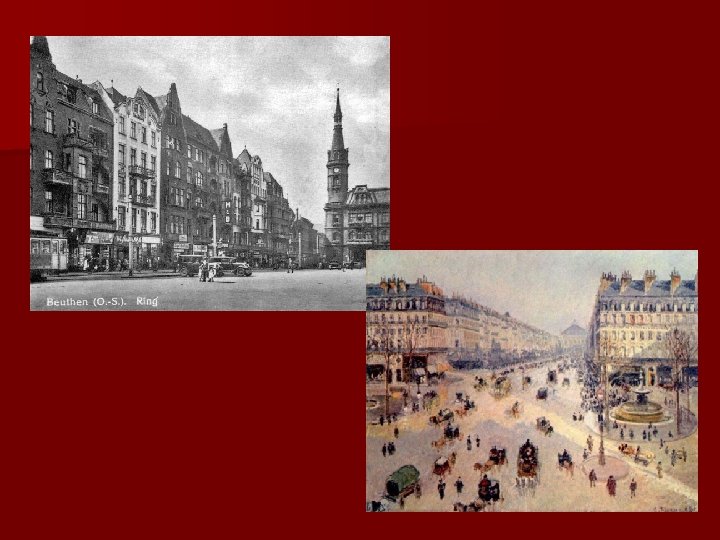
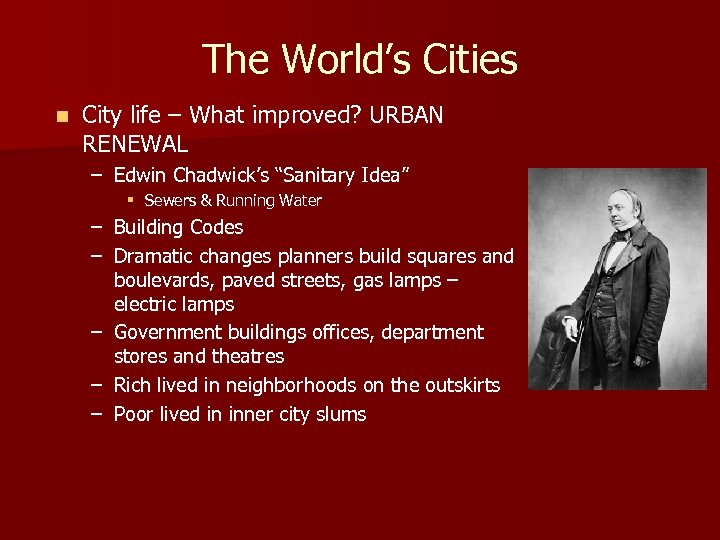 The World’s Cities n City life – What improved? URBAN RENEWAL – Edwin Chadwick’s “Sanitary Idea” § Sewers & Running Water – Building Codes – Dramatic changes planners build squares and boulevards, paved streets, gas lamps – electric lamps – Government buildings offices, department stores and theatres – Rich lived in neighborhoods on the outskirts – Poor lived in inner city slums
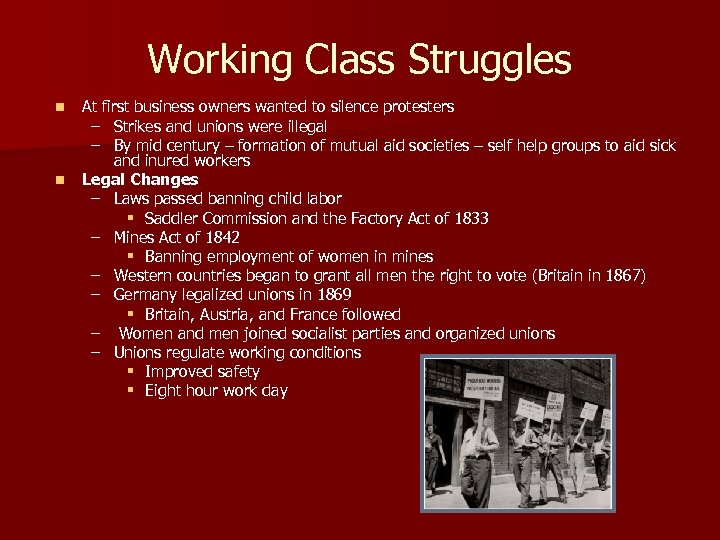 Working Class Struggles n n At first business owners wanted to silence protesters – Strikes and unions were illegal – By mid century – formation of mutual aid societies – self help groups to aid sick and inured workers Legal Changes – Laws passed banning child labor § Saddler Commission and the Factory Act of 1833 – Mines Act of 1842 § Banning employment of women in mines – Western countries began to grant all men the right to vote (Britain in 1867) – Germany legalized unions in 1869 § Britain, Austria, and France followed – Women and men joined socialist parties and organized unions – Unions regulate working conditions § Improved safety § Eight hour work day
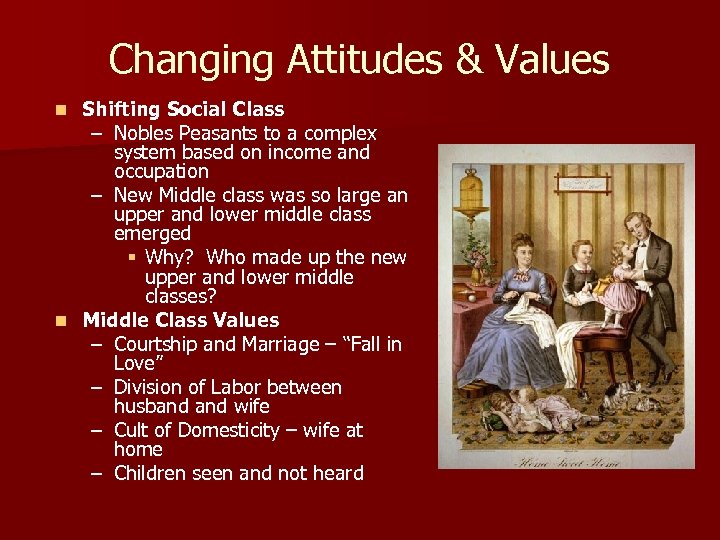 Changing Attitudes & Values Shifting Social Class – Nobles Peasants to a complex system based on income and occupation – New Middle class was so large an upper and lower middle class emerged § Why? Who made up the new upper and lower middle classes? n Middle Class Values – Courtship and Marriage – “Fall in Love” – Division of Labor between husband wife – Cult of Domesticity – wife at home – Children seen and not heard n
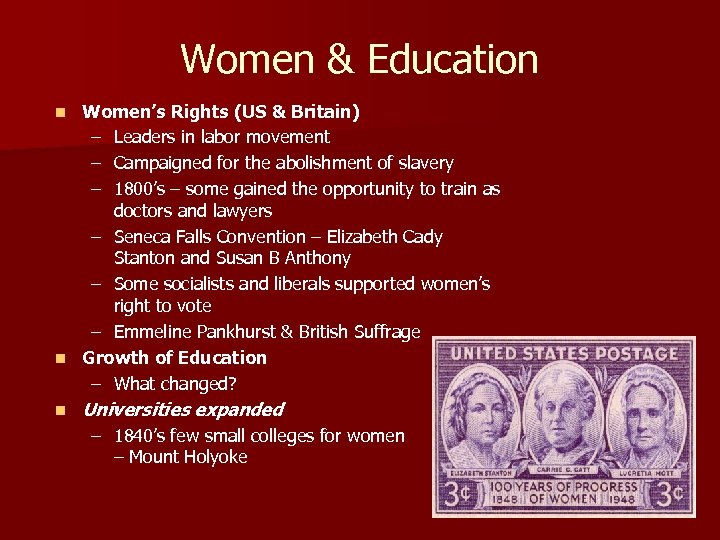 Women & Education Women’s Rights (US & Britain) – Leaders in labor movement – Campaigned for the abolishment of slavery – 1800’s – some gained the opportunity to train as doctors and lawyers – Seneca Falls Convention – Elizabeth Cady Stanton and Susan B Anthony – Some socialists and liberals supported women’s right to vote – Emmeline Pankhurst & British Suffrage n Growth of Education – What changed? n n Universities expanded – 1840’s few small colleges for women – Mount Holyoke
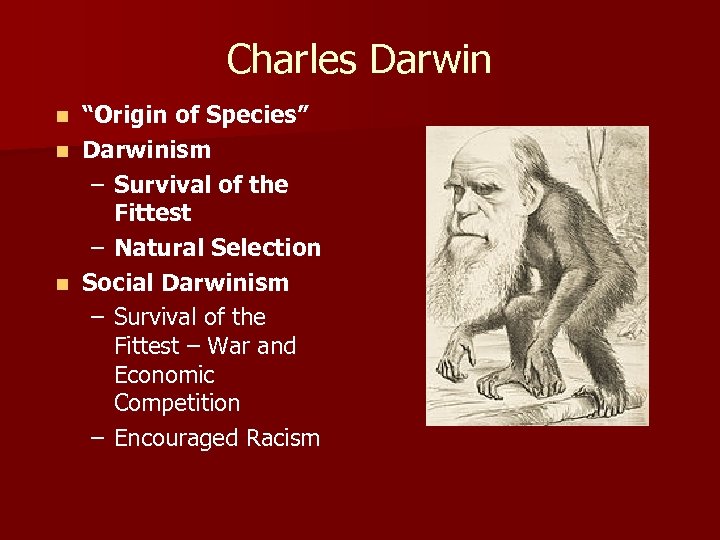 Charles Darwin “Origin of Species” n Darwinism – Survival of the Fittest – Natural Selection n Social Darwinism – Survival of the Fittest – War and Economic Competition – Encouraged Racism n
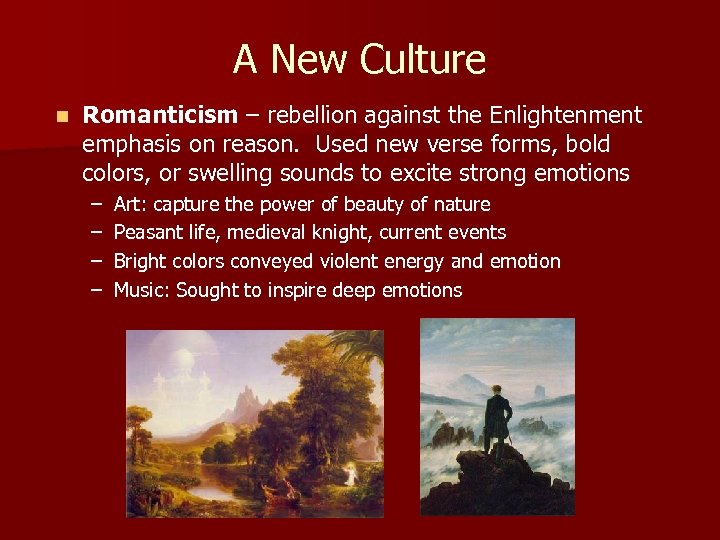 A New Culture n Romanticism – rebellion against the Enlightenment emphasis on reason. Used new verse forms, bold colors, or swelling sounds to excite strong emotions – – Art: capture the power of beauty of nature Peasant life, medieval knight, current events Bright colors conveyed violent energy and emotion Music: Sought to inspire deep emotions
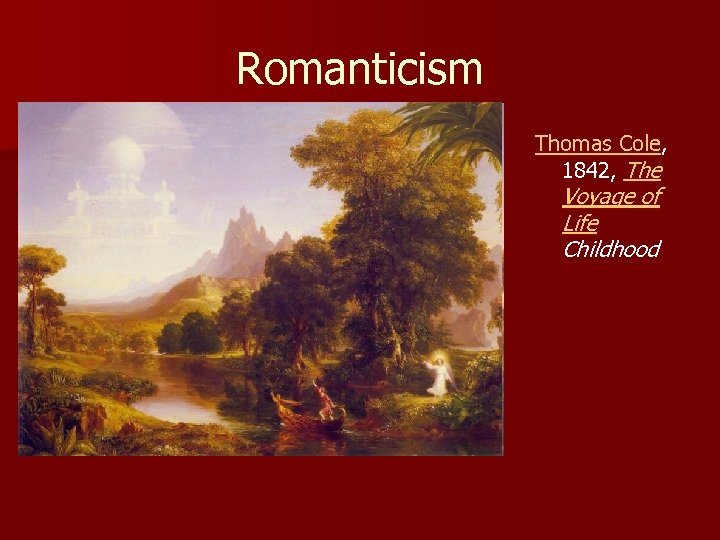 Romanticism Thomas Cole, 1842, The Voyage of Life Childhood
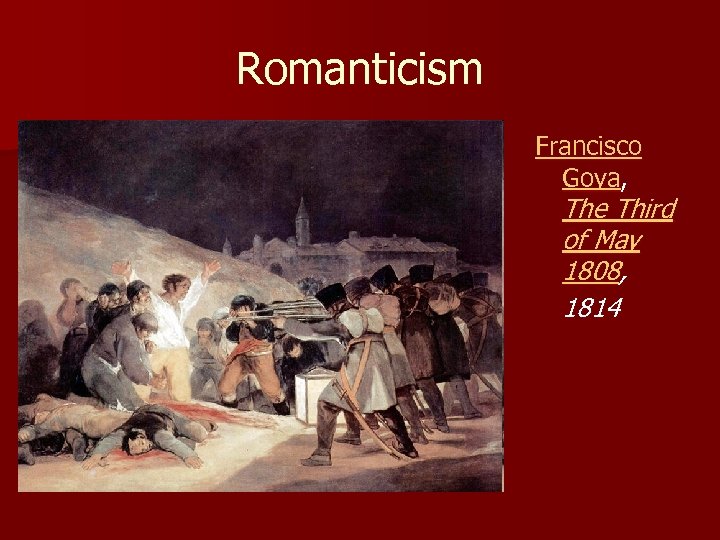 Romanticism Francisco Goya, The Third of May 1808, 1814
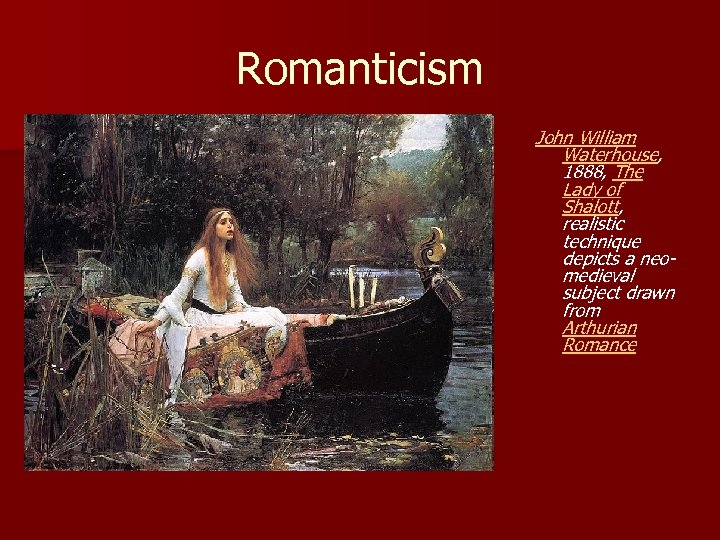 Romanticism John William Waterhouse, 1888, The Lady of Shalott, realistic technique depicts a neomedieval subject drawn from Arthurian Romance
 A New Culture n Realism: an attempt to represent the world as it was, without the sentiment associated with romanticism – Often looked at the harsher side of life in cities and villages – Many writers and artists were committed to improving the lot of the unfortunates whose lives they described – Novels: lives of slum dwellers and factory workers – Art: focused on ordinary subjects such as working class men and women – Photography – exposed slums and other harsh living conditions n Impressionism – sought to capture the first fleeting impression made by a scene or viewers object on the viewers eye.
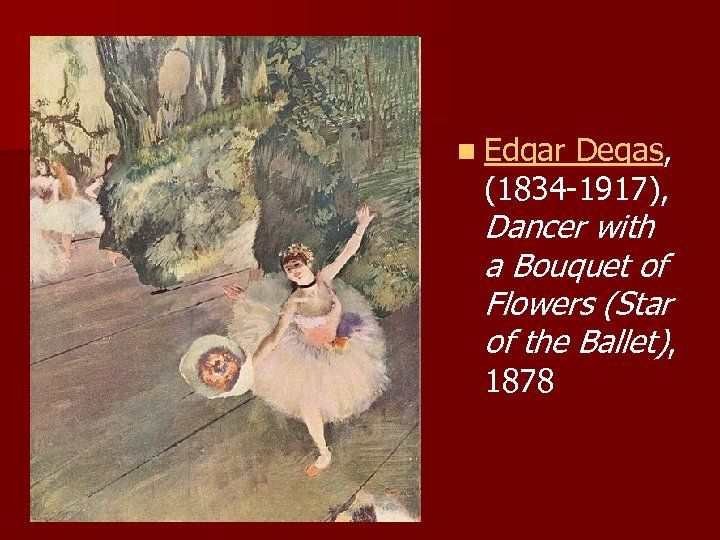 n Edgar Degas, (1834 -1917), Dancer with a Bouquet of Flowers (Star of the Ballet), 1878
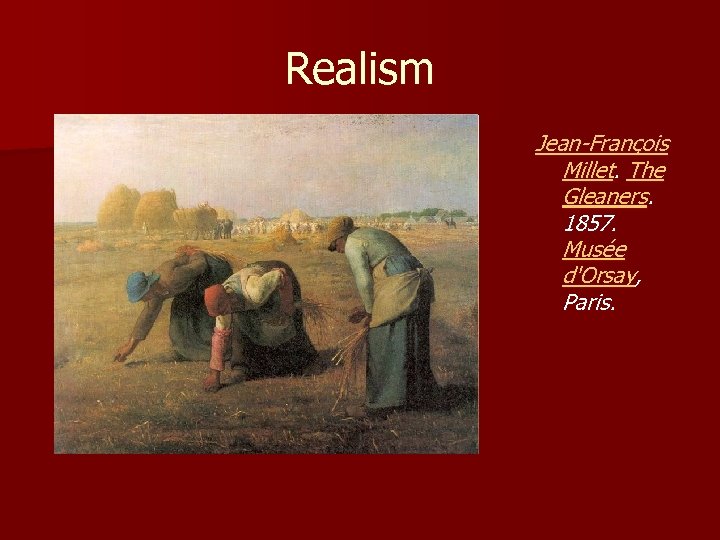 Realism Jean-François Millet. The Gleaners. 1857. Musée d'Orsay, Paris.
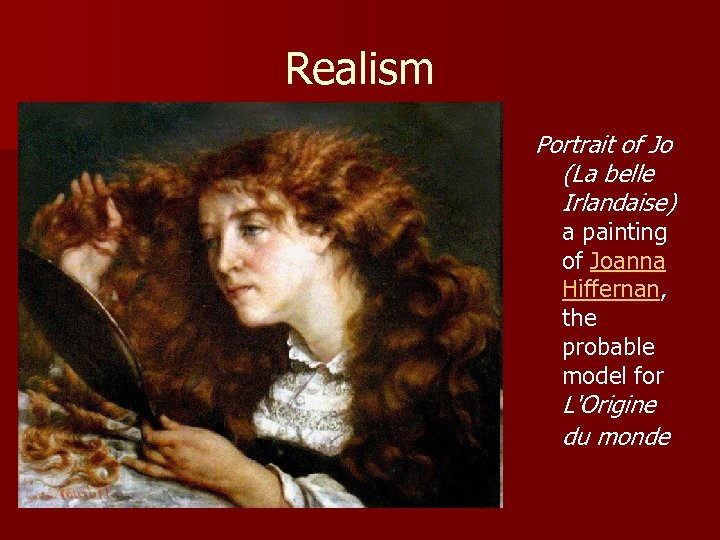 Realism Portrait of Jo (La belle Irlandaise) a painting of Joanna Hiffernan, the probable model for L'Origine du monde
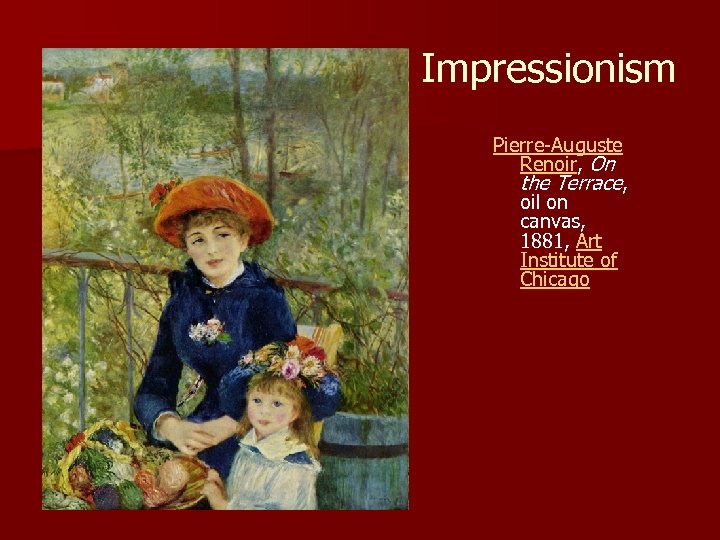 Impressionism Pierre-Auguste Renoir, On the Terrace, oil on canvas, 1881, Art Institute of Chicago
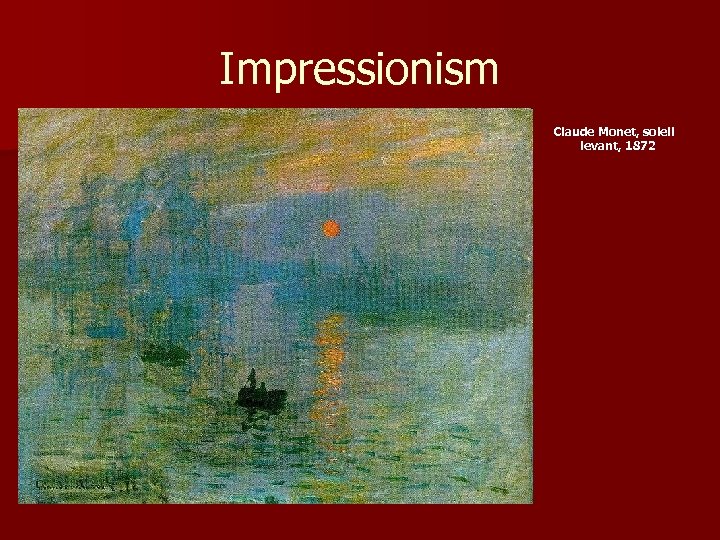 Impressionism Claude Monet, soleil levant, 1872
 What are the Effects of the Industrial Revolution?