


 Скачать презентацию TOPIC 1 WORK ECOLOGY HUMAN DEVELOPMENT FEM
1d05944e75de273183983f0cb8d07853.ppt
- Количество слайдов: 63
 TOPIC 1 WORK ECOLOGY & HUMAN DEVELOPMENT FEM 3104 /JPMPK/FEM/MAT-RK-MH Introduction: Concepts and Definition 1
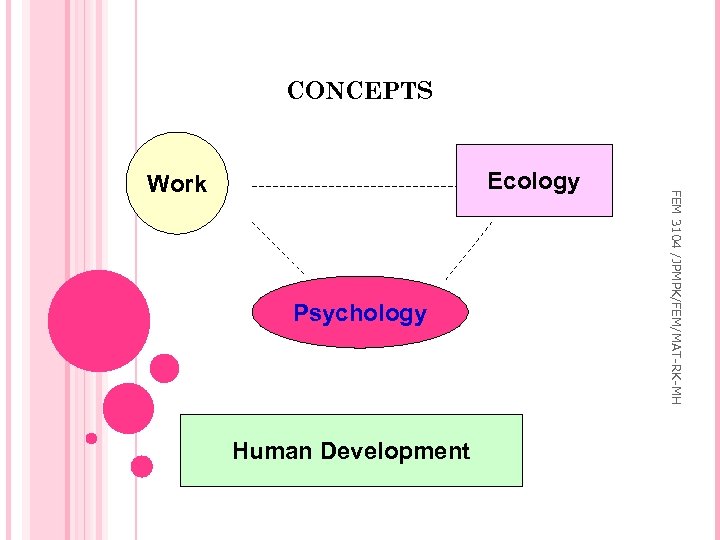 CONCEPTS FEM 3104 /JPMPK/FEM/MAT-RK-MH Ecology Work Psychology Human Development 2
 WHAT IS WORK? Service performed by an employee at the request and under the control of an employer and, on the employer's time. Something that one is doing, making or performing, especially as an occupation or undertaking: A duty or task: begin the day’s work An amount of such activity either done or required: a week’s work One’s place of employment : should I call you at home or work? Physical or mental effort or activity directed toward the production or accomplishment of something. FEM 3104 /JPMPK/FEM/MAT-RK-MH 3
 IN HUMAN LABOUR, WORK MAY REFER TO: FEM 3104 /JPMPK/FEM/MAT-RK-MH "Work“ one's place of employment. Work (project management) the effort applied to produce a deliverable or accomplish a task. Labour (economics) measure of the work done by human beings. Wage labour a worker sells their labour and an employer buys it Manual labour physical work done by people Sex work employment in the sex industry 4
 FEM 3104 /JPMPK/FEM/MAT-RK-MH 5
 FEM 3104 /JPMPK/FEM/MAT-RK-MH 6
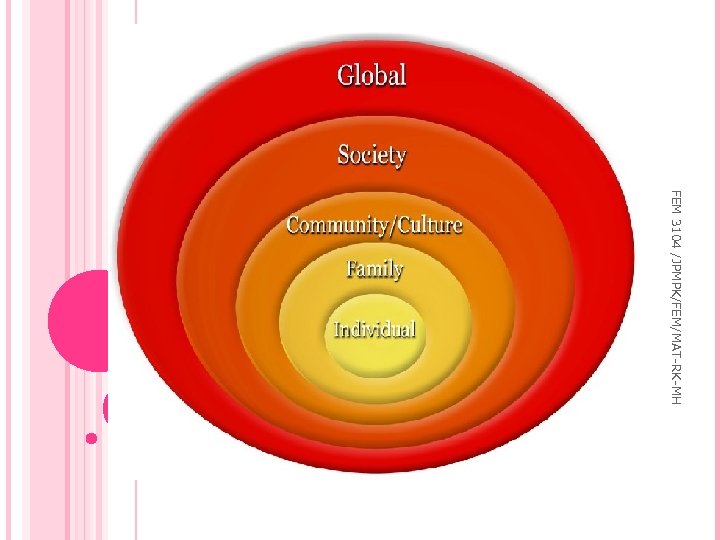
 WHAT IS ECOLOGY? An FEM 3104 /JPMPK/FEM/MAT-RK-MH ecosystem can be defined as any situation where there is interaction between organisms and their environment The study of the interaction between living organisms and their environment (physical & social environment). 7
 WHAT IS ECOLOGY? Terms “ecology” (oekologie) defined first by Ernst Haeckel in 1866 science of the between organisms environments. FEM 3104 /JPMPK/FEM/MAT-RK-MH The relationships and their Human ecology - The branch of sociology that is concerned with studying the relationships between human groups and their physical and social environments. 8
 THE FIRST PRINCIPLE OF ECOLOGY IS THAT Each FEM 3104 /JPMPK/FEM/MAT-RK-MH living organism has an ongoing and continual relationship with every other element that makes up its environment Ecology is concerned with patterns of distribution (where organisms occur) and with patterns of abundance (how many organisms occur) in space and time. 9
 FEM 3104 /JPMPK/FEM/MAT-RK-MH 10
 WHAT IS PSYCHOLOGY? Behaviors Thoughts and Emotions FEM 3104 /JPMPK/FEM/MAT-RK-MH Psychology- various definitions Simplest definition: “the science of mental health OR mental life” (Miller, 1996) Mental refers to 3 phenomenon: 11
 PSYCHOLOGY A theoretical, educational and applied science connecting the scientific study of mental operations and behavior or performance. The application or usage of understanding, knowledge and skills to a number of areas of human activity, involving issues concerning with daily activities such as education, events, people and their task, employment, association, relationship as well as the treatment of mental health difficulties. FEM 3104 /JPMPK/FEM/MAT-RK-MH 12
 FIVE AREAS IN BASIC PSYCHOLOGY I. III. IV. V. FEM 3104 /JPMPK/FEM/MAT-RK-MH II. Physiological psychology Cognitive psychology Developmental psychology Social psychology Personality psychology 13
 PHYSIOLOGICAL PSYCHOLOGY The study of the physiological basis of how we think, connecting the physical operation of the brain with what we actually say and do. It is thus concerned with brain cells, brain structures and components, brain chemistry, and how all this leads to speech and action. It is also, of course, important to understand how we take in information from our five senses. FEM 3104 /JPMPK/FEM/MAT-RK
 COGNITIVE PSYCHOLOGY Focuses on our cognitive functioning i. e our thought processes. How well we remember information under various condition and how we weigh up information when making decisions. FEM 3104 /JPMPK/FEM/MAT-RK-MH 15
 DEVELOPMENTAL PSYCHOLOGY Developmental psychology is the scientific study of progressive psychological changes that occur in human beings as their age (throughout adult life) eg: How and when children become able to understand particular concepts and how they learn language. Studying the Life Span from Conception to Death Integrates all development. aspects of FEM 3104 /JPMPK/FEM/MAT-RK-MH human 16
 SOCIAL PSYCHOLOGY Concerns how our behaviours, thoughts and emotions are affected by other people. How groups of people make decisions and the extent to which a person’s attitudes towards particular groups of people influence his or her behaviour towards them. FEM 3104 /JPMPK/FEM/MAT-RK-MH 17
 PERSONALITY PSYCHOLOGY Personality psychology is a branch of psychology that studies personality and individual differences. Its areas of focus include: Constructing a coherent picture of the individual and his or her major psychological processes Investigating individual differences—how people are unique Investigating human nature—how people are alike FEM 3104 /JPMPK/FEM/MAT-RK-MH 18
 WHAT IS WORK PSYCHOLOGY? It is an area of applied psychology Work psychologists use concepts, theories and techniques derived from all areas of basic psychology. FEM 3104 /JPMPK/FEM/MAT-RK-MH Work psychology is defined in terms of its ecology/context of application, and is not in itself one of the sub-discipline of psychology 19
 WHAT IS WORK PSYCHOLOGY? The study on people’s behavior, thoughts and emotions related to their work Area of psychology dealing with job analysis, defining and measuring job performance, performance appraisal, tests, employment interviews, employee selection and training, and human factors. FEM 3104 /JPMPK/FEM/MAT-RK-MH 20
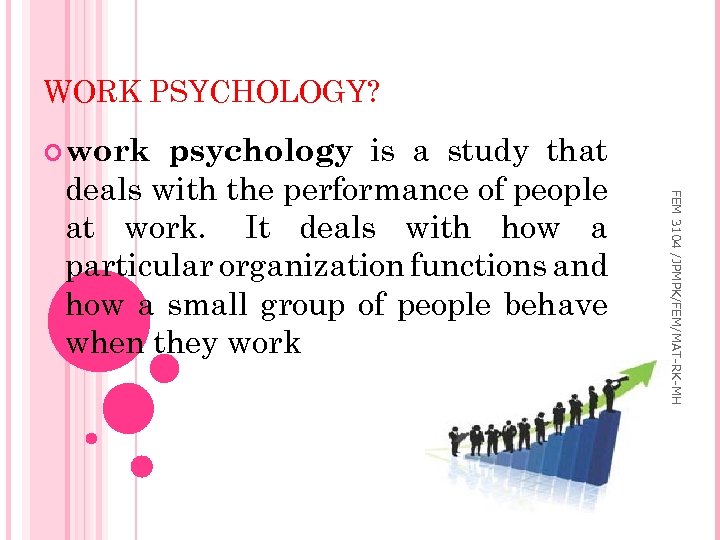 WORK PSYCHOLOGY? psychology is a study that deals with the performance of people at work. It deals with how a particular organization functions and how a small group of people behave when they work FEM 3104 /JPMPK/FEM/MAT-RK-MH 21
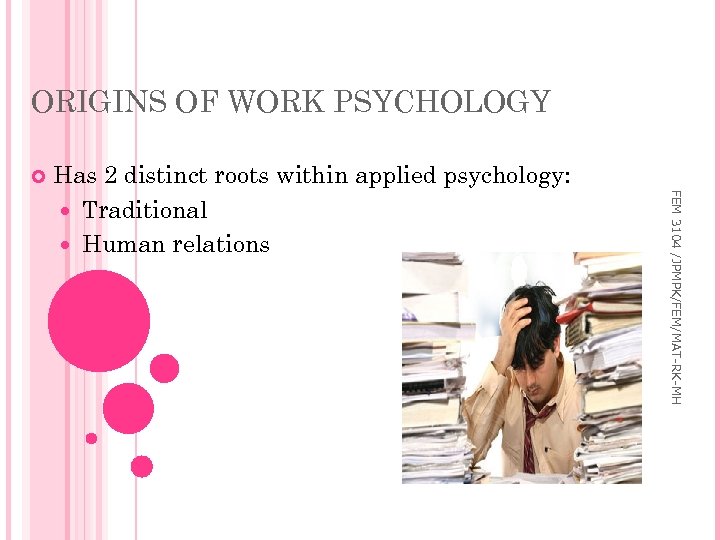 ORIGINS OF WORK PSYCHOLOGY FEM 3104 /JPMPK/FEM/MAT-RK-MH Has 2 distinct roots within applied psychology: Traditional Human relations 22
 ORIGIN: TRADITIONAL A) Fitting man to job (FMJ) B) Fitting the job to the man (FJM) The FMJ and FJM traditions essentially concern the relationship between individuals and their work. FEM 3104 /JPMPK/FEM/MAT-RK-MH 23
 Origin: Human Relations It is concerned with the complex interplay between individuals, groups, organizations and work. It therefore emphasizes social factors at work much more than FMJ and FJM. The importance of human relations was highlighted in some famous research now known as the Hawthorne studies. The study was conducted in the 1920 s at a large factory of the Western Electric Company at Hawthorne, near Chicago, USA. FEM 3104 /JPMPK/FEM/MAT-RK
 WORK PSYCHOLOGY TODAY Also known under the name of: Occupational psychology Psychology of work and organization Work and organizational psychology Vocational psychology Industrial psychology Personnel Psychology/ talent assessment In a simpler term Work psychology encompasses both the individual and organizational level of analysis. FEM 3104 /JPMPK/FEM/MAT-RK-MH 25
 FEM 3104 /JPMPK/FEM/MAT-RK-MH Guion (1965) defines I-O psychology as "the scientific study of the relationship between man and the world of work: . . . in the process of making a living" (p. 817). Blum and Naylor (1968) define it as "simply the application or extension of psychological facts and principles to the problems concerning human beings operating within the context of business 26 and industry" (p 4)
 FEM 3104 /JPMPK/FEM/MAT-RK-MH The "industrial" side of I-O psychology has its historical origins in research on individual differences, assessment, and the prediction of performance. This branch of the field crystallized during World War I, in response to the need to rapidly assign new troops to duty stations. After the War the growing industrial base in the U. S. added impetus to I-O psychology. 27
 WHAT IS HUMAN DEVELOPMENT? Human development is the process of growing to maturity and reaching one’s full potential in biological terms This entails growth from one called zygote to an adult human being The psychological study of human development is called developmental psychology FEM 3104 /JPMPK/FEM/MAT-RK-MH 28
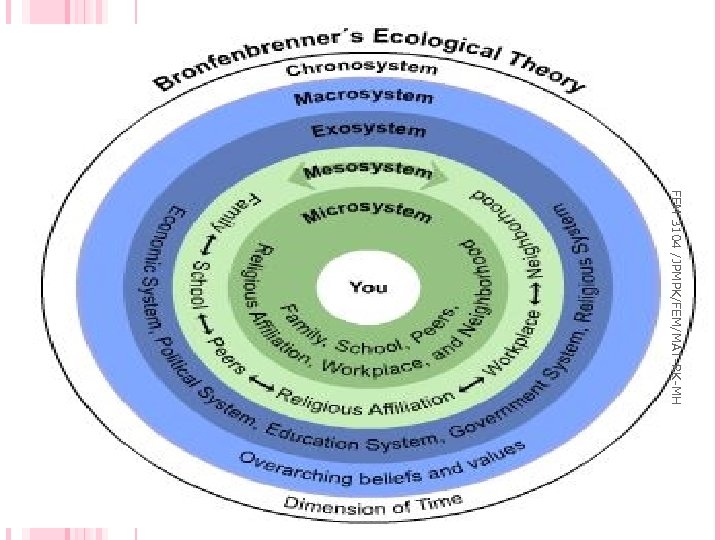
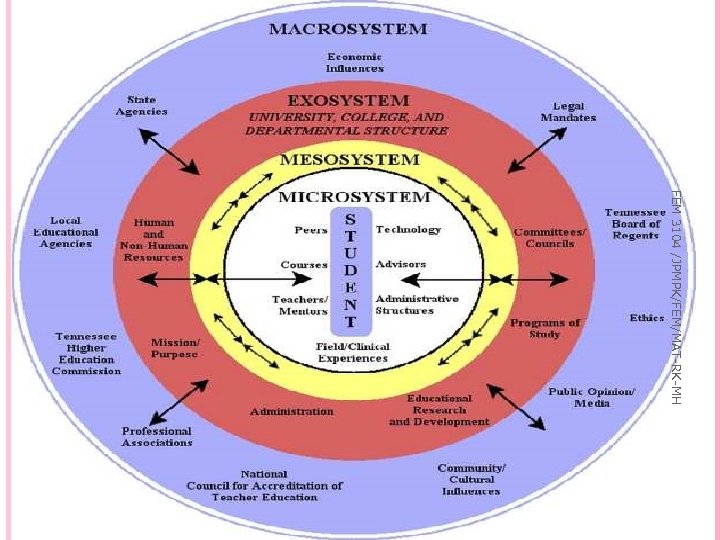
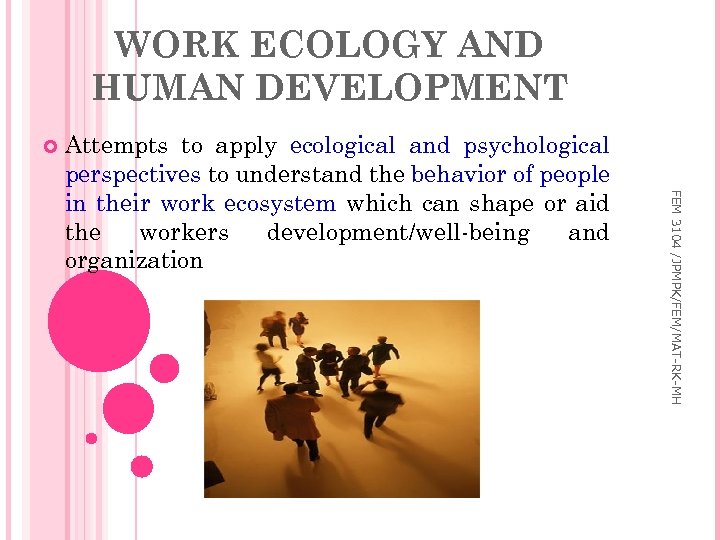 WORK ECOLOGY AND HUMAN DEVELOPMENT FEM 3104 /JPMPK/FEM/MAT-RK-MH Attempts to apply ecological and psychological perspectives to understand the behavior of people in their work ecosystem which can shape or aid the workers development/well-being and organization 29
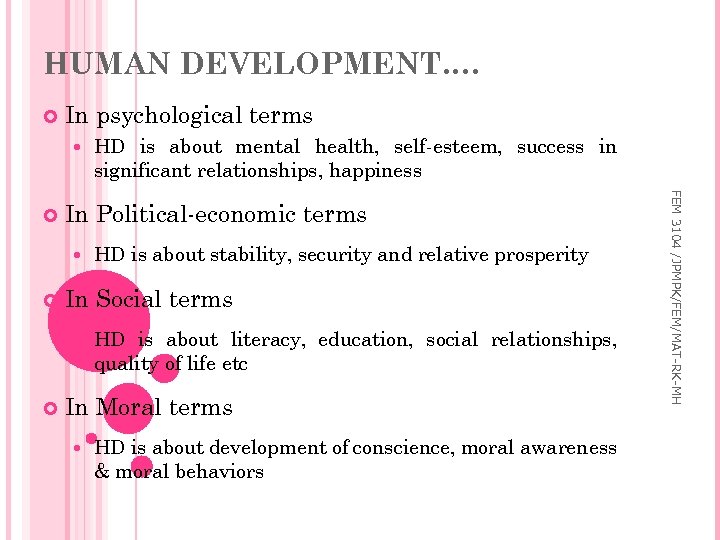 HUMAN DEVELOPMENT…. In psychological terms In Political-economic terms In Social terms HD is about stability, security and relative prosperity HD is about literacy, education, social relationships, quality of life etc In Moral terms HD is about development of conscience, moral awareness & moral behaviors FEM 3104 /JPMPK/FEM/MAT-RK-MH HD is about mental health, self-esteem, success in significant relationships, happiness 30
 FEM 3104 /JPMPK/FEM/MAT-RK-MH 31
 FEM 3104 /JPMPK/FEM/MAT-RK-MH 32
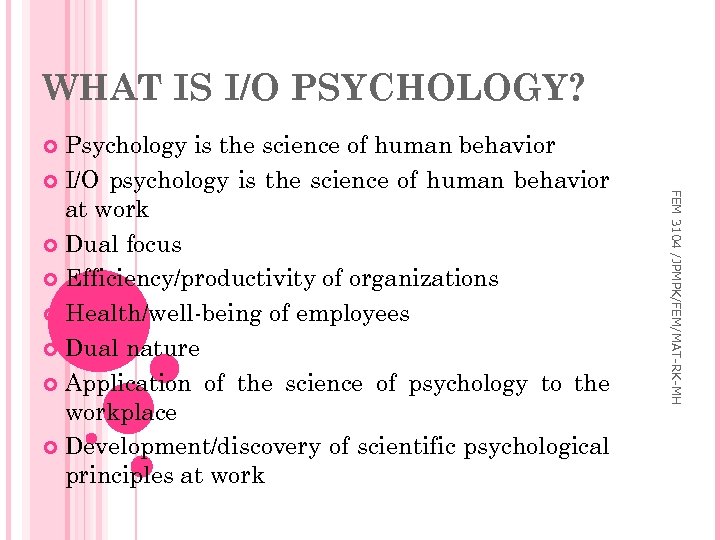 WHAT IS I/O PSYCHOLOGY? Psychology is the science of human behavior I/O psychology is the science of human behavior at work Dual focus Efficiency/productivity of organizations Health/well-being of employees Dual nature Application of the science of psychology to the workplace Development/discovery of scientific psychological principles at work FEM 3104 /JPMPK/FEM/MAT-RK-MH 33
 DEFINITION OF INDUSTRIAL AND ORGANIZATIONAL (I-O) PSYCHOLOGY “the application or extension of psychological facts ad principle to the problems concerning human beings operating within the context of business and industry” FEM 3104 /JPMPK/FEM/MAT-RK-MH Blum & Naylor (1968)- 34
 DEFINITION OF INDUSTRIAL AND ORGANIZATIONAL (I-O) PSYCHOLOGY improving the performance and well-being of its people. researches and identifies how behaviors and attitudes can be improved through hiring practices, training programs, and feedback systems. FEM 3104 /JPMPK/FEM/MAT-RK-MH Industrial and Organizational Psychology is a branch of Psychology devoted to organizations and the workplace. Therefore, an I-O Psychologists contribute to an organizations success by 35
 DEFINITION OF INDUSTRIAL AND ORGANIZATIONAL (I-O) PSYCHOLOGY Example problems include hiring better employees, reducing absenteeism, improving communication, and increasing job satisfaction FEM 3104 /JPMPK/FEM/MAT-RK-MH Applied I-O Psychology concerned with utilizing knowledge gathered from scientific inquiry “to solve real problems in the world of work” Muchinsky (2006), 36
 SPECIFIC AREAS OF CONCERN FEM 3104 /JPMPK/FEM/MAT-RK-MH Recruiting and selecting employees for jobs Training employees Assessing performance Defining and analyzing jobs Determining people feel about work Determining why people act as they do at work Effects work has on people Effects people have on one another How organizations are structured and function Designing work Designing tools and equipment Employee Health and Safety 37
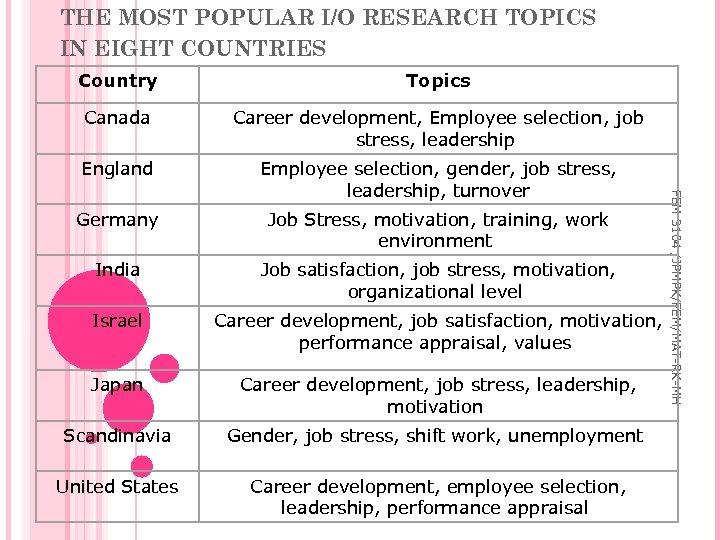 THE MOST POPULAR I/O RESEARCH TOPICS IN EIGHT COUNTRIES Topics Canada Career development, Employee selection, job stress, leadership England Employee selection, gender, job stress, leadership, turnover Germany Job Stress, motivation, training, work environment India Job satisfaction, job stress, motivation, organizational level Israel Career development, job satisfaction, motivation, performance appraisal, values Japan Career development, job stress, leadership, motivation Scandinavia Gender, job stress, shift work, unemployment United States Career development, employee selection, leadership, performance appraisal FEM 3104 /JPMPK/FEM/MAT-RK-MH Country 38
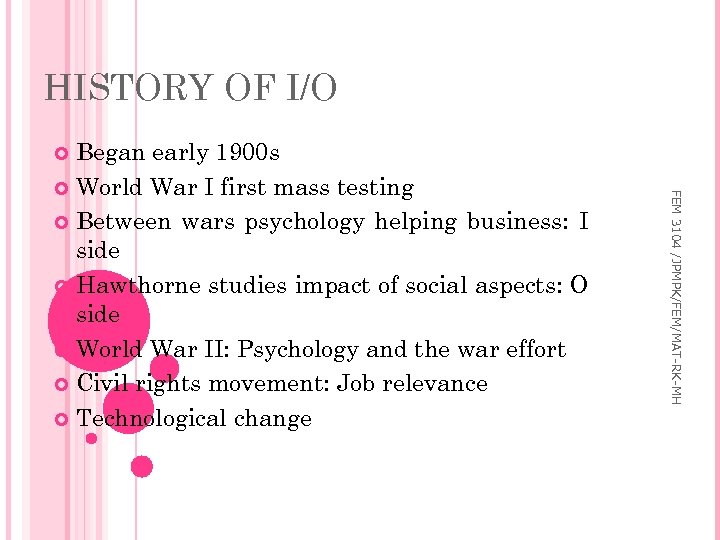 HISTORY OF I/O Began early 1900 s World War I first mass testing Between wars psychology helping business: I side Hawthorne studies impact of social aspects: O side World War II: Psychology and the war effort Civil rights movement: Job relevance Technological change FEM 3104 /JPMPK/FEM/MAT-RK-MH 39
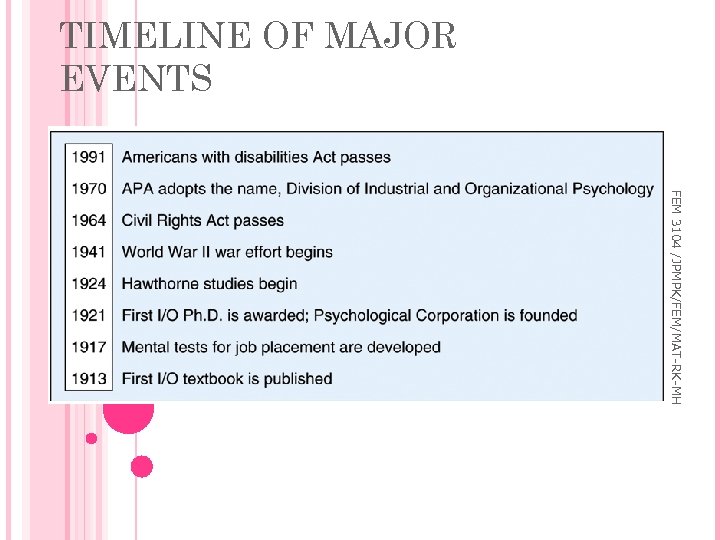 TIMELINE OF MAJOR EVENTS FEM 3104 /JPMPK/FEM/MAT-RK-MH 40
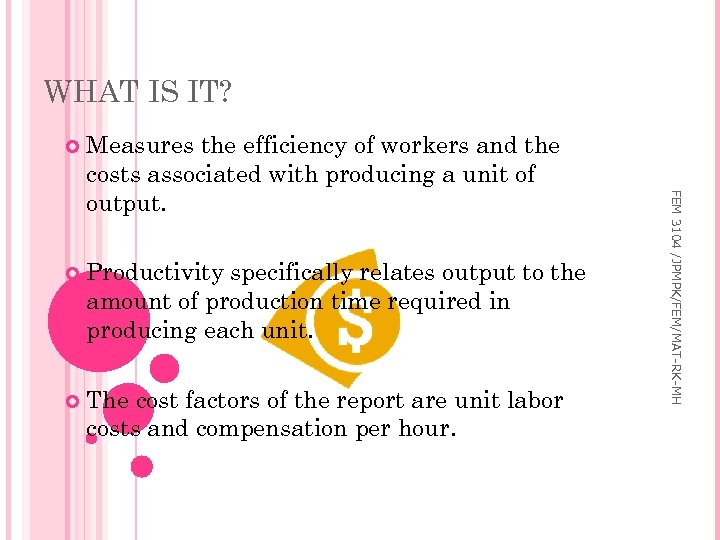 WHAT IS IT? Measures the efficiency of workers and the costs associated with producing a unit of output. Productivity specifically relates output to the amount of production time required in producing each unit. The cost factors of the report are unit labor costs and compensation per hour. FEM 3104 /JPMPK/FEM/MAT-RK-MH 41
 WHY IS IT IMPORTANT? Economic indicator. Aid economic policymakers in assessment of current economic activity and in economic analysis. Aid Bureau of Economic Analysis in compiling compensation measures for National Income and Product Accounts. Assessment of labor requirements. Studies of relationships among productivity, wages, prices, and employment. Aid in understanding sources of economic growth. FEM 3104 /JPMPK/FEM/MAT-RK-MH 42
 PRODUCTIVITY Productivity: Output per hours depends on: Capital investment Technology Capacity utilization Managerial skills FEM 3104 /JPMPK/FEM/MAT-RK-MH 43
 THE ORIGINS OF WORK PSYCHOLOGY FEM 3104 /JPMPK/FEM/MAT-RK-MH Work psychology has at least two distinct roots. One resides in a pair of traditions termed 'fitting the man [sic] to the job' (FMJ) and 'fitting the job to the man [sic]'(FJM). The FMJ tradition manifests itself in employee selection, training and vocational guidance. 44
 FMJ VS FJM The FMJ and FJM traditions essentially concern the relationship between individuals and their work. The other root of work psychology can be loosely labelled human relations. It is concerned with the complex interplay between individuals, groups, organizations and work. It therefore emphasizes social factors at work much more than FMJ and FJM. FEM 3104 /JPMPK/FEM/MAT-RK-MH 45
 The importance of human relations was highlighted in some famous research now known as the Hawthorne studies. These were conducted in the 1920 s at a large factory of the Western Electric Company at Hawthorne, near Chicago, USA. These strange results suggested that other factors apart from illumination were determining productivity. FEM 3104 /JPMPK/FEM/MAT-RK-MH Originally, they were designed to assess the effect of level of illumination on productivity. One group of workers (the experimental group) was subjected to changes in illumination whilst another (the control group) was not. The productivity of both groups increased slowly during this investigation; only when illumination was at a small fraction of its original level did the productivity of the experimental group begin to decline. 46
 RELAY ASSEMBLY TEST ROOM STUDY FEM 3104 /JPMPK/FEM/MAT-RK-MH This work was followed up with what became known as the Relay Assembly Test Room Study. A small group of female assembly workers was taken from their large department, and stationed in a separate room so that their working conditions could be controlled effectively. Over a period of more than a year, changes were made in the length of the working day and working week, the length and timing of rest pauses and other aspects of the work context. Productivity increased after every change, and the gains were maintained even after all conditions returned to their original levels. 47
 WHY DID THESE RESULTS OCCUR? FEM 3104 /JPMPK/FEM/MAT-RK-MH Clearly, factors other than those deliberately manipulated by the researchers were responsible. The researchers had allowed the workers certain privileges at work, and had taken a close interest in the group. Hence some factor probably to do with feeling special, or guessing what the researchers were investigating, seemed to be influencing the workers' behaviour. The problem of a person's behaviour being affected by the knowledge that they are in an experiment has come to be called the Hawthorne effect. The more general lessons here are: (i) it is difficult to experiment with people without altering some conditions other than those intended, and (ii) people's behaviour is substantially affected by their interpretation of what is happening around them (Adair, 1984). 48
 FEM 3104 /JPMPK/FEM/MAT-RK-MH These conclusions were extended by a study of a group of male workers who wired up equipment in the Bank Wiring Room. A researcher sat in the corner and observed the group's activities. At first this generated considerable suspicion, but apparently after a time the men more or less forgot about the researcher's presence. . 49
 FEM 3104 /JPMPK/FEM/MAT-RK-MH Once this happened, certain phenomena became apparent. First, there were social norms: that is, shared ideas about how things should be. Most importantly, there was a norm about what constituted an appropriate level of production. This was high enough to keep management off the men's backs, but less than they were capable of. Workers who consistently exceeded the productivity norm or fell short of it were subjected to social pressure to conform. Another norm concerned supervisors‘ behaviour. Supervisors were expected to be friendly and informal with the men: one who was more formal and officious was strongly disapproved of. Finally, there were two informal groups in the room, with some rivalry between them. The Bank Wiring Room showed clearly how social relationships between workers were important determinants of work behaviour. These relationships were often more influential than either official company policy or monetary rewards 50
 KAJIAN HAWTHORNE FEM 3104 /JPMPK/FEM/MAT-RK-MH Kajian ini merupakan kajian sistematik pertama yang mendedahkan pengaruh faktor manusia dalam situasi pekerjaan (Berkley & Rouse, 1990). Kajian ini mendapati bahawa banyak masalah wujud dalam hubungan pekerja dan pengurus, bukan disebabkan kekurangan pengkhususan tugas atau upah yang mencukupi ; tetapi disebabkan pengaruh sosial dan tekanan psikologi. Apabila pencahayaan kumpulan ujian ditingkatkan, daya pengeluaran didapati bertambah sebagaimana telah dijangkakan, sungguhpun pertambahan itu tidak tetap. Namun demikian, terdapat juga kecenderungan bagi daya pengeluaran untuk terus bertambah sekalipun pencahayaannya kemudian dikurangkan. 51
 Dalam satu set uji kaji yang baru, sekumpulan kecil pekerja telah diletakkan di dlm bilik yg berasingan dan beberapa pembolehubah ditukar. “Upah ditambah, tempoh waktu rehat yang berbeza lamanya diperkenalkan, masa bekerja dalam sehari dan seminggu lamanya diperkenalkan”. Para penyelidik yang bertindak sebagai penyelia juga membenarkan kumpulan 2 itu memilih sendiri waktu rehat dan boleh mengeluarkan pendapat berhubung dengan apa-apa perubahan lain yang dijangkakan. Sekali lagi hasilnya didapati meningkat mengikut masa tetapi ia juga naik dan turun secara tidak tetap. FEM 3104 /JPMPK/FEM/MAT-RK-MH 52
 Kajian yg telah dijalankan oleh Elton Mayor ini telah membawa sumbangan yang besar dan baru dalam dunia pengurusan. Menurut Cooper (1980), hasil uji kaji Hawthorne telah menyumbangkan kepada revolusi baru dalam ideologi organisasi dan pengurusan melalui dua cara iaitu mencabar pendekatan fizikal @ kejuruteraan untuk meningkatkan motivasi dan menjadikan tekanan pertama dalam pendekatan struktur dan hierarki pada organisasi. Dalam ertikata lain: “tiada cara saintifik atau cara terbaik untuk memotivasikan pekerja supaya lebih produktif melainkan dengan memberikan autoriti kepada pekerja untuk menguruskan organisasi. FEM 3104 /JPMPK/FEM/MAT-RK-MH 53
 Ekoran daripada ujikaji Hawthorne, corak latihan pengurusan dalam organisasi tertentu telah mula diubah. Daripada kemahiran teknik kepada kemahiran pengurusan manusia. Kajian Mayo ini telah melahirkan satu minat baru mengenai dinamik kumpulan di kalangan pengurusan dan manfaat kumpulan sebagai tambahan kepada tumpuan mereka yg dahulu terhadap ‘pekerja secara individu’. FEM 3104 /JPMPK/FEM/MAT-RK-MH 54
 Kajian Hawthorne dimulakan sebagai satu percubaan untuk menyelidiki kaitan antara takat pencahayaan di tempat kerja dan daya pengeluaran para pekerja. Para penyelidik Western Electric telah membahagikan pekerja kepada kumpulan ujian yang sengaja dikenakan perubahan-perubahan pencahayaan dan kumpulan kawalan yang pencahayaannya sentiasa dalam keadaan tetap FEM 3104 /JPMPK/FEM/MAT-RK-MH 55
 Layers of influence model Source: Dahlgren G and Whitehead M (1991), In Acheson (1998). FEM 3104 /JPMPK/FEM/MAT-RK-MH 56
 THE HUMAN DEVELOPMENT INDICES: AT THE FOREFRONT OF HD MEASUREMENT DEVELOPMENT The HDI (Human Development Index) - a summary measure of human development The GDI (Gender-related Development Index) - the HDI adjusted for gender inequality The GEM (Gender Empowerment Measure) - Measures gender equality in economic and political participation and decision making The HPI (Human Poverty Index) - Captures the level of human poverty Others FEM 3104 /JPMPK/FEM/MAT-RK-MH 57
 WHY THE HDI? The fundamental conceptual shift: • Human • Economic growth is only a means, though an important one, for human development. Human development accounting: breath vs focus 58 FEM 3104 /JPMPK/FEM/MAT-RK-MH development is both an outcome and a process of enlarging people’s choices to lead lives they value;
 PROBLEMS IN PERFORMANCE External Influence Management Influence Individual weaknesses FEM 3104 /JPMPK/FEM/MAT-RK-MH 59
 EXTERNAL INFLUENCE Family problems Social norms Labour market situation Government actions/procedures Work organization policy Working environment FEM 3104 /JPMPK/FEM/MAT-RK-MH 60
 MANAGEMENT INFLUENCE Management weaknesses Unmotivated working environment Personality problem Job task not suitable Lack of training Unable to determine task level FEM 3104 /JPMPK/FEM/MAT-RK-MH 61
 INDIVIDUAL WEAKNESSES ☻ Lack ☻ Substance abuser ☻ Ill ☻ Mentally ill FEM 3104 /JPMPK/FEM/MAT-RK-MH of motivation ☻ Lazy ☻ Personality clash ☻ Not satisfied with job/tasks given ☻ ‘Kaki ponteng’ ☻ Did not understand job specification. 62
 CONCLUSION The nexus between ecology + work + human development? Selection of works? Organization/industry Government/Private Company Criterias for Benefit for individual? Money/Status/ Living FEM 3104 /JPMPK/FEM/MAT-RK-MH 63