


 Скачать презентацию Top IT Issues in Higher Education Results from
a737be7013bb16c14b1159902faef436.ppt
- Количество слайдов: 63
 Top IT Issues in Higher Education Results from the 2005 EDUCAUSE Current Issues Survey Leslie Maltz Columbia University Deputy VP for IT Planning November 2005
 2005 CI Survey Measures Which issues: § are most important for the institution’s strategic success? § have potential to become more significant in the coming year? § do senior IT leaders spend the most time on? § require the most human and/or financial resources?
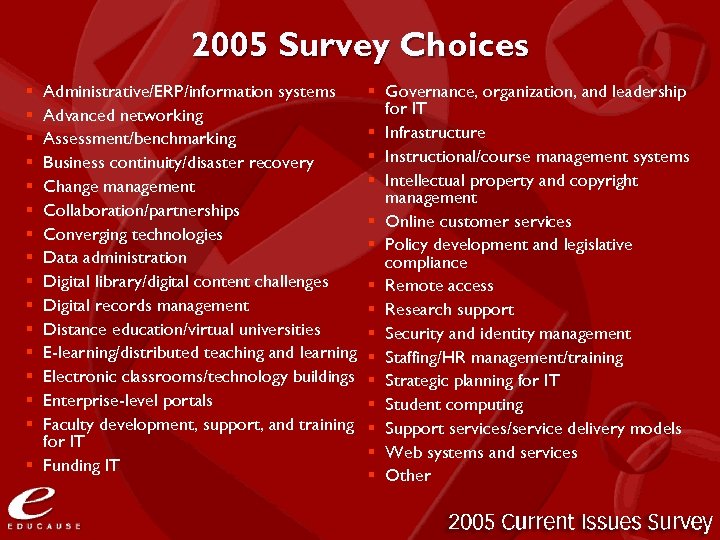 2005 Survey Choices Administrative/ERP/information systems Advanced networking Assessment/benchmarking Business continuity/disaster recovery Change management Collaboration/partnerships Converging technologies Data administration Digital library/digital content challenges Digital records management Distance education/virtual universities E-learning/distributed teaching and learning Electronic classrooms/technology buildings Enterprise-level portals Faculty development, support, and training for IT § Funding IT § § § § Governance, organization, and leadership for IT § Infrastructure § Instructional/course management systems § Intellectual property and copyright management § Online customer services § Policy development and legislative compliance § Remote access § Research support § Security and identity management § Staffing/HR management/training § Strategic planning for IT § Student computing § Support services/service delivery models § Web systems and services § Other
 2005 Survey Results and Comparison with 2004 Survey response rate: 36% (603) of 1, 653 institutions
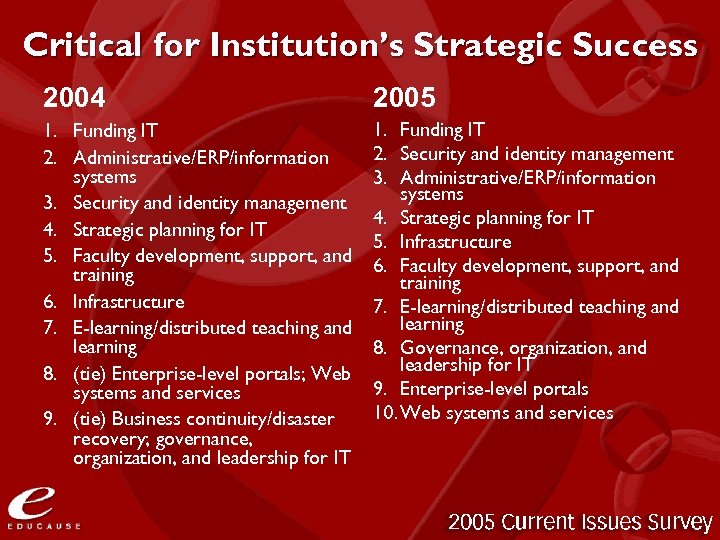 Critical for Institution’s Strategic Success 2004 2005 1. Funding IT 2. Administrative/ERP/information systems 3. Security and identity management 4. Strategic planning for IT 5. Faculty development, support, and training 6. Infrastructure 7. E-learning/distributed teaching and learning 8. (tie) Enterprise-level portals; Web systems and services 9. (tie) Business continuity/disaster recovery; governance, organization, and leadership for IT 1. Funding IT 2. Security and identity management 3. Administrative/ERP/information systems 4. Strategic planning for IT 5. Infrastructure 6. Faculty development, support, and training 7. E-learning/distributed teaching and learning 8. Governance, organization, and leadership for IT 9. Enterprise-level portals 10. Web systems and services
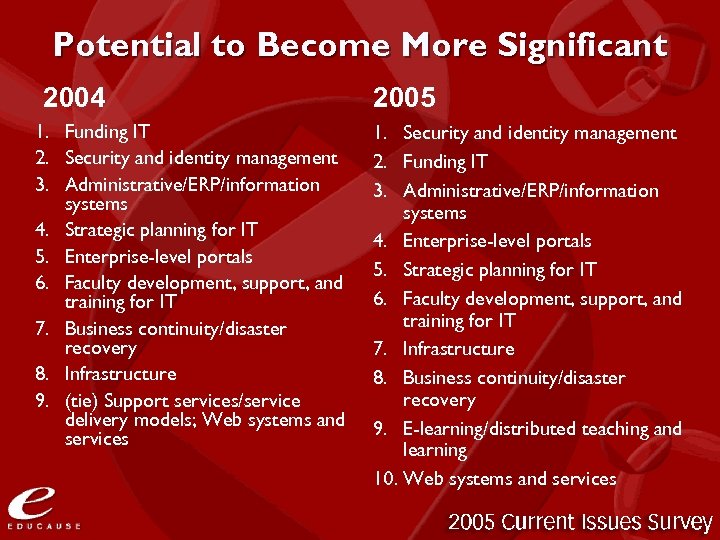 Potential to Become More Significant 2004 1. Funding IT 2. Security and identity management 3. Administrative/ERP/information systems 4. Strategic planning for IT 5. Enterprise-level portals 6. Faculty development, support, and training for IT 7. Business continuity/disaster recovery 8. Infrastructure 9. (tie) Support services/service delivery models; Web systems and services 2005 1. Security and identity management 2. Funding IT 3. Administrative/ERP/information systems 4. Enterprise-level portals 5. Strategic planning for IT 6. Faculty development, support, and training for IT 7. Infrastructure 8. Business continuity/disaster recovery 9. E-learning/distributed teaching and learning 10. Web systems and services
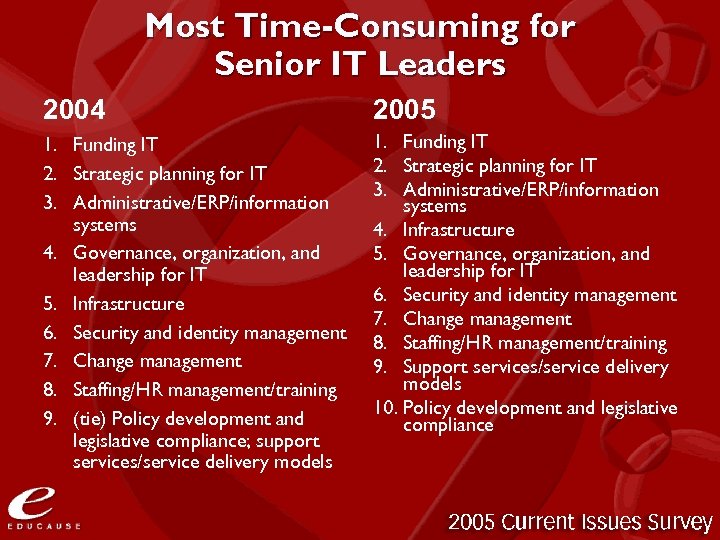 Most Time-Consuming for Senior IT Leaders 2004 2005 1. Funding IT 2. Strategic planning for IT 3. Administrative/ERP/information systems 4. Governance, organization, and leadership for IT 5. Infrastructure 6. Security and identity management 7. Change management 8. Staffing/HR management/training 9. (tie) Policy development and legislative compliance; support services/service delivery models 1. Funding IT 2. Strategic planning for IT 3. Administrative/ERP/information systems 4. Infrastructure 5. Governance, organization, and leadership for IT 6. Security and identity management 7. Change management 8. Staffing/HR management/training 9. Support services/service delivery models 10. Policy development and legislative compliance
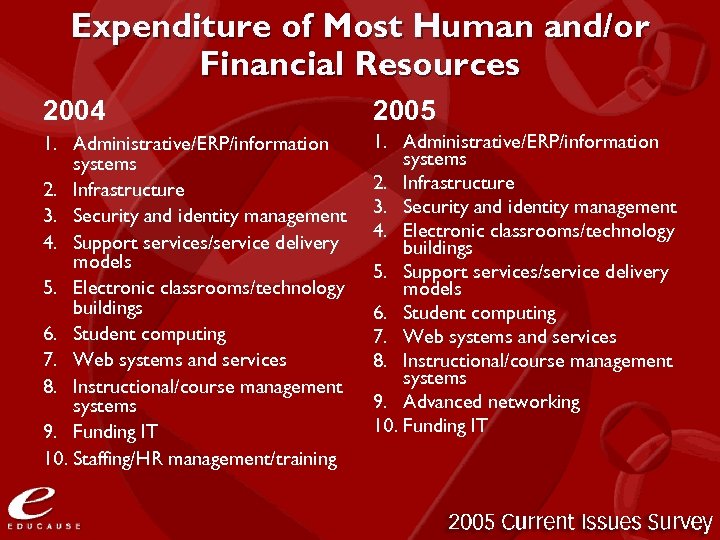 Expenditure of Most Human and/or Financial Resources 2004 2005 1. Administrative/ERP/information systems 2. Infrastructure 3. Security and identity management 4. Support services/service delivery models 5. Electronic classrooms/technology buildings 6. Student computing 7. Web systems and services 8. Instructional/course management systems 9. Funding IT 10. Staffing/HR management/training 1. Administrative/ERP/information systems 2. Infrastructure 3. Security and identity management 4. Electronic classrooms/technology buildings 5. Support services/service delivery models 6. Student computing 7. Web systems and services 8. Instructional/course management systems 9. Advanced networking 10. Funding IT
 Top Five Trends 2000– 2005
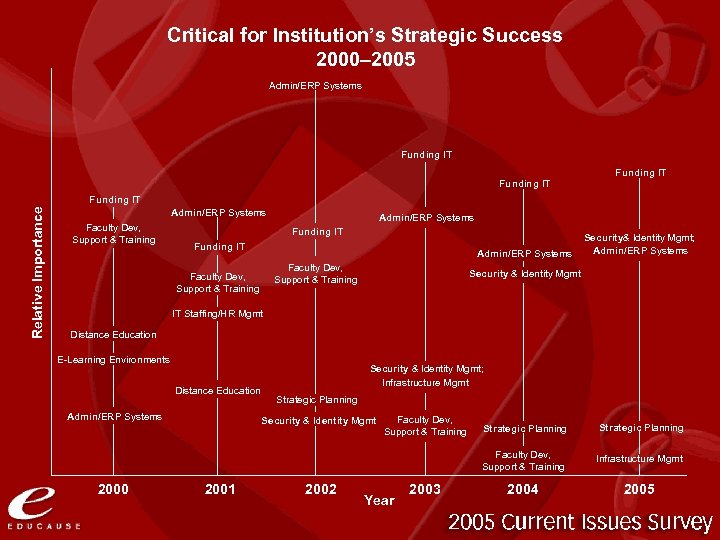 Critical for Institution’s Strategic Success 2000– 2005 Admin/ERP Systems Funding IT Relative Importance Funding IT Admin/ERP Systems Faculty Dev, Support & Training Admin/ERP Systems Funding IT Admin/ERP Systems Faculty Dev, Support & Training Security& Identity Mgmt; Admin/ERP Systems Security & Identity Mgmt IT Staffing/HR Mgmt Distance Education E-Learning Environments Distance Education Admin/ERP Systems Security & Identity Mgmt; Infrastructure Mgmt Strategic Planning Security & Identity Mgmt Faculty Dev, Support & Training 2001 2002 Year 2003 Strategic Planning Faculty Dev, Support & Training 2000 Strategic Planning Infrastructure Mgmt 2004 2005
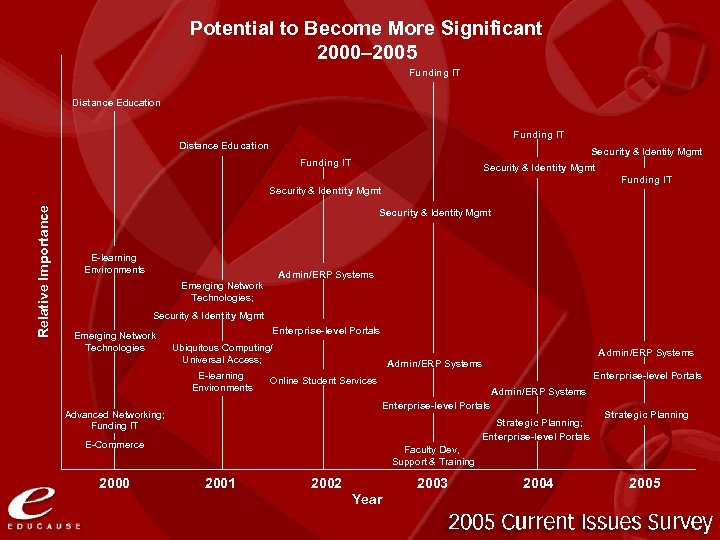 Potential to Become More Significant 2000– 2005 Funding IT Distance Education Security & Identity Mgmt Funding IT Relative Importance Security & Identity Mgmt E-learning Environments Admin/ERP Systems Emerging Network Technologies; Security & Identity Mgmt Emerging Network Technologies Enterprise-level Portals Ubiquitous Computing/ Universal Access; E-learning Environments Admin/ERP Systems Enterprise-level Portals Online Student Services Admin/ERP Systems Enterprise-level Portals Advanced Networking; Funding IT Strategic Planning; Enterprise-level Portals E-Commerce 2000 Strategic Planning Faculty Dev, Support & Training 2001 2002 2003 Year 2004 2005
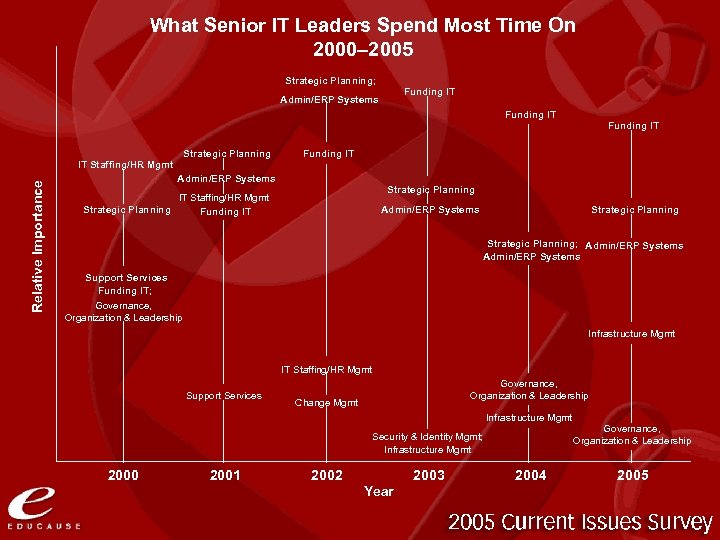 What Senior IT Leaders Spend Most Time On 2000– 2005 Strategic Planning; Funding IT Admin/ERP Systems Funding IT Strategic Planning Funding IT Relative Importance IT Staffing/HR Mgmt Admin/ERP Systems Strategic Planning IT Staffing/HR Mgmt Strategic Planning Funding IT Admin/ERP Systems Strategic Planning; Admin/ERP Systems Support Services Funding IT; Governance, Organization & Leadership Infrastructure Mgmt IT Staffing/HR Mgmt Support Services Governance, Organization & Leadership Change Mgmt Infrastructure Mgmt Governance, Organization & Leadership Security & Identity Mgmt; Infrastructure Mgmt 2000 2001 2002 2003 Year 2004 2005
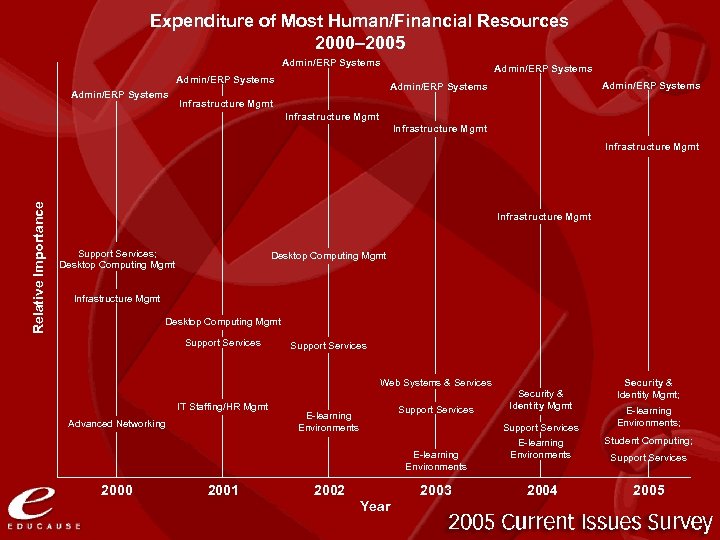 Expenditure of Most Human/Financial Resources 2000– 2005 Admin/ERP Systems Admin/ERP Systems Infrastructure Mgmt Relative Importance Infrastructure Mgmt Support Services; Desktop Computing Mgmt Infrastructure Mgmt Desktop Computing Mgmt Support Services Web Systems & Services IT Staffing/HR Mgmt Advanced Networking Support Services E-learning Environments 2000 2001 2002 2003 Year Security & Identity Mgmt; E-learning Environments; Support Services E-learning Environments Student Computing; 2004 2005 Support Services
 2005 Survey Results Demographic Detail
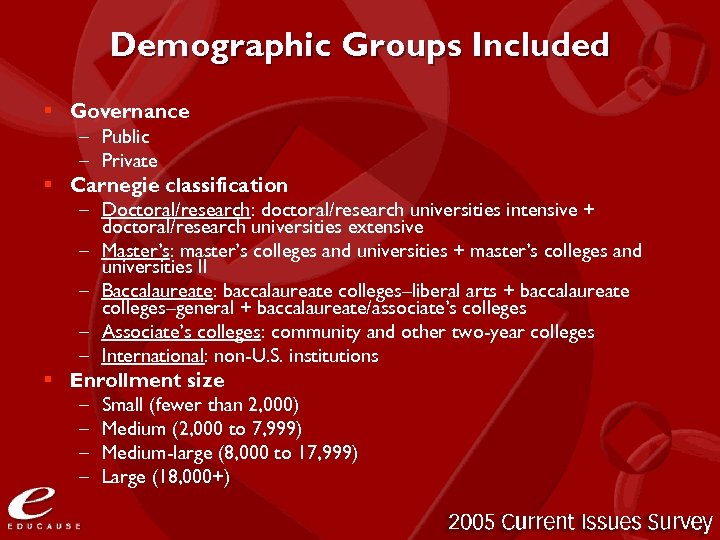 Demographic Groups Included § Governance – Public – Private § Carnegie classification – Doctoral/research: doctoral/research universities intensive + – – doctoral/research universities extensive Master’s: master’s colleges and universities + master’s colleges and universities II Baccalaureate: baccalaureate colleges–liberal arts + baccalaureate colleges–general + baccalaureate/associate’s colleges Associate’s colleges: community and other two-year colleges International: non-U. S. institutions – – § Enrollment size – Small (fewer than 2, 000) – Medium (2, 000 to 7, 999) – Medium-large (8, 000 to 17, 999) – Large (18, 000+)
 Issues Critical for Institution’s Strategic Success
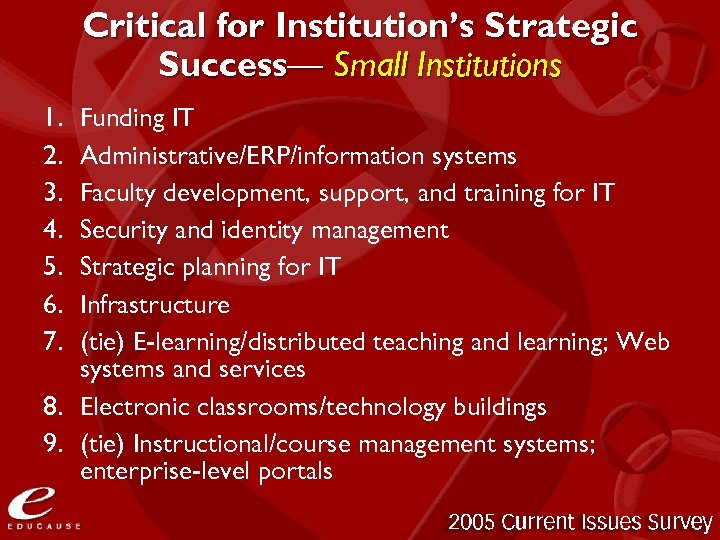 Critical for Institution’s Strategic Success— Small Institutions 1. 2. 3. 4. 5. 6. 7. Funding IT Administrative/ERP/information systems Faculty development, support, and training for IT Security and identity management Strategic planning for IT Infrastructure (tie) E-learning/distributed teaching and learning; Web systems and services 8. Electronic classrooms/technology buildings 9. (tie) Instructional/course management systems; enterprise-level portals
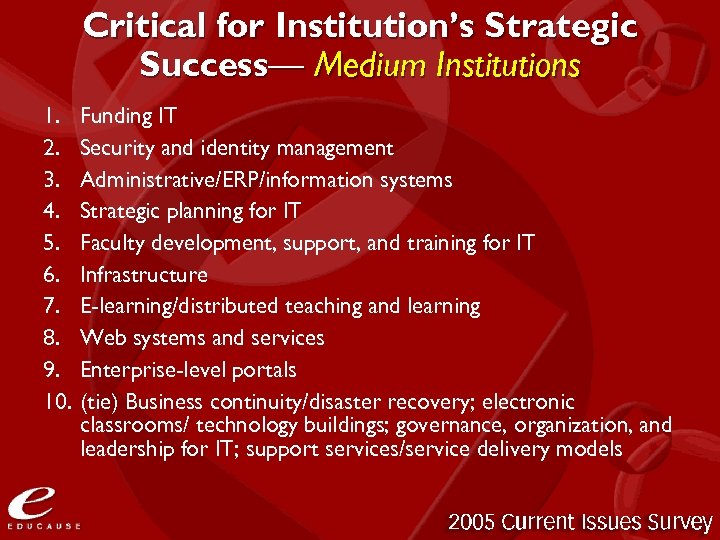 Critical for Institution’s Strategic Success— Medium Institutions 1. 2. 3. 4. 5. 6. 7. 8. 9. 10. Funding IT Security and identity management Administrative/ERP/information systems Strategic planning for IT Faculty development, support, and training for IT Infrastructure E-learning/distributed teaching and learning Web systems and services Enterprise-level portals (tie) Business continuity/disaster recovery; electronic classrooms/ technology buildings; governance, organization, and leadership for IT; support services/service delivery models
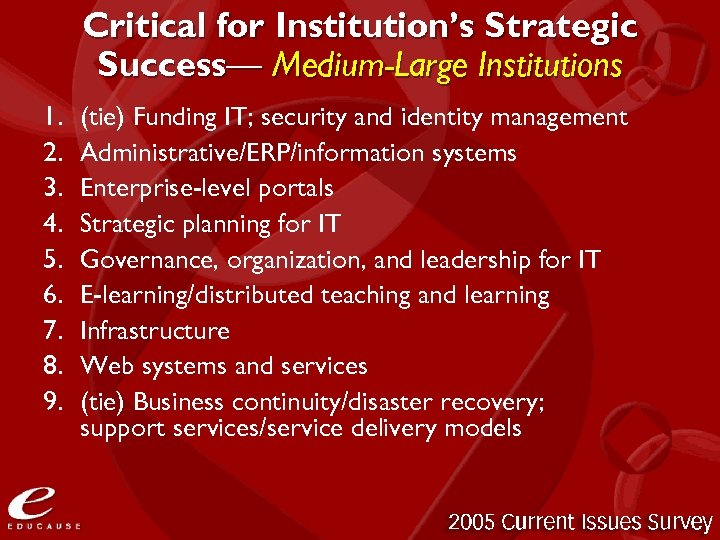 Critical for Institution’s Strategic Success— Medium-Large Institutions 1. 2. 3. 4. 5. 6. 7. 8. 9. (tie) Funding IT; security and identity management Administrative/ERP/information systems Enterprise-level portals Strategic planning for IT Governance, organization, and leadership for IT E-learning/distributed teaching and learning Infrastructure Web systems and services (tie) Business continuity/disaster recovery; support services/service delivery models
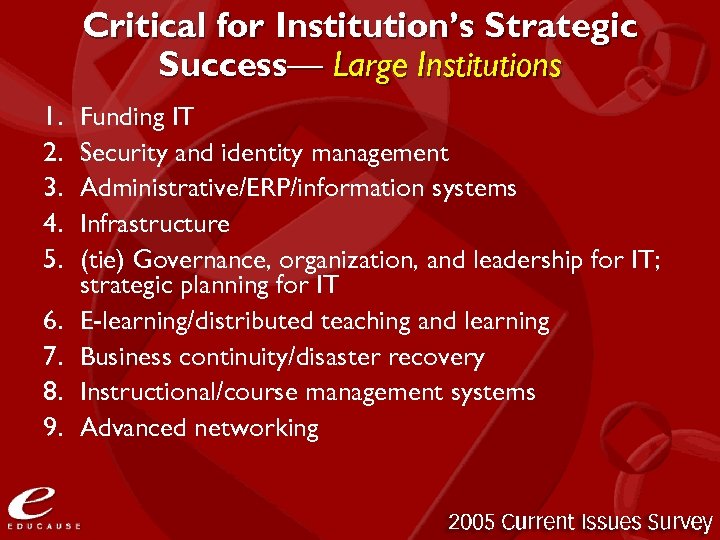 Critical for Institution’s Strategic Success— Large Institutions 1. 2. 3. 4. 5. 6. 7. 8. 9. Funding IT Security and identity management Administrative/ERP/information systems Infrastructure (tie) Governance, organization, and leadership for IT; strategic planning for IT E-learning/distributed teaching and learning Business continuity/disaster recovery Instructional/course management systems Advanced networking
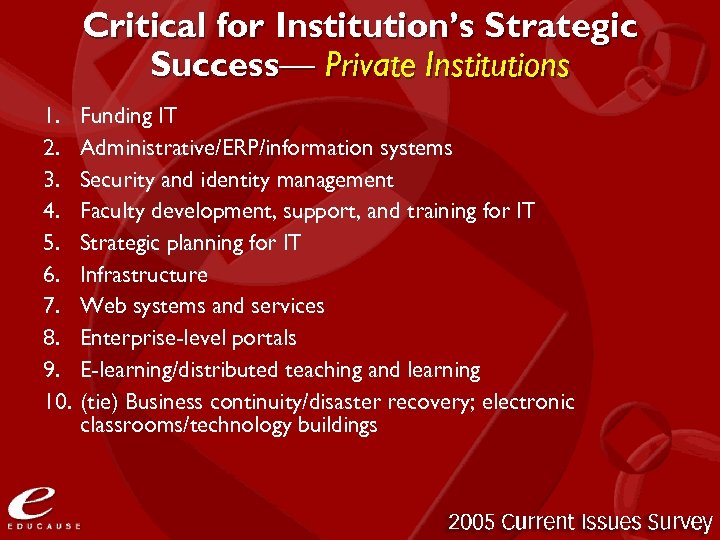 Critical for Institution’s Strategic Success— Private Institutions 1. 2. 3. 4. 5. 6. 7. 8. 9. 10. Funding IT Administrative/ERP/information systems Security and identity management Faculty development, support, and training for IT Strategic planning for IT Infrastructure Web systems and services Enterprise-level portals E-learning/distributed teaching and learning (tie) Business continuity/disaster recovery; electronic classrooms/technology buildings
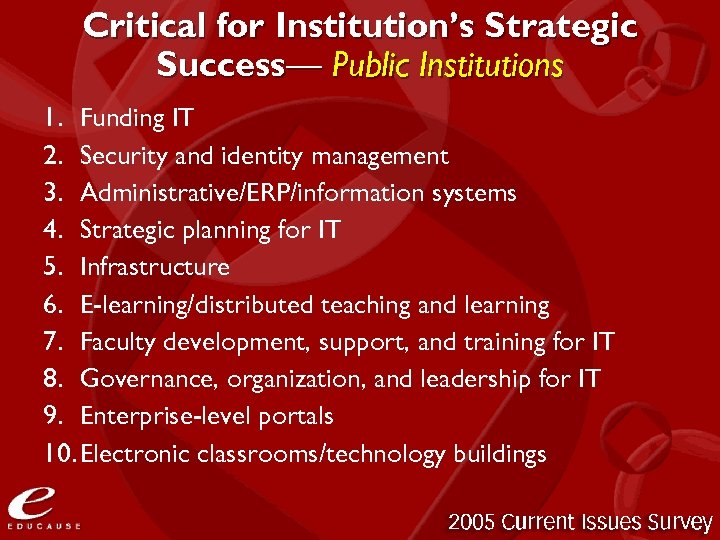 Critical for Institution’s Strategic Success— Public Institutions 1. Funding IT 2. Security and identity management 3. Administrative/ERP/information systems 4. Strategic planning for IT 5. Infrastructure 6. E-learning/distributed teaching and learning 7. Faculty development, support, and training for IT 8. Governance, organization, and leadership for IT 9. Enterprise-level portals 10. Electronic classrooms/technology buildings
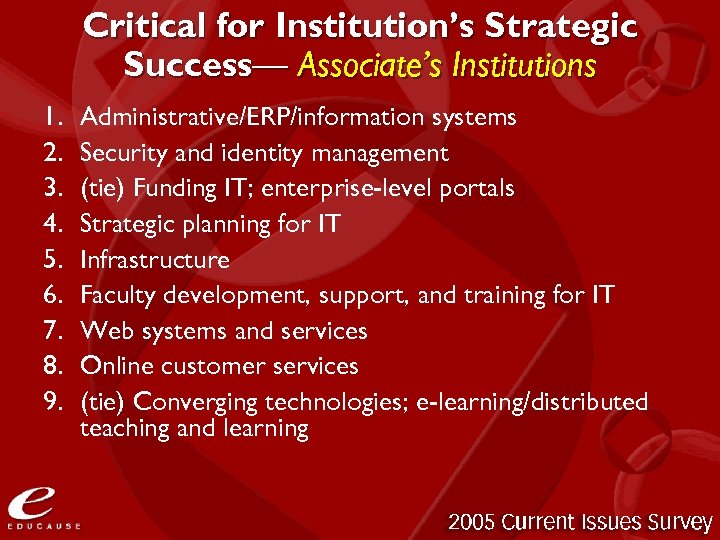 Critical for Institution’s Strategic Success— Associate’s Institutions 1. 2. 3. 4. 5. 6. 7. 8. 9. Administrative/ERP/information systems Security and identity management (tie) Funding IT; enterprise-level portals Strategic planning for IT Infrastructure Faculty development, support, and training for IT Web systems and services Online customer services (tie) Converging technologies; e-learning/distributed teaching and learning
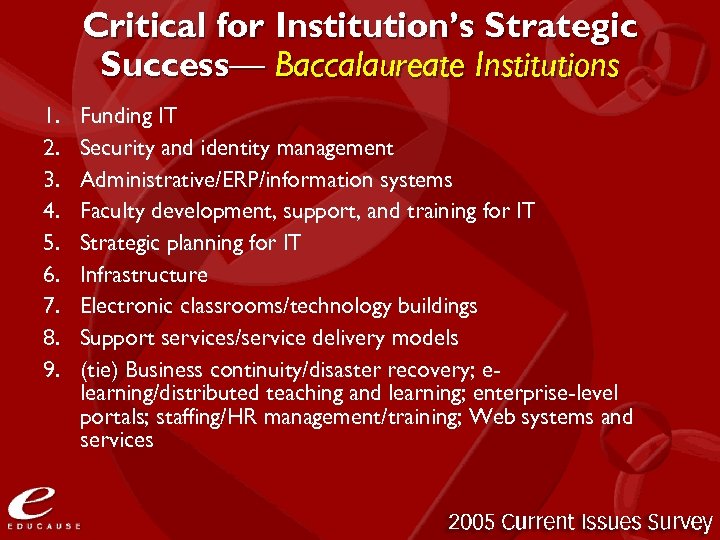 Critical for Institution’s Strategic Success— Baccalaureate Institutions 1. 2. 3. 4. 5. 6. 7. 8. 9. Funding IT Security and identity management Administrative/ERP/information systems Faculty development, support, and training for IT Strategic planning for IT Infrastructure Electronic classrooms/technology buildings Support services/service delivery models (tie) Business continuity/disaster recovery; elearning/distributed teaching and learning; enterprise-level portals; staffing/HR management/training; Web systems and services
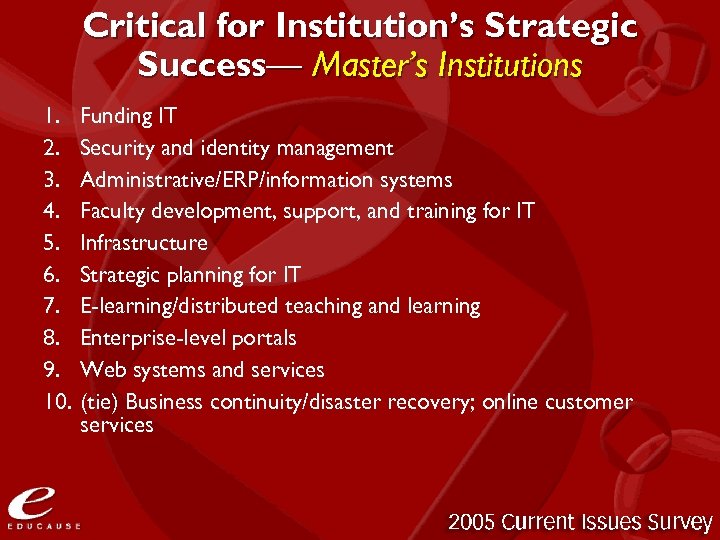 Critical for Institution’s Strategic Success— Master’s Institutions 1. 2. 3. 4. 5. 6. 7. 8. 9. 10. Funding IT Security and identity management Administrative/ERP/information systems Faculty development, support, and training for IT Infrastructure Strategic planning for IT E-learning/distributed teaching and learning Enterprise-level portals Web systems and services (tie) Business continuity/disaster recovery; online customer services
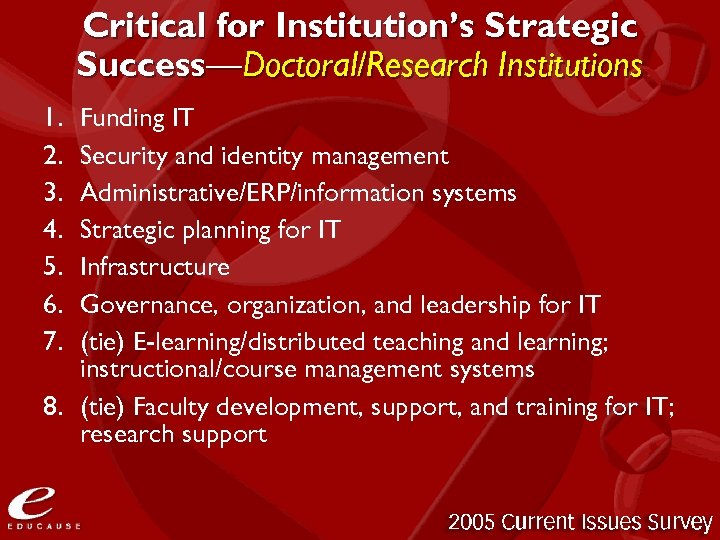 Critical for Institution’s Strategic Success—Doctoral/Research Institutions 1. 2. 3. 4. 5. 6. 7. Funding IT Security and identity management Administrative/ERP/information systems Strategic planning for IT Infrastructure Governance, organization, and leadership for IT (tie) E-learning/distributed teaching and learning; instructional/course management systems 8. (tie) Faculty development, support, and training for IT; research support
 Issues with Potential to Become More Significant
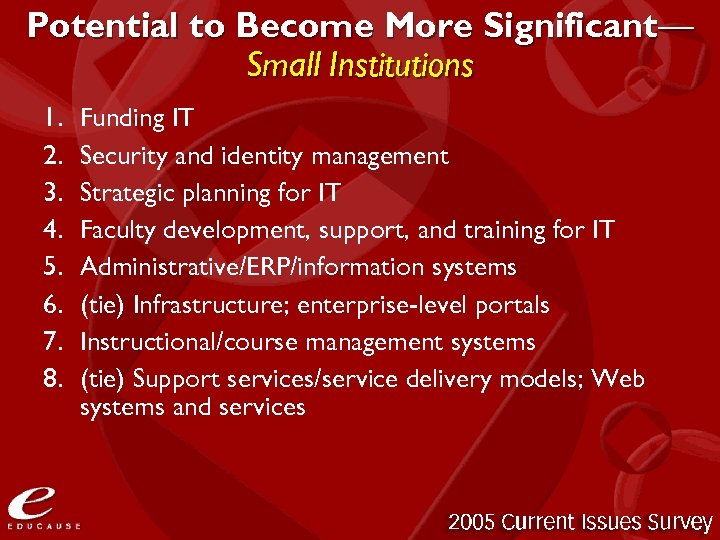 Potential to Become More Significant— Small Institutions 1. 2. 3. 4. 5. 6. 7. 8. Funding IT Security and identity management Strategic planning for IT Faculty development, support, and training for IT Administrative/ERP/information systems (tie) Infrastructure; enterprise-level portals Instructional/course management systems (tie) Support services/service delivery models; Web systems and services
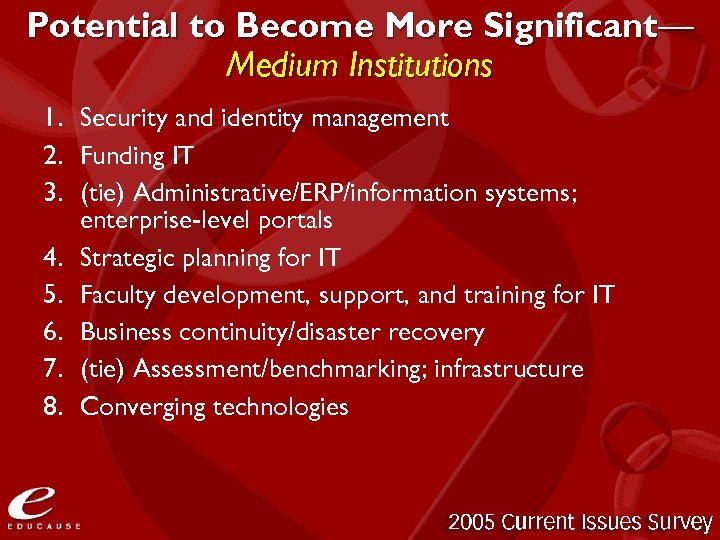 Potential to Become More Significant— Medium Institutions 1. Security and identity management 2. Funding IT 3. (tie) Administrative/ERP/information systems; enterprise-level portals 4. Strategic planning for IT 5. Faculty development, support, and training for IT 6. Business continuity/disaster recovery 7. (tie) Assessment/benchmarking; infrastructure 8. Converging technologies
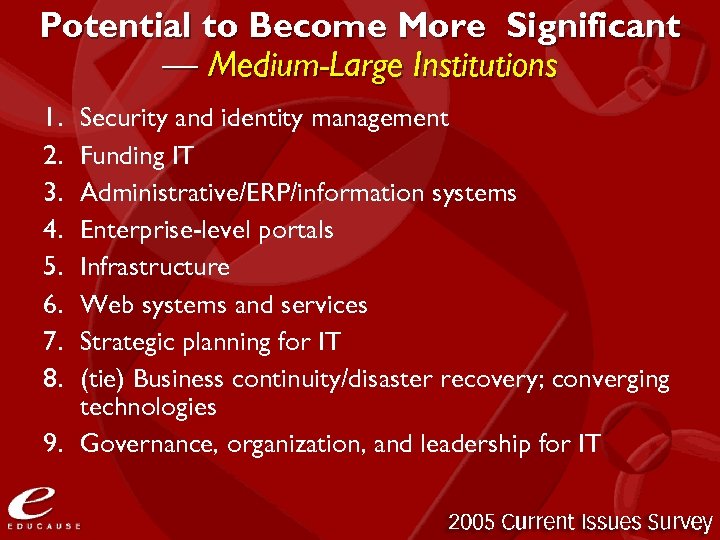 Potential to Become More Significant — Medium-Large Institutions 1. 2. 3. 4. 5. 6. 7. 8. Security and identity management Funding IT Administrative/ERP/information systems Enterprise-level portals Infrastructure Web systems and services Strategic planning for IT (tie) Business continuity/disaster recovery; converging technologies 9. Governance, organization, and leadership for IT
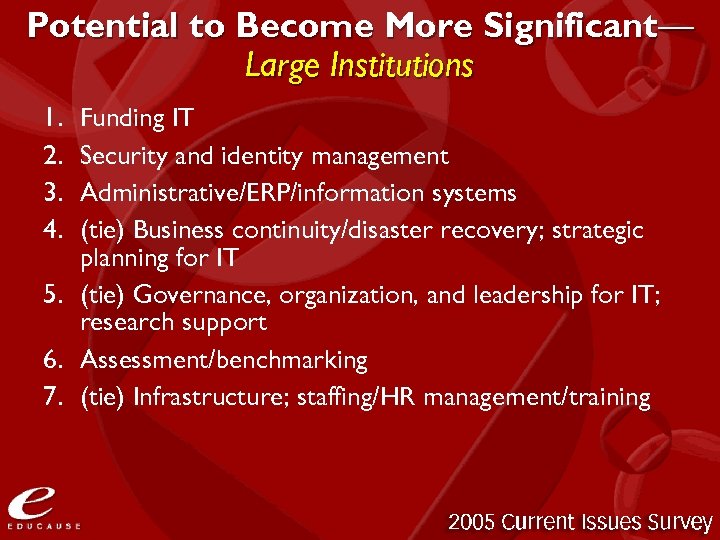 Potential to Become More Significant— Large Institutions 1. 2. 3. 4. Funding IT Security and identity management Administrative/ERP/information systems (tie) Business continuity/disaster recovery; strategic planning for IT 5. (tie) Governance, organization, and leadership for IT; research support 6. Assessment/benchmarking 7. (tie) Infrastructure; staffing/HR management/training
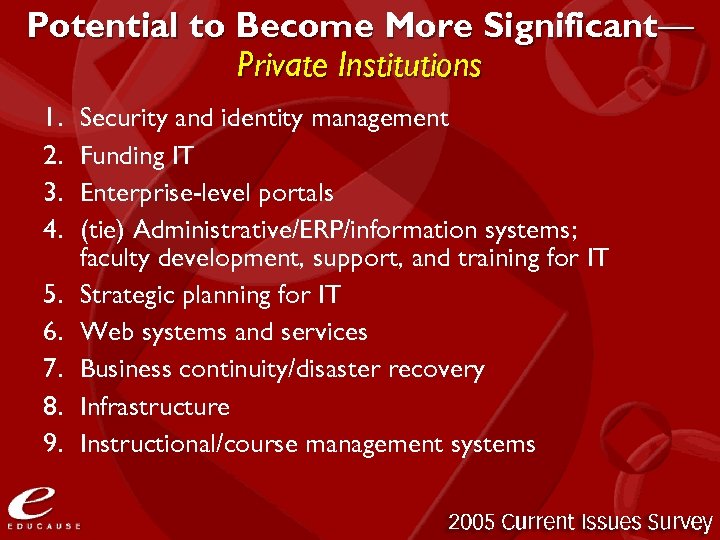 Potential to Become More Significant— Private Institutions 1. 2. 3. 4. 5. 6. 7. 8. 9. Security and identity management Funding IT Enterprise-level portals (tie) Administrative/ERP/information systems; faculty development, support, and training for IT Strategic planning for IT Web systems and services Business continuity/disaster recovery Infrastructure Instructional/course management systems
 Potential to Become More Significant— Public Institutions 1. 2. 3. 4. 5. 6. 7. 8. Funding IT Security and identity management Administrative/ERP/information systems Enterprise-level portals Strategic planning for IT Infrastructure Faculty development, support, and training for IT (tie) Assessment/benchmarking; converging technologies 9. Support services/service delivery models
 Potential to Become More Significant— Associate’s Institutions 1. Funding IT 2. (tie) Administrative/ERP/information systems; security and identity management 3. Enterprise-level portals 4. (tie) Strategic planning for IT; support services/service delivery models 5. Faculty development, support, and training for IT 6. Infrastructure 7. (tie) Business continuity/disaster recovery; online customer services; staffing/HR management/training; Web systems and services
 Potential to Become More Significant— Baccalaureate Institutions 1. 2. 3. 4. 5. 6. 7. 8. Security and identity management Funding IT Enterprise-level portals (tie) Administrative/ERP/information systems; strategic planning for IT Faculty development, support, and training for IT Infrastructure (tie) Instructional/course management systems; support services/service delivery models Business continuity/disaster recovery
 Potential to Become More Significant— Master’s Institutions 1. 2. 3. 4. 5. 6. 7. 8. 9. Security and identity management Funding IT Enterprise-level portals Administrative/ERP/information systems Faculty development, support, and training for IT Assessment/benchmarking Converging technologies E-learning/distributed teaching and learning (tie) Infrastructure; instructional/course management systems; strategic planning for IT
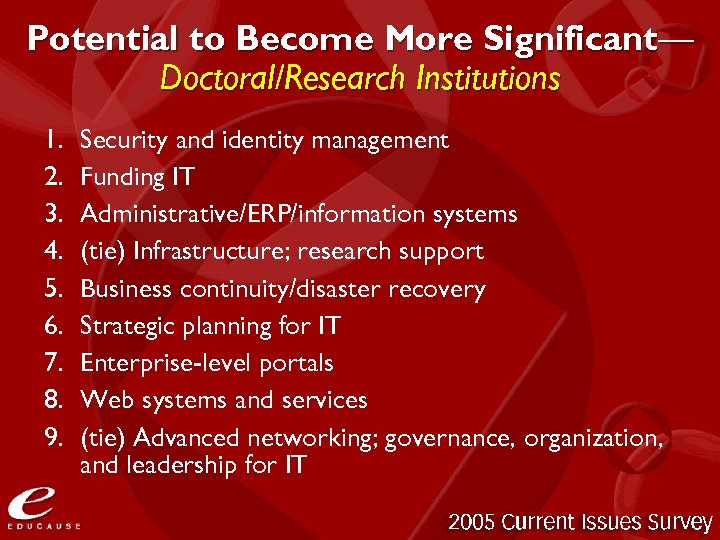 Potential to Become More Significant— Doctoral/Research Institutions 1. 2. 3. 4. 5. 6. 7. 8. 9. Security and identity management Funding IT Administrative/ERP/information systems (tie) Infrastructure; research support Business continuity/disaster recovery Strategic planning for IT Enterprise-level portals Web systems and services (tie) Advanced networking; governance, organization, and leadership for IT
 What Senior IT Leaders Spend Most Time On
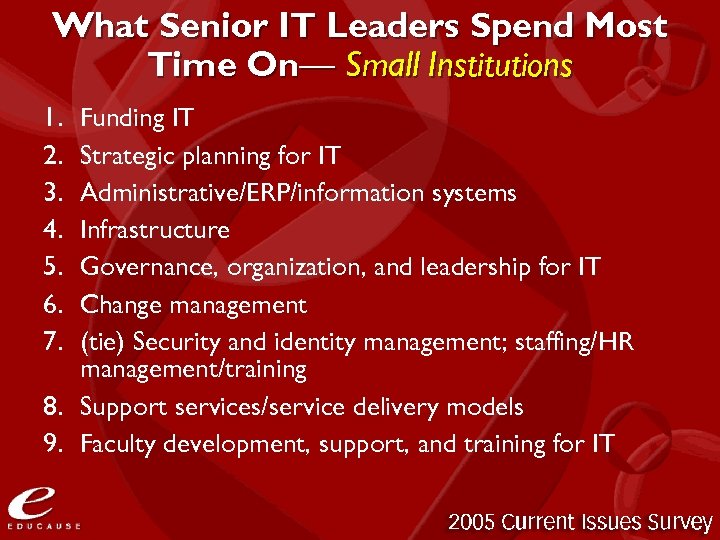 What Senior IT Leaders Spend Most Time On— Small Institutions 1. 2. 3. 4. 5. 6. 7. Funding IT Strategic planning for IT Administrative/ERP/information systems Infrastructure Governance, organization, and leadership for IT Change management (tie) Security and identity management; staffing/HR management/training 8. Support services/service delivery models 9. Faculty development, support, and training for IT
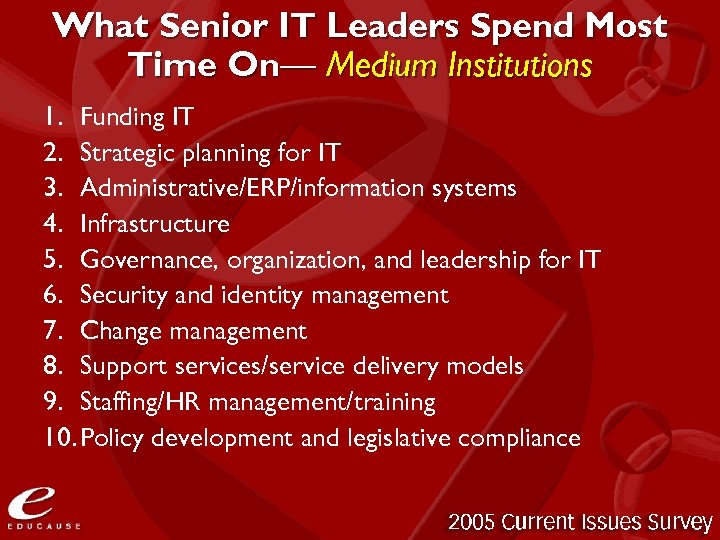 What Senior IT Leaders Spend Most Time On— Medium Institutions 1. Funding IT 2. Strategic planning for IT 3. Administrative/ERP/information systems 4. Infrastructure 5. Governance, organization, and leadership for IT 6. Security and identity management 7. Change management 8. Support services/service delivery models 9. Staffing/HR management/training 10. Policy development and legislative compliance
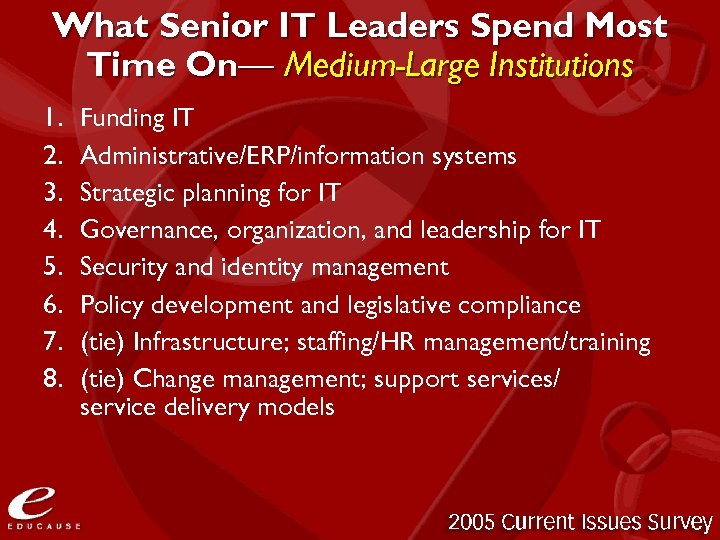 What Senior IT Leaders Spend Most Time On— Medium-Large Institutions 1. 2. 3. 4. 5. 6. 7. 8. Funding IT Administrative/ERP/information systems Strategic planning for IT Governance, organization, and leadership for IT Security and identity management Policy development and legislative compliance (tie) Infrastructure; staffing/HR management/training (tie) Change management; support services/ service delivery models
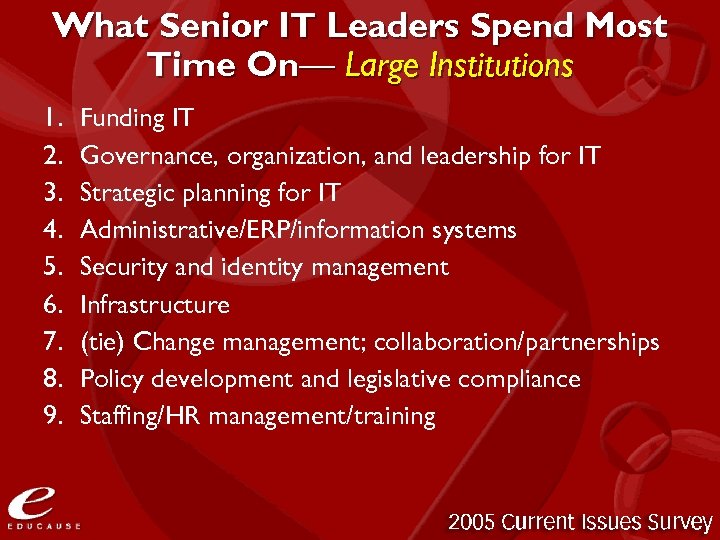 What Senior IT Leaders Spend Most Time On— Large Institutions 1. 2. 3. 4. 5. 6. 7. 8. 9. Funding IT Governance, organization, and leadership for IT Strategic planning for IT Administrative/ERP/information systems Security and identity management Infrastructure (tie) Change management; collaboration/partnerships Policy development and legislative compliance Staffing/HR management/training
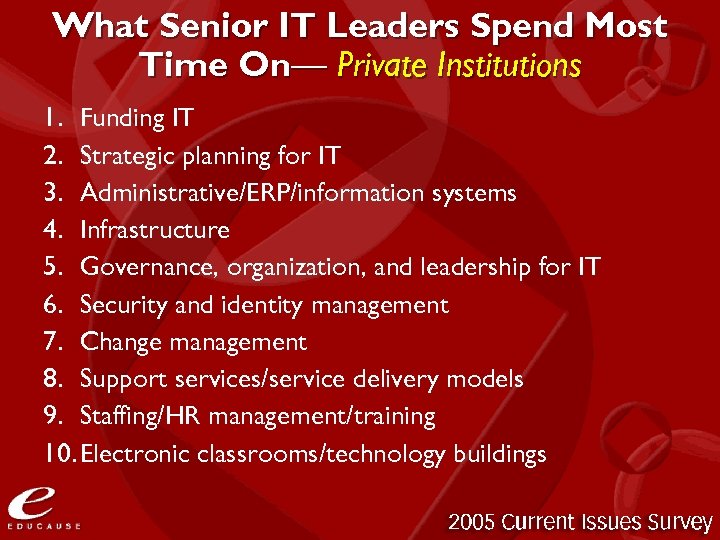 What Senior IT Leaders Spend Most Time On— Private Institutions 1. Funding IT 2. Strategic planning for IT 3. Administrative/ERP/information systems 4. Infrastructure 5. Governance, organization, and leadership for IT 6. Security and identity management 7. Change management 8. Support services/service delivery models 9. Staffing/HR management/training 10. Electronic classrooms/technology buildings
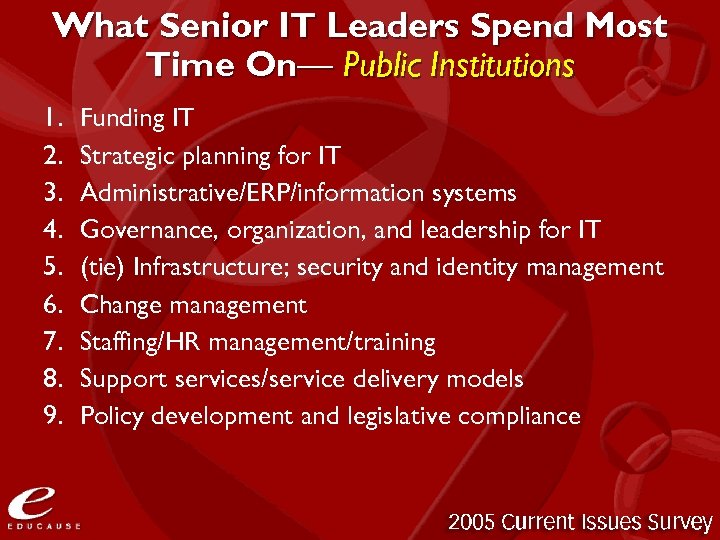 What Senior IT Leaders Spend Most Time On— Public Institutions 1. 2. 3. 4. 5. 6. 7. 8. 9. Funding IT Strategic planning for IT Administrative/ERP/information systems Governance, organization, and leadership for IT (tie) Infrastructure; security and identity management Change management Staffing/HR management/training Support services/service delivery models Policy development and legislative compliance
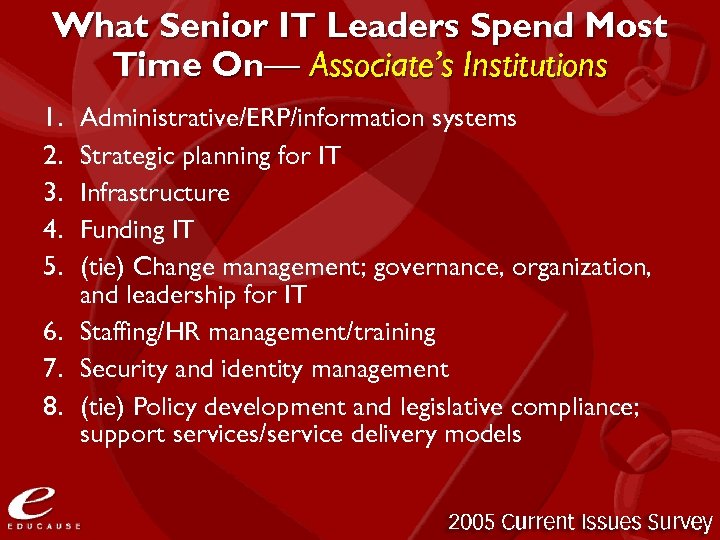 What Senior IT Leaders Spend Most Time On— Associate’s Institutions 1. 2. 3. 4. 5. Administrative/ERP/information systems Strategic planning for IT Infrastructure Funding IT (tie) Change management; governance, organization, and leadership for IT 6. Staffing/HR management/training 7. Security and identity management 8. (tie) Policy development and legislative compliance; support services/service delivery models
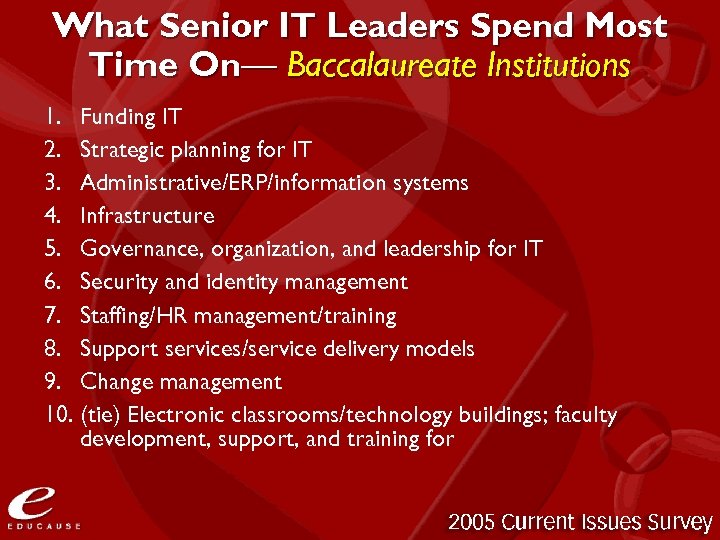 What Senior IT Leaders Spend Most Time On— Baccalaureate Institutions 1. Funding IT 2. Strategic planning for IT 3. Administrative/ERP/information systems 4. Infrastructure 5. Governance, organization, and leadership for IT 6. Security and identity management 7. Staffing/HR management/training 8. Support services/service delivery models 9. Change management 10. (tie) Electronic classrooms/technology buildings; faculty development, support, and training for
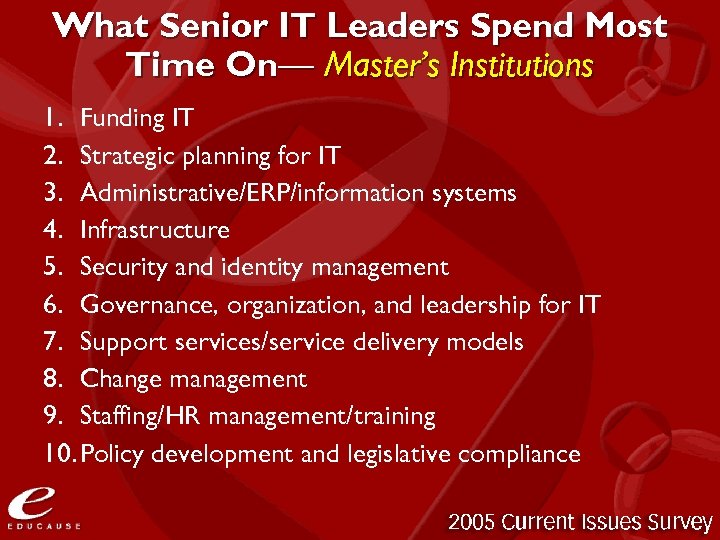 What Senior IT Leaders Spend Most Time On— Master’s Institutions 1. Funding IT 2. Strategic planning for IT 3. Administrative/ERP/information systems 4. Infrastructure 5. Security and identity management 6. Governance, organization, and leadership for IT 7. Support services/service delivery models 8. Change management 9. Staffing/HR management/training 10. Policy development and legislative compliance
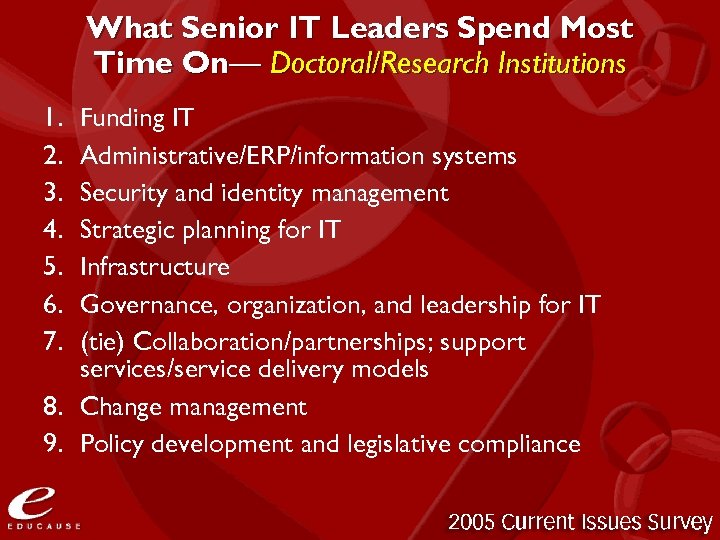 What Senior IT Leaders Spend Most Time On— Doctoral/Research Institutions 1. 2. 3. 4. 5. 6. 7. Funding IT Administrative/ERP/information systems Security and identity management Strategic planning for IT Infrastructure Governance, organization, and leadership for IT (tie) Collaboration/partnerships; support services/service delivery models 8. Change management 9. Policy development and legislative compliance
 Issues Requiring Expenditure of Most Human and/or Financial Resources
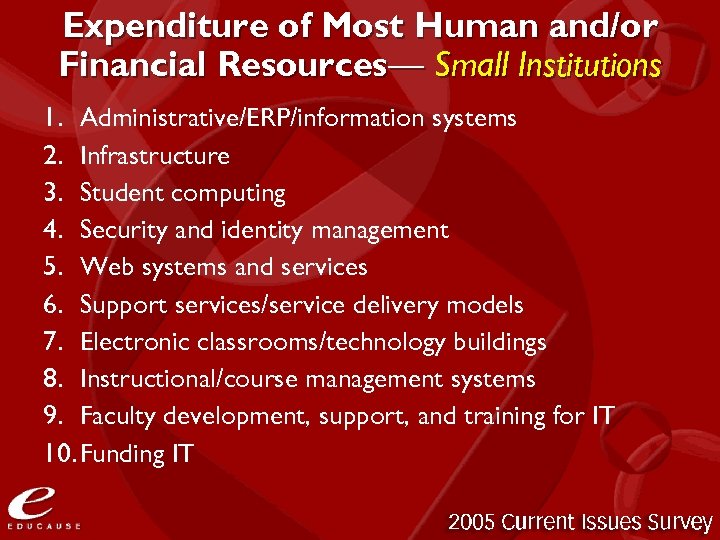 Expenditure of Most Human and/or Financial Resources— Small Institutions 1. Administrative/ERP/information systems 2. Infrastructure 3. Student computing 4. Security and identity management 5. Web systems and services 6. Support services/service delivery models 7. Electronic classrooms/technology buildings 8. Instructional/course management systems 9. Faculty development, support, and training for IT 10. Funding IT
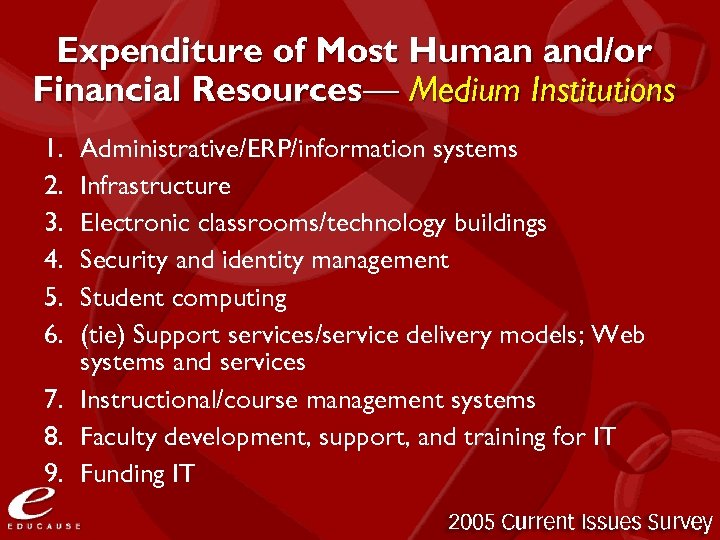 Expenditure of Most Human and/or Financial Resources— Medium Institutions 1. 2. 3. 4. 5. 6. Administrative/ERP/information systems Infrastructure Electronic classrooms/technology buildings Security and identity management Student computing (tie) Support services/service delivery models; Web systems and services 7. Instructional/course management systems 8. Faculty development, support, and training for IT 9. Funding IT
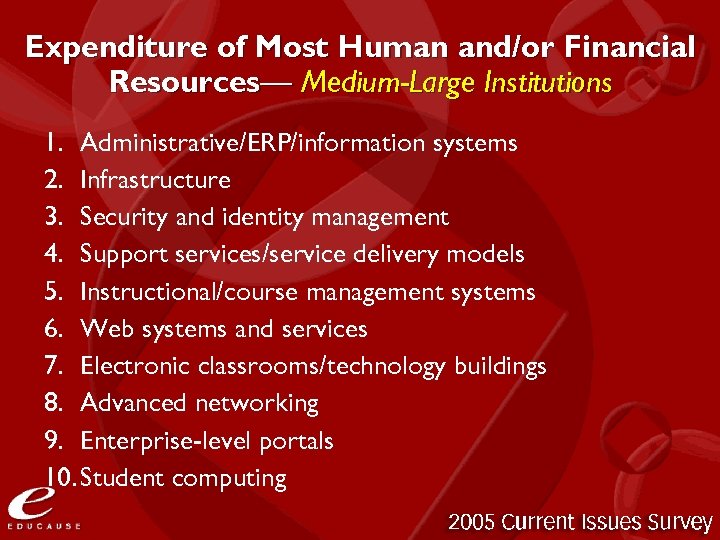 Expenditure of Most Human and/or Financial Resources— Medium-Large Institutions 1. Administrative/ERP/information systems 2. Infrastructure 3. Security and identity management 4. Support services/service delivery models 5. Instructional/course management systems 6. Web systems and services 7. Electronic classrooms/technology buildings 8. Advanced networking 9. Enterprise-level portals 10. Student computing
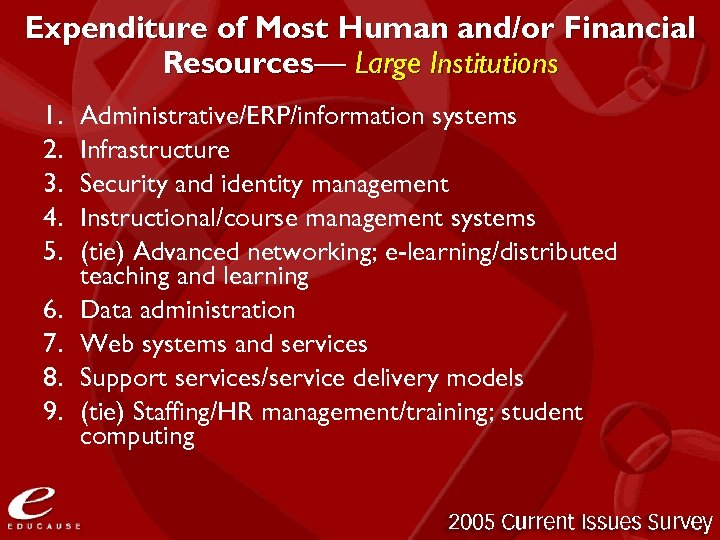 Expenditure of Most Human and/or Financial Resources— Large Institutions 1. 2. 3. 4. 5. 6. 7. 8. 9. Administrative/ERP/information systems Infrastructure Security and identity management Instructional/course management systems (tie) Advanced networking; e-learning/distributed teaching and learning Data administration Web systems and services Support services/service delivery models (tie) Staffing/HR management/training; student computing
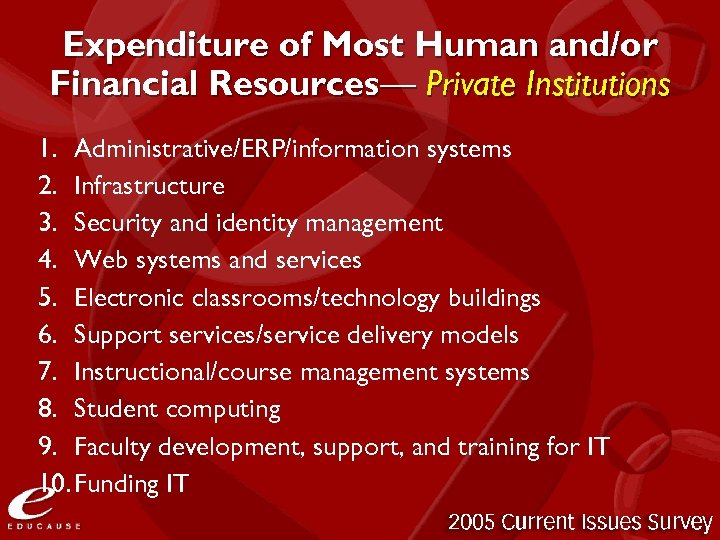 Expenditure of Most Human and/or Financial Resources— Private Institutions 1. Administrative/ERP/information systems 2. Infrastructure 3. Security and identity management 4. Web systems and services 5. Electronic classrooms/technology buildings 6. Support services/service delivery models 7. Instructional/course management systems 8. Student computing 9. Faculty development, support, and training for IT 10. Funding IT
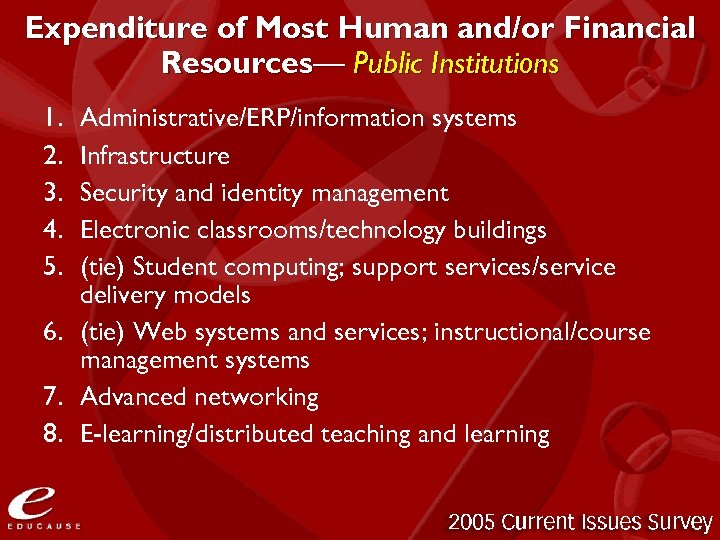 Expenditure of Most Human and/or Financial Resources— Public Institutions 1. 2. 3. 4. 5. Administrative/ERP/information systems Infrastructure Security and identity management Electronic classrooms/technology buildings (tie) Student computing; support services/service delivery models 6. (tie) Web systems and services; instructional/course management systems 7. Advanced networking 8. E-learning/distributed teaching and learning
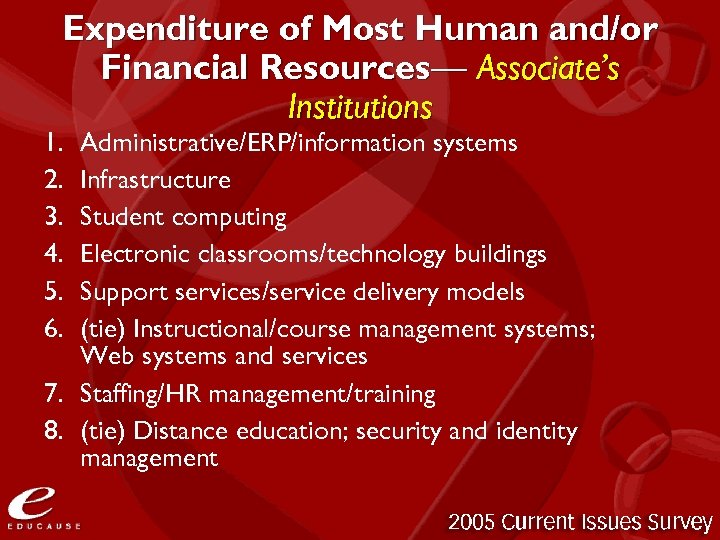 Expenditure of Most Human and/or Financial Resources— Associate’s Institutions 1. 2. 3. 4. 5. 6. Administrative/ERP/information systems Infrastructure Student computing Electronic classrooms/technology buildings Support services/service delivery models (tie) Instructional/course management systems; Web systems and services 7. Staffing/HR management/training 8. (tie) Distance education; security and identity management
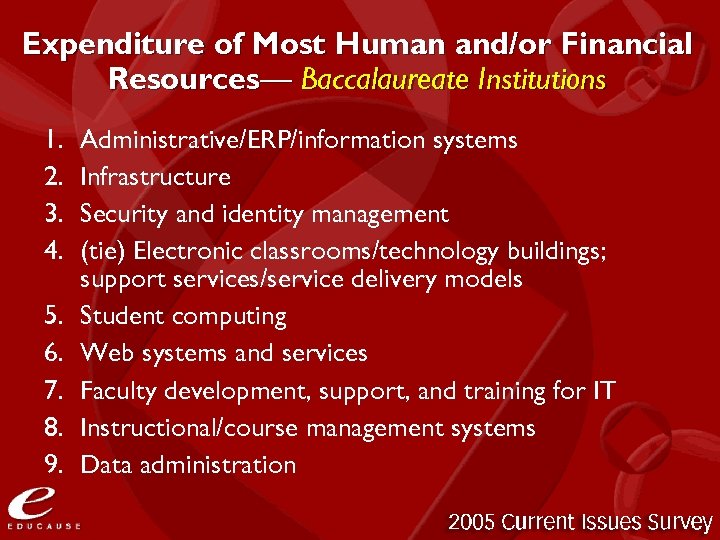 Expenditure of Most Human and/or Financial Resources— Baccalaureate Institutions 1. 2. 3. 4. 5. 6. 7. 8. 9. Administrative/ERP/information systems Infrastructure Security and identity management (tie) Electronic classrooms/technology buildings; support services/service delivery models Student computing Web systems and services Faculty development, support, and training for IT Instructional/course management systems Data administration
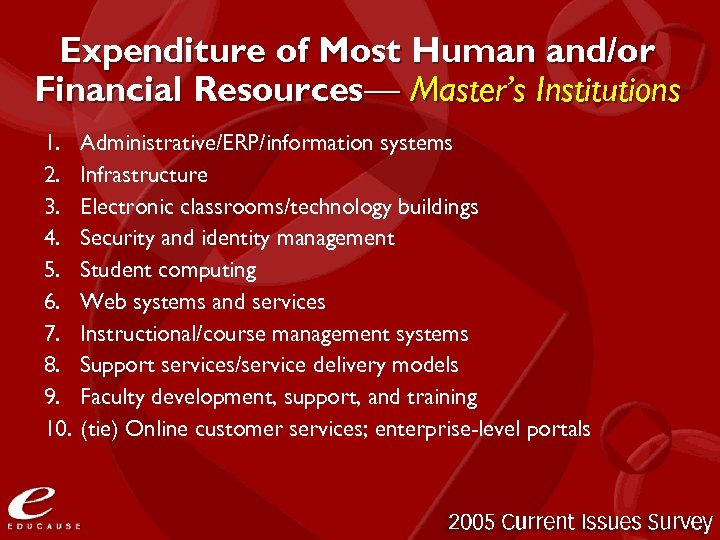 Expenditure of Most Human and/or Financial Resources— Master’s Institutions 1. 2. 3. 4. 5. 6. 7. 8. 9. 10. Administrative/ERP/information systems Infrastructure Electronic classrooms/technology buildings Security and identity management Student computing Web systems and services Instructional/course management systems Support services/service delivery models Faculty development, support, and training (tie) Online customer services; enterprise-level portals
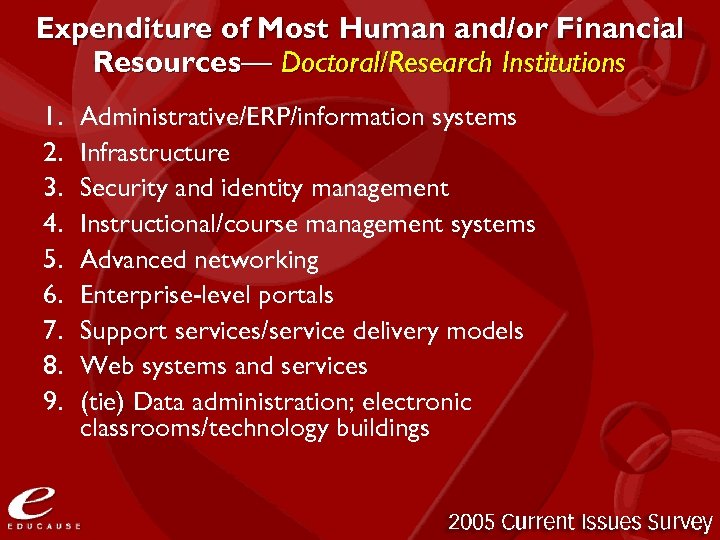 Expenditure of Most Human and/or Financial Resources— Doctoral/Research Institutions 1. 2. 3. 4. 5. 6. 7. 8. 9. Administrative/ERP/information systems Infrastructure Security and identity management Instructional/course management systems Advanced networking Enterprise-level portals Support services/service delivery models Web systems and services (tie) Data administration; electronic classrooms/technology buildings
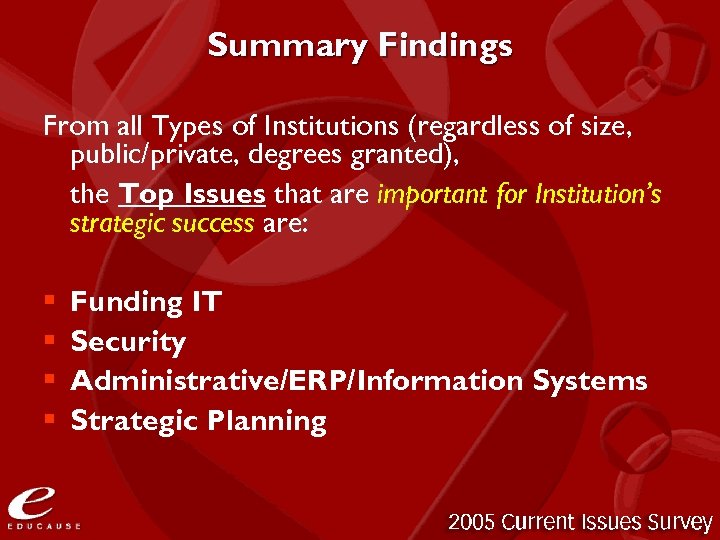 Summary Findings From all Types of Institutions (regardless of size, public/private, degrees granted), the Top Issues that are important for Institution’s strategic success are: § § Funding IT Security Administrative/ERP/Information Systems Strategic Planning
 Summary Findings From all Types of Institutions (regardless of size, public/private, degrees granted), the Top Issues that have the potential to become more significant are: § § Funding IT Security Administrative/ERP/Information Systems And Portals are growing in significance
 Summary Findings From all Types of Institutions (regardless of size, public/private, degrees granted), the Top Issues that Senior IT Leaders Spend them Most Time On: § Funding IT § Strategic Planning § Administrative/ERP/Information Systems
 Summary Findings From all Types of Institutions (regardless of size, public/private, degrees granted), the Top Issues that Require the Most Human and/or Financial Resources are: § Administrative/ERP/Information Systems § Infrastructure Management § Security