


 Скачать презентацию Top-10 Economic Predictions for 2010 And Implications for
3fd6436e083a4dba00487e4e93eb49ff.ppt
- Количество слайдов: 63
 Top-10 Economic Predictions for 2010 And Implications for Trade A Presentation Sponsored by The Port Authority of New York and New Jersey Nariman Behravesh, Chief Economist, HIS January 14, 2010
 Global Outlook • The recession is over and the recovery has begun – unfortunately, for most developed economies, this recovery won’t feel like one in its early stages • Strong tail winds (policy stimulus, improved financial conditions and pent-up demand) … • … Are being partially neutralized by equally strong head winds (rising unemployment rates, lingering hangovers from housing bubbles and the financial crisis, and the winding down of fiscal stimulus) • Global growth at 2. 8% in 2010 will be well below the 3. 5% to 4% trend rate of the last two decades 2 Copyright © 2010 IHS Global Insight. All Rights Reserved.
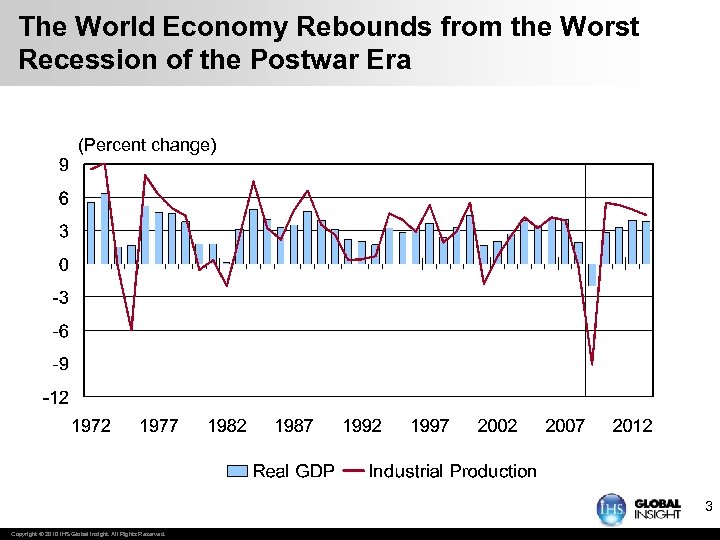 The World Economy Rebounds from the Worst Recession of the Postwar Era (Percent change) 3 Copyright © 2010 IHS Global Insight. All Rights Reserved.
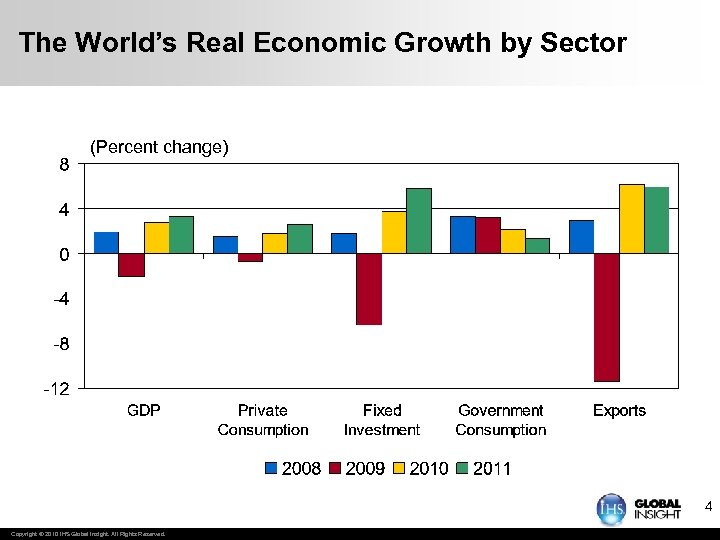 The World’s Real Economic Growth by Sector (Percent change) 4 Copyright © 2010 IHS Global Insight. All Rights Reserved.
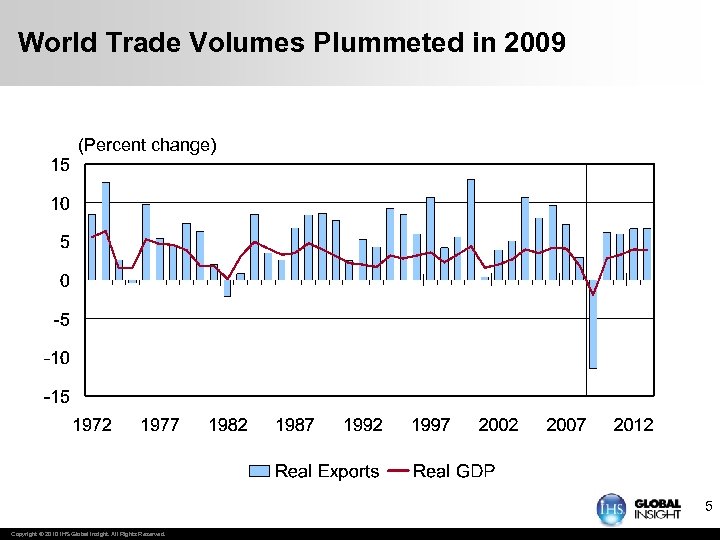 World Trade Volumes Plummeted in 2009 (Percent change) 5 Copyright © 2010 IHS Global Insight. All Rights Reserved.
 1. The U. S. Recovery Will Start Slowly • During much of 2010, growth will be stuck in the 2. 0% to 2. 5% range • Consumer spending is being held back by the strong headwind of a rising unemployment rate – expected to peak at around 10. 5% in the first quarter • The housing recovery, business spending on equipment and inventory rebuilding will boost growth… • …While non-residential construction and state-and-local spending will be a drag on the recovery • Despite strong growth in exports, net trade will be a negative factor as imports will grow even faster 6 Copyright © 2010 IHS Global Insight. All Rights Reserved.
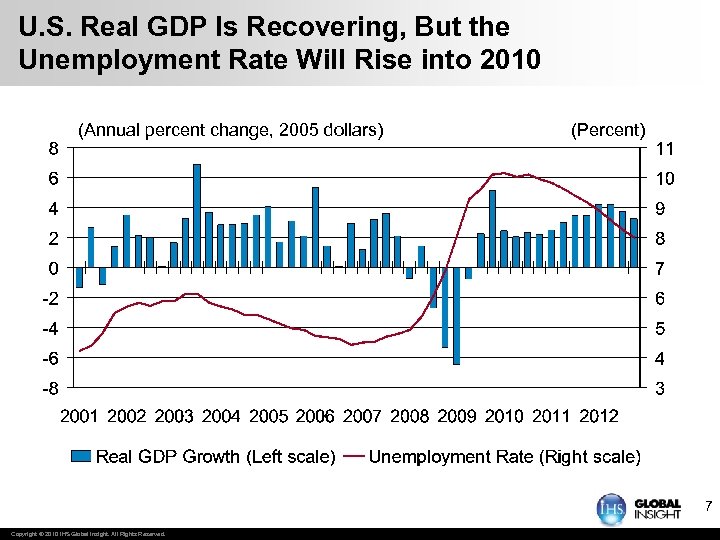 U. S. Real GDP Is Recovering, But the Unemployment Rate Will Rise into 2010 (Annual percent change, 2005 dollars) (Percent) 7 Copyright © 2010 IHS Global Insight. All Rights Reserved.
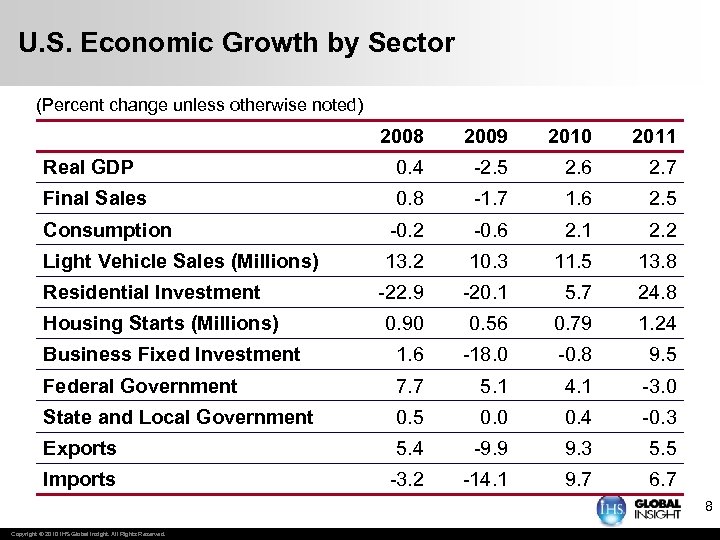 U. S. Economic Growth by Sector (Percent change unless otherwise noted) 2008 2009 2010 2011 Real GDP 0. 4 -2. 5 2. 6 2. 7 Final Sales 0. 8 -1. 7 1. 6 2. 5 Consumption -0. 2 -0. 6 2. 1 2. 2 Light Vehicle Sales (Millions) 13. 2 10. 3 11. 5 13. 8 -22. 9 -20. 1 5. 7 24. 8 0. 90 0. 56 0. 79 1. 24 Business Fixed Investment 1. 6 -18. 0 -0. 8 9. 5 Federal Government 7. 7 5. 1 4. 1 -3. 0 State and Local Government 0. 5 0. 0 0. 4 -0. 3 Exports 5. 4 -9. 9 9. 3 5. 5 Imports -3. 2 -14. 1 9. 7 6. 7 Residential Investment Housing Starts (Millions) 8 Copyright © 2010 IHS Global Insight. All Rights Reserved.
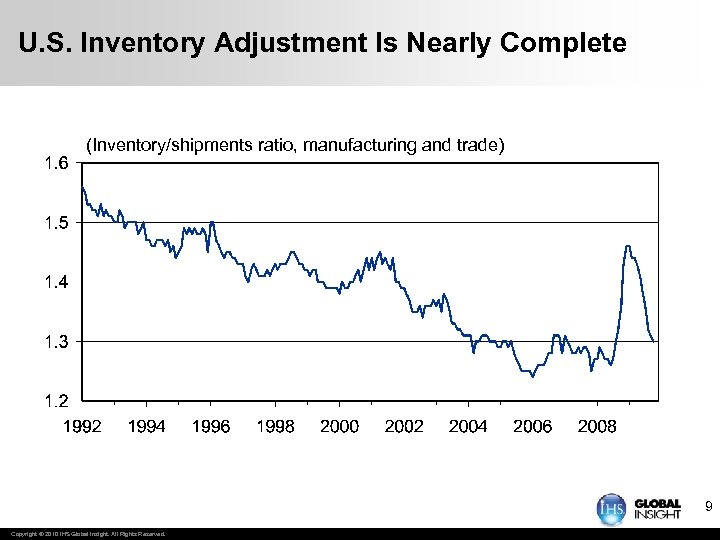 U. S. Inventory Adjustment Is Nearly Complete (Inventory/shipments ratio, manufacturing and trade) 9 Copyright © 2010 IHS Global Insight. All Rights Reserved.
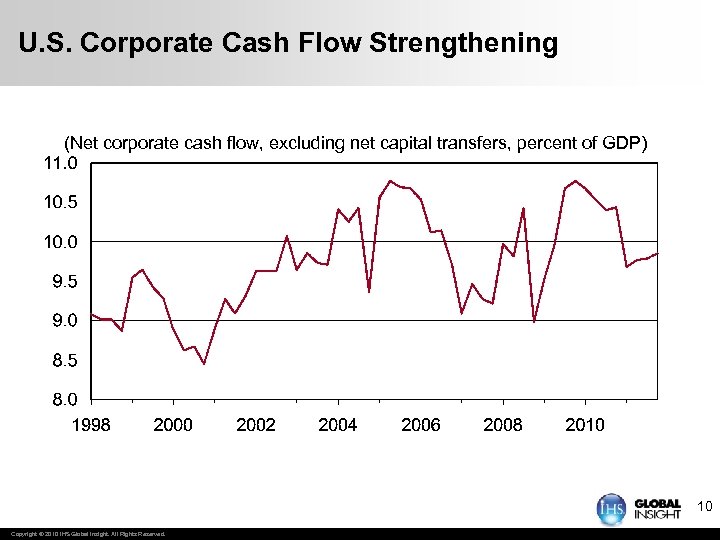 U. S. Corporate Cash Flow Strengthening (Net corporate cash flow, excluding net capital transfers, percent of GDP) 10 Copyright © 2010 IHS Global Insight. All Rights Reserved.
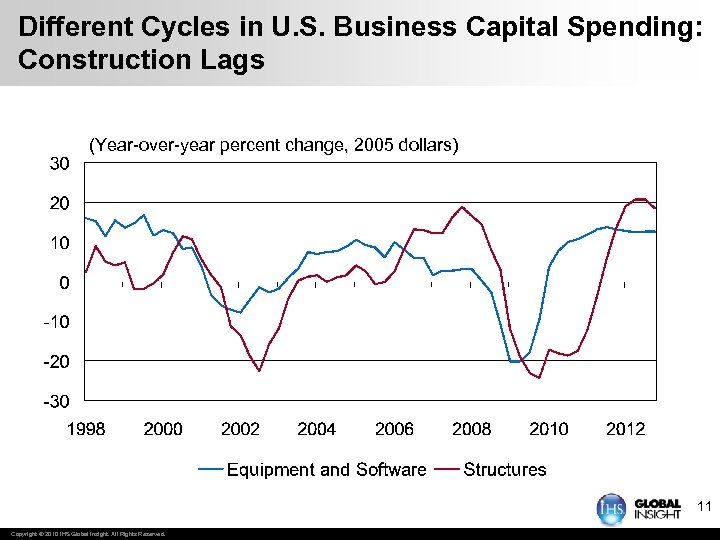 Different Cycles in U. S. Business Capital Spending: Construction Lags (Year-over-year percent change, 2005 dollars) 11 Copyright © 2010 IHS Global Insight. All Rights Reserved.
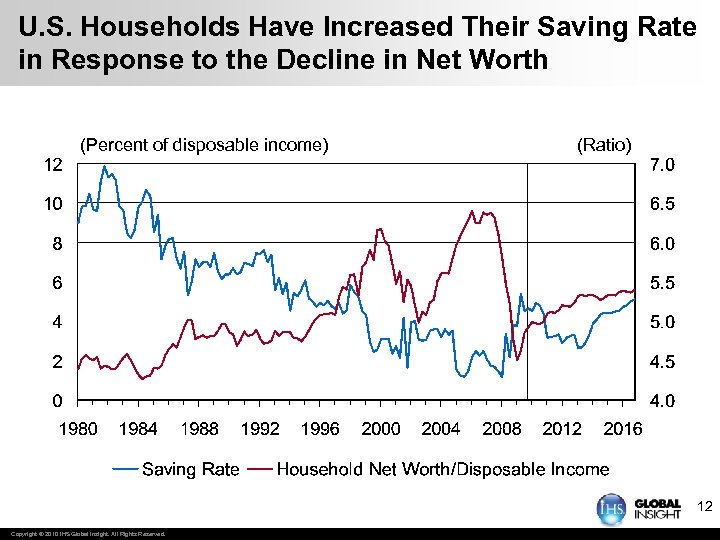 U. S. Households Have Increased Their Saving Rate in Response to the Decline in Net Worth (Percent of disposable income) (Ratio) 12 Copyright © 2010 IHS Global Insight. All Rights Reserved.
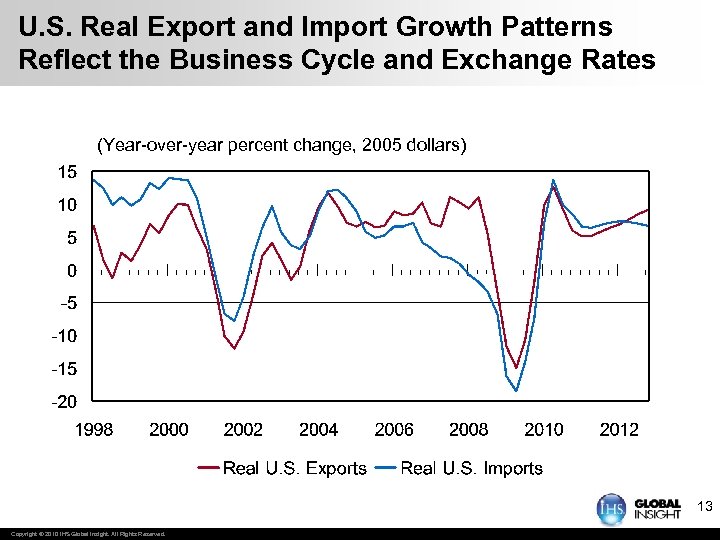 U. S. Real Export and Import Growth Patterns Reflect the Business Cycle and Exchange Rates (Year-over-year percent change, 2005 dollars) 13 Copyright © 2010 IHS Global Insight. All Rights Reserved.
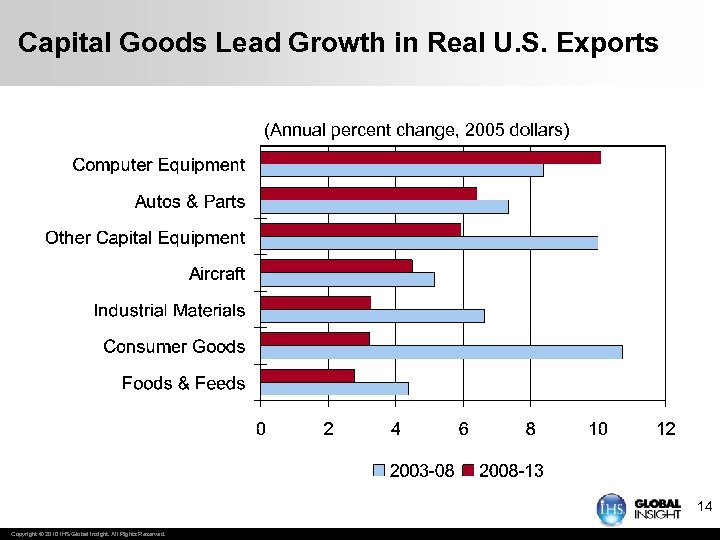 Capital Goods Lead Growth in Real U. S. Exports (Annual percent change, 2005 dollars) 14 Copyright © 2010 IHS Global Insight. All Rights Reserved.
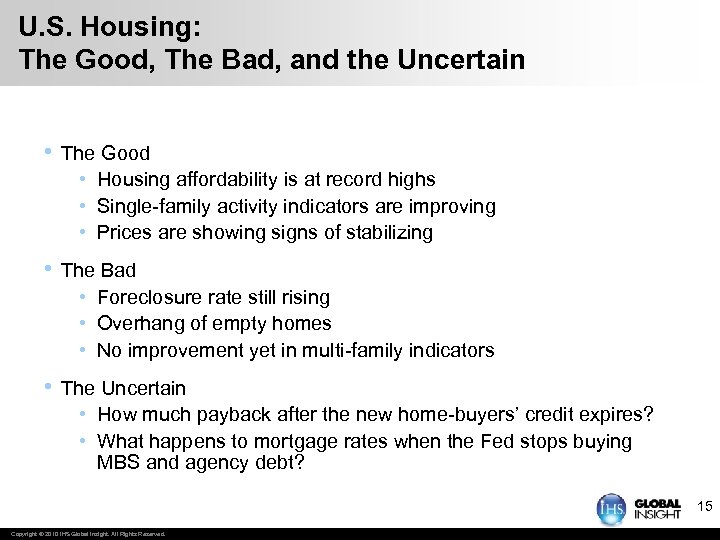 U. S. Housing: The Good, The Bad, and the Uncertain • The Good • Housing affordability is at record highs • Single-family activity indicators are improving • Prices are showing signs of stabilizing • The Bad • Foreclosure rate still rising • Overhang of empty homes • No improvement yet in multi-family indicators • The Uncertain • How much payback after the new home-buyers’ credit expires? • What happens to mortgage rates when the Fed stops buying MBS and agency debt? 15 Copyright © 2010 IHS Global Insight. All Rights Reserved.
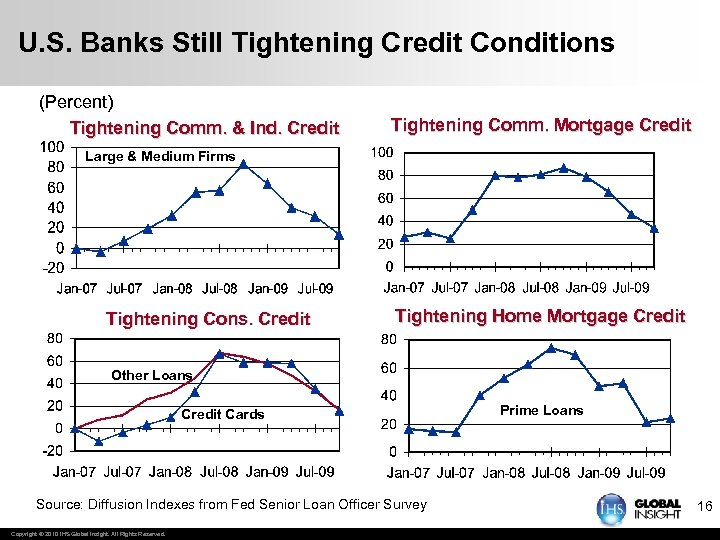 U. S. Banks Still Tightening Credit Conditions (Percent) Tightening Comm. & Ind. Credit Tightening Comm. Mortgage Credit Large & Medium Firms Tightening Cons. Credit Tightening Home Mortgage Credit Other Loans Credit Cards Source: Diffusion Indexes from Fed Senior Loan Officer Survey Copyright © 2010 IHS Global Insight. All Rights Reserved. Prime Loans 16
 2. Europe and Japan Will Recover Even More Slowly Than the U. S. • Second and third quarter growth rates in both Europe and Japan overstate the strength of the recovery • • Recent Eurozone data show a loss of momentum – how big of a risk is a W? • Houses are still over-valued in some markets (Ireland, Spain, U. K. etc. ) – how big of a vulnerability is this? • Some European economies (including those of Iceland Spain) will continue to contract in 2010 • The substantial downward revision of Japanese growth in the third quarter (from 4. 8% to 1. 3%) is troubling… • • …As is the sharp increase in the pace of deflation in recent months • Appreciating currencies are a major headwind for both the Eurozone and Japan While the worst of the financial crisis is over, there could be more aftershocks (including a possible sovereign default in the Eurozone), and credit remains tight Recent attempts by the Japanese government to stimulate the economy are likely to disappoint 17 Copyright © 2010 IHS Global Insight. All Rights Reserved.
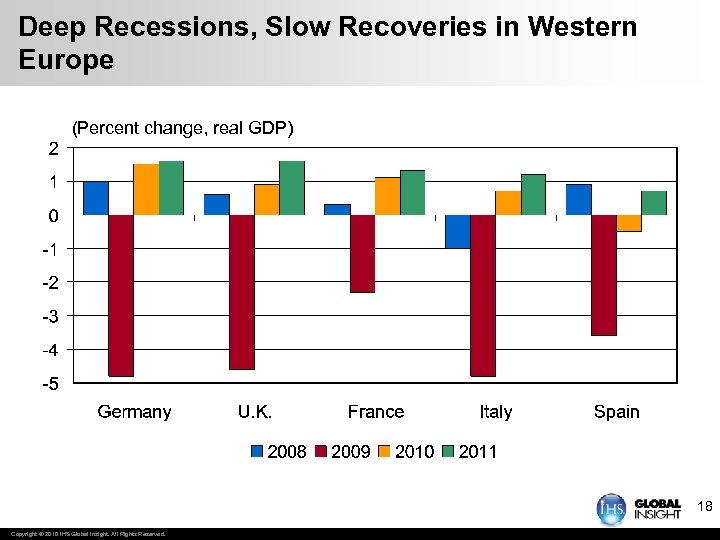 Deep Recessions, Slow Recoveries in Western Europe (Percent change, real GDP) 18 Copyright © 2010 IHS Global Insight. All Rights Reserved.
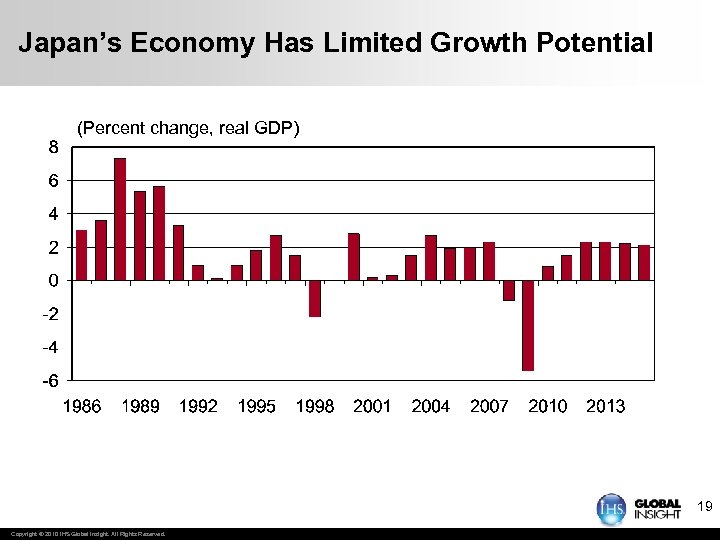 Japan’s Economy Has Limited Growth Potential (Percent change, real GDP) 19 Copyright © 2010 IHS Global Insight. All Rights Reserved.
 3. Most Emerging Markets – Especially Asia – Will Outpace the Developed Economies • Non-Japan Asia will be at the forefront, with a growth rate of over 7% next year • Latin America, the Middle East, and Africa will see gains in the 3% to 4% range • The laggard will be Emerging Europe, which will only grow between 1. 5% and 2% • Many emerging regions are benefitting from the sharp rebound in trade and the turn in the inventory cycle – can these be the basis for sustained growth? • With the exception of Emerging Europe and some Gulf states, the impact of the financial crisis on the emerging markets has been modest • Among the Big-6 emerging economies, China, India and Brazil will lead, while Russia, South Korea and Mexico will lag 20 Copyright © 2010 IHS Global Insight. All Rights Reserved.
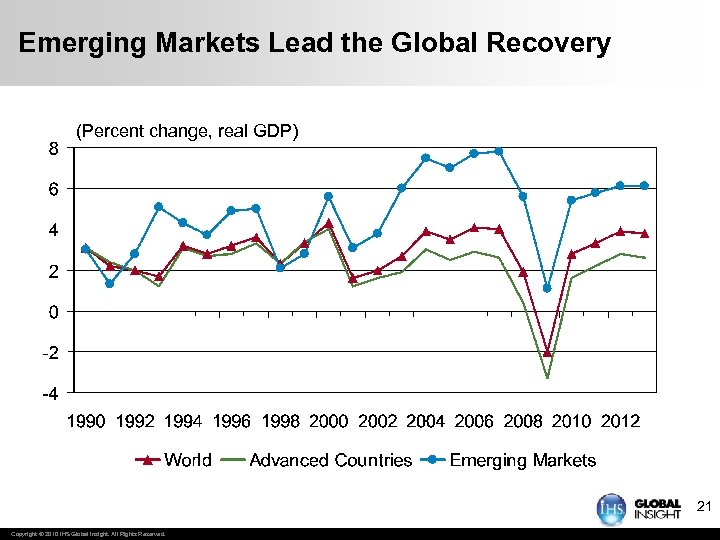 Emerging Markets Lead the Global Recovery (Percent change, real GDP) 21 Copyright © 2010 IHS Global Insight. All Rights Reserved.
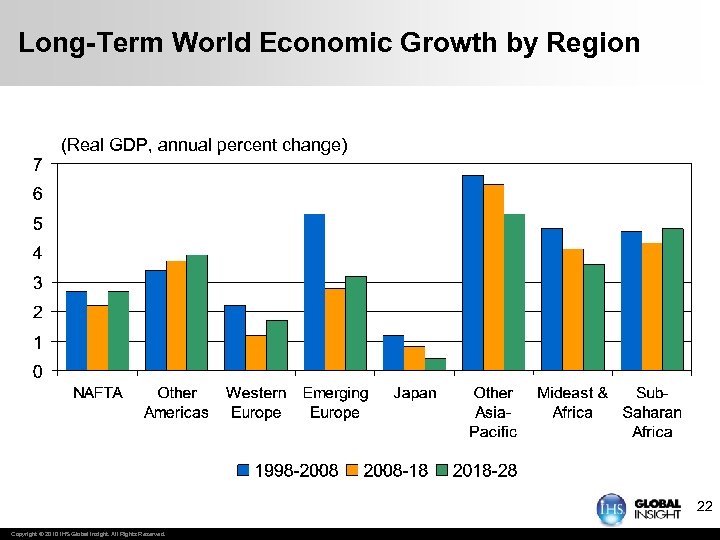 Long-Term World Economic Growth by Region (Real GDP, annual percent change) 22 Copyright © 2010 IHS Global Insight. All Rights Reserved.
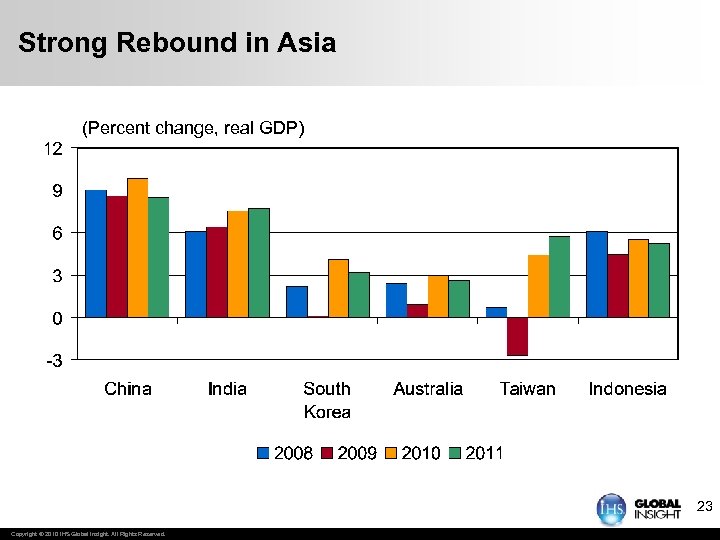 Strong Rebound in Asia (Percent change, real GDP) 23 Copyright © 2010 IHS Global Insight. All Rights Reserved.
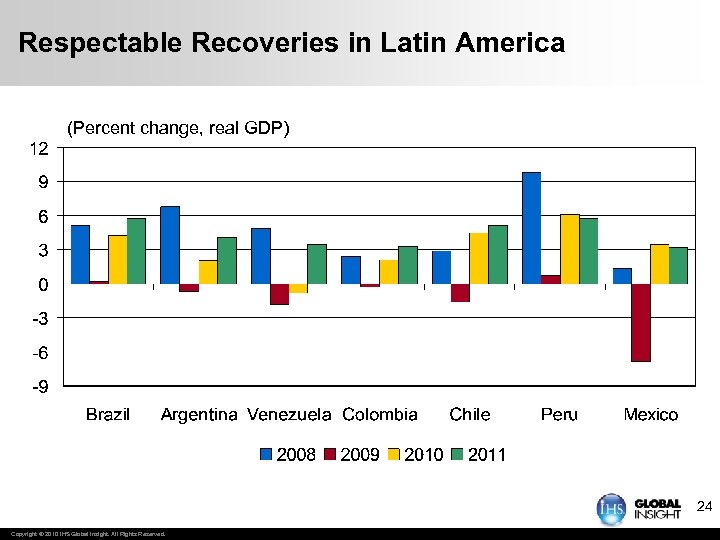 Respectable Recoveries in Latin America (Percent change, real GDP) 24 Copyright © 2010 IHS Global Insight. All Rights Reserved.
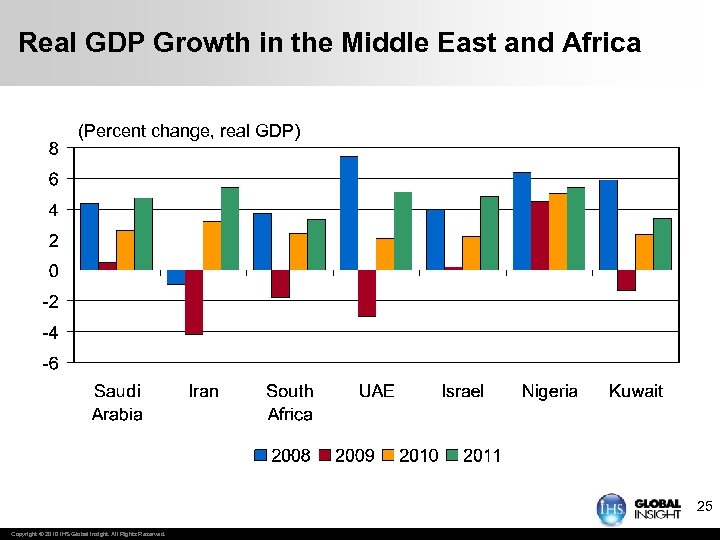 Real GDP Growth in the Middle East and Africa (Percent change, real GDP) 25 Copyright © 2010 IHS Global Insight. All Rights Reserved.
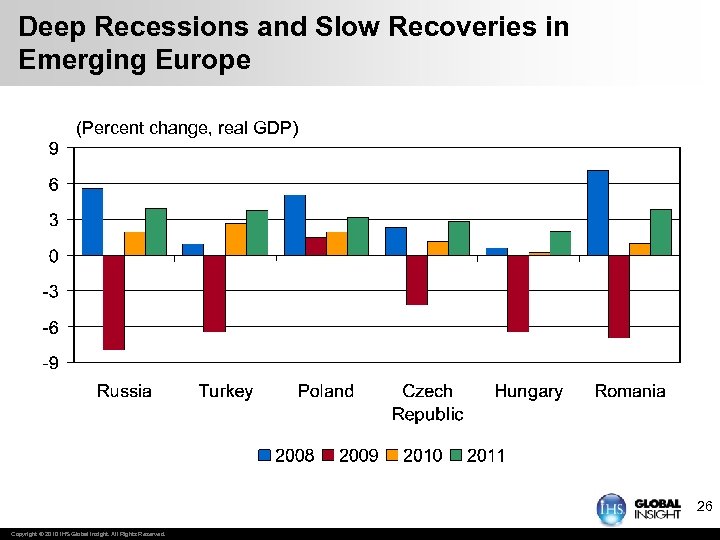 Deep Recessions and Slow Recoveries in Emerging Europe (Percent change, real GDP) 26 Copyright © 2010 IHS Global Insight. All Rights Reserved.
 4. Interest Rates in the G-7 and the BRICs Will Remain Low • Some central banks (notably Australia, Israel and Norway) have already started to raise rates • The Fed, the ECB, the Bank of England the Bank of Japan are unlikely to hike rates until the third quarter – although the “quantitative easing” measures will be phased out before then • The G-7 central bankers are currently more worried about the fragility of the recovery and the aftershocks of the financial crisis than inflation • Some Asian central banks (e. g. , the Reserve Bank of India and the Peoples Bank of China) may pull the trigger in the first or second quarter, due to concerns about inflation and asset bubbles 27 Copyright © 2010 IHS Global Insight. All Rights Reserved.
 Policy Interest Rates Will Stay Low into 2010 (Percent, end of quarter) 28 Copyright © 2010 IHS Global Insight. All Rights Reserved.
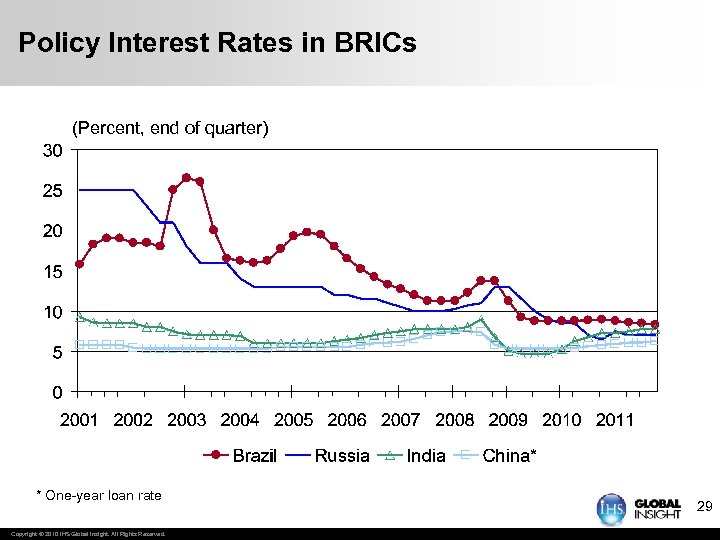 Policy Interest Rates in BRICs (Percent, end of quarter) * One-year loan rate Copyright © 2010 IHS Global Insight. All Rights Reserved. 29
 5. Fiscal Stimulus Will Begin to Ease • Shaky public finances and voter unease severely limit the scope for any further stimulus – some countries will actually be tightening fiscal policy next year (e. g. , the U. K. ) • Temporary measures (such as cash-for-clunker programs) have ended or will soon end • The pressure on the U. S. , European and Japanese governments to put in place credible deficit and debt reduction plans is likely to intensify • The recently announced U. S. jobs program will only be feasible by using budgetary sleight of hand (i. e. , TARP money) • The biggest fiscal challenge in the medium- to long-term will be the pressure from public pensions and healthcare programs 30 Copyright © 2010 IHS Global Insight. All Rights Reserved.
 A Record U. S. Federal Budget Deficit in Fiscal 2009 (Billions of dollars, fiscal years) (Percent of GDP) 31 Copyright © 2010 IHS Global Insight. All Rights Reserved.
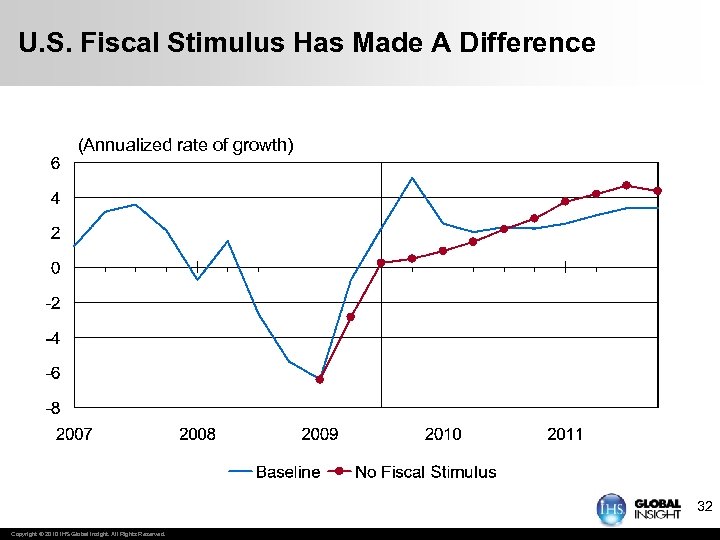 U. S. Fiscal Stimulus Has Made A Difference (Annualized rate of growth) 32 Copyright © 2010 IHS Global Insight. All Rights Reserved.
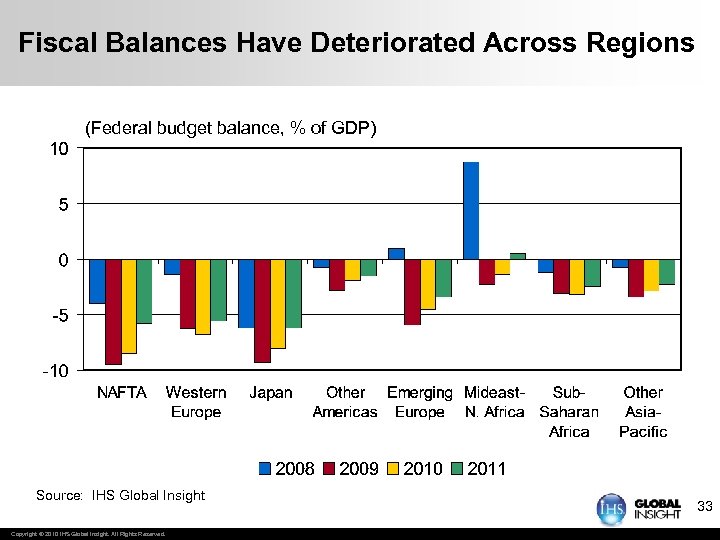 Fiscal Balances Have Deteriorated Across Regions (Federal budget balance, % of GDP) Source: IHS Global Insight Copyright © 2010 IHS Global Insight. All Rights Reserved. 33
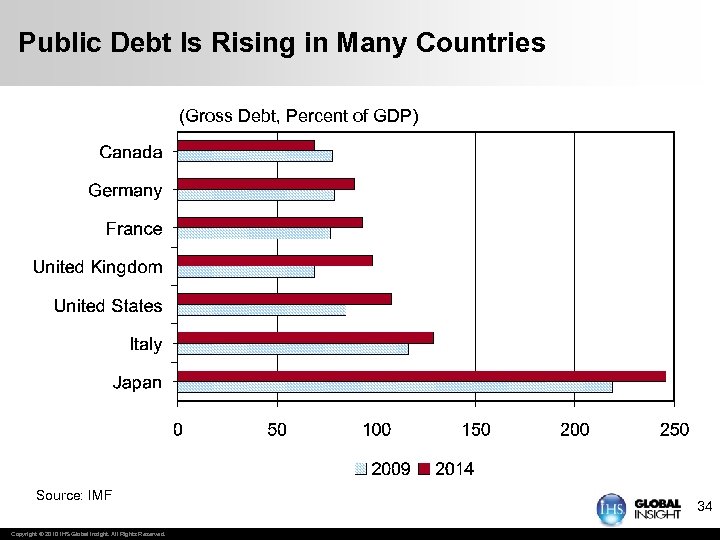 Public Debt Is Rising in Many Countries (Gross Debt, Percent of GDP) Source: IMF Copyright © 2010 IHS Global Insight. All Rights Reserved. 34
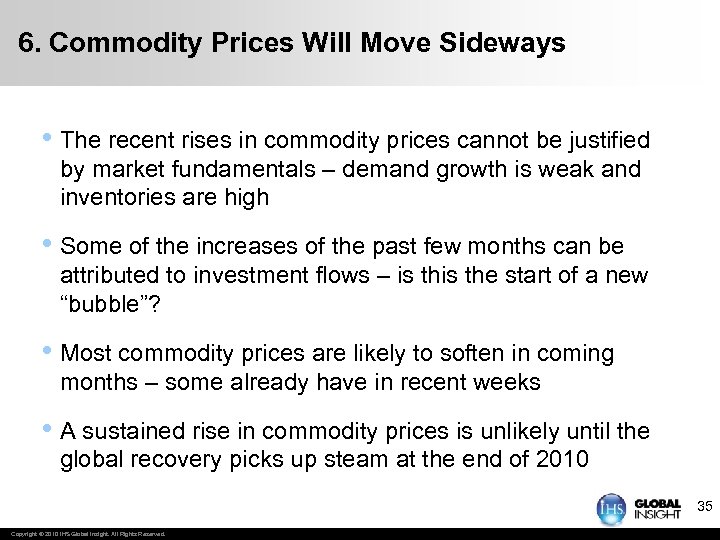 6. Commodity Prices Will Move Sideways • The recent rises in commodity prices cannot be justified by market fundamentals – demand growth is weak and inventories are high • Some of the increases of the past few months can be attributed to investment flows – is the start of a new “bubble”? • Most commodity prices are likely to soften in coming months – some already have in recent weeks • A sustained rise in commodity prices is unlikely until the global recovery picks up steam at the end of 2010 35 Copyright © 2010 IHS Global Insight. All Rights Reserved.
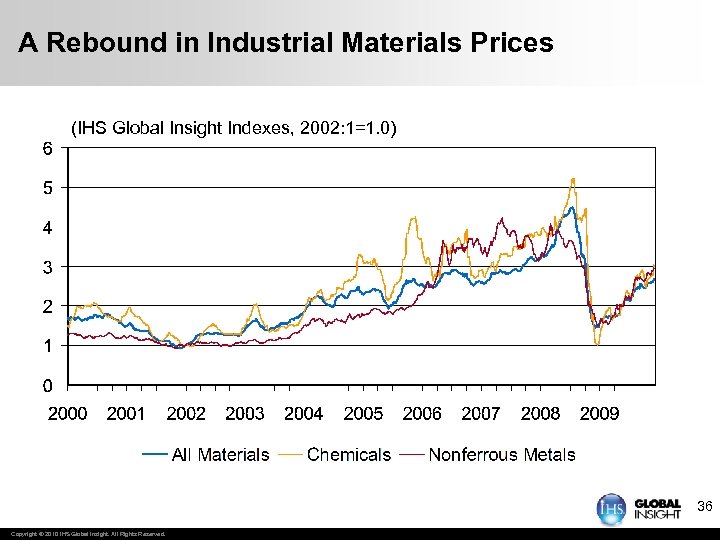 A Rebound in Industrial Materials Prices (IHS Global Insight Indexes, 2002: 1=1. 0) 36 Copyright © 2010 IHS Global Insight. All Rights Reserved.
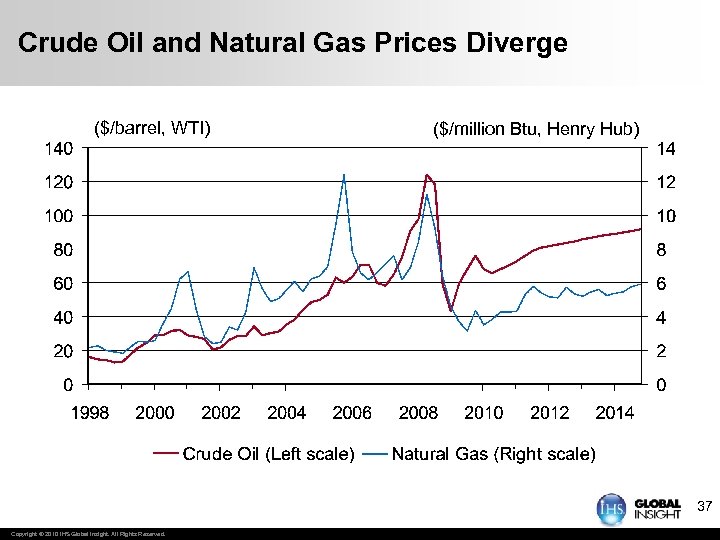 Crude Oil and Natural Gas Prices Diverge ($/barrel, WTI) ($/million Btu, Henry Hub) 37 Copyright © 2010 IHS Global Insight. All Rights Reserved.
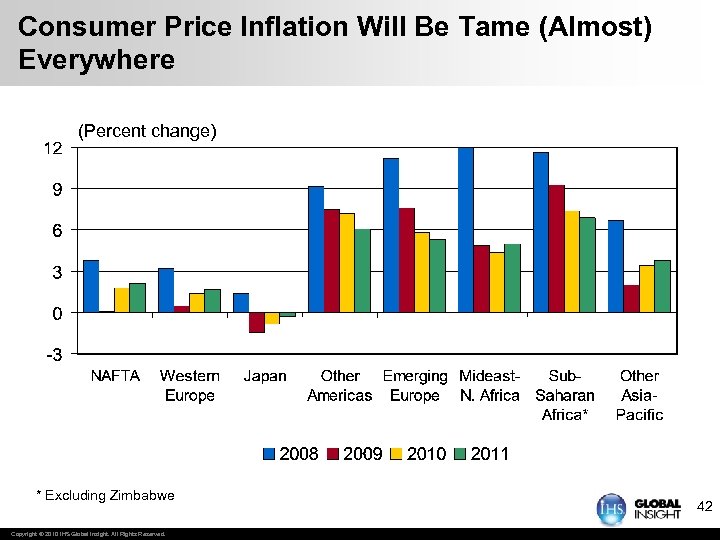
 7. Inflation Will (Mostly) Not Be a Problem • Historically-high levels of unemployment and excess capacity will limit both wage and price inflation – also strong productivity growth in the U. S. has been a powerful disinflationary force • Central banks will most likely remove the excess liquidity sloshing around the global economy, before inflation expectations begin to rise much • Strong growth in Asia will probably mean that inflationary pressures will be felt in that region first • Also at risk of rising inflation are countries that peg (or strongly manage) their exchange rates to the dollar – mostly in Asia and the Middle East 38 Copyright © 2010 IHS Global Insight. All Rights Reserved.
 Labor Market Slack Will Limit Wage Inflation (Unemployment rates, percent in October/November, 2009) 39 Copyright © 2010 IHS Global Insight. All Rights Reserved.
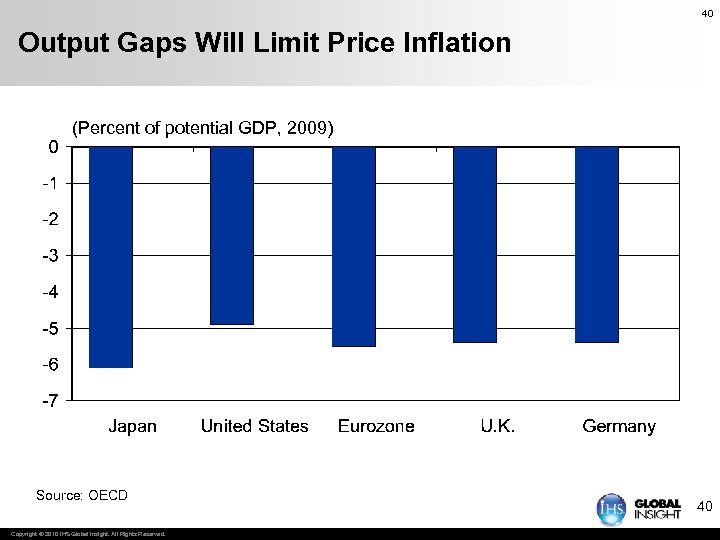 40 Output Gaps Will Limit Price Inflation (Percent of potential GDP, 2009) Source: OECD Copyright © 2010 IHS Global Insight. All Rights Reserved. 40
 Aggressive Cost-Cutting Has Boosted U. S. Productivity and Reduced Unit Labor Costs (Q/Q annualized growth rates) 41 Copyright © 2010 IHS Global Insight. All Rights Reserved.
 Consumer Price Inflation Will Be Tame (Almost) Everywhere (Percent change) * Excluding Zimbabwe Copyright © 2010 IHS Global Insight. All Rights Reserved. 42
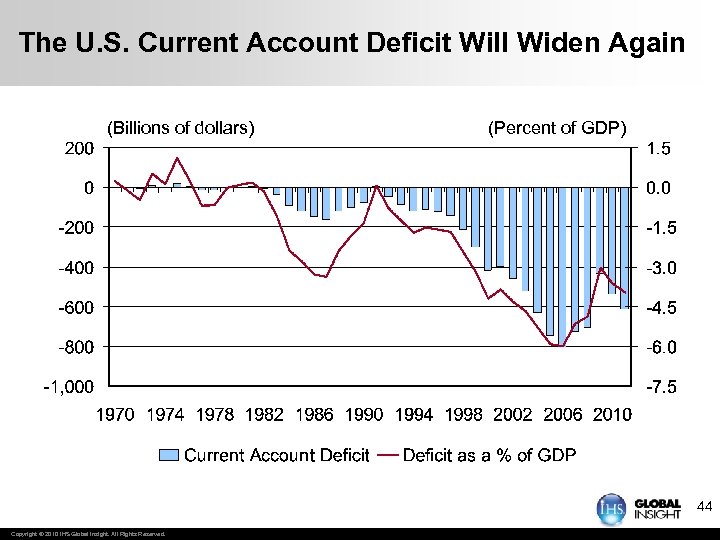
 8. After Improving for a While, Global Imbalances Will Worsen Again • The recent sharp improvement in the U. S. current account is mostly due to the deep U. S. recession and the big drop in oil prices • The less dramatic fall in the current account surpluses in other parts of the world reflects the sharp contraction in world exports and the drop in commodity prices • The U. S. current account deficit will increase again, as the American recovery outpaces that of the other developed economies • Likewise, continuing dependence on export-led growth in many large economies (e. g. , Germany, China and the rest of Asia) will contribute to the worsening in global imbalances 43 Copyright © 2010 IHS Global Insight. All Rights Reserved.
 The U. S. Current Account Deficit Will Widen Again (Billions of dollars) (Percent of GDP) 44 Copyright © 2010 IHS Global Insight. All Rights Reserved.
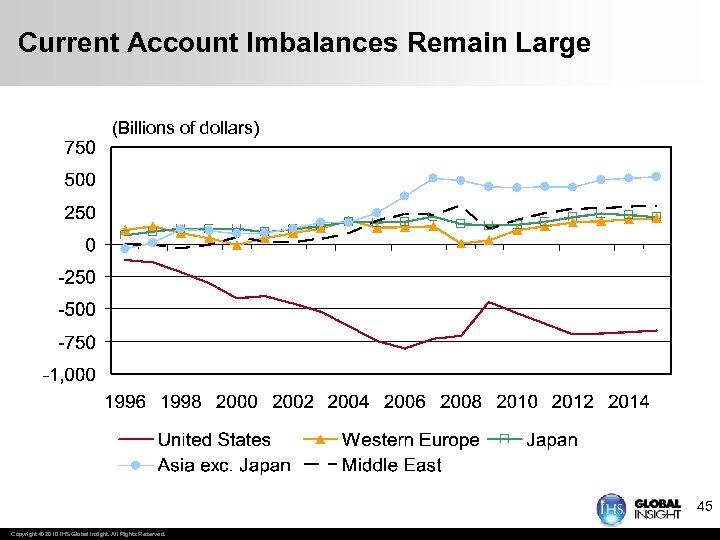 Current Account Imbalances Remain Large (Billions of dollars) 45 Copyright © 2010 IHS Global Insight. All Rights Reserved.
 9. While the Dollar May Strengthen a Little, It Is on a Downward Glide Path • The dollar is probably oversold relative to the euro and the yen, given the slightly better growth prospects of the U. S. economy – so a small appreciation in the next few months is likely • Nevertheless, given that progress on the global imbalances has been temporary, the downward pressure on the dollar will continue • The depreciation of the dollar is likely to be the largest vis-à-vis some emerging market currencies (especially the “floaters”) • Notwithstanding complaints about a weak dollar, many developed country currencies have been declining on an inflation-adjusted, trade -weighted basis – this is especially true of the yen • Despite being fixed relative to the dollar, the Chinese renminbi, is sharply down against the euro and on a real trade-weighted basis 46 Copyright © 2010 IHS Global Insight. All Rights Reserved.
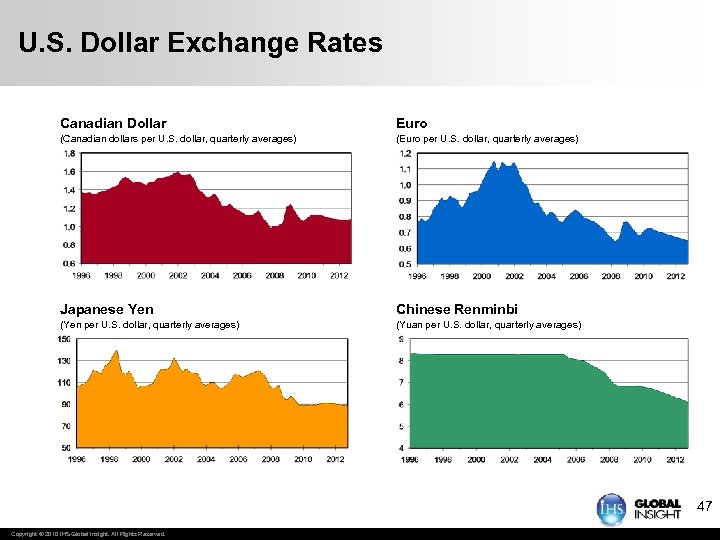 U. S. Dollar Exchange Rates Canadian Dollar Euro (Canadian dollars per U. S. dollar, quarterly averages) (Euro per U. S. dollar, quarterly averages) Japanese Yen Chinese Renminbi (Yen per U. S. dollar, quarterly averages) (Yuan per U. S. dollar, quarterly averages) 47 Copyright © 2010 IHS Global Insight. All Rights Reserved.
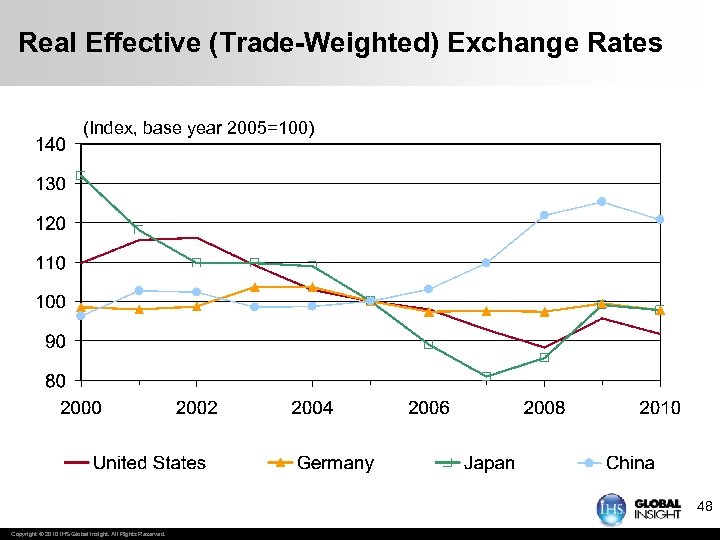 Real Effective (Trade-Weighted) Exchange Rates (Index, base year 2005=100) 48 Copyright © 2010 IHS Global Insight. All Rights Reserved.
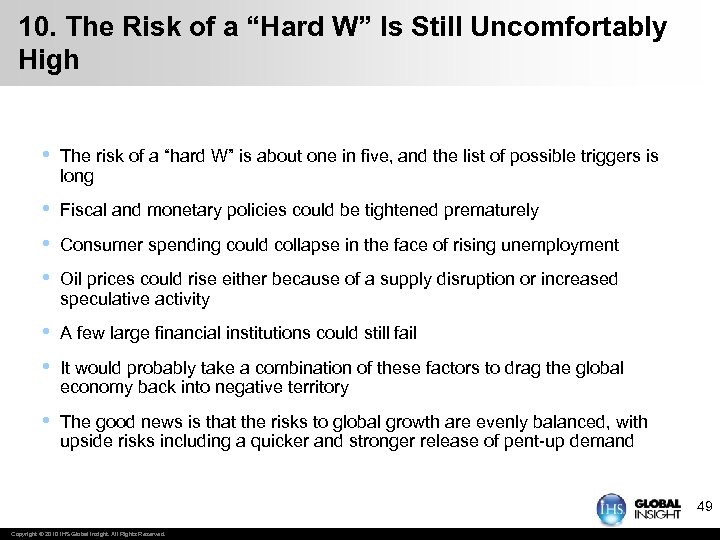 10. The Risk of a “Hard W” Is Still Uncomfortably High • The risk of a “hard W” is about one in five, and the list of possible triggers is long • Fiscal and monetary policies could be tightened prematurely • Consumer spending could collapse in the face of rising unemployment • Oil prices could rise either because of a supply disruption or increased speculative activity • A few large financial institutions could still fail • It would probably take a combination of these factors to drag the global economy back into negative territory • The good news is that the risks to global growth are evenly balanced, with upside risks including a quicker and stronger release of pent-up demand 49 Copyright © 2010 IHS Global Insight. All Rights Reserved.
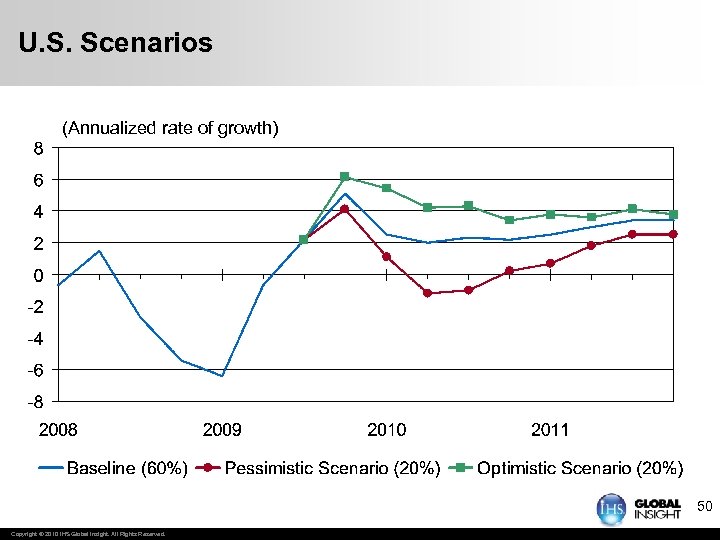 U. S. Scenarios (Annualized rate of growth) 50 Copyright © 2010 IHS Global Insight. All Rights Reserved.
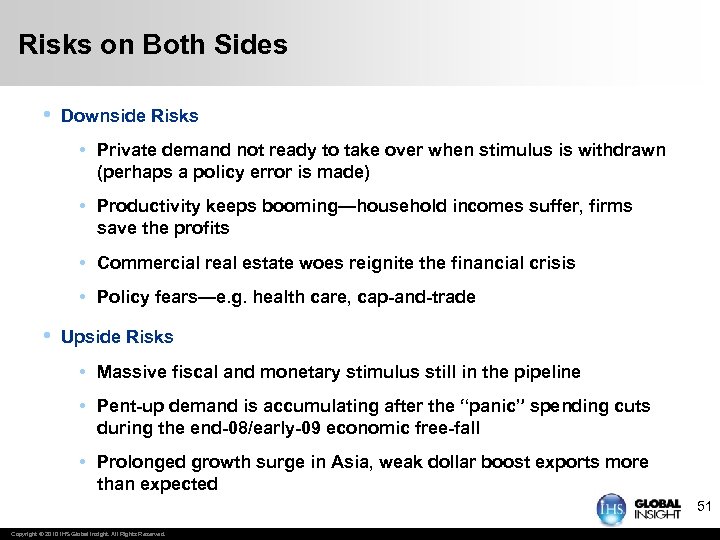 Risks on Both Sides • Downside Risks • Private demand not ready to take over when stimulus is withdrawn (perhaps a policy error is made) • Productivity keeps booming—household incomes suffer, firms save the profits • Commercial real estate woes reignite the financial crisis • Policy fears—e. g. health care, cap-and-trade • Upside Risks • Massive fiscal and monetary stimulus still in the pipeline • Pent-up demand is accumulating after the “panic” spending cuts during the end-08/early-09 economic free-fall • Prolonged growth surge in Asia, weak dollar boost exports more than expected 51 Copyright © 2010 IHS Global Insight. All Rights Reserved.
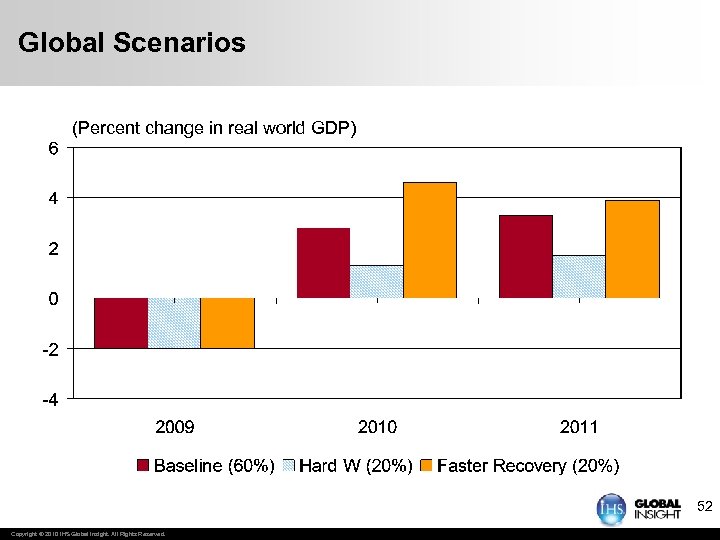 Global Scenarios (Percent change in real world GDP) 52 Copyright © 2010 IHS Global Insight. All Rights Reserved.
 Trade Implications
 World Trade Typically Grows Faster Than Real GDP (Percent change) 54 Copyright © 2010 IHS Global Insight. All Rights Reserved.
 U. S. International Trading Partners Are Shifting (Exports, trillions of U. S. dollars) Source: Global Insight World Trade Service Copyright © 2010 IHS Global Insight. All Rights Reserved. 55
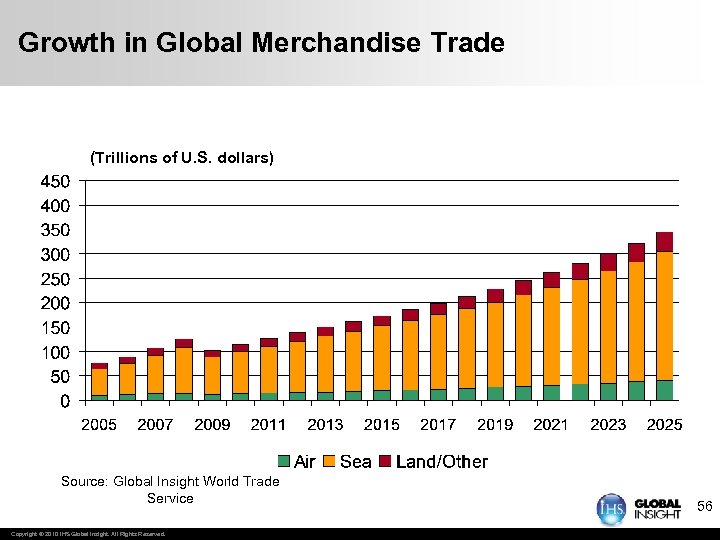 Growth in Global Merchandise Trade (Trillions of U. S. dollars) Source: Global Insight World Trade Service Copyright © 2010 IHS Global Insight. All Rights Reserved. 56
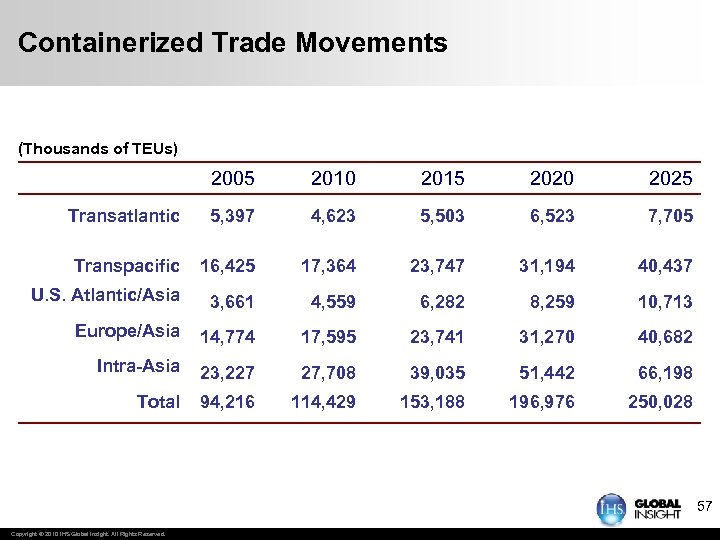 Containerized Trade Movements (Thousands of TEUs) 2005 2010 2015 2020 2025 Transatlantic 5, 397 4, 623 5, 503 6, 523 7, 705 Transpacific 16, 425 17, 364 23, 747 31, 194 40, 437 U. S. Atlantic/Asia 3, 661 4, 559 6, 282 8, 259 10, 713 Europe/Asia 14, 774 17, 595 23, 741 31, 270 40, 682 Intra-Asia 23, 227 27, 708 39, 035 51, 442 66, 198 Total 94, 216 114, 429 153, 188 196, 976 250, 028 57 Copyright © 2010 IHS Global Insight. All Rights Reserved.
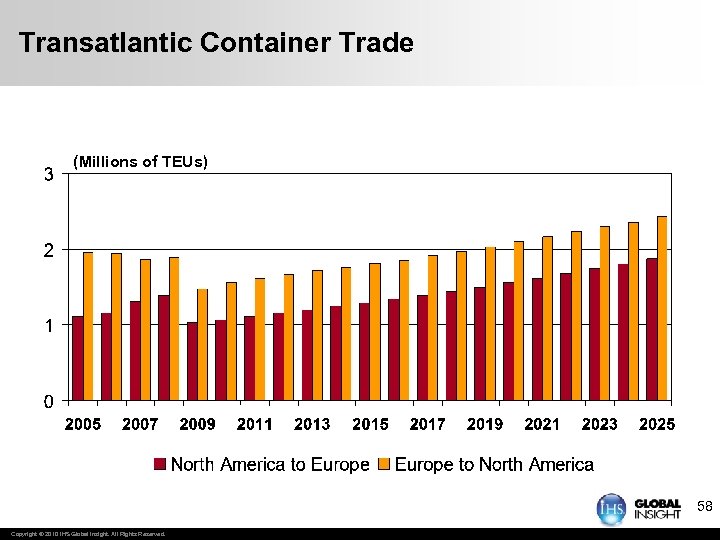 Transatlantic Container Trade (Millions of TEUs) 58 Copyright © 2010 IHS Global Insight. All Rights Reserved.
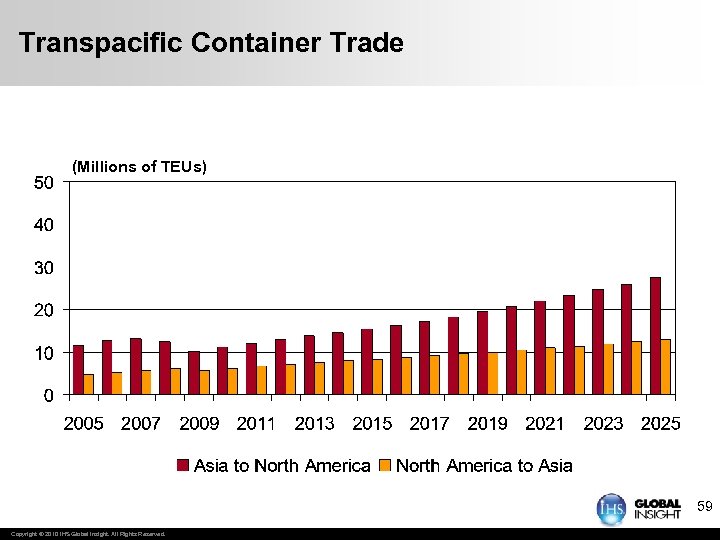 Transpacific Container Trade (Millions of TEUs) 59 Copyright © 2010 IHS Global Insight. All Rights Reserved.
 Europe to Far East Container Trade (Millions of TEUs) 60 Copyright © 2010 IHS Global Insight. All Rights Reserved.
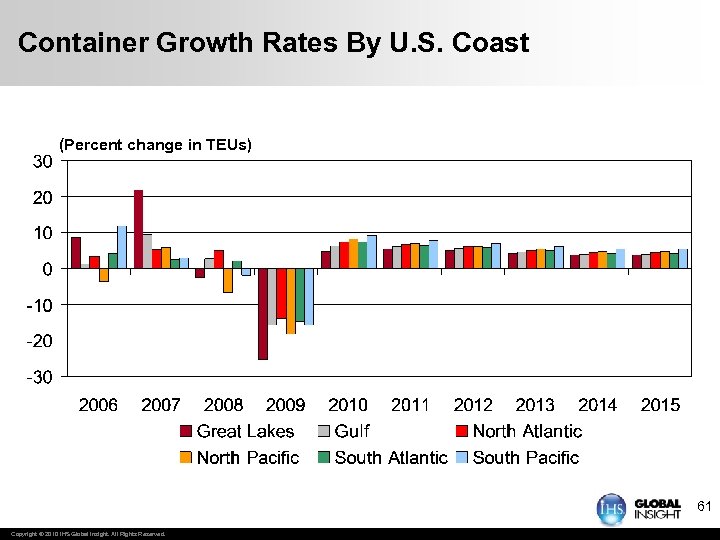 Container Growth Rates By U. S. Coast (Percent change in TEUs) 61 Copyright © 2010 IHS Global Insight. All Rights Reserved.
 Implications for the Port • The trade recovery from last year’s low has begun • Pace of trade volume recovery is slow • Export growth to Asia will be strong … • … While European trade will remain weak • This explains the East Coast/West Coast differences in container traffic • Bottom line: it will get better but slowly 62 Copyright © 2010 IHS Global Insight. All Rights Reserved.
 Thank you! Nariman Behravesh nariman. behravesh@ihs. com