


 Скачать презентацию Tools to understand the political and policy context
e9b19417bf3bfd9543ebf79325e7aa50.ppt
- Количество слайдов: 40
 Tools to understand the political and policy context & engage with policy makers Kent Buse, Ph. D John Young Oxford, November 2006
 Overview • What is policy? • What explains policy change? • What is the relationship between researchers and policy makers? • Tools to understand the political context of policy change • Tools to influence the policy process
 What is Policy?
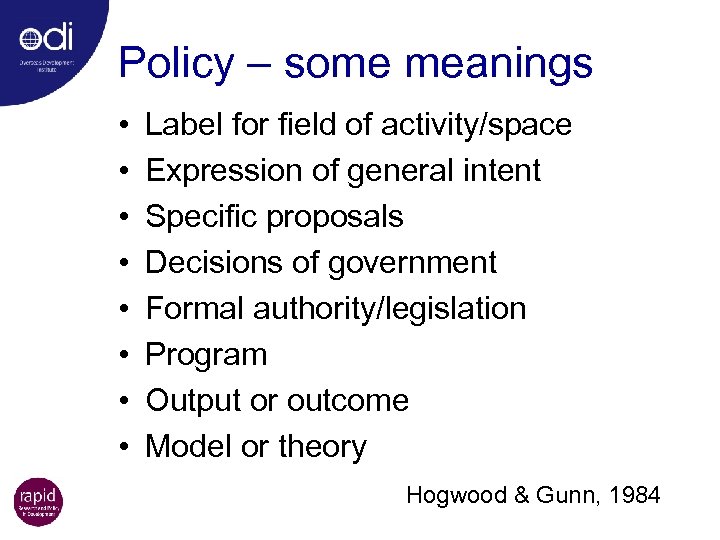 Policy – some meanings • • Label for field of activity/space Expression of general intent Specific proposals Decisions of government Formal authority/legislation Program Output or outcome Model or theory Hogwood & Gunn, 1984
 According to Peter John ‘the interplay between institutions, interests and ideas. ’ John P (1998) Analysing Public Policy. London: Cassell.
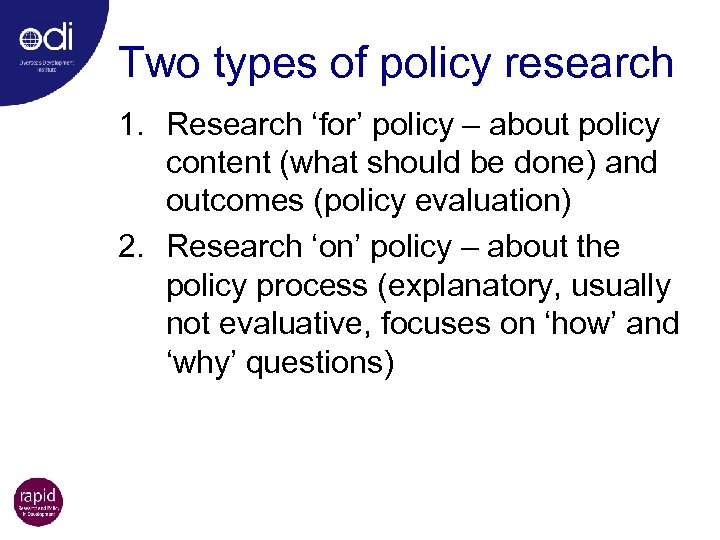 Two types of policy research 1. Research ‘for’ policy – about policy content (what should be done) and outcomes (policy evaluation) 2. Research ‘on’ policy – about the policy process (explanatory, usually not evaluative, focuses on ‘how’ and ‘why’ questions)
 Research ‘on’ policy ‘Research on policy seeks to understand how the machinery of the state and political actors interact to produce public actions. . The main tasks … are to explain how policy-making works and to explore the variety and complexity of the decision-making processes. ’ (John, 1998, p 1)
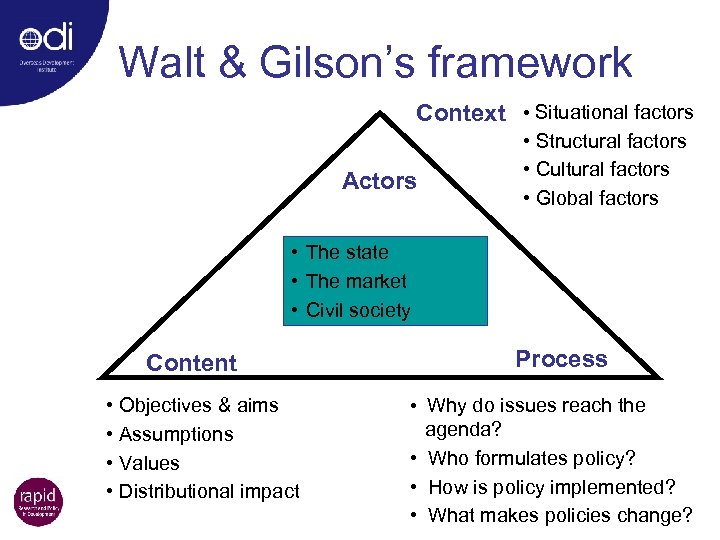 Walt & Gilson’s framework Context • Situational factors Actors • Structural factors • Cultural factors • Global factors • The state • The market • Civil society Content • Objectives & aims • Assumptions • Values • Distributional impact Process • Why do issues reach the agenda? • Who formulates policy? • How is policy implemented? • What makes policies change?
 Political Situation Analysis Systematically gather political intelligence associated with any policy reform on: • Content – the what of policy • Context – the social, cultural, temporal environment in which decisions taken • Process – how decisions are made – the rules of the game – how we do business • Actors – those who affect and are affected by decisions
 Bangladesh Case Study Unanticipated opposition to ‘no-brainer’ reform • • Learn lessons from poor performance to inform 2005 -2010 strategy Proposed Policy – Integration of two wings of ministry responsible for family planning & health services – Substantial body of research supported integration: cost-effectiveness, management, service delivery – Agreed by key health officials and subject of donor conditionality • Context: – Political volatility and partisan confrontation – Limited government ownership of health policy • Superficial analysis identified two loosing groups but did not anticipate opposition – no plan to – Alter costs by offering to change elements of policy – Modify perceptions of costs – Compensate losers • • Partial implementation reversed after affected FP managers mobilized many groups Donors – Confronted deep-rooted interests involved in distributing rents – Strategy relied on ‘sensitizing’ opponents of evidence-based virtues, failed to mobilize potential allies or shift dialogue to new forum, and took ‘non-negotiable’ stance – Suspended disbursements for a few months and then backed down
 Health Policy Reform History • ‘Conventional’ evidence ‘for’ policy necessary but insufficient for change – Policy failure – Losses fall on organized & powerful groups – Gains distributed among marginalize • Analysis of political-economy dimensions of change important determinant of success • Requires more systematic approaches to understanding political dimensions & influencing change
 Policy content Substance which details its constituent parts: • Aims and strategies of the policy • Empirical basis of the policy (evidence) • Underlying values and paradigms • Technical content (evidence informed) • Administrative feasibility of the policy
 Policy Consequences Distribution of benefits and costs in terms of: • Stakeholders • Scale • Characteristics • Intensity • Timing, etc
 Actors/Stakeholders • Individuals or groups with interest in the issue – Some role in making or implementing decision – Affected by policy decision – Specific to each policy reform and context • Stakeholder analysis – Identify stakeholder groups – Looking for independent groups/individuals with some influence or potential influence – Break down categories as far as feasible
 Bangladesh Integration Example: • • • • Ministry of Finance Planning Commission Prime Minister of Health Secretary of Min of Health Deputy Secretary Ministry of Health reformers in Ministry Cadre of Family Planning Officials Medical Association Donors Press Academics Select service delivery NGOs
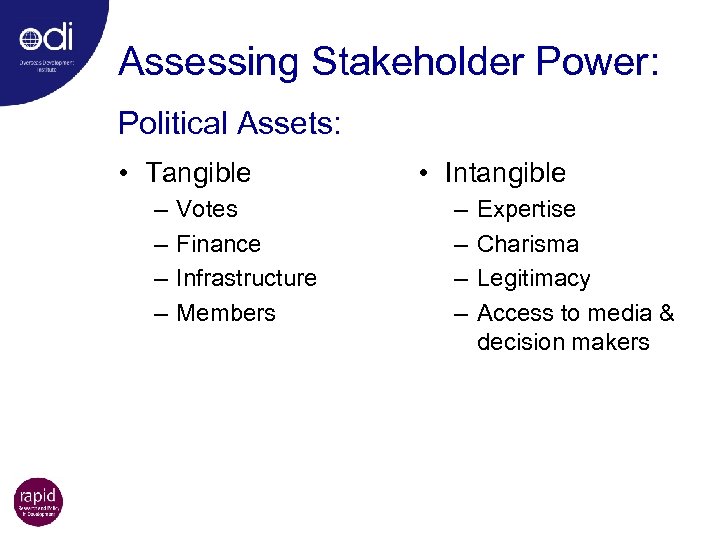 Assessing Stakeholder Power: Political Assets: • Tangible – – Votes Finance Infrastructure Members • Intangible – – Expertise Charisma Legitimacy Access to media & decision makers
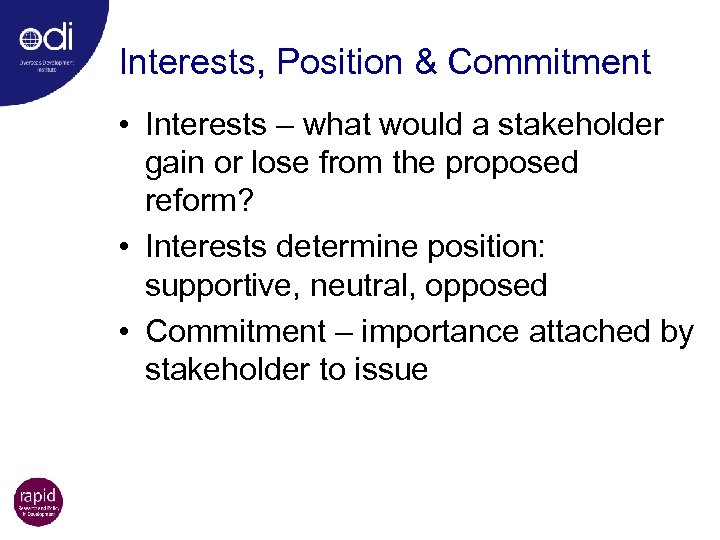 Interests, Position & Commitment • Interests – what would a stakeholder gain or lose from the proposed reform? • Interests determine position: supportive, neutral, opposed • Commitment – importance attached by stakeholder to issue
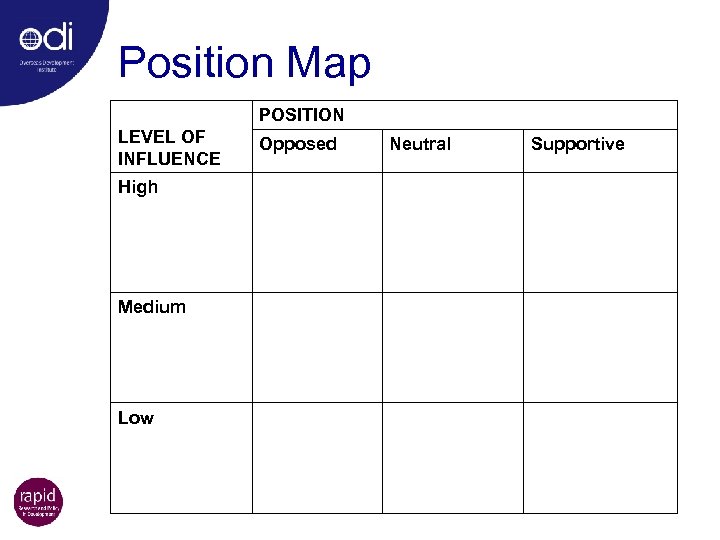 Position Map POSITION LEVEL OF INFLUENCE High Medium Low Opposed Neutral Supportive
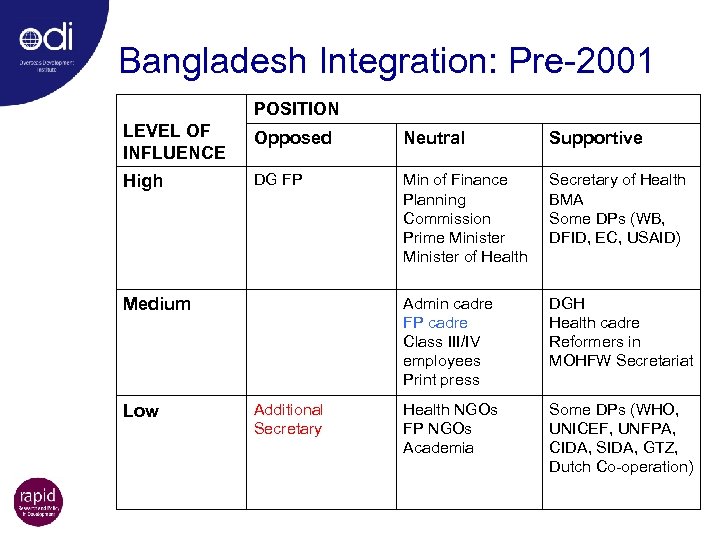 Bangladesh Integration: Pre-2001 POSITION LEVEL OF INFLUENCE Opposed Neutral Supportive High DG FP Min of Finance Planning Commission Prime Minister of Health Secretary of Health BMA Some DPs (WB, DFID, EC, USAID) Admin cadre FP cadre Class III/IV employees Print press DGH Health cadre Reformers in MOHFW Secretariat Health NGOs FP NGOs Academia Some DPs (WHO, UNICEF, UNFPA, CIDA, SIDA, GTZ, Dutch Co-operation) Medium Low Additional Secretary
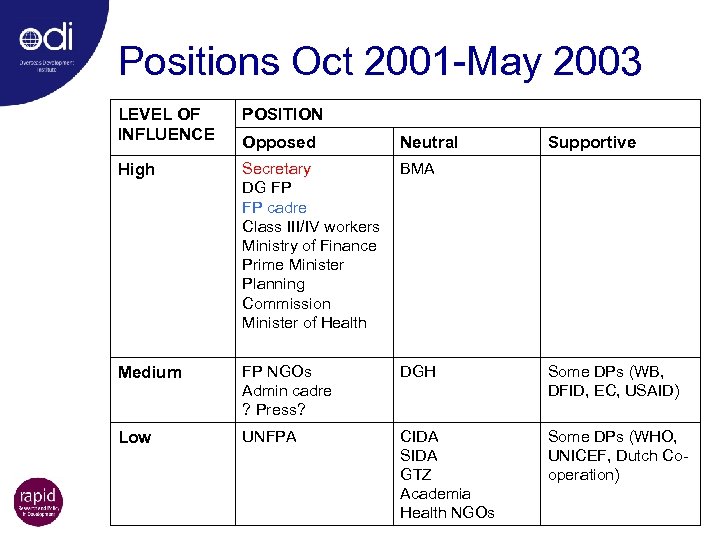 Positions Oct 2001 -May 2003 LEVEL OF INFLUENCE POSITION Opposed Neutral High Secretary DG FP FP cadre Class III/IV workers Ministry of Finance Prime Minister Planning Commission Minister of Health BMA Medium FP NGOs Admin cadre ? Press? DGH Some DPs (WB, DFID, EC, USAID) Low UNFPA CIDA SIDA GTZ Academia Health NGOs Some DPs (WHO, UNICEF, Dutch Cooperation) Supportive
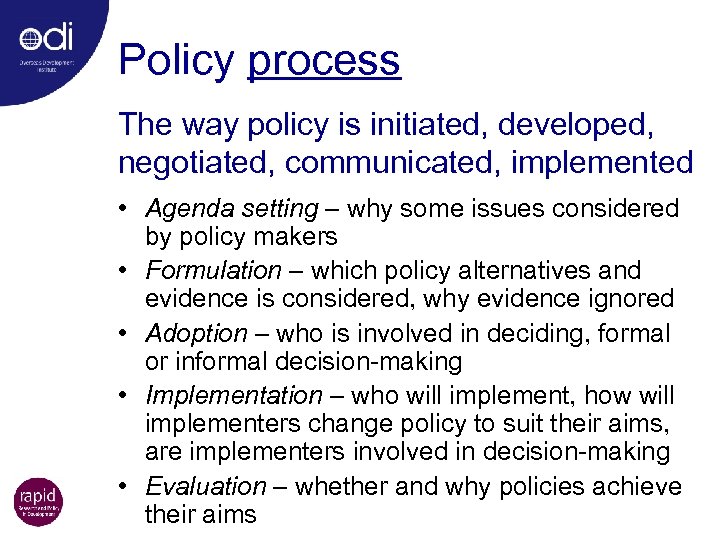 Policy process The way policy is initiated, developed, negotiated, communicated, implemented • Agenda setting – why some issues considered by policy makers • Formulation – which policy alternatives and evidence is considered, why evidence ignored • Adoption – who is involved in deciding, formal or informal decision-making • Implementation – who will implement, how will implementers change policy to suit their aims, are implementers involved in decision-making • Evaluation – whether and why policies achieve their aims
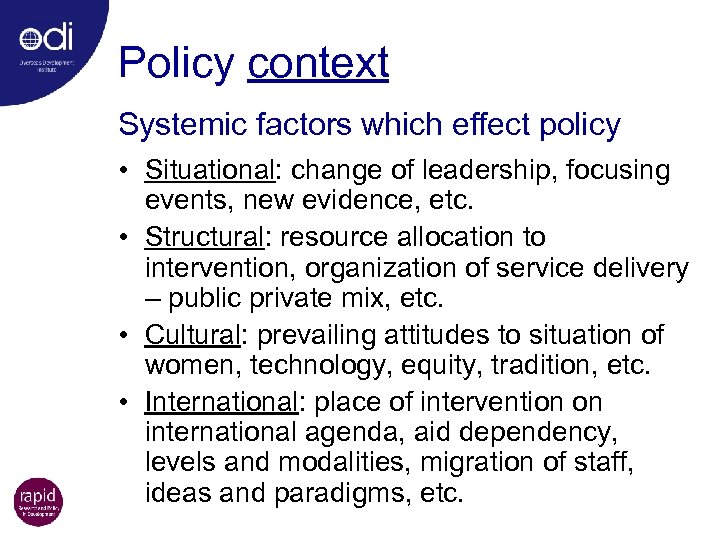 Policy context Systemic factors which effect policy • Situational: change of leadership, focusing events, new evidence, etc. • Structural: resource allocation to intervention, organization of service delivery – public private mix, etc. • Cultural: prevailing attitudes to situation of women, technology, equity, tradition, etc. • International: place of intervention on international agenda, aid dependency, levels and modalities, migration of staff, ideas and paradigms, etc.
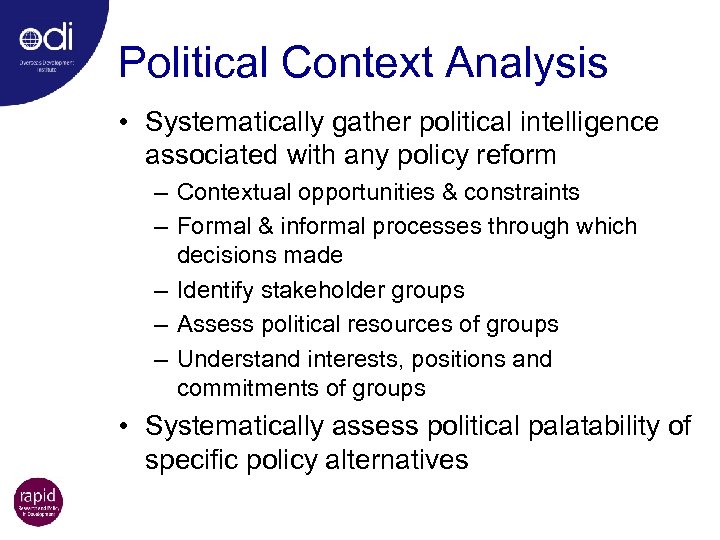 Political Context Analysis • Systematically gather political intelligence associated with any policy reform – Contextual opportunities & constraints – Formal & informal processes through which decisions made – Identify stakeholder groups – Assess political resources of groups – Understand interests, positions and commitments of groups • Systematically assess political palatability of specific policy alternatives
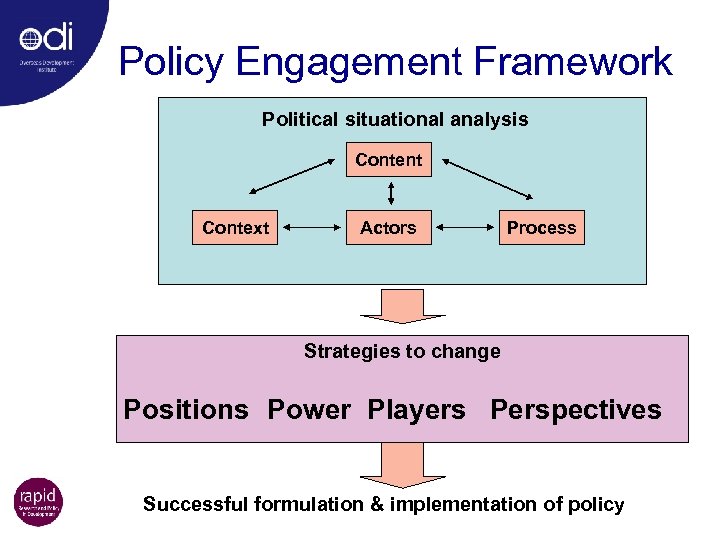 Policy Engagement Framework Political situational analysis Content Context Actors Process Strategies to change Context Positions Power Players Perspectives Successful formulation & implementation of policy
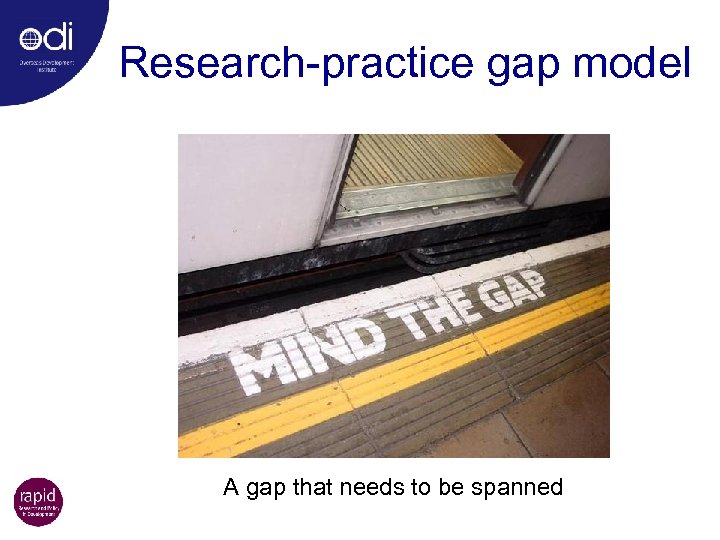 Research-practice gap model A gap that needs to be spanned
 The two communities model Researchers & policy makers: separate communities?
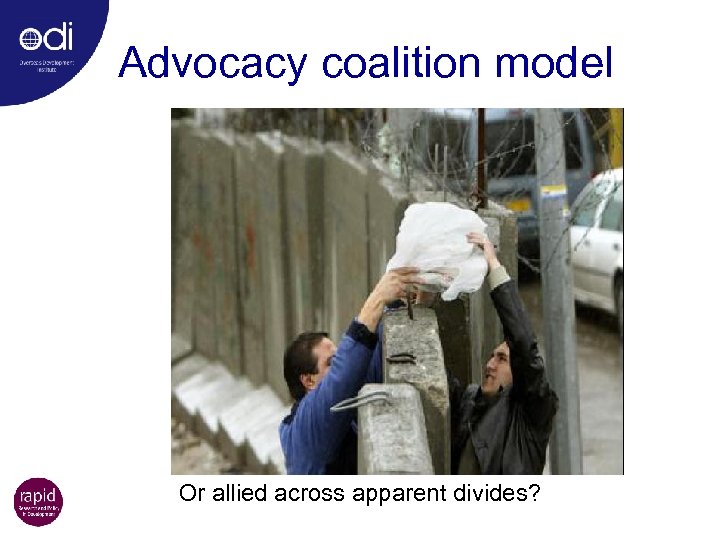 Advocacy coalition model Or allied across apparent divides?
 Strategies for Policy Engagement Develop political strategies to change • Position: deals to make to change – alter policy, horse trading, promises, threats • Power: provide supporters with funds, personnel, access to media & officials • Players: change number of actors by mobilizing and demobilising, venue shifting • Perceptions: use data and arguments to question to alter perspectives of problem/solution, use associations, invoke symbols, emphasise doability
 Policy Process Mapping
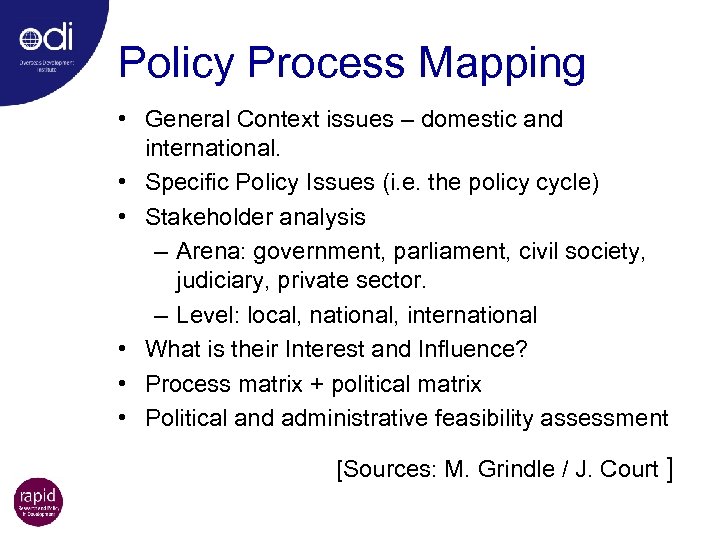 Policy Process Mapping • General Context issues – domestic and international. • Specific Policy Issues (i. e. the policy cycle) • Stakeholder analysis – Arena: government, parliament, civil society, judiciary, private sector. – Level: local, national, international • What is their Interest and Influence? • Process matrix + political matrix • Political and administrative feasibility assessment [Sources: M. Grindle / J. Court ]
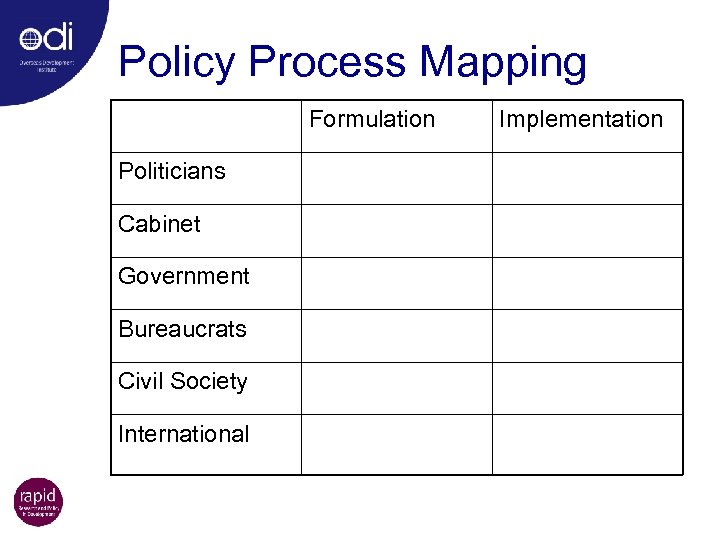 Policy Process Mapping Formulation Politicians Cabinet Government Bureaucrats Civil Society International Implementation
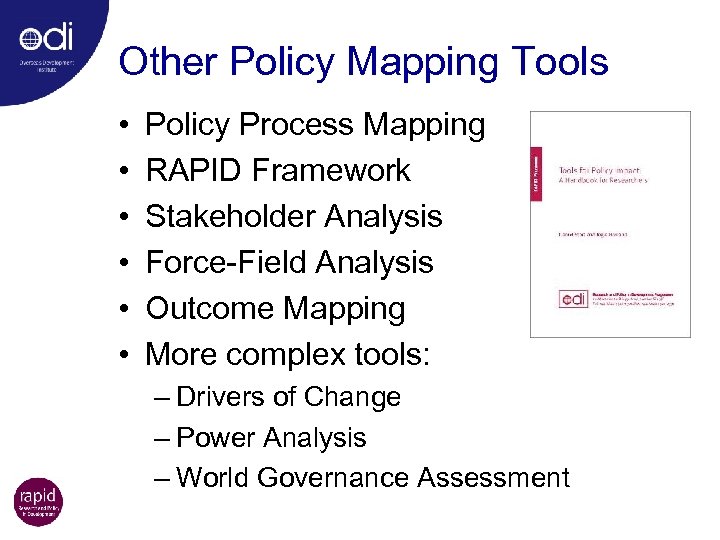 Other Policy Mapping Tools • • • Policy Process Mapping RAPID Framework Stakeholder Analysis Force-Field Analysis Outcome Mapping More complex tools: – Drivers of Change – Power Analysis – World Governance Assessment
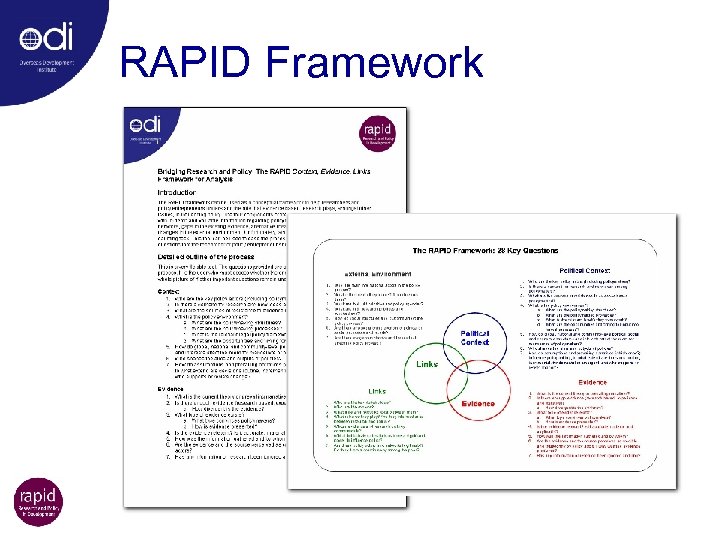 RAPID Framework
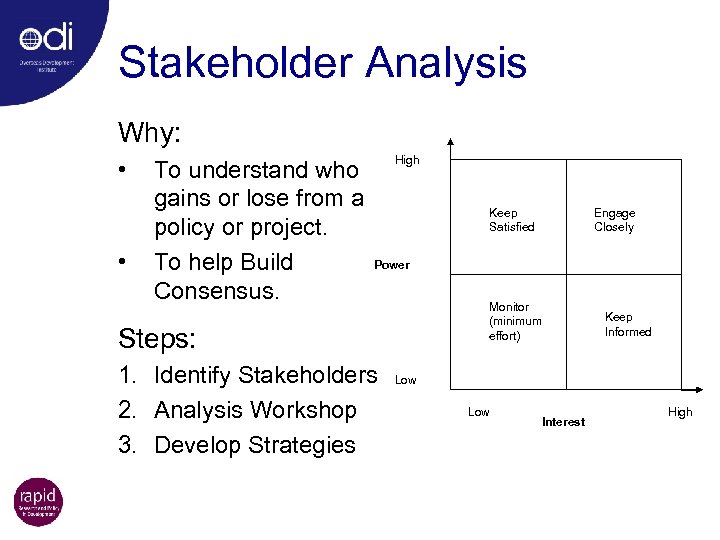 Stakeholder Analysis Why: • • To understand who gains or lose from a policy or project. To help Build Consensus. High Keep Satisfied Engage Closely Power Monitor (minimum effort) Steps: 1. Identify Stakeholders 2. Analysis Workshop 3. Develop Strategies Keep Informed Low Interest High
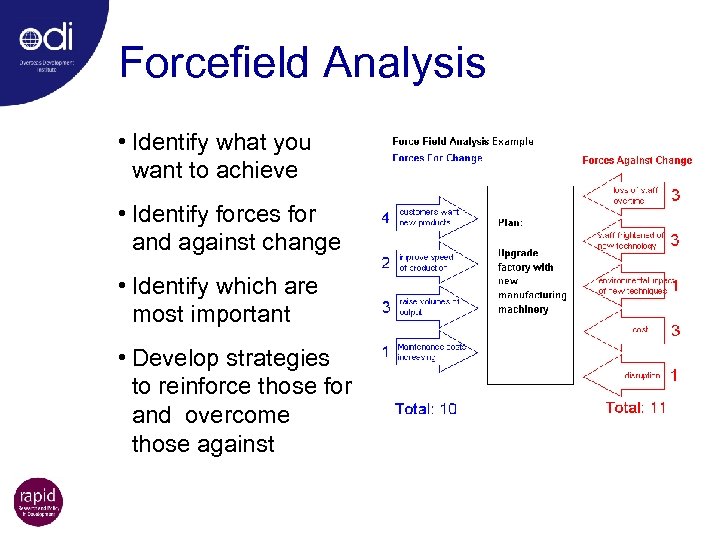 Forcefield Analysis • Identify what you want to achieve • Identify forces for and against change • Identify which are most important • Develop strategies to reinforce those for and overcome those against
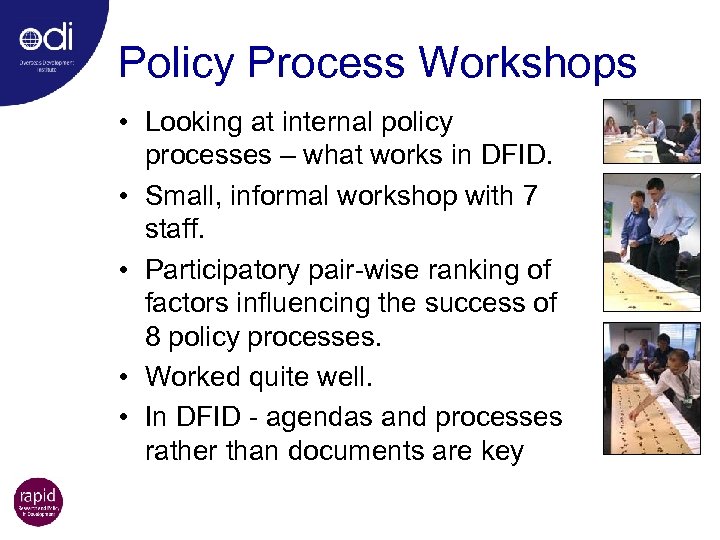 Policy Process Workshops • Looking at internal policy processes – what works in DFID. • Small, informal workshop with 7 staff. • Participatory pair-wise ranking of factors influencing the success of 8 policy processes. • Worked quite well. • In DFID - agendas and processes rather than documents are key
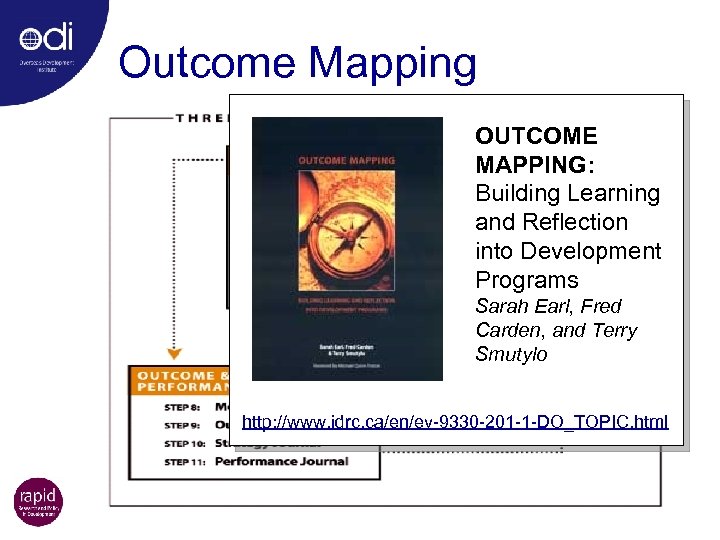 Outcome Mapping OUTCOME MAPPING: Building Learning and Reflection into Development Programs Sarah Earl, Fred Carden, and Terry Smutylo http: //www. idrc. ca/en/ev-9330 -201 -1 -DO_TOPIC. html
 More Complex Tools • Civil Society Index (CIVICUS) • Country Policy & Institutional Assessment (World Bank) • Democracy and Governance Assessment (USAID) • Drivers of Change (DFID) • Governance Questionnaire (GTZ) • Governance Matters (World Bank Institute) • Power Analysis (Sida) • World Governance Assessment
 Summary – – – Evidence-informed policy challenging Policy about interests, institutions & ideas Variety of tools to understand these factors range in sophistication/complexity and ease of use Tools to use the understanding to engage in policy processes – less well developed Extent to which the tools are helpful depends on creativity, tenacity, inside knowledge – advocacy coalitions useful You can get more info at …
 Further Information Mapping Political Contexts: http: //www. odi. org. uk/RAPID/Publications/Tools_Political_Context. html Tools for Policy Impact: http: //www. odi. org. uk/RAPID/Publications/Tools_Policy_Impact. html Best Practice in Policy Making: http: //www. policyhub. gov. uk/policy_tools/ Understanding Policy Process: