


 Скачать презентацию TOOLS AND METHODS FOR ASSESSING THE EFFICIENCY OF
e929aa5a9d4da42e170c5e28efddd49e.ppt
- Количество слайдов: 11
 TOOLS AND METHODS FOR ASSESSING THE EFFICIENCY OF AID INTERVENTIONS Markus Palenberg DAC Network on Development Evaluation Meeting, Paris, June 24, 2011 Study commissioned by the BMZ (German Federal Ministry for Economic Cooperation and Development) Institute for Development Strategy www. devstrat. org
 OVERVIEW Motivation Approach Results Why this study? How was the study conducted? What are the main study findings?
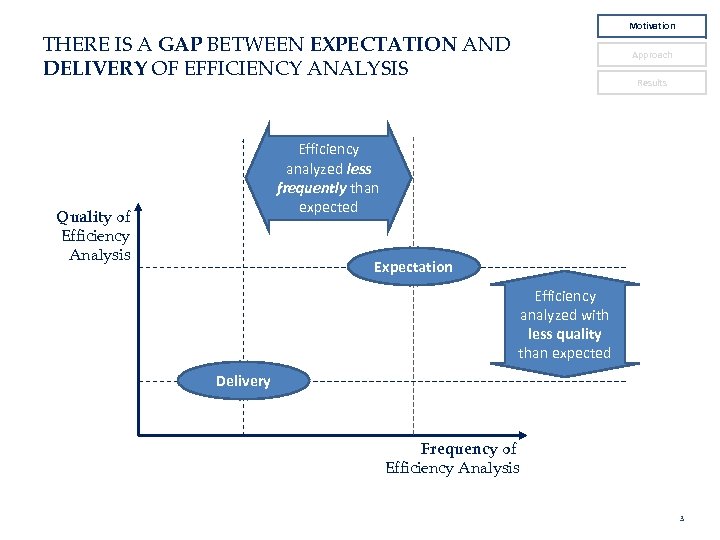 Motivation THERE IS A GAP BETWEEN EXPECTATION AND DELIVERY OF EFFICIENCY ANALYSIS Approach Results Efficiency analyzed less frequently than expected Quality of Efficiency Analysis Expectation Efficiency analyzed with less quality than expected Delivery Frequency of Efficiency Analysis 3
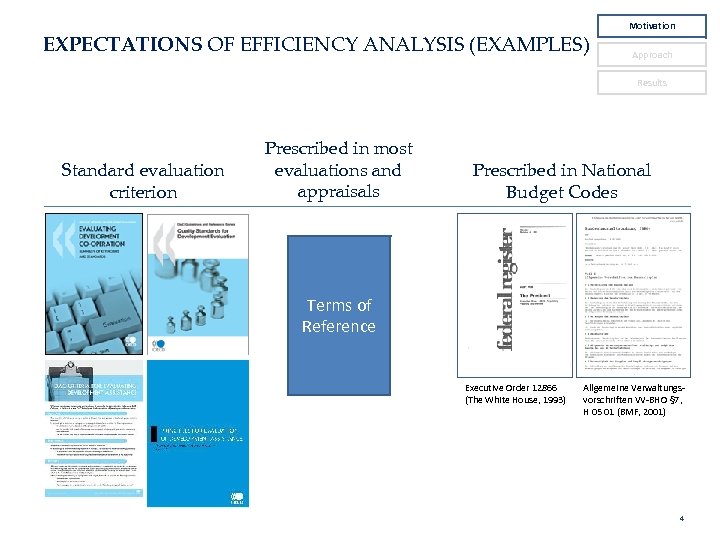 EXPECTATIONS OF EFFICIENCY ANALYSIS (EXAMPLES) Motivation Approach Results Standard evaluation criterion Prescribed in most evaluations and appraisals Prescribed in National Budget Codes Terms of Reference Executive Order 12866 (The White House, 1993) Allgemeine Verwaltungsvorschriften VV-BHO § 7, H 05 01 (BMF, 2001) 4
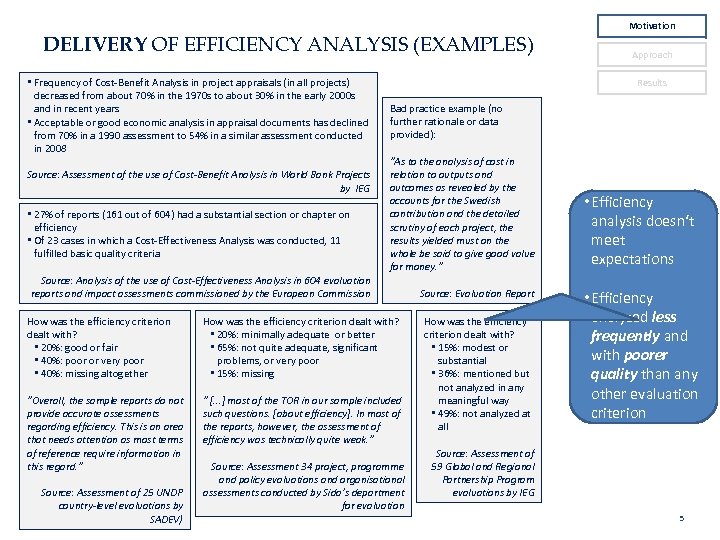 DELIVERY OF EFFICIENCY ANALYSIS (EXAMPLES) • Frequency of Cost-Benefit Analysis in project appraisals (in all projects) decreased from about 70% in the 1970 s to about 30% in the early 2000 s and in recent years • Acceptable or good economic analysis in appraisal documents has declined from 70% in a 1990 assessment to 54% in a similar assessment conducted in 2008 Source: Assessment of the use of Cost-Benefit Analysis in World Bank Projects by IEG • 27% of reports (161 out of 604) had a substantial section or chapter on efficiency • Of 23 cases in which a Cost-Effectiveness Analysis was conducted, 11 fulfilled basic quality criteria Approach Results Bad practice example (no further rationale or data provided): “As to the analysis of cost in relation to outputs and outcomes as revealed by the accounts for the Swedish contribution and the detailed scrutiny of each project, the results yielded must on the whole be said to give good value for money. ” Source: Analysis of the use of Cost-Effectiveness Analysis in 604 evaluation reports and impact assessments commissioned by the European Commission How was the efficiency criterion dealt with? • 20%: good or fair • 40%: poor or very poor • 40%: missing altogether How was the efficiency criterion dealt with? • 20%: minimally adequate or better • 65%: not quite adequate, significant problems, or very poor • 15%: missing “Overall, the sample reports do not provide accurate assessments regarding efficiency. This is an area that needs attention as most terms of reference require information in this regard. ” “ [. . . ] most of the TOR in our sample included such questions. [about efficiency]. In most of the reports, however, the assessment of efficiency was technically quite weak. ” Source: Assessment of 25 UNDP country-level evaluations by SADEV) Motivation Source: Assessment 34 project, programme and policy evaluations and organisational assessments conducted by Sida’s department for evaluation Source: Evaluation Report How was the efficiency criterion dealt with? • 15%: modest or substantial • 36%: mentioned but not analyzed in any meaningful way • 49%: not analyzed at all • Efficiency analysis doesn‘t meet expectations • Efficiency analyzed less frequently and with poorer quality than any other evaluation criterion Source: Assessment of 59 Global and Regional Partnership Program evaluations by IEG 5
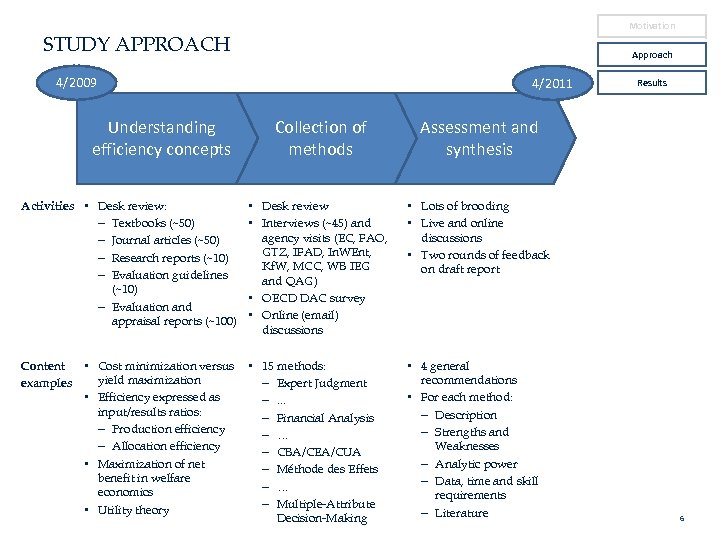 Motivation STUDY APPROACH Approach 4/2009 Understanding efficiency concepts 4/2011 Collection of methods Assessment and synthesis Activities • Desk review: - Textbooks (~50) - Journal articles (~50) - Research reports (~10) - Evaluation guidelines (~10) - Evaluation and appraisal reports (~100) • Desk review • Interviews (~45) and agency visits (EC, FAO, GTZ, IFAD, In. WEnt, Kf. W, MCC, WB IEG and QAG) • OECD DAC survey • Online (email) discussions • Lots of brooding • Live and online discussions • Two rounds of feedback on draft report Content • Cost minimization versus yield maximization examples • Efficiency expressed as input/results ratios: - Production efficiency - Allocation efficiency • Maximization of net benefit in welfare economics • Utility theory • 15 methods: - Expert Judgment -. . . - Financial Analysis - … - CBA/CEA/CUA - Méthode des Effets - … - Multiple-Attribute Decision-Making • 4 general recommendations • For each method: - Description - Strengths and Weaknesses - Analytic power - Data, time and skill requirements - Literature Results 6
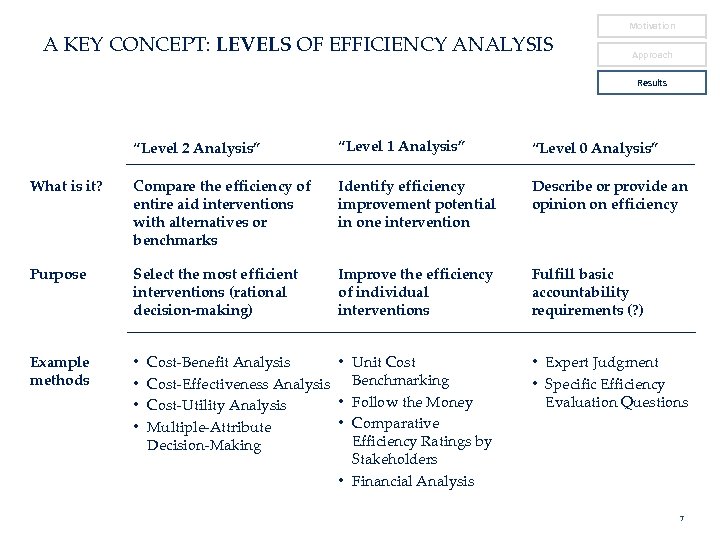 A KEY CONCEPT: LEVELS OF EFFICIENCY ANALYSIS Motivation Approach Results “Level 2 Analysis” “Level 1 Analysis” “Level 0 Analysis” What is it? Compare the efficiency of entire aid interventions with alternatives or benchmarks Identify efficiency improvement potential in one intervention Describe or provide an opinion on efficiency Purpose Select the most efficient interventions (rational decision-making) Improve the efficiency of individual interventions Fulfill basic accountability requirements (? ) Example methods • • Cost-Benefit Analysis • Unit Cost-Effectiveness Analysis Benchmarking • Follow the Money Cost-Utility Analysis • Comparative Multiple-Attribute Efficiency Ratings by Decision-Making Stakeholders • Financial Analysis • Expert Judgment • Specific Efficiency Evaluation Questions 7
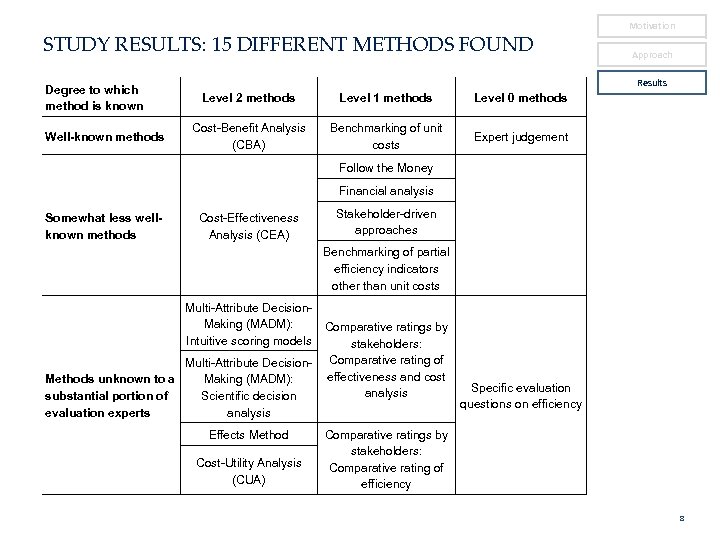 STUDY RESULTS: 15 DIFFERENT METHODS FOUND Degree to which method is known Well-known methods Motivation Approach Results Level 2 methods Level 1 methods Level 0 methods Cost-Benefit Analysis (CBA) Benchmarking of unit costs Expert judgement Follow the Money Financial analysis Somewhat less wellknown methods Cost-Effectiveness Analysis (CEA) Stakeholder-driven approaches Benchmarking of partial efficiency indicators other than unit costs Multi-Attribute Decision. Making (MADM): Intuitive scoring models Multi-Attribute Decision. Methods unknown to a Making (MADM): substantial portion of Scientific decision evaluation experts analysis Effects Method Cost-Utility Analysis (CUA) Comparative ratings by stakeholders: Comparative rating of effectiveness and cost analysis Specific evaluation questions on efficiency Comparative ratings by stakeholders: Comparative rating of efficiency 8
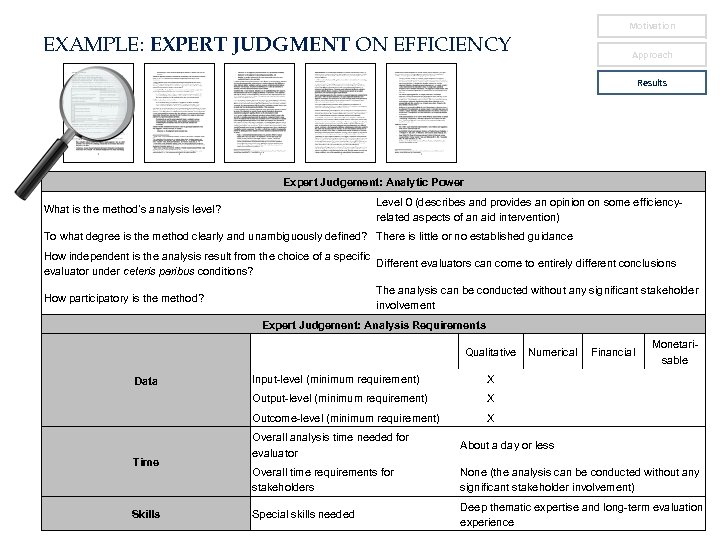 Motivation EXAMPLE: EXPERT JUDGMENT ON EFFICIENCY Approach Results Expert Judgement: Analytic Power Level 0 (describes and provides an opinion on some efficiencyrelated aspects of an aid intervention) What is the method’s analysis level? To what degree is the method clearly and unambiguously defined? There is little or no established guidance How independent is the analysis result from the choice of a specific Different evaluators can come to entirely different conclusions evaluator under ceteris paribus conditions? The analysis can be conducted without any significant stakeholder involvement How participatory is the method? Expert Judgement: Analysis Requirements Qualitative Skills Financial Monetarisable X X Outcome-level (minimum requirement) Time Input-level (minimum requirement) Output-level (minimum requirement) Data Numerical X Overall analysis time needed for evaluator About a day or less Overall time requirements for stakeholders None (the analysis can be conducted without any significant stakeholder involvement) Special skills needed Deep thematic expertise and long-term evaluation experience
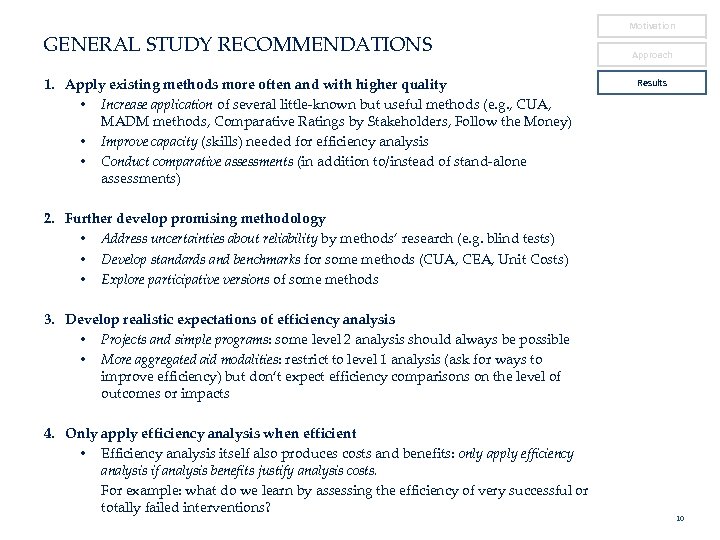 GENERAL STUDY RECOMMENDATIONS 1. Apply existing methods more often and with higher quality • Increase application of several little-known but useful methods (e. g. , CUA, MADM methods, Comparative Ratings by Stakeholders, Follow the Money) • Improve capacity (skills) needed for efficiency analysis • Conduct comparative assessments (in addition to/instead of stand-alone assessments) Motivation Approach Results 2. Further develop promising methodology • Address uncertainties about reliability by methods’ research (e. g. blind tests) • Develop standards and benchmarks for some methods (CUA, CEA, Unit Costs) • Explore participative versions of some methods 3. Develop realistic expectations of efficiency analysis • Projects and simple programs: some level 2 analysis should always be possible • More aggregated aid modalities: restrict to level 1 analysis (ask for ways to improve efficiency) but don‘t expect efficiency comparisons on the level of outcomes or impacts 4. Only apply efficiency analysis when efficient • Efficiency analysis itself also produces costs and benefits: only apply efficiency analysis if analysis benefits justify analysis costs. For example: what do we learn by assessing the efficiency of very successful or totally failed interventions? 10
 Thank you for your interest! Easy-to-remember link to the report: www. aidefficiency. org Contact: markus@devstrat. org (Markus, If. DS) Michaela. Zintl@bmz. bund. de (Michaela, BMZ) 11