


 Скачать презентацию Tomsk Polytechnic University International Management Institute Project Management
b2a678d2e85251e21403df20cb2b7a17.ppt
- Количество слайдов: 102
 Tomsk Polytechnic University International Management Institute Project Management Prof. Dr. -Eng. А. А. Dulzon
 Project cost planning and control Content of the Module 6 • 6. 1 Introduction • 6. 2 Project cost planning and control systems – – Cost planning and control as a concept Types of control system Costs and allowances Life cycle costs • 6. 3 The project cost control system – – The PCCS planning cycle The PCCS operating cycle
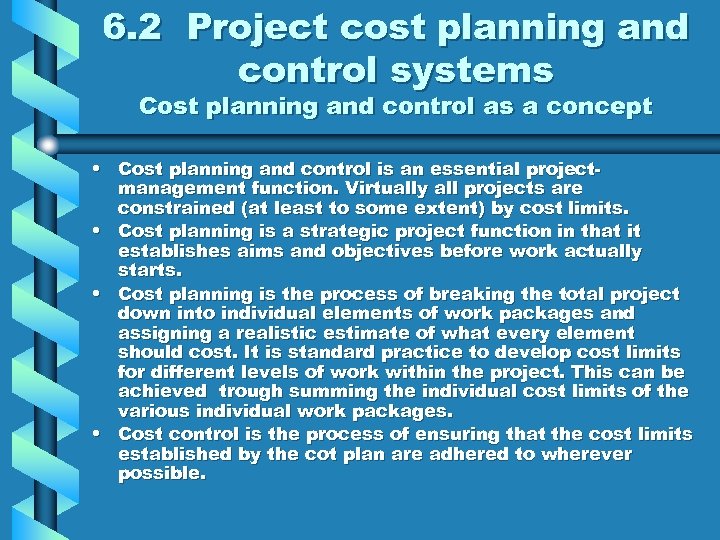 6. 2 Project cost planning and control systems Cost planning and control as a concept • Cost planning and control is an essential projectmanagement function. Virtually all projects are constrained (at least to some extent) by cost limits. • Cost planning is a strategic project function in that it establishes aims and objectives before work actually starts. • Cost planning is the process of breaking the total project down into individual elements of work packages and assigning a realistic estimate of what every element should cost. It is standard practice to develop cost limits for different levels of work within the project. This can be achieved trough summing the individual cost limits of the various individual work packages. • Cost control is the process of ensuring that the cost limits established by the cot plan are adhered to wherever possible.
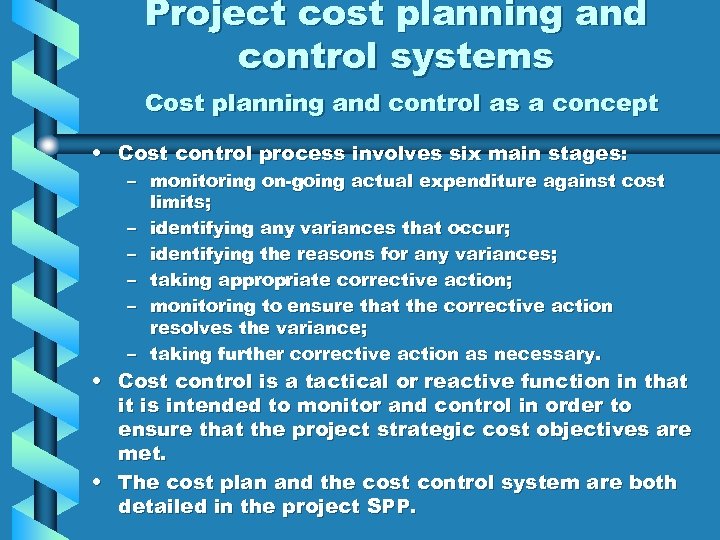 Project cost planning and control systems Cost planning and control as a concept • Cost control process involves six main stages: – monitoring on-going actual expenditure against cost limits; – identifying any variances that occur; – identifying the reasons for any variances; – taking appropriate corrective action; – monitoring to ensure that the corrective action resolves the variance; – taking further corrective action as necessary. • Cost control is a tactical or reactive function in that it is intended to monitor and control in order to ensure that the project strategic cost objectives are met. • The cost plan and the cost control system are both detailed in the project SPP.
 Project cost planning and control systems Cost planning and control as a concept • The time and cost planning process are intrinsically linked and use the same basic work-package elements as derived in the initial development of the project’s work breakdown structure (WBS). • Cost performance depends on schedule and quality performance. A particular element or package might be over cost, but this may not be a problem if that same element is ahead of schedule. • A cumulative expenditure profile can be plotted against actual expenditure profile at different levels through the WBS. This allows cost monitoring and control at top, intermediate and lower levels within the project. • The appropriate project management response to cost variances depends on the nature of the project. Identifying the “best response” under any given set of circumstances is a key project management skill.
 Project cost planning and control systems Cost planning and control as a concept • There will be some cost variances in all projects. Usually there is little justification for spending a lot of time investigating small cost variances. • The project manager has to be able to review a table of cost variances and identify which ones are indicators of more serious underlying problems. • It is not generally feasible for the project manager to monitor all element or package costs on a daily basis. The project manager has to ensure that the frequency of the reporting system is sufficient to allow adequate response before a variance can become critical. • Effective cost planning and control depends on a range of associated management functions. Cost control is an art rather than a science. The main complicating factor is time lag. There is always a time lag between a piece of work being done and payment actually being made.
 Project cost planning and control systems Cost planning and control as a concept • General requirements of a cost control system. – – – The project schedule must be accurate. The estimating system must be reliable. The scope of the project must be clear. The budgets must be realistic. The authorization system must be clear. The usual system is to designate one or two people who are authorized signatories. This process is generally controlled as part of the project configuration management system (CMS). In most cases, the control system will allow different levels of authorization depending on the cost of the proposed change. This kind of approvals system is sometimes referred to as an approvals filter.
 Project cost planning and control systems Cost planning and control as a concept – The system must be flexible and responsive. The cost control system has to be designed in such a way that it can provide output data in relation to changing requirements. The most common form of change on most projects takes place through variation orders or change notices. As each change notice is authorized by the approved person, the estimated cost of the appropriate work package, and the project as a whole, have to be updated accordingly. – There must be a reliable approach to cost tracking and variance analysis. The accuracy of the output will be a function of the frequency at which analysis takes place. Computerized database estimating systems (CDES) are increasingly used for cost planning and control
 Project cost planning and control systems Cost planning and control as a concept – The variance detection sensitivity envelope must be time dependent. In most cases, the degree of acceptable cost variance should diminish as the project continues. It is relatively common for cost variances to occur early in the execution of an element or work package. There should be little cost variances towards the later stages. – There should be a flexible approach to the use of reserves and contingencies. Even on the most carefully planned projects it is usual to find a contingency reserve of around 5% of the contract value. Provisional items (works that cannot be accurately measured) amounting to 10% or more of the contract value ate not unusual.
 Project cost planning and control systems Types of control system • There are three primary types of control system: – cybernetic; – analogue; – feedback. • Cybernetic control processes operate at different levels: – – – low-level cybernetic control system; mid-level cybernetic control system; high-level cybernetic control system; • The main differences between lower- and higher-order systems are: – the range of information that can be used in the system memory; – The extent to which this data can be used to influence the decision; – the extent to which two-way connections between the elements can be developed.
 Types of control system Cybernetic control systems • Low-level cybernetic control systems are widely used in range of applications such as in instrumental controls and in animals physiological responses. They are simple and can function automatically. They can be left to operate unattended with no real monitoring provided they are calibrated correctly and are subject to the required degree of checking and maintenance. • In the mid-level cybernetic control systems the preset system values interact with the environment and modify themselves as the environment changes. It is a learning system. Most mechanical systems require a micro-computer or advanced processor to carry out the level of analysis that is required for a mid-level cybernetic control system.
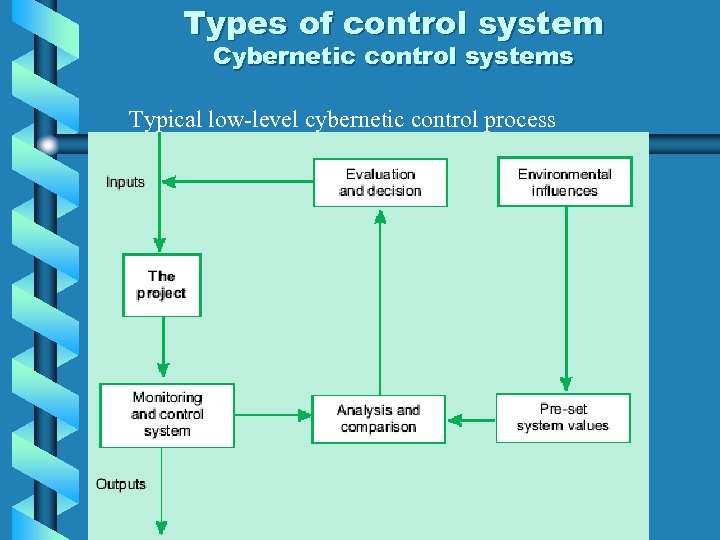 Types of control system Cybernetic control systems Typical low-level cybernetic control process
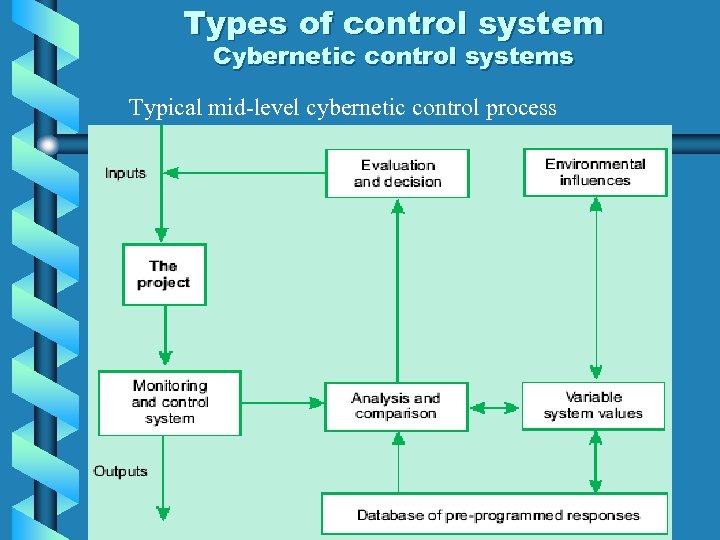 Types of control system Cybernetic control systems Typical mid-level cybernetic control process
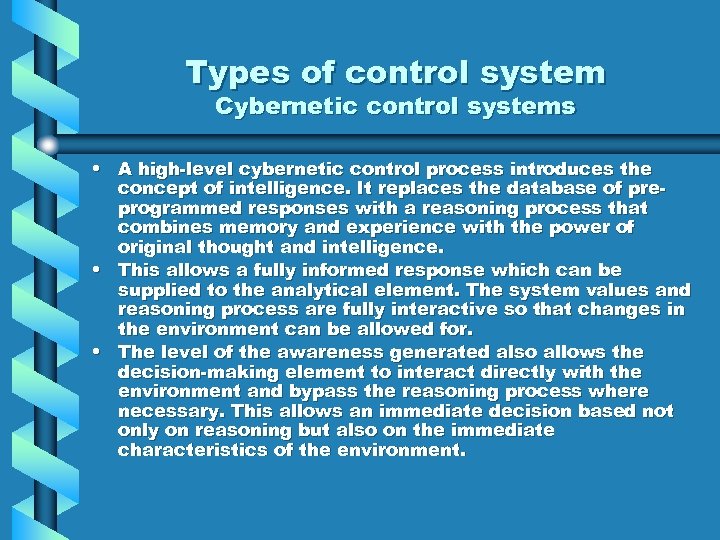 Types of control system Cybernetic control systems • A high-level cybernetic control process introduces the concept of intelligence. It replaces the database of preprogrammed responses with a reasoning process that combines memory and experience with the power of original thought and intelligence. • This allows a fully informed response which can be supplied to the analytical element. The system values and reasoning process are fully interactive so that changes in the environment can be allowed for. • The level of the awareness generated also allows the decision-making element to interact directly with the environment and bypass the reasoning process where necessary. This allows an immediate decision based not only on reasoning but also on the immediate characteristics of the environment.
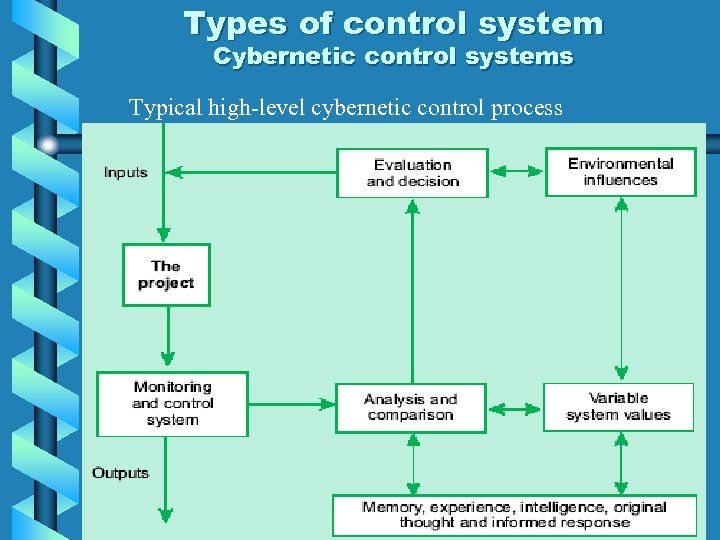 Types of control system Cybernetic control systems Typical high-level cybernetic control process
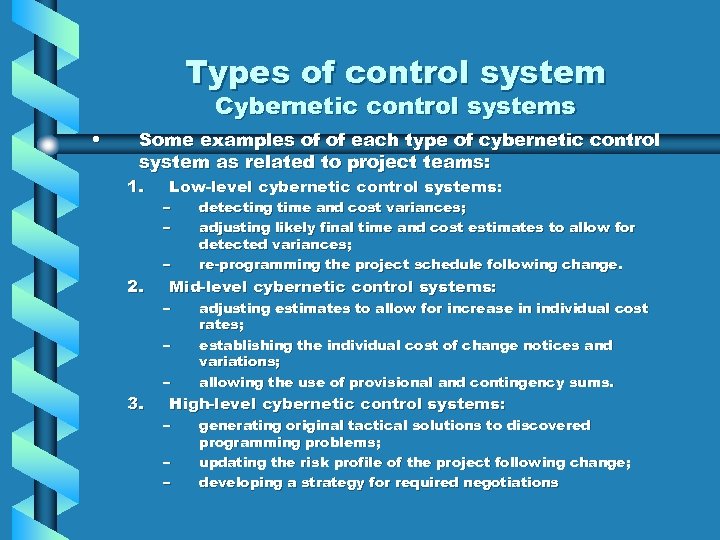 Types of control system Cybernetic control systems • Some examples of of each type of cybernetic control system as related to project teams: 1. 2. Low-level cybernetic control systems: – – – Mid-level cybernetic control systems: – – 3. detecting time and cost variances; adjusting likely final time and cost estimates to allow for detected variances; re-programming the project schedule following change. – adjusting estimates to allow for increase in individual cost rates; establishing the individual cost of change notices and variations; allowing the use of provisional and contingency sums. High-level cybernetic control systems: – – – generating original tactical solutions to discovered programming problems; updating the risk profile of the project following change; developing a strategy for required negotiations
 Types of control system Analogue control systems • While a high-level cybernetic control system is appropriate for tracking and controlling overall project performance, or at least performance of large work packages, an analogue system can be used on almost every aspect of a project. • An analogue system comprises a series of simple “yes or no” questions. Depending on the answer, the system directs the process to another “yes or no” question. The approach may appear to be over-simplified, and yet the approach forms the basis for most reasoning processes. • The human reasoning process tends to operate by a process of elimination. When faced with a complex problem, the natural human reaction is to: – eliminate those solutions that are not feasible; – take the remained solutions and break them into smaller and sections; – take the feasible solutions and break them into smaller and smaller subsections; – Tackle each subsection separately.
 Types of control system • In practice, most projects incorporate some form of analogue control system in the form of gateways. • Cybernetic controls are designed to automatic and will operate as often as they designed to, whereas an analogue control system will only operate when and if the people use them. • Cybernetic and analogue controls are directed towards accomplishing the goals of an ongoing project. Feedback controls are applied after the project has finished, so as to improve the chances for future projects to meet their objectives. • Feedback control takes an evaluation of performance on an existing project and uses this as a form of learning to try to improve control procedures for future projects.
 Cost and allowances • In preparing overall project budgets and estimates, it is necessary to consider the different types of costs that may or may not be incurred during the project, and the allowances that should be included to mitigate the inherent risk of projects. These can be classified as follows: – – – – – Fixed and variable costs. Direct and indirect costs. Measured works. Contingencies and reserve. Fluctuations. Prime cost and provisional sums. Direct payments. Bonds and warranties. Exchange rates and currency fluctuations. Insurance.
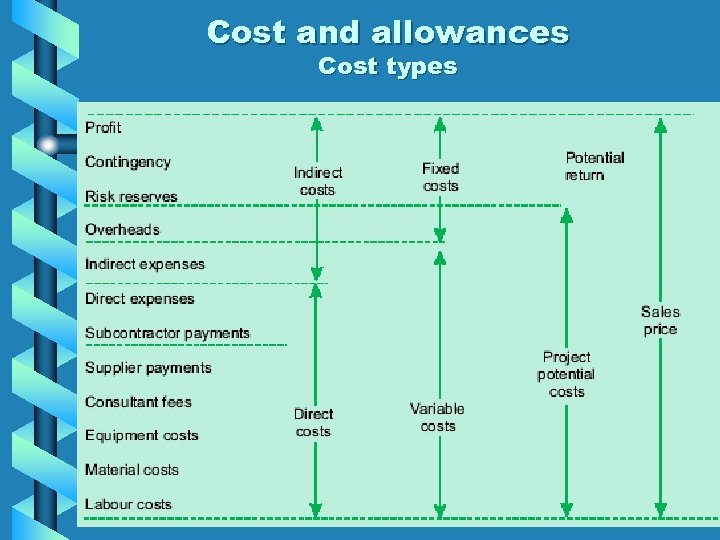 Cost and allowances Cost types
 Life cycle costs • Life cycle costing (LCC) is the process of attaching costs to individual life-cycle stages of the project. LCC is therefore concerned with the overall life cycle of the project. LCC is concerned with the overall cost incurred in the ownership of a product, structure or system over its entire life span. It includes costs that have traditionally been ignored during the planning phase. • LCC is important because decisions made during the early stages of a design process invariably have an impact on longer-term performance in the later stages. Obvious examples would be running costs and maintenance costs for any mechanical product.
 Life cycle costs • Typical life-cycle cost phases of a project: 1. 2. 3. 4. 5. Inception. Feasibility stage. Detailed development stage. Production stage. Project termination and system operation and maintenance stage. This stage is where the project has been completed and it becomes operational. 6. System divestment stage. The product is decommissioned or switched off, or its use is in some other way terminated.
 Life cycle costs • Additional life-cycle cost phases of a project: – – – – Research and development costs. Prototype costs. Design costs. Production costs. Commissioning costs. Operational costs. Maintenance costs. Decommissioning costs. This section covers the cost of running the project down prior to recycling. – Product retirement and phase out costs. This section includes the demolition or dismantling costs, including any decontamination or recycling costs.
 Life cycle costs • • Most life cycle costing methods use a common approach, as set out in the next five steps: 1. 2. 3. 4. 5. Establish the characteristic of the life cycle. Build a process cost model. Calibrate the process cost model. Input all relevant data. Generate a life cycle cost and establish a strategy. – – – Long range considerations. Life cycle viability. Strategic decision making. Future awareness. Market position. Compliance. Advantages of life cycle costing (LCC) over traditional cost planning approaches:
 Life cycle costs • LCC has also some obvious disadvantages: – Prediction accuracy. The LCC model is only as accurate as the assessment of the current and future characteristics that are applied to it. There may be unforeseeable changes in industry and society in the future that render current assumptions obsolete. – Cost. LCC is generally not applicable for smaller projects because a full LCC analyze is expensive. – Sensitivity. The further ahead an LCC model attempts to consider, the more likely it is to be inaccurate. – Competition. Manufacturer can only use the trade-off within the limits of acceptable competitive behavior. – Risk. If any part of the LCC process models is incorrect or primed with inaccurate data, the cost implications could be very significant.
 6. 3 The project cost control system • The PMI and APM together with BS 6079, all now recommend the use of some form of standard project cost control system (PCCS). • A PCCS is a format for the development of cost plans and for mechanisms for monitoring and controlling actual expenditure with planned expenditure. • The first cycle (phase 1) of the PCSS is the cost planning cycle. This includes all aspects of pricing, estimating, establishing targets and budgets and setting up accurate cost plans. • The second cycle is the cost control cycle. This involves four phases: – – Phase 2: work initiation; Phase 3: cost data collection; Phase 4: generation of variances; Phase 5: cost reporting.
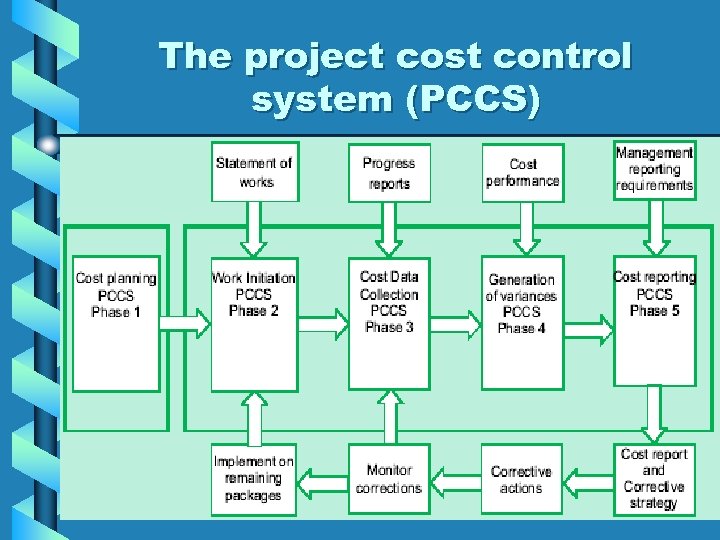 The project cost control system (PCCS)
 The project cost control system The PCCS planning cycle • The PCCS planning cycle involves breaking the project down into manageable packages, and then attaching individual budget totals to these packages based on an estimate of the likely cost involved. • These costs are normally based on some form of historical or published data. • There are two main approaches to who should undertake the estimating process: – A professional estimator; – The project team. • Both alternatives have some advantages and disadvantages.
 The PCCS planning cycle • Advantages of a professional estimator: – – he is specifically trained as an estimator; he has (hopefully) considerable estimating experience; he is aware of the limitations of the estimating; he can make accurate assessments of the works involved in individual activities; – he can appreciate the interdependencies involved in the use of multiple resources; – he can make informed judgments on risk and risk allowances; – he is free from project team influence and risk. • The main disadvantage is that a professional estimator has no loyalty to the project team and his obligation is therefore restricted to professional competence.
 The PCCS planning cycle • Advantages of the project team: – the people who make the estimates are also directly responsible for implementation; – the project team has the best knowledge of what is required and what resources are available; – the project team are aware of the limitations of the system; – Where necessary, project team members can confer and, where necessary, negotiate on the availability of resources. • The main disadvantage of the project team as an estimator is that it is not probably professional enough in estimating, and there is a greater risk of them making a mistake or making over-optimistic estimates.
 The PCCS planning cycle • The estimate has to be linked with the characteristic of the project: – – project success criteria; project linkages; standardized approach; feedback. – – – labor costs; material costs; plant costs. • Estimating generally involves a number of component parts. The most obvious of these are: • Projects also incur many other costs, for example, fuel, maintains, waste. In addition, there may be a contribution to the centre and other allowances in the form of murk-up. For the labor element, these could be built in as a part of an all-in estimating rate, which includes provision for normal levels of holidays, sick pay, national insurance etc.
 The PCCS planning cycle • Estimating has traditionally been carried out using a standard estimating sheet. • Labor costs are usually straightforward to estimate. They can be estimated by taking the total number of hours required multiplied by the various hourly unit rates. • Two types of estimate are required for materials and equipment. The first and most obvious is the financial cost. Included in this should be all costs associated with the design, manufacture and delivery to site of the item, including packing, shipping, insurance in transit, port duties and import taxes. • Second, is to estimate the availability of the item. If an item cannot be delivered in time, either the schedule has to be rearranged or an alternative source with earlier delivery times has to be found, perhaps with higher costs.
 The PCCS planning cycle • There are several standard sources of estimating data: – – standard tables; company-specific tables; previous project data; estimator skill and knowledge. The particular estimator can be accurate, optimistic, pessimistic or inconsistent. • There are three generally recognized stages of estimate development: – – – The order-of magnitude-estimate. The indicative estimate. The definitive estimate.
 The PCCS planning cycle • The order-of magnitude-estimate is made without any precise data. It may be based on past experience of similar work or on published information. The typical level of accuracy would be plus or minus 25% to at least to get a feel for the order of magnitude of the cost. This type of estimate is used for initial appraisals and feasibility reports. • The indicative level estimate is based on known information and published data. Indicative estimates are generally accurate to plus or minus 10 -15%. This level of accuracy would normally apply at the bidding stage, where the project manager can forecast resource requirements with reasonable accuracy. • The definitive estimate is produced from standard drawings, contractor prices etc. It should be accurate to within plus or minus 5%. Most sets of contract documentation would contain sufficient reserve to cover it.
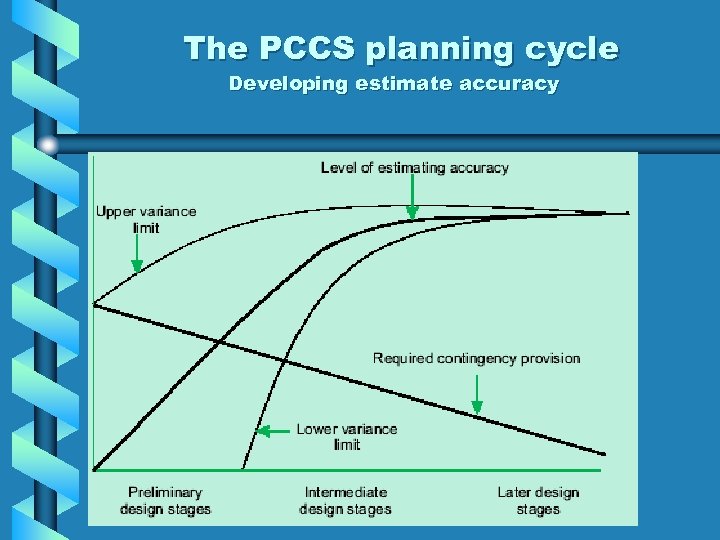 The PCCS planning cycle Developing estimate accuracy
 The PCCS planning cycle Project estimating • Cost estimations are prepared first and foremost to calculate the sales price, but they are generally needed on all projects to provide valuable input into a whole host of other management activities: – milestone planning; – valuing the likely cost of change notices and variation orders; – periodically reviewing the likely final account total; – assisting in cost control; – assisting in trade-off analysis; – assisting in performance monitoring; – assisting in establishing productivity targets as a basis for bonus payments.
 Project estimating Top-down estimating • Top-down estimating is very common and involves senior management setting the overall project budget. They do this by estimating the overall project costs on the basis of their experience, knowledge and accessible project data. • These estimates are often fixed and then handed down to lower-level managers to break down the costs to individual activity and work packages level. • The benefits of top-down estimating: – the budget is set by senior management and is therefore compatible with the overall strategic objectives of the organization; – the budget carries more authority since it originates from senior management; – the budget is less likely to be changed or tampered with during the course of the project; – any such changes are likely to be formalized;
 Project estimating Top-down estimating – because the estimate originates from higher levels within the organization, it is likely to be more reliable and accurate; – local influence and bias are unlikely to be factors. • The disadvantages are that: – the project team may feel that unrealistic budgets have been imposed upon them; – where great incompatibilities are perceived there may be a reduction in project team motivation; – the senior management may be “out of touch” with operational costs; – politics may be a factor. Some element or package managers may receive a greater budget for “specially” reasons. – the inappropriate budget allocation can affect the entire cost control and performance management systems.
 Project estimating Bottom-up estimating • The project budget being developed upwards from the individual activity level. • Each activity is estimated as accurately as possible in terms of labor hours, materials and equipment required to complete the task. • These estimates are then converted into a financial cost estimate. • The resulting tusk budgets are then aggregated to give the total direct costs of the project. • The project manager or senior manager will then add indirect costs, any contingencies and a profit figure, to arrive at the total project budget.
 Project estimating Bottom-up estimating • The advantages of the bottom-up estimating are that: – the people “on the ground” decide on what is required and on how much it should cost; – the people are more likely to commit themselves when they have had a say in setting their own budgets; – the people who set their own budgets are more likely to stick to them; – provided budgets are allocated fairly, this eliminates the motivational problems associated with favouritism or other forms of inequitable budget allocation. • The disadvantages are that: – the budgets may carry less status than those set by senior management;
 Project estimating Bottom-up estimating – careful controls are needed to ensure that budgets are not altered; – local influence and bias may be issues; – it may be difficult to adjust budgets in line with strategic changes; – the budgets are more easily overridden by senior management; – senior managers sometimes feel threatened; – element and package managers tend to overestimate to “be on the safe side”; – the whole project budget can become driven by the process itself rather than by market conditions.
 Project estimating Iterative estimating • Iterative estimating is based on negotiation and represents a compromise between to-down and bottom-up estimating. • Element and package managers develop detailed action plans and corresponding estimates for the work which they are responsible for. They then present these plans and estimates to senior management for approval. • Operational managers and senior managers negotiate on the action plans and estimates, and some re-definition and refining occur. • The end result should be an action plan and estimate that lies somewhere between the market-driven conservative estimate of the senior management and the processdriven generous estimate of the operational manager.
 Project estimating Iterative estimating • Advantages of the iterative estimating: – the estimate is prepared by the operational manager; – the estimate is tempered by senior management and is therefore more likely to be compatible with the strategic objectives of the organization; – the influence of market forces is maintained; – the end result combines practical (operational) considerations with senior management (strategic) considerations. • Disadvantages: – the negotiation process is time consuming and costly; – adequate control procedures have to be put in place to prevent the senior managers simply overriding the operatio 9 nal managers; – some operational managers might be better at negotiation than others and may secure themselves a better budget total than their less gifted colleagues; – negotiation skills can become more important than estimating skills.
 Project estimating Bidding strategy and estimate reporting • • In the case of an internal project management system, once the project or work package has been approved in principle, the next stage is to prepare the bid for approval by senior management. In most cases, the developing of the bid progresses to eight stages: 1. 2. 3. 4. 5. 6. 7. 8. Formulate a viable estimating strategy. Make initial (order of magnitude) minimum realistic estimate. Carry out any necessary preliminary refinement. Make realistic (indicative) minimum estimate. Add for profit and risk. Compare overall price to projected cost limit. Make subjective evaluation of bid success probability. Develop final (definitive) estimate.
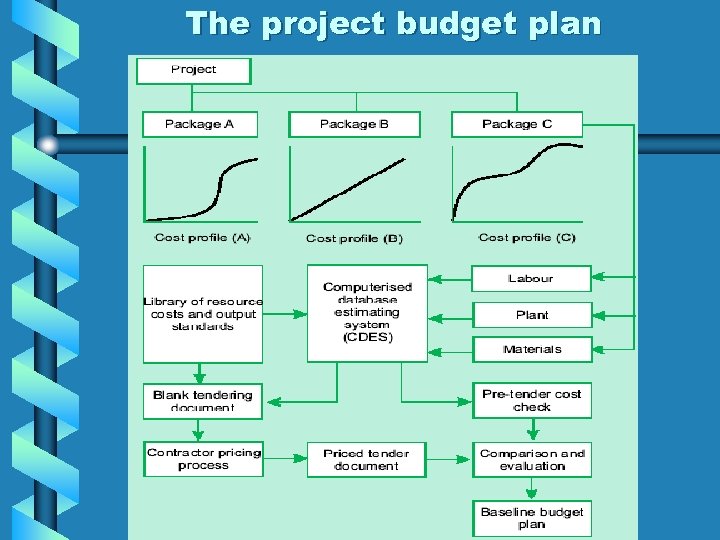
 Project estimating Computerized database estimating systems (CDES) • The CDES works by linking together several different databases. Each database contains a different type of information: – The description library. It is a collection of standard descriptions. The descriptions are arranged in an hierarchical format, where each item of work is broken down into more and more detail until a level of detail is arrived at where accurate pricing can occur. Different databases are available for different industries. – The price code and unit rate databases. For each description, the price code database has a record of what individual components are included within the description. For every library description, there is pre-set list of labour, equipment and material, together with time allowances and unit costs. – Other database elements.
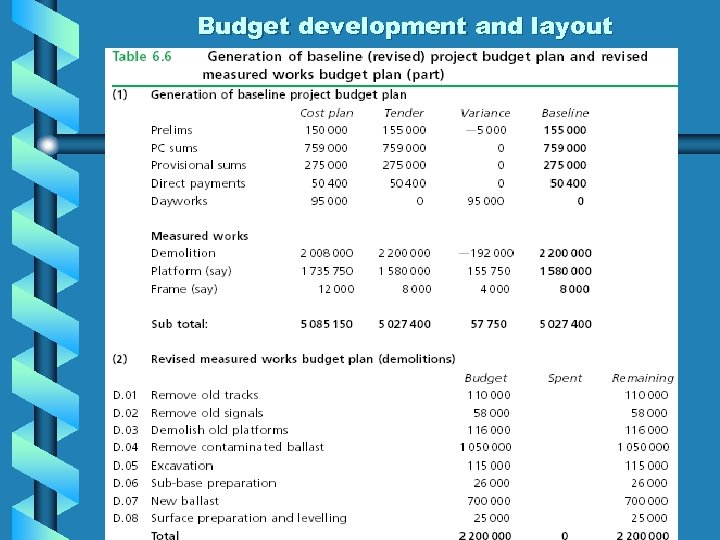
 The project budget plan • The project budget is the end result of the planning phase. It is the sum total of all individual work package budgets for the whole project. • The project budget is therefore the estimated cost for the whole project. It comprises a whole series of sub-budgets for individual WBS work packages. The project budget WBS is normally identical to the project WBS that is developed during the planning phase of the project life cycle. It is developed to a level where a pre-tender cost check is performed before contract documents are issued to prospective tenderers. • The project budget is not the same as the selling price, or even the tender price. The project budget is the effective cost limit as authorized and set by the client. • The final or baseline budget plan are the end result of a series of internal estimate planning processes, tempered by the external influences of tenderers who are usually free to price the same works in any way that they wish.
 The project budget plan
 The project budget plan • At it most basic level, the project budget relates the forecast costs to particular project task. It also considered to be a management, planning and decisionmaking tool, that may be used for: – establishing the overall budget baseline for the project. This baseline acts as the basis for subsequent earned value analysis; – developing (in association with the project schedule) the projected cost curves for each element and work package; – establishing a reference for variance analysis allowing the performance of individual elements and packages to be assessed throughout the course of the project; – moderating the spending of element and package managers; – generating the basic data for scenario analysis in trade-offs; – estimating the likely effects of change notices and variation orders.
 The project budget plan Budget development and layout • To be an effective management tool, the project budget should contain at least: – project objectives and activities in terms of measurable outputs; – the financial resources allocated to achieve these objectives and complete the activities; – clearly defined start and finish points of each activity; – the facility to compare actual and planned performance details. • Perhaps the most important aspect of the budget is the cost-coding format. For accurate monitoring and control, it is essential that each element of the budget corresponds to an identifiable and measurable work package and that the budget element and its associated work package must share a common, unique cost code.
 The project budget plan Budget development and layout
 Budget development and layout
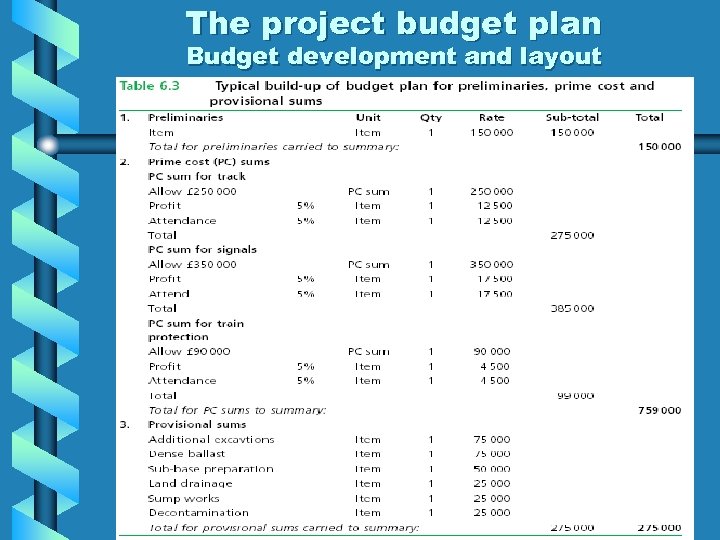
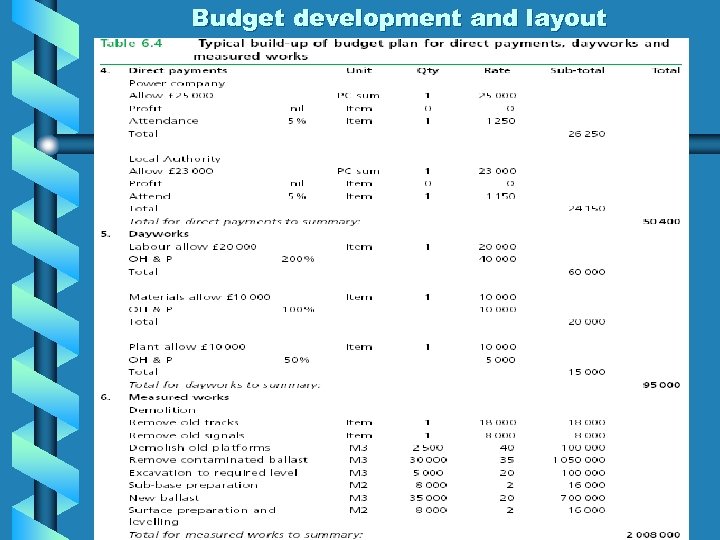
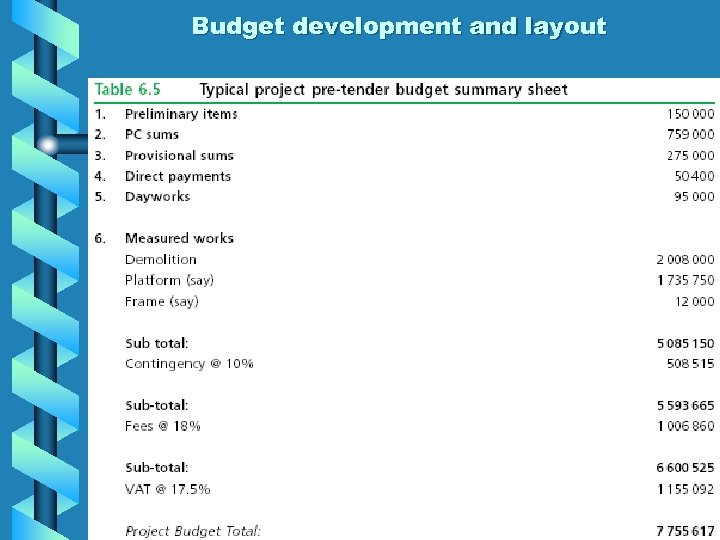
 The project budget plan Budget development and layout • Preliminary costs are those that are considered to be general project overheads. • Prime cost sums are those where the work is to be subject to a nominated or named subcontractor. • Provisional sums are those where the exact extent of the works is not known and an exact cost estimate cannot be produced. A provisional sum is included to cover the likely extent of the works. • Direct payments are payments made through the project, but made to organizations that are not part of the actual project team. • Dayworks are generally included to allow for unforeseen and unmeasurable works, which might nevertheless arise. • Typical overall additions would include allowances for contingencies, fees and taxes.
 Budget development and layout
 Budget development and layout
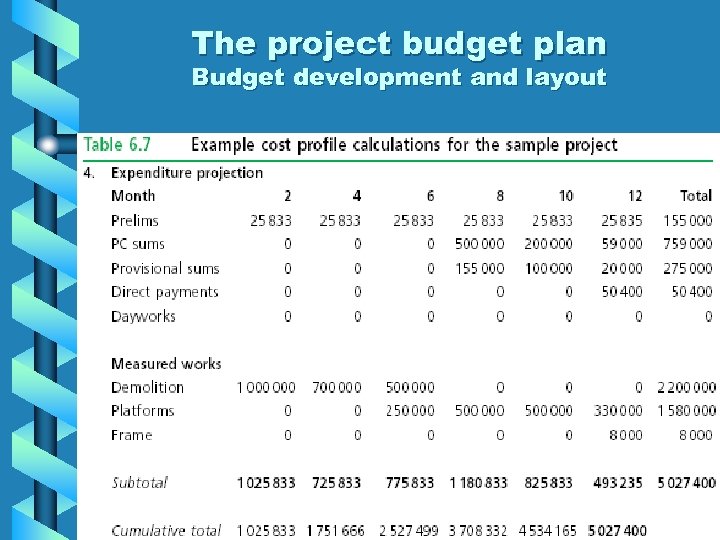
 The project budget plan Budget development and layout • The final requirement for completion of the baseline budget plan is to calculate some form of expenditure profile for the project. This is normally performed by relating the CAC sums to the project draft master schedule (DMS). • Modern project planning and control software does this automatically. • The start and finish dates for each activity are used to show the start and the finish expenditure dates for each CAC element. By knowing the spend duration and the spend curve characteristics of each activity, it is possible to calculate a spend profile for each package and for roll-up elements at each level higher in the WBS.
 The project budget plan Budget development and layout
 The project budget plan Budget changes • Budgets are generally not static, particularly in large projects where the exact scope of work is difficult to define precisely at the outset. They change throughout the life cycle of the project, and with every agreed project-scope variation (or change order) there is an associated variation in cost that has to be budgeted for. The budget should therefore be prepared in a manner in which changes are easy to accommodate. • At any time during a project, its budget should be transparent enough to identify the original budget, the cost associated with approved change orders, and the total current budget. • It is clearly important that budget changes are controlled in some way. Large project typically include some kind of change control section (CCS). The CCS is responsible for monitoring all change on the project and for predicting the implications of change requests before authorizing them. • On large projects, changes to the project budget are often formalized through the issue of a cost account variation notice (CAVN).
 The PCCS operating cycle • The operating cycle, sometimes referred to as the cost and control system, is the section of the PCCS that implements the estimating and budgeting sections of the planning cycle. • The operating cycle authorizes commencement of the priced works and monitors the actual expenditure against planned expenditure in order to generate cost variances. • The PCCS operating cycle comprises four phases: – – Phase 2: work initiation; Phase 3: cost data collection; Phase 4: generation of variances; Phase 5: cost reporting.
 The PCCS operating cycle Phase 2: work initiation • In order to be able to control costs, there must be some form of controlled release of work. • This could be done through the formal issue of a contract, or through control change control notices such as variation orders or works orders. • The project works order (PWO) would typically describe the work, and any standards to be adhered to, and identify the cost center to be charged. This is usually done through some system of cost accounting codes (CAC). The cost accounting codes system is usually based on the project WBS.
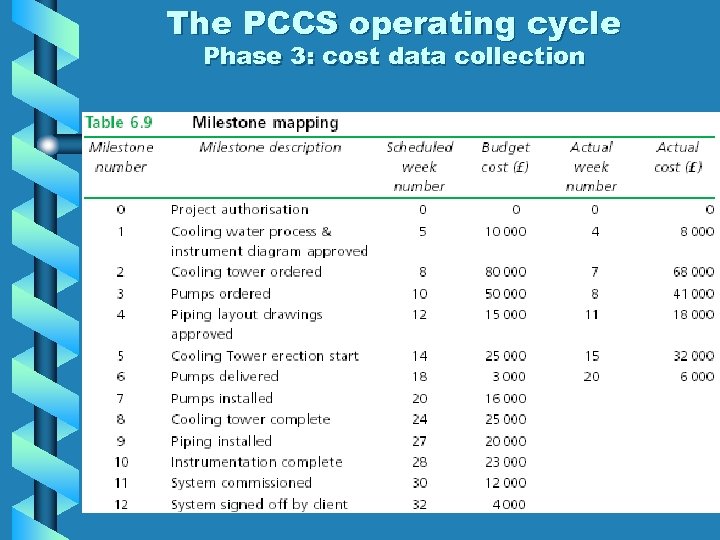
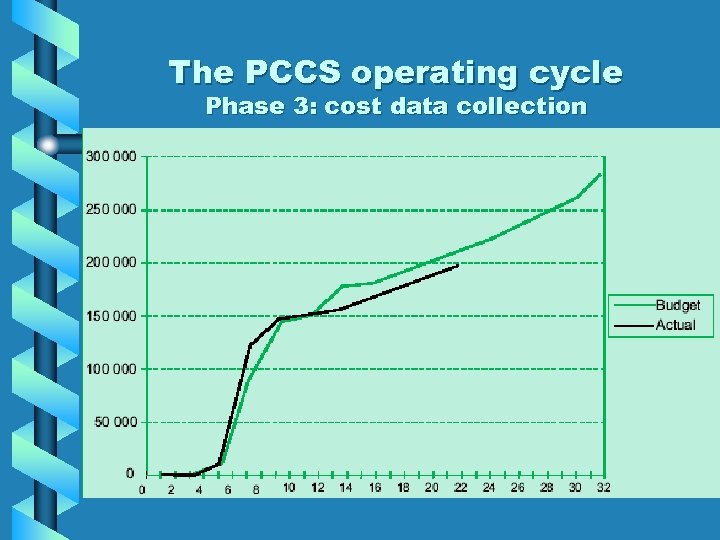
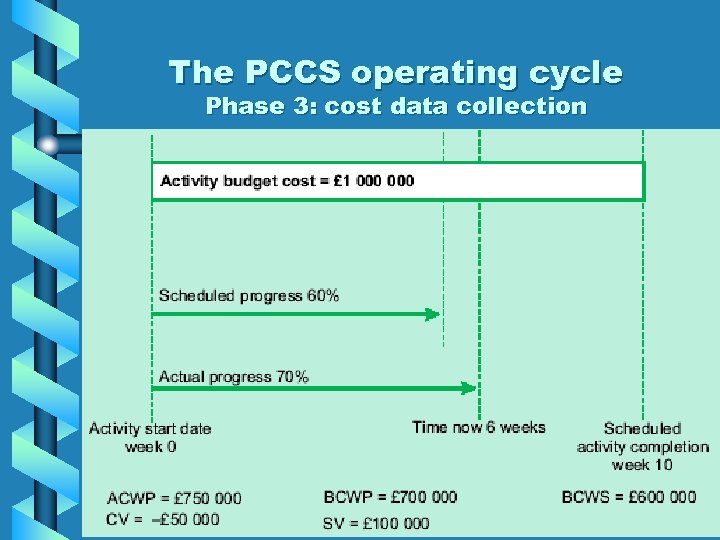
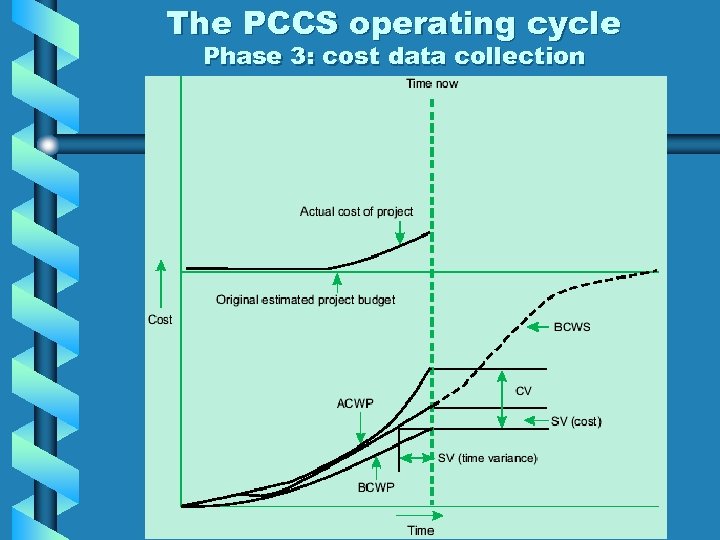
 The PCCS operating cycle Phase 3: cost data collection • PCCS cost-data collection and reporting use earned value analysis (EVA). EVA is simply a way of comparing actual with target figures for performance and cost. • EVA uses variance analysis as the basis for its calculation. Variance analysis is centered on two variances, cost variance and schedule variance. • EVA is based historically on milestone monitoring. A milestone represents a definite stage in the project and is an appropriate point at which to measure performance. • Milestone monitoring is most suitable for use when plans and schedules are not particularly detailed. It is a simple tool, but as with any simple technique, it does have a number of disadvantages.
 The PCCS operating cycle Phase 3: cost data collection
 The PCCS operating cycle Phase 3: cost data collection
 The PCCS operating cycle Phase 3: cost data collection • Milestone monitoring has a number of disadvantages: – Reaction time lag. A milestone report could indicate a cost variance that originated in an element several months previously and it could be to late to fully correct whatever caused the variance. – Residual accumulated overspend. Even if the ongoing expenditure are brought back into line, the accumulated over spend will remain. – Re-planning issues. Milestone programs are very susceptible to re-planning and trade-offs. – Time scale issues. Milestones represent conditions at a particular point in time rather than along a time continuum. This is a limitation as the project is dynamic. Milestones do not allow for work in progress.
 The PCCS operating cycle Phase 3: cost data collection • EVA is a type of milestone monitoring applied specifically to determine cost and schedule variances for component sections of a project. EVA is an attractive method of project control because it: – is dynamic; – provides combined and simultaneous time- and costperformance assessment; – provides frequent reporting; a good system allows daily reporting, if required; – demonstrates value as well as cost. It therefore gives a high frequency report on profitability; – generates accurate assessment of the cost implication of delays; – allows easier trade-off analysis in that the calculations include resource implications.
 The PCCS operating cycle Phase 3: cost data collection • The cost variance is the difference between the budgeted cost of the works and the actual cost. For both budgeted and actual costs, the value is taken in terms of the works actually completed or performed. • Variances can be expressed in terms of measurable effort and support effort. • Measurable effort relates to separate elements of work that are set within a defined schedule for accomplishment. Completion of the effort produces tangible results. • Support effort relates to project actions where it is difficult to isolate it into measurable units. Examples would include project support and administrative services. • Variance analysis is designed to show different parts of the budget plan are performing at any one time.
 The PCCS operating cycle Phase 3: cost data collection • There are seven major considerations involved in variance analysis: – – Identify and validate the variance. Quantify the variance. Determine the source of the variance. Determine the impact of the variance on the project as a whole. – Determine the impact of the variance on other elements and packages. – Determine the extent to which tactical response is already underway. – Determine the range of possible outcomes of any corrective action.
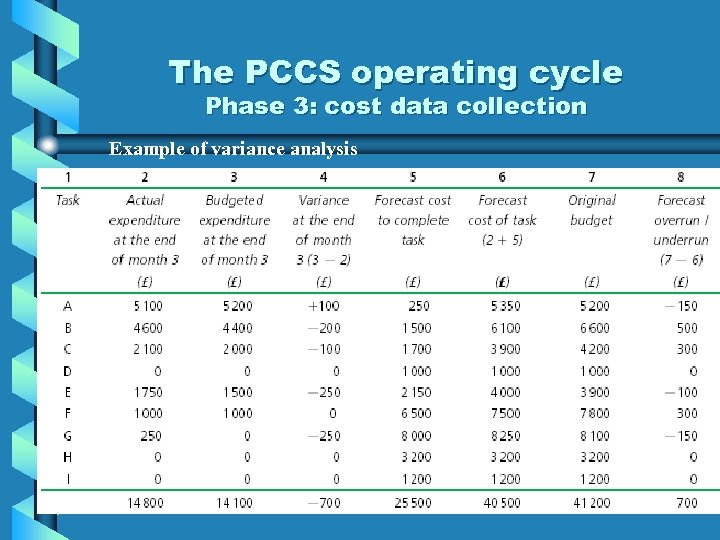 The PCCS operating cycle Phase 3: cost data collection Example of variance analysis
 The PCCS operating cycle Phase 3: cost data collection • Earned value analysis makes use of following variables: – – – – – Actual cost of the works performed (ACWP); Budgeted cost of the works performed (BCWP); Budgeted cost of the works scheduled (BCWS); Scheduled time for work performed (STWP); Actual time for work performed (ATWP); Cost variance (CV); Schedule variance (SV); Budget at completion (BAC); Estimate at completion (EAC); Variance at completion (VAC).
 The PCCS operating cycle Phase 3: cost data collection
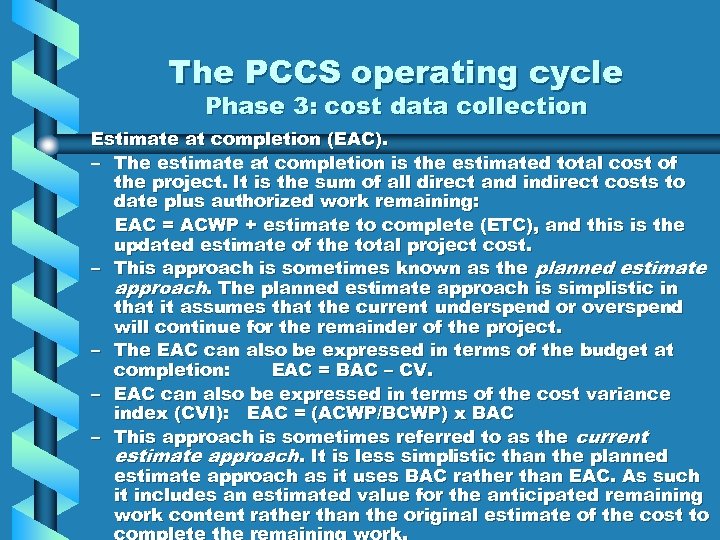 The PCCS operating cycle Phase 3: cost data collection Estimate at completion (EAC). – The estimate at completion is the estimated total cost of the project. It is the sum of all direct and indirect costs to date plus authorized work remaining: EAC = ACWP + estimate to complete (ETC), and this is the updated estimate of the total project cost. – This approach is sometimes known as the planned estimate approach. The planned estimate approach is simplistic in that it assumes that the current underspend or overspend will continue for the remainder of the project. – The EAC can also be expressed in terms of the budget at completion: EAC = BAC – CV. – EAC can also be expressed in terms of the cost variance index (CVI): EAC = (ACWP/BCWP) x BAC – This approach is sometimes referred to as the current estimate approach. It is less simplistic than the planned estimate approach as it uses BAC rather than EAC. As such it includes an estimated value for the anticipated remaining work content rather than the original estimate of the cost to
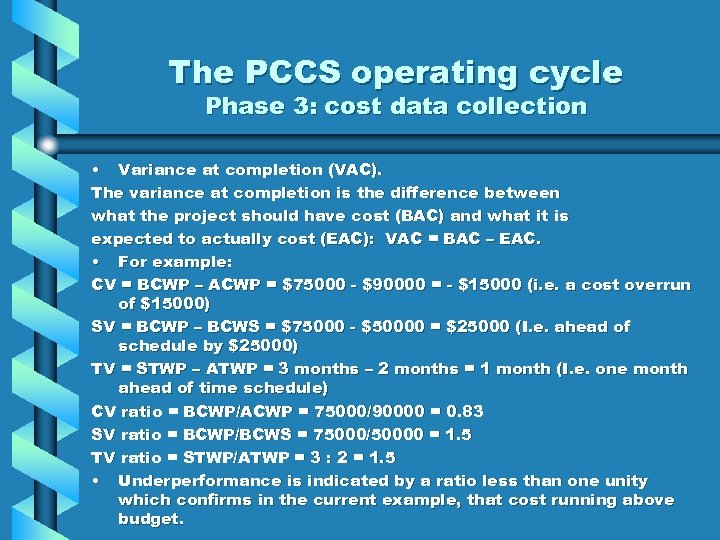 The PCCS operating cycle Phase 3: cost data collection • Variance at completion (VAC). The variance at completion is the difference between what the project should have cost (BAC) and what it is expected to actually cost (EAC): VAC = BAC – EAC. • For example: CV = BCWP – ACWP = $75000 - $90000 = - $15000 (i. e. a cost overrun of $15000) SV = BCWP – BCWS = $75000 - $50000 = $25000 (I. e. ahead of schedule by $25000) TV = STWP – ATWP = 3 months – 2 months = 1 month (I. e. one month ahead of time schedule) CV ratio = BCWP/ACWP = 75000/90000 = 0. 83 SV ratio = BCWP/BCWS = 75000/50000 = 1. 5 TV ratio = STWP/ATWP = 3 : 2 = 1. 5 • Underperformance is indicated by a ratio less than one unity which confirms in the current example, that cost running above budget.
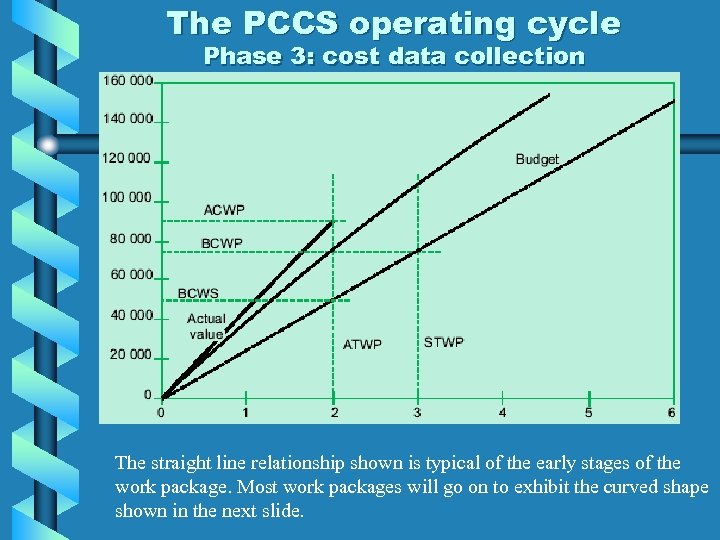 The PCCS operating cycle Phase 3: cost data collection The straight line relationship shown is typical of the early stages of the work package. Most work packages will go on to exhibit the curved shape shown in the next slide.
 The PCCS operating cycle Phase 3: cost data collection
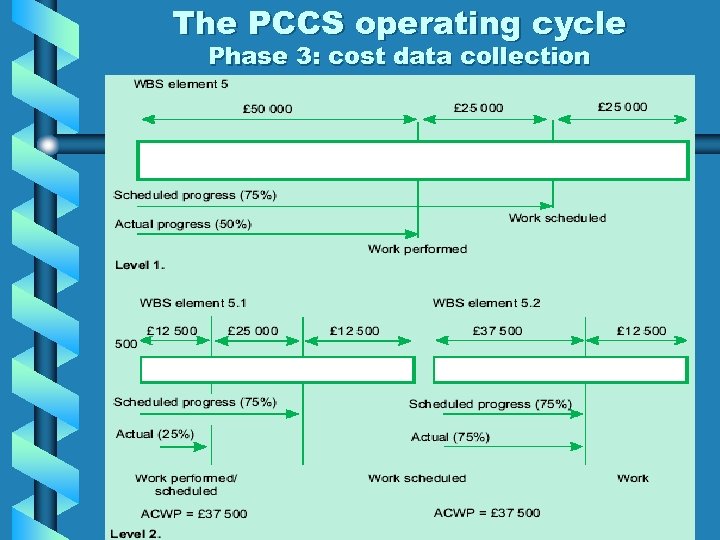
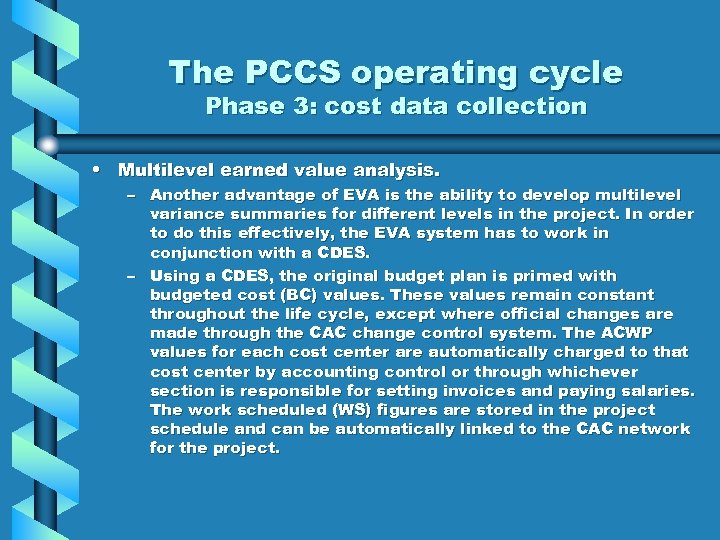 The PCCS operating cycle Phase 3: cost data collection • Multilevel earned value analysis. – Another advantage of EVA is the ability to develop multilevel variance summaries for different levels in the project. In order to do this effectively, the EVA system has to work in conjunction with a CDES. – Using a CDES, the original budget plan is primed with budgeted cost (BC) values. These values remain constant throughout the life cycle, except where official changes are made through the CAC change control system. The ACWP values for each cost center are automatically charged to that cost center by accounting control or through whichever section is responsible for setting invoices and paying salaries. The work scheduled (WS) figures are stored in the project schedule and can be automatically linked to the CAC network for the project.
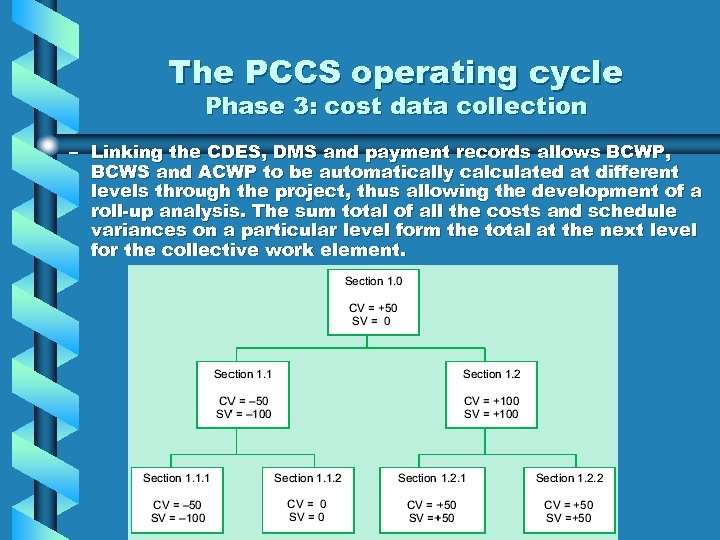 The PCCS operating cycle Phase 3: cost data collection – Linking the CDES, DMS and payment records allows BCWP, BCWS and ACWP to be automatically calculated at different levels through the project, thus allowing the development of a roll-up analysis. The sum total of all the costs and schedule variances on a particular level form the total at the next level for the collective work element.
 The PCCS operating cycle Phase 3: cost data collection
 The PCCS operating cycle Phase 4: generation of variances Variance and variation envelope. A variance is any cost or schedule deviation from a specific and predetermined plan. Permitted variances are usually larger in the early stages of a project becoming smaller as the project progresses. • The variance envelope defines the limits of acceptable performance around the mean, beyond which some kind of alarm bells should start to sound. • Analysis of this variance envelope is one of the main applications for the monitoring and control aspects of EVA. The values for CV and SV can be used together to show the cost and schedule performance of any individual WBS element and also for groups of elements using a roll-up analysis. • The variance generation process involves looking at CV and SV in order to assess the performance of individual work packages and groups of work packages.
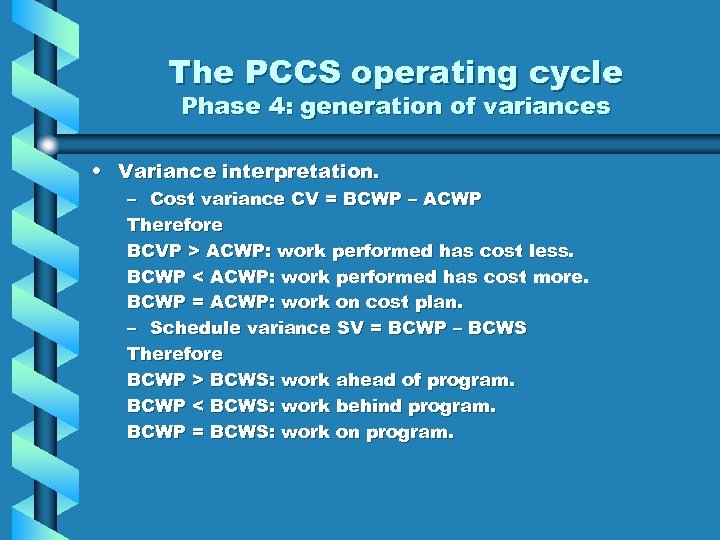 The PCCS operating cycle Phase 4: generation of variances • Variance interpretation. – Cost variance CV = BCWP – ACWP Therefore BCVP > ACWP: work performed has cost less. BCWP < ACWP: work performed has cost more. BCWP = ACWP: work on cost plan. – Schedule variance SV = BCWP – BCWS Therefore BCWP > BCWS: work ahead of program. BCWP < BCWS: work behind program. BCWP = BCWS: work on program.
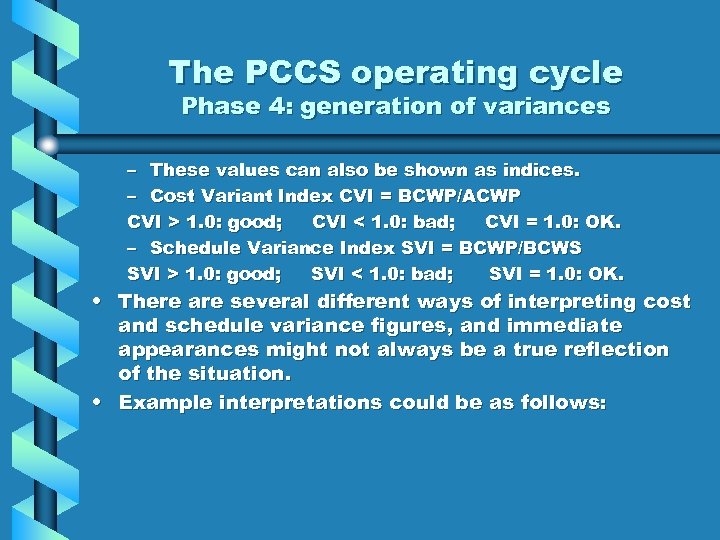 The PCCS operating cycle Phase 4: generation of variances – These values can also be shown as indices. – Cost Variant Index CVI = BCWP/ACWP CVI > 1. 0: good; CVI < 1. 0: bad; CVI = 1. 0: OK. – Schedule Variance Index SVI = BCWP/BCWS SVI > 1. 0: good; SVI < 1. 0: bad; SVI = 1. 0: OK. • There are several different ways of interpreting cost and schedule variance figures, and immediate appearances might not always be a true reflection of the situation. • Example interpretations could be as follows:
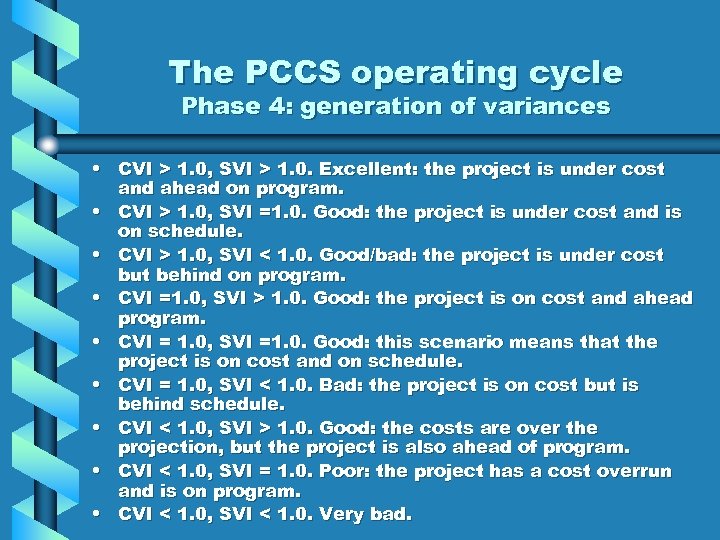 The PCCS operating cycle Phase 4: generation of variances • CVI > 1. 0, SVI > 1. 0. Excellent: the project is under cost and ahead on program. • CVI > 1. 0, SVI =1. 0. Good: the project is under cost and is on schedule. • CVI > 1. 0, SVI < 1. 0. Good/bad: the project is under cost but behind on program. • CVI =1. 0, SVI > 1. 0. Good: the project is on cost and ahead program. • CVI = 1. 0, SVI =1. 0. Good: this scenario means that the project is on cost and on schedule. • CVI = 1. 0, SVI < 1. 0. Bad: the project is on cost but is behind schedule. • CVI < 1. 0, SVI > 1. 0. Good: the costs are over the projection, but the project is also ahead of program. • CVI < 1. 0, SVI = 1. 0. Poor: the project has a cost overrun and is on program. • CVI < 1. 0, SVI < 1. 0. Very bad.
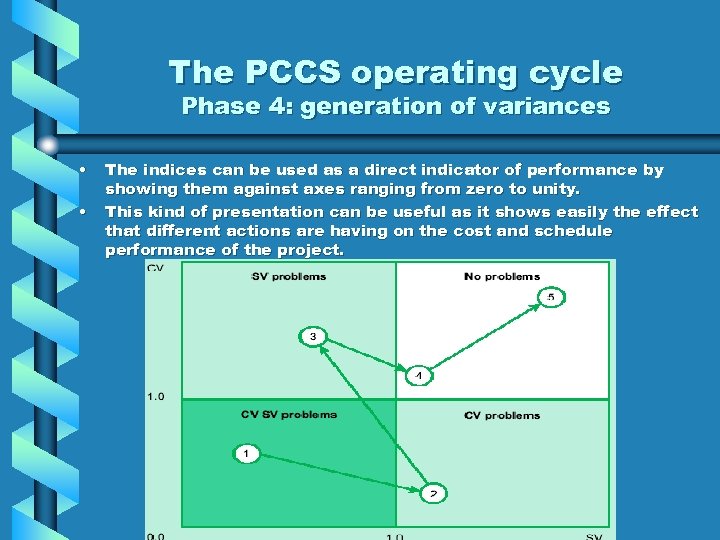 The PCCS operating cycle Phase 4: generation of variances • • The indices can be used as a direct indicator of performance by showing them against axes ranging from zero to unity. This kind of presentation can be useful as it shows easily the effect that different actions are having on the cost and schedule performance of the project.
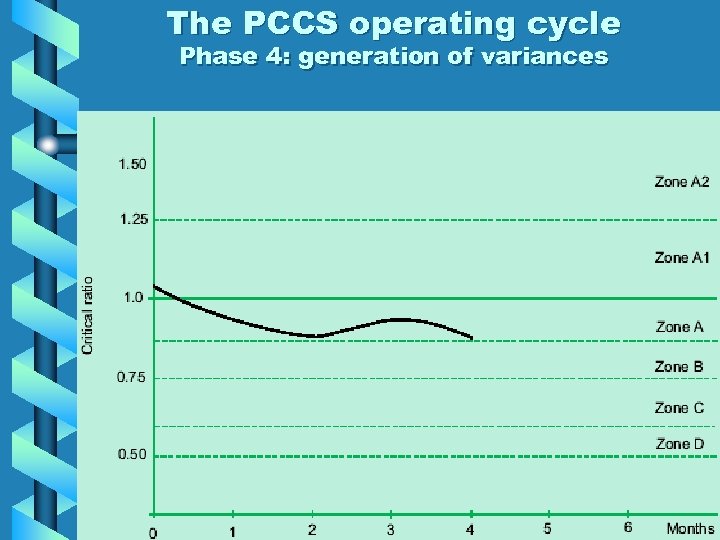
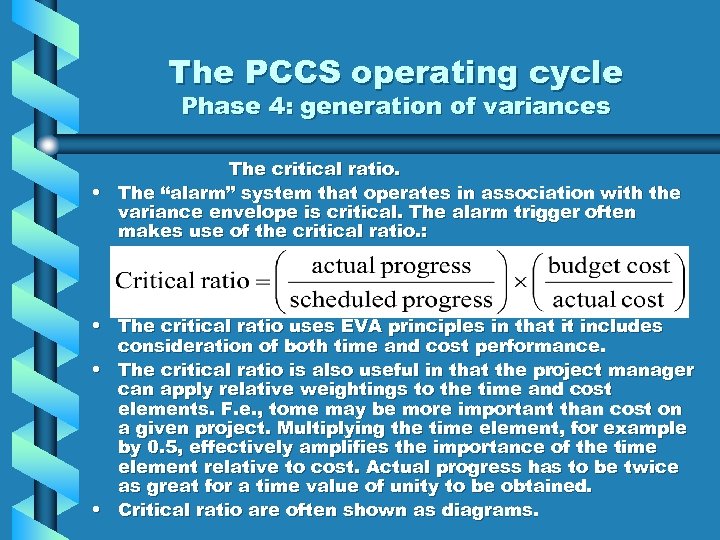 The PCCS operating cycle Phase 4: generation of variances The critical ratio. • The “alarm” system that operates in association with the variance envelope is critical. The alarm trigger often makes use of the critical ratio. : • The critical ratio uses EVA principles in that it includes consideration of both time and cost performance. • The critical ratio is also useful in that the project manager can apply relative weightings to the time and cost elements. F. e. , tome may be more important than cost on a given project. Multiplying the time element, for example by 0. 5, effectively amplifies the importance of the time element relative to cost. Actual progress has to be twice as great for a time value of unity to be obtained. • Critical ratio are often shown as diagrams.
 The PCCS operating cycle Phase 4: generation of variances
 The PCCS operating cycle Phase 5: cost reporting • Reporting is the first step towards monitoring, analyzing and ultimately managing the progress of any project. • Good-quality information is the key to good project decision making and therefore good project management. • The quality and nature of the project reporting system will directly influence the quality, appropriateness, and timeliness of the information provided to managers and upon which they will base their decisions.
 The PCCS operating cycle Phase 5: cost reporting • In general reports should: – be produced on time; – include only relevant information; – allow for all interrelationships between the data contained in them; ’ – be honest and accurate; – be issued to everybody who is involved; – highlight particularly important issues; – put forward proposed solutions (where appropriate); – put forward clear responsibilities and time scales for implementation (where appropriate).
 The PCCS operating cycle Phase 5: cost reporting • When used properly reports can be extremely useful. Timely well-written reports can: – improve the overall understanding and efficiency of the project team; – provide early warning of potential problems; – act as an overall stabilizing mechanism; – contribute to the project audit trail; – provide essential data to act as the basis for management decision making; – assist in progress reviews; – improve coordination of management response.
 The PCCS operating cycle Phase 5: cost reporting • Basic report types: – Routine reports are issued routinely. These are used primarily to keep team members up to date on the everyday performance of the project. Routine reports tend to be specific: cost reports, schedule progress reports, quality reports, risk reports. Large projects tend to have review meetings. – Development review reports are used where the project team is undergoing any kind of development program or where the project itself is subject to review. This type of report is typical on research and development projects where the precise work content is not known at the outset. – Exception reports are issued primarily to highlight an exception where something has occurred that is out of the ordinary. – Subject specific reports are produced where a specific aspect of the project is causing concern and where detailed monitoring and control is required. – Project variance and analysis report (PVAR) combine the approaches listed above.
 The PCCS operating cycle Phase 5: cost reporting • PVAR reporting use EVA as the primary analysis tool. – A PVAR report is generated directly from cost data and would normally be assembled each month. – The report shows the variance performance of the project as a whole and then moves down to finer levels of detail according to the WBS breakdown used by the CDES. – The PVAR report itself would typically show: • routine reporting information; • development progress and review information; • the performance of each level of the WBS in terms of: ACWP, BCWS, CV, SV, EAC, ETC. • any significant cost or schedule variances; • sources and reasons of such variances; • proposal responses together with individual responsibilities, action plans and time scales.
 The PCCS operating cycle Phase 5: cost reporting • For each problem cost center, separate PVAR reports are generated showing: – WBS identifiers (project, elements, sub-elements etc. ); – CAC identifier and approved budget limits; – current values of ACWP, BCWS, CV, SV, BAC, ETC and VAC figures; – previous month (or other reporting period) corresponding values; – summary of differences between previous month and current month values; – summary of significant differences (improvements and deteriorations); – current EAC, ETC, ECTC, ETTC values. • The PVAR report would probably show the curves given in the next slide.
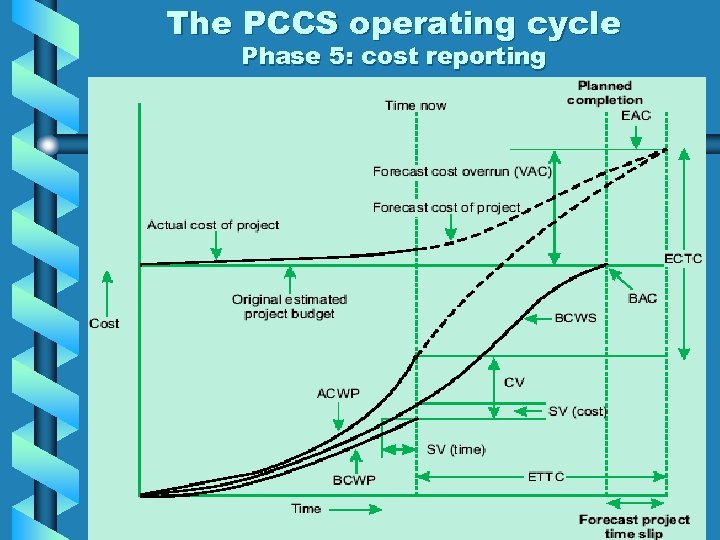 The PCCS operating cycle Phase 5: cost reporting
 The PCCS operating cycle Phase 5: cost reporting • Once the value in terms of performance variables has been established for every task, the only input required to make the system work is the approximation of works completed. Once this has been input, the EVA system can quickly and easily calculate the following parameters: – Earned value is the money that has been earned by doing the work to date. It is equivalent to the budget cost of the work multiplied by the amount of work completed and valued. – Earned value hours are the total budgeted number of hours multiplied by the proportion of total hours actually completed. This shows the proportion of earned value that has already been achieved and gives an indication of the proportion that remains. – Anticipated final hours are the total budgeted number of hours divided by the proportion of total hours actually completed. – Project efficiency is the earned value hours divided by the total hours actually completed. – Project progress is the earned value hours divides by the total budgeted work hours.
 Review questions (module 6) Project cost planning and control system True or false? 6. 1 Cost planning and control can operate in isolation from time and quality considerations. 6. 2 A cost plan is the same as the budget plan. 6. 3 Budget plans generally use the same work packages and cost accounting codes as identified in the main project WBS. 6. 4 Variance analysis is the only effective approach to cost monitoring and control. 6. 5 Most control systems use a retrospective approach rather than a proactive one. 6. 6 Cost control systems must be dynamic and responsive to changes in the project as a whole. 6. 7 Most of the final cost of a project occurs through change notices after the original scope of the works has been agreed.
 Review questions (module 6) Project cost planning and control system • 6. 8 One of the main functional requirements of a cost control system is that it must be able to process project data quickly. • 6. 9 Cybernetic control is based on the concept of an automatic response to actual performance against target performance. • 6. 10 Cybernetic control systems are best suited to large complex packages. • 6. 11 Analogue systems are appropriate to all levels of work packages. • 6. 12 Post control reviews are used as the basis for project performance feedback. • 6. 13 “Below the line” cost include all contingencies, provisional sums and other provisions for works that are unforeseeable or not directly measurable. • 6. 14 Direct costs are those costs that are directly attributable to the project, for example to cover project labor, plant and materials.
 Review questions (module 6) Project cost planning and control system • 6. 15 Fixed costs represent overheads that continue at a given level irrespective of the level of output or performance of the project. • 6. 16 Variable costs are those costs that vary in relation to the output or performance of the project. • 6. 17 Life cycle costs (LCC) can be defined as the total cost of ownership of a product, structure or system over its useful life. • 6. 30 Most cost planning and control systems are A proactive. B reactive. C combination. D neither. • 6. 31 Cybernetic control systems are based on which of the following? A Automatic reactive response. C Random response. B Pre-programmed response. D Other.
 Review questions (module 6) Project cost planning and control system • 6. 32 Which of the following does a first-order cybernetic control system utilize? A B C D Pre-programmed responses. Conscious, memory-based judgmental responses. Immediate comparison of performance with standard. Other. • 6. 33 Which of the following does a second-order cybernetic control system utilize?
 Review questions (module 6) Project cost planning and control system • 6. 34 Which of the following does a third-order cybernetic control system utilize? A B C D Pre-programmed responses. Conscious, memory-based judgmental responses. Immediate comparison of performance with standard. Other. • 6. 35 Head office contributions are an example of A project direct costs. C project overhead costs. B project indirect costs. D project below-the-line costs. • 6. 36 Contingencies are an example of • 6. 37 Project chargeable labor costs are an example of
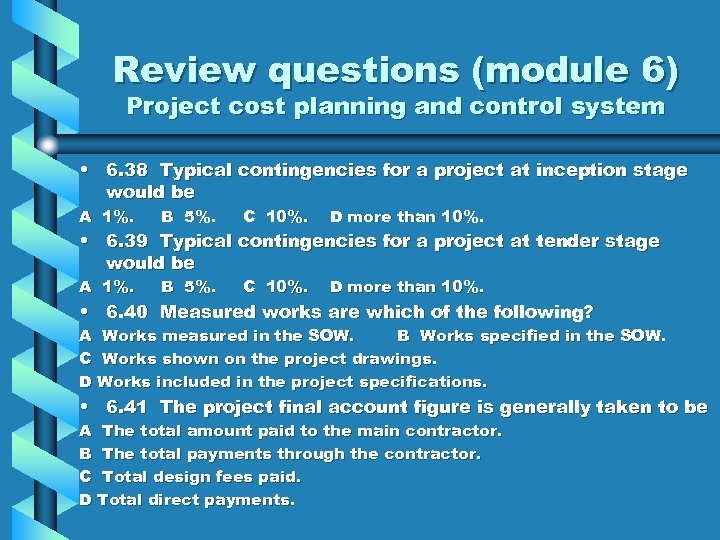 Review questions (module 6) Project cost planning and control system • 6. 38 Typical contingencies for a project at inception stage would be A 1%. B 5%. C 10%. D more than 10%. • 6. 39 Typical contingencies for a project at tender stage would be • 6. 40 Measured works are which of the following? A Works measured in the SOW. B Works specified in the SOW. C Works shown on the project drawings. D Works included in the project specifications. • 6. 41 The project final account figure is generally taken to be A The total amount paid to the main contractor. B The total payments through the contractor. C Total design fees paid. D Total direct payments.
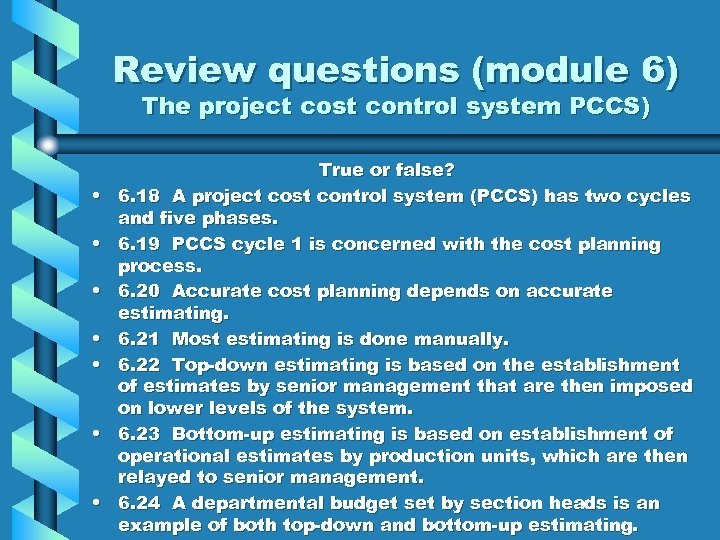 Review questions (module 6) The project cost control system PCCS) • • True or false? 6. 18 A project cost control system (PCCS) has two cycles and five phases. 6. 19 PCCS cycle 1 is concerned with the cost planning process. 6. 20 Accurate cost planning depends on accurate estimating. 6. 21 Most estimating is done manually. 6. 22 Top-down estimating is based on the establishment of estimates by senior management that are then imposed on lower levels of the system. 6. 23 Bottom-up estimating is based on establishment of operational estimates by production units, which are then relayed to senior management. 6. 24 A departmental budget set by section heads is an example of both top-down and bottom-up estimating.
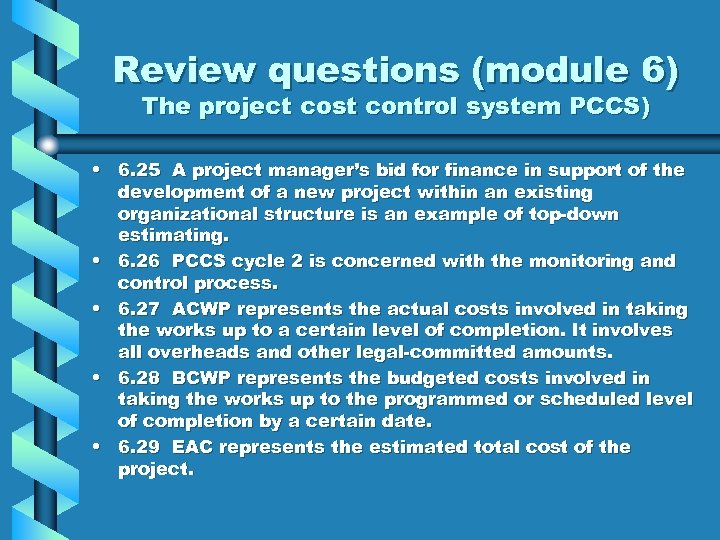 Review questions (module 6) The project cost control system PCCS) • 6. 25 A project manager’s bid for finance in support of the development of a new project within an existing organizational structure is an example of top-down estimating. • 6. 26 PCCS cycle 2 is concerned with the monitoring and control process. • 6. 27 ACWP represents the actual costs involved in taking the works up to a certain level of completion. It involves all overheads and other legal-committed amounts. • 6. 28 BCWP represents the budgeted costs involved in taking the works up to the programmed or scheduled level of completion by a certain date. • 6. 29 EAC represents the estimated total cost of the project.
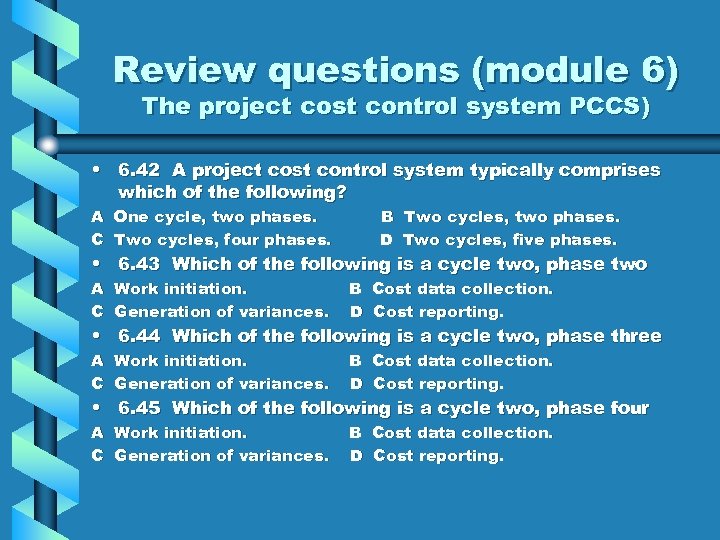 Review questions (module 6) The project cost control system PCCS) • 6. 42 A project cost control system typically comprises which of the following? A One cycle, two phases. C Two cycles, four phases. B Two cycles, two phases. D Two cycles, five phases. • 6. 43 Which of the following is a cycle two, phase two A Work initiation. C Generation of variances. B Cost data collection. D Cost reporting. • 6. 44 Which of the following is a cycle two, phase three • 6. 45 Which of the following is a cycle two, phase four
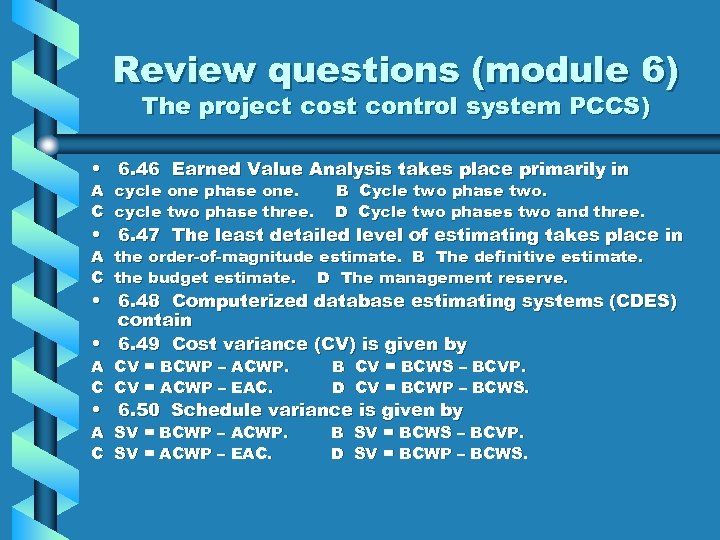 Review questions (module 6) The project cost control system PCCS) • 6. 46 Earned Value Analysis takes place primarily in A cycle one phase one. C cycle two phase three. B Cycle two phase two. D Cycle two phases two and three. • 6. 47 The least detailed level of estimating takes place in A the order-of-magnitude estimate. B The definitive estimate. C the budget estimate. D The management reserve. • 6. 48 Computerized database estimating systems (CDES) contain • 6. 49 Cost variance (CV) is given by A CV = BCWP – ACWP. C CV = ACWP – EAC. B CV = BCWS – BCVP. D CV = BCWP – BCWS. A SV = BCWP – ACWP. C SV = ACWP – EAC. B SV = BCWS – BCVP. D SV = BCWP – BCWS. • 6. 50 Schedule variance is given by
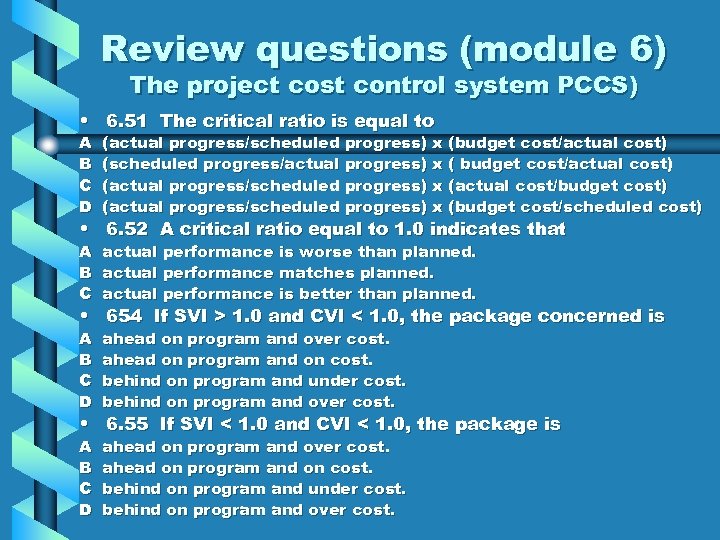 Review questions (module 6) The project cost control system PCCS) • 6. 51 The critical ratio is equal to A B C D (actual progress/scheduled progress) x (budget cost/actual cost) (scheduled progress/actual progress) x ( budget cost/actual cost) (actual progress/scheduled progress) x (actual cost/budget cost) (actual progress/scheduled progress) x (budget cost/scheduled cost) • 6. 52 A critical ratio equal to 1. 0 indicates that A actual performance is worse than planned. B actual performance matches planned. C actual performance is better than planned. • 654 If SVI > 1. 0 and CVI < 1. 0, the package concerned is A B C D ahead on program and over cost. ahead on program and on cost. behind on program and under cost. behind on program and over cost. • 6. 55 If SVI < 1. 0 and CVI < 1. 0, the package is