 Скачать презентацию TOM TORLAKSON State Superintendent of Public Instruction Assessment
9b51d7437c46931e26ff85471775e346.ppt
- Количество слайдов: 47



TOM TORLAKSON State Superintendent of Public Instruction Assessment Policies and Implications: A National and State Perspective California Algebra Forum May 21, 2012 Deborah V. H. Sigman Deputy Superintendent of Public Instruction District, School & Innovation Branch California Department of Education 1
Summer and Fall of 2010 TOM TORLAKSON State Superintendent of Public Instruction • Adoption of Common Core Standards • Prohibition on frameworks and materials adoption • Participating state in the Partnership for Assessment of Readiness for College and Career Consortium • Extraordinary Fiscal Climate 2
Summer and Fall 2011 TOM TORLAKSON State Superintendent of Public Instruction • Transitioning to Common Core • Ability to move forward on frameworks • Offering supplemental material review • Become Governing state in the SMARTER Balanced Assessment Consortium • Extraordinary Fiscal Climate 3
CCSS Implementation Plan TOM TORLAKSON State Superintendent of Public Instruction • Highlights from the past year: – Superintendent sponsored legislation to implement common core – Creation of Common Core Integrated Action Team – Stakeholder meetings and request for information to gather statewide input – CDE and SBE forward Implementation Plan to Legislative body and governor in March 2012 4
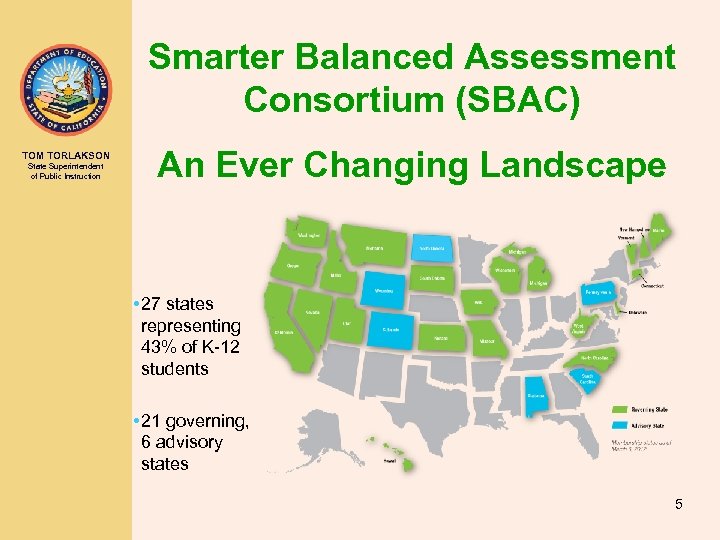
Smarter Balanced Assessment Consortium (SBAC) TOM TORLAKSON State Superintendent of Public Instruction An Ever Changing Landscape • 27 states representing 43% of K-12 students • 21 governing, 6 advisory states 5
Opportunities and Challenges of Transitioning to New Assessment System TOM TORLAKSON State Superintendent of Public Instruction • • Richer assessment of and for learning Use of technology as a tool Adaptive testing Universal access National expertise Preparation for 21 st century skills College and career ready students 6
Opportunities and Challenges of Transitioning to New Assessment System (cont. ) TOM TORLAKSON State Superintendent of Public Instruction • • • Change is difficult Sequencing of activities Technology infrastructure Communication efforts Fiscal climate 7
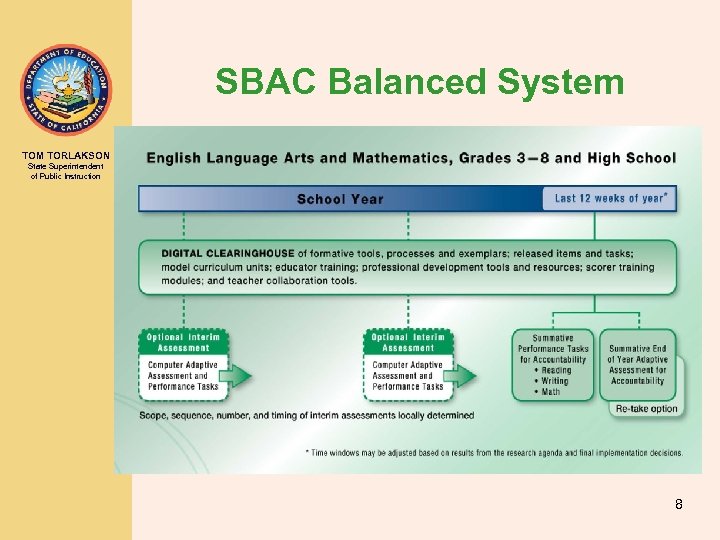
SBAC Balanced System TOM TORLAKSON State Superintendent of Public Instruction 8
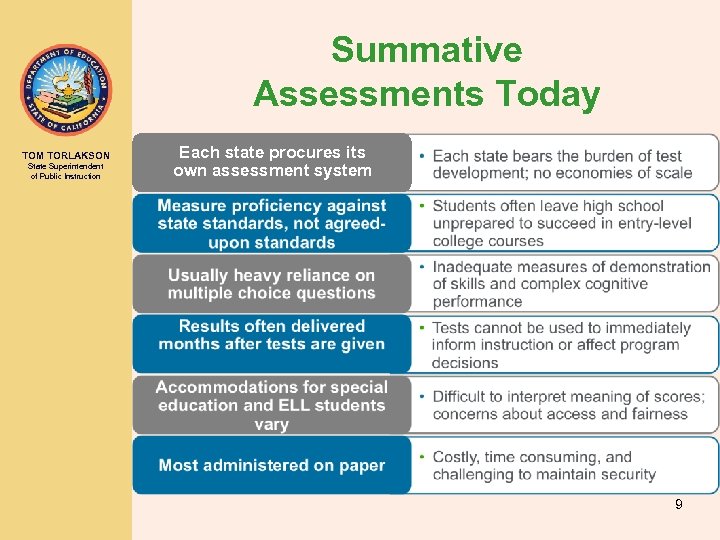
Summative Assessments Today TOM TORLAKSON State Superintendent of Public Instruction Each state procures its own assessment system 9
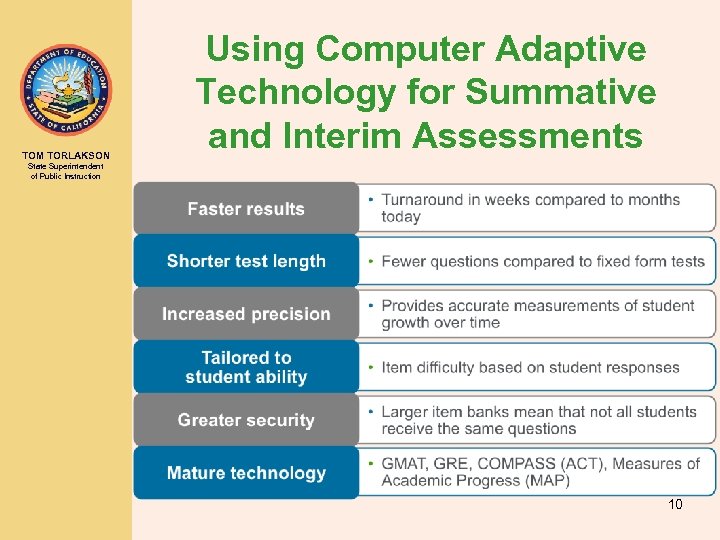
TOM TORLAKSON Using Computer Adaptive Technology for Summative and Interim Assessments State Superintendent of Public Instruction 10
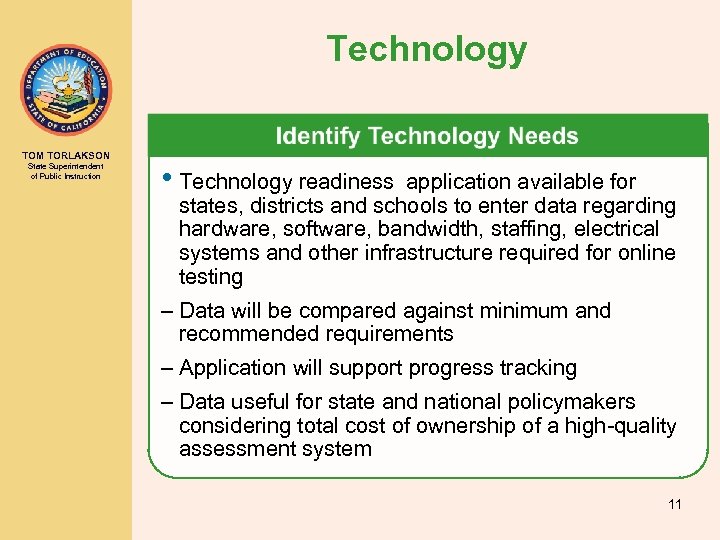
Technology TOM TORLAKSON State Superintendent of Public Instruction • Technology readiness application available for states, districts and schools to enter data regarding hardware, software, bandwidth, staffing, electrical systems and other infrastructure required for online testing – Data will be compared against minimum and recommended requirements – Application will support progress tracking – Data useful for state and national policymakers considering total cost of ownership of a high-quality assessment system 11
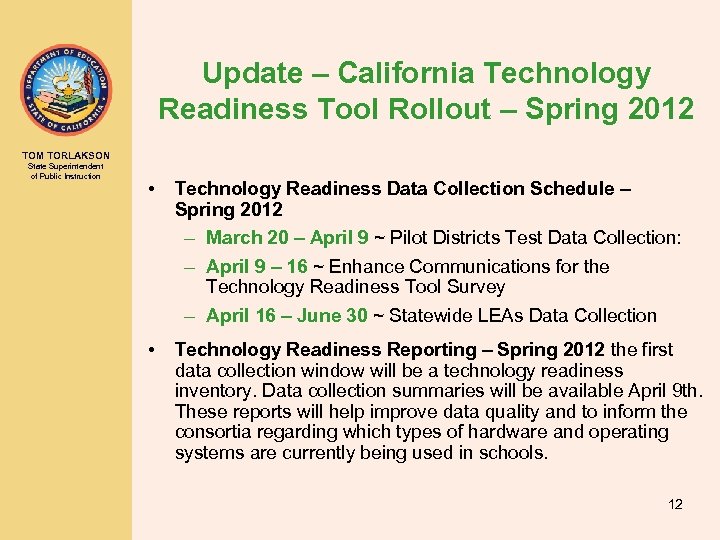
Update – California Technology Readiness Tool Rollout – Spring 2012 TOM TORLAKSON State Superintendent of Public Instruction • Technology Readiness Data Collection Schedule – Spring 2012 – March 20 – April 9 ~ Pilot Districts Test Data Collection: – April 9 – 16 ~ Enhance Communications for the Technology Readiness Tool Survey – April 16 – June 30 ~ Statewide LEAs Data Collection • Technology Readiness Reporting – Spring 2012 the first data collection window will be a technology readiness inventory. Data collection summaries will be available April 9 th. These reports will help improve data quality and to inform the consortia regarding which types of hardware and operating systems are currently being used in schools. 12
Guidelines for Purchasing New Hardware TOM TORLAKSON State Superintendent of Public Instruction • Designed to inform schools and districts on current and future technology purchasing decisions consistent with SBAC requirements. • Include hardware and operating system specifications covering the vast majority of commercially available computers and tablets. Specifications are described below. • The full guidelines are available online at http: //www. smarterbalanced. org/smarterbalanced-assessments/technology/ (Outside Source). 13
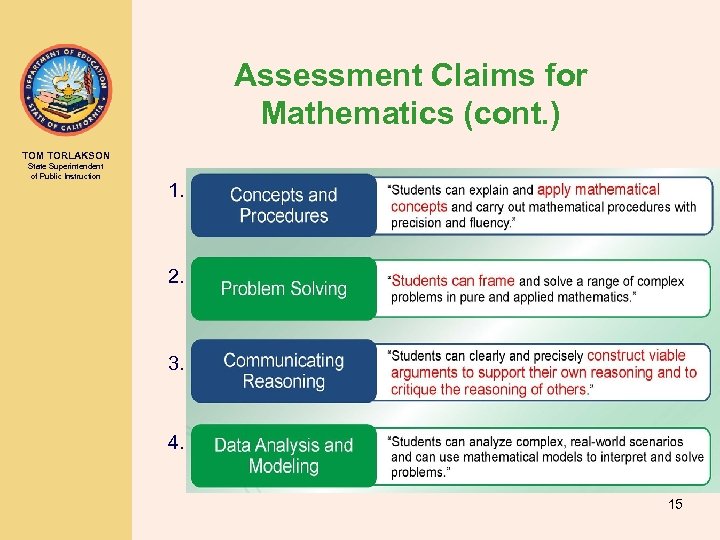
Assessment Claims for Mathematics (cont. ) TOM TORLAKSON State Superintendent of Public Instruction 1. 2. 3. 4. 15
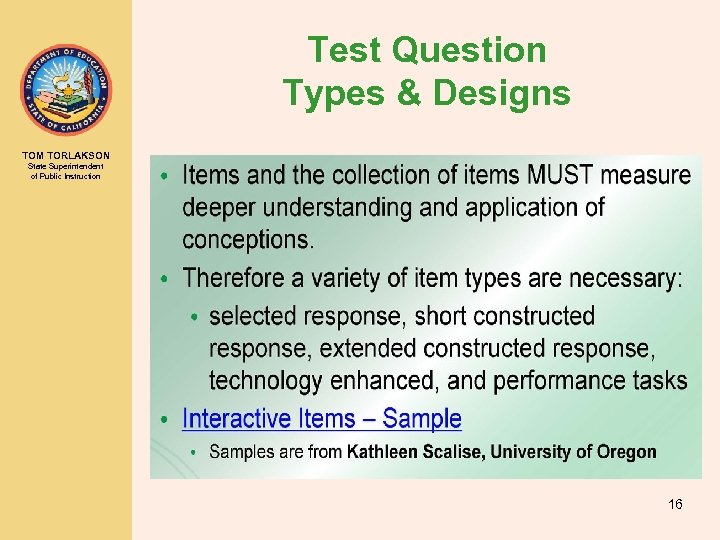
Test Question Types & Designs TOM TORLAKSON State Superintendent of Public Instruction 16
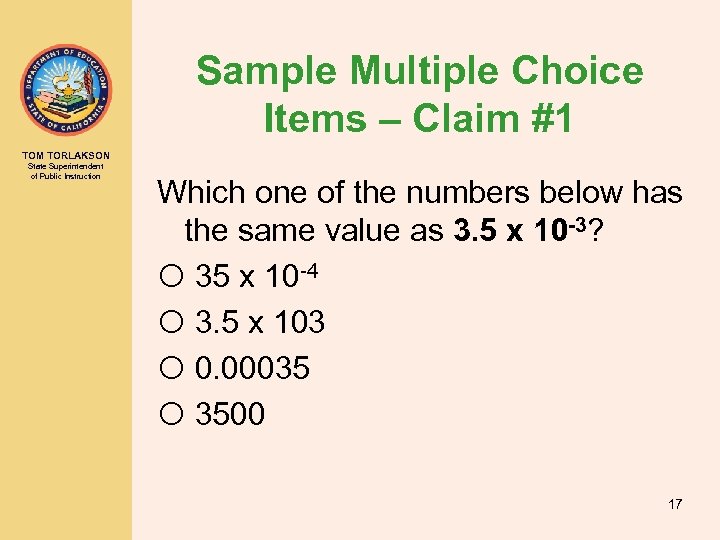
Sample Multiple Choice Items – Claim #1 TOM TORLAKSON State Superintendent of Public Instruction Which one of the numbers below has the same value as 3. 5 x 10 -3? 35 x 10 -4 3. 5 x 10³ 0. 00035 3500 17
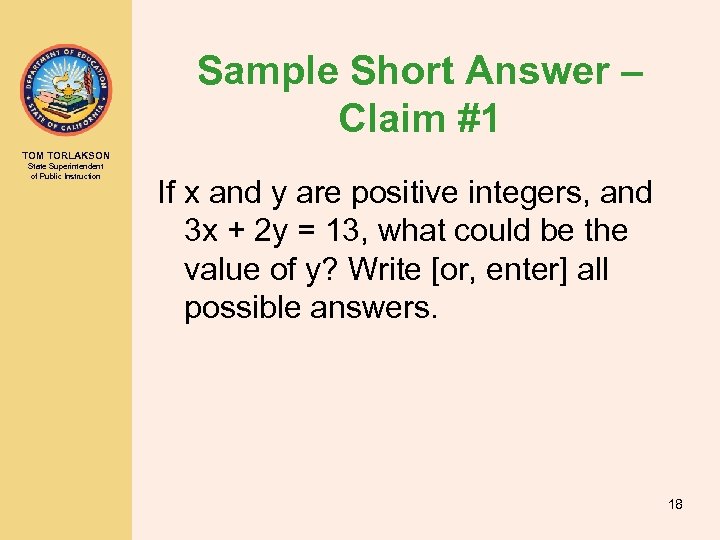
Sample Short Answer – Claim #1 TOM TORLAKSON State Superintendent of Public Instruction If x and y are positive integers, and 3 x + 2 y = 13, what could be the value of y? Write [or, enter] all possible answers. 18
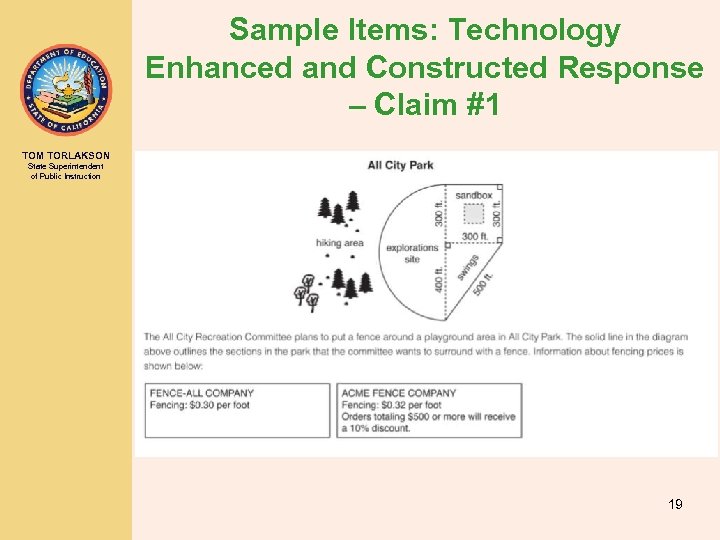
Sample Items: Technology Enhanced and Constructed Response – Claim #1 TOM TORLAKSON State Superintendent of Public Instruction 19
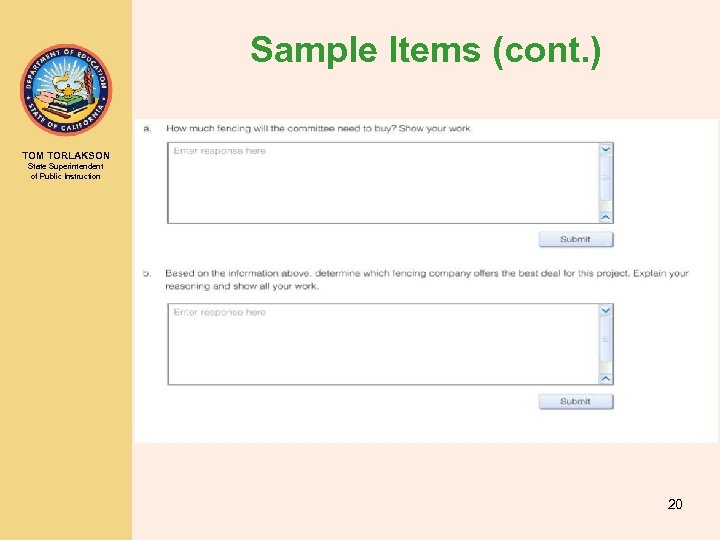
Sample Items (cont. ) TOM TORLAKSON State Superintendent of Public Instruction 20
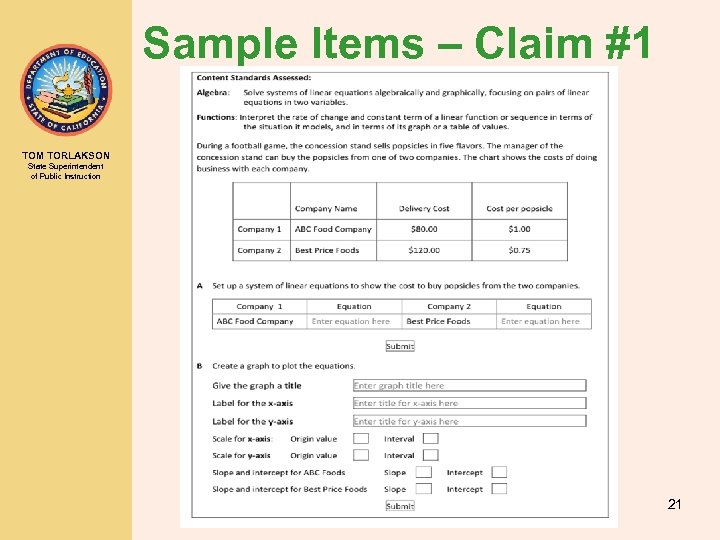
Sample Items – Claim #1 TOM TORLAKSON State Superintendent of Public Instruction 21
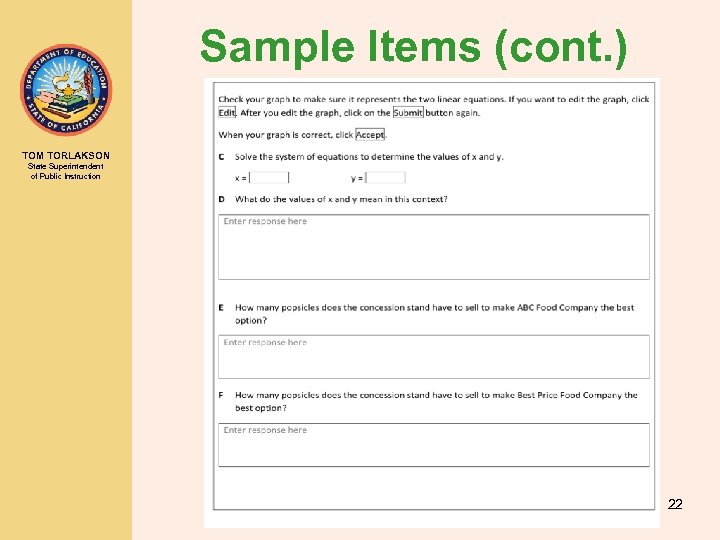
Sample Items (cont. ) TOM TORLAKSON State Superintendent of Public Instruction 22
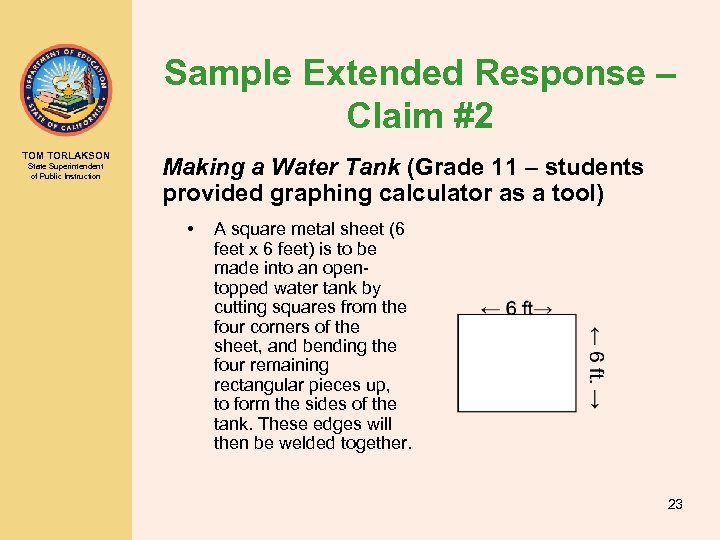
Sample Extended Response – Claim #2 TOM TORLAKSON State Superintendent of Public Instruction Making a Water Tank (Grade 11 – students provided graphing calculator as a tool) • A square metal sheet (6 feet x 6 feet) is to be made into an opentopped water tank by cutting squares from the four corners of the sheet, and bending the four remaining rectangular pieces up, to form the sides of the tank. These edges will then be welded together. 23
Sample Extended Response (cont. ) TOM TORLAKSON State Superintendent of Public Instruction A. How will the final volume of the tank depend upon the size of the squares cut from the corners? Describe your answer by: – i) Sketching a rough graph – ii) explaining the shape of your graph in words – iii) writing an algebraic formula for the volume B. How large should the four corners be cut, so that the resulting volume of the tank is as large as possible? • Item assesses Claim #2: Students can frame and solve a range of complex problems in pure and applied mathematics. 24
Sample Extended Response – Claim #4 TOM TORLAKSON State Superintendent of Public Instruction Planning a Class Trip You and your friends on the Class Activities Committee are charged with deciding where this year's class trip will be. You have a fixed budget for the class and you need to figure out what will be the most fun and affordable option. Your committee members have collected a bunch of brochures from various parks - e. g. , Marine World, Great Adventure, and others (see inbox of materials) which have different admissions costs and are different distances from school. You have also collected information about the costs of meals and buses. Your job is to plan and justify a trip that includes bus fare, admission and possibly rides, as well as lunch, within the fixed budget the class has. 25
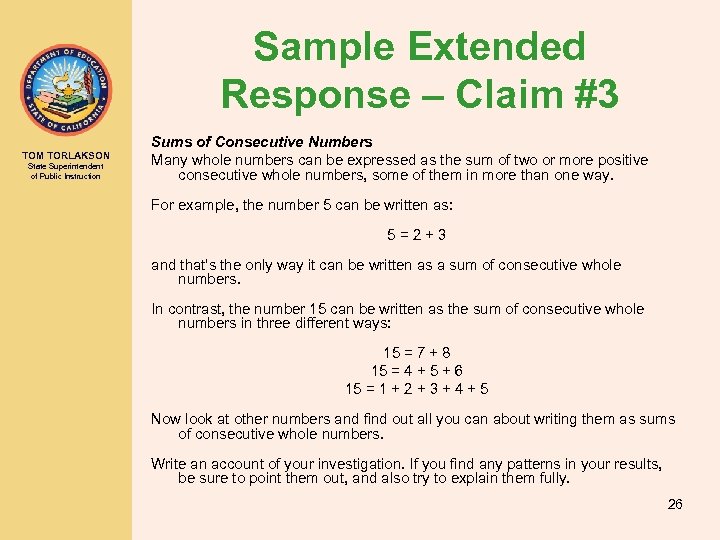
Sample Extended Response – Claim #3 TOM TORLAKSON State Superintendent of Public Instruction Sums of Consecutive Numbers Many whole numbers can be expressed as the sum of two or more positive consecutive whole numbers, some of them in more than one way. For example, the number 5 can be written as: 5=2+3 and that‘s the only way it can be written as a sum of consecutive whole numbers. In contrast, the number 15 can be written as the sum of consecutive whole numbers in three different ways: 15 = 7 + 8 15 = 4 + 5 + 6 15 = 1 + 2 + 3 + 4 + 5 Now look at other numbers and find out all you can about writing them as sums of consecutive whole numbers. Write an account of your investigation. If you find any patterns in your results, be sure to point them out, and also try to explain them fully. 26
TOM TORLAKSON State Superintendent of Public Instruction California currently has two sets of eighth grade mathematics standards. What is the SBAC plan for assessing grade eight students in mathematics? • The SBAC is developing a single assessment that is aligned to the Common Core grade eight mathematics standards. • As is the case now, student course selection is a local decision. • California will have to determine if another assessment should be developed. 27
SB 1200 - Hancock TOM TORLAKSON State Superintendent of Public Instruction • Requires the State Superintendent to recommend and the SBE to adopt the college and career readiness anchor standards developed by the Common Core State Standards Initiative 28
SB 1200 – Hancock (cont. ) TOM TORLAKSON State Superintendent of Public Instruction • Calls for a standards review commission to review the stateadopted CCSS in mathematics and recommend changes to the grade eight standards. 29
SBAC Resources TOM TORLAKSON State Superintendent of Public Instruction • SBAC information: – CDE/SBAC presentations and an electronic mailing list is found on the CDE SBAC Web page at http: //www. cde. ca. gov/ta/tg/sa/smarterbalanced. asp • To receive press releases and other announcements from SBAC, please email info@smarterbalanced. org • CCSS information: – www. cde. ca. gov/ci/cc/ 30
SBAC - CDE Contact Information TOM TORLAKSON State Superintendent of Public Instruction Patrick Traynor Division Director Assessment Development & Administration Division ptraynor@cde. ca. gov 916 -319 -0803 Kristen Brown SBAC Coordinator Education and Research Evaluation Consultant Assessment Development & Administration Division kbrown@cde. ca. gov 916 -319 -0334 31
Transitioning to New Assessments - STAR Reauthorization TOM TORLAKSON State Superintendent of Public Instruction • Assembly Bill (AB) 250 modifies California Education Code (EC) to address the development and adoption of new curriculum frameworks, instructional materials, professional development practices, and high-quality assessments. 32
Statutory Authorization TOM TORLAKSON State Superintendent of Public Instruction – Requires that the State Superintendent of Public Instruction (SSPI) develop recommendations for the reauthorization of the statewide pupil assessment system, which includes a plan for transitioning to a system of “high-quality” assessments as defined in EC Section 60603. 33
High-Quality Assessments TOM TORLAKSON State Superintendent of Public Instruction • Means an assessment designed to measure a pupil’s knowledge of, understanding of, and ability to apply critical concepts through the use of a variety of item types and formats, including, but not limited to, items that allow for open-ended responses and items that require the completion of performancebased tasks. 34
High-Quality Assessments TOM TORLAKSON State Superintendent of Public Instruction • A high-quality assessment should have the following characteristics: – Enable measurement of pupil achievement and pupil growth – Be of high technical quality by being valid, reliable, fair, and aligned to standards – Incorporate technology where appropriate – Include the assessment of pupils with disabilities and English learners – Use, to the extent feasible, universal design principles, as defined in Section 3 of the federal Assistive Technology Act of 1998 35
Requirements of Bill – Requires that the SSPI consult with TOM TORLAKSON State Superintendent of Public Instruction • The State Board of Education • Public Schools Accountability Act (PSSA) Committee • Measurement experts from California private and public universities • Individuals with expertise working with students with disabilities and English learners • Teachers, administrators, and governing boards from California’s local educational agencies. • Parents 36
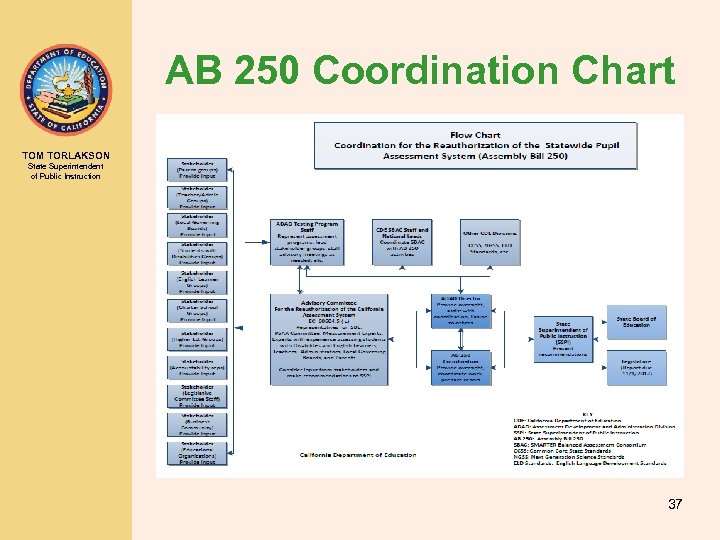
AB 250 Coordination Chart TOM TORLAKSON State Superintendent of Public Instruction 37
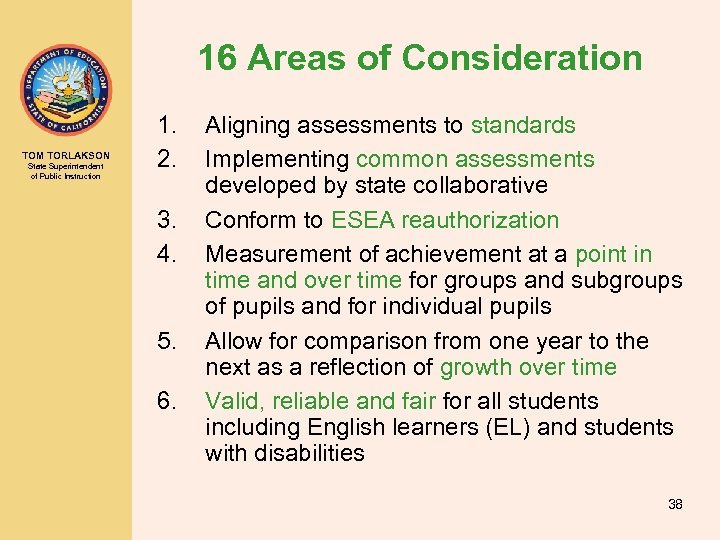
16 Areas of Consideration TOM TORLAKSON State Superintendent of Public Instruction 1. 2. 3. 4. 5. 6. Aligning assessments to standards Implementing common assessments developed by state collaborative Conform to ESEA reauthorization Measurement of achievement at a point in time and over time for groups and subgroups of pupils and for individual pupils Allow for comparison from one year to the next as a reflection of growth over time Valid, reliable and fair for all students including English learners (EL) and students with disabilities 38
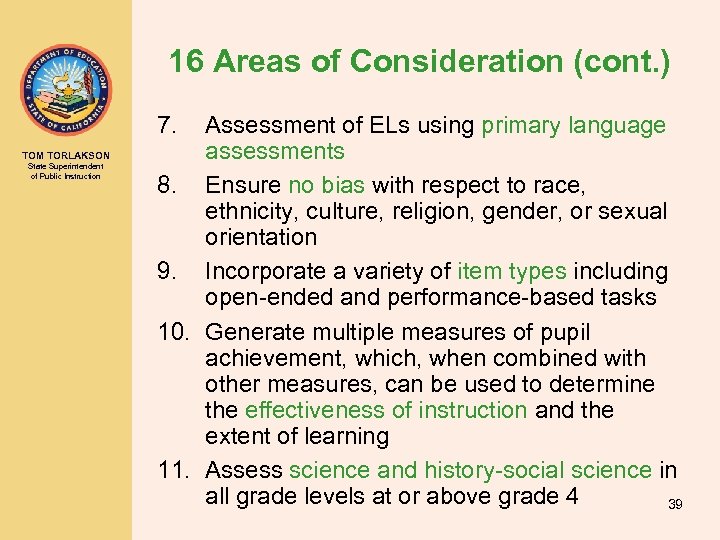
16 Areas of Consideration (cont. ) 7. TOM TORLAKSON State Superintendent of Public Instruction Assessment of ELs using primary language assessments 8. Ensure no bias with respect to race, ethnicity, culture, religion, gender, or sexual orientation 9. Incorporate a variety of item types including open-ended and performance-based tasks 10. Generate multiple measures of pupil achievement, which, when combined with other measures, can be used to determine the effectiveness of instruction and the extent of learning 11. Assess science and history-social science in all grade levels at or above grade 4 39
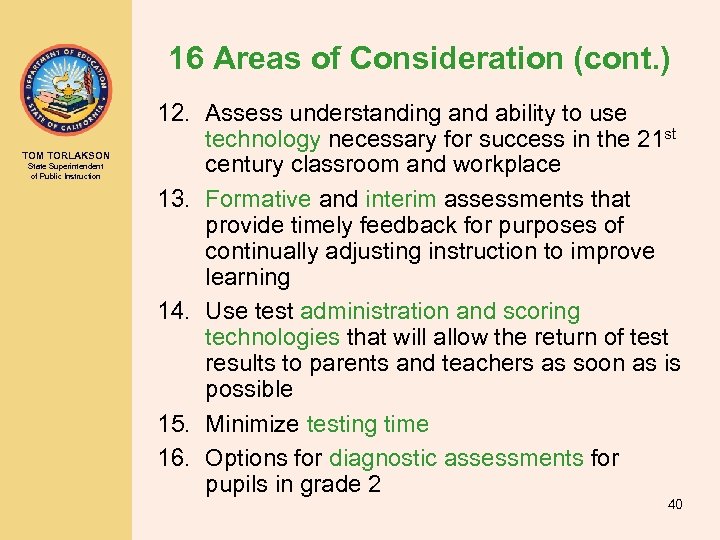
16 Areas of Consideration (cont. ) TOM TORLAKSON State Superintendent of Public Instruction 12. Assess understanding and ability to use technology necessary for success in the 21 st century classroom and workplace 13. Formative and interim assessments that provide timely feedback for purposes of continually adjusting instruction to improve learning 14. Use test administration and scoring technologies that will allow the return of test results to parents and teachers as soon as is possible 15. Minimize testing time 16. Options for diagnostic assessments for pupils in grade 2 40
Public Input Opportunities TOM TORLAKSON State Superintendent of Public Instruction • • • AB 250 Work Group Regional public meetings Survey Focus groups E-mail account – reauthorization@cde. ca. gov • Web page: http: //www. cde. ca. gov/ta/tg/sa/ab 250. asp 41
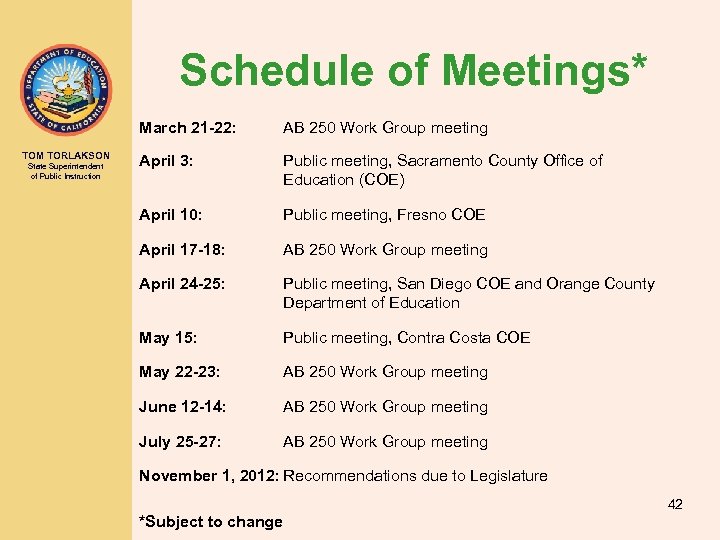
Schedule of Meetings* March 21 -22: TOM TORLAKSON State Superintendent of Public Instruction AB 250 Work Group meeting April 3: Public meeting, Sacramento County Office of Education (COE) April 10: Public meeting, Fresno COE April 17 -18: AB 250 Work Group meeting April 24 -25: Public meeting, San Diego COE and Orange County Department of Education May 15: Public meeting, Contra Costa COE May 22 -23: AB 250 Work Group meeting June 12 -14: AB 250 Work Group meeting July 25 -27: AB 250 Work Group meeting November 1, 2012: Recommendations due to Legislature 42 *Subject to change
Reauthorization of Statewide Assessment System CDE Contact Information TOM TORLAKSON State Superintendent of Public Instruction Patrick Traynor Division Director Assessment Development & Administration Division ptraynor@cde. ca. gov 916 -319 -0803 Jessica Barr AB 250 Lead Assessment Development & Administration Division jbarr@cde. ca. gov 916 -319 -0364 43
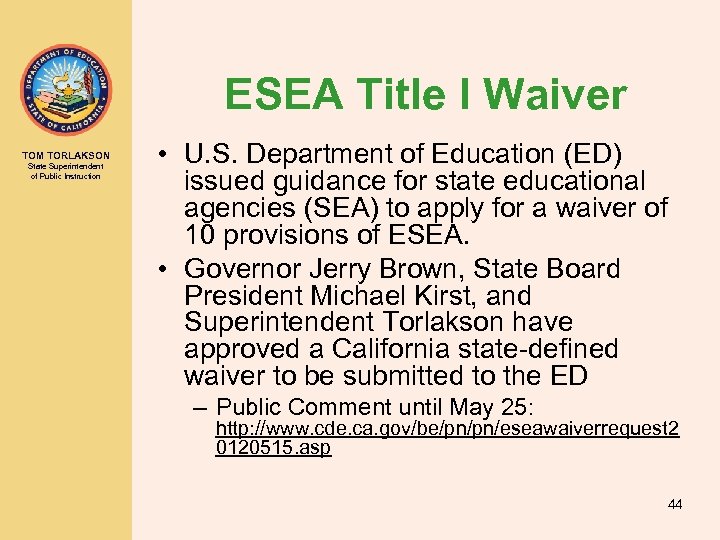
ESEA Title I Waiver TOM TORLAKSON State Superintendent of Public Instruction • U. S. Department of Education (ED) issued guidance for state educational agencies (SEA) to apply for a waiver of 10 provisions of ESEA. • Governor Jerry Brown, State Board President Michael Kirst, and Superintendent Torlakson have approved a California state-defined waiver to be submitted to the ED – Public Comment until May 25: http: //www. cde. ca. gov/be/pn/pn/eseawaiverrequest 2 0120515. asp 44
ESEA Reauthorization TOM TORLAKSON State Superintendent of Public Instruction • U. S. Congress had re-engaged in its deliberations on the reauthorization of ESEA but that has since stalled 45
Harkin Bill TOM TORLAKSON State Superintendent of Public Instruction • Harkin bill through Committee last October, but not a priority for Senate leadership • Harkin waits for bipartisan house action 46
Kline Bills TOM TORLAKSON State Superintendent of Public Instruction • Kline has 3 bills through Committee, one (charter schools) through full House • Kline’s 2 other bills which comprise a substantial reauthorization effort – Student Success Act (H. R. 3989) – Encouraging Innovation and Effective Teachers Act (H. R. 3990) • Kline’s bills receive harsh criticism from civil rights, business leaders, Congressional colleagues (not bipartisan effort) 47
Reflections TOM TORLAKSON State Superintendent of Public Instruction • Consider prior policy decisions and their impact to student/school decisions • Consider unintended long term consequences with a short term gain • Consider policy decisions made in the context of a fiscal crisis 48
Скачать презентацию TOM TORLAKSON State Superintendent of Public Instruction Assessment
9b51d7437c46931e26ff85471775e346.ppt