


 Скачать презентацию Tokamak physics and thermonuclear perspectives Alexei Dnestrovskij Kurchatov
lecture2004.ppt
- Количество слайдов: 24
 Tokamak physics and thermonuclear perspectives Alexei Dnestrovskij Kurchatov Institute, Moscow Russia 2004 This lecture was prepared during the visit to the Culham Science Centre, UK
 Outline • Requirements for fusion energy release, Lawson criterion • Tokamak device • Tokamak basic physics • Examples of Tokamak experiment • The next step – ITER
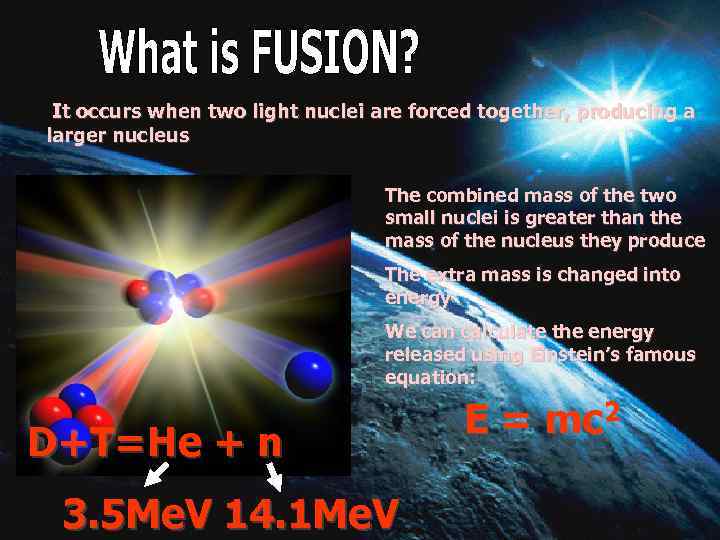 It occurs when two light nuclei are forced together, producing a larger nucleus The combined mass of the two small nuclei is greater than the mass of the nucleus they produce The extra mass is changed into energy We can calculate the energy released using Einstein’s famous equation: D+T=He + n 3. 5 Me. V 14. 1 Me. V E = mc 2
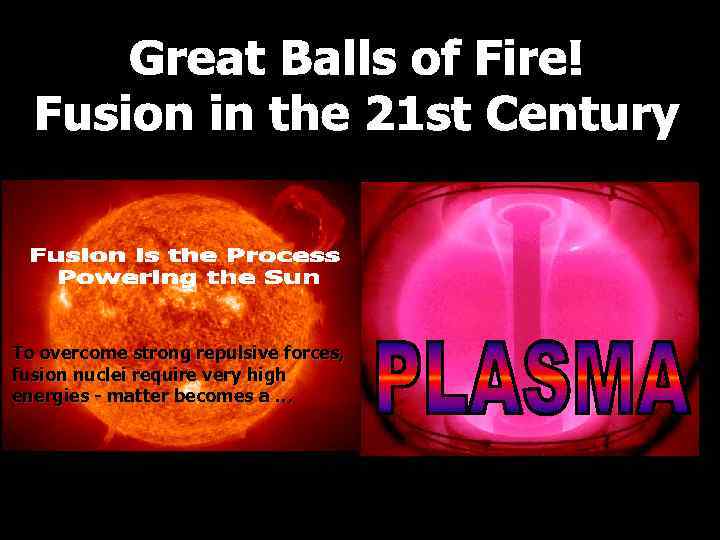 To overcome strong repulsive forces, fusion nuclei require very high energies - matter becomes a …
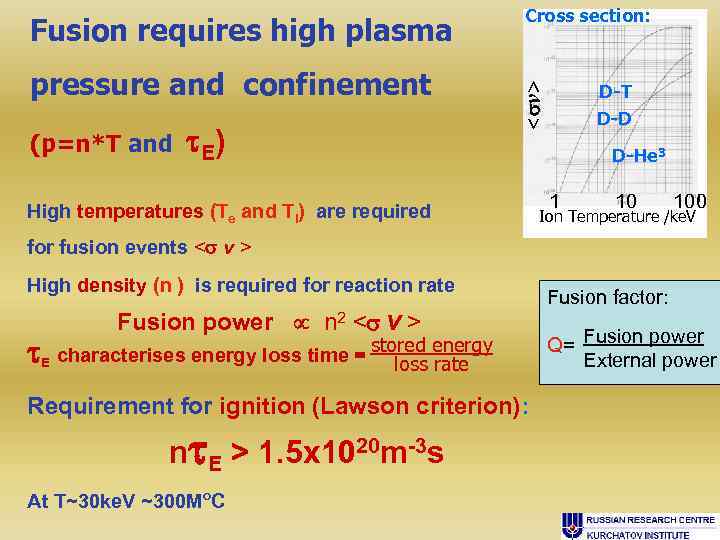 pressure and confinement (p=n*T and E) < v> Fusion requires high plasma Cross section: High temperatures (Te and Ti) are required D-T D-D D-He 3 1 1 10 10 100 Ion Temperature /ke. V for fusion events < v > High density (n ) is required for reaction rate E Fusion power n 2 < v > stored energy characterises energy loss time = loss rate Requirement for ignition (Lawson criterion): n E > 1. 5 x 10²⁰ m-3 s At T~30 ke. V ~300 Mo. C Fusion factor: Q= Fusion power External power
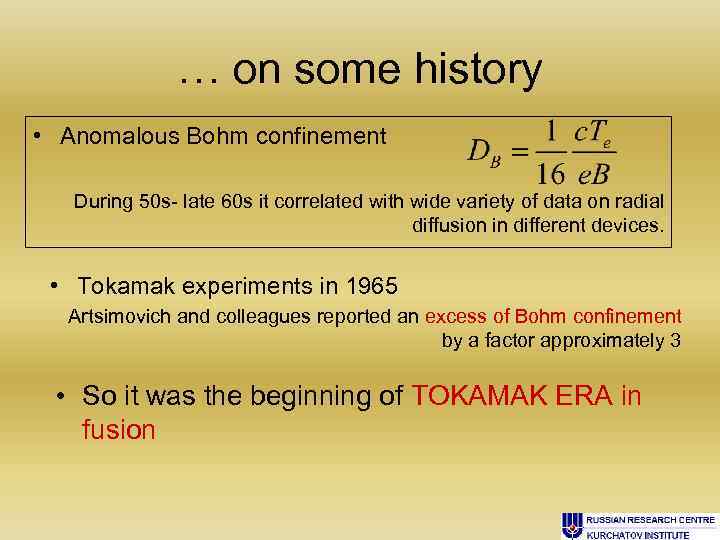 … on some history • Anomalous Bohm confinement During 50 s- late 60 s it correlated with wide variety of data on radial diffusion in different devices. • Tokamak experiments in 1965 Artsimovich and colleagues reported an excess of Bohm confinement by a factor approximately 3 • So it was the beginning of TOKAMAK ERA in fusion
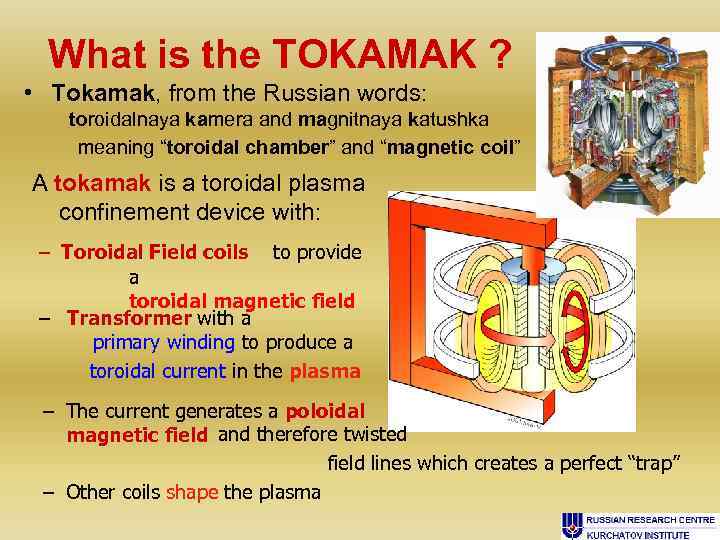 What is the TOKAMAK ? • Tokamak, from the Russian words: toroidalnaya kamera and magnitnaya katushka meaning “toroidal chamber” and “magnetic coil” A tokamak is a toroidal plasma confinement device with: – Toroidal Field coils to provide a toroidal magnetic field – Transformer with a primary winding to produce a toroidal current in the plasma – The current generates a poloidal magnetic field and therefore twisted field lines which creates a perfect “trap” – Other coils shape the plasma
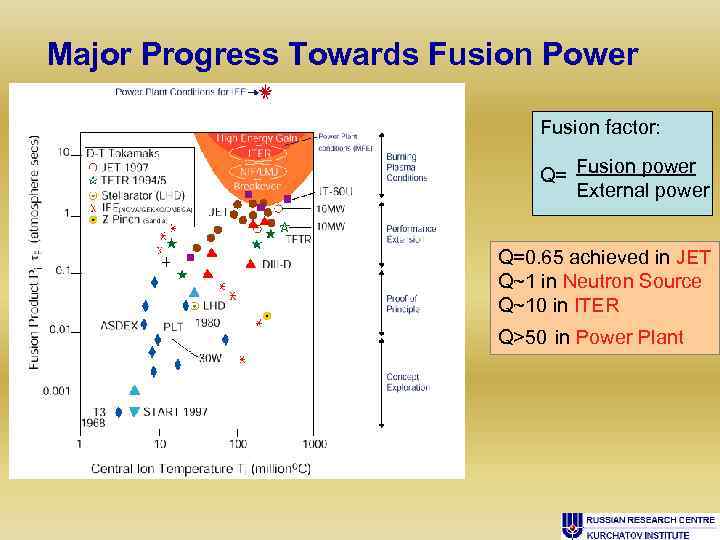 Major Progress Towards Fusion Power Fusion factor: Q= Fusion power External power Q=0. 65 achieved in JET Q~1 in Neutron Source Q~10 in ITER Q>50 in Power Plant
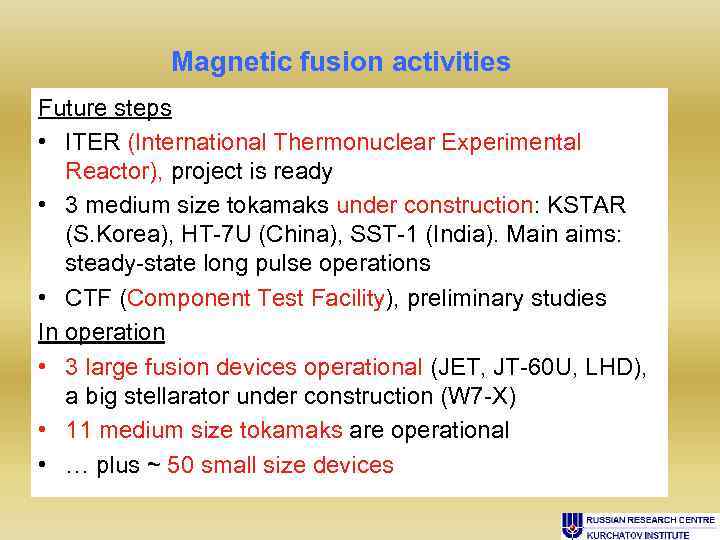 Magnetic fusion activities Future steps • ITER (International Thermonuclear Experimental Reactor), project is ready • 3 medium size tokamaks under construction: KSTAR (S. Korea), HT-7 U (China), SST-1 (India). Main aims: steady-state long pulse operations • CTF (Component Test Facility), preliminary studies In operation • 3 large fusion devices operational (JET, JT-60 U, LHD), a big stellarator under construction (W 7 -X) • 11 medium size tokamaks are operational • … plus ~ 50 small size devices
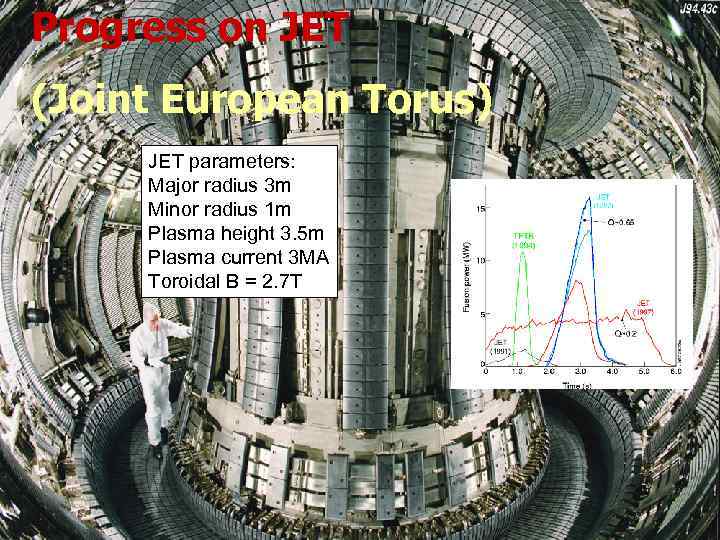 Progress on JET (Joint European Torus) JET parameters: Major radius 3 m Minor radius 1 m Plasma height 3. 5 m Plasma current 3 MA Toroidal B = 2. 7 T
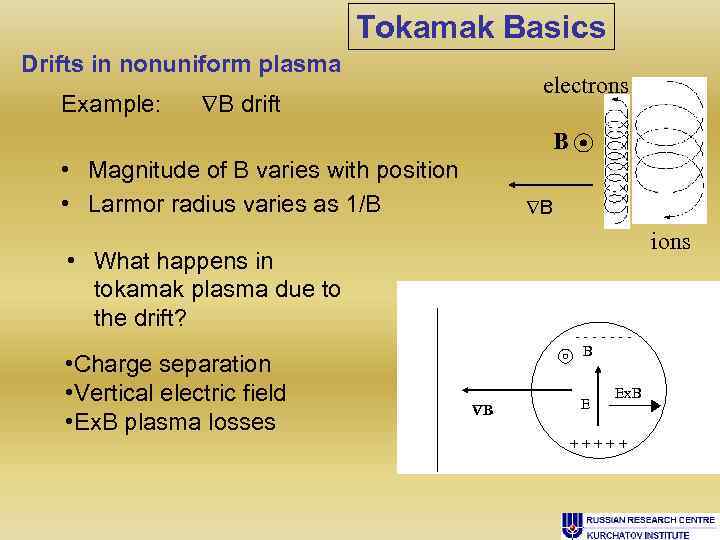 Tokamak Basics Drifts in nonuniform plasma Example: electrons B drift B • Magnitude of B varies with position • Larmor radius varies as 1/B • What happens in tokamak plasma due to the drift? • Charge separation • Vertical electric field • Ex. B plasma losses B ions • Outwards Ex. B drift ------B B B E Ex. B +++++
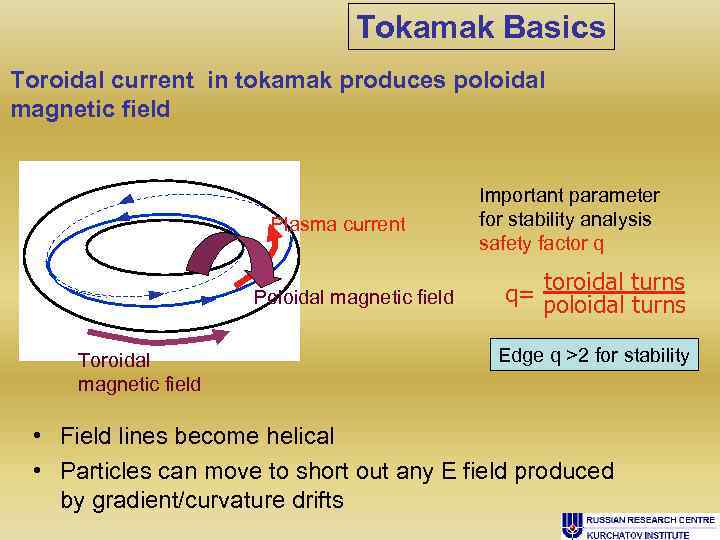 Tokamak Basics Toroidal current in tokamak produces poloidal magnetic field Plasma current Poloidal magnetic field Toroidal magnetic field Important parameter for stability analysis safety factor q toroidal q= poloidal turns Edge q >2 for stability • Field lines become helical • Particles can move to short out any E field produced by gradient/curvature drifts
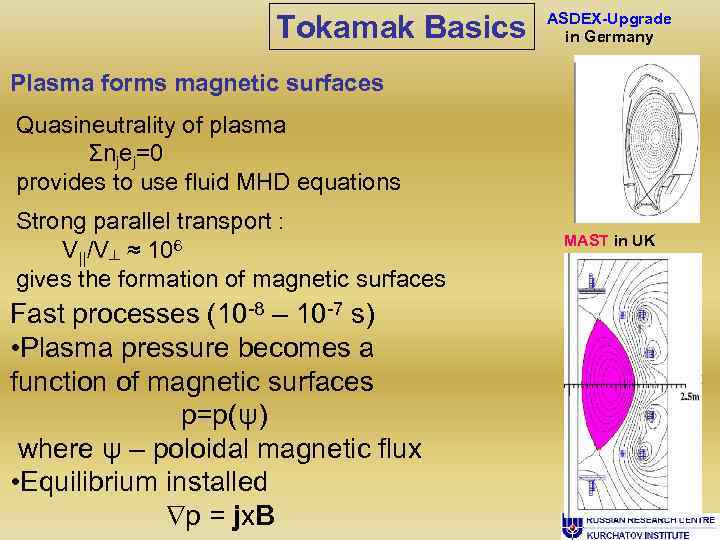 Tokamak Basics ASDEX-Upgrade in Germany Plasma forms magnetic surfaces Quasineutrality of plasma Σnjej=0 provides to use fluid MHD equations Strong parallel transport : V||/V┴ ≈ 106 gives the formation of magnetic surfaces Fast processes (10 -8 – 10 -7 s) • Plasma pressure becomes a function of magnetic surfaces p=p(ψ) where ψ – poloidal magnetic flux • Equilibrium installed p = jx. B MAST in UK
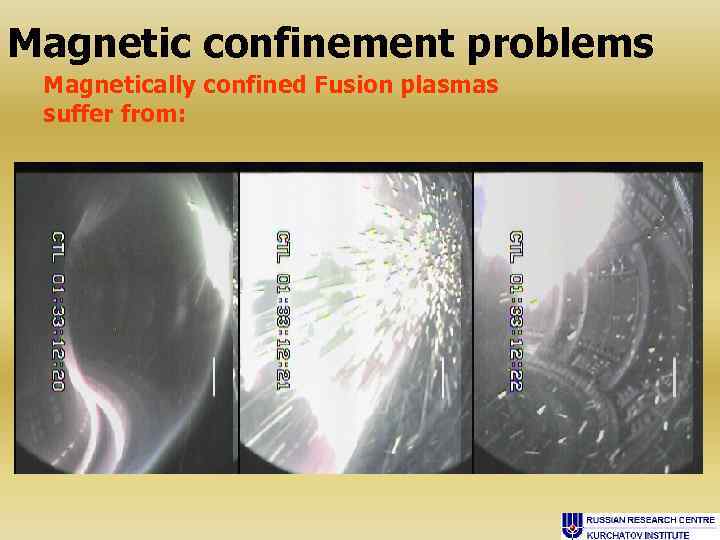 Magnetic confinement problems Magnetically confined Fusion plasmas suffer from: 1) Instability - difficult to confine a high density and temperature plasma with low magnetic fields. 2) Turbulence - limits the confinement time for a given sized machine. 3) Power loading - high volume to surface area ratio means power loading on surfaces is high. 4) Neutron activation - materials must withstand high neutron fluxes
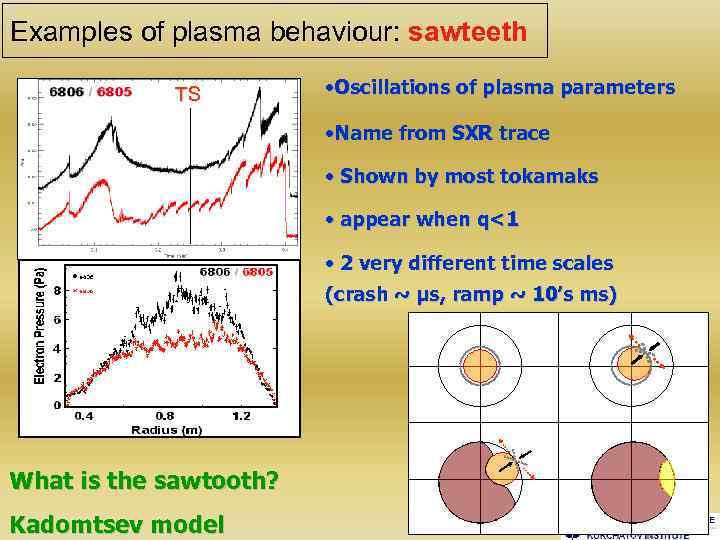 Examples of plasma behaviour: sawteeth TS • Oscillations of plasma parameters • Name from SXR trace • Shown by most tokamaks • appear when q<1 • 2 very different time scales (crash ~ µs, ramp ~ 10’s ms) What is the sawtooth? Kadomtsev model
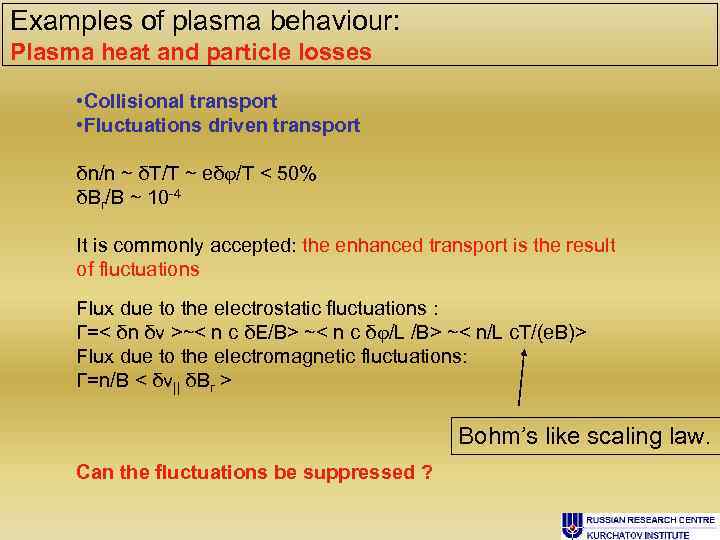 Examples of plasma behaviour: Plasma heat and particle losses • Collisional transport • Fluctuations driven transport δn/n ~ δT/T ~ eδ /T < 50% δBr/B ~ 10 -4 It is commonly accepted: the enhanced transport is the result of fluctuations Flux due to the electrostatic fluctuations : Γ=< δn δv >~< n c δE/B> ~< n c δ /L /B> ~< n/L c. T/(e. B)> Flux due to the electromagnetic fluctuations: Γ=n/B < δv|| δBr > Bohm’s like scaling law. Can the fluctuations be suppressed ?
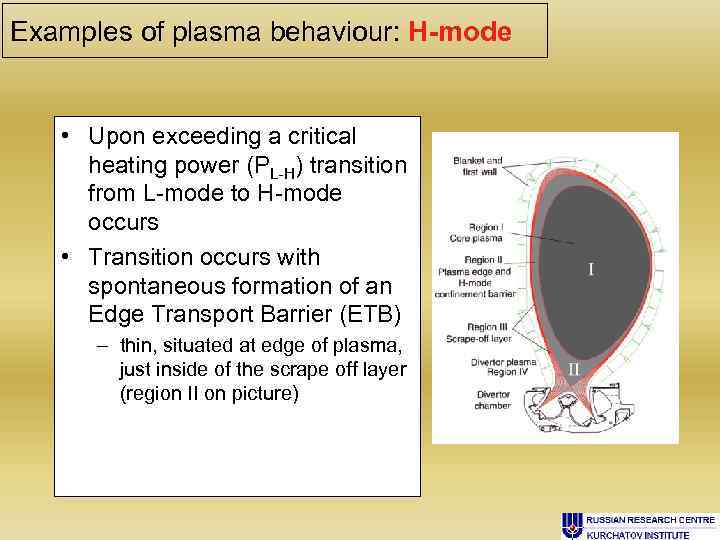 Examples of plasma behaviour: H-mode • Upon exceeding a critical heating power (PL-H) transition from L-mode to H-mode occurs • Transition occurs with spontaneous formation of an Edge Transport Barrier (ETB) – thin, situated at edge of plasma, just inside of the scrape off layer (region II on picture)
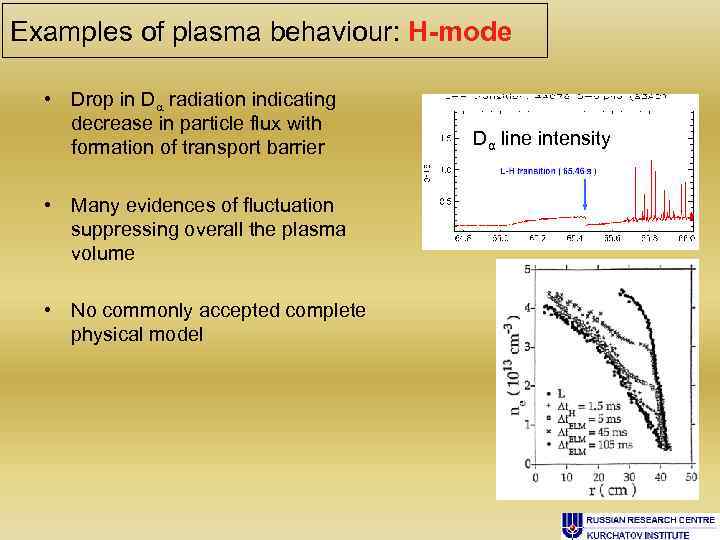 Examples of plasma behaviour: H-mode • Drop in D radiation indicating decrease in particle flux with formation of transport barrier • Many evidences of fluctuation suppressing overall the plasma volume • No commonly accepted complete physical model Dα line intensity
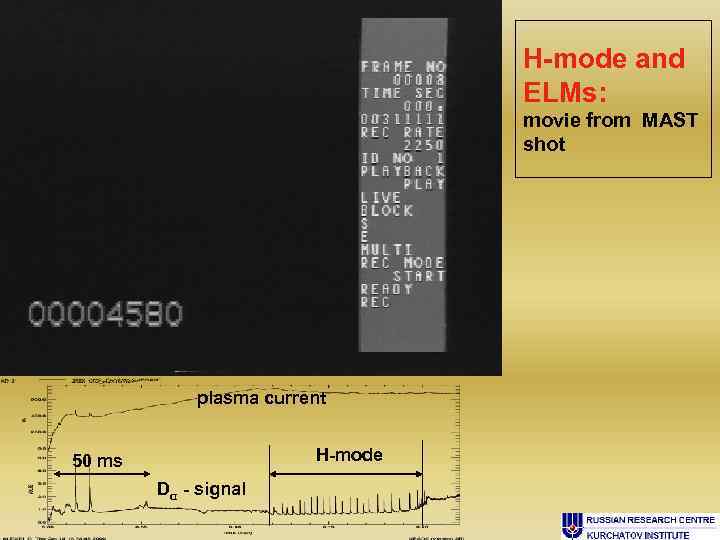 H-mode and ELMs: movie from MAST shot plasma current H-mode 50 ms Dα - signal
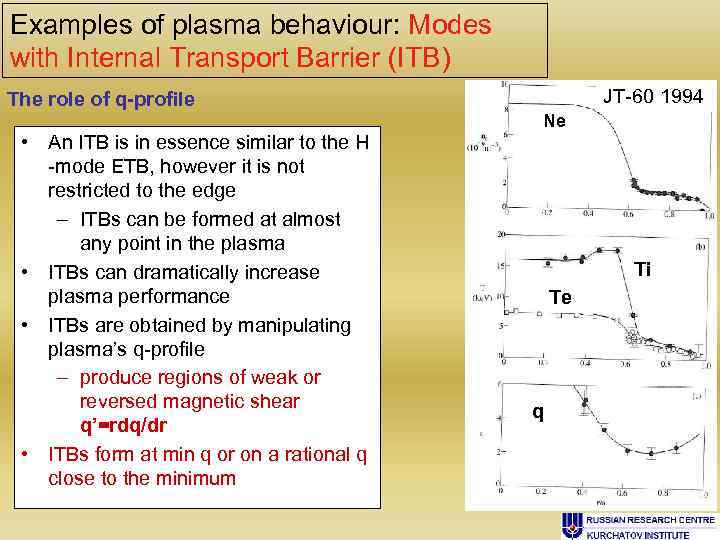 Examples of plasma behaviour: Modes with Internal Transport Barrier (ITB) JT-60 1994 The role of q-profile Ne • An ITB is in essence similar to the H -mode ETB, however it is not restricted to the edge – ITBs can be formed at almost any point in the plasma • ITBs can dramatically increase plasma performance • ITBs are obtained by manipulating plasma’s q-profile – produce regions of weak or reversed magnetic shear q’=rdq/dr • ITBs form at min q or on a rational q close to the minimum Ti Te q
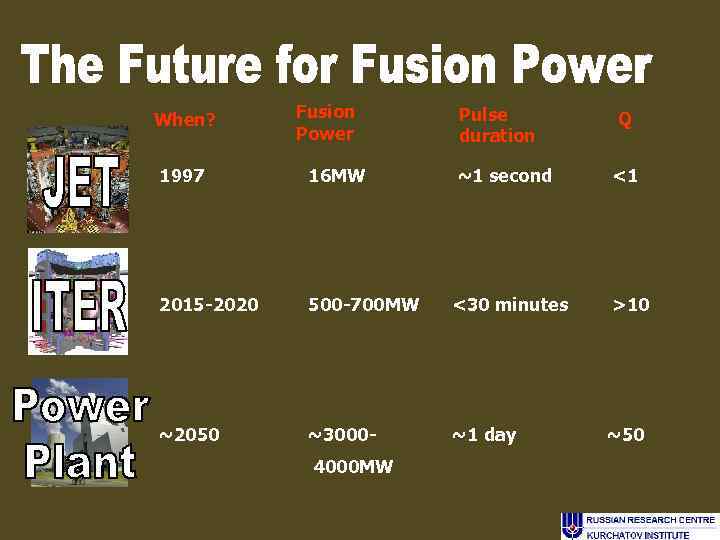 When? Fusion Power Pulse duration Q 1997 16 MW ~1 second <1 2015 -2020 500 -700 MW <30 minutes >10 ~2050 ~3000 - ~1 day ~50 4000 MW
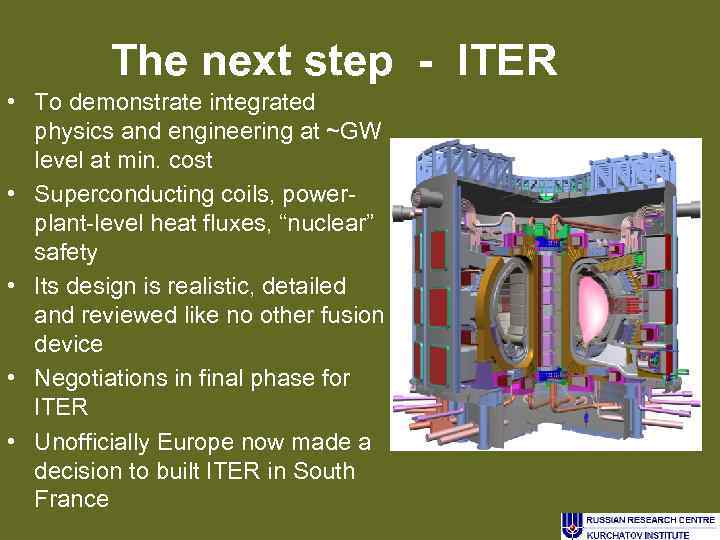 The next step - ITER • To demonstrate integrated physics and engineering at ~GW level at min. cost • Superconducting coils, powerplant-level heat fluxes, “nuclear” safety • Its design is realistic, detailed and reviewed like no other fusion device • Negotiations in final phase for ITER • Unofficially Europe now made a decision to built ITER in South France
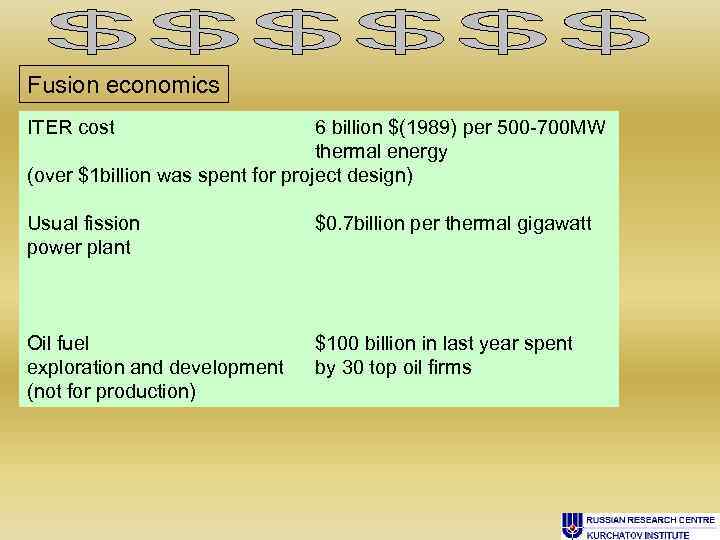 Fusion economics ITER cost 6 billion $(1989) per 500 -700 MW thermal energy (over $1 billion was spent for project design) Usual fission power plant $0. 7 billion per thermal gigawatt Oil fuel exploration and development (not for production) $100 billion in last year spent by 30 top oil firms
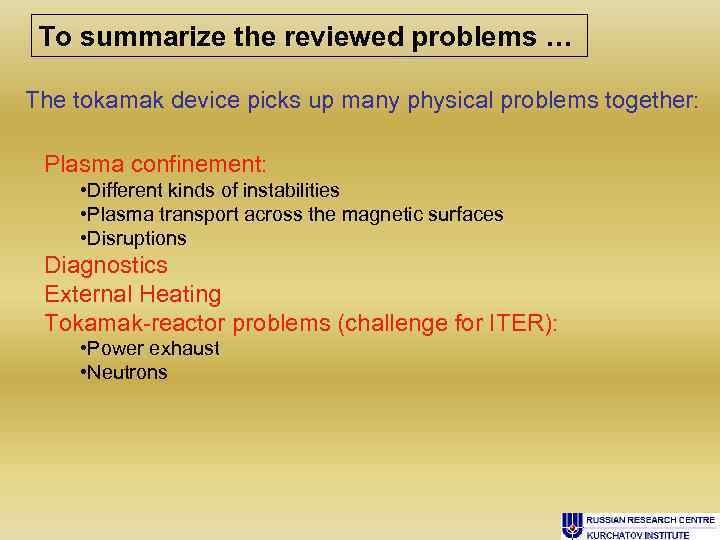 To summarize the reviewed problems … The tokamak device picks up many physical problems together: Plasma confinement: • Different kinds of instabilities • Plasma transport across the magnetic surfaces • Disruptions Diagnostics External Heating Tokamak-reactor problems (challenge for ITER): • Power exhaust • Neutrons