


 Скачать презентацию Today s Topics Ø Chapter 2 Internet and World
8b97c47ae807051130b622abfda7cc78.ppt
- Количество слайдов: 25
 Today’s Topics Ø Chapter 2: Internet and World Wide Web Ø Chapter 3: Wired and Wireless Technology
 Chapter 2 The Internet & World Wide Web
 How the Internet Works Ø Internet: a global computer network Ø Interoperability: a key success to the Internet Ø Internet Service Provider (ISP): a company that sells Internet accounts l Netzero, SBC, Charter, AT&T, Verizon Ø Online Service: a for-profit firm that provides a proprietary network l AOL, Earth. Link, MSN
 Internet Accesses Dial-Up Access: slow, not reliable but lowest cost Ø Digital Subscriber Line (DSL): medium, reliable but high cost Ø Cable and Satellite Access: fast, reliable but high cost Ø Satellite Access: medium, reliable, but high cost Ø Network Access: fast, available, and usually free to users Ø
 World Wide Web Ø WWW: a portion of the Internet that contains billions of documents Ø World Wide Web Consortium (W 3 C): an organization issuing standards related to all aspects of the Web Ø Web Site: a location that is accessible from the Internet and makes web pages available
 World Wide Web Ø Web Page: any document on a Web site that includes text, graphics, sound, or video Ø Home Page or Index Page: a default page that is displayed automatically when entering a site at the top level Ø Hypertext: a method of preparing and publishing text that is suited to be read with a computer
 World Wide Web Ø Hyperlink or Link: a word that can be clicked to bring another document into view Ø Distribute Hypermedia System: a networkbased content development system that uses multimedia resources as a mean of navigation or illustration Ø Dead or Broken Link: a link to documents that have disappeared
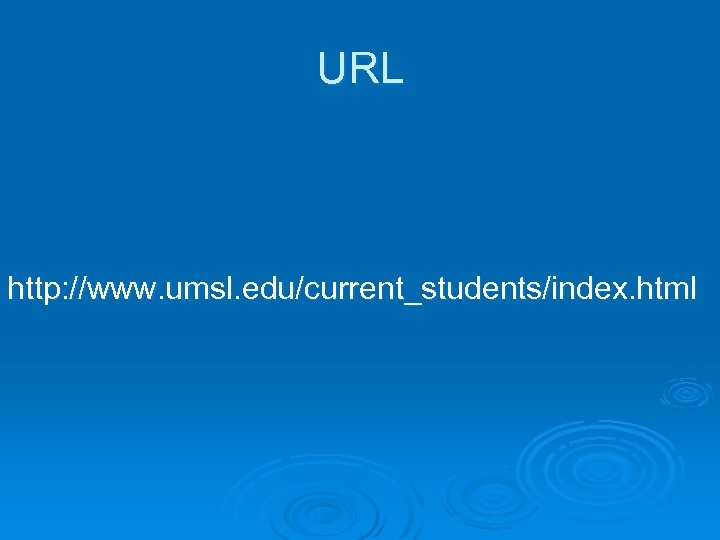
 World Wide Web Ø Web Browser: a program that displays a Web document l Ø IE, Netscape Navigator, Mosaic Uniform Resource Locator (URL): a string of characters that precisely identifies an Internet resource’s type and location l l Protocol Server Path Resource Name
 URL http: //www. umsl. edu/current_students/index. html
 URL Ø Hypertext Transfer Protocol (HTTP): the Internet standard that supports the exchange of information on the Web Ø Domain Name System (DNS): an Internet address system that includes letters as well as numbers Ø Domain Name Registration: a process for individuals and organizations to register a domain name
 URL Ø Top-Level Domain (TLD) Name: the last part of the domain name that indicates the type of organization in which the computer is located l . com, . edu, . gov, . org
 World Wide Web Ø Downloading: transferring a document or file from another computer to your computer Ø Uploading: transferring a document or file from your computer to another computer
 Finding Information on the Web Ø Search Engine: a searching database that claims to index the full Web l Ø Specialized Search Engine: a searching database to index specialized information l Ø Google, MSN, Yahoo, Alta. Vista Careerbuilder, Travelocity Portal: a gateway that provides a conveniently organized subject guide to various Internet content l MSN
 Search Techniques Ø Search Operators: symbols or words used for advanced searches l l l Inclusion and Exclusion Operators ( + and -) Wildcards (*) Phrase Searches (“ ”) Boolean Searches (AND, OR and NOT) Parentheses
 Internet Services E-Mail: a software application to send and receive messages via networks Ø E-Mail Attachment: any computer file that is included with an e-mail message Ø E-Mail Address: a unique cyberspace identity for a particular recipient composed of a user name, @ sign, name of the server hosting the e-mail service, and the top level domain Ø Spam: an unsolicited e-mail advertising Ø
 Internet Services Ø Instant Messaging (IM) System: a system that allows Internet users to exchange near real-time messages Ø Internet Relay Chat (IRC): an Internet service that allows Internet users to join chat groups, using text-based conversation Ø File Transfer Protocol (FTP): a way that files can be transferred over the Internet
 Internet Services Ø Usenet: a worldwide computer-based discussion system Ø Newsgroups: discussion groups devoted to a single topic Ø Listserv: electronic mailing list
 Chapter 3 Wired & Wireless Communication
 Communications Ø Communication: process of electronically sending and receiving messages between two points Ø Communication Channel: path through which messages are passed from one location to the next - analog signal: phone - digital signal : computer
 Communications Bandwidth: amount of data that can be transmitted through a given communication channel, measured in bits per second (bps) Ø Broadband: any transmission medium that transports high volumes of data at high speeds Ø Modem: communications device used to transmit data over telephone lines Ø l l Modulation: transformation from digital to analog Demodulation: transformation from analog to digital
 Transmission Media Ø Wired Media l l l Ø Twisted Pair Coaxial Cable Fiber-Optic Cable Wireless Media l l l Infrared Radio Bluetooth Microwaves Satellites
 Wired Communication Ø Public Switched Telephone Network (PSTN): global telephone system Ø Last-Mile Problem: inability of home and businesses to access the PSTN’s highspeed fiber-optic cables, along with bottleneck of data on the last mile of phone lines connecting homes and businesses
 Last-Mile Technologies Ø Integrated Services Digital Network (ISDN) Ø Digital Subscriber Line (DSL) Ø Coaxial Cable and Cable Modems Ø Leased Lines: T 1, T 2, T 3 Ø Synchronous Optical Network (SONET)
 Convergence Ø Convergence: merging of disparate objects into new combinations l l 1 G: Analog Cellular Phone 2 G: Personal Communication Service (PCS) • Digital Cellular Phone • Web-Based Device: PDA (Palm Pilot, Blackberry, etc. )
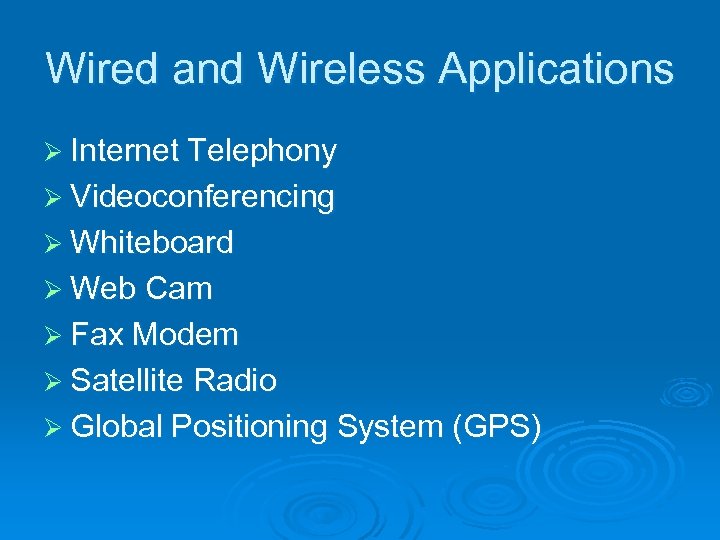 Wired and Wireless Applications Ø Internet Telephony Ø Videoconferencing Ø Whiteboard Ø Web Cam Ø Fax Modem Ø Satellite Radio Ø Global Positioning System (GPS)