


 Скачать презентацию Today o o Parts of vocal tract used
dd8d54bb1b5ad2bbf96c226736e2ada5.ppt
- Количество слайдов: 15
 Today o o Parts of vocal tract used in producing vowels Articulatory description of vowels IPA symbols for English vowels Speech Synthesis: brief intro Readings: 3. 4, 14. 4 -14. 5
 Review of Consonants Three-part Articulatory description of consonants: 1) Voicing 2) Place of articulation 3) Manner of articulation [d] = voiced alveolar stop
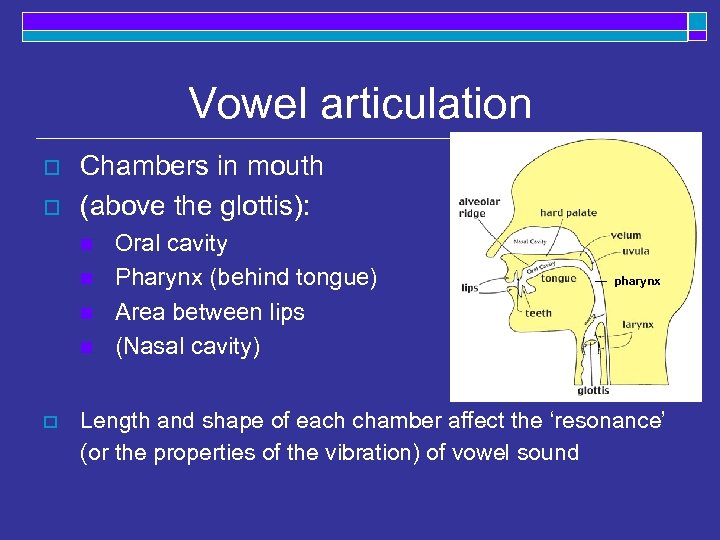 Vowel articulation o o Chambers in mouth (above the glottis): n n o Oral cavity Pharynx (behind tongue) Area between lips (Nasal cavity) --- pharynx Length and shape of each chamber affect the ‘resonance’ (or the properties of the vibration) of vowel sound
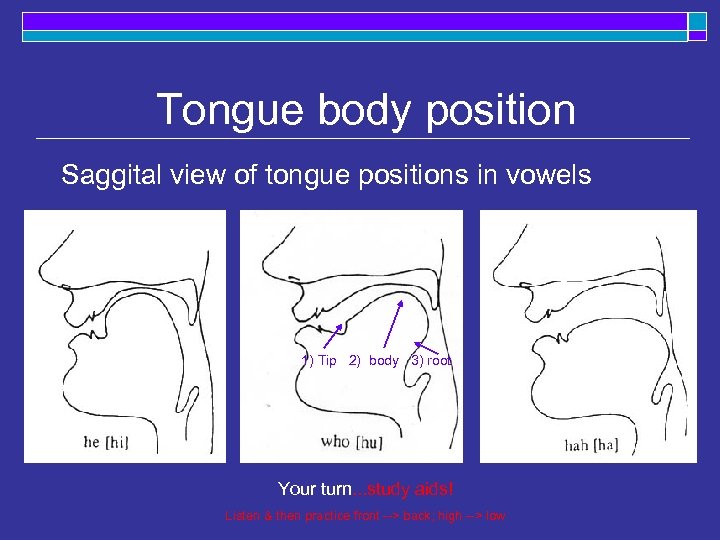 Tongue body position Saggital view of tongue positions in vowels 1) Tip 2) body 3) root Your turn. . . study aids! Listen & then practice front --> back; high --> low
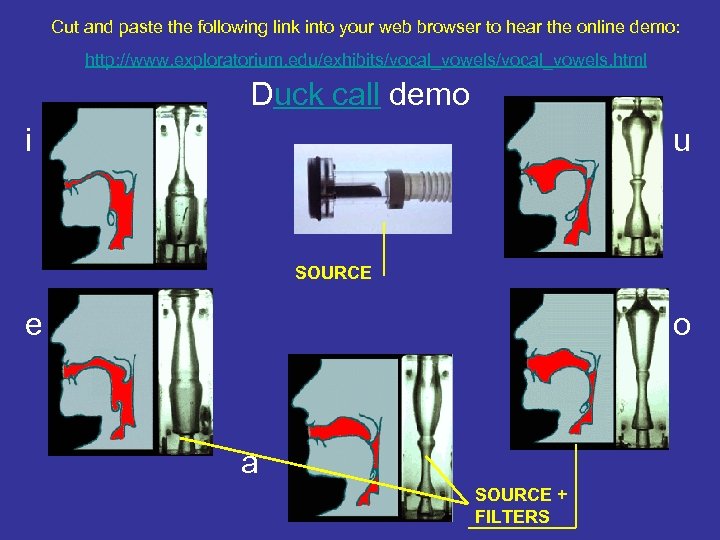 Cut and paste the following link into your web browser to hear the online demo: http: //www. exploratorium. edu/exhibits/vocal_vowels. html Duck call demo i u SOURCE e o a SOURCE + FILTERS
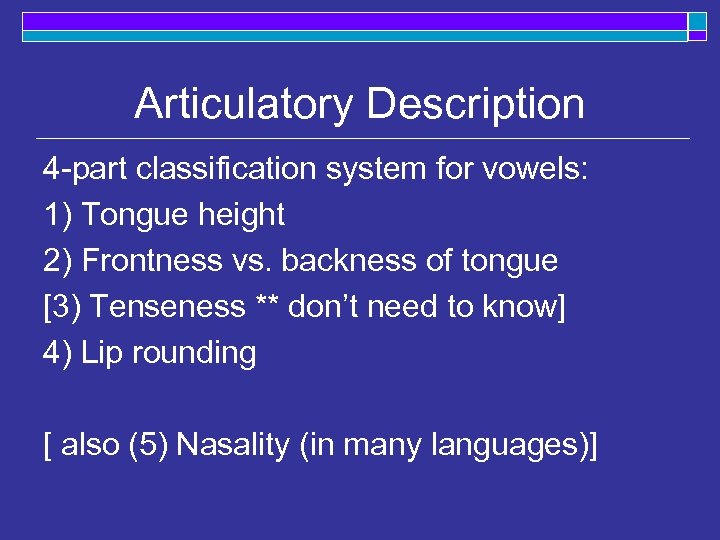 Articulatory Description 4 -part classification system for vowels: 1) Tongue height 2) Frontness vs. backness of tongue [3) Tenseness ** don’t need to know] 4) Lip rounding [ also (5) Nasality (in many languages)]
![Vowel height o High vowels: tongue body is raised n o [u] [U] ‘boot’](https://present5.com/presentation/dd8d54bb1b5ad2bbf96c226736e2ada5/image-7.jpg "Vowel height o High vowels: tongue body is raised n o [u] [U] ‘boot’") Vowel height o High vowels: tongue body is raised n o [u] [U] ‘boot’ ‘put’ Mid vowels: tongue body is intermediate n n o [i] [I] ‘beat’ ‘bit’ [e. I] [E] [e] ‘bait’ ‘bet’ [o. U] [ç] [o] ‘boat’ ‘bought’ ‘bore’* [ √ ] ‘butt’ Low vowels: tongue body is lowered n [Q] ‘bat’ [a] ‘bomb’ ‘bar’ [e] [espesijal] [e. I] *[e. Ispe. Isijal]
Vowel height o High vowels: tongue body is raised n o [u] [U] ‘boot’ ‘put’ Mid vowels: tongue body is intermediate n n o [i] [I] ‘beat’ ‘bit’ [e. I] [E] [e] ‘bait’ ‘bet’ [o. U] [ç] [o] ‘boat’ ‘bought’ ‘bore’* [ √ ] ‘butt’ Low vowels: tongue body is lowered n [Q] ‘bat’ [a] ‘bomb’ ‘bar’ [e] [espesijal] [e. I] *[e. Ispe. Isijal]
![Vowel height high [u] [i] [U] [I] mid low [e] [E] [Q] [´] [o]](https://present5.com/presentation/dd8d54bb1b5ad2bbf96c226736e2ada5/image-8.jpg "Vowel height high [u] [i] [U] [I] mid low [e] [E] [Q] [´] [o]") Vowel height high [u] [i] [U] [I] mid low [e] [E] [Q] [´] [o] [√] [ç] [a]
Vowel height high [u] [i] [U] [I] mid low [e] [E] [Q] [´] [o] [√] [ç] [a]
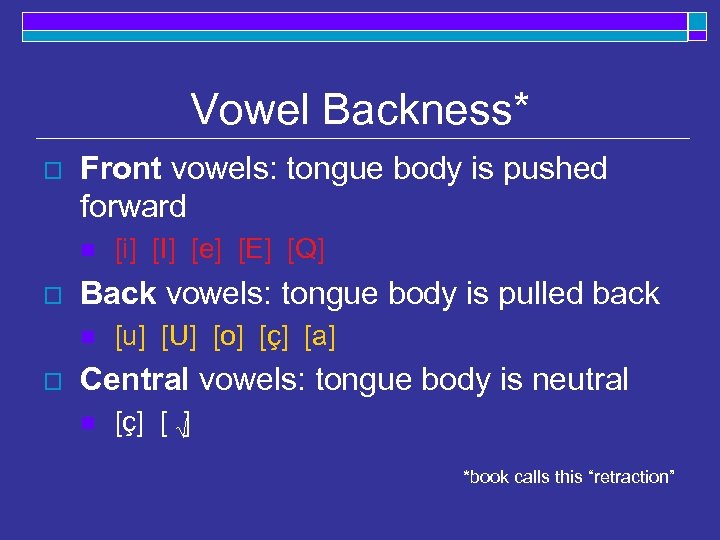 Vowel Backness* o Front vowels: tongue body is pushed forward n o Back vowels: tongue body is pulled back n o [i] [I] [e] [E] [Q] [u] [U] [o] [ç] [a] Central vowels: tongue body is neutral n [ç] [ √] *book calls this “retraction”
![Vowel Backness [u] [i] [U] [I] [e] [E] [´] [o] [√] [a] [Q] front](https://present5.com/presentation/dd8d54bb1b5ad2bbf96c226736e2ada5/image-10.jpg "Vowel Backness [u] [i] [U] [I] [e] [E] [´] [o] [√] [a] [Q] front") Vowel Backness [u] [i] [U] [I] [e] [E] [´] [o] [√] [a] [Q] front [ç] central back
Vowel Backness [u] [i] [U] [I] [e] [E] [´] [o] [√] [a] [Q] front [ç] central back
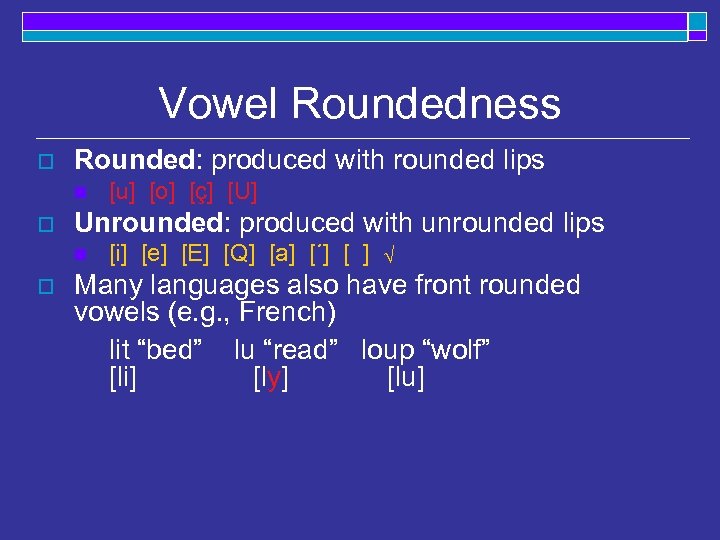 Vowel Roundedness o Rounded: produced with rounded lips n o Unrounded: produced with unrounded lips n o [u] [o] [ç] [U] [i] [e] [E] [Q] [a] [´] [ ] √ Many languages also have front rounded vowels (e. g. , French) lit “bed” lu “read” loup “wolf” [li] [ly] [lu]
![Vowel Roundedness high [u] [i] [U] [I] mid low [e] [E] [´] [o] [](https://present5.com/presentation/dd8d54bb1b5ad2bbf96c226736e2ada5/image-12.jpg "Vowel Roundedness high [u] [i] [U] [I] mid low [e] [E] [´] [o] [") Vowel Roundedness high [u] [i] [U] [I] mid low [e] [E] [´] [o] [ ʌ [ç] ] [a] [Q] front central back round
Vowel Roundedness high [u] [i] [U] [I] mid low [e] [E] [´] [o] [ ʌ [ç] ] [a] [Q] front central back round
![Practice: Articulatory descriptions [i] [o] [a] = High front unrounded = Mid back rounded](https://present5.com/presentation/dd8d54bb1b5ad2bbf96c226736e2ada5/image-13.jpg "Practice: Articulatory descriptions [i] [o] [a] = High front unrounded = Mid back rounded") Practice: Articulatory descriptions [i] [o] [a] = High front unrounded = Mid back rounded = Low back unrounded
Practice: Articulatory descriptions [i] [o] [a] = High front unrounded = Mid back rounded = Low back unrounded
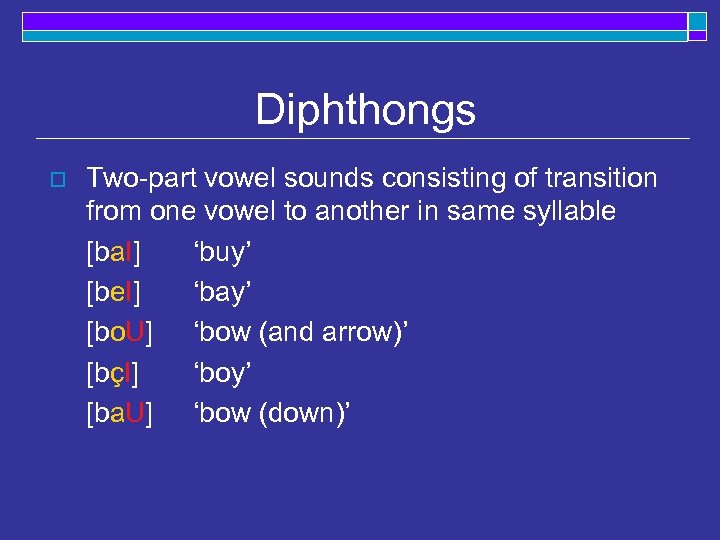 Diphthongs o Two-part vowel sounds consisting of transition from one vowel to another in same syllable [ba. I] ‘buy’ [be. I] ‘bay’ [bo. U] ‘bow (and arrow)’ [bçI] ‘boy’ [ba. U] ‘bow (down)’
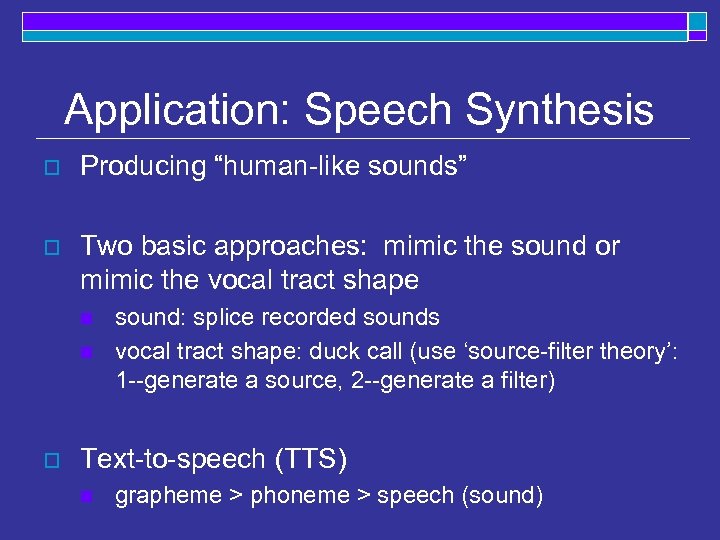 Application: Speech Synthesis o Producing “human-like sounds” o Two basic approaches: mimic the sound or mimic the vocal tract shape n n o sound: splice recorded sounds vocal tract shape: duck call (use ‘source-filter theory’: 1 --generate a source, 2 --generate a filter) Text-to-speech (TTS) n grapheme > phoneme > speech (sound)