


 Скачать презентацию To SEE — Tourism in Southern and Eastern
7dcd8e768821130d5433db5f739ffd7c.ppt
- Количество слайдов: 12
 To. SEE - Tourism in Southern and Eastern Europe 4 th International Scientific Conference Tourism and Creative Industries: Trends and Challenges University of Rijeka, Faculty of Tourism and Hospitality Management New energy measures for sustainable local development – a challange for hotel industry Marinela Krstinić Nižić Maša Trinajstić Branko Blažević Faculty of Tourism and Hospitality Management, Opatija, Croatia marikn@fthm. hr masat@fthm. hr brankob@fthm. hr http: //www. fthm. uniri. hr To. SEE 2017 Slide Number
 To. SEE - Tourism in Southern and Eastern Europe 4 th International Scientific Conference Tourism and Creative Industries: Trends and Challenges University of Rijeka, Faculty of Tourism and Hospitality Management Purpose Analyse and propose new energy measures to increase energy efficiency, reduce energy costs and achieve sustainable local development To explore correlation between hotel size and reactive energy consumption To explore correlation between new technologies and reactive energy consumption To. SEE 2017 Slide Number 2
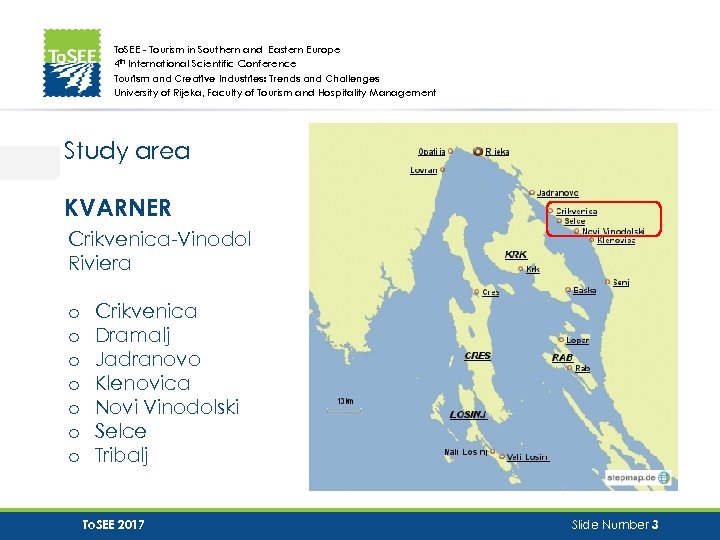 To. SEE - Tourism in Southern and Eastern Europe 4 th International Scientific Conference Tourism and Creative Industries: Trends and Challenges University of Rijeka, Faculty of Tourism and Hospitality Management Study area KVARNER Crikvenica-Vinodol Riviera o o o o Crikvenica Dramalj Jadranovo Klenovica Novi Vinodolski Selce Tribalj To. SEE 2017 Slide Number 3
 To. SEE - Tourism in Southern and Eastern Europe 4 th International Scientific Conference Tourism and Creative Industries: Trends and Challenges University of Rijeka, Faculty of Tourism and Hospitality Management Study area Crikvenica – Vinodol Riviera: larger cities like Crikvenica, Selce, Novi Vinodolski The research was conducted in 3* and 4* hotels: between 18 hotels in this Riviera, for analysis were selected 6 - 2 smaller, 2 medium and 2 large hotels To. SEE 2017 Slide Number 4
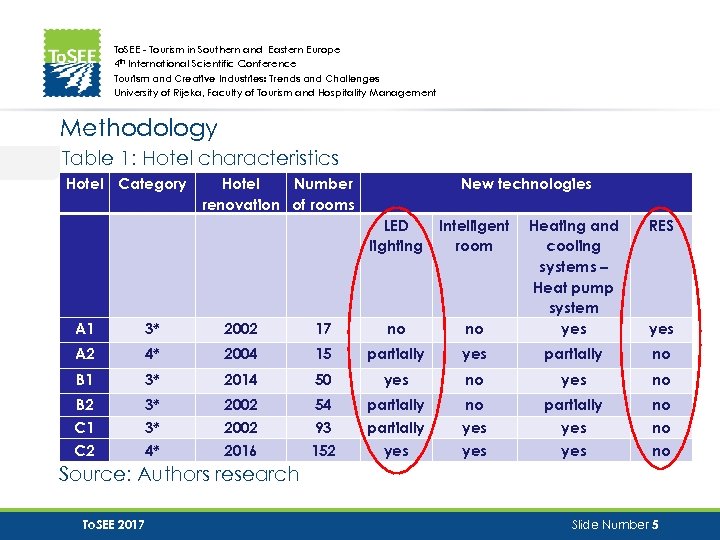 To. SEE - Tourism in Southern and Eastern Europe 4 th International Scientific Conference Tourism and Creative Industries: Trends and Challenges University of Rijeka, Faculty of Tourism and Hospitality Management Methodology Table 1: Hotel characteristics Hotel Category Hotel Number renovation of rooms A 1 3* 2002 A 2 4* B 1 New technologies LED lighting Intelligent room no Heating and cooling systems – Heat pump system yes 17 no 2004 15 3* 2014 B 2 3* C 1 C 2 RES yes partially no 50 yes no 2002 54 partially no 3* 2002 93 partially yes no 4* 2016 152 yes yes no Source: Authors research To. SEE 2017 Slide Number 5
 To. SEE - Tourism in Southern and Eastern Europe 4 th International Scientific Conference Tourism and Creative Industries: Trends and Challenges University of Rijeka, Faculty of Tourism and Hospitality Management Methodology Study uses primary and secondary data sources Interviews were conducted with the managers of the 6 selected hotels Authors were allowed insight into electricity invoices for the year 2016 Determined whethere is a correlation between the size of the hotel and reactive energy consumption and whether new technologies influence that consumption To. SEE 2017 Slide Number 6
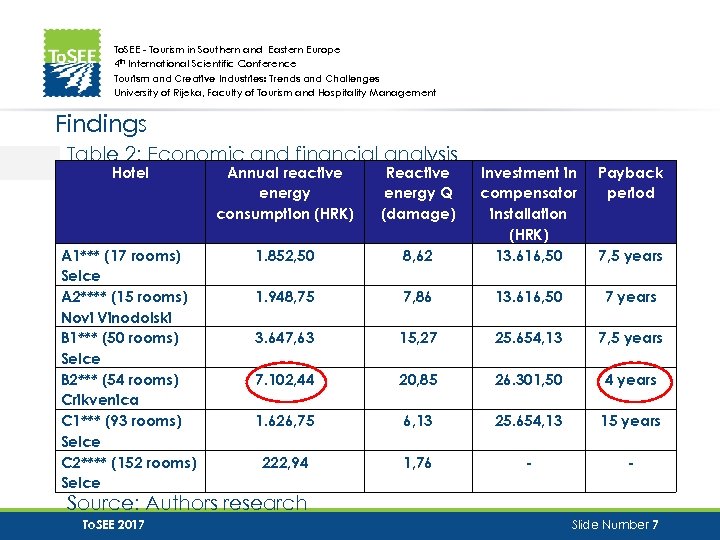 To. SEE - Tourism in Southern and Eastern Europe 4 th International Scientific Conference Tourism and Creative Industries: Trends and Challenges University of Rijeka, Faculty of Tourism and Hospitality Management Findings Table 2: Economic and financial analysis Hotel Annual reactive energy consumption (HRK) Reactive energy Q (damage) Payback period 8, 62 Investment in compensator installation (HRK) 13. 616, 50 A 1*** (17 rooms) Selce A 2**** (15 rooms) Novi Vinodolski B 1*** (50 rooms) Selce B 2*** (54 rooms) Crikvenica C 1*** (93 rooms) Selce C 2**** (152 rooms) Selce 1. 852, 50 1. 948, 75 7, 86 13. 616, 50 7 years 3. 647, 63 15, 27 25. 654, 13 7, 5 years 7. 102, 44 20, 85 26. 301, 50 4 years 1. 626, 75 6, 13 25. 654, 13 15 years 222, 94 1, 76 - - 7, 5 years Source: Authors research To. SEE 2017 Slide Number 7
 To. SEE - Tourism in Southern and Eastern Europe 4 th International Scientific Conference Tourism and Creative Industries: Trends and Challenges University of Rijeka, Faculty of Tourism and Hospitality Management Findings The resulting values and the data from Table 1 indicate that the size of the hotel does not correlate to reactive energy consumption The highest reactive energy consumption is recorded in the medium-size hotel B 2 with 54 rooms, while the lowest is in the large hotel C 2, which has 152 rooms The correlation between new technologies and reactive energy consumption does exist The hotels that use new technology (LED lighting, smart rooms, central heating and cooling system - heat pump, RES) have lower annual reactive energy consumption To. SEE 2017 Slide Number 8
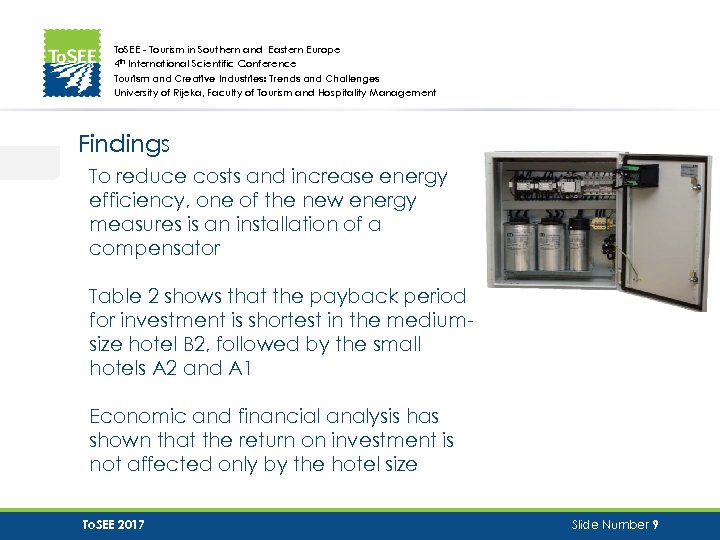 To. SEE - Tourism in Southern and Eastern Europe 4 th International Scientific Conference Tourism and Creative Industries: Trends and Challenges University of Rijeka, Faculty of Tourism and Hospitality Management Findings To reduce costs and increase energy efficiency, one of the new energy measures is an installation of a compensator Table 2 shows that the payback period for investment is shortest in the mediumsize hotel B 2, followed by the small hotels A 2 and A 1 Economic and financial analysis has shown that the return on investment is not affected only by the hotel size To. SEE 2017 Slide Number 9
 To. SEE - Tourism in Southern and Eastern Europe 4 th International Scientific Conference Tourism and Creative Industries: Trends and Challenges University of Rijeka, Faculty of Tourism and Hospitality Management Contribution Authors suggests a number of measures for energy management, energy saving and increasing energy efficiency q Hotel energy policy q Energy planning q Energy monitoring and measuring q Financing q Analysis Proposed measures provide the guidelines for tourism management To. SEE 2017 Slide Number 10
 To. SEE - Tourism in Southern and Eastern Europe 4 th International Scientific Conference Tourism and Creative Industries: Trends and Challenges University of Rijeka, Faculty of Tourism and Hospitality Management Conclusion Hotels consume large amounts of energy in order to maintain the high level of comfort and service quality It represents a major environmental and economic problem; to increase energy efficiency, hotels implement different energy measures: Ø creation of energy policy and systematic planning and analysing Increasing energy efficiency has multiple effects on both, local development and the hotel itself; it reduces air pollution and CO 2 emissions, encourages investment in infrastructure and creates new jobs To. SEE 2017 Slide Number 11
 To. SEE - Tourism in Southern and Eastern Europe 4 th International Scientific Conference Tourism and Creative Industries: Trends and Challenges University of Rijeka, Faculty of Tourism and Hospitality Management Thank you for your attention! § § § Marinela Krstinić Nižić Maša Trinajstić Branko Blažević Faculty of Tourism and Hospitality Management, Opatija E-mail: marikn@fthm. hr; masat@fthm. hr; brankob@fthm. hr To. SEE 2017 Slide Number 12