


 Скачать презентацию To provide additional guidance in managing cases
dc6a54a31155f16146a6cf79c4c20040.ppt
- Количество слайдов: 39
 To provide additional guidance in managing cases involving domestic violence, especially during intake, case management and case closure To increase safety for YOU and the family To provide you with more in-depth, comprehensive assessment tools for domestic violence cases

 Improved assessments for clients Increased safety for children, family and staff More accurate assessment of danger Improved outcomes for domestic violence cases Greater efficiency when working with domestic violence cases More effective policies and goals
 Domestic Violence is the establishment of control and fear in a relationship through the use of coercive, controlling behaviors, violence and many other forms of abuse. The offender may use physical abuse, emotional abuse, sexual abuse, economic oppression, isolation, threats, intimidation and maltreatment of the children to control the other person. Relationships involving domestic violence may differ in terms of the severity of the abuse, but the power and control is the primary goal of all offenders.
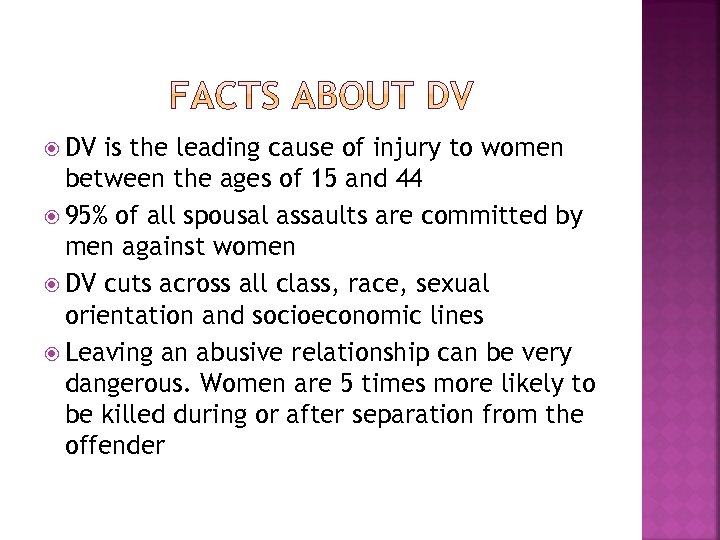 DV is the leading cause of injury to women between the ages of 15 and 44 95% of all spousal assaults are committed by men against women DV cuts across all class, race, sexual orientation and socioeconomic lines Leaving an abusive relationship can be very dangerous. Women are 5 times more likely to be killed during or after separation from the offender
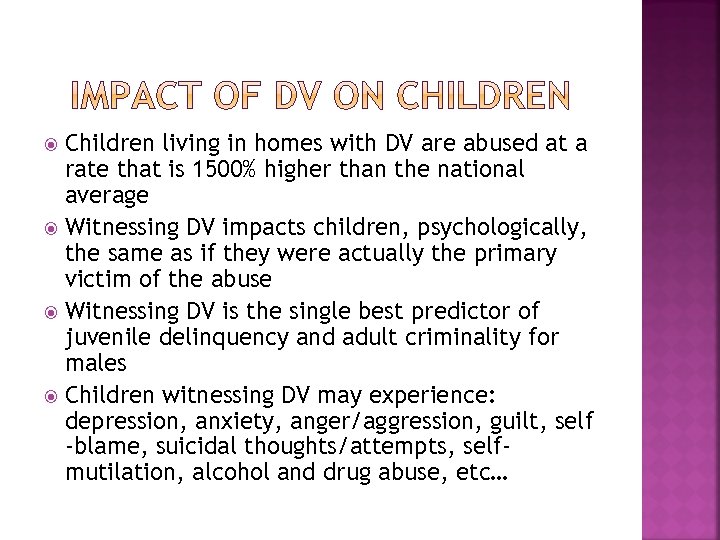 Children living in homes with DV are abused at a rate that is 1500% higher than the national average Witnessing DV impacts children, psychologically, the same as if they were actually the primary victim of the abuse Witnessing DV is the single best predictor of juvenile delinquency and adult criminality for males Children witnessing DV may experience: depression, anxiety, anger/aggression, guilt, self -blame, suicidal thoughts/attempts, selfmutilation, alcohol and drug abuse, etc…
 Ongoing assessment of the risk posed to children by the presence of DV. The preferred way to protect children in most DV cases is to join with the mother in safety planning and to hold the offender accountable. It is important to work closely with battered women’s programs, the criminal justice system and batterer’s treatment providers.
 Contact the police to see if they have responded to any calls at the victim’s address Do NOT confront the offender If you lack adequate information re: the offender OR you have concerns, err on the side of safety…. Do NOT go in the home If necessary, contact the police to accompany you. Offer the victim options for safety, and advise rights.
 Hand deliver correspondence to the alleged victim when they are home alone Make every effort to interview all household members separately, beginning with the victim, children and alleged offender. Do NOT confront the offender with information obtained from the victim and the children… focus on information contained in the original report and information obtained from third party reports (e. g. police reports) Safety plan, support, and educate right away.
 Do NOT force a victim of DV to select one option for safety. Victim knows partner better than you do and if victim feels something will increase danger, then you must listen to that. Offer as many resources as possible but allow victim to choose when and how to use them. Leaving and separation are the most dangerous times for DV victims so they are the best judge on when they can safely do that. If the offender is no longer present therefore, seemingly, there is no immediate risk of DV, resources should still be offered and encouraged to promote ongoing recovery for the victim and the children. If the victim is not ready for or able to receive services and/or if the dangerousness of the offender renders services insufficient to protect the victim or children from imminent risk, explore options in consultation with your supervisor and consult with community partners that specialize in DV. When documenting, accurately identify the perpetrator in DV cases (victims are often reported as neglectful, “crazy”, uncooperative etc. when the actual abuse and cause of the issues is due to the batterers behavior)
 Interview alone and you may need to be creative in order to do this. If you are unable to get the victim alone, this could be a sign of danger and related to the control the offender has over the family. Assure victim you are concerned for their safety and the safety of her children. Assure the victim that you will not confront the offender with any information given you but explain the limits of confidentiality.
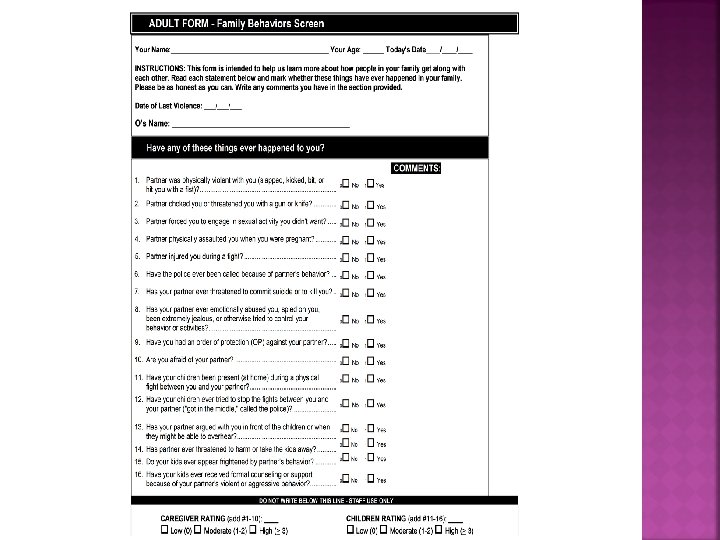
 Tell me about your relationship? How are decisions made in your relationship? Do you feel free to do, think, believe what you want? Does your partner ever act jealous or possessive? Tell me more about that. (8 FBS) Has your partner ever stalked or harassed you (ie: constant phone calls or text messages, following you when you leave the house etc)? Has your partner ever strangled you? (2 FBS) Has your partner ever threatened to kill you? (7 FBS) Has your partner ever threatened suicide? (7 FBS) Have you ever felt afraid of your partner? In what ways? (10 FBS) Has your partner ever physically used force on you (ie: pushed, pulled, slapped, punched, or kicked you)? (1 FBS) Have you ever been afraid for the safety of your children?
 Prevented you from going to work/school/church Prevented you from seeing friends or family Listened in on your phone calls or violated your privacy in other ways Followed you Accused you of being unfaithful Acted jealous Controlled your money Stolen your money
 Called you degrading names Emotionally insulted you Humiliated you at home? In public? Destroyed your possessions (ie: clothes, photographs) Broken furniture Destroyed your phone or taken your phone Threatened to injure you, himself, your children or other family members Hit, slapped, pushed, kicked, strangled or burned you Threatened to use a weapon or used a weapon on you (2 FBS) Threatened to kill you (7 FBS) Hurt your pets Engaged in reckless behavior (ie: drove too fast with you and the kids in the car) Behaved violently in public Been arrested for violent crimes Forced you to perform sexual acts that make you feel uncomfortable (3 FBS) Prevented you from using birth control Withheld sex Hurt you during pregnancy Forced you to engage in prostitution or pornography Forced you to use drugs
 called your child degrading names Threatened to take the child(ren) from your care (14 FBS) Called or threatened to call DCS Accused you of being an unfit parent Threatened to hurt or kill your child Hurt you in front of the children Hit your child with belts, straps or other objects Touched your child in a way that made you feel uncomfortable Assaulted you while you were holding your child Asked your child to tell him what you were doing during the day Treated one child significantly different from another Forced your children to participate in or watch the abuse of you
 Overheard the yelling and/or violence Behaved in ways that remind you of your partner Physically hurt you or other family members Tried to protect you Tried to stop the violence Hurt him/herself Hurt pets Been fearful of leaving you alone Exhibited physical/emotional/behavioral problems at home/school/daycare
 Told anyone about the abuse? What happened? Seen a counselor? What happened? Left home as a result of the abuse? Where did you go? Did you take the children? If not, why not? Called the police? What happened? Pressed criminal charges? What happened? Filed for an order of protection(OP)? What happened? Did he violate the OP? Used a battered women’s group or shelter? Was it helpful? Fought back? What happened?
 How dangerous do you think your partner is What do you think he is capable of Do you have any current injuries or health problems How has this relationship affected how you feel about yourself, your children, the future How do you explain the violence to yourself How do you believe your children understand the violence What do you believe would help keep you and your children safe
 You should have a good understanding of the power structure of the family If there is extreme danger and the children have learned to survive by identifying with the offender, then direct questioning of the children may need to be postponed until safety can be achieved because confidentiality will be a concern If the victim is fearful of the consequences of questioning the offender, then it should be postponed until safety can be achieved
 All offenders have the potential to be lethal Some are more likely to be more dangerous though Typical offenders have an external locus of control (ie blame the victim, or other systems for his behavior) We will discuss 3 types of offenders and if the offender fits one of these profiles, there is more serious cause for concern
 Cannot tolerate separation from partner Extremely jealous Makes irrational accusations Monitors partner’s whereabouts through calls, questioning the children, and others, drive-by check-up visits, etc Threatens to harm or kill if she leaves him This type of offender is most likely to stalk, injure or kill his partner, even months or years after she has left him, obtained OP, etc. Charles Thomas
 Pattern of abuse is vengeful and has a bizarre depersonalized character Treats partner with a profound absence of consideration for her as a person (ie forces her to have sex immediately following an operation or childbirth) Violence involves inflicting severe pain or torture such as burning her, starving her or beating her for hours Assault without any warning or provocation Terrifies partner through torture and continuous degradation making her unlikely to attempt to flee Retaliates even when he appears to accept what you say Frequently has no criminal record Usually employed and may have a prestigious position in the community NSecure
 Takes offense easily Feels all “challenges” place his manhood and courage in question and he must always prove himself Often has long criminal history resulting from general violence Very dangerous to partner, particularly if she fights back Has very conflicted, belligerent relationships with authority figures He may assault you if he feels strongly or directly challenged Set very clear limits and refuse to continue working with him if there are threats or attempts to intimidate you La. Keith Moody
 If an offender resembles any of the profiles mentioned and you suspect drug or alcohol abuse, access to weapons, or training in martial arts/boxing, there is increased potential for danger Assessing lethality is important to protect yourself as well as the victim and the children Lessening the risk for you and the victim and children means safety planning If you obtain information that leads you to believe that the offender is too dangerous (for you or the children/victim) consult with your supervisor and community DV partners before proceeding and document reasons in the record Only interview the offender once you have determined that such an interview will not pose a danger to you, the victim or the children
 Is the victim or the offender denying or minimizing the abuse (very common) Do they offer similar or different accounts What do the children report (also very common for them to minimize) Is victim afraid and openly asking for help Does victim fear disclosure of the abuse because they fears losing the children or they fear retaliation from the offender or they do not believe that real help is available based on past experiences Has victim been so severely traumatized that their ability to assess the danger in the situation is impaired Does victim believe they are at fault or that partner will change if they get “help”
 Victim is openly asking for help: inform of the community resources, such as family supports, battered women’s programs, legal services, welfare and housing advocacy, mental health services etc. Ideally, a referral will be made with an offer to transport her there Victim is uncooperative or resistant: it is counterproductive to force disclosure. Reiterate your concerns for safety and the safety of the children. Educate on the options and resources available as well as the reasons for your concerns. It is most important to pay attention to safety and err on the side of caution. Most often these victims and children are in great danger and the victim is protecting the family by keeping the silence. Outside intervention will increase risk and it is critical that you inform the mother in advance of any plans. Consult with community DV partners in these cases.
 Cultural influence on the family Does victim have a history of child abuse or history of other DV relationships? Does victim look to each new partner for a sense of safety and security? Does victim lack family support? Does victim lack access to information? Women who have experienced chronic abuse may need greater assistance accessing resources and strong reinforcement for positive service outcomes Does victim present as severely depressed? Assess for suicidal ideations. Depression is symptomatic of trauma and may not subside until safety is achieved. Interventions and services should be decided in partnership with the victim to promote a personal sense of competence and power Does the relationship appear to be battering both ways? Does victim behave in aggressive and violent ways? It can be confusing and difficult to ascertain selfdefense and other responses to violence accurately. Examine who holds the control in the relationship, who has been injured, who is afraid, and who has access to resources. Court records, police reports, and documentation from probation and batterer’s treatment may provide critical information. Substance abuse may exacerbate but does NOT cause DV. Does substance abuse impede the victim’s ability to assess the level of danger in the home? Impede ability to safety plan for self and the children? Does the offender use victim’s substance abuse to exercise power and control? Does partner use own substance abuse or victim’s as an excuse for the violence? Does victim blame self for the violence? Does victim feel a deep sense of shame and hopelessness? Always assess for the potential of self harm. Never confront an offender or victim that is under the influence.
 Parent and children will participate in counseling (group which provides additional support of the group members or individual) to address safety planning, the negative effects of DV, education on DV and the impact on children, appropriate discipline etc. Services may include: individual or group counseling from a DV community partner, legal, housing, welfare advocacy, shelter and transitional living services, visitation services, specialized assessment services focusing on the issues of DV Daycare Parent support groups
 Will not behave in a manner that is verbally, emotionally, sexually, or physically abusive toward partner or children Will not involve the children in attempt to control the partner or force them to witness or participate in other abusive behaviors Will participate in evaluation and specialized treatment program and follow all recommendations Will be educated on the impact of DV on children Will follow all conditions of court orders and probation
 Ideally, the offender would be referred to the Domestic Violence Assessment Center (DVAC) which will thoroughly assess for risk and make recommendations for treatment. State certified batterer’s intervention programs Visitation services or safe exchange Cooperation with police, probation and parole when involved
 NEVER Options for protection for the victim that in her opinion increase the level of danger Couples or family therapy Court mediation/divorce mediation Anger management groups or other non-state certified batterer’s intervention programs Visitation arrangements that endanger the victim and/or the children
 Documentation and disclosure may dramatically increase risk Any information in the case record pertaining to confidential address of a victim should be redacted Any disclosures made by the victim or the children regarding their safety should NOT be disclosed to the offender When information must be shared, such as in court proceedings, the victim should be notified in advance so they can prepare for their safety, however, every effort should be made for that NOT to happen ie inform the judge that victim and the children are in a non-disclosed location for safety and revealing their location would place them in danger) When disclosure of DV is made during care and protection proceedings, attorneys may want to privately share with the judge the possible consequences of such disclosure All documentation of DV should be written in a manner that holds the offender responsible Safety of victims and children must be considered when planning case transfers (ie notifying the offender of victim’s whereabouts is dangerous)
 This is essentially an OP for an organization This is a further protection for the victim This can be beneficial to take the blame off the victim if the offender is arrested Any business, landlord, or organization can obtain one to ensure safety of victim Can be obtained at your local precinct Must be kept readily available for all in the even that the police need to be called
 At no time should a victim of DV be evicted due to a violent incident According to VAWA, you MUST have an emergency transfer plan Victims should immediately be transferred to a safe location Landlords are typically understanding and will provide a transfer to another, safer location If there is some difficulty with a landlord, you can consult Fair Housing Division with Memphis Area Legal Services
 Safety planning should be reviewed with the victim The new location for safe housing should be kept confidential (in my opinion, the less people that know, the safer the victim is) Document what measures you have taken to transfer the victim to a new, safe location and add documentation of police reports and orders of protection if available
 The Exchange Club Family Center 276 -2200 victims: women and children groups and individual, DVAC for offenders The Shelby County Crime Victims Center 222 -3950 Family Safety Center 222 -4400 victims
 Thank you for working diligently to help victims and children living in DV situations!!