 Скачать презентацию To Make a Desert Bloom Exploring Israel s Experience
ba3e9872e008055d73bb7789c551b947.ppt
- Количество слайдов: 41



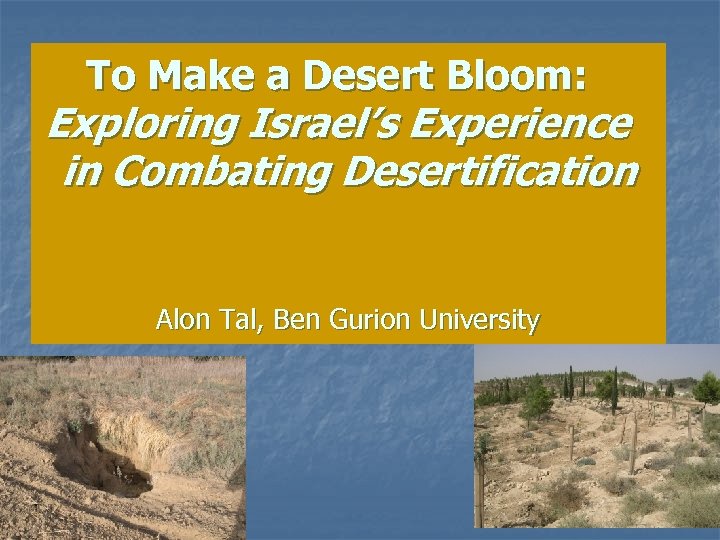
To Make a Desert Bloom: Exploring Israel’s Experience in Combating Desertification Alon Tal, Ben Gurion University
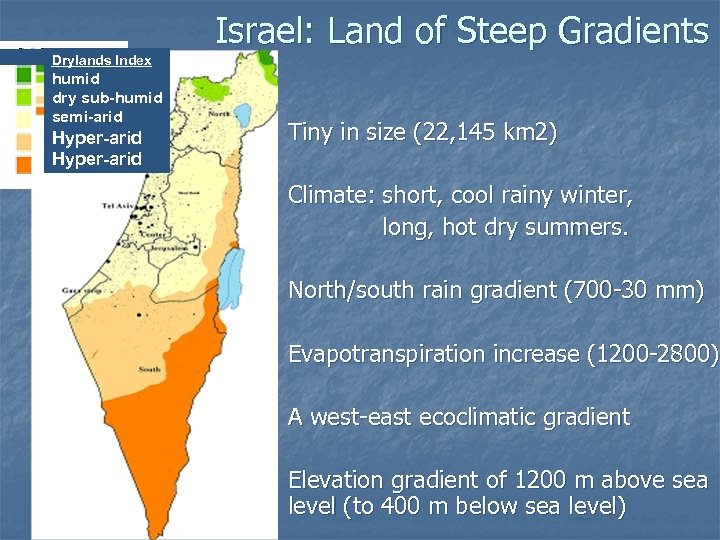
Israel: Land of Steep Gradients Drylands Index humid dry sub-humid semi-arid Hyper-arid Tiny in size (22, 145 km 2) Climate: short, cool rainy winter, long, hot dry summers. North/south rain gradient (700 -30 mm) Evapotranspiration increase (1200 -2800) A west-east ecoclimatic gradient Elevation gradient of 1200 m above sea level (to 400 m below sea level)
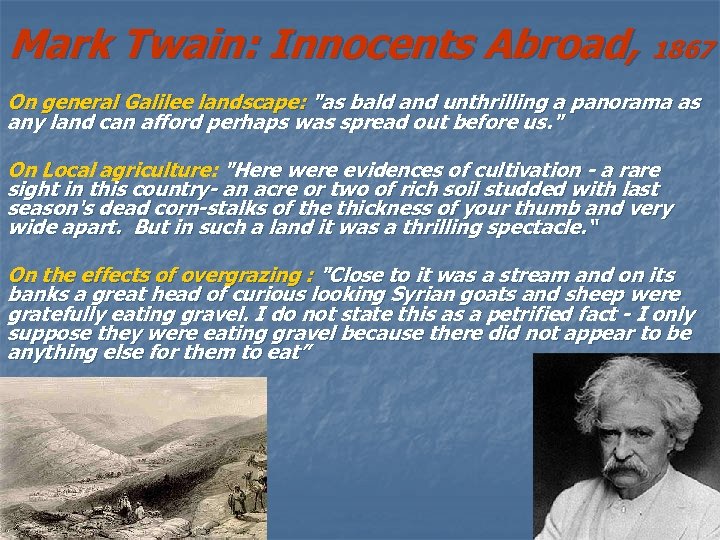
Mark Twain: Innocents Abroad, 1867 On general Galilee landscape: "as bald and unthrilling a panorama as any land can afford perhaps was spread out before us. " On Local agriculture: "Here were evidences of cultivation - a rare sight in this country- an acre or two of rich soil studded with last season's dead corn-stalks of the thickness of your thumb and very wide apart. But in such a land it was a thrilling spectacle. “ On the effects of overgrazing : "Close to it was a stream and on its banks a great head of curious looking Syrian goats and sheep were gratefully eating gravel. I do not state this as a petrified fact - I only suppose they were eating gravel because there did not appear to be anything else for them to eat”
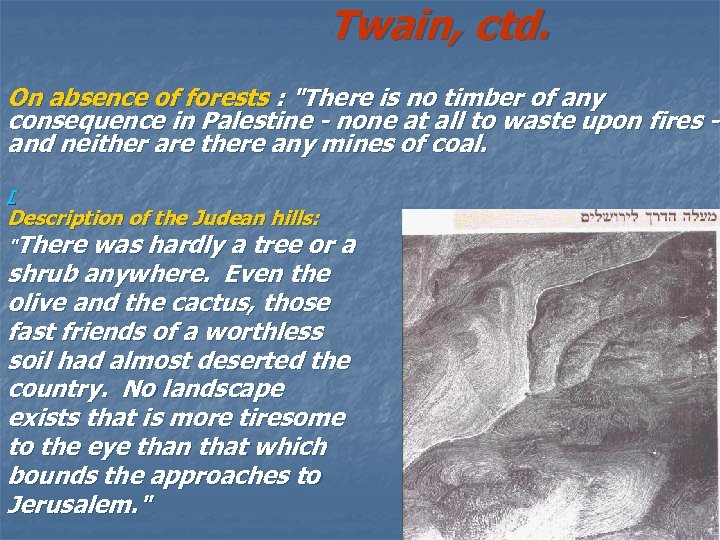
Twain, ctd. On absence of forests : "There is no timber of any consequence in Palestine - none at all to waste upon fires and neither are there any mines of coal. [ Description of the Judean hills: "There was hardly a tree or a shrub anywhere. Even the olive and the cactus, those fast friends of a worthless soil had almost deserted the country. No landscape exists that is more tiresome to the eye than that which bounds the approaches to Jerusalem. "
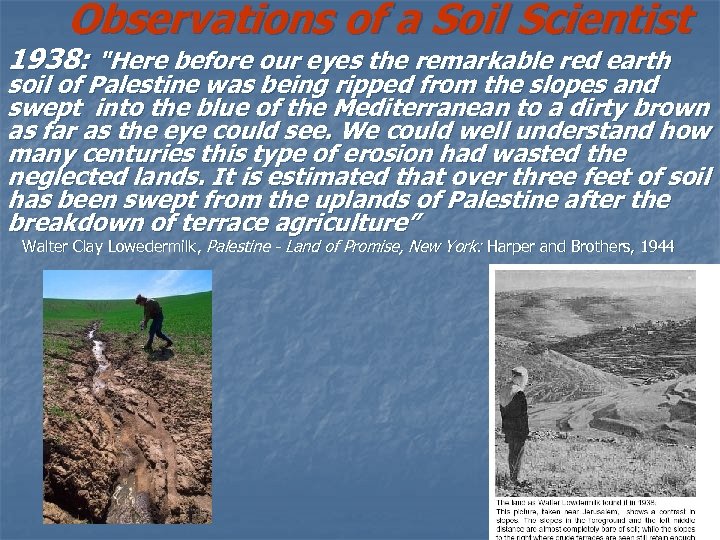
Observations of a Soil Scientist 1938: "Here before our eyes the remarkable red earth soil of Palestine was being ripped from the slopes and swept into the blue of the Mediterranean to a dirty brown as far as the eye could see. We could well understand how many centuries this type of erosion had wasted the neglected lands. It is estimated that over three feet of soil has been swept from the uplands of Palestine after the breakdown of terrace agriculture” Walter Clay Lowedermilk, Palestine - Land of Promise, New York: Harper and Brothers, 1944
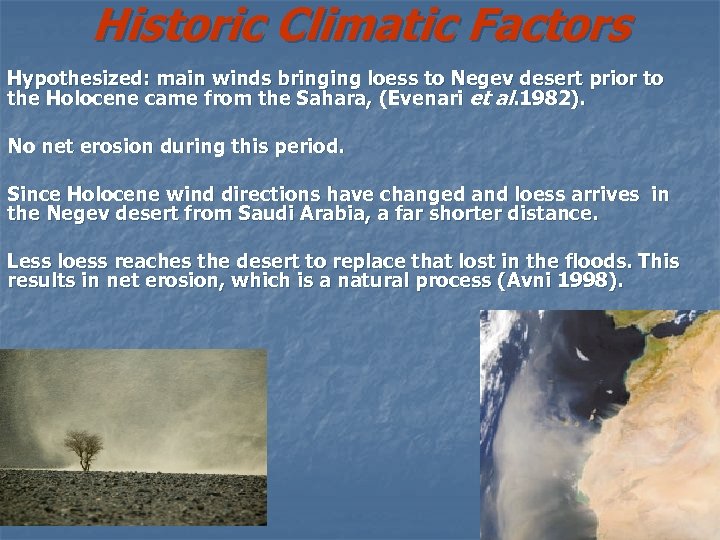
Historic Climatic Factors Hypothesized: main winds bringing loess to Negev desert prior to the Holocene came from the Sahara, (Evenari et al. 1982). No net erosion during this period. Since Holocene wind directions have changed and loess arrives in the Negev desert from Saudi Arabia, a far shorter distance. Less loess reaches the desert to replace that lost in the floods. This results in net erosion, which is a natural process (Avni 1998).
Desertification trends: Conventional View Prior to State of Israel Pollen analysis shows Mediterranean Forests. For millennia intensive human utilization of dry subhumid/semiarid parts of current Israel. Results are described by travelers: - Woodlands converted to scrublands. - Overgrazing in ranges.
Because of low rainfall and hence low primary productivity, regrowth of vegetation could not keep pace with its destruction, especially in the presence of overgrazing by abundant goats. With the tree and grass cover removed, erosion proceeded and valleys silted up, while irrigation agriculture in the low-rainfall environment led to salt accumulation. . Thus, Fertile Crescent and Eastern Mediterranean societies had the misfortune to arise in an ecologically fragile environment. They committed ecological suicide by destroying their own resource base. Jared Diamond
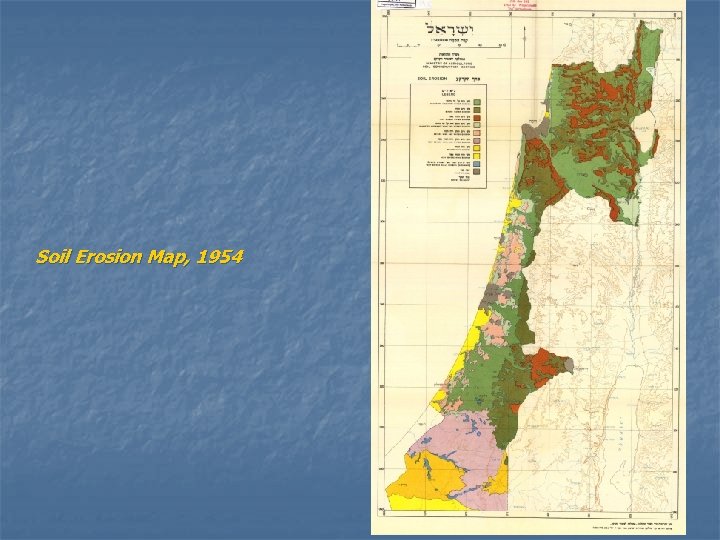
Soil Erosion Map, 1954
Pre 1948 - Conclusion “The country was desertified, but the impact diminished with aridity. The expression of desertification might have been soil salinization in dry subhumid areas, and definite loss of natural vegetation and soil erosion in dry subhumid and some semiarid areas… ecological and hydrological processes would have been disrupted, the provision of ecosystem services have been impaired, resulting in an overall gradual decline in productivity. “ - Professor Uriel Safriel
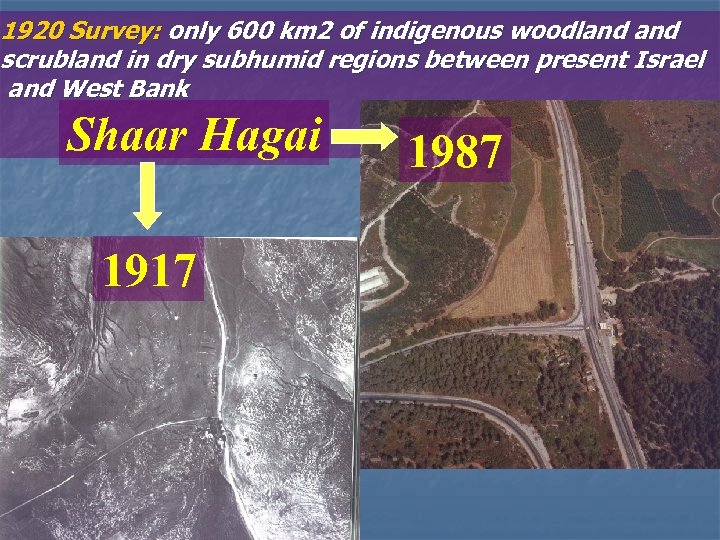
1920 Survey: only 600 km 2 of indigenous woodland scrubland in dry subhumid regions between present Israel and West Bank Shaar Hagai 1917 1987
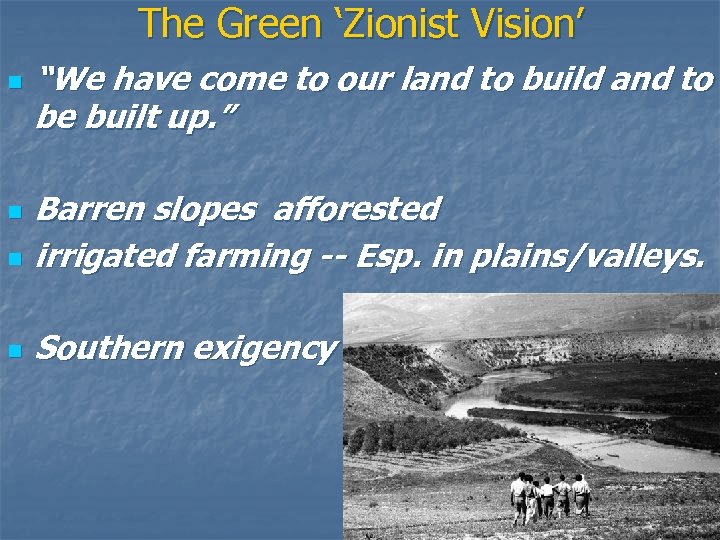
The Green ‘Zionist Vision’ n “We have come to our land to build and to be built up. ” n Barren slopes afforested irrigated farming -- Esp. in plains/valleys. n Southern exigency n
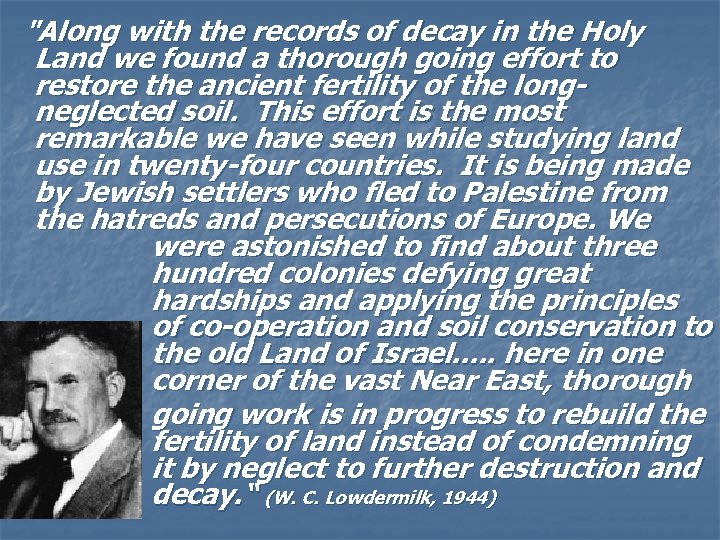
"Along with the records of decay in the Holy Land we found a thorough going effort to restore the ancient fertility of the longneglected soil. This effort is the most remarkable we have seen while studying land use in twenty-four countries. It is being made by Jewish settlers who fled to Palestine from the hatreds and persecutions of Europe. We were astonished to find about three hundred colonies defying great hardships and applying the principles of co-operation and soil conservation to the old Land of Israel. . . here in one corner of the vast Near East, thorough going work is in progress to rebuild the fertility of land instead of condemning it by neglect to further destruction and decay. “ (W. C. Lowdermilk, 1944) n
Israeli Policies to Combat Desertification 1. 2. 3. 4. Irrigated Agriculture Water Management Control of Grazing Afforestation
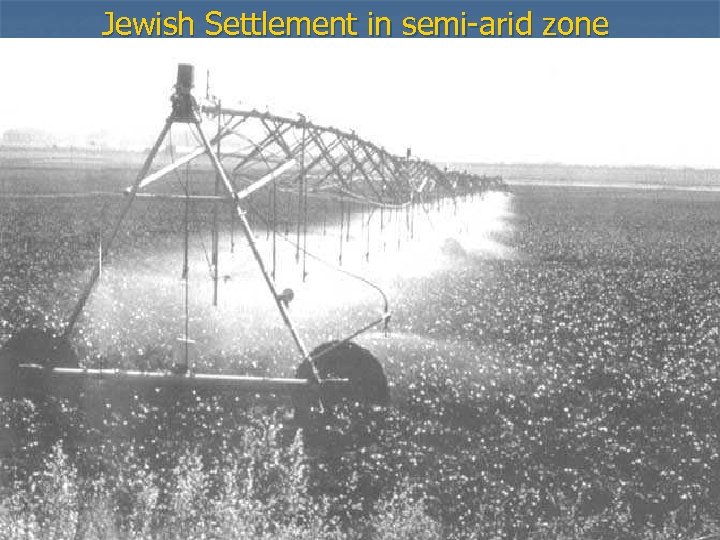
Jewish Settlement in semi-arid zone I
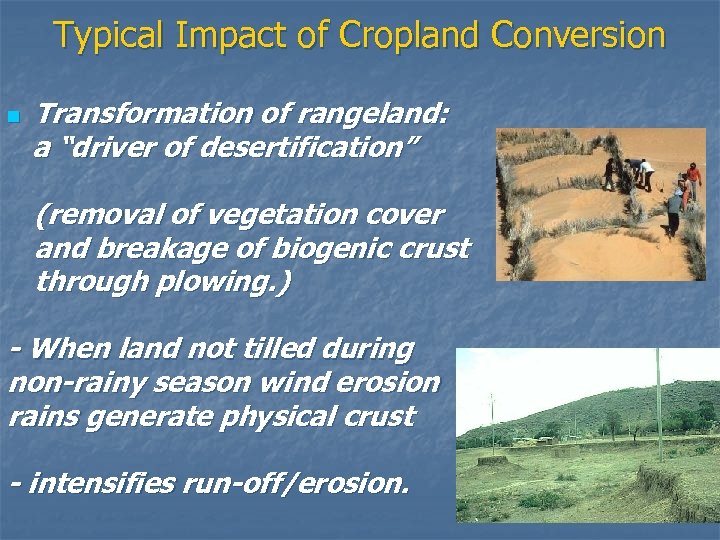
Typical Impact of Cropland Conversion n Transformation of rangeland: a “driver of desertification” (removal of vegetation cover and breakage of biogenic crust through plowing. ) - When land not tilled during non-rainy season wind erosion rains generate physical crust - intensifies run-off/erosion.
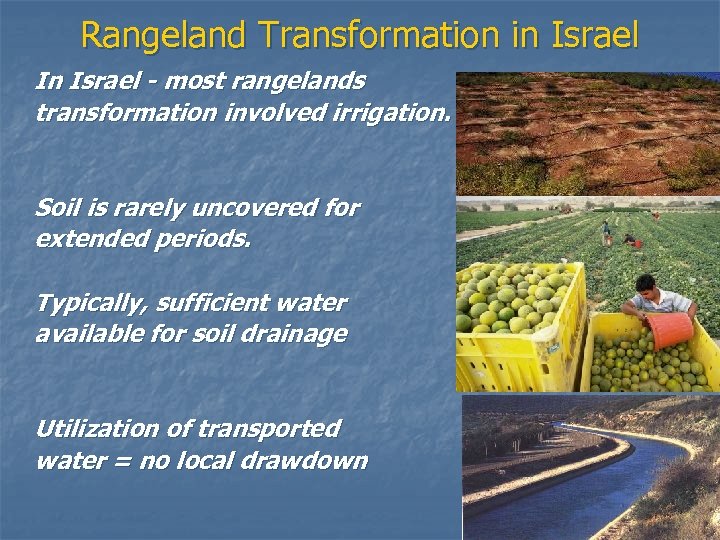
Rangeland Transformation in Israel In Israel - most rangelands transformation involved irrigation. Soil is rarely uncovered for extended periods. Typically, sufficient water available for soil drainage Utilization of transported water = no local drawdown
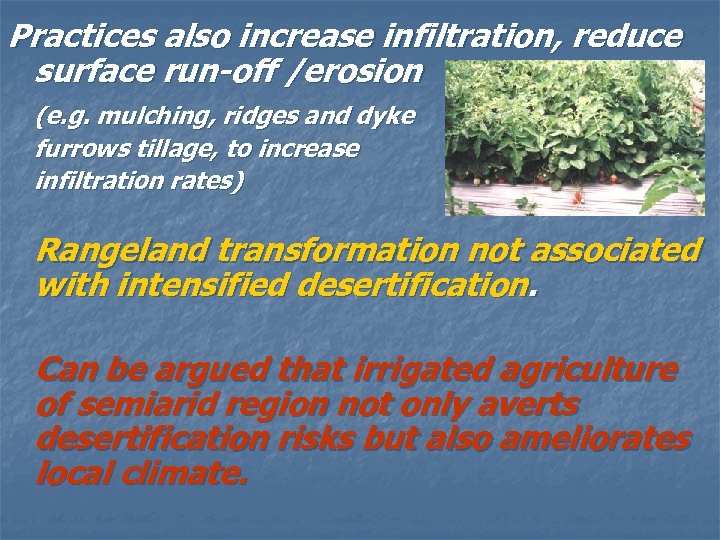
Practices also increase infiltration, reduce surface run-off /erosion (e. g. mulching, ridges and dyke furrows tillage, to increase infiltration rates) Rangeland transformation not associated with intensified desertification. Can be argued that irrigated agriculture of semiarid region not only averts desertification risks but also ameliorates local climate.
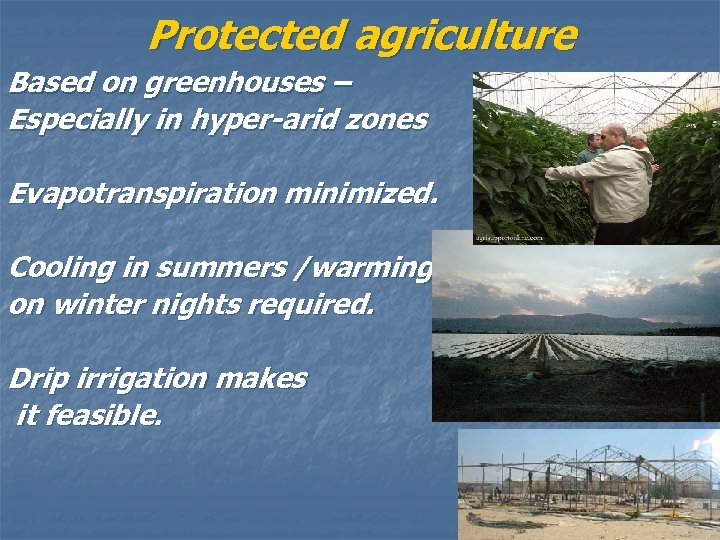
Protected agriculture Based on greenhouses – Especially in hyper-arid zones Evapotranspiration minimized. Cooling in summers /warming on winter nights required. Drip irrigation makes it feasible.
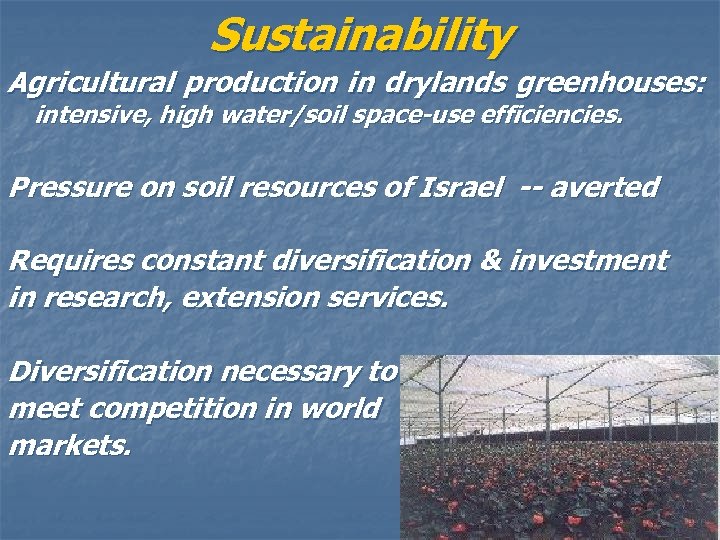
Sustainability Agricultural production in drylands greenhouses: intensive, high water/soil space-use efficiencies. Pressure on soil resources of Israel -- averted Requires constant diversification & investment in research, extension services. Diversification necessary to meet competition in world markets.
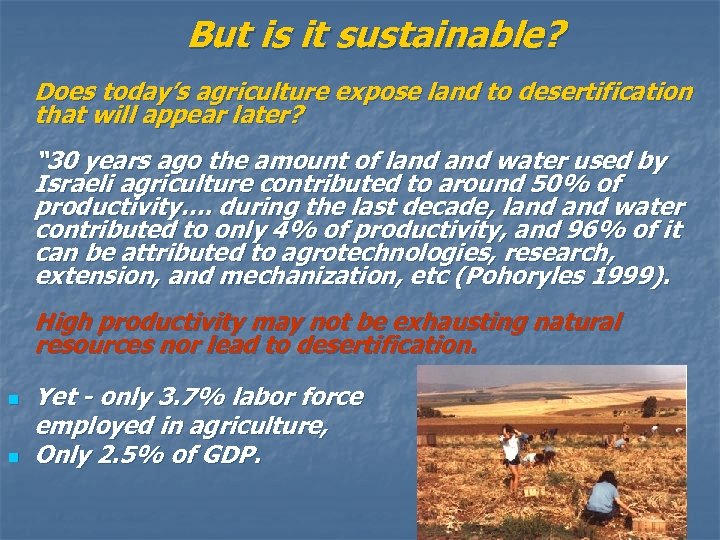
But is it sustainable? Does today’s agriculture expose land to desertification that will appear later? “ 30 years ago the amount of land water used by Israeli agriculture contributed to around 50% of productivity…. during the last decade, land water contributed to only 4% of productivity, and 96% of it can be attributed to agrotechnologies, research, extension, and mechanization, etc (Pohoryles 1999). High productivity may not be exhausting natural resources nor lead to desertification. n n Yet - only 3. 7% labor force employed in agriculture, Only 2. 5% of GDP.
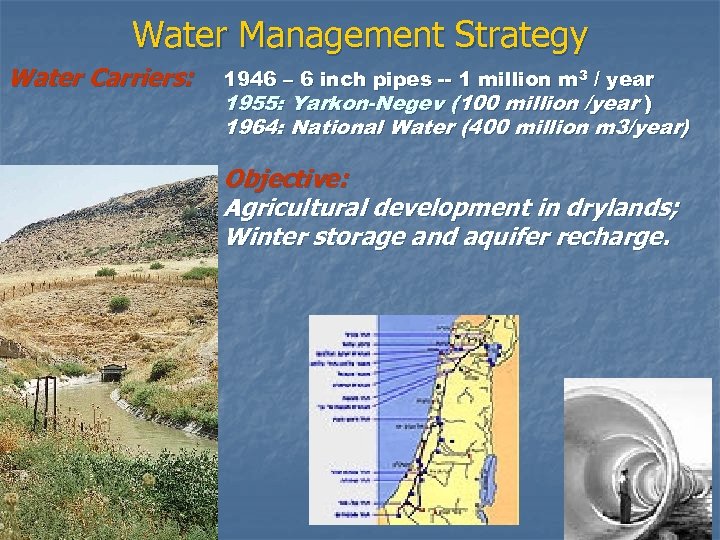
Water Management Strategy Water Carriers: 1946 – 6 inch pipes -- 1 million m 3 / year 1955: Yarkon-Negev (100 million /year ) 1964: National Water (400 million m 3/year) Objective: Agricultural development in drylands; Winter storage and aquifer recharge.
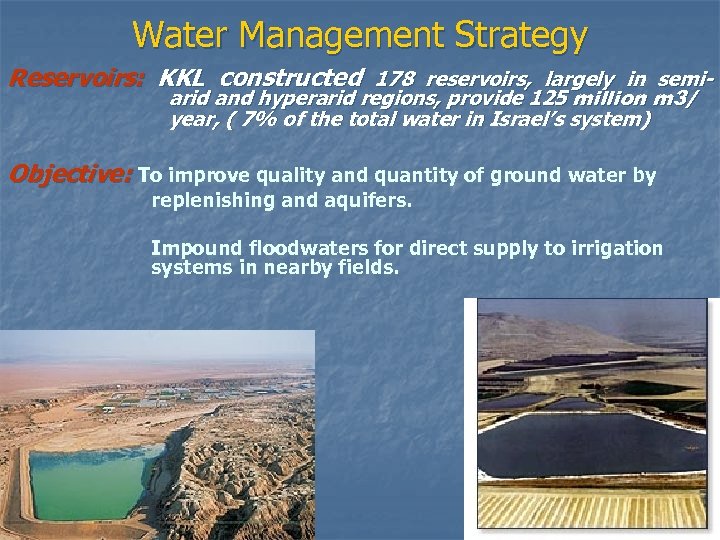
Water Management Strategy Reservoirs: KKL constructed 178 reservoirs, largely in semiarid and hyperarid regions, provide 125 million m 3/ year, ( 7% of the total water in Israel’s system) Objective: To improve quality and quantity of ground water by replenishing and aquifers. Impound floodwaters for direct supply to irrigation systems in nearby fields.
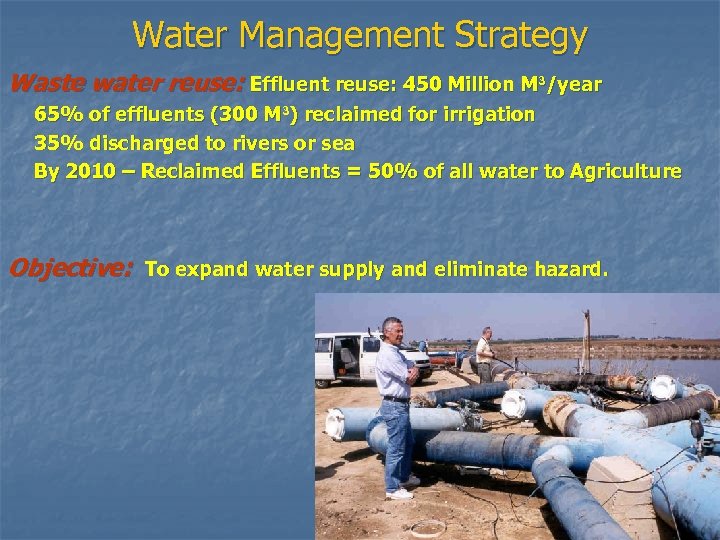
Water Management Strategy Waste water reuse: Effluent reuse: 450 Million M 3/year 65% of effluents (300 M 3) reclaimed for irrigation 35% discharged to rivers or sea By 2010 – Reclaimed Effluents = 50% of all water to Agriculture Objective: To expand water supply and eliminate hazard.
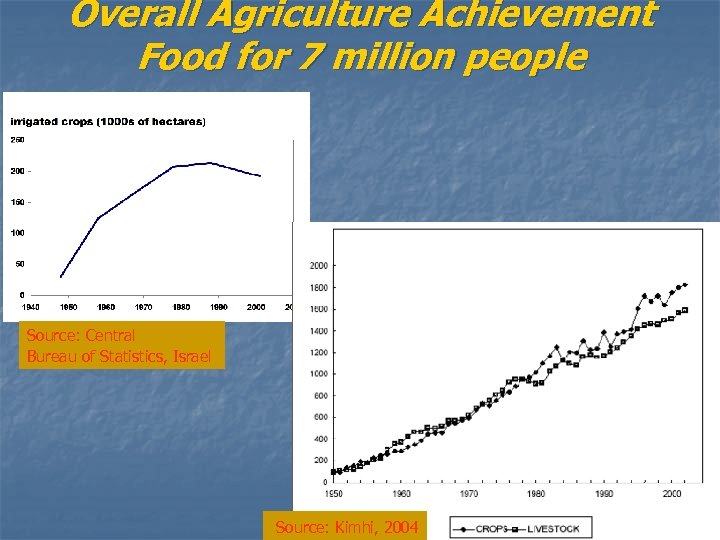
Overall Agriculture Achievement Food for 7 million people Source: Central Bureau of Statistics, Israel Source: Kimhi, 2004
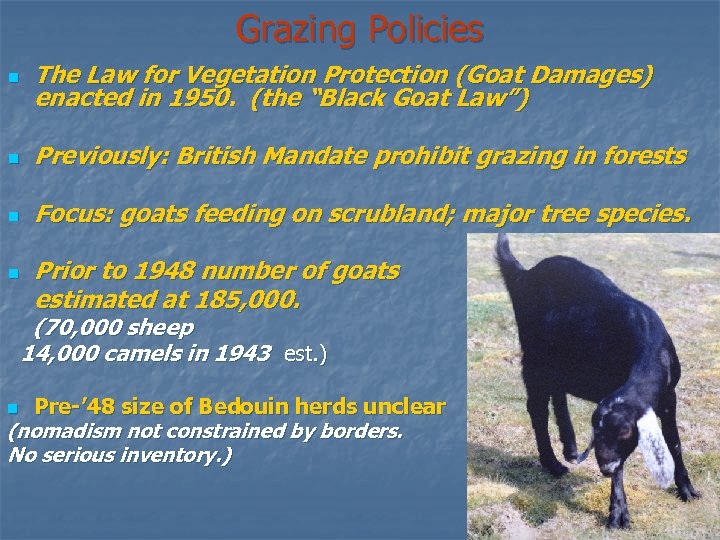
Grazing Policies n The Law for Vegetation Protection (Goat Damages) enacted in 1950. (the “Black Goat Law”) n Previously: British Mandate prohibit grazing in forests n Focus: goats feeding on scrubland; major tree species. n Prior to 1948 number of goats estimated at 185, 000. (70, 000 sheep 14, 000 camels in 1943 est. ) Pre-’ 48 size of Bedouin herds unclear (nomadism not constrained by borders. No serious inventory. ) n
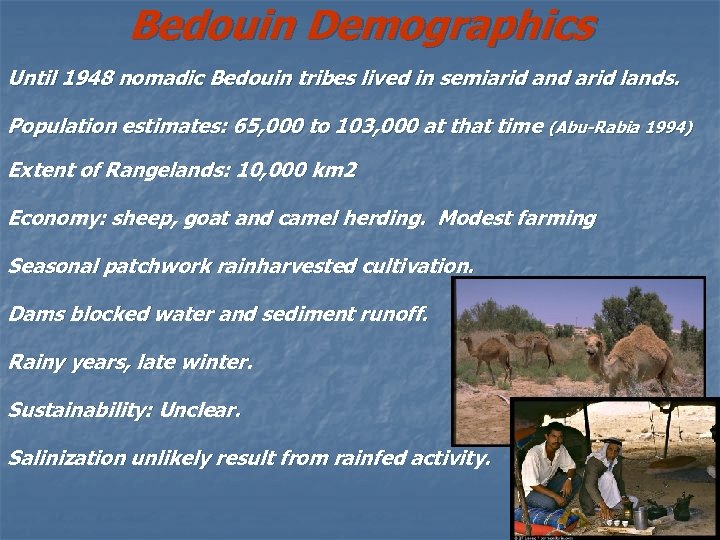
Bedouin Demographics Until 1948 nomadic Bedouin tribes lived in semiarid and arid lands. Population estimates: 65, 000 to 103, 000 at that time (Abu-Rabia 1994) Extent of Rangelands: 10, 000 km 2 Economy: sheep, goat and camel herding. Modest farming Seasonal patchwork rainharvested cultivation. Dams blocked water and sediment runoff. Rainy years, late winter. Sustainability: Unclear. Salinization unlikely result from rainfed activity.
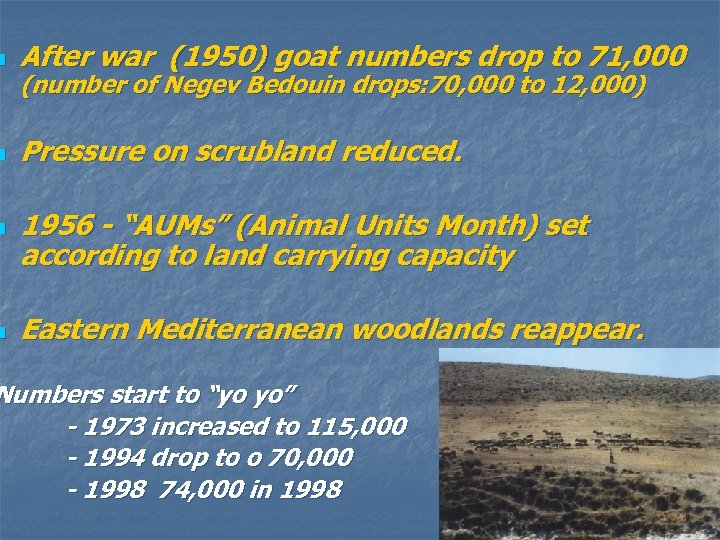
n After war (1950) goat numbers drop to 71, 000 n Pressure on scrubland reduced. n n (number of Negev Bedouin drops: 70, 000 to 12, 000) 1956 - “AUMs” (Animal Units Month) set according to land carrying capacity Eastern Mediterranean woodlands reappear. Numbers start to “yo yo” - 1973 increased to 115, 000 - 1994 drop to o 70, 000 - 1998 74, 000 in 1998
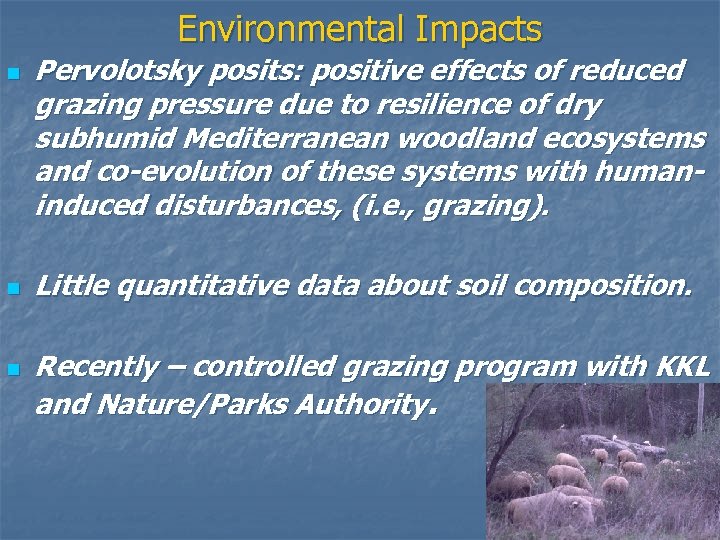
Environmental Impacts n n n Pervolotsky posits: positive effects of reduced grazing pressure due to resilience of dry subhumid Mediterranean woodland ecosystems and co-evolution of these systems with humaninduced disturbances, (i. e. , grazing). Little quantitative data about soil composition. Recently – controlled grazing program with KKL and Nature/Parks Authority.
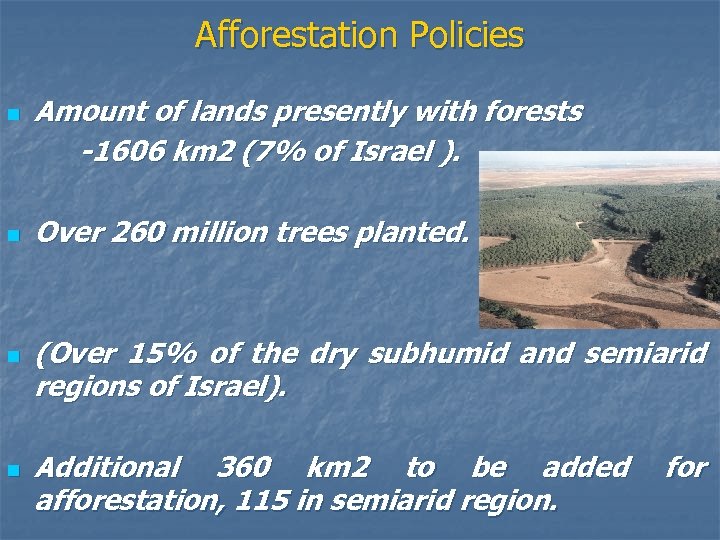
Afforestation Policies n n Amount of lands presently with forests -1606 km 2 (7% of Israel ). Over 260 million trees planted. (Over 15% of the dry subhumid and semiarid regions of Israel). Additional 360 km 2 to be added afforestation, 115 in semiarid region. for
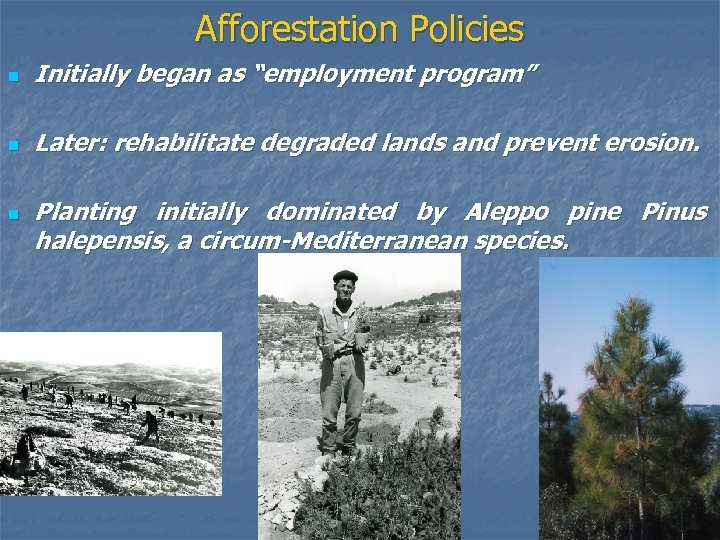
Afforestation Policies n Initially began as “employment program” n Later: rehabilitate degraded lands and prevent erosion. n Planting initially dominated by Aleppo pine Pinus halepensis, a circum-Mediterranean species.
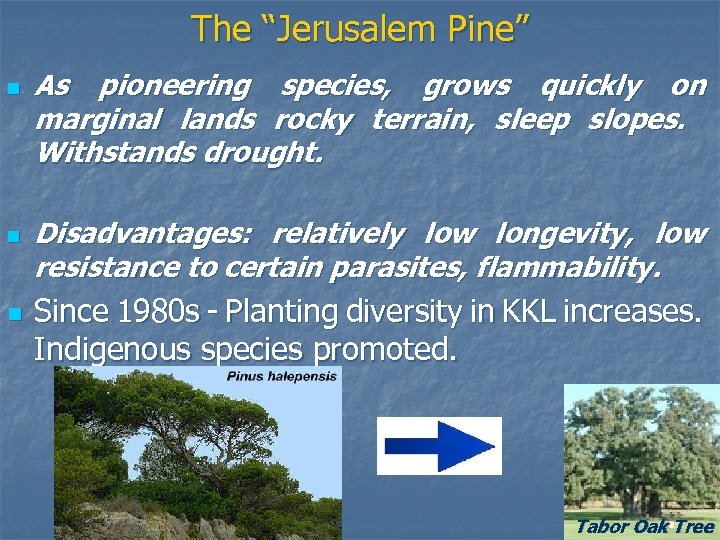
The “Jerusalem Pine” n n n As pioneering species, grows quickly on marginal lands rocky terrain, sleep slopes. Withstands drought. Disadvantages: relatively low longevity, low resistance to certain parasites, flammability. Since 1980 s - Planting diversity in KKL increases. Indigenous species promoted. Tabor Oak Tree
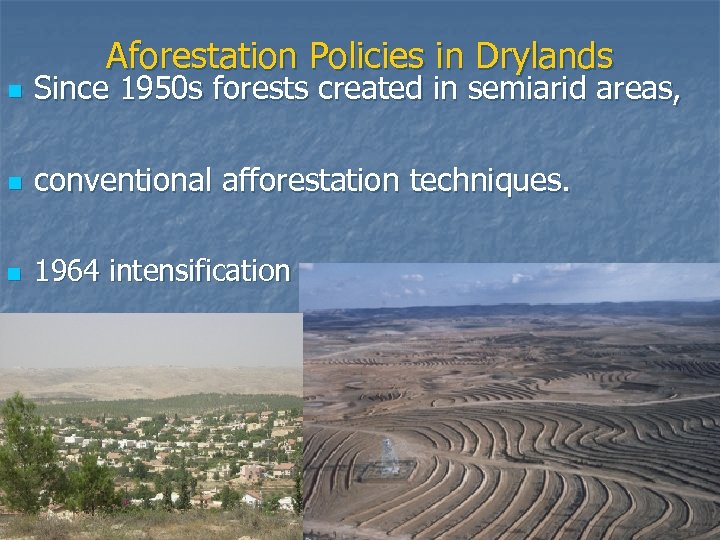
Aforestation Policies in Drylands n Since 1950 s forests created in semiarid areas, n conventional afforestation techniques. n 1964 intensification
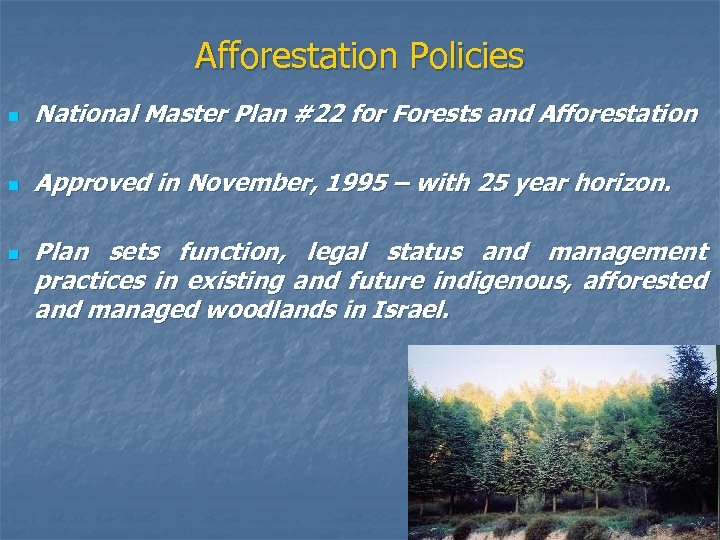
Afforestation Policies n National Master Plan #22 for Forests and Afforestation n Approved in November, 1995 – with 25 year horizon. n Plan sets function, legal status and management practices in existing and future indigenous, afforested and managed woodlands in Israel.
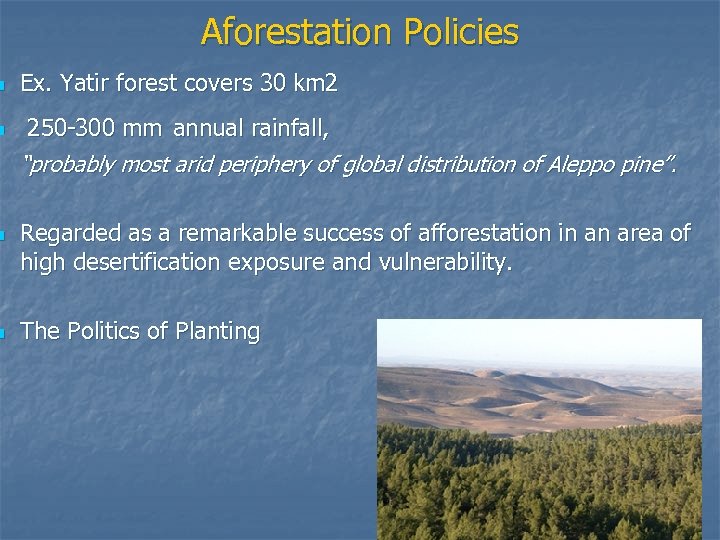
n n Aforestation Policies Ex. Yatir forest covers 30 km 2 250 -300 mm annual rainfall, “probably most arid periphery of global distribution of Aleppo pine”. Regarded as a remarkable success of afforestation in an area of high desertification exposure and vulnerability. The Politics of Planting
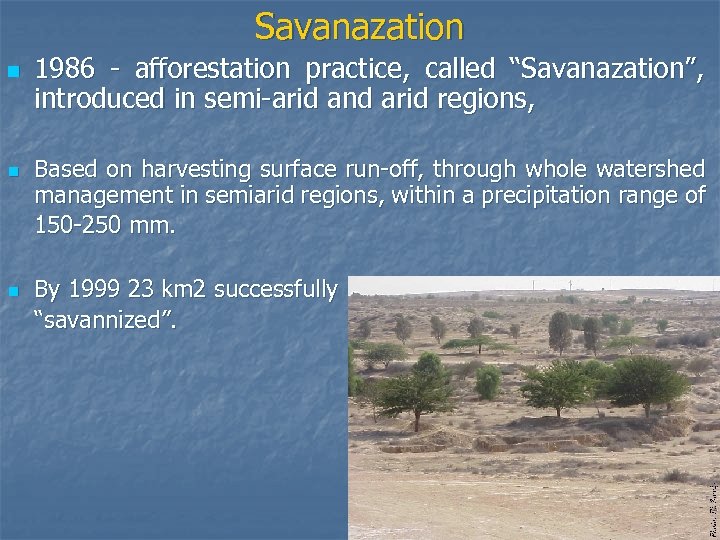
Savanazation n 1986 - afforestation practice, called “Savanazation”, introduced in semi-arid and arid regions, Based on harvesting surface run-off, through whole watershed management in semiarid regions, within a precipitation range of 150 -250 mm. By 1999 23 km 2 successfully “savannized”.
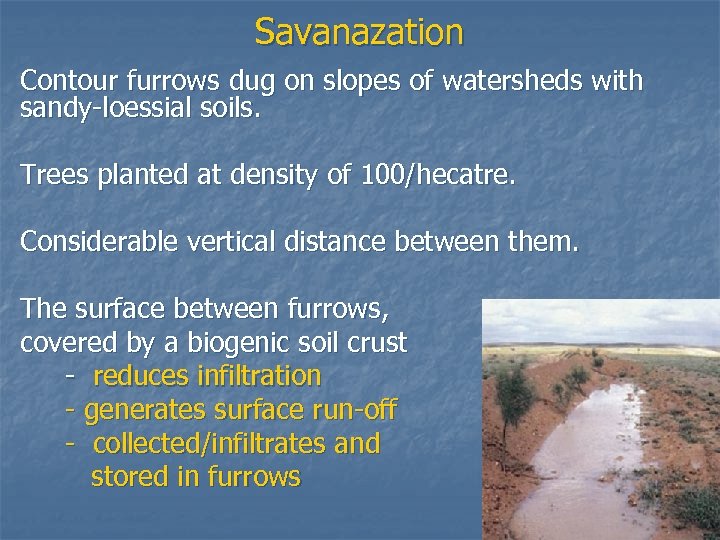
Savanazation Contour furrows dug on slopes of watersheds with sandy-loessial soils. Trees planted at density of 100/hecatre. Considerable vertical distance between them. The surface between furrows, covered by a biogenic soil crust - reduces infiltration - generates surface run-off - collected/infiltrates and stored in furrows
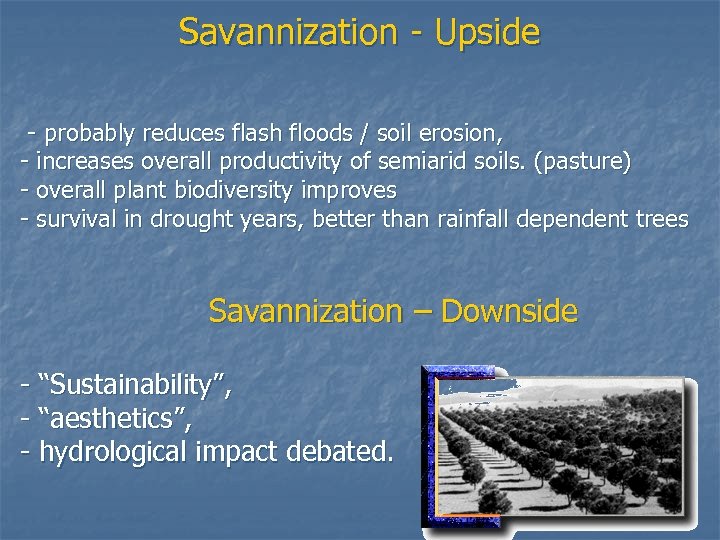
. Savannization - Upside - probably reduces flash floods / soil erosion, - increases overall productivity of semiarid soils. (pasture) - overall plant biodiversity improves - survival in drought years, better than rainfall dependent trees Savannization – Downside - “Sustainability”, - “aesthetics”, - hydrological impact debated.
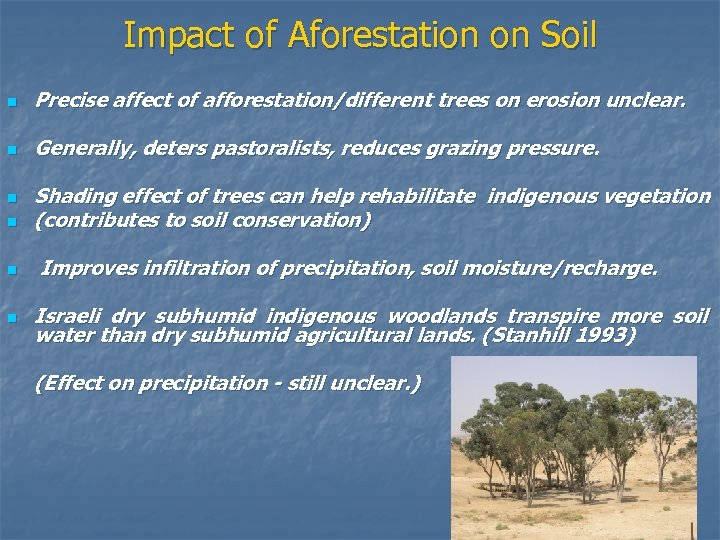
Impact of Aforestation on Soil n Precise affect of afforestation/different trees on erosion unclear. n Generally, deters pastoralists, reduces grazing pressure. n n Shading effect of trees can help rehabilitate indigenous vegetation (contributes to soil conservation) Improves infiltration of precipitation, soil moisture/recharge. Israeli dry subhumid indigenous woodlands transpire more soil water than dry subhumid agricultural lands. (Stanhill 1993) (Effect on precipitation - still unclear. )
Erosion Control – The Official Word n “Ten years later the face of the land has become rejuvenated – its wrinkles smoothed, its scars healed, many of its gullies gone. Even, it seems the pallid hue of eroded areas has been replaced by a healthier color – a darker feritle soil. In every field, one still discerns traces of the uncontrolled flow of water over the years. But now, with the aid of different erosion control measures, these traces are slowly disappearing” Soil Conservation in Israel - 1958
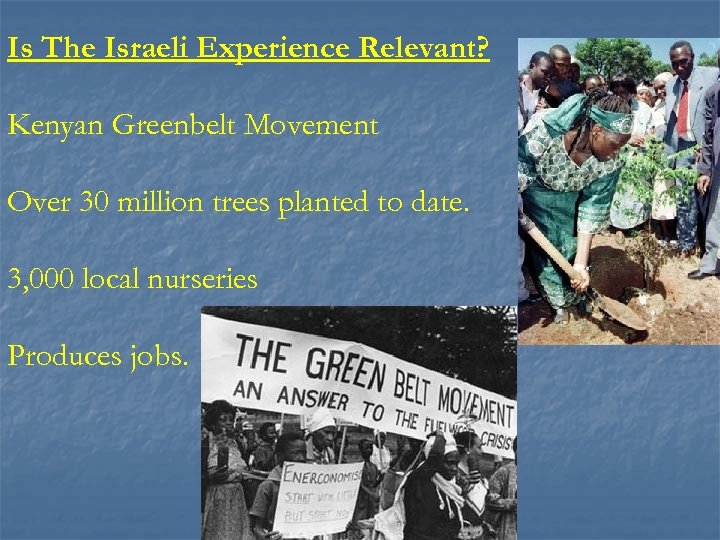
Is The Israeli Experience Relevant? Kenyan Greenbelt Movement Over 30 million trees planted to date. 3, 000 local nurseries Produces jobs.
Скачать презентацию To Make a Desert Bloom Exploring Israel s Experience
ba3e9872e008055d73bb7789c551b947.ppt