


 Скачать презентацию To Introduce n Why SA 8000
a7538e5d06ffb53ac6b93bb61515cc10.ppt
- Количество слайдов: 29
 To Introduce …. . n Why SA 8000 n Who Is Behind n What Is SA 8000 n How To Audit SA 8000 n Who Is Doing SA 8000 ISO 140 01 SA 8000 ISO 900 OHSAS 1 8001 QS 9 n How To Be Accredited n Where Is Market Potential n What Is The Value 1
 Why SA 8000 n Governments, shareholders, customers, and other interested parties expect to purchase from socially responsible organizations. Do The Right Things Right 2
 Business Response n Try to give confidence that goods or services have been produced and delivered within a socially acceptable set of values n Try to demonstrate their commitment in social responsibility , legally compliant workplace and purchasing practices n Try to handle the unique requirements and routine monitoring audits from each buyer 3
 CEPAA , 1997 n Trade Unions n NGOs n Business 4
 What Is SA 8000 n A consensus standard which encourages organizations to develop, maintain and apply socially acceptable workplace practices in those areas that they can control or influence. 5
 What Is SA 8000 n Based on: n Universal declaration of Human Rights n UN Convention on the Rights of the Child n 11 Conventions of the International Labour Organization ( ILO ) n Auditable standard, modelled after the established ISO 9001 and ISO 14001 6
 Mission of SA 8000 n Ensures ethical sourcing of goods and services n Improve working conditions globally n Provide universal standard in all business and country sectors n Work in parallel with human rights and labor organizations worldwide n Provide a beneficial incentive though a “ win / win ” approach 7
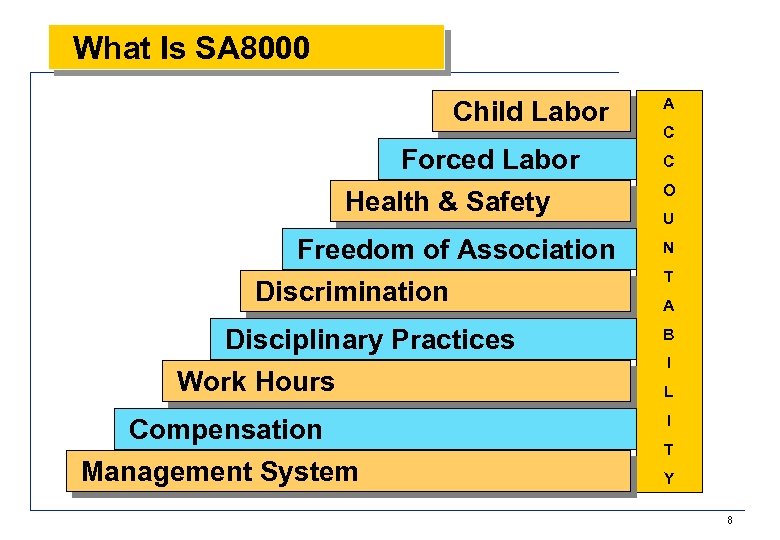 What Is SA 8000 Child Labor Forced Labor Health & Safety Freedom of Association Discrimination Disciplinary Practices Work Hours Compensation Management System A C C O U N T A B I L I T Y 8
 Child Labor n Minimum work age of 15 unless local min. age law stipulates a higher age n Minimum work age of 14 if the law follows ILO Convention 138 n Children or young workers put in safe and health workplace n Provision of the Policies and Procedure for remediation of Children 9
 Forced Labor n No forced or indentured labor n No deposits or lodge of identity documents 10
 Health and Safety n Ensure a safe and healthy working environment n A senior management staff appointed for health & safety Issues n Adequate safety training provided for staff n A system to detect, avoid or respond to safety threats n Clean bathrooms & potable water & food storage facility n Dormitories meet basic needs of workers 11
 Freedom of Association n Respect trade unions & right of workers to bargain collectively n If legally restricted , there shall be parallel means of free association n No discrimination against union reps and members 12
 Discrimination n Not engage in or support discrimination n No interference with individual rights to observe tenets or practices n No form of worker harassment allowed 13
 Disciplinary Practices n Not engage in or support the use of corporal punishment , mental or physical coercion & verbal abuse 14
 Working Hours n Not exceed 48 hrs per week for normal working hrs n At least one day off in every seven days n Overtime not more than 12 hrs per week n Overtime paid at a premium rate 15
 Compensation n Wages meet legal requirement and sufficient to meet “ Basic Needs” n Wages not withheld for Discipline n Wages presented as understood by workers n Wages paid in Cash or Check form n No false apprentice scheme 16
 Management System n Policy n Management Review n Company Representatives n Planning and Implementation n Control of Suppliers 17
 Management System n Address Concerns and Taking Corrective Actions n Outside Communication n Access for Verification n Records 18
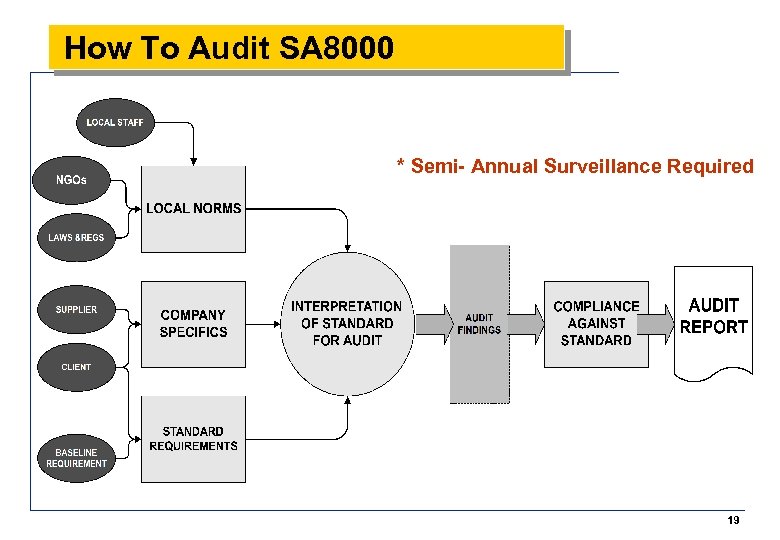 How To Audit SA 8000 * Semi- Annual Surveillance Required 19
 Critical Data Gathering n Applicable laws n Local NGOs n Political situation n Industry profile n Union situation n Chronic industry n Food costs problems (market basket) n Average family size for country 20
 Worker Interview n Anonymity critical for accurate response n Focus group and individual interviews n Setting the stage with worker n Off-site interviews for anonymity n Indirect questioning techniques n Notes should be taken for reference n Female auditors crucial element n Audit team selects workers 21
 Who Is Doing SA 8000 n BVQI n DNV n ITS n SGS n UL 22
 How To Be Accredited n ISO / IEC GUIDE 62 n CEPAA GUIDELINE 1 23
 CEPAA GUIDELINE 1 n An appropriate summary of confirmation and application for following items : n Information of working conditions from local interested parties, NGOs, and workers n To determine the sufficient wage level n To ascertain the languages spoken on site before accepting a client 24
 CEPAA GUIDELINE 1 n Successful completion of an approved accredited SA 8000 Lead Assessor course n The use of certified SA 8000 auditors / Selection of a qualified team of auditors n To obtain factual information sensitive to local cultural norms, and protect the confidentiality of workers who are interviewed 25
 CEPAA GUIDELINE 1 n A documented procedure for ensuring auditor possession of appropriate local language and interview skills n Where a subcontractor, auditor or translator, is engaged, the certification body shall have procedures to confirm that person's impartiality, including that such subcontractor is not an employee or recent ex-employee of the auditee 26
 Accreditation Process n Capacility Evaluation by CEPAA n An audit of policies , procedures and documentation n A witness audit n Periodical reevaluations / Surveillance audits n NGOs encouraged 27
 Value of SA 8000 n Cost Reduction in monitoring n Better Corporate Image when products are from a safer and fairer working environment. n Trust-building to investors and bank-analysts when evaluating social performance n Sustainable Development from Continuous Improvement 28
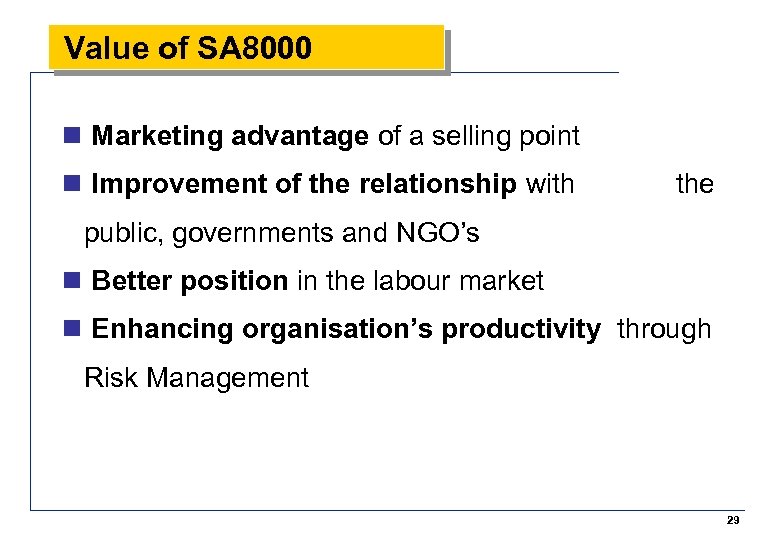 Value of SA 8000 n Marketing advantage of a selling point n Improvement of the relationship with the public, governments and NGO’s n Better position in the labour market n Enhancing organisation’s productivity through Risk Management 29