

To explain the meaning of investment properties. To



 Скачать презентацию To explain the meaning of investment properties. To
14296-topic_4_ias+40.ppt
- Количество слайдов: 31
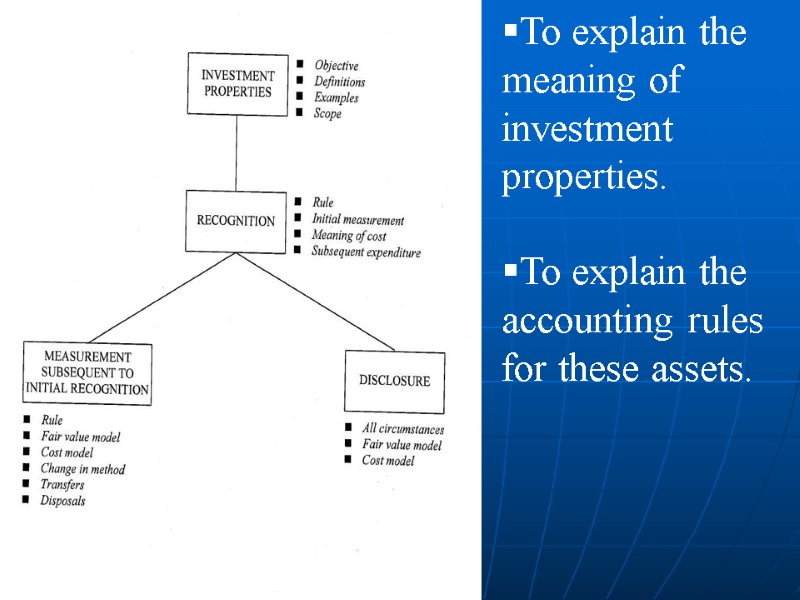
To explain the meaning of investment properties. To explain the accounting rules for these assets.
Objective IAS 40 prescribes the accounting treatment for investment property and related disclosure requirements. Commentary It applies to investment properties (as defined) held by all entities - not only those held by entities specialising in owning such property.
Definitions Investment property is property (land or a building - or part of a building - or both) held (by the owner or by the lessee under a finance lease): to earn rentals; or for capital appreciation (or both),
Not for use in the production or supply of goods or services or for administrative purposes ("owner-occupation"); or for sale in the ordinary course of business (i.e. inventory). Owner-occupied property is property held by the owner (or by the lessee under a finance lease) for use in the production or supply of goods or services or for administrative purposes.
Examples Investment property includes: land held for long-term capital appreciation rather than for short- term sale in the ordinary course of business; land held for a currently undetermined future use;
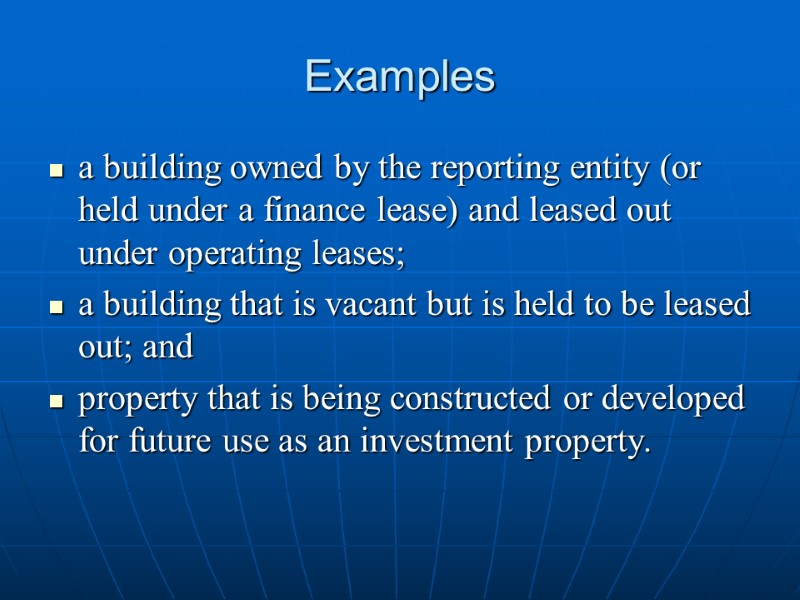
Examples a building owned by the reporting entity (or held under a finance lease) and leased out under operating leases; a building that is vacant but is held to be leased out; and property that is being constructed or developed for future use as an investment property.
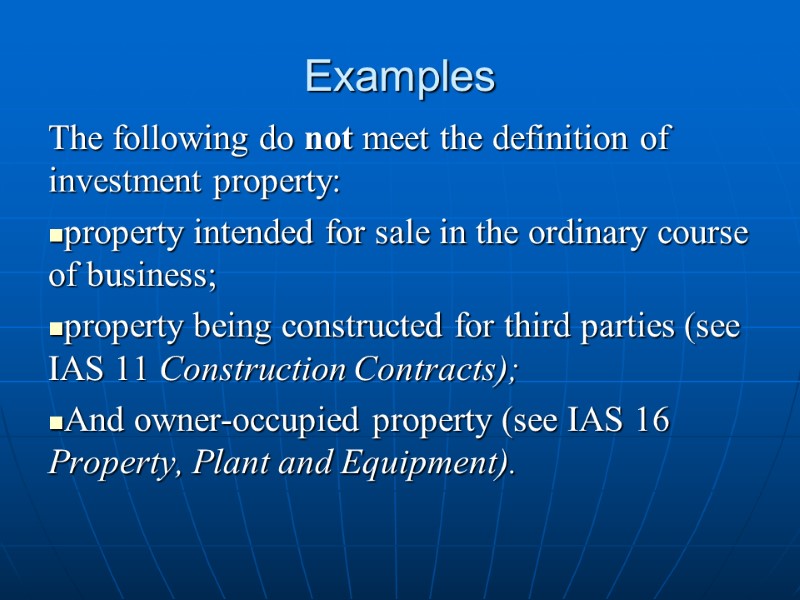
Examples The following do not meet the definition of investment property: property intended for sale in the ordinary course of business; property being constructed for third parties (see IAS 11 Construction Contracts); And owner-occupied property (see IAS 16 Property, Plant and Equipment).
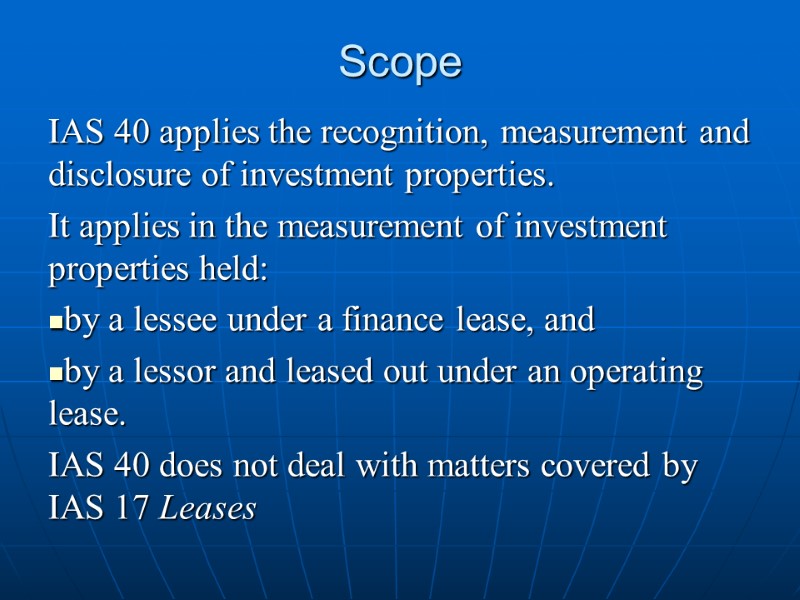
Scope IAS 40 applies the recognition, measurement and disclosure of investment properties. It applies in the measurement of investment properties held: by a lessee under a finance lease, and by a lessor and leased out under an operating lease. IAS 40 does not deal with matters covered by IAS 17 Leases
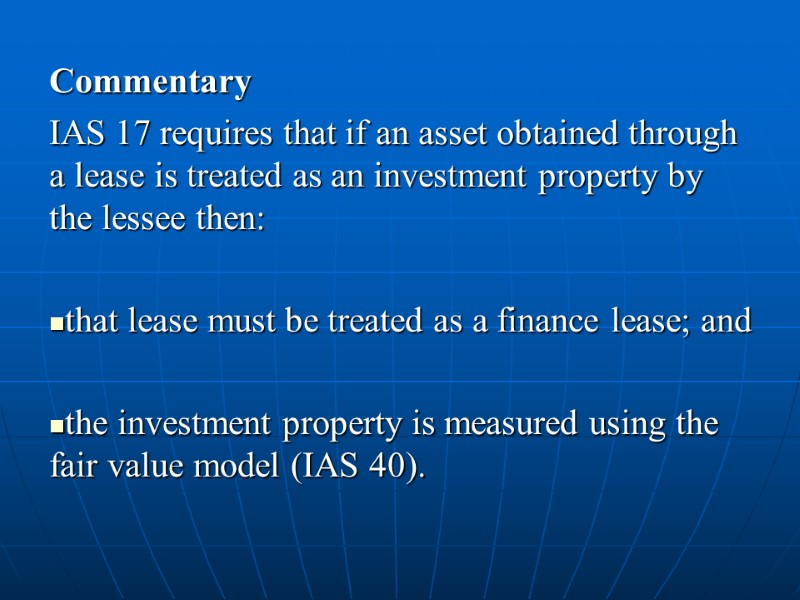
Commentary IAS 17 requires that if an asset obtained through a lease is treated as an investment property by the lessee then: that lease must be treated as a finance lease; and the investment property is measured using the fair value model (IAS 40).
Scope IAS 40 does not apply to: Biological assets in respect of agricultural activity; and Mineral rights and reserves and similar non-regenerative resources.
Recognition Rule Investment property should be recognised as an asset when: it is probable that the future economic benefits that are attributable to the investment property will flow to the entity; and the cost or fair value of the investment property can be measured reliably.
Initial measurement ■ An investment property should be measured initially at its cost, which is the fair value of the consideration given for it. Transaction costs are included in the initial measurement. Meaning of cost The cost of a purchased investment property comprises its purchase price, and any directly attributable expenditure. Directly attributable expenditure includes, for example, professional fees for legal services and property transfer taxes.
If a company uses the fair value model (see later) and is self-constructing an investment property then it should value that property at fair value during construction. IAS 40 allows that if fair value cannot be measured reliably during construction then the property can be valued at cost until construction is complete. When construction is complete the property should be valued at its fair value.
Subsequent expenditure Day to day costs of running the investment property are recognised as an expense as incurred. If a part of an investment property requires replacement during the useful life of the property the replacement part is capitalised when the cost is incurred as long as the recognition criteria are met. Any value remaining in respect of the replaced part will be de-recognised as the new cost is capitalised. Commentary This replacement of components principle is the same as that applied to other non-current assets (IAS 16).
Measurement subsequent to initial recognition Rule An entity should choose either: the fair value model; or the cost model.
Fair value model Application of the model After initial recognition, an entity that chooses the fair value model should measure all of its investment property at its fair value except in exceptional circumstances. A gain or loss arising from a change in the fair value of investment property should be included in profit or loss for the period in which it arises.
Commentary This is known as "marking to market". The fair value should reflect the actual market and circumstances at the end of the reporting period, not as of either a past or future date. The fair value of investment property is an estimated amount rather than a predetermined or actual sale price. It is the price at which the market expects a transaction that meets all other elements of the fair value definition would be completed on the date of valuation.
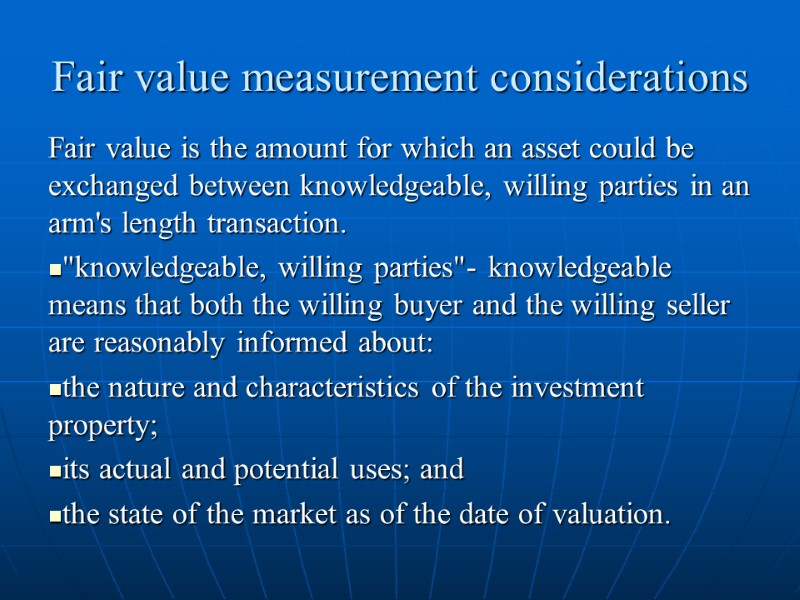
Fair value measurement considerations Fair value is the amount for which an asset could be exchanged between knowledgeable, willing parties in an arm's length transaction. "knowledgeable, willing parties"- knowledgeable means that both the willing buyer and the willing seller are reasonably informed about: the nature and characteristics of the investment property; its actual and potential uses; and the state of the market as of the date of valuation.
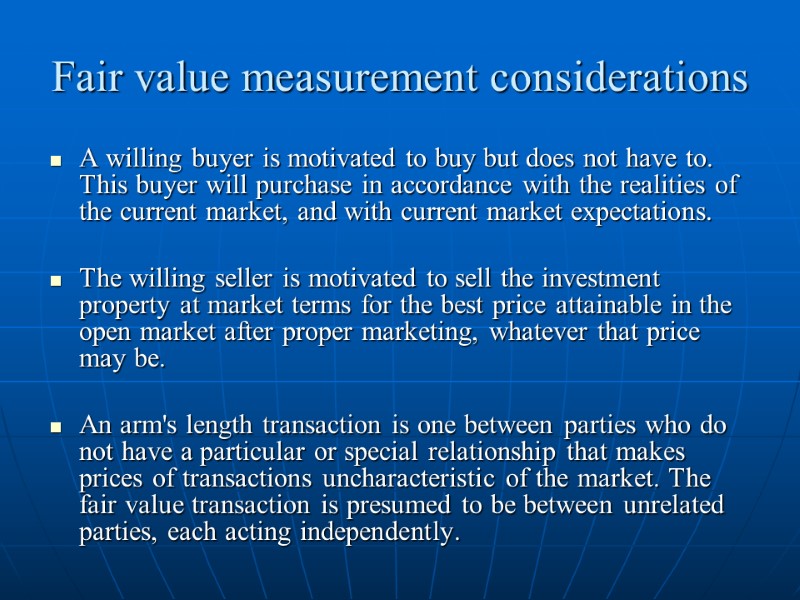
Fair value measurement considerations A willing buyer is motivated to buy but does not have to. This buyer will purchase in accordance with the realities of the current market, and with current market expectations. The willing seller is motivated to sell the investment property at market terms for the best price attainable in the open market after proper marketing, whatever that price may be. An arm's length transaction is one between parties who do not have a particular or special relationship that makes prices of transactions uncharacteristic of the market. The fair value transaction is presumed to be between unrelated parties, each acting independently.
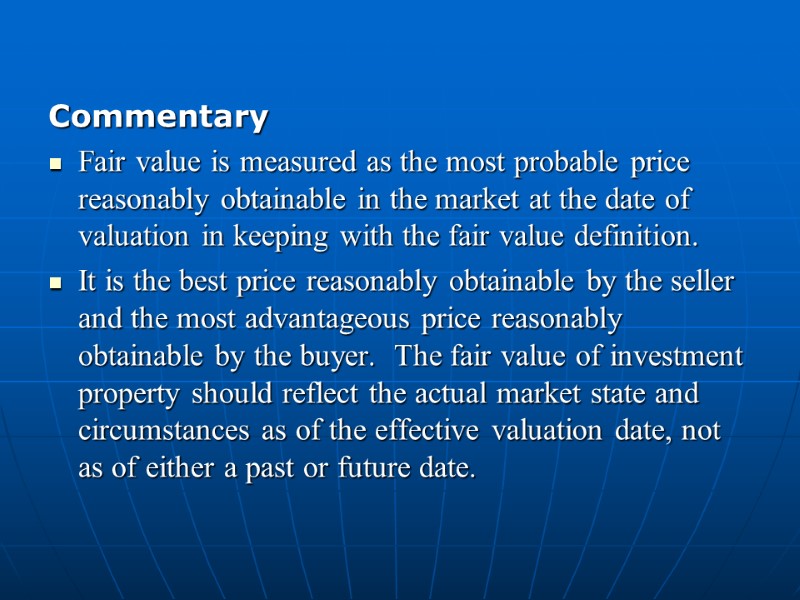
Commentary Fair value is measured as the most probable price reasonably obtainable in the market at the date of valuation in keeping with the fair value definition. It is the best price reasonably obtainable by the seller and the most advantageous price reasonably obtainable by the buyer. The fair value of investment property should reflect the actual market state and circumstances as of the effective valuation date, not as of either a past or future date.
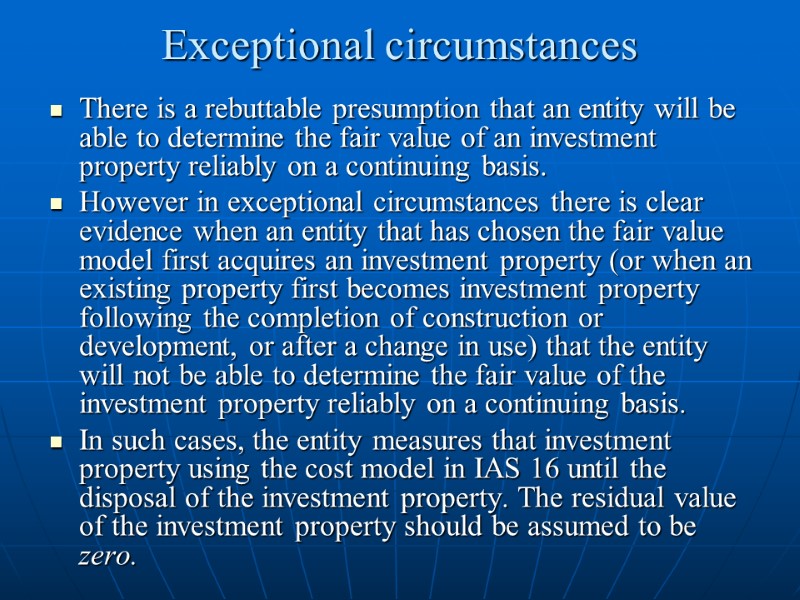
Exceptional circumstances There is a rebuttable presumption that an entity will be able to determine the fair value of an investment property reliably on a continuing basis. However in exceptional circumstances there is clear evidence when an entity that has chosen the fair value model first acquires an investment property (or when an existing property first becomes investment property following the completion of construction or development, or after a change in use) that the entity will not be able to determine the fair value of the investment property reliably on a continuing basis. In such cases, the entity measures that investment property using the cost model in IAS 16 until the disposal of the investment property. The residual value of the investment property should be assumed to be zero.
Cost model After initial recognition, an entity that chooses the cost model should measure all of its investment property using the cost model in IAS 16 (that is at cost less any accumulated depreciation and less any accumulated impairment losses). Commentary Note that investment properties meeting the IFRS 5 criteria to be classified as held for sale are measured in accordance with IFRS 5 "Non-current Assets Held for Sale and Discontinued Operations ". An entity that chooses the cost model should disclose the fair value of its investment property.
Change in method A change from one model to the other model should be made only if the change will result in a more appropriate presentation. IAS 40 states that this is highly unlikely to be the case for a change from the fair value model to the cost model.
Transfers Transfers to and from investment property should be made when and only when there is a change in use evidenced by commencement of: owner occupation - for a transfer from investment property to owner occupied property; development with a view to sale - for a transfer from investment property to inventories;
Commentary The above transfers will be at fair value under IAS 40 's fair value model. End of owner occupation - for a transfer from owner occupied property to investment property; Commentary Any revaluation surplus up to the date of transfer will be recognised in other comprehensive income and presented in equity. Commencement of an operating lease to another party-for a transfer from inventories to investment property.
Disposals An investment property should be derecognised (i.e. eliminated from the statement of financial position) on disposal or when the investment property is permanently withdrawn from use and no future economic benefits are expected from its disposal.
Disclosure Classification criteria (to distinguish owner-occupied, investment property, property held for sale in situations where classification is difficult). Methods and assumptions used to determine fair value. Extent of involvement of independent, professional and recently experienced valuers in the determination of fair value (whether used as measurement basis or disclosed).
Disclosure Amounts included in profit or loss for: Rental income Direct operating expenses from rented property Direct operating expenses from non-rented property Restrictions on readability of property or remittance of income/disposal proceeds. Material contractual obligations: to purchase, construct or develop investment property; or for repairs, maintenance or enhancements.
Fair value model Reconciliation between opening and closing carrying amount of investment property held at fair value. Any investment property that is not carried at fair value should be similarly subject to reconciliation separately from other properties, and additional disclosures made (e.g. including an explanation of why it is an exception).
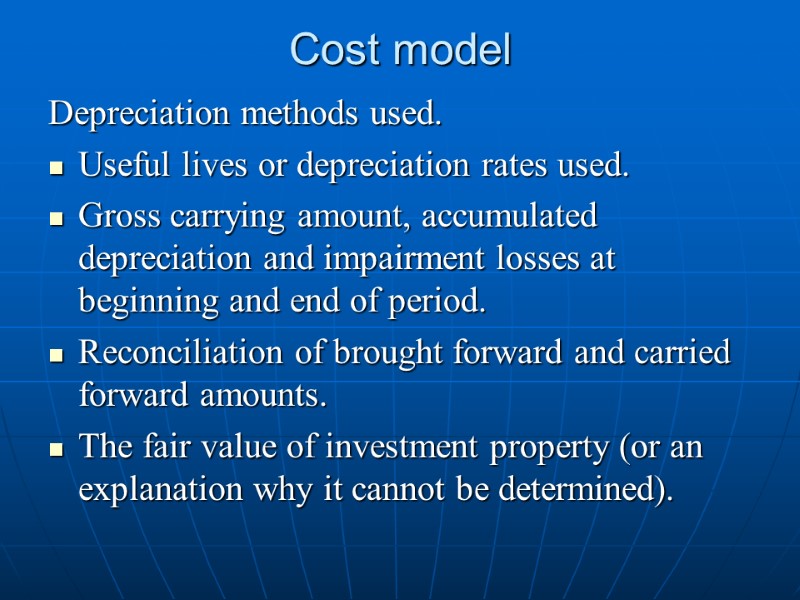
Cost model Depreciation methods used. Useful lives or depreciation rates used. Gross carrying amount, accumulated depreciation and impairment losses at beginning and end of period. Reconciliation of brought forward and carried forward amounts. The fair value of investment property (or an explanation why it cannot be determined).
THANK YOU FOR YOUR ATTENTION!!!