 Скачать презентацию To be born into a family
Choosing a career (к урокам).ppt
- Количество слайдов: 39



• To be born into a family, to offer a general course of academic and non-academic subjects, to provide general education, to offer a number of courses, to give profound knowledge in a variety of fields, the humanities, a natural (social) science, to specialize in, to take a course, to be … chief interest, to discuss professionals matters, prospective occupation, to choose a career, a matter of future prestige and wealth, socially important, to be well aware of the fact that, insufficient, ambition, to take preparatory course at, to pass a school-leaving (entrance) exam, to fail at exams, to have a try, final choice, communication skills, require, allow, key, a quality, a (to do) qualification(s), salary, employment, achievements, skilled, co-operate (ive), self-motivated, showing initiative, flexible, self-confident, school-leaver, step, experience, object to, satisfy
What jobs will/won’t be popular in the future? • I think either … or … will be the top job • I think neither … nor … will be popular • An account, a dentist, a doctor, an IT consultant, a lawyer, a manager, a teacher, an engineer, a skilled worker…
What factors influence the choice? • People choose a job of a … because … • Have good/bad career opportunities, earn the respect of people, have good/bad working conditions, work in a friendly atmosphere, have short/long working hours, do hard work, earn a low/high salary
When are people satisfied with the job? • People are satisfied with the job that allows them … • To be financially independent, to feel safe as they work, to feel good about themselves, to feel respect, to belong to a team, to feel personal achievements, to have an opportunity to make a career
What skills are necessary for different jobs? • The job of … requires … • Communication skills, basic IT skills, an ability to learn, team-working skills, time management skills, skills in problem solving, skills in planning and organisation
What qualities are valued? • It is valued when workers are … • Showing initiative, co-operative, selfmotivated, creative, flexible, wellorganised
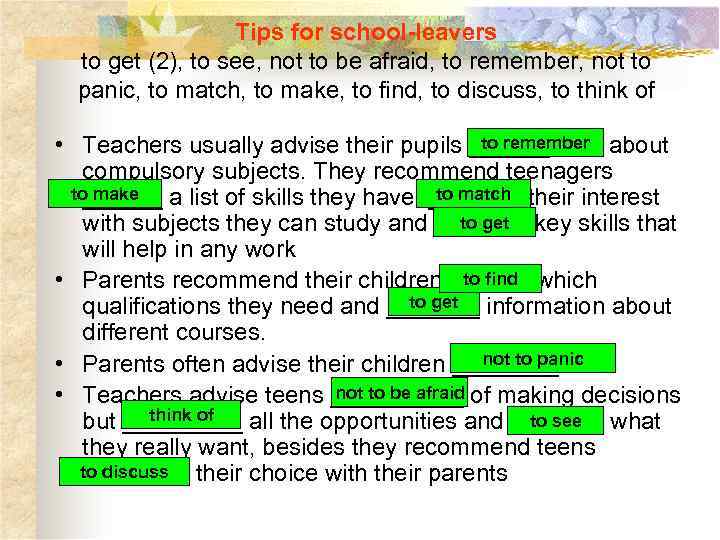
Tips for school-leavers to get (2), to see, not to be afraid, to remember, not to panic, to match, to make, to find, to discuss, to think of to remember about • Teachers usually advise their pupils ______ compulsory subjects. They recommend teenagers to make to match ______ a list of skills they have, _______ their interest to get with subjects they can study and _______ key skills that will help in any work to find • Parents recommend their children ______ which to get qualifications they need and _______ information about different courses. not to panic • Parents often advise their children ____ not to be afraid • Teachers advise teens _____ of making decisions think of to see but _____ all the opportunities and _______ what they really want, besides they recommend teens to discuss their choice with their parents ____
Psychologists/they advise/warn/recommend parents • Do not give advice your teenagers doesn’t need • Provide your teens with respect and support while giving up some of your control • Help your child to develop decision-making and problemsolving skills • Prepare your teenagers to take care of themselves away from home • Teach them to cook and to manage a budget • Don’t be afraid to set limits on how much you can financially support your teenager • Be supportive and enthusiastic, even your teenagers often change their minds
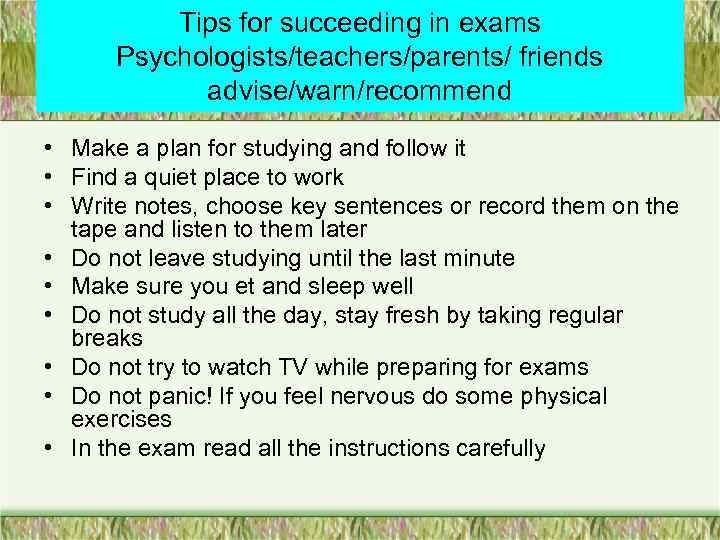
Tips for succeeding in exams Psychologists/teachers/parents/ friends advise/warn/recommend • Make a plan for studying and follow it • Find a quiet place to work • Write notes, choose key sentences or record them on the tape and listen to them later • Do not leave studying until the last minute • Make sure you et and sleep well • Do not study all the day, stay fresh by taking regular breaks • Do not try to watch TV while preparing for exams • Do not panic! If you feel nervous do some physical exercises • In the exam read all the instructions carefully
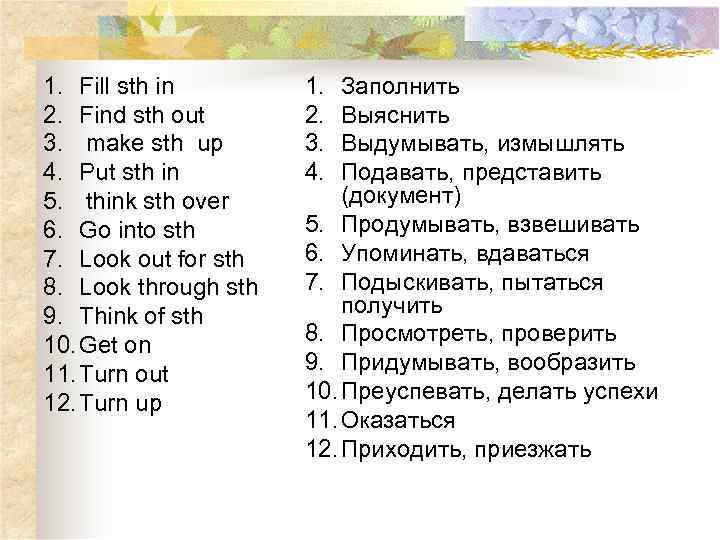
1. Fill sth in 2. Find sth out 3. make sth up 4. Put sth in 5. think sth over 6. Go into sth 7. Look out for sth 8. Look through sth 9. Think of sth 10. Get on 11. Turn out 12. Turn up 1. 2. 3. 4. Заполнить Выяснить Выдумывать, измышлять Подавать, представить (документ) 5. Продумывать, взвешивать 6. Упоминать, вдаваться 7. Подыскивать, пытаться получить 8. Просмотреть, проверить 9. Придумывать, вообразить 10. Преуспевать, делать успехи 11. Оказаться 12. Приходить, приезжать
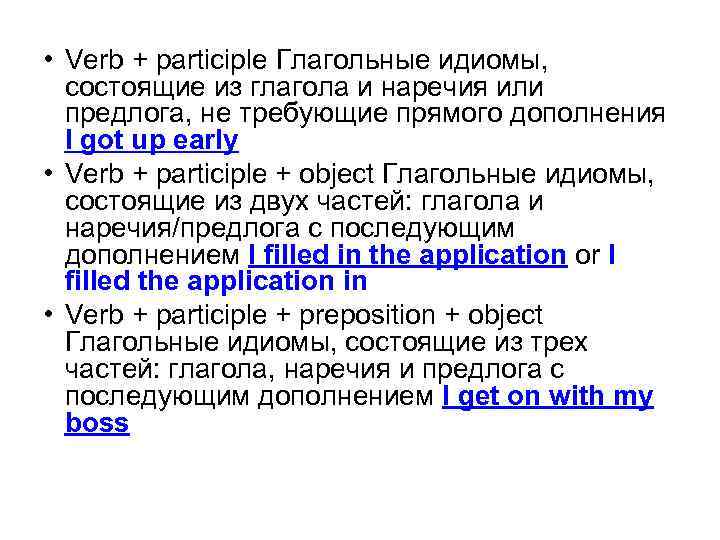
• Verb + participle Глагольные идиомы, состоящие из глагола и наречия или предлога, не требующие прямого дополнения I got up early • Verb + participle + object Глагольные идиомы, состоящие из двух частей: глагола и наречия/предлога с последующим дополнением I filled in the application or I filled the application in • Verb + participle + preposition + object Глагольные идиомы, состоящие из трех частей: глагола, наречия и предлога с последующим дополнением I get on with my boss
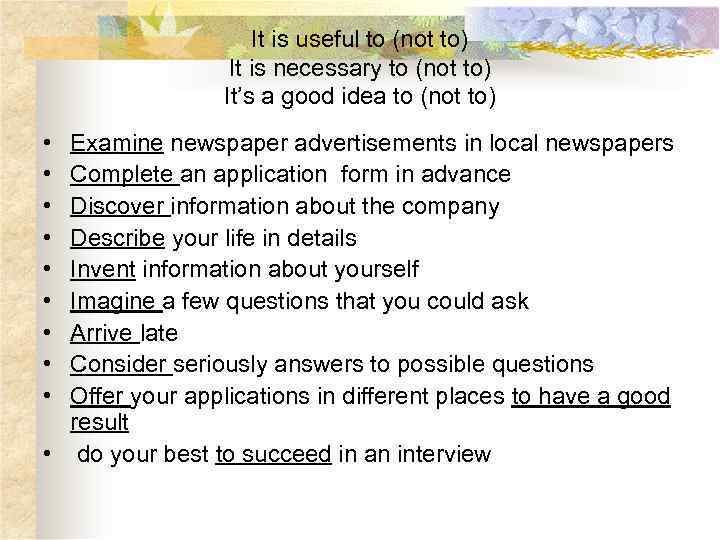
It is useful to (not to) It is necessary to (not to) It’s a good idea to (not to) • • • Examine newspaper advertisements in local newspapers Complete an application form in advance Discover information about the company Describe your life in details Invent information about yourself Imagine a few questions that you could ask Arrive late Consider seriously answers to possible questions Offer your applications in different places to have a good result • do your best to succeed in an interview
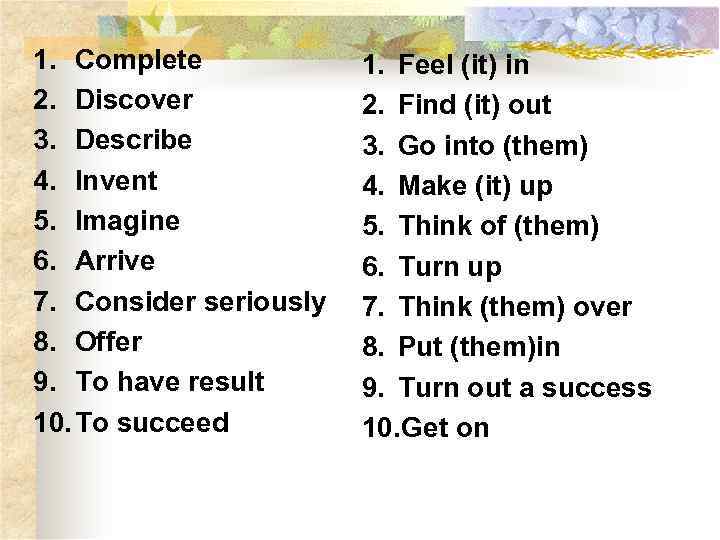
1. Complete 2. Discover 3. Describe 4. Invent 5. Imagine 6. Arrive 7. Consider seriously 8. Offer 9. To have result 10. To succeed 1. Feel (it) in 2. Find (it) out 3. Go into (them) 4. Make (it) up 5. Think of (them) 6. Turn up 7. Think (them) over 8. Put (them)in 9. Turn out a success 10. Get on
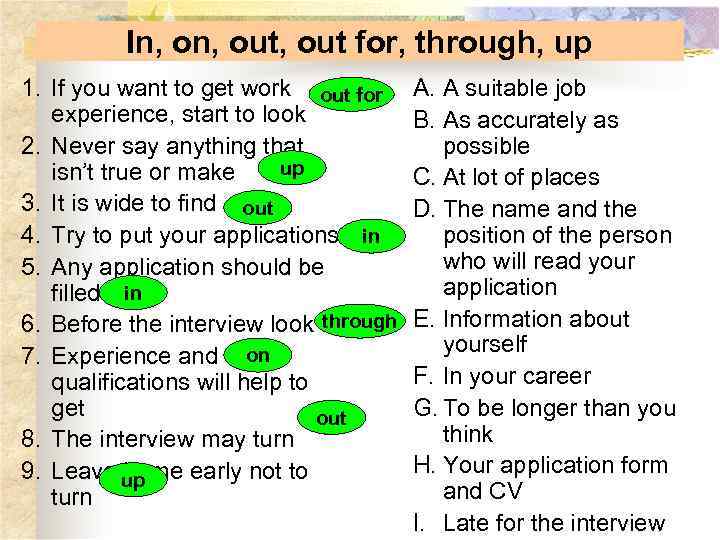
In, out, out for, through, up 1. If you want to get work out for experience, start to look 2. Never say anything that up isn’t true or make 3. It is wide to find out 4. Try to put your applications in 5. Any application should be filled in 6. Before the interview look through 7. Experience and on qualifications will help to get out 8. The interview may turn 9. Leave up home early not to turn A. A suitable job B. As accurately as possible C. At lot of places D. The name and the position of the person who will read your application E. Information about yourself F. In your career G. To be longer than you think H. Your application form and CV I. Late for the interview
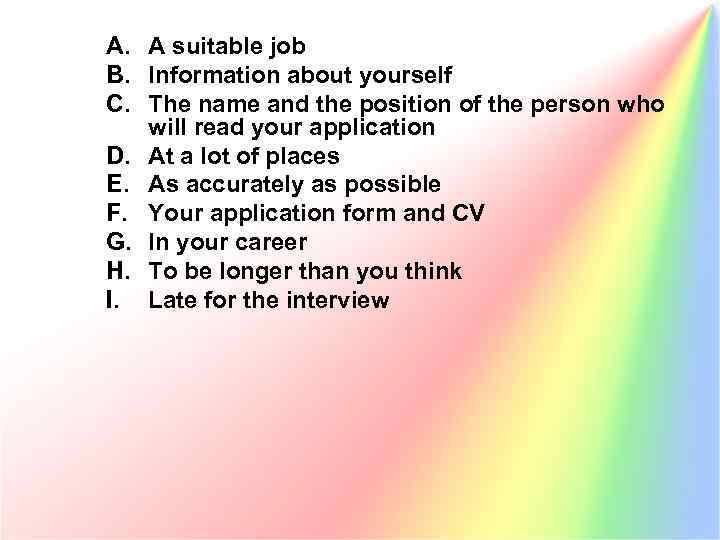
A. A suitable job B. Information about yourself C. The name and the position of the person who will read your application D. At a lot of places E. As accurately as possible F. Your application form and CV G. In your career H. To be longer than you think I. Late for the interview
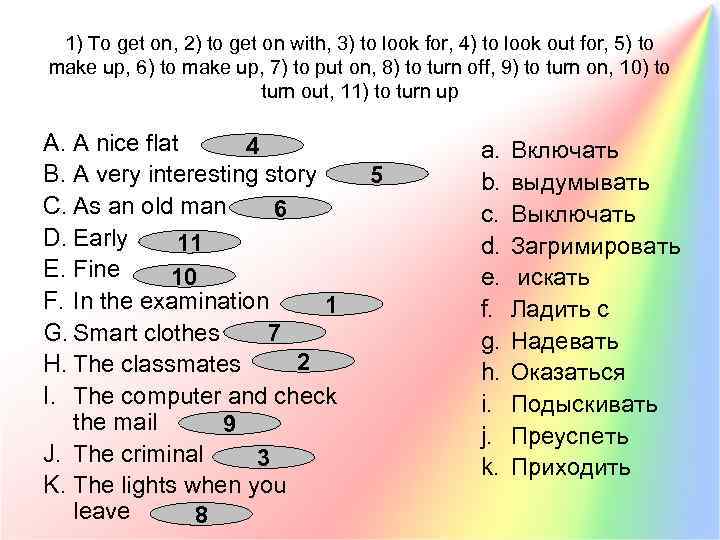
1) To get on, 2) to get on with, 3) to look for, 4) to look out for, 5) to make up, 6) to make up, 7) to put on, 8) to turn off, 9) to turn on, 10) to turn out, 11) to turn up A. A nice flat 4 B. A very interesting story C. As an old man 6 D. Early 11 E. Fine 10 F. In the examination 1 G. Smart clothes 7 2 H. The classmates I. The computer and check the mail 9 J. The criminal 3 K. The lights when you leave 8 5 a. b. c. d. e. f. g. h. i. j. k. Включать выдумывать Выключать Загримировать искать Ладить с Надевать Оказаться Подыскивать Преуспеть Приходить
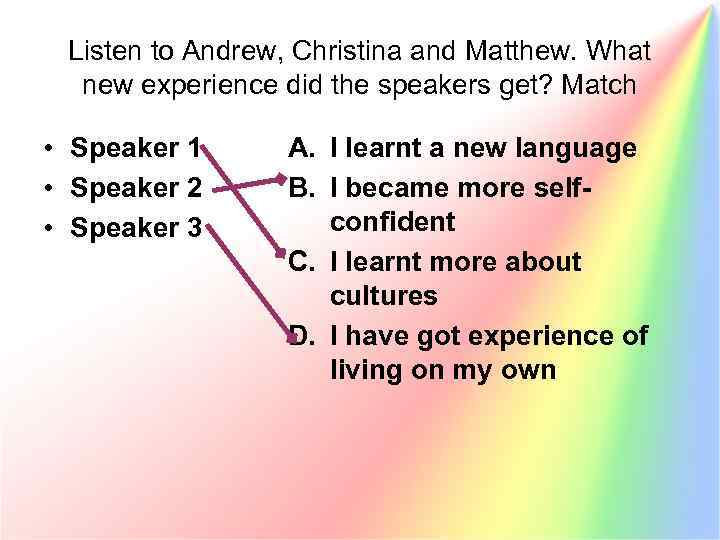
Listen to Andrew, Christina and Matthew. What new experience did the speakers get? Match • Speaker 1 • Speaker 2 • Speaker 3 A. I learnt a new language B. I became more selfconfident C. I learnt more about cultures D. I have got experience of living on my own
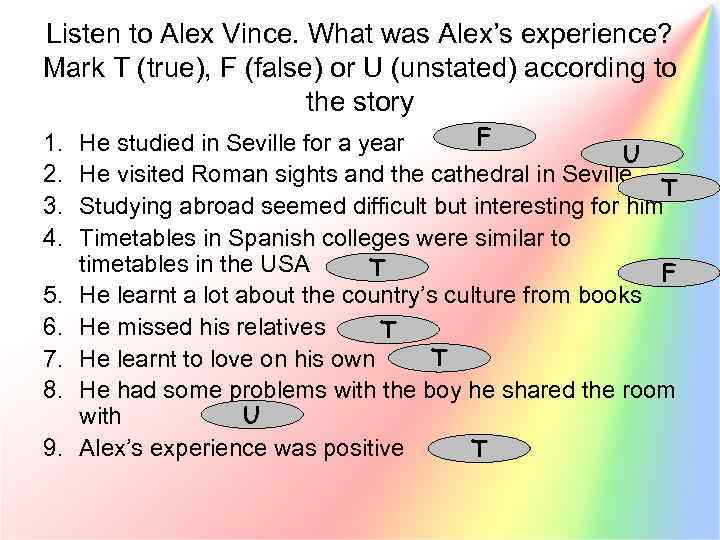
Listen to Alex Vince. What was Alex’s experience? Mark T (true), F (false) or U (unstated) according to the story 1. 2. 3. 4. 5. 6. 7. 8. 9. F He studied in Seville for a year U He visited Roman sights and the cathedral in Seville T Studying abroad seemed difficult but interesting for him Timetables in Spanish colleges were similar to timetables in the USA T F He learnt a lot about the country’s culture from books He missed his relatives T T He learnt to love on his own He had some problems with the boy he shared the room U with Alex’s experience was positive T
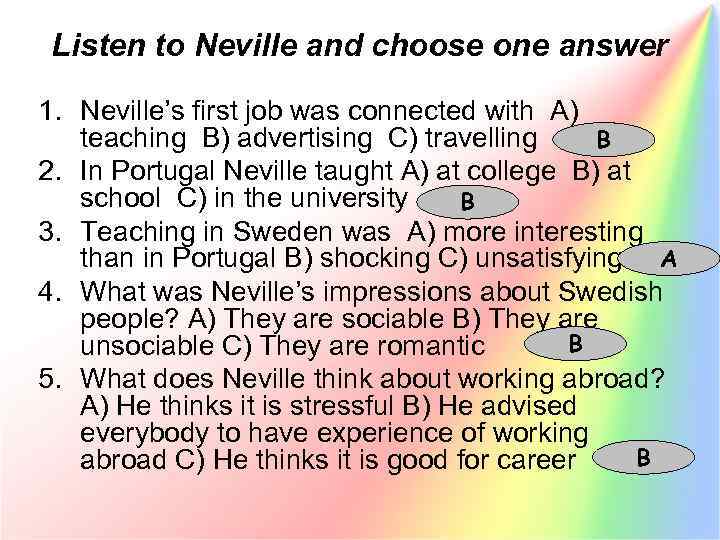
Listen to Neville and choose one answer 1. Neville’s first job was connected with A) teaching B) advertising C) travelling B 2. In Portugal Neville taught A) at college B) at school C) in the university B 3. Teaching in Sweden was A) more interesting than in Portugal B) shocking C) unsatisfying A 4. What was Neville’s impressions about Swedish people? A) They are sociable B) They are B unsociable C) They are romantic 5. What does Neville think about working abroad? A) He thinks it is stressful B) He advised everybody to have experience of working B abroad C) He thinks it is good for career
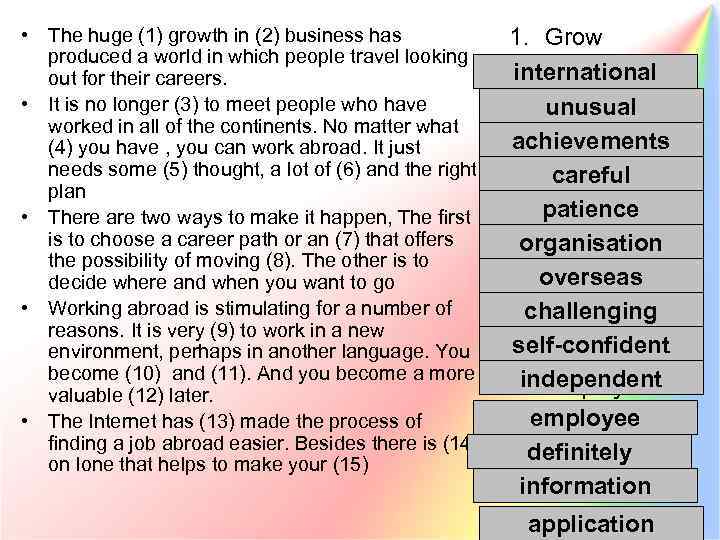
• The huge (1) growth in (2) business has produced a world in which people travel looking out for their careers. • It is no longer (3) to meet people who have worked in all of the continents. No matter what (4) you have , you can work abroad. It just needs some (5) thought, a lot of (6) and the right plan • There are two ways to make it happen, The first is to choose a career path or an (7) that offers the possibility of moving (8). The other is to decide where and when you want to go • Working abroad is stimulating for a number of reasons. It is very (9) to work in a new environment, perhaps in another language. You become (10) and (11). And you become a more valuable (12) later. • The Internet has (13) made the process of finding a job abroad easier. Besides there is (14) on lone that helps to make your (15) 1. Grow 2. Nation international 3. Usual unusual 4. Achieve achievements 5. Care careful 6. Patient patience 7. Organies organisation 8. Sea overseas 9. Challenge challenging 10. Confident self-confident 11. Dependent independent 12. Employ 13. Definite employee 14. Inform definitely 15. Apply information application
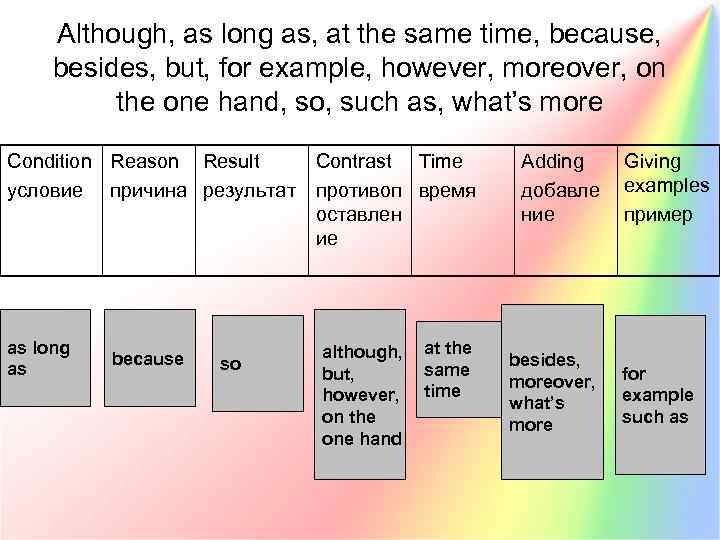
Although, as long as, at the same time, because, besides, but, for example, however, moreover, on the one hand, so, such as, what’s more Condition Reason Result условие причина результат as long as because so Contrast Time противоп время оставлен ие although, but, however, on the one hand at the same time Adding добавле ние besides, moreover, what’s more Giving examples пример for example such as
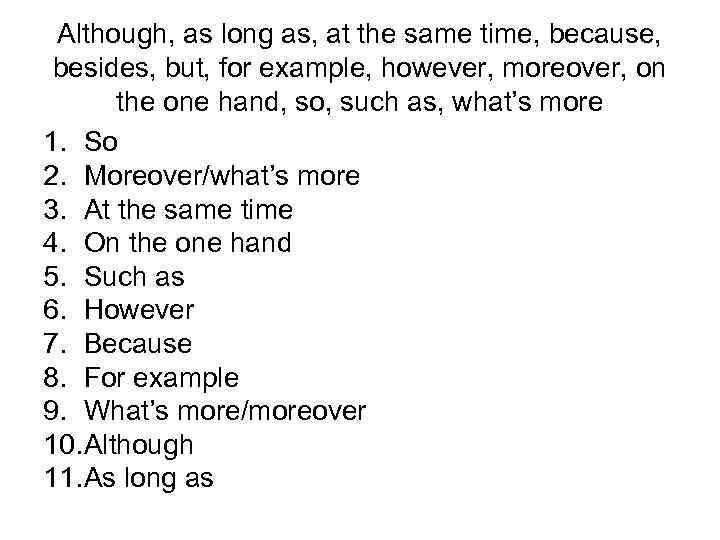
Although, as long as, at the same time, because, besides, but, for example, however, moreover, on the one hand, so, such as, what’s more 1. So 2. Moreover/what’s more 3. At the same time 4. On the one hand 5. Such as 6. However 7. Because 8. For example 9. What’s more/moreover 10. Although 11. As long as
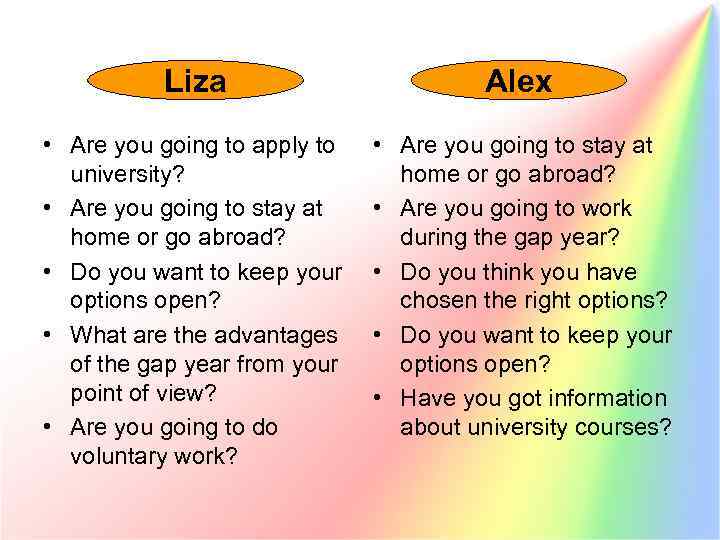
Liza Alex • Are you going to apply to university? • Are you going to stay at home or go abroad? • Do you want to keep your options open? • What are the advantages of the gap year from your point of view? • Are you going to do voluntary work? • Are you going to stay at home or go abroad? • Are you going to work during the gap year? • Do you think you have chosen the right options? • Do you want to keep your options open? • Have you got information about university courses?
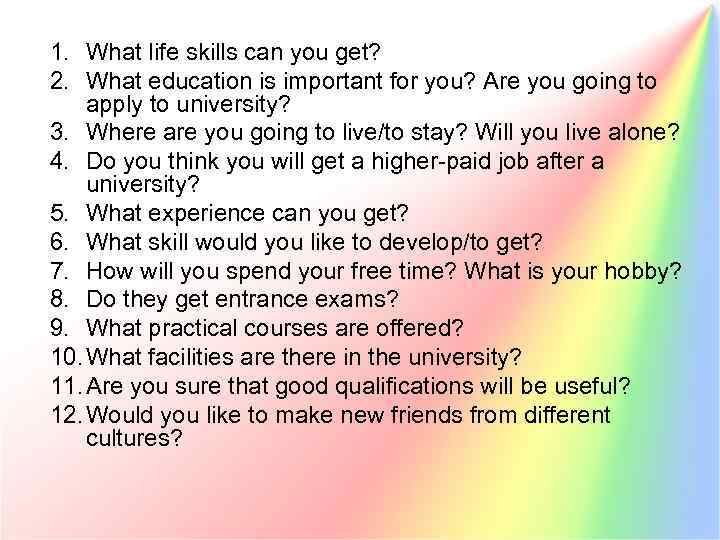
1. What life skills can you get? 2. What education is important for you? Are you going to apply to university? 3. Where are you going to live/to stay? Will you live alone? 4. Do you think you will get a higher-paid job after a university? 5. What experience can you get? 6. What skill would you like to develop/to get? 7. How will you spend your free time? What is your hobby? 8. Do they get entrance exams? 9. What practical courses are offered? 10. What facilities are there in the university? 11. Are you sure that good qualifications will be useful? 12. Would you like to make new friends from different cultures?
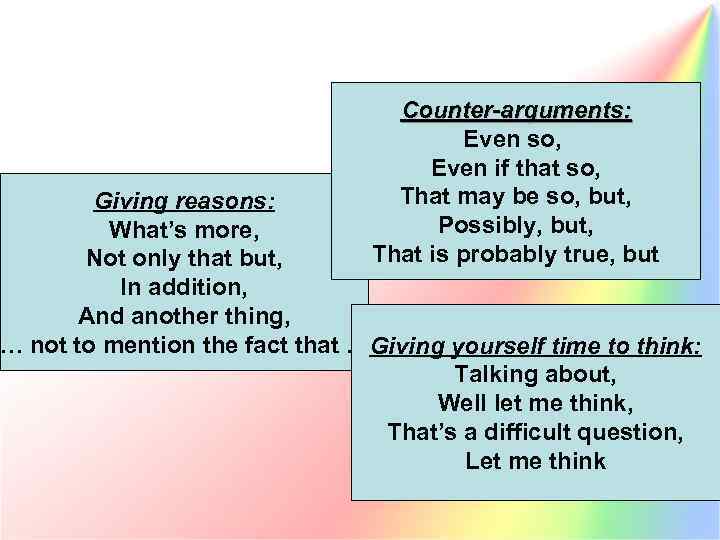
Counter-arguments: Even so, Even if that so, That may be so, but, Possibly, but, That is probably true, but Giving reasons: What’s more, Not only that but, In addition, And another thing, … not to mention the fact that …Giving yourself time to think: Talking about, Well let me think, That’s a difficult question, Let me think
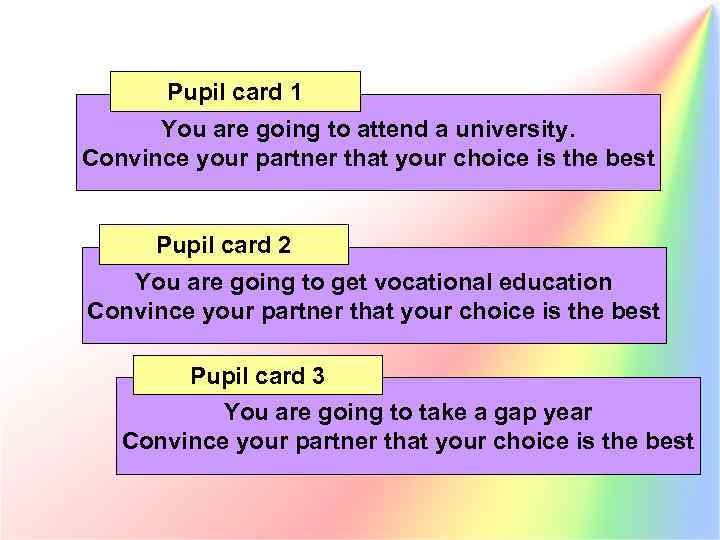
Pupil card 1 You are going to attend a university. Convince your partner that your choice is the best Pupil card 2 You are going to get vocational education Convince your partner that your choice is the best Pupil card 3 You are going to take a gap year Convince your partner that your choice is the best
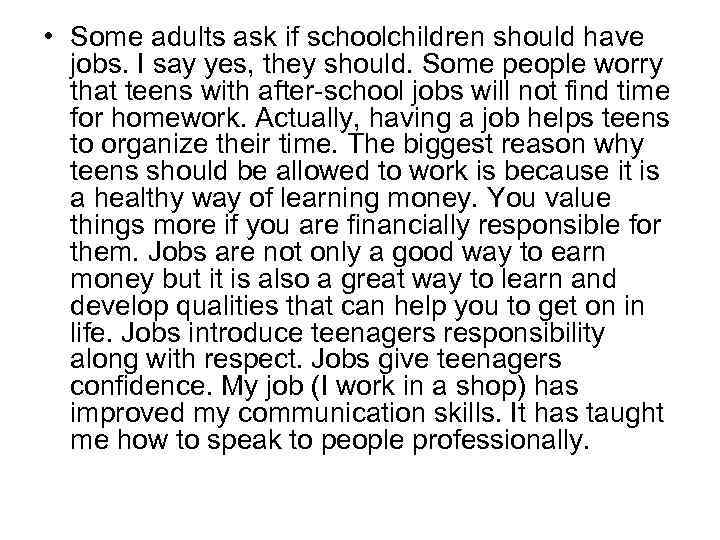
• Some adults ask if schoolchildren should have jobs. I say yes, they should. Some people worry that teens with after-school jobs will not find time for homework. Actually, having a job helps teens to organize their time. The biggest reason why teens should be allowed to work is because it is a healthy way of learning money. You value things more if you are financially responsible for them. Jobs are not only a good way to earn money but it is also a great way to learn and develop qualities that can help you to get on in life. Jobs introduce teenagers responsibility along with respect. Jobs give teenagers confidence. My job (I work in a shop) has improved my communication skills. It has taught me how to speak to people professionally.
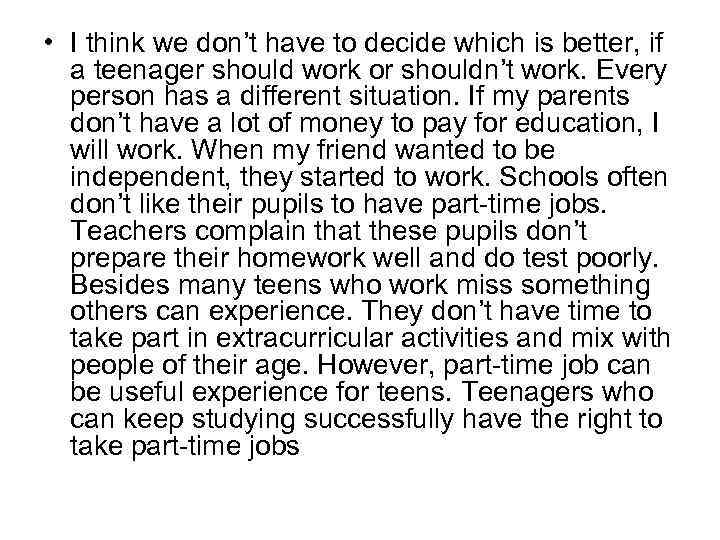
• I think we don’t have to decide which is better, if a teenager should work or shouldn’t work. Every person has a different situation. If my parents don’t have a lot of money to pay for education, I will work. When my friend wanted to be independent, they started to work. Schools often don’t like their pupils to have part-time jobs. Teachers complain that these pupils don’t prepare their homework well and do test poorly. Besides many teens who work miss something others can experience. They don’t have time to take part in extracurricular activities and mix with people of their age. However, part-time job can be useful experience for teens. Teenagers who can keep studying successfully have the right to take part-time jobs
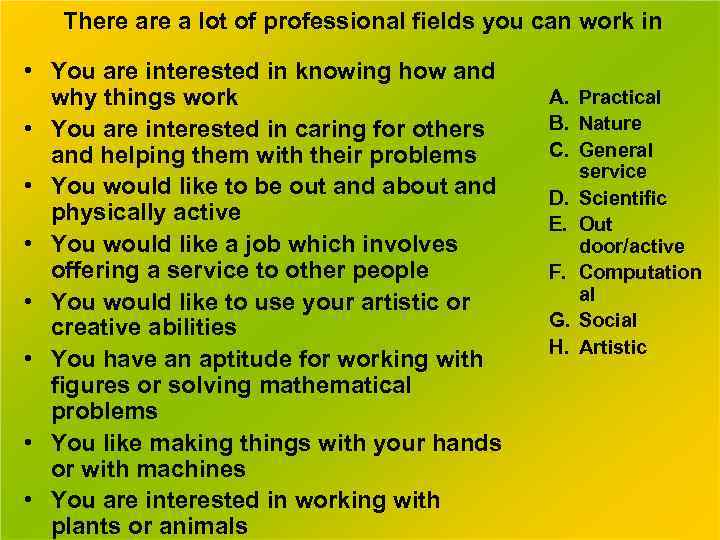
There a lot of professional fields you can work in • You are interested in knowing how and why things work • You are interested in caring for others and helping them with their problems • You would like to be out and about and physically active • You would like a job which involves offering a service to other people • You would like to use your artistic or creative abilities • You have an aptitude for working with figures or solving mathematical problems • You like making things with your hands or with machines • You are interested in working with plants or animals A. Practical B. Nature C. General service D. Scientific E. Out door/active F. Computation al G. Social H. Artistic
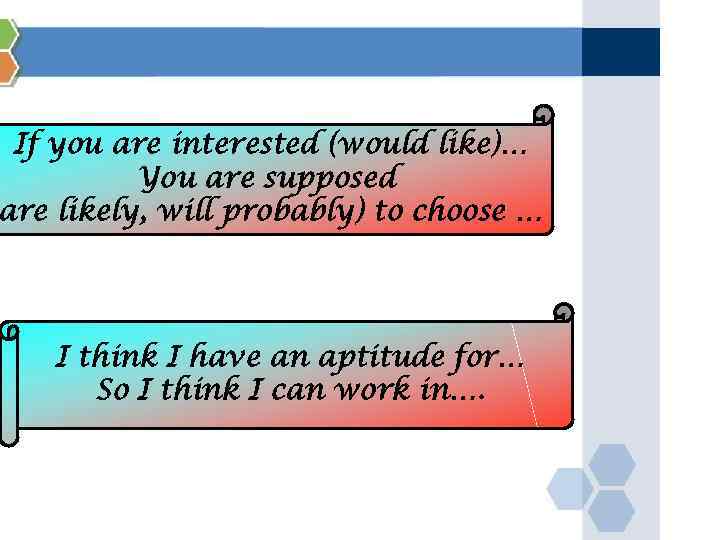
If you are interested (would like)… You are supposed are likely, will probably) to choose … I think I have an aptitude for… So I think I can work in….
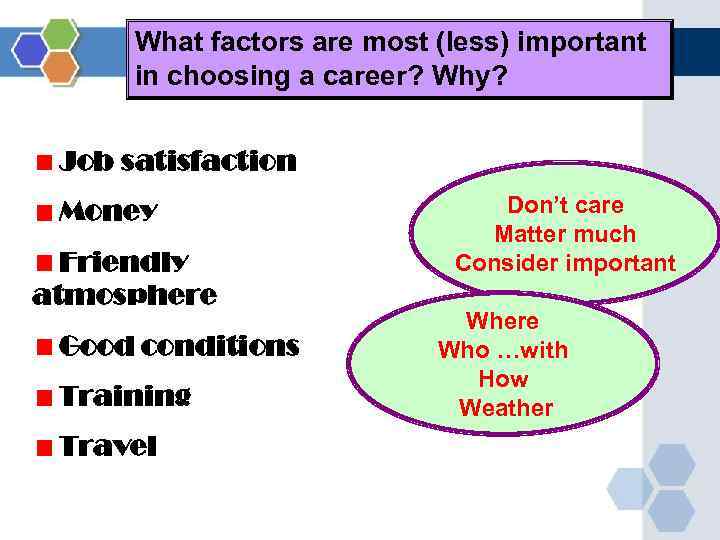
What factors are most (less) important in choosing a career? Why? Job satisfaction Money Friendly atmosphere Good conditions Training Travel Don’t care Matter much Consider important Where Who …with How Weather
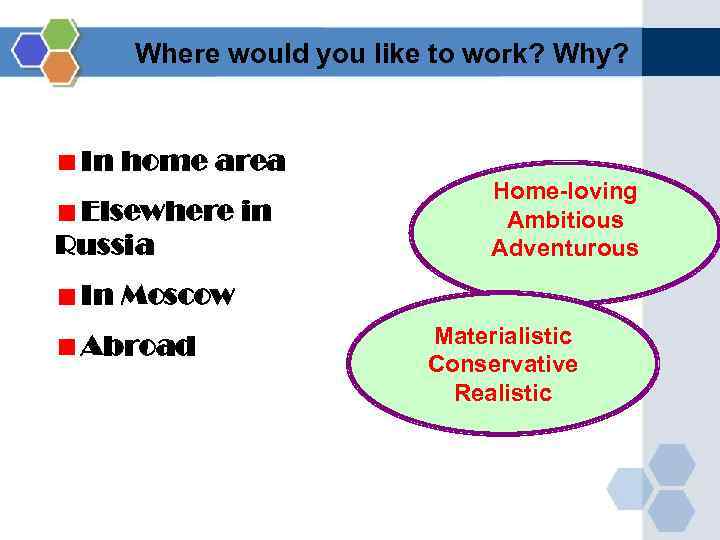
Where would you like to work? Why? In home area Elsewhere in Russia Home-loving Ambitious Adventurous In Moscow Abroad Materialistic Conservative Realistic
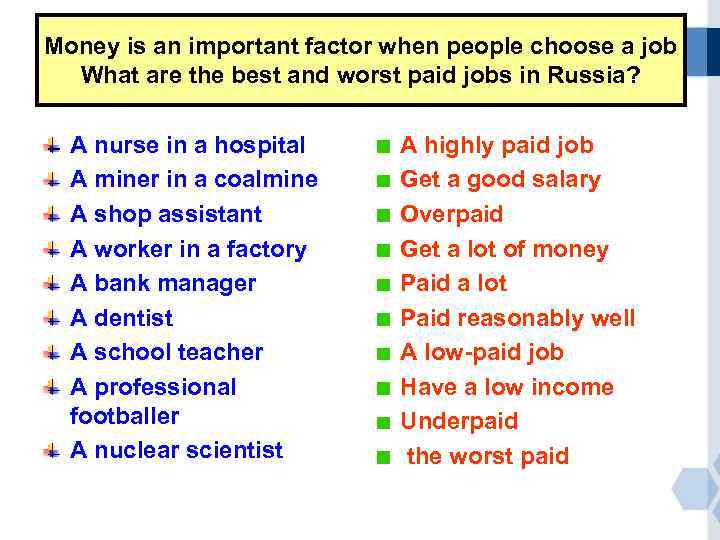
Money is an important factor when people choose a job What are the best and worst paid jobs in Russia? A nurse in a hospital A miner in a coalmine A shop assistant A worker in a factory A bank manager A dentist A school teacher A professional footballer A nuclear scientist A highly paid job Get a good salary Overpaid Get a lot of money Paid a lot Paid reasonably well A low-paid job Have a low income Underpaid the worst paid
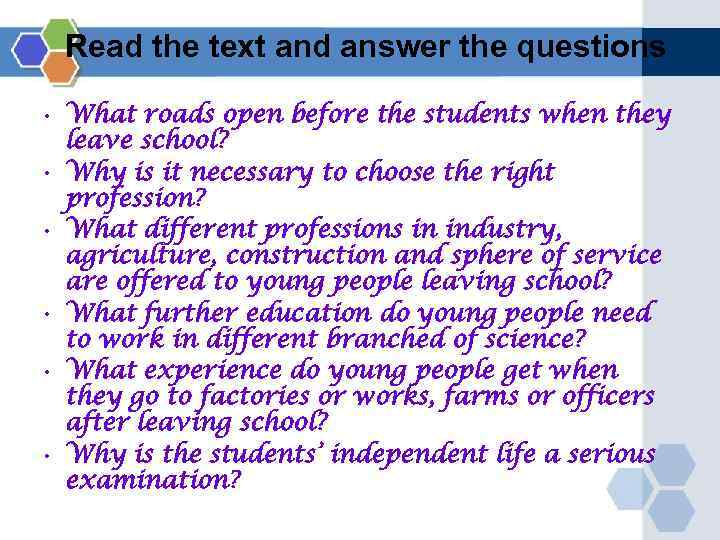
Read the text and answer the questions • What roads open before the students when they leave school? • Why is it necessary to choose the right profession? • What different professions in industry, agriculture, construction and sphere of service are offered to young people leaving school? • What further education do young people need to work in different branched of science? • What experience do young people get when they go to factories or works, farms or officers after leaving school? • Why is the students’ independent life a serious examination?
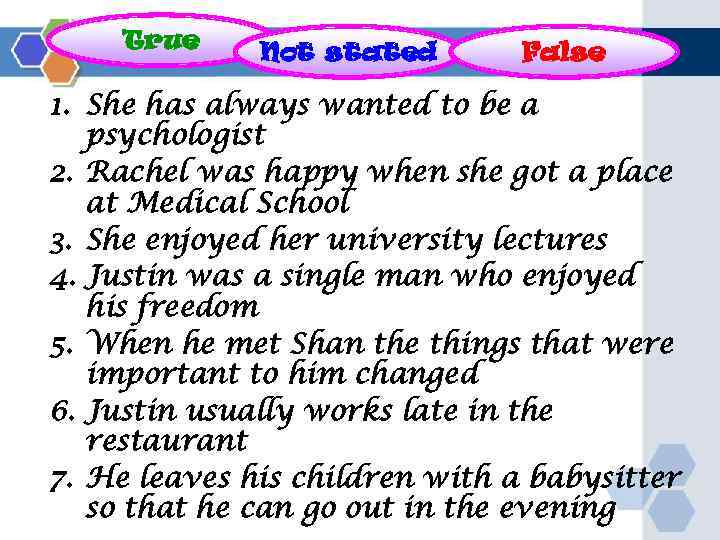
True Not stated False 1. She has always wanted to be a psychologist 2. Rachel was happy when she got a place at Medical School 3. She enjoyed her university lectures 4. Justin was a single man who enjoyed his freedom 5. When he met Shan the things that were important to him changed 6. Justin usually works late in the restaurant 7. He leaves his children with a babysitter so that he can go out in the evening
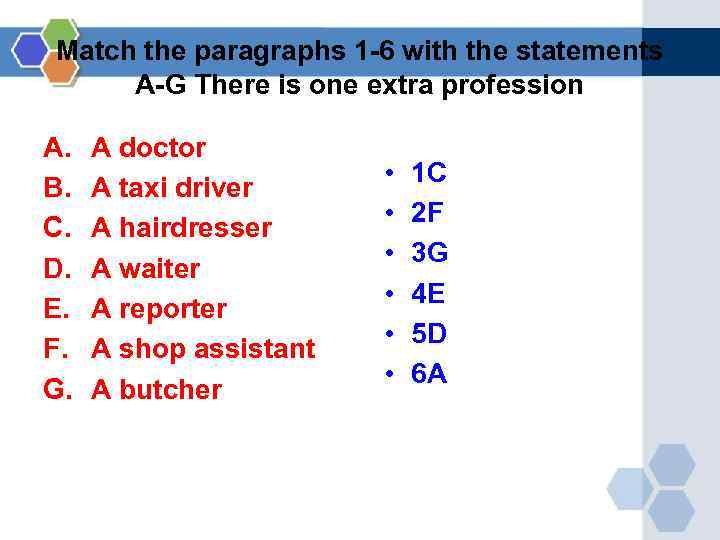
Match the paragraphs 1 -6 with the statements A-G There is one extra profession A. B. C. D. E. F. G. A doctor A taxi driver A hairdresser A waiter A reporter A shop assistant A butcher • • • 1 C 2 F 3 G 4 E 5 D 6 A
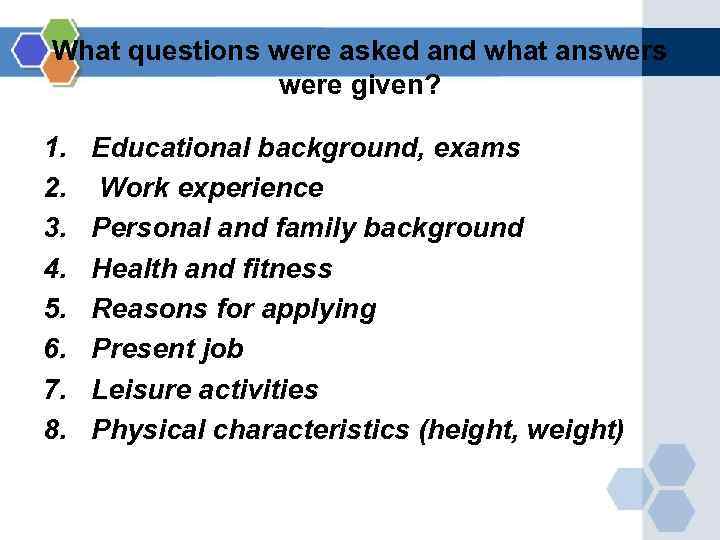
What questions were asked and what answers were given? 1. 2. 3. 4. 5. 6. 7. 8. Educational background, exams Work experience Personal and family background Health and fitness Reasons for applying Present job Leisure activities Physical characteristics (height, weight)
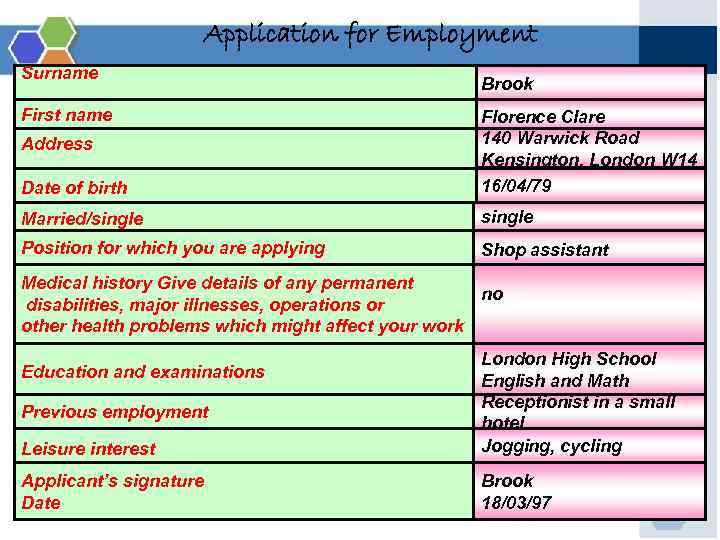
Application for Employment Surname First name Brook Date of birth Florence Clare 140 Warwick Road Kensington, London W 14 16/04/79 Married/single Position for which you are applying Shop assistant Address Medical history Give details of any permanent no disabilities, major illnesses, operations or other health problems which might affect your work Leisure interest London High School English and Math Receptionist in a small hotel Jogging, cycling Applicant’s signature Date Brook 18/03/97 Education and examinations Previous employment
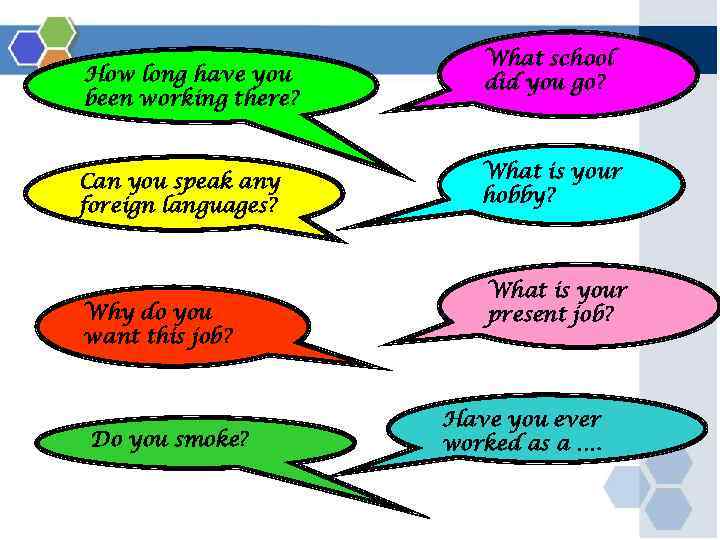
How long have you been working there? Can you speak any foreign languages? Why do you want this job? Do you smoke? What school did you go? What is your hobby? What is your present job? Have you ever worked as a ….
Скачать презентацию To be born into a family
Choosing a career (к урокам).ppt