 Скачать презентацию TNK-BP Investor Presentation April 2010 2 Important
bbb9ad2261acdf5434ce85e4870cd1d2.ppt
- Количество слайдов: 44



TNK-BP Investor Presentation April 2010
2 Important notice These materials include statements that are, or may be deemed to be, ‘‘forward-looking statements’’. These forward-looking statements can be identified by the use of forward-looking terminology, including, but not limited to, the terms ‘‘believes’’, ‘‘estimates’’, ‘‘anticipates’’, ‘‘expects’’, ‘‘intends’’, ‘‘may’’, ‘‘target’’, ‘‘will’’, or ‘‘should’’ or, in each case, their negative or other variations or comparable terminology or by discussions of strategy, plans, objectives, goals, future events or intentions. These forward-looking statements include all matters that are not historical facts. They include, but are not limited to, statements regarding the intentions, beliefs and statements of current expectations of TNK-BP International Limited and its subsidiaries (“TNK-BP”) concerning, amongst other things, TNK-BP’s results of operations, financial condition, liquidity, prospects, growth, potential acquisitions, strategies and as to the industries and locations in which TNK-BP operates. By their nature, forward-looking statements involve risk and uncertainty because they relate to future events and circumstances that may or may not occur. Forward-looking statements are not guarantees of future performance and the actual results of TNK-BP's operations, financial condition and liquidity and the development of the country, regions, political environment and industries in which TNK-BP operates may differ materially from those described in, or suggested by, the forwardlooking statements contained in these materials. TNK-BP does not intend, and does not assume any obligation, to update or revise any forwardlooking statements or information set out in these materials, whether as a result of new information, future events or otherwise. TNK-BP does not make any representation, warranty or prediction that the results anticipated by such forward-looking statements will be achieved. These materials contain reserves data for TNK-BP which has been extracted without material adjustment from the Reserves Reports prepared for TNK-BP by independent petroleum engineers using three different methods. These methods include the U. S. Securities and Exchange Commission ("SEC") standards, the U. S. Society of Petroleum Engineers, Inc. ("SPE") standards and a variation of the SEC standards pursuant to which reserves are calculated through the economic life of the fields ("SEC-LOF"). The SEC-LOF standards differ in certain material respects from the SEC standards and the SPE standards. Unless otherwise indicated reserves data contained in these materials are based on the SEC-LOF standards as in effect on the date of the Reserve Report from which such data has been extracted. The SEC has adopted significant revisions to the SEC standards on oil and gas reporting, which became effective on 1 January 2010. The main revisions that may have an impact on TNK-BP’s reserve quantities relate to the use of a 12 -month average price to estimate reserves rather than the price on the last day of the year and to the use of new technology and the enlargement of the areas for which reserves may be determined. These materials do not constitute or form part of and should not be construed as, an offer to sell or issue or the solicitation of an offer to buy or acquire any securities in any jurisdiction or an inducement to enter into investment activity. No part of these materials, nor the fact of its distribution, should form the basis of, or be relied on in connection with, any contract or commitment or investment decision whatsoever. These materials may not be forwarded, distributed or reproduced in whole or in part, in any manner whatsoever, without TNK-BP’s express consent. 2
3 Table of contents 1. Company introduction 2. Corporate governance 3. Business update – Performance highlights – Upstream – Gas – Downstream 4. Financial overview 5. 2010 outlook 3

Company introduction
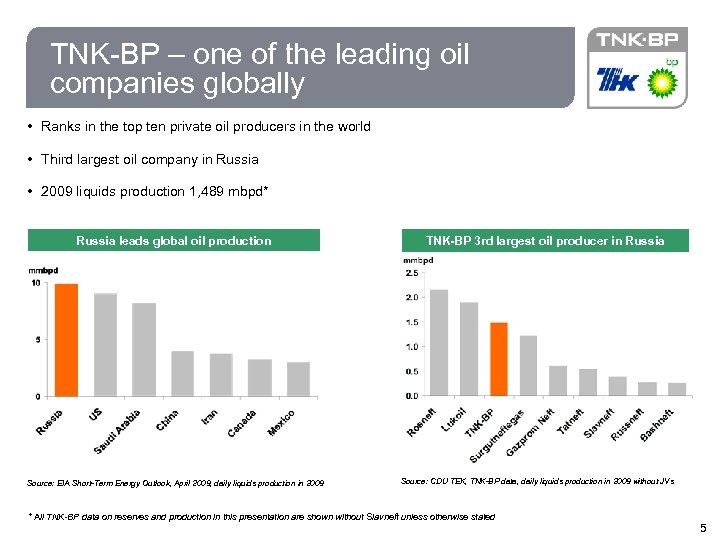
5 TNK-BP – one of the leading oil companies globally • Ranks in the top ten private oil producers in the world • Third largest oil company in Russia • 2009 liquids production 1, 489 mbpd* Russia leads global oil production Source: EIA Short-Term Energy Outlook, April 2009, daily liquids production in 2009 TNK-BP 3 rd largest oil producer in Russia Source: CDU TEK, TNK-BP data, daily liquids production in 2009 without JVs * All TNK-BP data on reserves and production in this presentation are shown without Slavneft unless otherwise stated 5
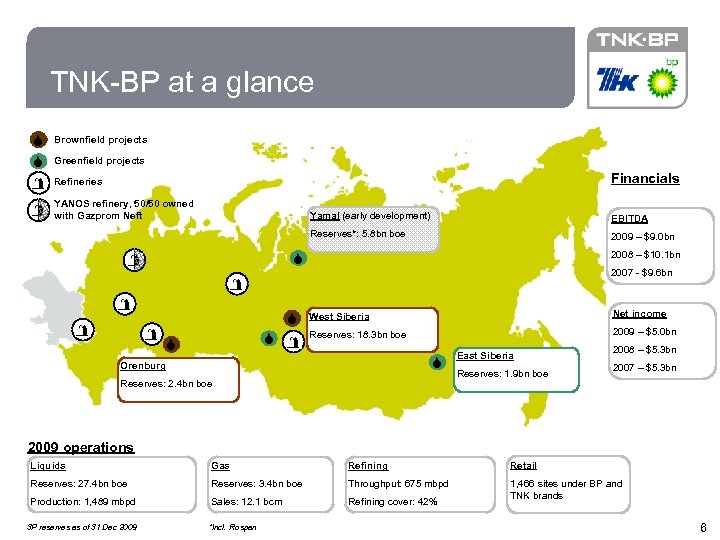
6 TNK-BP at a glance Brownfield projects Greenfield projects Financials Refineries YANOS refinery, 50/50 owned with Gazprom Neft Yamal (early development) EBITDA Reserves*: 5. 8 bn boe 2009 – $9. 0 bn 2008 – $10. 1 bn 2007 - $9. 6 bn West Siberia Net income Reserves: 18. 3 bn boe 2009 – $5. 0 bn Orenburg Reserves: 2. 4 bn boe East Siberia Reserves: 1. 9 bn boe 2008 – $5. 3 bn 2007 – $5. 3 bn 2009 operations Liquids Gas Refining Retail Reserves: 27. 4 bn boe Reserves: 3. 4 bn boe Throughput: 675 mbpd Production: 1, 489 mbpd Sales: 12. 1 bcm Refining cover: 42% 1, 466 sites under BP and TNK brands 3 P reserves as of 31 Dec 2009 *Incl. Rospan 6
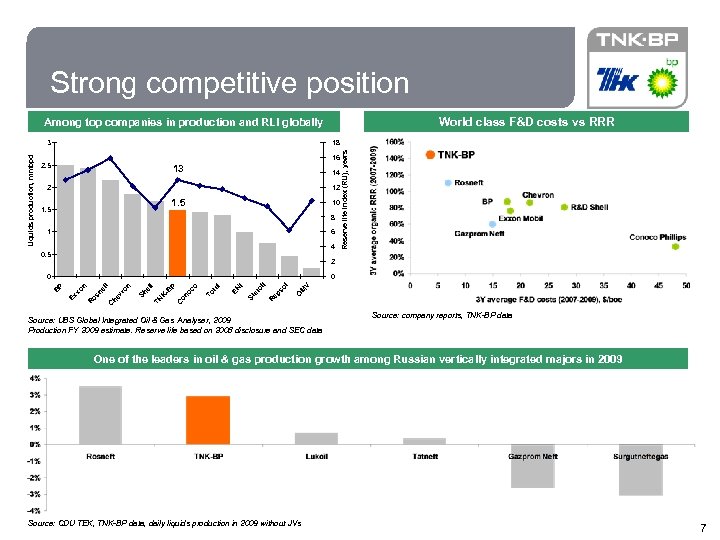
7 Strong competitive position World class F&D costs vs RRR Among top companies in production and RLI globally 18 16 2. 5 13 14 2 12 1. 5 10 8 1 6 4 0. 5 Reserve life index (RLI), years Liquids production, mmbpd 3 2 M O so V l l I oi ep R at St EN l ta To o oc P on -B C el l on Sh K TN C he vr ne n os R Ex xo B ft 0 P 0 Source: UBS Global Integrated Oil & Gas Analyser, 2009 Production FY 2009 estimate. Reserve life based on 2008 disclosure and SEC data Source: company reports, TNK-BP data One of the leaders in oil & gas production growth among Russian vertically integrated majors in 2009 Source: CDU TEK, TNK-BP data, daily liquids production in 2009 without JVs 7
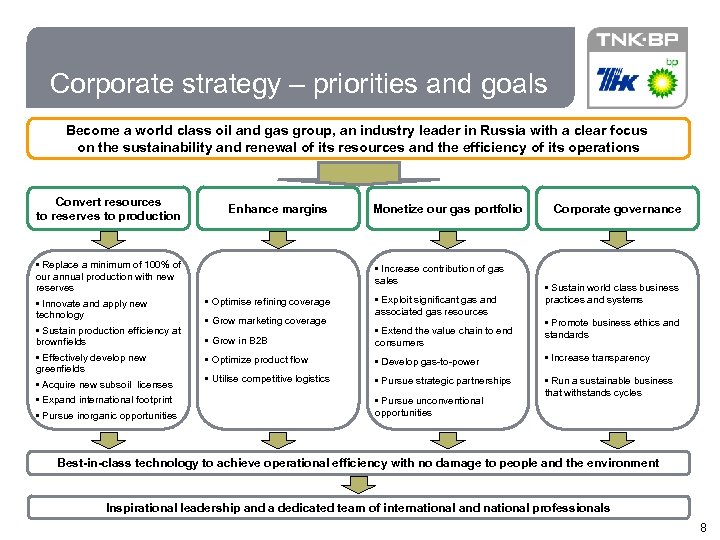
8 Corporate strategy – priorities and goals Become a world class oil and gas group, an industry leader in Russia with a clear focus on the sustainability and renewal of its resources and the efficiency of its operations Convert resources to reserves to production • Replace a minimum of 100% of our annual production with new reserves • Innovate and apply new technology • Sustain production efficiency at brownfields • Effectively develop new greenfields • Acquire new subsoil licenses • Expand international footprint • Pursue inorganic opportunities Enhance margins Monetize our gas portfolio • Increase contribution of gas sales • Optimise refining coverage • Grow marketing coverage • Exploit significant gas and associated gas resources Corporate governance • Sustain world class business practices and systems • Promote business ethics and standards • Grow in B 2 B • Extend the value chain to end consumers • Optimize product flow • Develop gas-to-power • Increase transparency • Utilise competitive logistics • Pursue strategic partnerships • Run a sustainable business that withstands cycles • Pursue unconventional opportunities Best-in-class technology to achieve operational efficiency with no damage to people and the environment Inspirational leadership and a dedicated team of international and national professionals 8
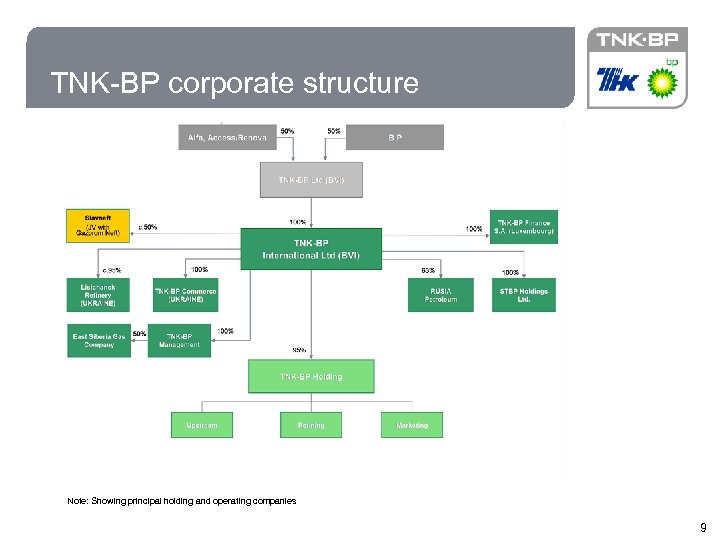
9 TNK-BP corporate structure Note: Showing principal holding and operating companies 9
Corporate governance
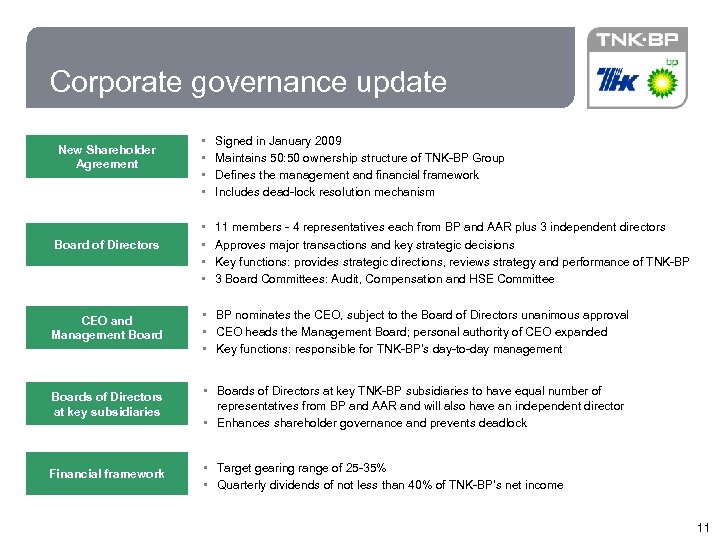
11 Corporate governance update New Shareholder Agreement Board of Directors • • Signed in January 2009 Maintains 50: 50 ownership structure of TNK-BP Group Defines the management and financial framework Includes dead-lock resolution mechanism • • 11 members - 4 representatives each from BP and AAR plus 3 independent directors Approves major transactions and key strategic decisions Key functions: provides strategic directions, reviews strategy and performance of TNK-BP 3 Board Committees: Audit, Compensation and HSE Committee CEO and Management Board • BP nominates the CEO, subject to the Board of Directors unanimous approval • CEO heads the Management Board; personal authority of CEO expanded • Key functions: responsible for TNK-BP’s day-to-day management Boards of Directors at key subsidiaries • Boards of Directors at key TNK-BP subsidiaries to have equal number of representatives from BP and AAR and will also have an independent director • Enhances shareholder governance and prevents deadlock Financial framework • Target gearing range of 25 -35% • Quarterly dividends of not less than 40% of TNK-BP’s net income 11
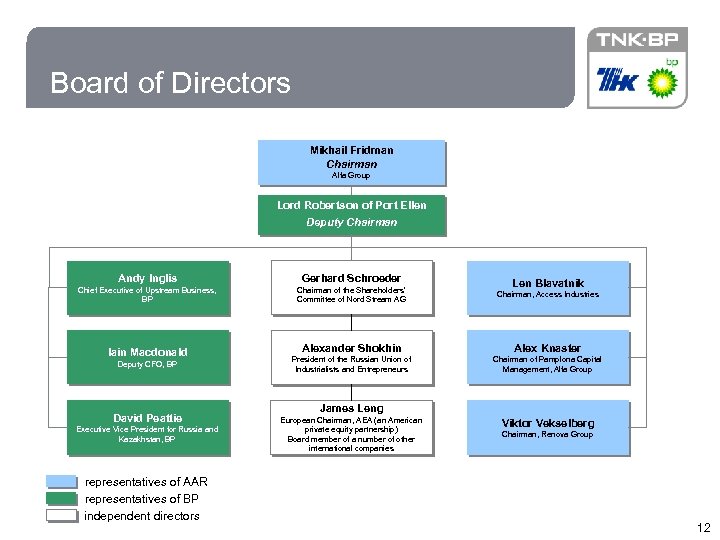
12 Board of Directors Mikhail Fridman Chairman Alfa Group Lord Robertson of Port Ellen Deputy Chairman Andy Inglis Gerhard Schroeder Chief Executive of Upstream Business, BP Chairman of the Shareholders’ Committee of Nord Stream AG Iain Macdonald Deputy CFO, BP David Peattie Executive Vice President for Russia and Kazakhstan, BP representatives of AAR representatives of BP independent directors Len Blavatnik Chairman, Access Industries Alexander Shokhin Alex Knaster President of the Russian Union of Industrialists and Entrepreneurs Chairman of Pamplona Capital Management, Alfa Group James Leng European Chairman, AEA (an American private equity partnership) Board member of a number of other international companies Viktor Vekselberg Chairman, Renova Group 12
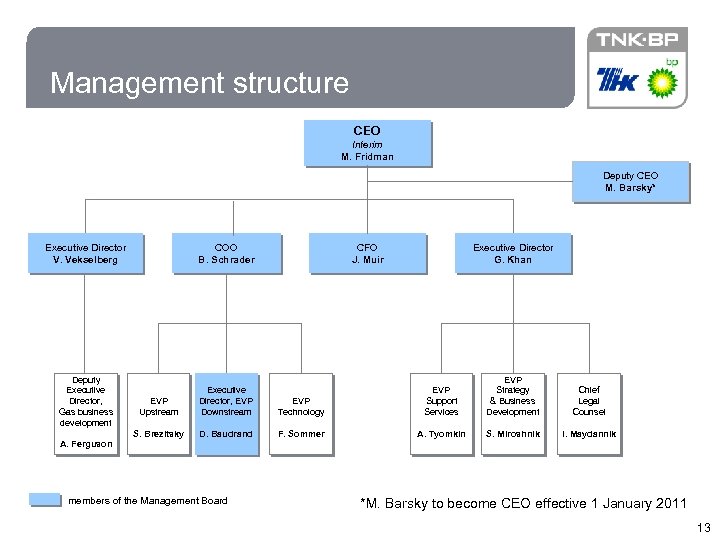
13 Management structure CEO Interim M. Fridman Deputy CEO M. Barsky* Executive Director V. Vekselberg Deputy Executive Director, Gas business development EVP Upstream Executive Director, EVP Downstream S. Brezitsky D. Baudrand Executive Director G. Khan CFO J. Muir СОО B. Schrader EVP Technology EVP Support Services EVP Strategy & Business Development Chief Legal Counsel F. Sommer A. Tyomkin S. Miroshnik I. Maydannik A. Ferguson members of the Management Board *M. Barsky to become CEO effective 1 January 2011 13
Business update Performance highlights Upstream Gas Downstream
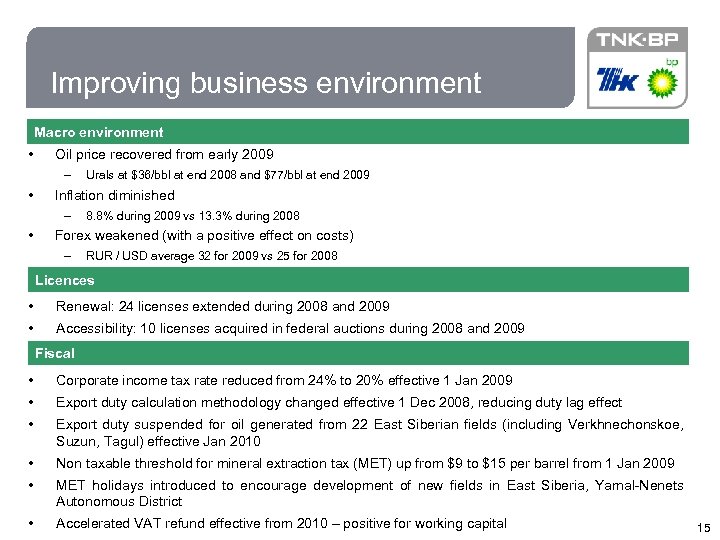
15 Improving business environment Macro environment • Oil price recovered from early 2009 – • Inflation diminished – • Urals at $36/bbl at end 2008 and $77/bbl at end 2009 8. 8% during 2009 vs 13. 3% during 2008 Forex weakened (with a positive effect on costs) – RUR / USD average 32 for 2009 vs 25 for 2008 Licences • Renewal: 24 licenses extended during 2008 and 2009 • Accessibility: 10 licenses acquired in federal auctions during 2008 and 2009 Fiscal • Corporate income tax rate reduced from 24% to 20% effective 1 Jan 2009 • Export duty calculation methodology changed effective 1 Dec 2008, reducing duty lag effect • Export duty suspended for oil generated from 22 East Siberian fields (including Verkhnechonskoe, Suzun, Tagul) effective Jan 2010 • Non taxable threshold for mineral extraction tax (MET) up from $9 to $15 per barrel from 1 Jan 2009 • MET holidays introduced to encourage development of new fields in East Siberia, Yamal-Nenets Autonomous District • Accelerated VAT refund effective from 2010 – positive for working capital 15
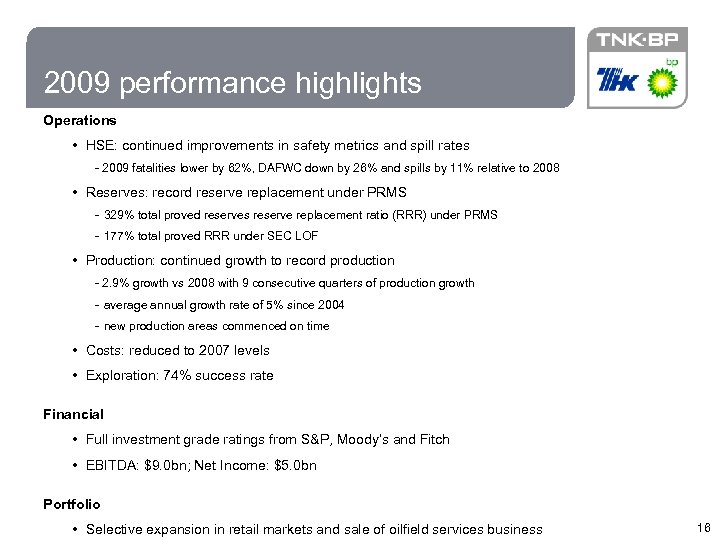
16 2009 performance highlights Operations • HSE: continued improvements in safety metrics and spill rates - 2009 fatalities lower by 62%, DAFWC down by 26% and spills by 11% relative to 2008 • Reserves: record reserve replacement under PRMS - 329% total proved reserves reserve replacement ratio (RRR) under PRMS - 177% total proved RRR under SEC LOF • Production: continued growth to record production - 2. 9% growth vs 2008 with 9 consecutive quarters of production growth - average annual growth rate of 5% since 2004 - new production areas commenced on time • Costs: reduced to 2007 levels • Exploration: 74% success rate Financial • Full investment grade ratings from S&P, Moody’s and Fitch • EBITDA: $9. 0 bn; Net Income: $5. 0 bn Portfolio • Selective expansion in retail markets and sale of oilfield services business 16
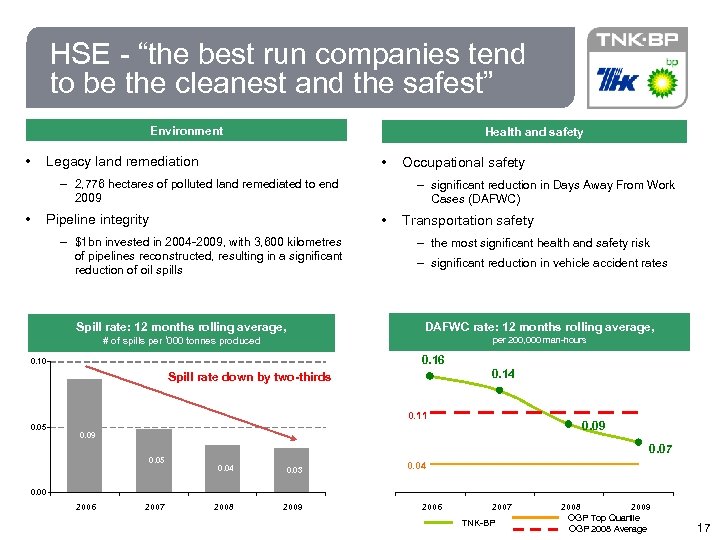
17 HSE - “the best run companies tend to be the cleanest and the safest” Environment • Health and safety Legacy land remediation • – 2, 776 hectares of polluted land remediated to end 2009 • Pipeline integrity – significant reduction in Days Away From Work Cases (DAFWC) • – $1 bn invested in 2004 -2009, with 3, 600 kilometres of pipelines reconstructed, resulting in a significant reduction of oil spills Occupational safety Transportation safety – the most significant health and safety risk – significant reduction in vehicle accident rates Spill rate: 12 months rolling average, DAFWC rate: 12 months rolling average, # of spills per ‘ 000 tonnes produced per 200, 000 man-hours 0. 16 0. 10 0. 14 Spill rate down by two-thirds 0. 11 0. 05 0. 09 0, 05 0. 07 0. 04 0, 04 0. 03 0, 03 2008 2009 0. 04 0. 00 2006 2007 TNK-BP 2008 2009 OGP Top Quartile OGP 2008 Average 17
Business update Performance highlights Upstream Gas Downstream
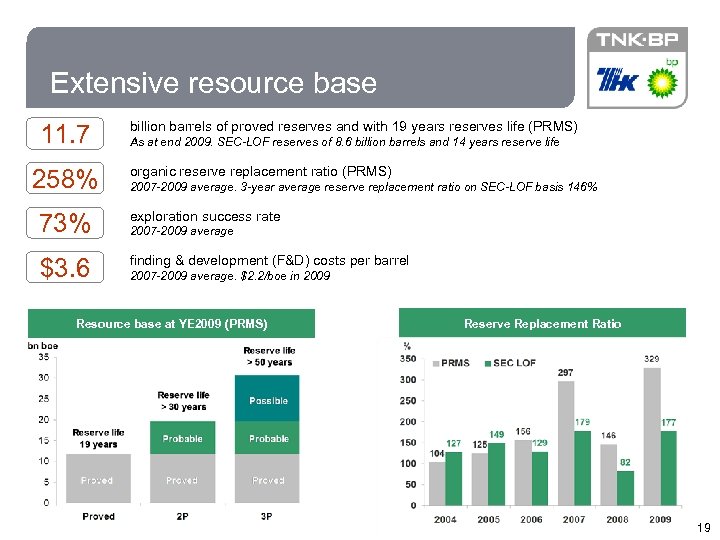
19 Extensive resource base 11. 7 258% billion barrels of proved reserves and with 19 years reserves life (PRMS) As at end 2009. SEC-LOF reserves of 8. 6 billion barrels and 14 years reserve life organic reserve replacement ratio (PRMS) 2007 -2009 average. 3 -year average reserve replacement ratio on SEC-LOF basis 146% 73% exploration success rate $3. 6 finding & development (F&D) costs per barrel 2007 -2009 average. $2. 2/boe in 2009 Resource base at YE 2009 (PRMS) Reserve Replacement Ratio 19
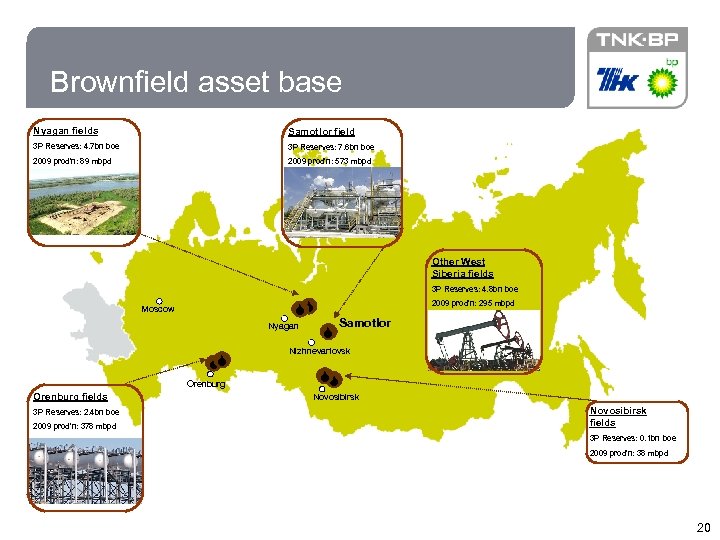
20 Brownfield asset base Nyagan fields Samotlor field 3 P Reserves: 4. 7 bn boe 3 P Reserves: 7. 6 bn boe 2009 prod’n: 89 mbpd 2009 prod’n: 573 mbpd Other West Siberia fields 3 P Reserves: 4. 8 bn boe Moscow Nyagan Orenburg fields 3 P Reserves: 2. 4 bn boe 2009 prod’n: 378 mbpd 2009 prod’n: 295 mbpd Samotlor Nizhnevartovsk Novosibirsk fields 3 P Reserves: 0. 1 bn boe 2009 prod’n: 38 mbpd 20
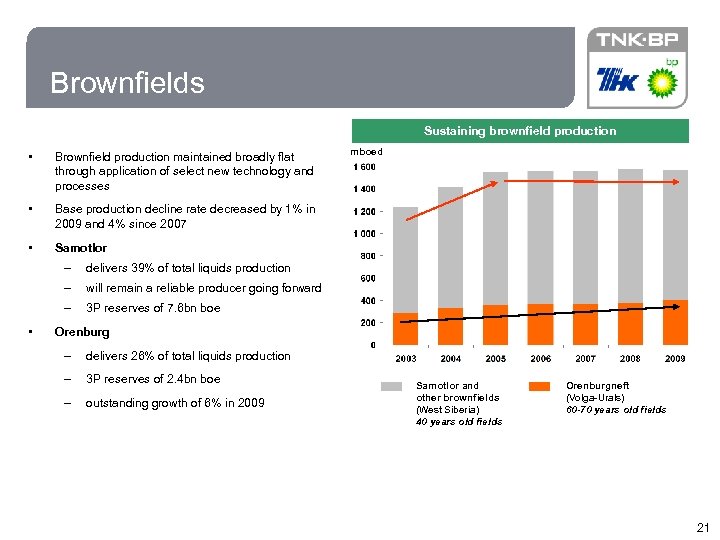
21 Brownfields Sustaining brownfield production • Brownfield production maintained broadly flat through application of select new technology and processes • Base production decline rate decreased by 1% in 2009 and 4% since 2007 • mboed Samotlor – – will remain a reliable producer going forward – • delivers 39% of total liquids production 3 P reserves of 7. 6 bn boe Orenburg – delivers 26% of total liquids production – 3 P reserves of 2. 4 bn boe – outstanding growth of 6% in 2009 Samotlor and other brownfields (West Siberia) 40 years old fields Orenburgneft (Volga-Urals) 60 -70 years old fields 21
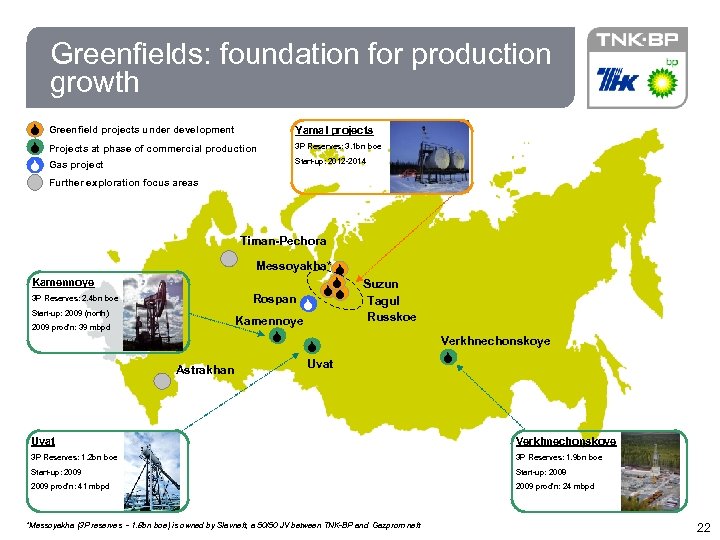
22 Greenfields: foundation for production growth Greenfield projects under development Yamal projects Projects at phase of commercial production 3 P Reserves: 3. 1 bn boe Gas project Start-up: 2012 -2014 Further exploration focus areas Timan-Pechora Messoyakha* Kamennoye Rospan 3 P Reserves: 2. 4 bn boe Start-up: 2009 (north) Kamennoye 2009 prod’n: 39 mbpd Astrakhan Suzun Tagul Russkoe Uvat Verkhnechonskoye 3 P Reserves: 1. 2 bn boe 3 P Reserves: 1. 9 bn boe Start-up: 2009 Start-up: 2008 2009 prod’n: 41 mbpd 2009 prod’n: 24 mbpd *Messoyakha (3 P reserves - 1. 8 bn boe) is owned by Slavneft, a 50/50 JV between TNK-BP and Gazprom neft 22
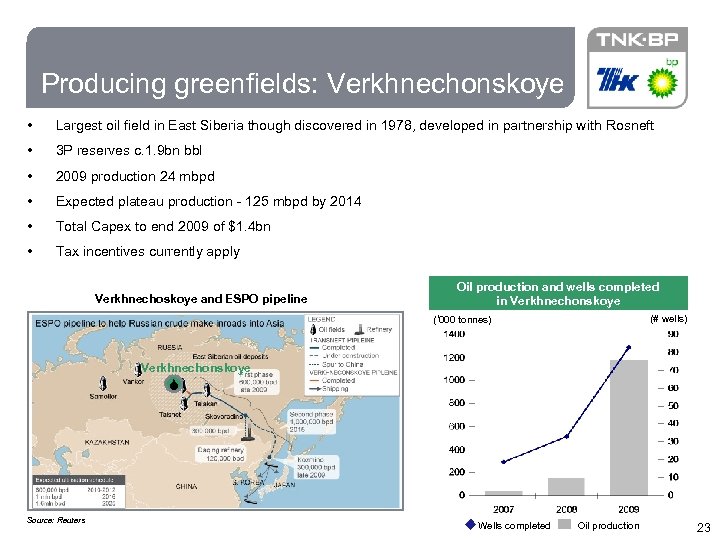
23 Producing greenfields: Verkhnechonskoye • Largest oil field in East Siberia though discovered in 1978, developed in partnership with Rosneft • 3 P reserves c. 1. 9 bn bbl • 2009 production 24 mbpd • Expected plateau production - 125 mbpd by 2014 • Total Capex to end 2009 of $1. 4 bn • Tax incentives currently apply Verkhnechoskoye and ESPO pipeline Oil production and wells completed in Verkhnechonskoye (# wells) (‘ 000 tonnes) Verkhnechonskoye Source: Reuters Wells completed Oil production 23
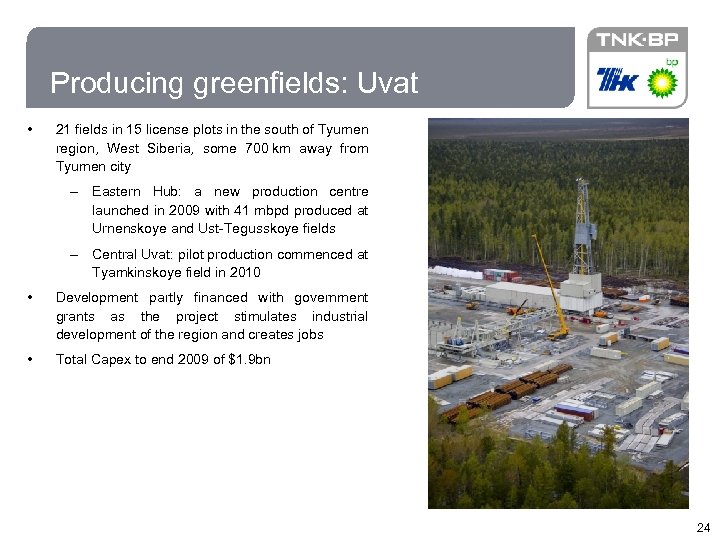
24 Producing greenfields: Uvat • 21 fields in 15 license plots in the south of Tyumen region, West Siberia, some 700 km away from Tyumen city – Eastern Hub: a new production centre launched in 2009 with 41 mbpd produced at Urnenskoye and Ust-Tegusskoye fields – Central Uvat: pilot production commenced at Tyamkinskoye field in 2010 • Development partly financed with government grants as the project stimulates industrial development of the region and creates jobs • Total Capex to end 2009 of $1. 9 bn 24
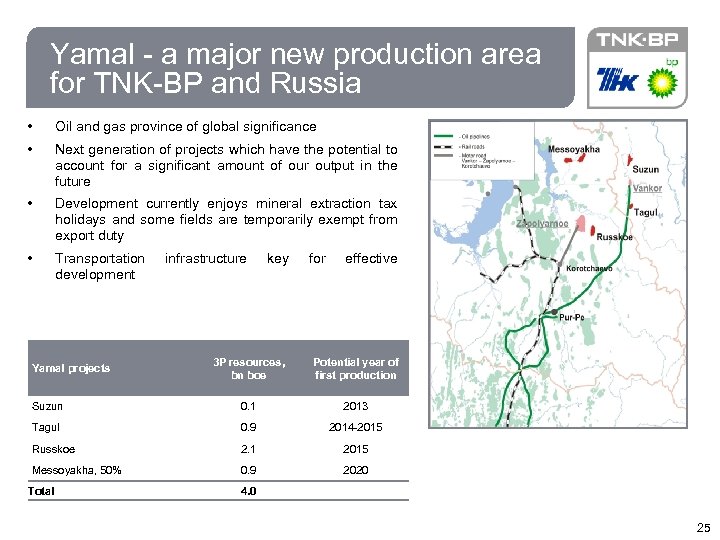
25 Yamal - a major new production area for TNK-BP and Russia • Oil and gas province of global significance • Next generation of projects which have the potential to account for a significant amount of our output in the future • Development currently enjoys mineral extraction tax holidays and some fields are temporarily exempt from export duty • Transportation development infrastructure key for effective 3 P resources, bn boe Potential year of first production Suzun 0. 1 2013 Tagul 0. 9 2014 -2015 Russkoe 2. 1 2015 Messoyakha, 50% 0. 9 2020 Yamal projects Total 4. 0 25
Business update Performance highlights Upstream Gas Downstream
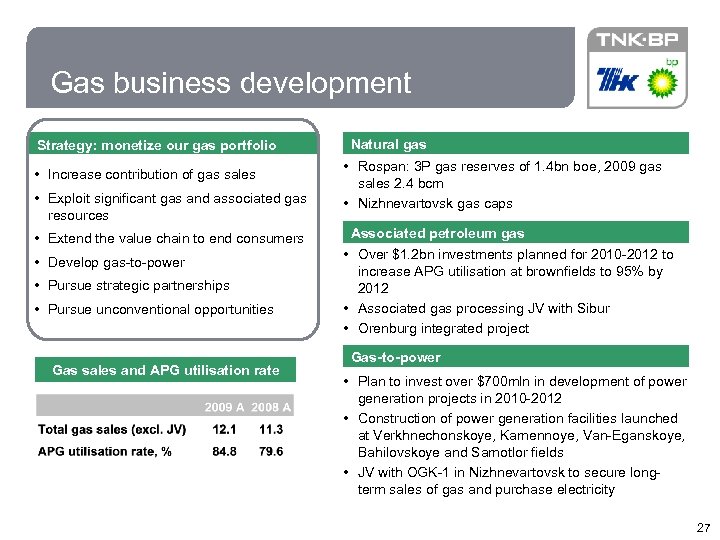
27 Gas business development Strategy: monetize our gas portfolio • Increase contribution of gas sales • Exploit significant gas and associated gas resources • Extend the value chain to end consumers • Develop gas-to-power • Pursue strategic partnerships • Pursue unconventional opportunities Gas sales and APG utilisation rate Natural gas • Rospan: 3 P gas reserves of 1. 4 bn boe, 2009 gas sales 2. 4 bcm • Nizhnevartovsk gas caps Associated petroleum gas • Over $1. 2 bn investments planned for 2010 -2012 to increase APG utilisation at brownfields to 95% by 2012 • Associated gas processing JV with Sibur • Orenburg integrated project Gas-to-power • Plan to invest over $700 mln in development of power generation projects in 2010 -2012 • Construction of power generation facilities launched at Verkhnechonskoye, Kamennoye, Van-Eganskoye, Bahilovskoye and Samotlor fields • JV with OGK-1 in Nizhnevartovsk to secure longterm sales of gas and purchase electricity 27
Business update Performance highlights Upstream Gas Downstream
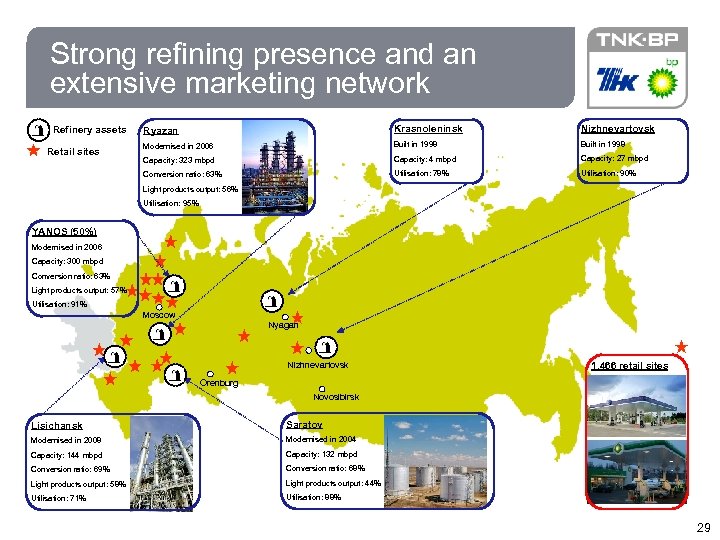
29 Strong refining presence and an extensive marketing network Retail sites Ryazan Krasnoleninsk Nizhnevartovsk Modernised in 2006 Built in 1998 Capacity: 323 mbpd Capacity: 4 mbpd Capacity: 27 mbpd Conversion ratio: 63% Refinery assets Utilisation: 78% Utilisation: 90% Light products output: 56% Utilisation: 95% YANOS (50%) Modernised in 2006 Capacity: 300 mbpd Conversion ratio: 63% Light products output: 57% Utilisation: 91% Moscow Nyagan Nizhnevartovsk 1, 466 retail sites Orenburg Novosibirsk Lisichansk Saratov Modernised in 2008 Modernised in 2004 Capacity: 144 mbpd Capacity: 132 mbpd Conversion ratio: 69% Conversion ratio: 68% Light products output: 58% Light products output: 44% Utilisation: 71% Utilisation: 88% 29
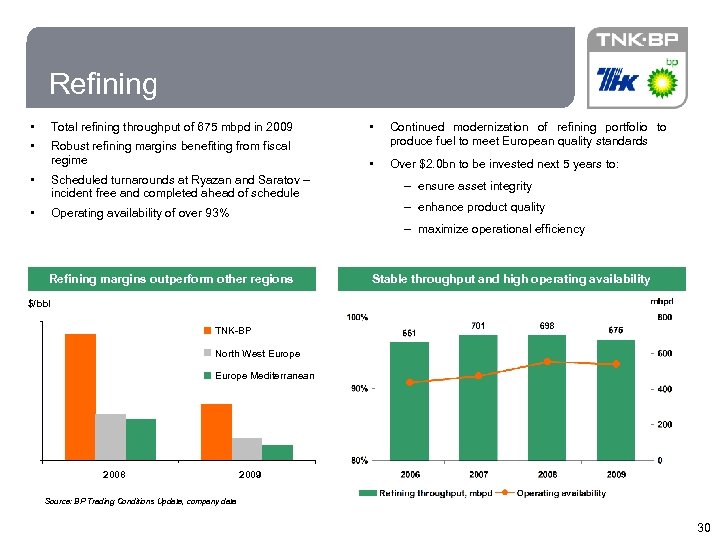
30 Refining • Total refining throughput of 675 mbpd in 2009 • • Robust refining margins benefiting from fiscal regime Continued modernization of refining portfolio to produce fuel to meet European quality standards • Over $2. 0 bn to be invested next 5 years to: • Scheduled turnarounds at Ryazan and Saratov – incident free and completed ahead of schedule – ensure asset integrity • Operating availability of over 93% – enhance product quality – maximize operational efficiency Refining margins outperform other regions Stable throughput and high operating availability $/bbl TNK-BP North West Europe Mediterranean 2008 2009 Source: BP Trading Conditions Update, company data 30
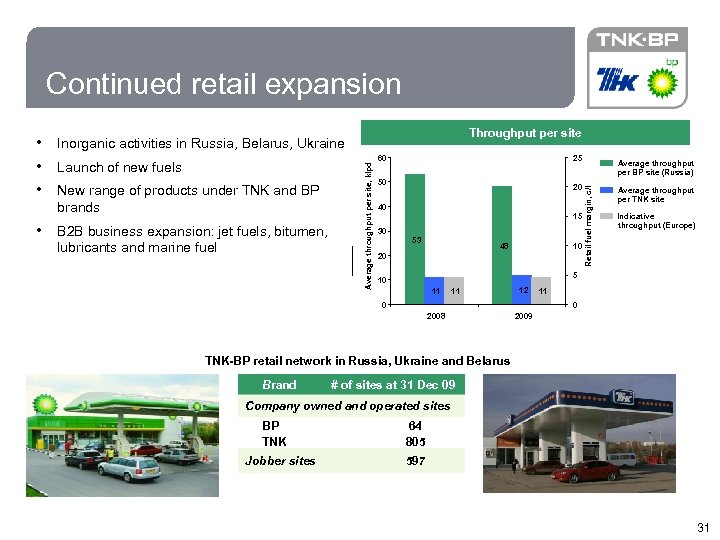
31 Continued retail expansion • B 2 B business expansion: jet fuels, bitumen, lubricants and marine fuel 60 25 50 20 40 15 30 53 48 10 20 Average throughput per BP site (Russia) Retail fuel margin, c/l brands Throughput per site Average throughput per site, klpd • Inorganic activities in Russia, Belarus, Ukraine • Launch of new fuels • New range of products under TNK and BP Average throughput per TNK site Indicative throughput (Europe) 5 10 11 11 12 0 11 0 2008 2009 TNK-BP retail network in Russia, Ukraine and Belarus Brand # of sites at 31 Dec 09 Company owned and operated sites BP TNK Jobber sites 64 805 597 31
Financial overview
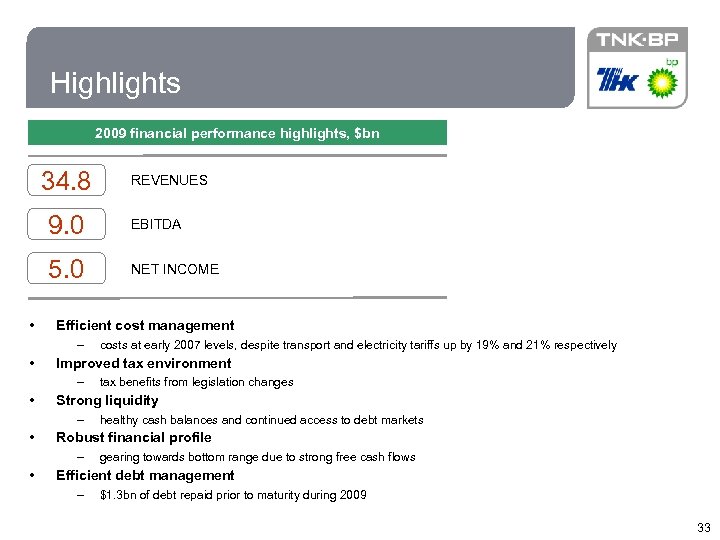
33 Highlights 2009 financial performance highlights, $bn 34. 8 REVENUES 9. 0 5. 0 • EBITDA NET INCOME Efficient cost management – • Improved tax environment – • healthy cash balances and continued access to debt markets Robust financial profile – • tax benefits from legislation changes Strong liquidity – • costs at early 2007 levels, despite transport and electricity tariffs up by 19% and 21% respectively gearing towards bottom range due to strong free cash flows Efficient debt management – $1. 3 bn of debt repaid prior to maturity during 2009 33
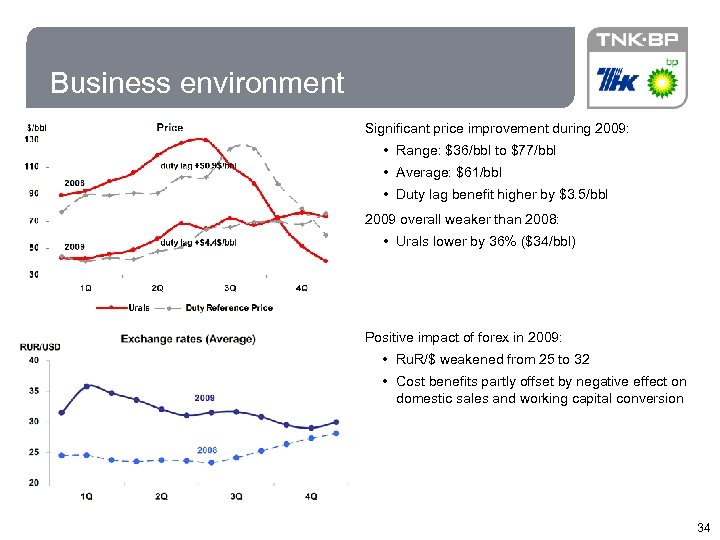
34 Business environment Significant price improvement during 2009: • Range: $36/bbl to $77/bbl • Average: $61/bbl • Duty lag benefit higher by $3. 5/bbl 2009 overall weaker than 2008: • Urals lower by 36% ($34/bbl) Positive impact of forex in 2009: • Ru. R/$ weakened from 25 to 32 • Cost benefits partly offset by negative effect on domestic sales and working capital conversion 34
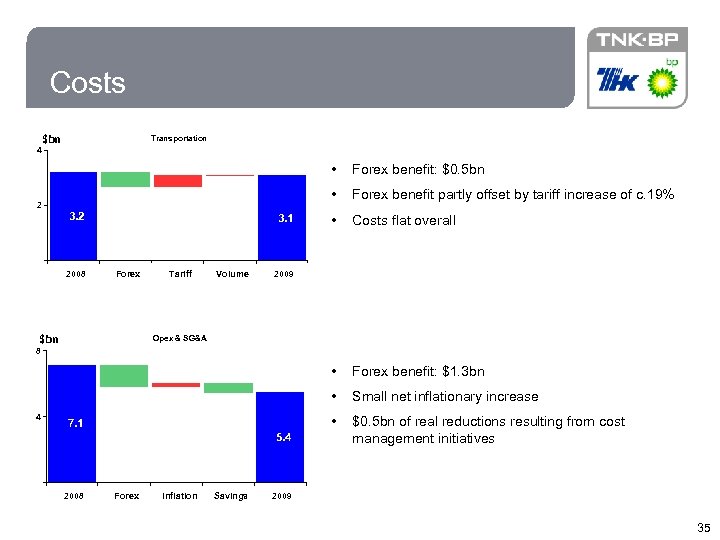
35 Costs $bn Transportation 4 • • 2008 Forex $bn Tariff Volume Costs flat overall Forex benefit: $1. 3 bn Small net inflationary increase • 3. 1 • • 3. 2 Forex benefit partly offset by tariff increase of c. 19% • 2 Forex benefit: $0. 5 bn of real reductions resulting from cost management initiatives 2009 Opex & SG&A 8 4 7. 1 5. 4 2008 Forex Inflation Savings 2009 35
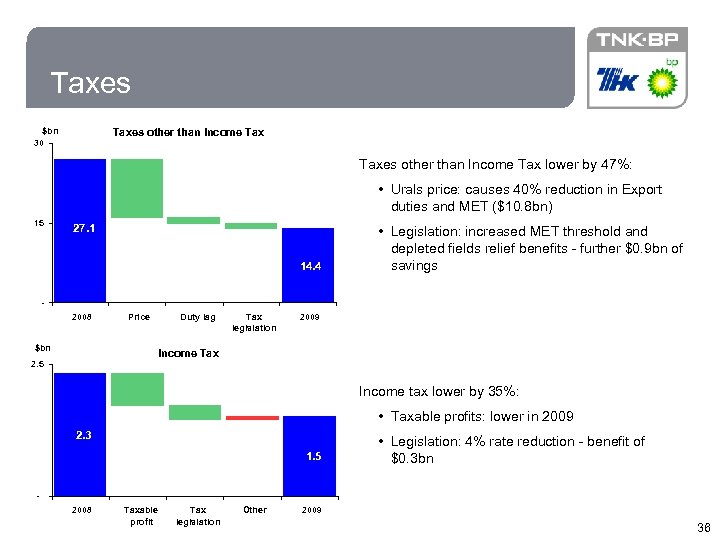
36 Taxes $bn 30 Taxes other than Income Tax lower by 47%: • Urals price: causes 40% reduction in Export duties and MET ($10. 8 bn) 15 27. 1 14. 4 • Legislation: increased MET threshold and depleted fields relief benefits - further $0. 9 bn of savings 2008 Price $bn Duty lag Tax legislation 2009 Income Tax 2. 5 Income tax lower by 35%: • Taxable profits: lower in 2009 2. 3 1. 5 • Legislation: 4% rate reduction - benefit of $0. 3 bn 2008 Taxable profit Tax legislation Other 2009 36
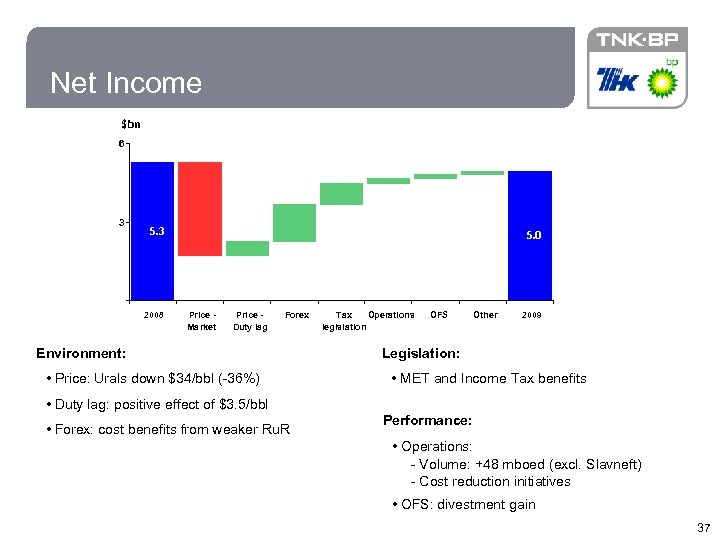
37 Net Income $bn 6 3 5. 3 2008 5. 0 Price Market Price Duty lag Forex Environment: • Price: Urals down $34/bbl (-36%) Tax Operations legislation OFS Other 2009 Legislation: • MET and Income Tax benefits • Duty lag: positive effect of $3. 5/bbl • Forex: cost benefits from weaker Ru. R Performance: • Operations: - Volume: +48 mboed (excl. Slavneft) - Cost reduction initiatives • OFS: divestment gain 37
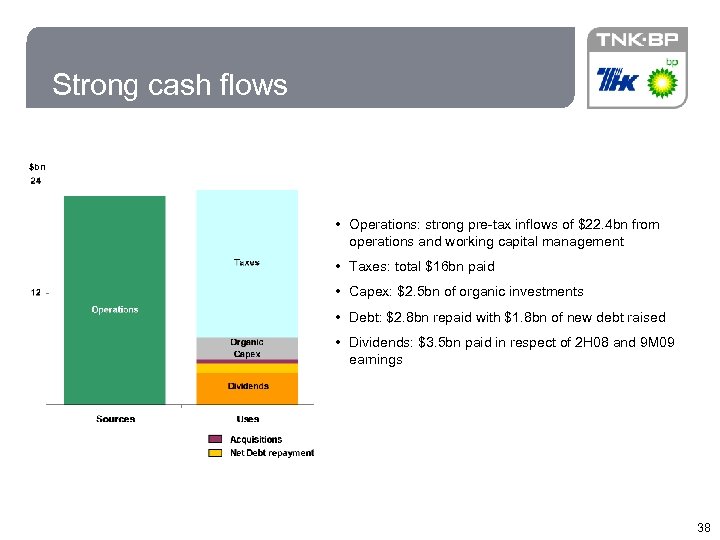
38 Strong cash flows $bn • Operations: strong pre-tax inflows of $22. 4 bn from operations and working capital management • Taxes: total $16 bn paid • Capex: $2. 5 bn of organic investments • Debt: $2. 8 bn repaid with $1. 8 bn of new debt raised • Dividends: $3. 5 bn paid in respect of 2 H 08 and 9 M 09 earnings 38
39 Prudent financial strategy Focused on supporting the Group’s growth while minimising financial risks and maintaining a strong balance sheet with adequate liquidity and financial flexibility Financial framework • Maintain gearing within a range of 25% to 35% Narrowed from the previous 25 -50% starting from Jan 2009 • Maintain financial ratios in line with strong investment grade companies • Maintain investment grade credit ratings • Dividends of 40% min of Net Income • Maintain average life of debt portfolio at 4 -5 years Debt strategy Reflecting investment project cash generation profiles • Maintain the right fixed / floating ratio By balancing between bonds and bank financing • Maintain a smooth repayment profile • Keep debt portfolio largely unsecured • Maintain proper currency of debt • Broaden investor base 39
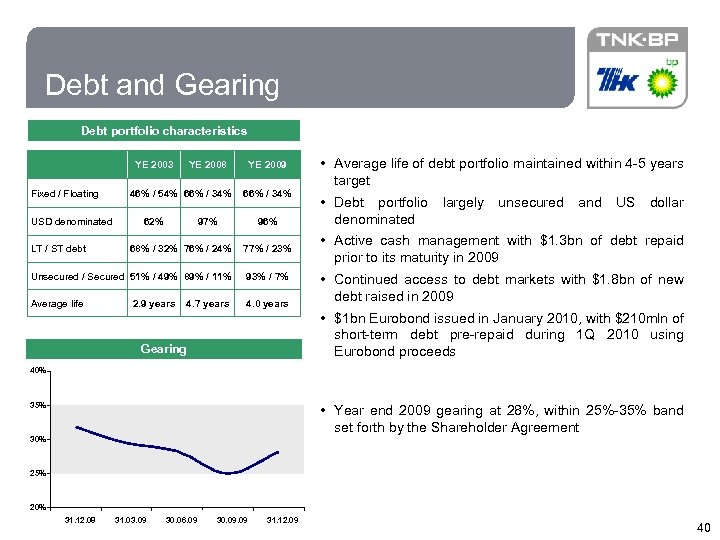
40 Debt and Gearing Debt portfolio characteristics YE 2003 Fixed / Floating USD denominated LT / ST debt YE 2008 46% / 54% 66% / 34% 62% YE 2009 66% / 34% 97% 96% 68% / 32% 76% / 24% 77% / 23% Unsecured / Secured 51% / 49% 89% / 11% 93% / 7% Average life 4. 0 years 2. 9 years 4. 7 years • Average life of debt portfolio maintained within 4 -5 years target • Debt portfolio largely unsecured and US dollar denominated • Active cash management with $1. 3 bn of debt repaid prior to its maturity in 2009 • Continued access to debt markets with $1. 8 bn of new debt raised in 2009 • $1 bn Eurobond issued in January 2010, with $210 mln of short-term debt pre-repaid during 1 Q 2010 using Eurobond proceeds Gearing 40% 35% • Year end 2009 gearing at 28%, within 25%-35% band set forth by the Shareholder Agreement 30% 25% 20% 31. 12. 08 31. 03. 09 30. 06. 09 30. 09 31. 12. 09 40
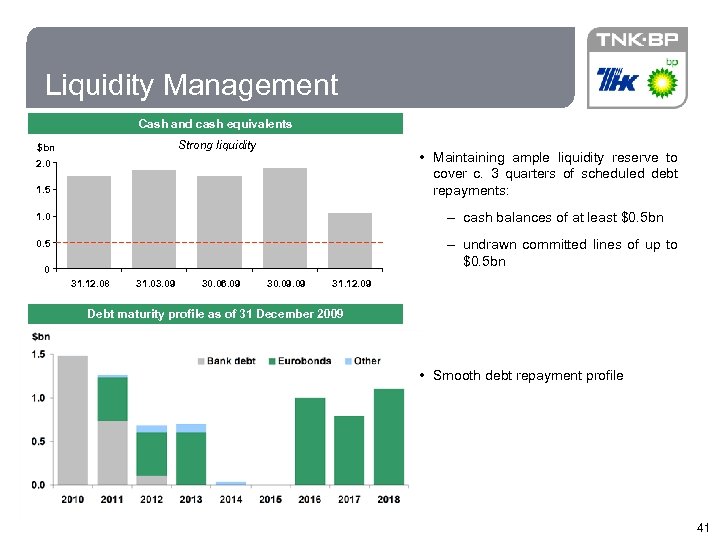
41 Liquidity Management Cash and cash equivalents Strong liquidity $bn • Maintaining ample liquidity reserve to cover c. 3 quarters of scheduled debt repayments: 2. 0 1. 5 1. 0 – cash balances of at least $0. 5 bn 0. 5 – undrawn committed lines of up to $0. 5 bn 0 31. 12. 08 31. 03. 09 30. 06. 09 30. 09 31. 12. 09 Debt maturity profile as of 31 December 2009 • Smooth debt repayment profile 41
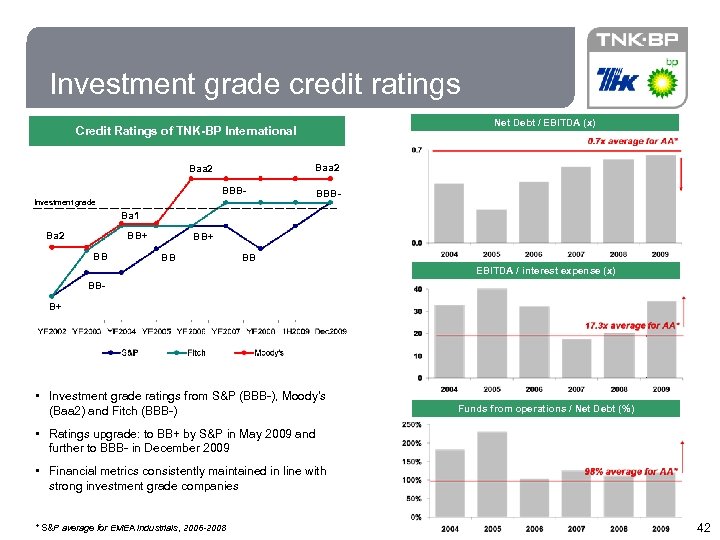
42 Investment grade credit ratings Net Debt / EBITDA (x) Credit Ratings of TNK-BP International Baa 2 BBBInvestment grade BBB- Ba 1 BB+ Ba 2 BB BB+ BB BB EBITDA / interest expense (x) BBB+ • Investment grade ratings from S&P (BBB-), Moody’s (Baa 2) and Fitch (BBB-) Funds from operations / Net Debt (%) • Ratings upgrade: to BB+ by S&P in May 2009 and further to BBB- in December 2009 • Financial metrics consistently maintained in line with strong investment grade companies * S&P average for EMEA industrials, 2006 -2008 42

2010 outlook
44 2010 outlook Operations • $4. 4 bn Capex approved by the Board • Continued production growth (1 -2%) • Further development of Greenfields, including Yamal • Cost focus – particularly energy efficiency • Refinery upgrades to improve fuel quality Portfolio • Selective M&A opportunities Financing • Continuous optimization of debt portfolio Governance • M. Barsky to assume a deputy CEO role from mid 2010 44
Скачать презентацию TNK-BP Investor Presentation April 2010 2 Important
bbb9ad2261acdf5434ce85e4870cd1d2.ppt