


 Скачать презентацию TMR 4225 Marine Operations 2009 03 12
705de1c149769f10b276673cf804ec7c.ppt
- Количество слайдов: 45
 TMR 4225 Marine Operations, 2009. 03. 12 • Lecture content: – – – 1 ROV classes and mission objectives Minerva Stealth 3000 hydrodynamic coefficients Simulation tools ROV pilot training
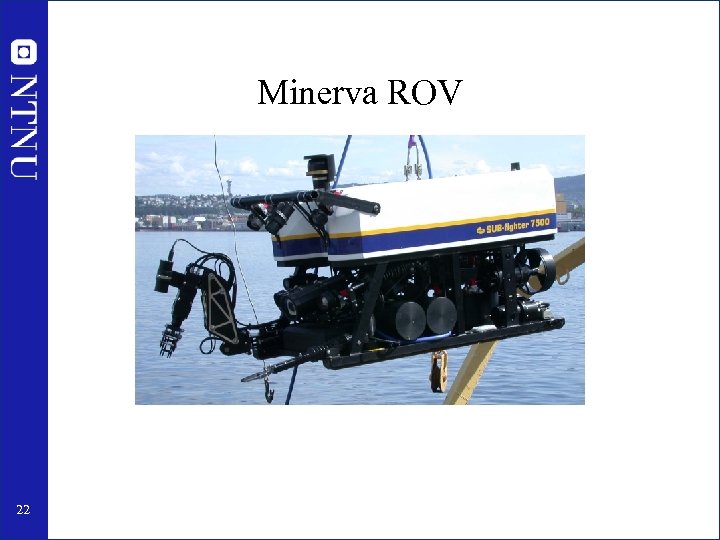
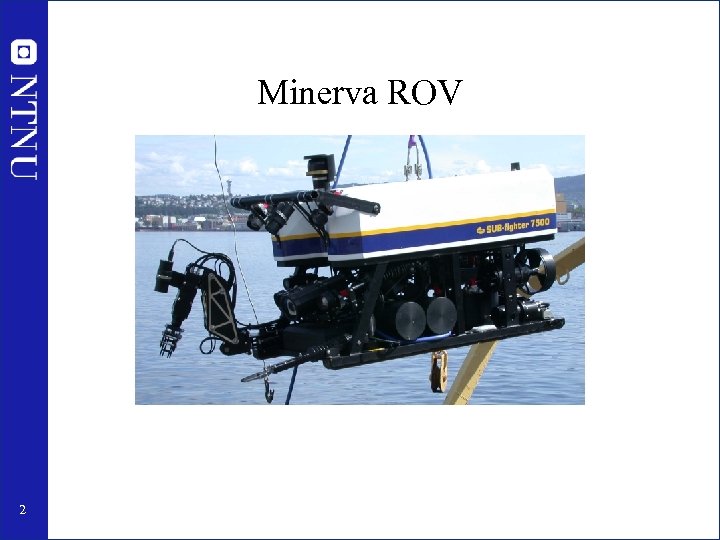 Minerva ROV 2
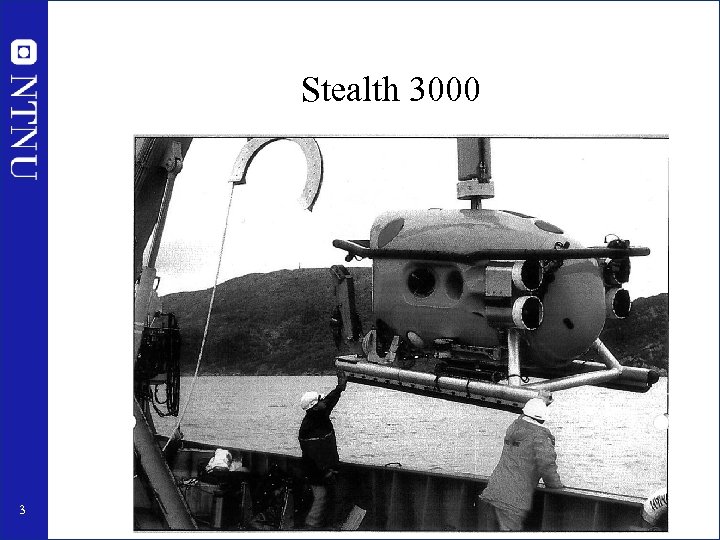 Stealth 3000 3
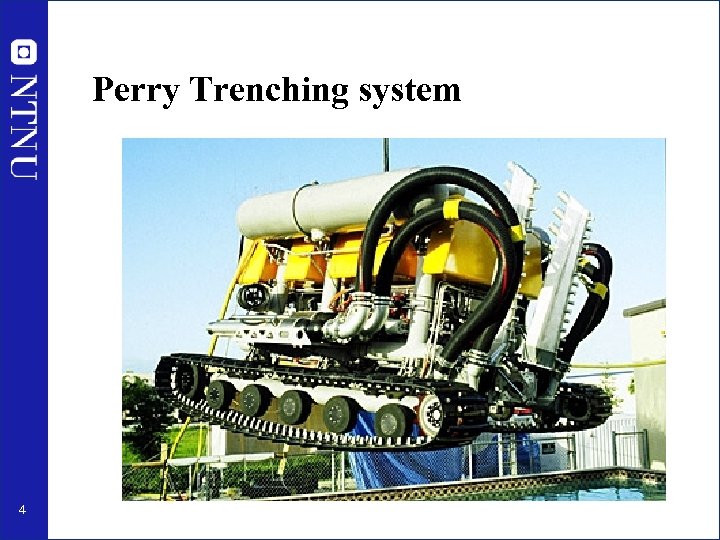 Perry Trenching system 4
 ROV overview • ROV: – Remotely Operated Vehicle with umbilical connection to mother vessel – Umbilical is used for power transfer to the vehicle and for communication between it and its pilot – Important working tool for subsea installations and maintenance – Increasing depth rating – systems designed for operation down to 2500 – 3000 m – Umbilical handling is critical for most ROV operations 5
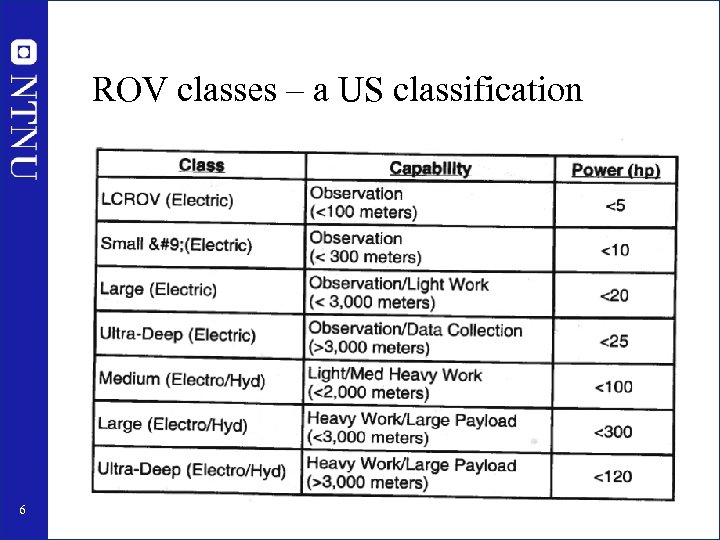 ROV classes – a US classification 6
 ROV operational goals • Visual inspection – Inspection of underwater structures – Observation of ongoing work tasks on subsea structures – Biological observation • • 7 Different types of mechanical inspection Non destructive testing Mechanical work Biological sampling, water column and bottom
 Phases of an ROV mission • • • 8 Pre launch Launching Penetration of wave surface (splash zone) Transit to work space Entering work space, homing in on work task Completing work task Leaving work space Transit to surface/Moving to next work space Penetration of surface Hook-up, lifting, securing on deck
 Flow characteristics for standard operations • ROV – Non-streamlined body – Mostly turbulent flow due to separation on edges – Low speed – Large angles of attack; have to be able to operate in cross current – Different characteristics for up and down motion – Complex flow due to interacting thrusters – Umbilical drag can be high for operations at large depths – Tether management system can be used to remove umbilical induced motion of ROV 9
 ROV umbilicals • Vessel motion and induced motion at the upper end of the umbilical • Umbilical geometry resulting from depth varying current • Use of buoyancy and weight elements to obtain a S-form to reduce umbilical forces on the ROV • Induced transverse vibrations of umbilical • Forces and motions at lower end of umbilical 10
 Other forces • • • 11 Gravity and buoyancy forces and moments Thruster forces and moments Control forces from any additional control units Umbilical forces Environmental forces Interaction forces from bottom and/or sea bed structures
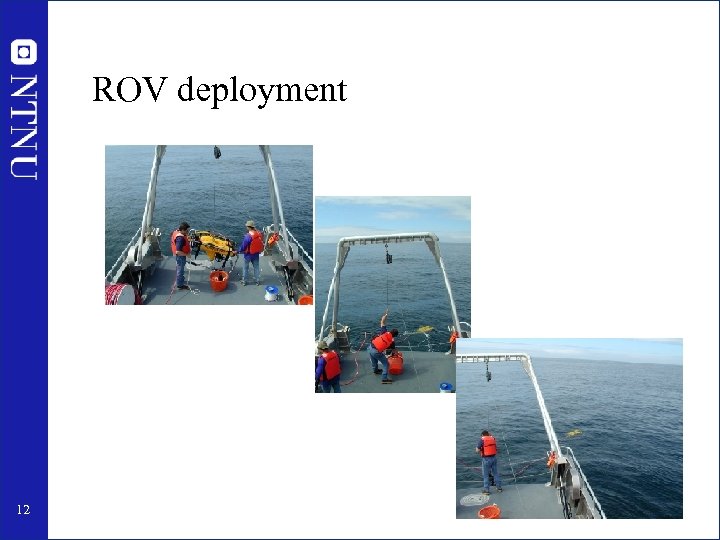 ROV deployment 12
 ROV operational challenges • • • Surface vessel motion Crane tip motion Umbilical geometry and forces Operational foot-print ROV hydrodynamic characteristics – Influence of sea bottom – Interference from subsea structures • ROV control systems 13
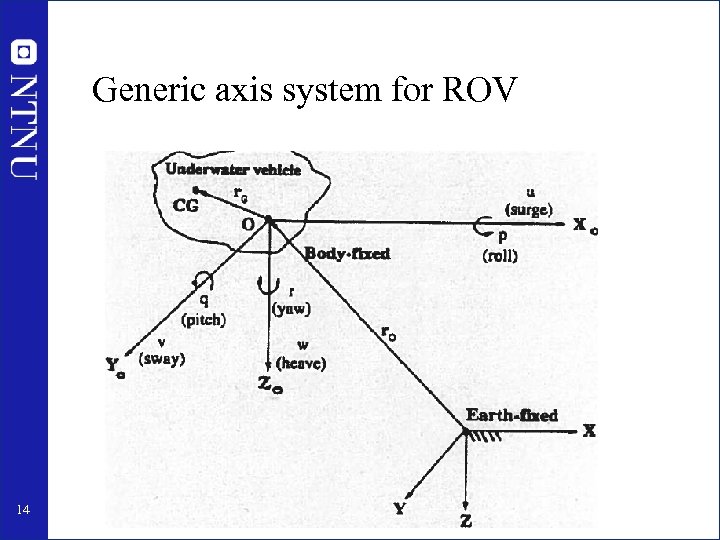 Generic axis system for ROV 14
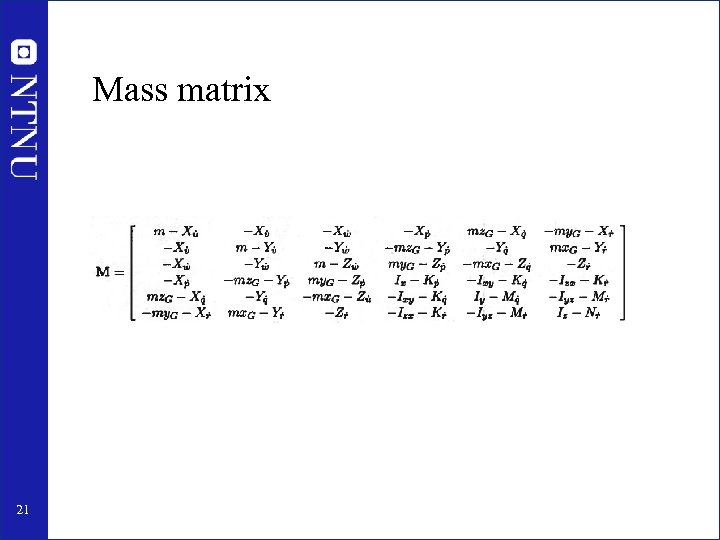
 Equation of motion for ROVs • 6 degree of freedom (6 DOF) model • No defined steady state motion as a baseline for development of motion equations • ROVs are usually asymmetrical up-down and fore-aft • As far as possible the ROVs are designed for portstarboard symmetry • See section 4. 6 of lecture note for ROV motion equations 15
 Hydrodynamic added mass/moment of inertia • 6 x 6 matrix • Non-diagonal terms exists • Terms may have different values for positive and negative accelerations, especially for heave and pitch motion • Ideal fluid sink-source methods can be used • Motion decay tests can be used to find some terms • Generalized Planar Motion Mechanism tests can be used to find all terms • Simplified 2 D cross sections can be used to estimate some of the terms 16
 Velocity dependent forces (drag and lift) • Non linear terms are important • Streamlining of buoyancy elements influence both drag and lift forces and moments • Motion decay tests can be used to find some drag terms • Generalized Planar Motion Mechanism tests can be used to find all terms 17
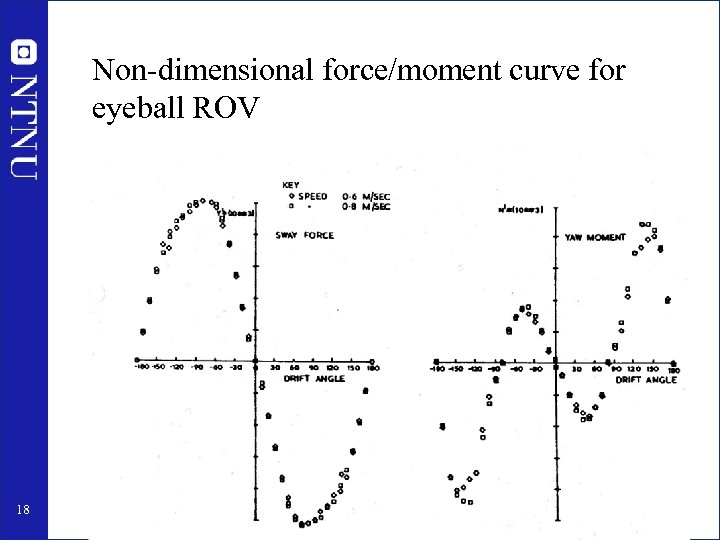 Non-dimensional force/moment curve for eyeball ROV 18
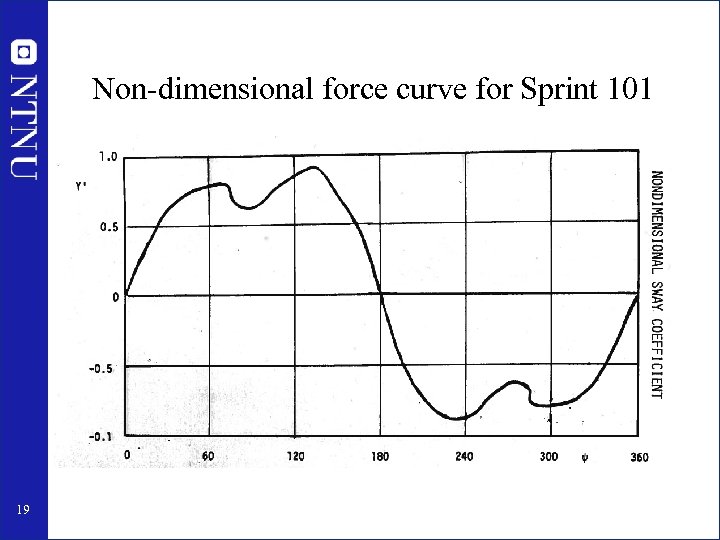 Non-dimensional force curve for Sprint 101 19
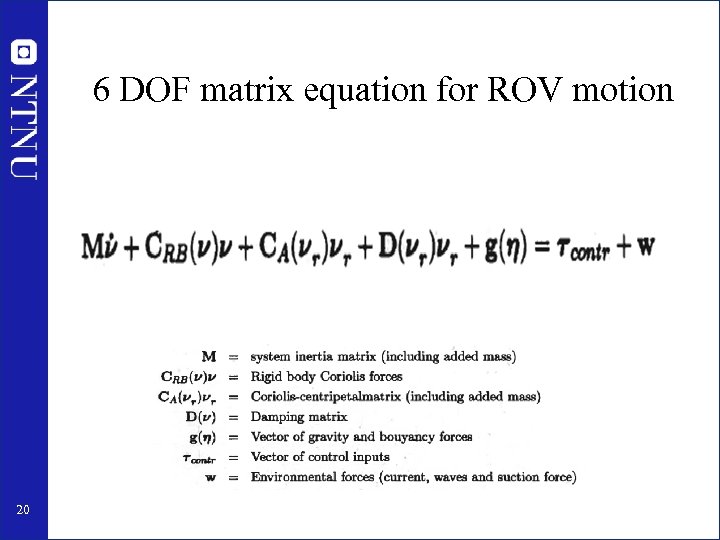 6 DOF matrix equation for ROV motion 20
 Mass matrix 21
 Minerva ROV 22
 MINERVA tests • • Drag tests, varying speed Drag test, varying angle of attack Full scale tests Use of vehicle to generate input to parametric identification of mathematical model characteristics • Exercise no. 4 includes comparison of own calculations with model test results for MINERVA (exercise not used in 2008) 23
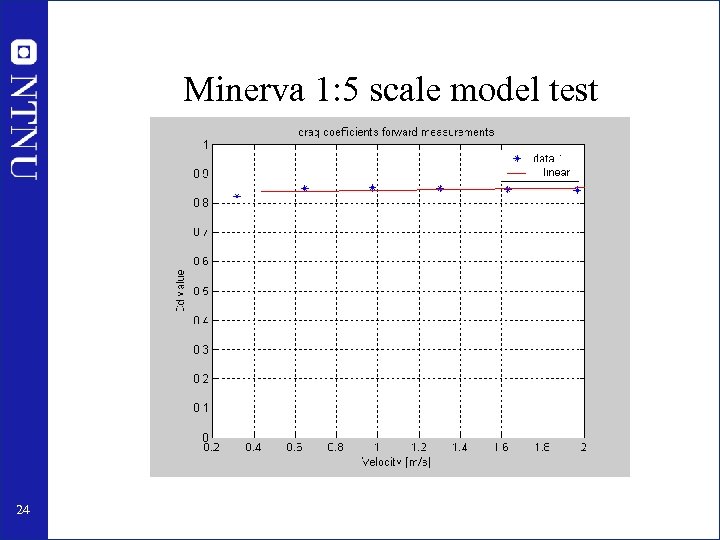 Minerva 1: 5 scale model test 24
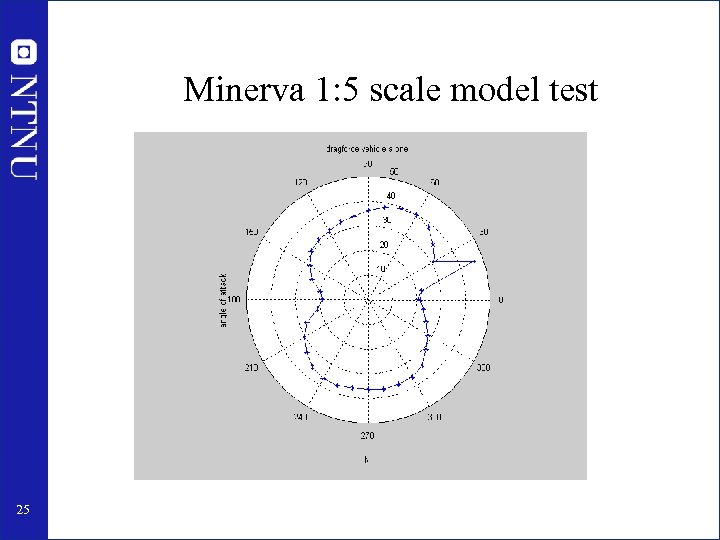 Minerva 1: 5 scale model test 25
 STEALTH 3000 characteristics • Dimensions – Length: 3. 2 m – Breadth: 1. 9 m – Depth: 1. 9 m • 7 horizontal and 3 vertical thrusters • Thruster pull and speed values: – 1200 kgf forward/aft, 5 knots forward, 3 knots reverse – 500 kgf lateral, 2 knots lateral – 1000 kgf vertical, 2. 4 knots vertical 26
 Hydrodynamic analysis of STEALTH • MSc thesis on ”Manoeuvrability for ROV in a deep water tie-in operation” – Simplified geometries used when estimating added mass coefficients based on work by Faltinsen and Øritsland for various shapes of rectangular bodies – Quadratic damping coefficients used, corrections made for rounding of corners based on Hoerner curves – Maximum speed as a function of heading angle has been calculated using simplified thruster model 27
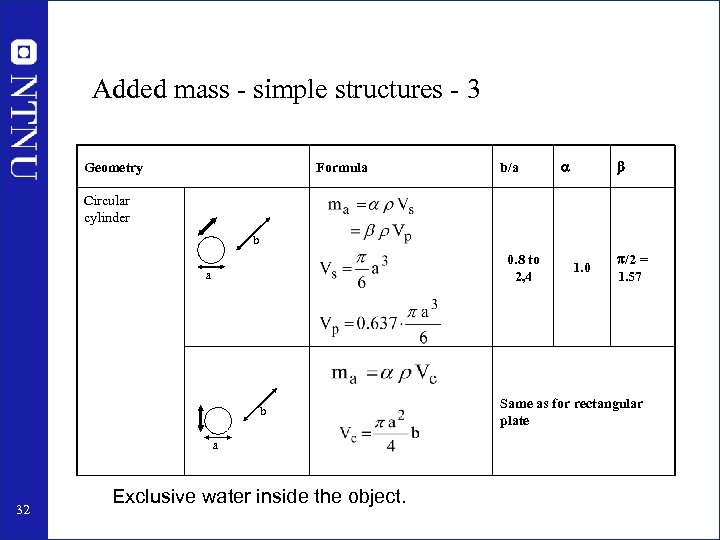
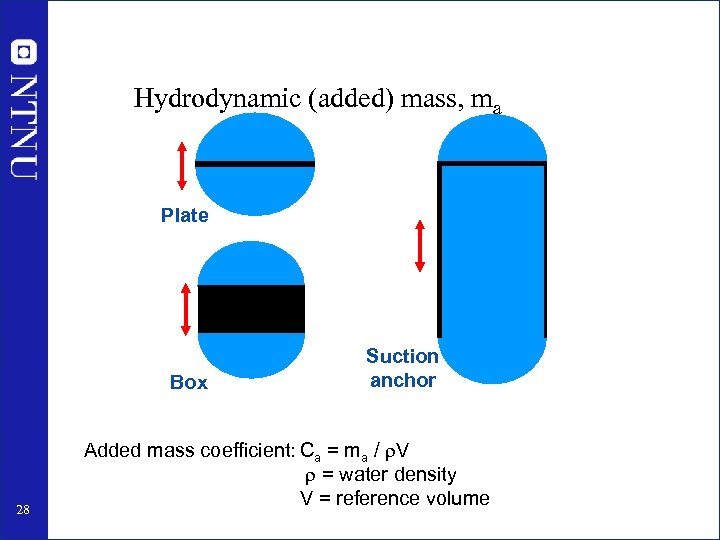 Hydrodynamic (added) mass, ma Plate Box 28 Suction anchor Added mass coefficient: Ca = ma / V = water density V = reference volume
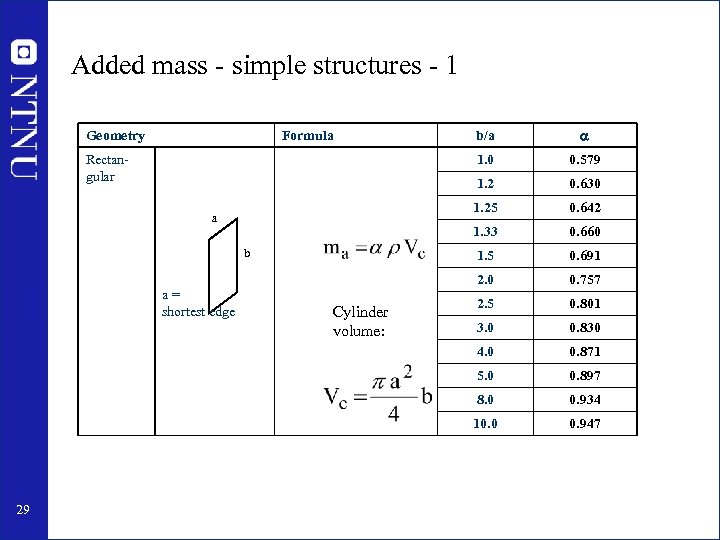 Added mass - simple structures - 1 0. 757 2. 5 0. 801 3. 0 0. 830 0. 871 5. 0 0. 897 8. 0 0. 934 10. 0 29 0. 691 2. 0 Cylinder volume: 0. 660 4. 0 a = shortest edge 0. 642 1. 5 b 0. 630 1. 33 a 0. 579 1. 25 Rectangular 1. 2 Formula b/a 1. 0 Geometry 0. 947
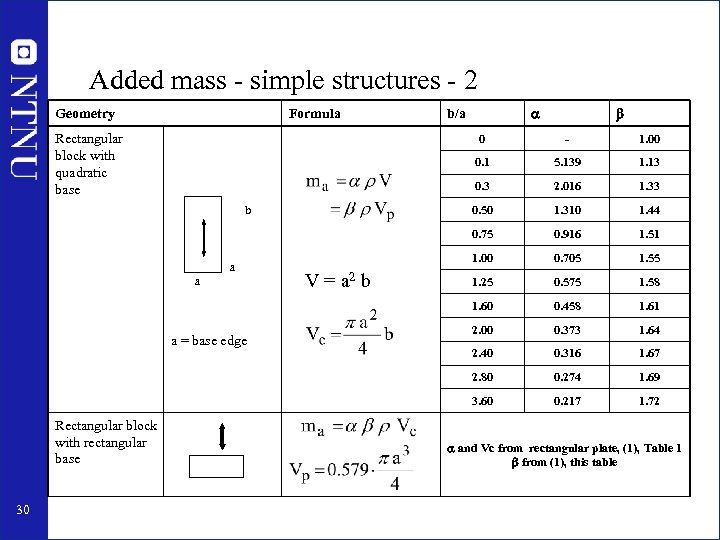 Added mass - simple structures - 2 Geometry Formula Rectangular block with quadratic base b/a 0 1. 44 0. 916 1. 51 1. 00 0. 705 1. 55 1. 25 0. 575 1. 58 0. 458 1. 61 2. 00 0. 373 1. 64 2. 40 0. 316 1. 67 0. 274 1. 69 3. 60 30 1. 310 2. 80 Rectangular block with rectangular base 1. 33 1. 60 a = base edge 2. 016 0. 50 V = a 2 b 1. 13 0. 75 a 5. 139 0. 3 a 1. 00 0. 1 b - 0. 217 1. 72 and Vc from rectangular plate, (1), Table 1 from (1), this table
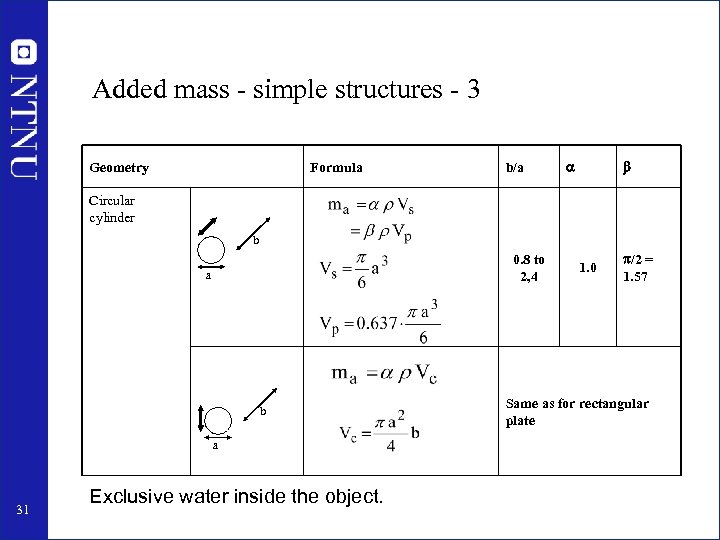 Added mass - simple structures - 3 Geometry Formula b/a Circular cylinder b 0. 8 to 2, 4 a b a 31 Exclusive water inside the object. 1. 0 /2 = 1. 57 Same as for rectangular plate
 Added mass - simple structures - 3 Geometry Formula b/a Circular cylinder b 0. 8 to 2, 4 a b a 32 Exclusive water inside the object. 1. 0 /2 = 1. 57 Same as for rectangular plate
 ROV simulator – systems requirements • System requirements give DESIGN IMPLICATIONS with respect to: – Simulation software – Computer hardware architecture – Mechanical packaging • See article by Smallwood et. al. for more information – A New Remotely Operated Underwater Vehicle for Dynamics and Control Research 33
 System requirement - Example • Simulate a variety of ROV design configurations for both military and commercial mission applications • DESIGN IMPLICATIONS for simulation software: – Sensor databases must include a wide range of underwater objects – Modular model for ROV hydrodynamics – Standard protocols for information exchange between modules • DESIGN IMPLICATIONS for mechanical packaging – System must be reconfigurable to replicate a wide range of control/operator console layouts. 34
 Simulator design • A modular design will make it easy to change modules for different subsystems of a ROV, subsea structures etc • The simulator should allow both real time and fast time simulation • High Level Architecture (HLA) is used for defence simulators to allow different modules to communicate through predefined protocols • Marine Cybernetics uses: – SH**2 i. L as their structure for simulators (Software-Hardware. Human-in-the-Loop) 35
 Simulator design (cont. ) • Check – http: //www. marinecybernetics. com – for their modular simulator concept • or – http: //www. generalrobotics. co. uk/rovsimrecent. htm – http: //rovolution. co. uk/GRLMATIS. htm 36
 New Marine ROV Simulator Launched 12/11/2006 37 Marine Simulation LLC announced the release of ROVsim, an affordable, physics accurate, and visually realistic Remotely Operated Vehicle (ROV) simulator. Using state of the art technologies originally developed for the video game industry and over 2 decades of hands-on industry experience, ROVsim is optimized to simulate a wide range of mission variables: from changing currents and visibility, tether and collision problems, to electronics and gear failures. Potential simulated missions include: harbor security, hull inspections, dam and bridge inspections, deep water drilling and cable work, law enforcement / evidence recovery, scientific data collection, tunnel / pipeline inspections, marine archeology and underwater rescue. ROVsim is designed to operate on low-cost personal computers as well as “off the shelf” components and is available for both Microsoft Windows and Apple OS X operating systems. A free demo version is available for download from Marine Simulation LLC's website www. marinesimulation. com/
 Downloads Demo versions of v. SHIP™ and ROVsim™ are available as free downloads. Select a link below for an automated form to contact us. Please complete this form, click on "submit" and we will reply by email within 24 hours with download instructions. http: //www. marinesimulation. com/downloads. html 38
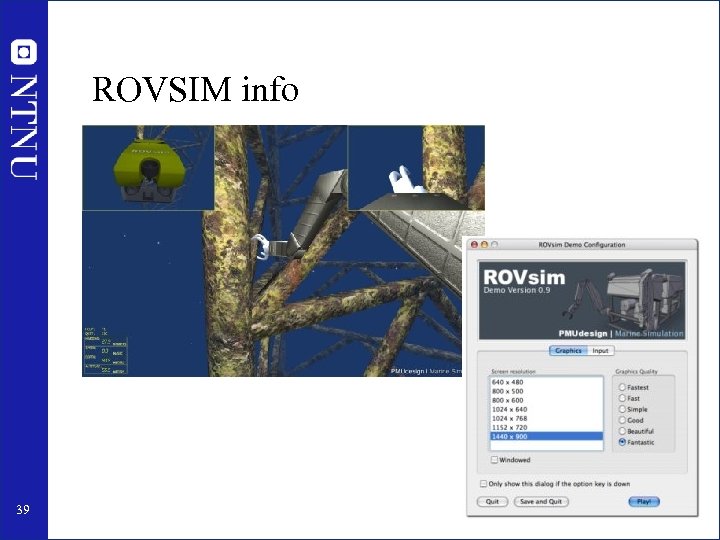 ROVSIM info 39
 Buzz group question no. 1: • List functional requirements for a ROV simulator to be used for accessibility studies 40
 Student responses 2004 – Easy integration of different kinds of underwater structures – Easy implementation of different ROVs – Easy implementation of different types of sensors – Realistic model of umbilical – Catalogue of error modes and related what –if statements – Ability to simulate realistic environmental conditions, such as reduced visibility and varying sonar conditions 41
 Buzz group question no. 1 (cont), 2004: • Realistic simulation of different navigation systems • Obstacle recognition and handling • Easy input interface for parametres related to ROV geometry, environment, navigation systems and different work tools • Realistic model for calculation of ROV motion • Good interface for presentation of ROV position and motion, including available control forces (Graphical User Interface, GUI) 42
 Simulation benefits: 43 • Computer simulation of subsea operations has repeatedly proved itself, in the real world, as a means of driving up profit with the following direct benefits: • Quickly generate visualisations of complex scenarios for training and marketing. • Repeatable and quantifiable training in a completely safe environment. • Early identification of design and implementation errors. • Simulator trained operators outperform other operators, both in speed and quality. • Users access powerful, physics-based simulation using our mature, in-house mathematics engine, that delivers ‘as real’ behaviour
 Necessary improvements for advanced ROV operations • • • 3 D navigational tools 3 D based planning tools Digital, visual ”online” reporting Realistic simulator training for pilots Access verification using simulator during the engineering phase of a subsea operation involving ROVs • Central placed special control room 44
 Challenges for future ROV operations • Better visualization for pilot situational awareness • Better planning of operations, for instance through use of simulator in the engineering design and development of operational procedures • Better reporting system, including automatic functions to reduce the workload of the ROV pilot • Closer co-operation between ROV pilot and subsea system experts in a central on shore operations control centre 45