 Скачать презентацию Tivoli Autonomic Computing A Research Agenda for Business-Driven
59e93444a4b4fcf795301bcb33aaffa0.ppt
- Количество слайдов: 20



Tivoli Autonomic Computing A Research Agenda for Business-Driven IT Jeff Kephart (IBM Research) Steve White (IBM Research) Edie Stern (IBM Tivoli) © 2003 IBM Corporation
Tivoli Autonomic Computing Business-Driven IT § We want a world in which businesses can respond flexibly to opportunities and threats § Flexible business requires flexible IT … 2 © 2003 IBM Corporation
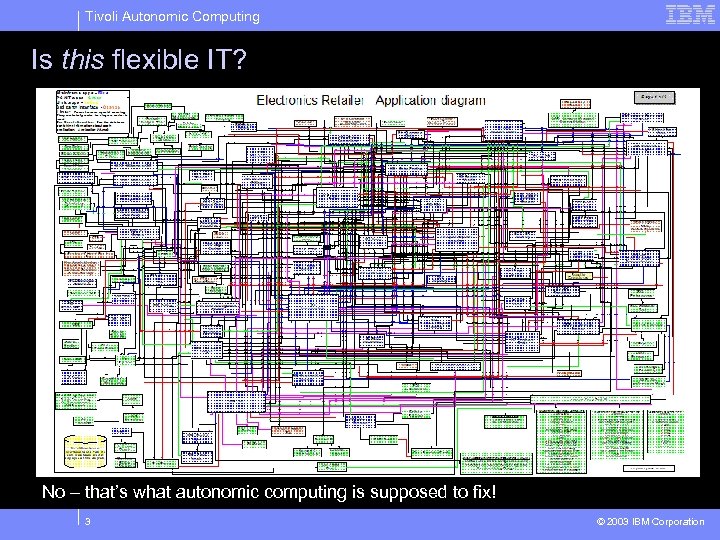
Tivoli Autonomic Computing Is this flexible IT? No – that’s what autonomic computing is supposed to fix! 3 © 2003 IBM Corporation
Tivoli Autonomic Computing The role of autonomic computing § Autonomic computing systems are: – “Computing systems that manage themselves in accordance with highlevel objectives from humans. ” • A Vision of Autonomic Computing, IEEE Computer, J. Kephart and D. Chess, Jan. 2003. § How high is “high”? § Business-driven IT: the high-level objectives are business objectives 4 © 2003 IBM Corporation
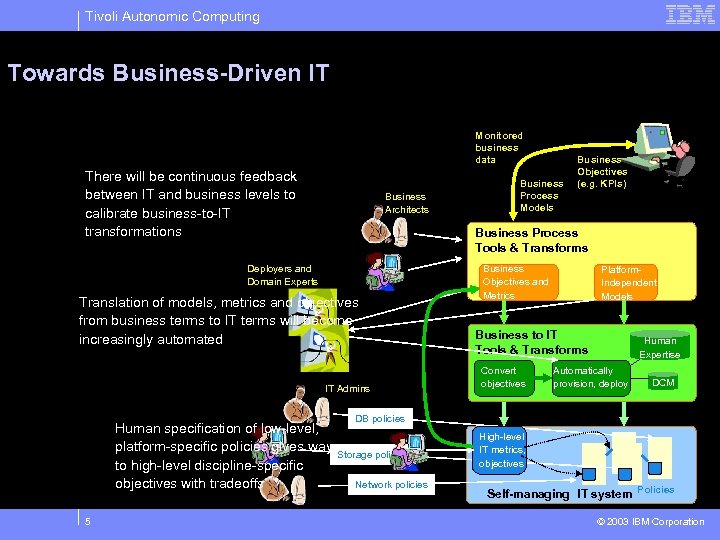
Tivoli Autonomic Computing Towards Business-Driven IT Monitored business data There will be continuous feedback between IT and business levels to calibrate business-to-IT transformations Business Architects Business Process Tools & Transforms Deployers and Domain Experts Translation of models, metrics and objectives from business terms to IT terms will become increasingly automated IT Admins Human specification of low-level, platform-specific policies gives way to high-level discipline-specific objectives with tradeoffs 5 Business Process Models Business Objectives (e. g. KPIs) Business Objectives and Metrics Platform. Independent Models Business to IT Tools & Transforms Convert objectives Human Expertise Automated Automatically Provisioning and provision, deploy Deployment DCM DB policies Storage policies Network policies High-level IT metrics, objectives Self-managing IT system Policies © 2003 IBM Corporation
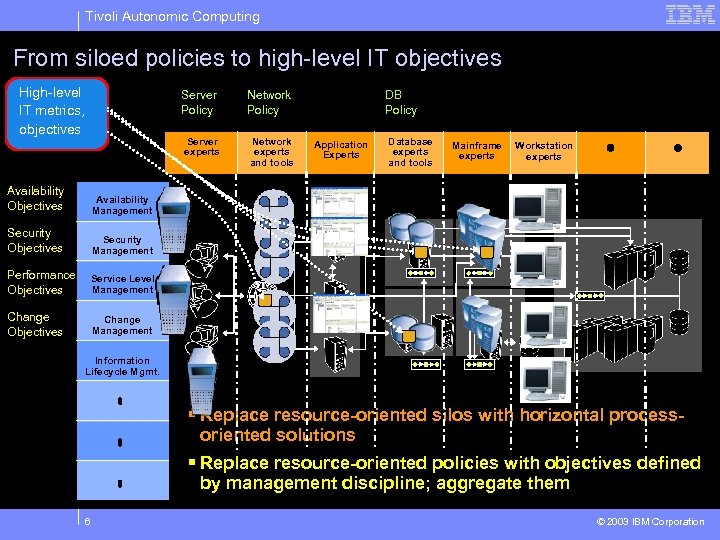
Tivoli Autonomic Computing From siloed policies to high-level IT objectives High-level IT metrics, objectives Server Policy Server experts Availability Objectives Database experts and tools Mainframe experts Workstation experts Service Level Management Change Objectives Application Experts Security Management Performance Objectives Network experts and tools DB Policy Availability Management Security Objectives Network Policy Change Management Information Lifecycle Mgmt. § Replace resource-oriented silos with horizontal processoriented solutions § Replace resource-oriented policies with objectives defined by management discipline; aggregate them 6 © 2003 IBM Corporation
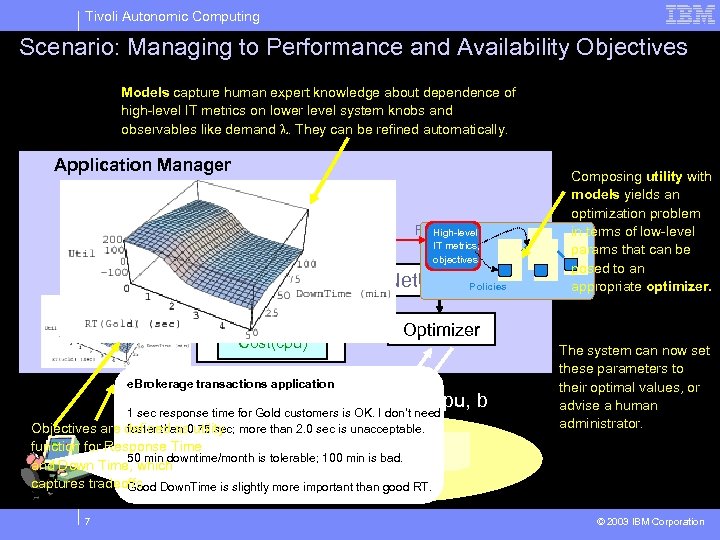
Tivoli Autonomic Computing Scenario: Managing to Performance and Availability Objectives Models capture human expert knowledge about dependence of high-level IT metrics on lower level system knobs and observables like demand l. They can be refined automatically. Application Manager Models Service-level utility Util(RT, DT) Perf. Model Resource-level High-level IT metrics, utility RT(cpu, b; l) Avail. Model DT(b) objectives Net. Util(cpu, b; l) Policies Cost Model Optimizer Cost(cpu) e. Brokerage transactions application Composing utility with models yields an optimization problem in terms of low-level params that can be posed to an appropriate optimizer. l cpu, b 1 sec response time for Gold customers is OK. I don’t need Objectives are defined as 0. 75 sec; more than 2. 0 sec is unacceptable. faster than utility The system can now set these parameters to their optimal values, or advise a human administrator. function for Response Time 50 min downtime/month is tolerable; 100 min is bad. and Down Time, which captures tradeoffs Down. Time is slightly more important than good RT. On Demand Env 1 Good 7 © 2003 IBM Corporation
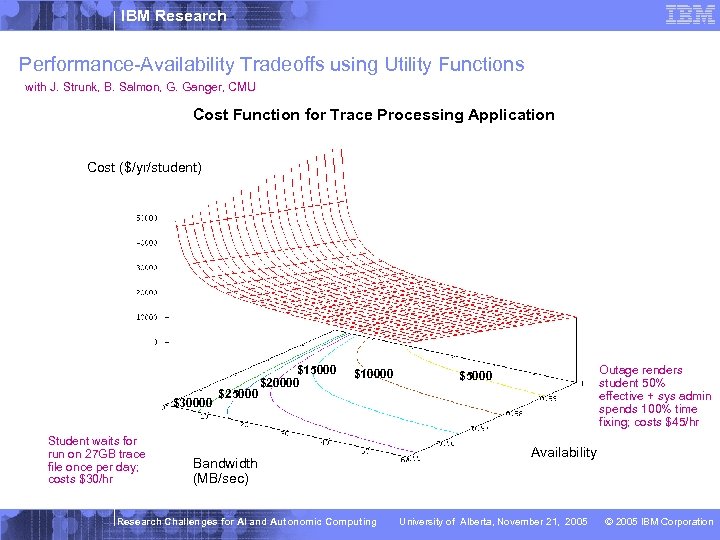
IBM Research Performance-Availability Tradeoffs using Utility Functions with J. Strunk, B. Salmon, G. Ganger, CMU Cost Function for Trace Processing Application Cost ($/yr/student) $30000 Student waits for run on 27 GB trace file once per day; costs $30/hr $25000 $15000 $20000 $10000 Bandwidth (MB/sec) Research Challenges for AI and Autonomic Computing Outage renders student 50% effective + sys admin spends 100% time fixing; costs $45/hr $5000 Availability University of Alberta, November 21, 2005 © 2005 IBM Corporation
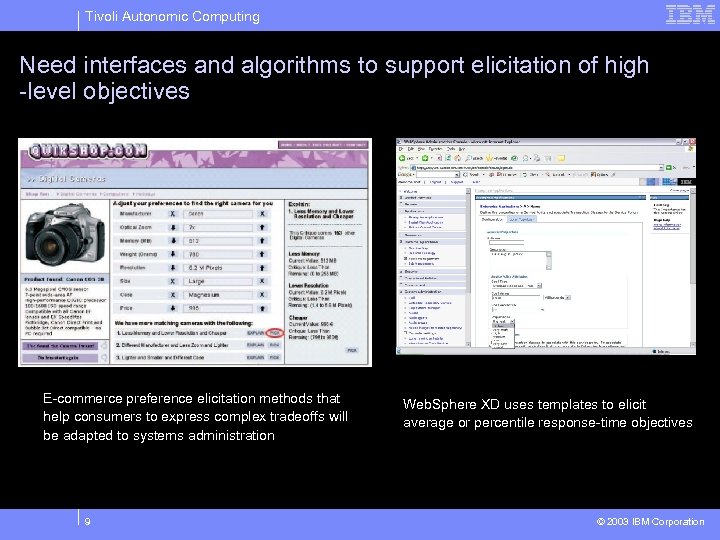
Tivoli Autonomic Computing Need interfaces and algorithms to support elicitation of high -level objectives E-commerce preference elicitation methods that help consumers to express complex tradeoffs will be adapted to systems administration 9 Web. Sphere XD uses templates to elicit average or percentile response-time objectives © 2003 IBM Corporation
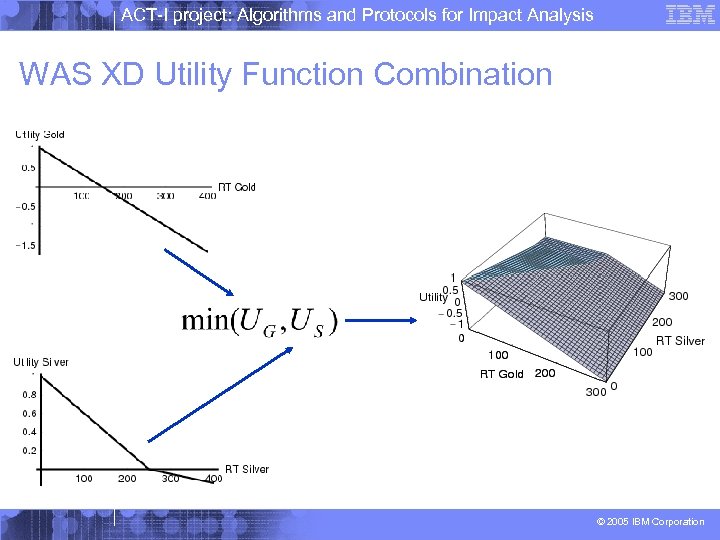
ACT-I project: Algorithms and Protocols for Impact Analysis WAS XD Utility Function Combination © 2005 IBM Corporation
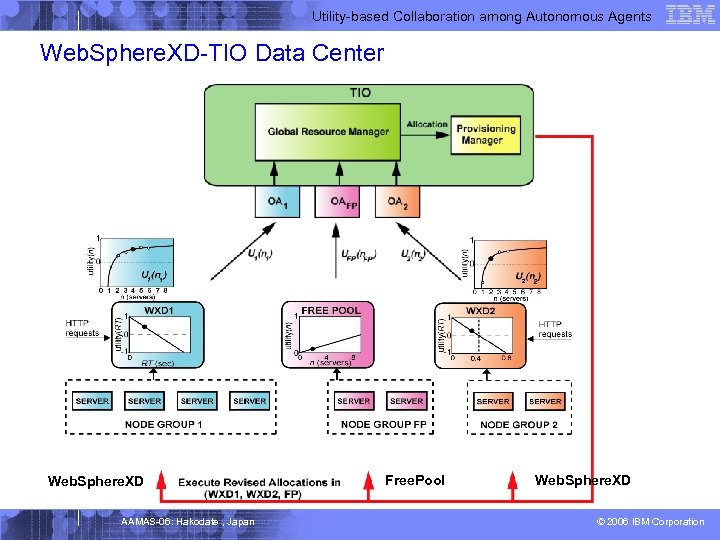
Utility-based Collaboration among Autonomous Agents Web. Sphere. XD-TIO Data Center Web. Sphere. XD AAMAS-06: Hakodate , Japan Free. Pool Web. Sphere. XD © 2006 IBM Corporation
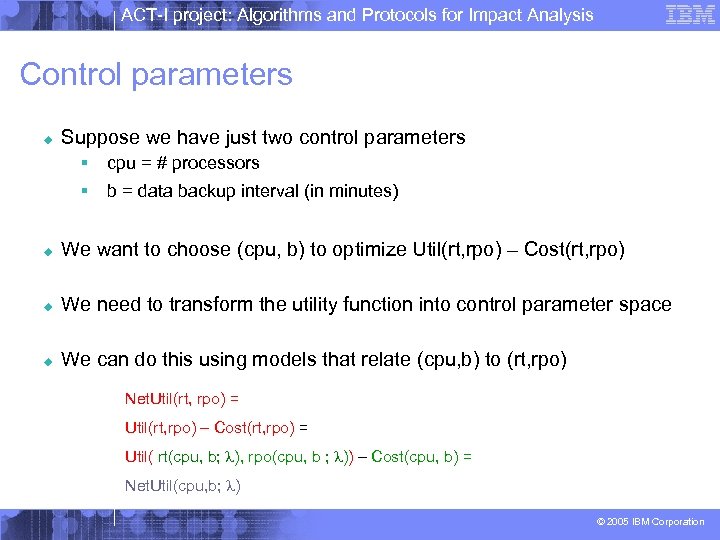
ACT-I project: Algorithms and Protocols for Impact Analysis Control parameters u Suppose we have just two control parameters § cpu = # processors § b = data backup interval (in minutes) u We want to choose (cpu, b) to optimize Util(rt, rpo) – Cost(rt, rpo) u We need to transform the utility function into control parameter space u We can do this using models that relate (cpu, b) to (rt, rpo) Net. Util(rt, rpo) = Util(rt, rpo) – Cost(rt, rpo) = Util( rt(cpu, b; l), rpo(cpu, b ; l)) – Cost(cpu, b) = Net. Util(cpu, b; l) © 2005 IBM Corporation
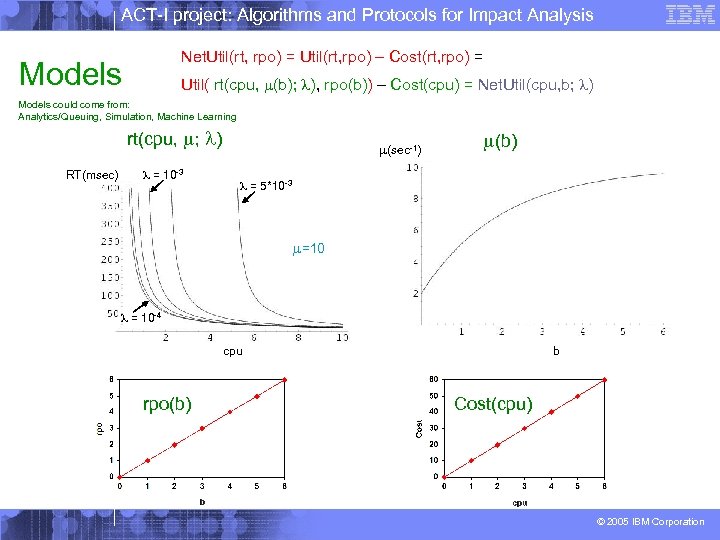
ACT-I project: Algorithms and Protocols for Impact Analysis Net. Util(rt, rpo) = Util(rt, rpo) – Cost(rt, rpo) = Models Util( rt(cpu, m(b); l), rpo(b)) – Cost(cpu) = Net. Util(cpu, b; l) Models could come from: Analytics/Queuing, Simulation, Machine Learning rt(cpu, m; l) RT(msec) l = 10 -3 m(sec-1) m(b) l = 5*10 -3 m=10 l = 10 -4 b cpu rpo(b) Cost(cpu) © 2005 IBM Corporation
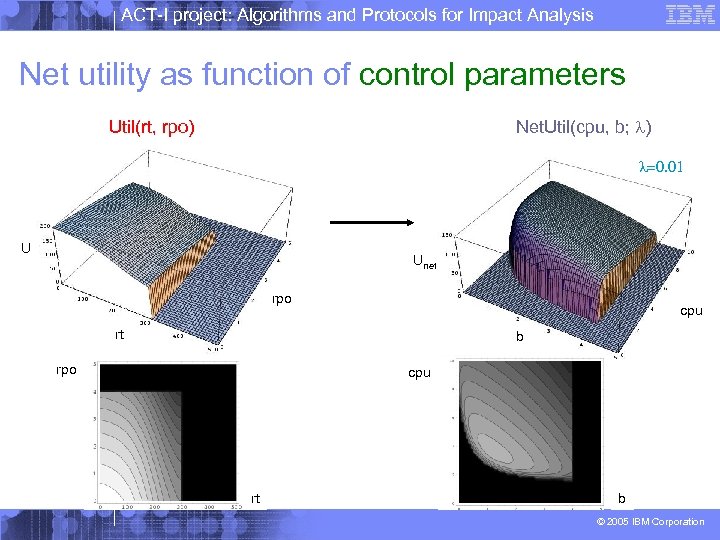
ACT-I project: Algorithms and Protocols for Impact Analysis Net utility as function of control parameters Net. Util(cpu, b; l) Util(rt, rpo) l=0. 01 U Unet rpo cpu rt b © 2005 IBM Corporation
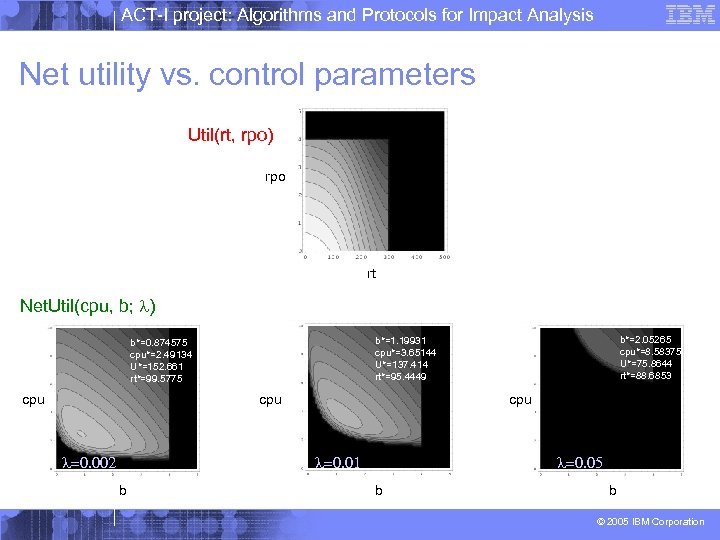
ACT-I project: Algorithms and Protocols for Impact Analysis Net utility vs. control parameters Util(rt, rpo) rpo rt Net. Util(cpu, b; l) cpu l=0. 002 cpu l=0. 01 b b*=2. 05265 cpu*=8. 58375 U*=75. 8644 rt*=88. 6853 b*=1. 19931 cpu*=3. 65144 U*=137. 414 rt*=95. 4449 b*=0. 874575 cpu*=2. 49134 U*=152. 661 rt*=99. 5775 l=0. 05 b b © 2005 IBM Corporation
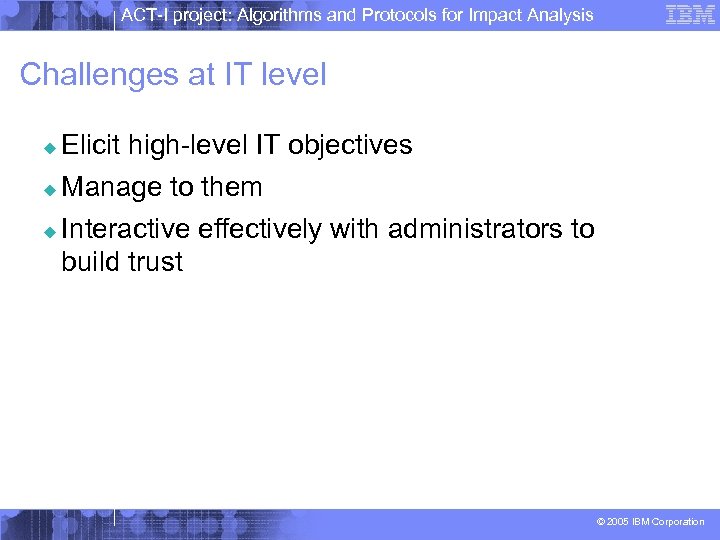
ACT-I project: Algorithms and Protocols for Impact Analysis Challenges at IT level u Elicit high-level IT objectives u Manage to them u Interactive effectively with administrators to build trust © 2005 IBM Corporation
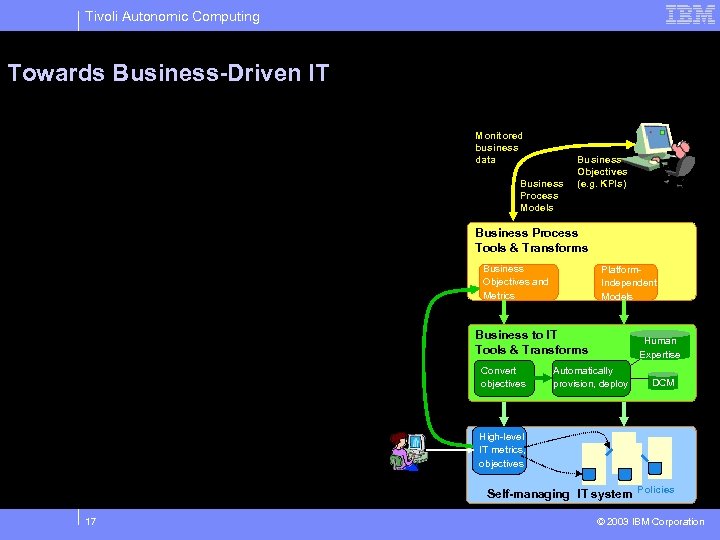
Tivoli Autonomic Computing Towards Business-Driven IT Monitored business data Business Process Models Business Objectives (e. g. KPIs) Business Process Tools & Transforms Business Objectives and Metrics Platform. Independent Models Business to IT Tools & Transforms Convert objectives Human Expertise Automated Automatically Provisioning and provision, deploy Deployment DCM High-level IT metrics, objectives Self-managing IT system Policies 17 © 2003 IBM Corporation
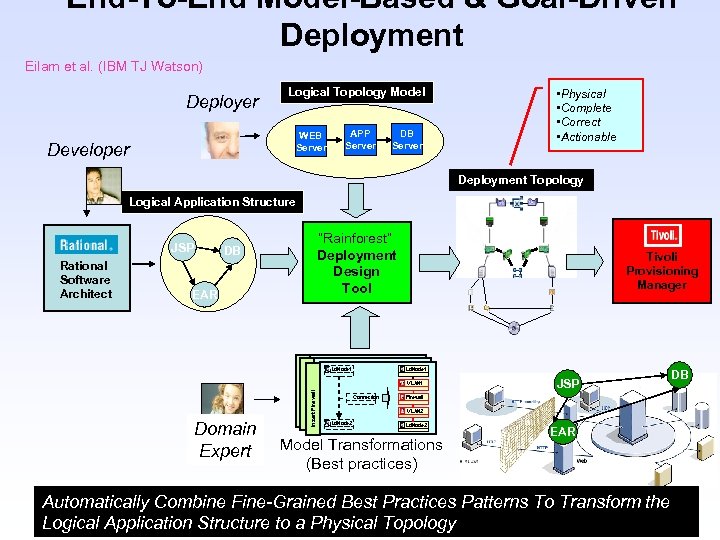
End-To-End Model-Based & Goal-Driven Deployment Eilam et al. (IBM TJ Watson) Deployer Logical Topology Model WEB Server Developer APP Server DB Server • Physical • Complete • Correct • Actionable Deployment Topology Logical Application Structure JSP Rational Software Architect “Rainforest” Deployment Design Tool DB EAR Domain Expert Insert Firewall Ld. Node 1 Connection Ld. Node 2 Ld. Node 1 VLAN 1 Firewall VLAN 2 Ld. Node 2 Model Transformations (Best practices) Tivoli Provisioning Manager JSP DB EAR Automatically Combine Fine-Grained Best Practices Patterns To Transform the Autonomic Systems and © Motorola Page 18 Logical Application. Networks – Theorya Physical Topology and IBM, 2005 -2006 Structure to and Practice
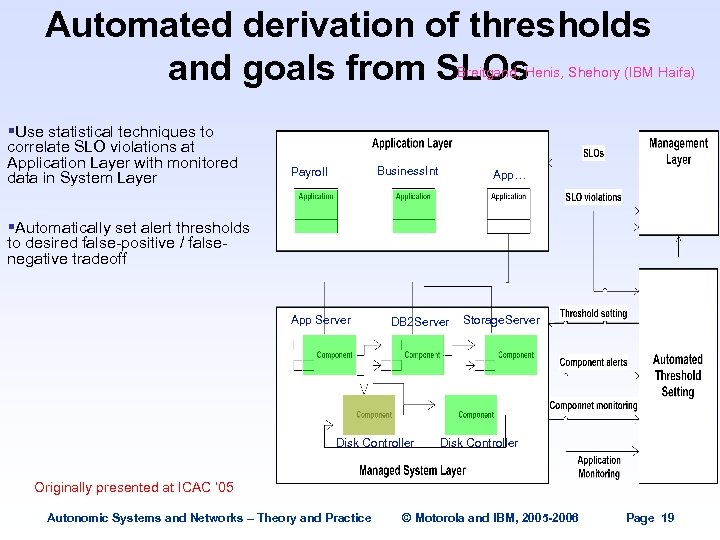
Automated derivation of thresholds and goals from SLOs Breitgand, Henis, Shehory (IBM Haifa) §Use statistical techniques to correlate SLO violations at Application Layer with monitored data in System Layer Business. Int Payroll App… §Automatically set alert thresholds to desired false-positive / falsenegative tradeoff App Server DB 2 Server Disk Controller Storage. Server Disk Controller Originally presented at ICAC ‘ 05 Autonomic Systems and Networks – Theory and Practice © Motorola and IBM, 2005 -2006 Page 19
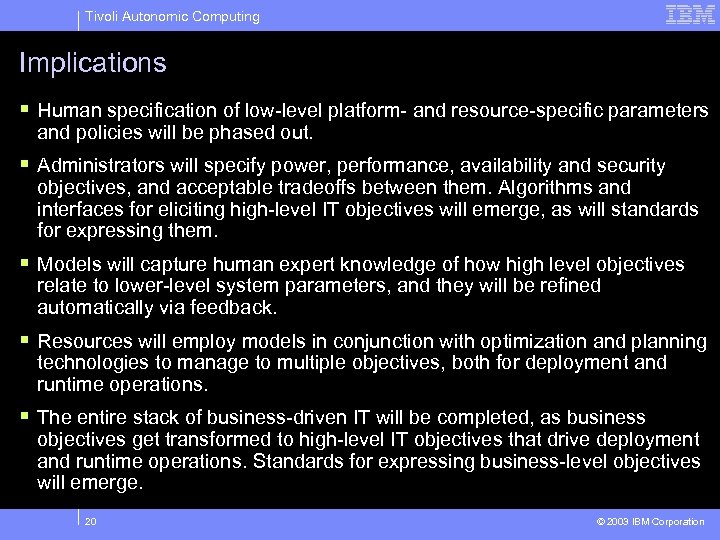
Tivoli Autonomic Computing Implications § Human specification of low-level platform- and resource-specific parameters and policies will be phased out. § Administrators will specify power, performance, availability and security objectives, and acceptable tradeoffs between them. Algorithms and interfaces for eliciting high-level IT objectives will emerge, as will standards for expressing them. § Models will capture human expert knowledge of how high level objectives relate to lower-level system parameters, and they will be refined automatically via feedback. § Resources will employ models in conjunction with optimization and planning technologies to manage to multiple objectives, both for deployment and runtime operations. § The entire stack of business-driven IT will be completed, as business objectives get transformed to high-level IT objectives that drive deployment and runtime operations. Standards for expressing business-level objectives will emerge. 20 © 2003 IBM Corporation
Скачать презентацию Tivoli Autonomic Computing A Research Agenda for Business-Driven
59e93444a4b4fcf795301bcb33aaffa0.ppt