


 Скачать презентацию Title VI Environmental Justice and Customer Service January
647096a9c4cc2aef1c07372be2c34ee8.ppt
- Количество слайдов: 134
 Title VI, Environmental Justice, and Customer Service January 24, 2013 Presented by: Robbie L. Sarles, President RLS & Associates, Inc.
 Objectives ♦ ♦ ♦ Overview of civil rights legislation requirements for transit Enable agencies to develop appropriate Title VI plans and assess compliance Provide guidance on the development of public participation plans
 Objectives ♦ ♦ Provide guidance on methods to eliminate or prevent civil rights violations Provide effective customer service insights and tools
 Civil Rights Related Requirements for Transit ♦ ♦ ♦ Title VI of the Civil Rights Act of 1964 Providing Language Access to Persons with Limited English Proficiency (LEP) – Executive Order 13166 Environmental Justice – Executive Order 12898
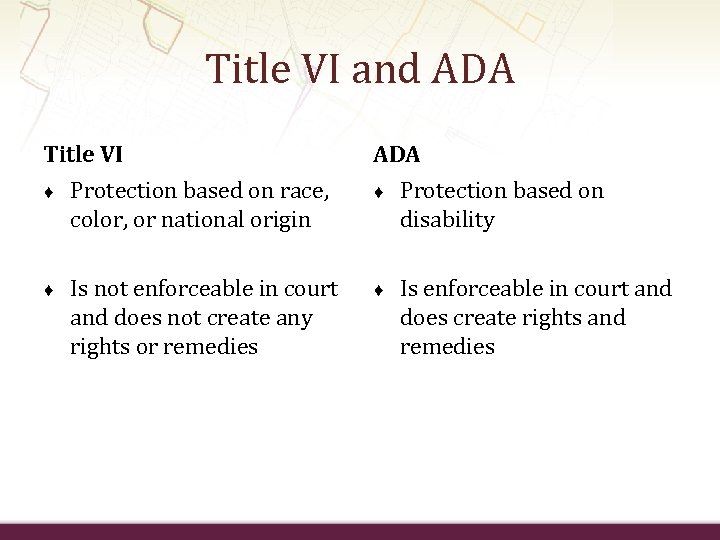 Title VI and ADA Title VI ADA ♦ Protection based on race, color, or national origin ♦ Protection based on disability ♦ Is not enforceable in court and does not create any rights or remedies ♦ Is enforceable in court and does create rights and remedies
 Unintentional Discrimination Transit service discrimination can occur in many ways, including: ○ ○ ○ Assigning buses to routes (old vs. new buses) Crowding allowed on buses Service headways Service on-time performance Temporal distribution of service (time of day, day of week)
 FTA’s Title VI Circular ♦ Distinguishes between Title VI and Environmental Justice by creating two circulars ○ ○ ♦ Title VI Requirements and Guidance for Federal Transit Administration Recipients, FTA C 4702. 1 B Environmental Justice Policy Guidance for Federal Transit Administration Recipients, FTA C 4703. 1 Considered equally important
 Circulars ♦ ♦ Title VI Circular – 4702. 1 B issued August 28, 2012, effective October 1, 2012 Environmental Justice Circular – 4703. 1 issued July 14, 2012, effective August 15, 2012
 Title VI ♦ Applies to all FTA recipients and subrecipients ○ ○ “No person in the United States shall, on the grounds of race, color, or national origin, be excluded from participation in, be denied the benefits of, or be subjected to discrimination under any program or activity receiving Federal financial assistance. ” 42 U. S. C. , Section 2000 d
 Title VI Protects: ♦ ♦ Anyone intended to be the beneficiary of, applicant for, or participant in a Federally assisted program Applies to all persons ○ ○ ○ All races All shades of color National Origin
 Applicability ♦ Recipient ○ ○ ○ ♦ State DOT Transit Agency Any Public or Private agency receiving FTA Funding Subrecipient ○ Pass through recipient of FTA Financial Assistance
 Institution-wide ♦ Later statutes extended the scope of Title VI to include prohibitions against discrimination on the basis of income, age, sex, and disability
 DOT and DOJ Regulation ♦ Prohibits disparate impact discrimination ○ ○ ○ ♦ Practice lacks a substantial legitimate justification There are other comparable alternatives that would result in less disparate impact The justification is a pretext for discrimination Intentional discrimination ○ Disparate treatment
 DOT Title VI Regulations ♦ Recipients may not: ○ ○ ○ Deny any protected individual service, financial aid, or benefit under the program Provide any service, financial aid, or benefit that is different for protected individuals from that provided to others Subject a protected individual to segregation or separate treatment
 DOT Title VI Regulations ♦ Recipients may not: (continued) ○ ○ ○ Restrict a protected individual in the employment of any advantage or privilege enjoyed by others Treat protected individuals differently in terms of whether they satisfy admission, eligibility, or membership requirements Deny a protected individual the opportunity to participate in the provision of services
 DOT Title VI Regulations ♦ Recipients may not: (continued) ○ ○ Deny a protected individual the opportunity to participate as a member of a planning or advisory body Use criteria or methods of administration that have the effect of subjecting individuals to discrimination
 DOT Title VI Regulations ♦ Recipients may not: (continued) ○ ○ Make decisions in regard to facility location with the purpose or effect of subjecting persons to discrimination Discriminate with regard to the routing, scheduling, or quality of transit service
 DOT Title VI Regulations ♦ Recipients may not: (continued) ○ Use race, color, or national origin as a basis for determining frequency of service, age and quality of vehicles assigned to routes, quality of stations serving different routes, and location of routes
 DOT Title VI Regulations ♦ Recipients MUST: ○ Take affirmative action to assure nondiscrimination
 FTA Guidance for Compliance ♦ Title VI Program Guidelines to FTA Recipients ○ ○ ♦ FTA Circular 4702. 1 B Proposed circular was published September 29, 2011 and became effective October 1, 2012 www. fta. dot. gov ○ Civil rights/accessibility
 FTA Guidance for Compliance ♦ Annual Title VI Assurances ○ ♦ Annual certification and assurance submission Direct Recipient Plan Submission ○ Every 3 Years
 Eight Required Actions 1. Develop Title VI complaint procedures ○ ○ ○ Develop method for filing complaints Timeframe for accepting complaint Investigation and resolution timeframe Who investigates the complaint Who resolves the complaint Develop method for investigating and tracking complaints
 Eight Required Actions 2. Record Title VI investigations, complaints, and lawsuits Maintain a list of active investigations conducted by entities other than FTA, lawsuits or complaints alleging discrimination ○ § § Date filed Summary of allegation Current status Actions taken in response
 Eight Required Actions 3. Provide meaningful access to persons with Limited English Proficiency – benefits, services, information, and other important portions of their programs ○ Develop an LEP Plan or equivalent
 Eight Required Actions 4. Notify beneficiaries of Title VI protections Disseminate information to public ○ § § § Statement that agency operates programs without regard to race, color, national origin, sex, age, income, or disability (should be included in all printed materials regarding service) Procedures for requesting additional information on non-discrimination obligations Complaint procedures
 Eight Required Actions 4. Notify beneficiaries of Title VI protections (Continued) ○ ○ Use variety of dissemination methods General notification Document translation See example
 Eight Required Actions 5. Provide additional information upon request ○ ○ In response to a complaint investigation To resolve concerns about possible noncompliance 6. Prepare and submit a Title VI program ○ Report certain general information as part of grant application
 Eight Required Actions 7. Analyze impact of construction projects ○ ○ ○ National Environmental Policy Act (NEPA) Categorical exclusion ODOT will work with each system to determine when a NEPA analysis is required
 Eight Required Actions 8. Promote inclusive public participation Conduct public outreach and involvement activities with minority and low-income individuals Agency determines most appropriate approach ○ ○ § § Should seek out and consider the viewpoints of minority, low-income, and LEP populations when conducting public outreach and involvement activities Early and continuous opportunity for input
 Guidance for Transit Agencies ♦ ♦ ♦ Certify your compliance Document Title VI complaints/lawsuits Inform public of your Title VI policy and complaint process ○ ○ Post complaint process in public locations and public documents Provide direction of where complaint process can be found
 Guidance for Transit Agencies ♦ Prepare demographic analysis ○ ♦ Set system-wide service standards ○ ♦ ♦ Maps with overlays showing distribution of service to protected populations Vehicle load, headway, assignment, access, amenities Monitor and compare Assess impact of service and fare changes
 Guidance for Transit Agencies ♦ ♦ ODOT is currently working through the processes to enable them to assist with the development of demographic information such as maps Reporting accurate service standard data is critical in ODOT’s ability to set service standards
 Guidance for Transit Agencies ♦ ♦ Document procedures for informing protected populations of upcoming service changes Provide a racial breakdown of non-elected boards, advisory councils, and committees ○ Encourage participation of protected populations’ representatives
 Potential Title VI Issues ♦ ♦ ♦ Unintentional exclusion of groups from the decision process Failure to consider impacts of alternatives and programs on groups Disproportionate impact
 What is Public Participation ♦ “Public participation in the transportation field is the process through which transportation agencies inform and engage people in the transportation decision-making process. The goals of public involvement are to provide information to the public and obtain feedback on analysis, recommendations, or decisions. ” Public Participation Strategies for Transit; Transportation Research Board; TCRP Synthesis #89; 2011
 Public Participation ♦ Effective public participation is: ○ Functional for planning § ○ Helps create better decisions Meaningful to the public § § Provides opportunity to influence decisions Promotes a sense of ownership in the transit system
 Public Participation Plan ♦ Effective Public Participation Plans should: ○ ○ ○ Link public participation to planning Recognize the intended public audience Define the transit system’s intentions for public participation
 Public Participation Plans must: • • • Comply with Title VI and EJ Regulations Be inclusive Be appropriate for service and service area Be practical Be do-able Be documentable
 Public Participation Plan ♦ Developing and implementing a good Public Participation Plan can be difficult. And, it is made more difficult when trying to engage traditionally hard to reach populations such as people with limited English language proficiency and low-income and minority communities
 Public Participation Plan ♦ The four cornerstones of the Public Participation Plan are: ○ ○ Purpose People Methods Evaluation
 Purpose ♦ ♦ What the public is involved to do and when The Plan’s Purpose should: ○ ○ ○ List planning tasks to create a transit plan Establish which tasks require or benefit from public involvement Evaluate when planning tasks must be achieved and when the public must be involved
 People ♦ ♦ Identifies those who are involved in community transit planning This Cornerstone should: ○ ○ Describe the public that will be involved in the process Describe the transit officials and local officials that will be involved in the process
 Methods ♦ ♦ Identifies the specific methods for involving the public to achieve the tasks Methods are to: ○ Increase the public’s awareness of planning participation activities
 Evaluation ♦ ♦ Documentation and evaluation of public participation In the Evaluation portion you will: ○ Outline and establish procedures for documenting public participation and a protocol for evaluating public participation activities and results
 Public Participation Plan ♦ If your Plan says you are going to do something, then you have to actually do it and be able to provide documentation to ODOT (as part of the TAR reviews)
 Public Participation Incorporate Title VI requirements into policies and procedures 1. 2. 3. 4. Scheduling policies Fare polices Eligibility policies Service area policies
 Public Participation Encourage and seek participation from those directly impacted 1. 2. 3. Who is impacted? Where do I find those who are impacted? How do I find the most appropriate meeting location and time?
 Public Participation Contact minority community leaders, organizations, media, and safety and enforcement agencies 1. 2. 3. Churches Civic Groups Homeless Shelters
 Public Participation Conduct community/public meetings 1. 2. 3. Where should meetings be held? Who should be invited to the meetings? How should I promote and advertise meetings to encourage attendance?
 Public Participation Participate on civic and advisory committees 1. 2. 3. Workforce Development Boards Community Action Boards United Way Boards
 Public Participation Set appropriate meeting location, time, and day and ensure accessibility and other needs are accommodated 1. 2. 3. 4. Civic Centers and Community Centers Schools and Libraries Evening meetings Saturday meetings
 Public Participation ♦ Demonstrate consideration of community input in printed and communication materials 1. Publish participation results in local newspaper 2. Announce results on local radio 3. Post results on website
 Public Participation Focus outreach to allow minorities and LEP populations the opportunity for involvement 1. 2. 3. Take the meeting to the people Spend time in the community Utilize the entire family of communication, including word of mouth
 Public Participation Conduct awareness and sensitivity trainings 1. Provide training to front line staff 2. Provide training to transit leaders 3. Provide training to stakeholders
 Public Participation Allow adequate time for public comment 1. Keep surveys, input opportunities available • Allow adequate response time at least 45 days
 Public Participation Communicate with other transit systems and share successful outreach methods 1. Establish a best practices techniques list on ODOT’s new linked in site. www. linkedin. com/groups/Mobility. Management-in-Ohio-4571348
 Public Participation Meetings 1. 2. 3. Hold in accessible facility Meeting notice should contain process to request alternate documents and assistive services Public service announcements must be closed captioned
 Limited English Proficiency – Title VI Requirements ♦ FTA Recipients must take responsible steps to ensure meaningful access to the benefits, services, information, and other important portions of their programs and activities for individuals who are LEP
 Provide Meaningful Access to Persons with LEP and Low Literacy ♦ Persons with Limited English Proficiency (LEP) ○ ○ Persons who do not speak English as their primary language Persons who have a limited ability to read, write, speak, or understand English
 Provide Meaningful Access to Persons with LEP and Low Literacy ♦ Households with Limited English Proficiency (LEP) ○ No one over age 14 speaks English well, and is linguistically isolated
 LEP Population in the U. S. ♦ ♦ More than 25 million do not speak English at all or well Increased by 80% from 1990 to 2010
 LEP Population in the U. S. ♦ Other common languages ○ ○ ♦ Spanish Chinese Vietnamese Korean Greater than 11% of LEP persons take transit to work
 Low Literacy ♦ National Literacy Council defines “low literacy” as: ○ “An individual’s ability to read, write, and speak English and compute and solve problems at levels of proficiency necessary to function on the job and in society, to achieve one’s goals, and develop one’s knowledge and potential. ”
 Low Literacy ♦ On a scale of 1 – 5, 21% had the lowest literacy skills (level 1) and 27% had the second lowest (level 2)
 LEP Executive Order 13166 ♦ ♦ Each Federal agency shall examine the services it provides and develop and implement a system by which LEP persons can meaningfully access those services Required in all State DOT and FTA program applications and proposals (ODOT currently assures compliance at all transit systems
 DOT LEP Guidance ♦ Two methods ○ Agencies serving significant populations of LEP persons § ○ Develop a language implementation plan Agencies serving small populations of LEP persons § Implement procedures to reasonably provide meaningful access
 Significant LEP Population – Develop a Language Implementation Plan ♦ FTA publication ○ “Implementing the Department of Transportation’s Policy Guidance Concerning Recipients’ Responsibilities to Limited English Proficiency (LEP) Persons: A Handbook for Public Transportation Providers”
 Four Factors Included in Plan 1. Identify number or proportion of LEP persons eligible or likely to be served ○ Compare service area with geographic distribution of LEP persons
 Four Factors Included in Plan 2. Determine frequency with which LEP persons come into contact with the service ○ ○ ○ Track number of calls or service requests made by LEP persons Track number of requests for a translator or travel trainer Track number of LEP persons that attended public meetings or outreach activities
 Four Factors Included in Plan 3. Define the nature and importance of the program, activity, or service provided to LEP persons ○ ○ ○ System’s mission statement Provide a trip purpose summary List major trip generators
 Four Factors Included in Plan 3. Define the nature and importance of the program, activity, or service provided to LEP persons (continued) ○ Type of Information § § § Fares/Tickets Route and Schedules Safety/Security/Evacuation
 Four Factors Included in Plan 4. Identify resources and costs associated with providing meaningful access to LEP persons ○ ○ Identify others in community that address the needs of LEP persons Identify resources available in local community § Resources that can provide oral and written translation
 Safe Harbor and LEP Thresholds ♦ Safe Harbor ○ ○ 5% or 1, 000 individuals Written translation of vital documents for each group If you are a transit system claiming Safe Harbor you MUST support the claim with factual documentation
 Safe Harbor and LEP Thresholds ♦ Vital Documents ○ ○ ○ Documents critical for accessing recipients services or benefits Letters requiring response from customer Informing customers of free language assistance Complaint forms Notification of rights
 Small LEP Population – Implement Reasonable Procedures to Provide Meaningful Access ♦ ♦ No written plan requirement Minimum recommendations ○ ○ ♦ Summaries of vital documents should be translated upon request Qualified community volunteers should be engaged to provide oral translation when needed Other actions as appropriate
 Reasonable Steps ♦ ♦ Smaller agencies are encouraged to explore the most cost-effective means of delivering competent and accurate language services before limiting services due to resource concerns Reduce cost by technological advances, reasonable business practices, and sharing language assistance materials and resources
 Reasonable steps – Providing Language Assistance ♦ Oral interpretation in person ○ ○ ○ ♦ Train bilingual staff to serve as interpreters or translators Use qualified community volunteers to provide interpretive services Hire qualified interpreters for critical presentations/ meetings provided to a high volume of LEP persons Oral interpretation via commercially available telephonic interpretation services
 Reasonable steps – Providing Language Assistance ♦ Guidance on oral interpretation services ○ ○ Ensure competency of interpreters Ensure interpretation is made in a timely manner Utilize skills of existing staff Contract with interpreters when there is no regular need for a particular language skill
 Reasonable steps – Providing Language Assistance ♦ Written translation ○ ○ ○ Translate entire reports that provide essential information Translate a short description of the report Translate reports upon request
 Reasonable steps – Providing Language Assistance ♦ Written Translation (continued) ○ ○ ○ Use qualified translators to make sure documents are accurate Translate into languages where there is identified need (four factor analysis) Use pictures/pictograms for low-literacy persons
 Other Suggestions ♦ ♦ ♦ Use of Pictograms where possible Use Language identification cards (U. S. Census) Advertise in Ethnic Media
 Elements of an Effective Implementation Plan on Language Assistance ♦ ♦ ♦ ♦ Conduct needs assessment – 4 Factor Analysis Develop language assistance measures Train staff Translate vital documents as appropriate Provide notice to LEP persons Expand outreach efforts Monitor and update plan
 Engaging Low-Literacy and LEP Populations in Transportation Decision Making ♦ ♦ ♦ Hold public meeting(s) in accessible locations and at accessible times Provide notice through radio announcements Be observant and sensitive to people who cannot read English Give opportunity to provide verbal comments Use maps, diagrams, pictures
 New Title VI Circular ♦ ♦ Effective October 1, 2012 Requirements remain primarily the same Clarifies regulations and requirements Removal of most references to Environmental Justice (EJ) (replaced by new EJ Circular that provides distinct framework to assist grantees integrate EJ principles)
 New Title VI Circular ♦ All FTA Recipients (ODOT) must submit to FTA: ○ ○ ○ Title VI Notice to the Public Complaint Procedures Complaint Form Limited English Proficiency Plan & Public Involvement Plan List of investigations, lawsuits, and complaints
 New Title VI Circular ♦ All FTA recipients must submit…(continued): ○ ○ ♦ Information regarding siting of fixed facilities (not construction projects) Table depicting racial composition of membership of non-elected bodies All transit providers regardless of size must adopt service standards and policies
 New Title VI Circular ♦ Large transit providers – annual operating budgets of $10 million or more – must submit: ○ ○ Monitoring program Service and fare equity analysis Demographic analysis of customers Customer demographics and travel patterns
 New Title VI Circular ♦ ♦ ♦ Includes templates and checklist for information submitted to FTA Flow charts of responsibilities Updated Title VI plans due dates: (from ODOT) ○ ○ Plans that expired prior to October 1, 2012 were due to FTA prior to October 1, 2012 (compliant with Circular 4702. 1 A) Plans that expire after October 1, 2012 must submit a plan compliant with 4702. 1 B by April 1, 2013
 Title VI Plan Due Dates ♦ ODOT must comply with FTA established due dates ○ All grantees are required to be in compliance based on the dates provided by ODOT All grantees should have already submitted a Title VI plan Public Participation Plans are due by January 30, 2013
 Title VI Circular – State Requirements ♦ ♦ ♦ Clarifies existing requirements Requires demographic maps that overlay the percent minority and non-minority populations Requires charts that analyze the impacts of the distribution of state and federal funds
 Environmental Justice Circular ♦ ♦ Provides framework for integrating EJ principles in transportation decision-making processes Discusses public outreach strategies when engaging EJ populations ○ ○ ○ ♦ Planning Decision making Environmental reviews Discusses meaningful demographic information
 Environmental Justice Circular ♦ Three principles of EJ Avoid, minimize, or mitigate disproportionately high and adverse human health and environmental effects, including social and economic effects 1. § § Minority populations Low-income populations
 Environmental Justice Circular ♦ Three principles of EJ (continued) 2. 3. Ensure full and fair participation by all potentially affected communities in the transportation decision-making process Prevent the denial of, reduction in, or signification delay in receipt of benefits by minority or low-income populations
 Environmental Justice Circular ♦ Three fundamental steps for an EJ analysis 1. 2. 3. Determine if there any EJ populations potentially impacted Consider potential effects Determine whether any disproportionally high and adverse effects can be avoided, minimized, or mitigated and if there are off-setting benefits
 Environmental Justice Population Compared to General Population ♦ ♦ ‘Meaningfully greater’ determined on a case by case basis Always when the percentage of minority population exceeds 50%
 Environmental Justice Analysis Required For: ♦ ♦ ♦ Service cuts, changes, or restructuring Building or extending a rail line Establishing a multi-modal station Increasing fares Building new facilities
 Ensuring Compliance ♦ ODOT Procedures for securing compliance ○ Identify deficiency or non-compliance § § ○ Notification to recipient § ○ Technical Assistance Review (TAR) Compliant required review process Letter of finding Recipient response § § Planned corrective action Sufficient justification for action
 Ensuring Compliance ♦ Procedures for securing compliance (continued) ○ Final decision § § § ♦ ODOT USDOT Department of Justice Enforcement Proceeding ○ Suspend or terminate Federal financial assistance
 Customer Service
 Customer Service in Public Transportation ♦ ♦ ♦ No Industry Can Prosper That Does Not Place The Customer First Customer-Focused Public Transportation Can Make a Difference To Be Successful, Systems Must Implement Agency-Wide, Results-Oriented, Customer. Focused Programs
 Obstacles to Good Customer Service t Indifferent Employee Attitudes t Union Opposition t Lack of Support From Other Departments t Understaffing t Inadequate Communications Between Departments
 Obstacles to Good Customer Service Inadequate Computer Systems/ Technology t Inadequate Training in People Skills t Inadequate Driver Selection Criteria t Low Morale – No Team Spirit t Conflicting Organizational Policies and Procedures t Funding Limitations t
 Customer Service Goals Increase Customer Satisfaction t Increase Ridership t Improve System Image t Increase Community Support t
 LACK OF EMPATHY AND UNDERSTANDING Misfocus Attention
 State of the Art Customer-Focused Transit Programs General Interaction Between the Customer and Transit System t Obtaining and Using Customer Input t Involving Employees in Customer-Focused Transit Service t Methods to Achieve Customer Satisfaction t
 General Interaction Between the Customer and Transit System Mission Statement t Public Route Timetables t System Maps t Web Page t
 General Interaction Mission Statements “The Mission of Southwest Airlines is dedication to the highest quality of customer service delivered with a sense of warmth, friendliness, individual pride and company spirit. ”
 General Interaction Mission Statements “With our customer-first focus to exceed guest’s expectations, we pledge to provide a safe, dependable, and clean public transit system – delivered by a spirited, diverse workforce accountable to the people of our community. ”
 General Interaction General Information Public Forum t Regional Transit Map t Visitor Map and Transit Guide t Transit Rider’s Handbook t Transit Information Call Center t
 General Interaction General Information Virtual Ride Guide on Website t Information and Brochures t Information Kiosks/Bus Stop Signs t Print Advertising t TV/Radio Advertising t
 General Interaction Technology Electronic Scrolling Signs t Real Time Vehicle Location Information t Internet Connections to Timetables t
 Obtaining and Using Customer Input t Monitor Complaints t Public Forums t On-Board Surveys t Telephone Surveys t Employee Meetings t Focus Groups – Honest Feedback t Consumer Driven Planning Workshops
 Involving Employees in Customer. Focused Public Transportation ♦ ♦ Employee Involvement is Key to Success Top to Bottom Must be Reflected in Corporate Culture
 Involving Employees Employee Training Effective Verbal Skills t Effective Non-Verbal Communication t Situational Examples t Empathetic Handling of Situations t Establish Employee’s Credibility as a Professional t
 Involving Employees Employee Training How to Develop a Positive Responsive Relationship t How to Add Value to the Service t Make Every Interaction Positive t Being Knowledgeable, Dependable, Reliable t
 Methods to Achieve Customer Satisfaction/Customer Loyalty Rider Discounts t Guaranteed Ride Home t Customer Loyalty Promotions t
 What is Missing?
 Get to Know Your Customers t To Help you Determine Your System’s Vision, Goals, and Objectives t To Guide Planning Efforts t To Aid in the Decision-Making Process t To Help Transit Management, Board, Drivers and Customer Service Agents Stay Focused
 Get to Know Your Customers t To Avoid Mistakes t To Build Relationships t To Generate Loyalty t To Develop Political Support t To Mobilize Your System’s Best Supporters t To Satisfy Your Mission
 Get to Know Your Customers Understand Passenger Point of View, But Don’t be Limited by it, or Create Unrealistic Expectations
 Get to Know Your Customers t Important Customer Service Questions o o o o What are our customers’ lives really like? What do they value? What are their physical needs? What is their psychological well being? How does this translate to service needs? What are their wants? What are their aspirations?
 Get to Know Your Customers ♦ Important Customer Service Questions o o o What motivates them? What discourages them? What are peoples’ bottom line expectations? What must we do to meet and exceed this expectation every time? How can we best communicate to our customers?
 Get to Know Your Customers What are peoples’ bottom line expectations? t What must we do to meet and exceed this expectation every time? t How can we best communicate to our customers? t How can we identify what we need to do better? t
 Get to Know Your Customers t Knowing Your Customer’s Travel Needs o o o Who are your customers? Why are they traveling? Why are they using your service? When to they travel? Where do they go? What other modes of travel to they use?
 Get to Know Your Customers ♦ Knowing Your Customer’s Travel Needs ○ ○ ○ In what circumstances do they use transit? What other locations and times do they want/need service? What problems do they encounter? § § ○ Those they complain about? Those they accept as normal? What aren’t they telling you?
 Get to Know Your Customers ♦ ♦ ♦ What do you know about customers you lost? What do you know about potential customers? How can we identify what we need to do better?
 Different Populations Have Different Needs Service Security Technology
 How Can We Improve? Finding and retaining quality employees t Knowing your customers intimately t Focusing departments on organizational purpose t Creating “easy to do business with” delivery systems t Training and supporting employees t
 How Can We Improve? Involving and empowering employees t Recognizing and rewarding good performance and celebrating success t Setting the tone and leading the way through personal example t
 Ten Demandments ♦ ♦ ♦ Earn my trust Inspire me Make it easy Put me in charge Guide me 130
 Ten Demandments (continued) ♦ ♦ ♦ 24/7 Get to know me Exceed my expectations Reward me Stay with me
 Conclusion Customer Service is an attitude woven throughout the agency!
 CONTACT INFORMATION: Robbie L. Sarles RLS & Associates, Inc. Phone: 937 -299 -5007 Fax: 937 -299 -1055 Email: rls@rlsandassoc. com
 Workshop Materials ♦ Workshop materials are available on the ODOT Office of Transit Rural Transit webpage: ○ http: //www. dot. state. oh. us/Divisions/Planning /Transit/Pages/Rural. aspx