


 Скачать презентацию Title Page Lesson Thirteen Matthew
81fe8a52670db583706988558d9e3063.ppt
- Количество слайдов: 62
 Title Page
 Lesson Thirteen
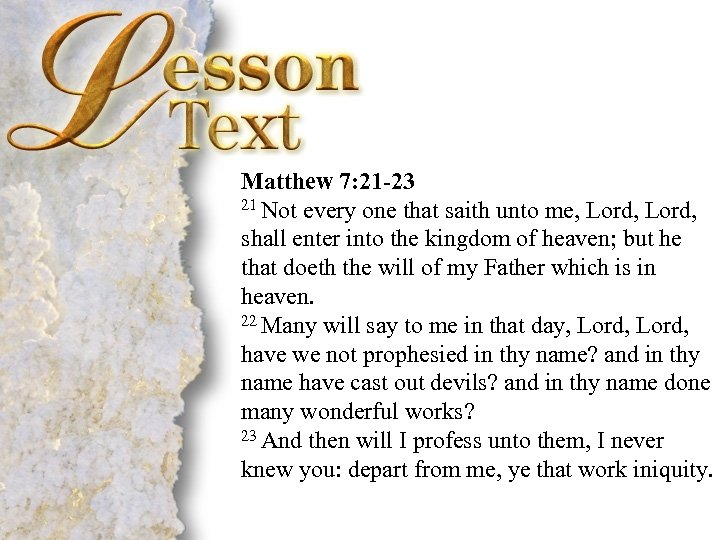 Matthew 7: 21 -23 21 Not every one that saith unto me, Lord, shall enter into the kingdom of heaven; but he that doeth the will of my Father which is in heaven. 22 Many will say to me in that day, Lord, have we not prophesied in thy name? and in thy name have cast out devils? and in thy name done many wonderful works? 23 And then will I profess unto them, I never knew you: depart from me, ye that work iniquity.
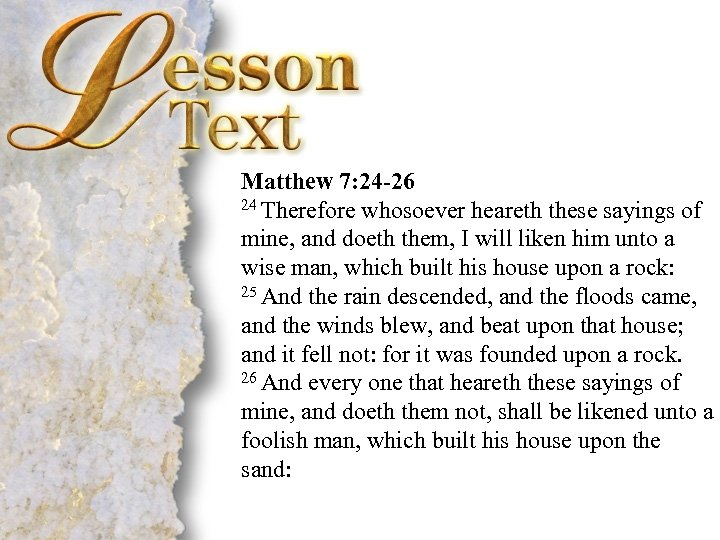 Matthew 7: 24 -26 24 Therefore whosoever heareth these sayings of mine, and doeth them, I will liken him unto a wise man, which built his house upon a rock: 25 And the rain descended, and the floods came, and the winds blew, and beat upon that house; and it fell not: for it was founded upon a rock. 26 And every one that heareth these sayings of mine, and doeth them not, shall be likened unto a foolish man, which built his house upon the sand:
 Matthew 7: 27 27 And the rain descended, and the floods came, and the winds blew, and beat upon that house; and it fell: and great was the fall of it.
 Luke 6: 46 And why call ye me, Lord, and do not the things which I say?
 John 13: 13 Ye call me Master and Lord: and ye say well; for so I am.
 Focus Verse John 20: 28 And Thomas answered and said unto him, My Lord and my God.
 Focus Thought Full submission to Christ recognizes Him as both Lord and God.
 Introduction In the Gospel of Luke, before relating the parable about the men who built houses on the rock and the sand, Jesus asked an important question: “And why call ye me, Lord, and do not the things which I say? ” (Luke 6: 46). Certainly, the lordship of Christ in a person’s life is the difference between his spiritual success and failure. Calling Him Lord but never following the instructions that He gives is quite a contradiction, to say the least. If He is indeed Lord of our lives, we will carefully attend to His every word.
 Introduction The term lord is used in the English language to identify one who is “owner, ruler, master; one who has power and authority over others. ” In the terms of this lesson, Lord refers directly to God, who is without question our owner, ruler, master, and the One who has all power. Jesus declared to His disciples, “All power is given unto me in heaven and in earth” (Matthew 28: 18).
 Introduction God spoke these words to the people of Israel: “Thou shalt have no other gods before me” (Exodus 20: 3). Although we have a choice, we should place the Lord first in our lives. Moreover, it is imperative that we allow the wisdom of God’s precious Word to guide our decision-making processes.
 Lord of Lords I. Lord of Lords “Which in his times he shall shew, who is the blessed and only Potentate, the King of kings, and Lord of lords” (I Timothy 6: 15).
 A. Who Is the Lord? I. Lord of Lords (A) In his sermon on the Day of Pentecost, Peter clearly stated who the Lord was: “Therefore let all the house of Israel know assuredly, that God hath made that same Jesus, whom ye have crucified, both Lord and Christ” (Acts 2: 36). There is only one Lord, and He is certainly Lord of all lords!
 I. Lord of Lords (A) Even the Israelites of Moses’ day knew that the Lord was God: “Know therefore this day, and consider it in thine heart, that the LORD he is God in heaven above, and upon the earth beneath: there is none else” (Deuteronomy 4: 39).
 The Scripture also reveals the Lord as being strong and mighty in battle and as the King of glory: “Lift up your heads, O ye gates; and be ye lift up, ye everlasting doors; and the King of glory shall come in. Who is this King of glory? The LORD strong and mighty, the LORD mighty in battle. Lift up your heads, O ye gates; even lift them up, ye everlasting doors; and the King of glory shall come in. Who is this King of glory? The LORD of hosts, he is the King of glory” (Psalm 24: 7 -10). I. Lord of Lords (A)
 I. Lord of Lords (A) Pilate ordered an inscription for the soldiers to place upon the cross where Jesus was crucified, and it revealed Jesus’ identity to the world. “And set up over his head his accusation written, THIS IS JESUS THE KING OF THE JEWS” (Matthew 27: 37).
 I. Lord of Lords (A) As Jesus hung on the cross, the chief priest, scribes, and elders mocked Him and declared, “He saved others; himself he cannot save. If he be the King of Israel, let him now come down from the cross, and we will believe him” (Matthew 27: 42).
 I. Lord of Lords (A) However, Jesus knew His identity and His mission, and He refused to allow the taunting words of the unbelievers to stop the overall plan of God in providing for us such a great salvation. Surely, He was the Lord of lords and the King of kings (Revelation 17: 14). John also recorded a vivid description of our Savior’s lordship: “And he hath on his vesture and on his thigh a name written, KING OF KINGS, AND LORD OF LORDS” (Revelation 19: 16).
 I. Lord of Lords (A) We should consider ourselves privileged to know the Lord of lords and the King of kings. We have entered the realm of a very elite group—those who have received the marvelous revelation of the mighty God in Christ.
 I. Lord of Lords (A) One day soon, Jesus Christ will return for His bride. In that day, every knee shall bow to Him, and every tongue will confess His lordship! “That at the name of Jesus every knee should bow, of things in heaven, and things in earth, and things under the earth; and that every tongue should confess that Jesus Christ is Lord, to the glory of God the Father” (Philippians 2: 10 -11).
 B. One Lord I. Lord of Lords (B) “Let this mind be in you, which was also in Christ Jesus: who, being in the form of God, thought it not robbery to be equal with God: but made himself of no reputation, and took upon him the form of a servant, and was made in the likeness of men: and being found in fashion as a man, he humbled himself, and became obedient unto death, even the death of the cross” (Philippians 2: 5 -8).
 Philippians 2: 9 -11 “Wherefore God also hath highly exalted him, and given him a name which is above every name: that at the name of Jesus every knee should bow, of things in heaven, and things in earth, and things under the earth; and that every tongue should confess that Jesus Christ is Lord, to the glory of God the Father” (Philippians 2: 9 -11).
 Although many people assert that there is more than one person in the Godhead, the Word of God clearly reveals that one day every tongue will confess that Jesus Christ is truly Lord. In fact, Paul clearly declared in his writings to the Ephesian church that there is only one Lord: “One Lord, one faith, one baptism, one God and Father of all, who is above all, and through all, and in you all” (Ephesians 4: 5 -6). I. Lord of Lords (B)
 The Old Testament also firmly established the doctrine of one Lord, and the law of Moses obligated parents to teach their children this beautiful truth: “Hear, O Israel: The LORD our God is one LORD: and thou shalt love the LORD thy God with all thine heart, and with all thy soul, and with all thy might” (Deuteronomy 6: 4 -5). Moses declared that it was their responsibility to ensure that their children understood the precept of worshiping and serving the one true God. I. Lord of Lords (B)
 I. Lord of Lords (B) One of the difficulties facing this present-day generation is the delinquency of parents in teaching their children biblical truths. Parents cannot afford to allow this responsibility to fall entirely upon the shoulders of teachers within the church, for it always has been primarily the responsibility of parents.
 As long as Israel worshiped the one true Lord, they received the blessings and protection of Jehovah God who helped them defeat their enemies. However, when they turned to other gods and worshiped idols and built groves, they began the downward steps of backsliding and lost the blessings and protection of the Lord. Often when they were in a crisis, they turned back to their only source of hope—the one true living God. What confidence, joy, and strength one can draw from the biblical truth of one Lord! I. Lord of Lords (B)
 Obedience II. Obedience (A) A. Tragedy of Empty Profession
 “Not every one that saith unto me, Lord, Matthew 7: 21 -23 Lord, shall enter into the kingdom of heaven; but he that doeth the will of my Father which is in heaven. Many will say to me in that day, Lord, have we not prophesied in thy name? and in thy name have cast out devils? and in thy name done many wonderful works? And then will I profess unto them, I never knew you: depart from me, ye that work iniquity” (Matthew 7: 21 -23).
 II. Obedience (A) What a tragedy to have handled the Word of the Lord, to have witnessed the miraculous in action, and then to miss out on the opportunity to spend eternity with Him. This is entirely possible. Jesus warned that our prophesying, casting out devils, and performing many wonderful works do not guarantee that our spiritual house is in order.
 Professional Christianity, entertaining preaching, and elaborate programs seem to dominate many so-called Christian churches today in their efforts to attract the masses. However, if they miss the most important ingredient, a genuine relationship with the Lord Jesus Christ through the new birth, they will hear the Master say, “I never knew you” (Matthew 7: 23). We should be sure that we are aligned perfectly with every aspect of the Word of God. It does not matter on this earth whether we receive recognition and glory; what matters is that He receives all the glory and honor due His name! II. Obedience (A)
 II. Obedience (A) As this dispensation of grace rapidly closes, we should concentrate on making our calling and election sure. This is not the hour for a person to live on the fringe, living just as close to the world as possible. This is the time to live as fervently for Christ as possible and to let absolutely nothing hinder us from serving Him faithfully. (See Deuteronomy 26: 16; 30: 2; Joshua 24: 15. )
 Proverbs 3: 5 “Trust in the LORD with all thine heart; and lean not unto thine own understanding” (Proverbs 3: 5).
 B. Spirit of Deception II. Obedience (B) 1. The Warning against Deception. “And Jesus answered and said unto them, Take heed that no man deceive you. For many shall come in my name, saying, I am Christ; and shall deceive many” (Matthew 24: 4 -5). Deception means “to mislead by giving a distorted impression or false sense of reality; to trick; to cheat; to beguile. ” The ancient Greeks used the word to describe the pleasure that comes from watching theater. Deception occurs when one is pacified by unreality, thus resulting in confusion from a person’s trusting false promises or believing a lie.
 People often have ordered something from a catalog thinking that it looked like just what they wanted, only to receive the package, open it, and discover that the item was not as it had appeared in the picture. Deception is a scary thing because it undermines truth in such a subtle way. If we are not rooted and grounded in the Word of God, the enemy will sneak in and destroy our love for the truth. However, the believer who has an assurance of the Lord’s identity is not easily deceived in doctrine. He knows the Lord Jesus with such confidence that he refuses to allow anything to sidetrack him. II. Obedience (B)
 “Now we beseech you, brethren, by the coming of our Lord Jesus Christ, and by II Thessalonians 2: 1 -3 our gathering together unto him, that ye be not soon shaken in mind, or be troubled, neither by spirit, nor by word, nor by letter as from us, as that the day of Christ is at hand. Let no man deceive you by any means: for that day shall not come, except there come a falling away first, and that man of sin be revealed, the son of perdition” (II Thessalonians 2: 1 -3).
 II. Obedience (B) Many people today are attempting to distort the truth of God’s Word by ignoring or perverting important doctrines. Satan deceived Eve in the Garden of Eden by simply questioning God’s instructions. Bringing into question the Word of the Lord always results in a skewed understanding. Once a person has been deceived, it is then easier for him to turn against the authority of the lordship of Jesus Christ.
 II. Obedience (B) The Word of God clearly states, “For God is not the author of confusion, but of peace, as in all churches of the saints” (I Corinthians 14: 33). Jesus stated to His disciples, “And ye shall know the truth, and the truth shall make you free” (John 8: 32). The apostle James declared, “Brethren, if any of you do err from the truth, and one convert him; let him know, that he which converteth the sinner from the error of his way shall save a soul from death, and shall hide a multitude of sins” (James 5: 19 -20).
 2. False Prophets. II. Obedience (B) “For there shall arise false Christs, and false prophets, and shall shew great signs and wonders; insomuch that, if it were possible, they shall deceive the very elect” (Matthew 24: 24).
 Jesus declared to His disciples that many false prophets would appear and would deceive numerous people (Matthew 24: 11). During the lifetime of the apostles, false prophets appeared: “For there are certain men crept in unawares, who were before of old ordained to this condemnation, ungodly men, turning the grace of our God into lasciviousness, and denying the only Lord God, and our Lord Jesus Christ” (Jude 4). False prophets creep in, sneak in, and enter through the side door almost unnoticed. They arrive with a purpose, coming to undermine and sow a spirit of discord and error in the minds of people. II. Obedience (B)
 The word prophet comes from a Greek word meaning “to speak for, to proclaim, to foretell. ” A prophet comes from God bringing a message that reveals information regarding current or future situations. In the Book of Deuteronomy, the Lord spoke harshly about a false prophet: “But the prophet, which shall presume to speak a word in my name, which I have not commanded him to speak, or that shall speak in the name of other gods, even that prophet shall die” (Deuteronomy 18: 20). II. Obedience (B)
 The Old Testament instructs us concerning how to identify a false prophet. (See Deuteronomy 18: 22. ) In his first epistle to the church, John advised us to “believe not every spirit, but try the spirits whether they are of God: because many false prophets are gone out into the world” (I John 4: 1). II. Obedience (B)
 3. Antichrist. Counterfeiting the work of God has always been the work of Satan. He has excelled in his deceptive manner, and the Antichrist is his masterpiece. Notice the contrasts between Jesus Christ and the Antichrist: 1. Christ came from above. The Antichrist will ascend from the pit. 2. Christ came in His Father’s name. The Antichrist will come in his own name. 3. Christ humbled Himself. The Antichrist will exalt himself. 4. Christ was despised. The Antichrist will be admired. II. Obedience (B)
 5. Christ will be exalted. The Antichrist will be cast down to hell. 6. Christ came to do His Father’s will. The Antichrist will do his own will. 7. Christ came to save. The Antichrist will come to destroy. 8. Christ is the “truth. ” The Antichrist is the “lie. ” 9. Christ is the “Holy One. ” The Antichrist is the “lawless one. ” 10. Christ is the “man of sorrows. ” The Antichrist is the “man of sin. ” 11. Christ is the “Son of God. ” The Antichrist is the “son of perdition. ” II. Obedience (B)
 There are seven major activities of the Antichrist: 1. The Antichrist’s Rise to Power (Revelation 6: 2). The Antichrist will come into power not by war, but by tricking the world into believing that he can offer peace (Daniel 8: 25). 2. The Antichrist’s One-World Government (Revelation 17: 12 -15). 3. The Antichrist’s Dominance of the World Economy (Revelation 17: 13). When the kings give their power to the beast, this means both their military and economic power. II. Obedience (B)
 4. The Antichrist’s Atheistic Religion (II Thessalonians 2: 1 -12). At first, theme of t he Antichrist’s religion will be “do whatever you want, ” but it will change to “worship the Antichrist or else. ” 5. The Antichrist’s Covenant with Israel (Daniel 9: 27). The Antichrist will make a covenant with Israel for seven years, but he will break it after three and one-half years. 6. The Antichrist’s or World System’s Death and Revival (Revelation 17: 8). II. Obedience (B)
 Students of prophecy are divided on their opinion regarding Revelation 17, as well as most other points concerning prophecy. Some believe that the Antichrist will die in the middle of the Tribulation —the Beast of Revelation 17: 8. Others see this as only the death wound of the world system at that time. In either view, however, the system, if not the Antichrist himself, will be revived, which will lead to the final culmination of all end-time events. II. Obedience (B)
 7. The Antichrist’s Ultimate Destruction (Revelation 19: 19 -21). The Antichrist and false prophet are cast into the lake of fire. Although the Antichrist will deceive millions of people who will end up in the lake of fire with him, he will one day be destroyed. Mankind cannot afford to be deceived, for his eternal destiny depends on knowing the truth of the lordship of Jesus Christ. II. Obedience (B)
 C. Wisdom of Following Instructions II. Obedience (C) “Therefore whosoever heareth these sayings of mine, and doeth them, I will liken him unto a wise man, which built his house upon a rock: and the rain descended, and the floods came, and the winds blew, and beat upon that house; and it fell not: for it was founded upon a rock” (Matthew 7: 24 -25).
 Matthew 7: 26 -27 “And every one that heareth these sayings of mine, and doeth them not, shall be likened unto a foolish man, which built his house upon the sand: and the rain descended, and the floods came, and the winds blew, and beat upon that house; and it fell: and great was the fall of it” (Matthew 7: 26 -27).
 We learn an important lesson from this parable that Jesus told. We should take His words to heart and dig deep our spiritual foundations, all the way to the Rock of ages. The “I’ll do it my way” attitude is all right when putting together toys or furniture because we can always tear them apart and start over. However, when it comes to the real issues of life, the consequences can be devastating. II. Obedience (C)
 Try to imagine the following story. Possibly it is something that you have experienced. It is eleven o’clock on the eve of your child’s birthday. All family members, except you, are in bed. It is now time to put together that special toy you bought to delight your child. You open the box and pull out the envelope that says, “Instructions Inside. ” You toss it aside and begin to pull out all the parts. II. Obedience (C)
 Everything looks simple enough. You roll up your sleeves and go for it on your own. Two hours later, just out of curiosity, you reach for the instruction booklet. You are horrified to find that the diagram looks nothing like what you have just assembled. You then take it all apart and start over—from scratch—this time with the instructions. II. Obedience (C)
 The men whom Jesus described as building their houses either succeeded or failed depending on the location of their building. Jesus instructed us to build upon the rock, which becomes a simple process when we carefully follow His instructions. We should listen intently to what Jesus said, and then do what He instructed us to do. Jesus Christ is the rock upon which God built His church, and He also is the solid foundation upon which we should build our lives. II. Obedience (C)
 A life built on the shifting sands of time will not stand when the floodwaters and storms of life arrive. However, a life built upon the solid rock, Jesus Christ, will stand after the storm is gone. We cannot go wrong when we follow His instructions. II. Obedience (C)
 “But be ye doers of the word, and not James 1: 22 -25 hearers only, deceiving your own selves. For if any be a hearer of the word, and not a doer, he is like unto a man beholding his natural face in a glass: for he beholdeth himself, and goeth his way, and straightway forgetteth what manner of man he was. But whoso looketh into the perfect law of liberty, and continueth therein, he being not a forgetful hearer, but a doer of the work, this man shall be blessed in his deed” (James 1: 22 -25).
 Worship III. Worship It is important that we keep the focus of the church —to glorify, or to worship, God. Dr. W. M. Temple, a British preacher, defined worship: “For to worship is to quicken the conscience by the holiness of God; to free the mind with the truth of God; to purge the imagination by the beauty of God; to open the heart to the love of God; to devote the will to the purpose of God. ”
 III. Worship Mankind was born with an innate desire to worship, and he will worship something. It is imperative that he offer his worship only to Jesus Christ, God manifest in flesh. In the Book of Revelation, John described a scene of perpetual worship around the throne where the worshipers repeated, “Holy, holy, Lord God Almighty, which was, and is to come” (Revelation 4: 8).
 III. Worship The Scriptures confirm that the Lord is worthy to receive glory, honor, and power. What a privilege to worship Him, knowing that He has the prominent place of lordship in our lives! That is why we do everything in His name, including both public and private worship.
 While there may be many physical aspects to our worship, we do not demonstrate true worship by our physical strength alone. True worship is dependent upon our heart strength. When our hearts are right, God will receive our worship without hindrance. As a worshiper, David refused to allow the circumstances of life to deter his desire to worship. It always is easy to worship when everything is running smoothly, but real worship comes in the midst of life’s battles. It is then that we demonstrate that our God is greater than any of our problems. III. Worship
 Reflections The phrase “lordship of Christ” is more than a cliché or a fancy term. It is rather a powerful statement that defines our relationship to Jesus Christ as our Lord and Master. When He is in supreme control and is directing our steps, Psalm 37: 23 is being fulfilled: “The steps of a good man are ordered by the LORD: and he delighteth in his way. ”
 Reflections It is imperative that we allow the Lord to provide instruction for the journey of life through His servants and His holy Word. When we discover His instructions, we should not set them aside and lean unto our own understanding. We should follow them closely, for our eternal destiny depends on it. The beautiful part is that we have the choice to allow His will to protect us and guide us from this life to the life that He has prepared for us in eternity.