 Скачать презентацию Title I-A Coordinators Conversation December 15 2015
6907fd30dc606f7e3082b2480f5b8790.ppt
- Количество слайдов: 27



Title I-A Coordinators Conversation December 15, 2015
Agenda Introductions & ODE Updates ESEA Reauthorization Highlights Every Student Succeeds Act Timelines Topics from Coordinators
Introductions (Who’s online & in the room? )
Updates & Changes at ODE Saying Goodbye to Paula Radich, Assistant Superintendent & Please Welcome Lisa Plumb, Education Specialist (Joined the Title IA team in August) Dawne Huckaby, Assistant Superintendent (from Roseburg Public Schools)

The purpose of today’s presentation is to provide highlights of the new law. Details will be forthcoming in the months ahead.
Signed into law December 10, 2015 on introducing EVERY STUDENT SUCCEEDS ACT (ESSA)
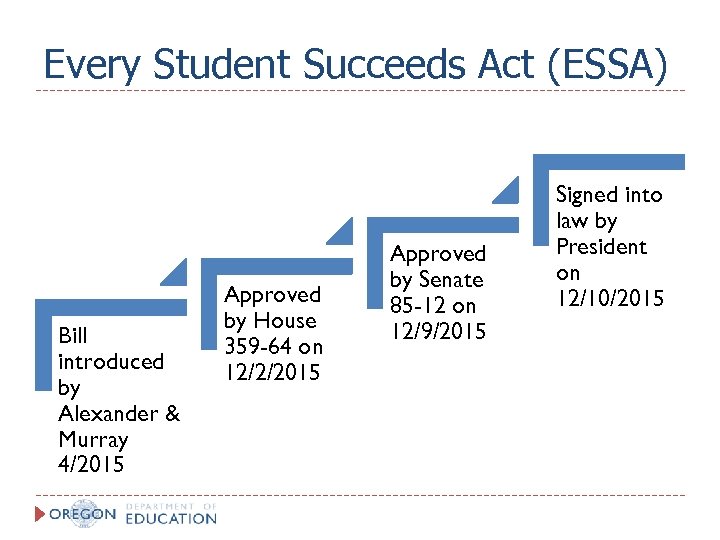
Every Student Succeeds Act (ESSA) Bill introduced by Alexander & Murray 4/2015 Approved by House 359 -64 on 12/2/2015 Approved by Senate 85 -12 on 12/9/2015 Signed into law by President on 12/10/2015
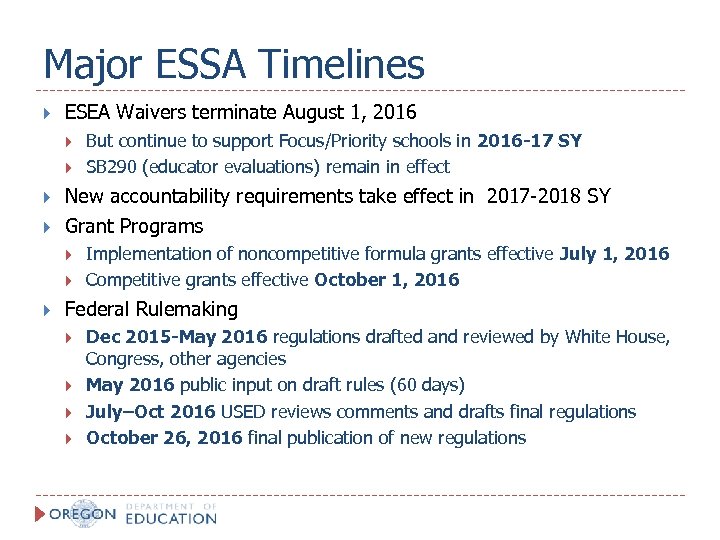
Major ESSA Timelines ESEA Waivers terminate August 1, 2016 New accountability requirements take effect in 2017 -2018 SY Grant Programs But continue to support Focus/Priority schools in 2016 -17 SY SB 290 (educator evaluations) remain in effect Implementation of noncompetitive formula grants effective July 1, 2016 Competitive grants effective October 1, 2016 Federal Rulemaking Dec 2015 -May 2016 regulations drafted and reviewed by White House, Congress, other agencies May 2016 public input on draft rules (60 days) July–Oct 2016 USED reviews comments and drafts final regulations October 26, 2016 final publication of new regulations
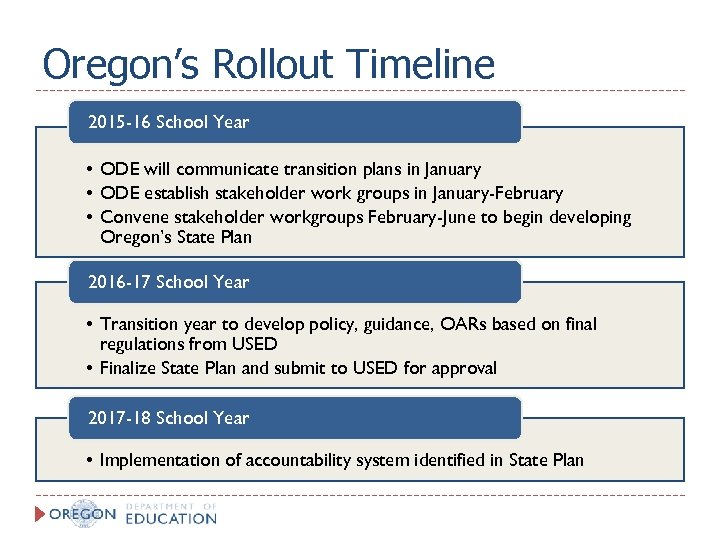
Oregon’s Rollout Timeline 2015 -16 School Year • ODE will communicate transition plans in January • ODE establish stakeholder work groups in January-February • Convene stakeholder workgroups February-June to begin developing Oregon’s State Plan 2016 -17 School Year • Transition year to develop policy, guidance, OARs based on final regulations from USED • Finalize State Plan and submit to USED for approval 2017 -18 School Year • Implementation of accountability system identified in State Plan
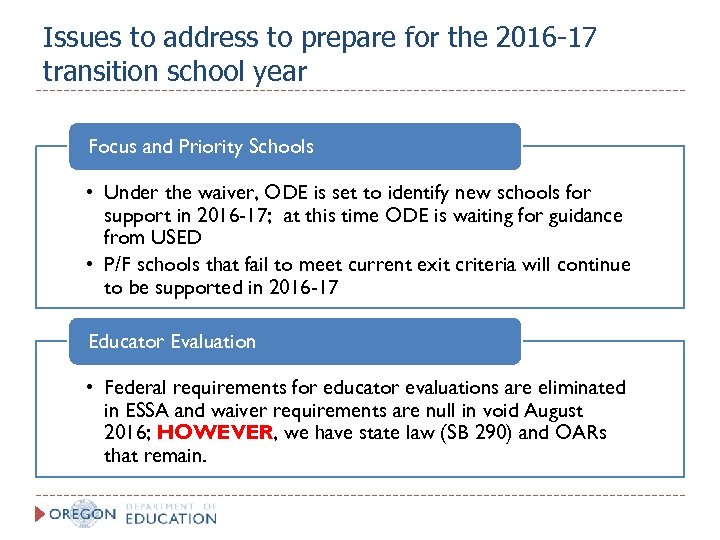
Issues to address to prepare for the 2016 -17 transition school year Focus and Priority Schools • Under the waiver, ODE is set to identify new schools for support in 2016 -17; at this time ODE is waiting for guidance from USED • P/F schools that fail to meet current exit criteria will continue to be supported in 2016 -17 Educator Evaluation • Federal requirements for educator evaluations are eliminated in ESSA and waiver requirements are null in void August 2016; HOWEVER, we have state law (SB 290) and OARs that remain.
This information will continue to be updated by ODE as new details becomes available.
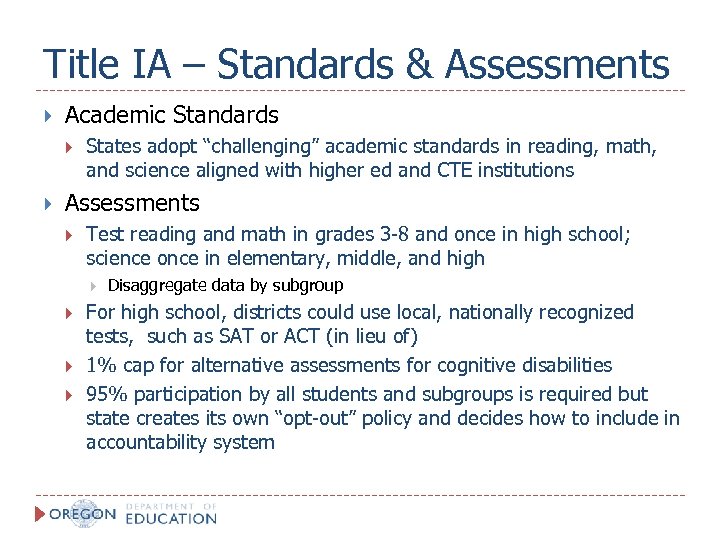
Title IA – Standards & Assessments Academic Standards States adopt “challenging” academic standards in reading, math, and science aligned with higher ed and CTE institutions Assessments Test reading and math in grades 3 -8 and once in high school; science once in elementary, middle, and high Disaggregate data by subgroup For high school, districts could use local, nationally recognized tests, such as SAT or ACT (in lieu of) 1% cap for alternative assessments for cognitive disabilities 95% participation by all students and subgroups is required but state creates its own “opt-out” policy and decides how to include in accountability system
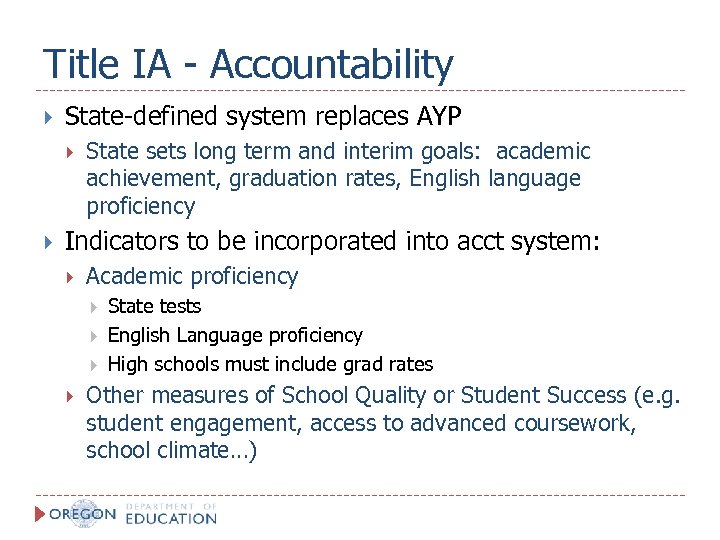
Title IA - Accountability State-defined system replaces AYP State sets long term and interim goals: academic achievement, graduation rates, English language proficiency Indicators to be incorporated into acct system: Academic proficiency State tests English Language proficiency High schools must include grad rates Other measures of School Quality or Student Success (e. g. student engagement, access to advanced coursework, school climate…)
Title I-A Accountability cont. Also requires 95% participation on state assessments to be factored into accountability, but how is up to states Weighting the Indicators States decide how much the individual indicator will count, though academic factors would have to count “much” more as a group than the “other” indicators (USED to define “much”)
Title I – School Improvement At least once every 3 years, states must identify and intervene in bottom 5% of lowest performing schools, and high schools where grad rate <67% District develops Comprehensive Support and Improvement plan approved and monitored by state State sets exit criteria and determines action if not met States must annually notify districts when one or more subgroups of students are consistently underperforming Schools implement Targeted Support and Improvement plans, approved and monitored by district
Title I – School Improvement cont. School Improvement Grants (SIG) eliminated Current 4% set-aside for school improvement increased to 7% 95% to local districts to fund “SIG-like” evidence-based activities to help districts meet the needs of students in poverty States may reserve up to 3% for Direct Student Services such as credit recovery, Advanced Placement (AP), tutoring, transportation for public school choice
State Report Cards Current structure of State and local report cards remain Reporting includes: Description of accountability system (goals, indicators, weights) Disaggregation on student achievement, all students and subgroups Assessments and graduation rates for foster and homeless students Professional qualifications of teachers; eliminates HQT reporting
Teacher Quality and Evaluation Ends “Highly Qualified Teachers” (HQT); However, districts must still report on experience, credentials, and teaching out-of-field; data disaggregated and by high/low poverty in Report Card Ends federal mandate on educator evaluations; However, state law (SB 290) and Oregon Administrative rule remains Build on existing system; stakeholder conversations
Title II State grant formula ensures states receive funding that is reflective of their student poverty population States may reserve up to 3% for subgrants to district to support principals and other school leaders Establishes national initiatives: Teacher and School Leader Incentives Literacy Education for All, Results for the Nation American History and Civics Education Programs of National Significance Supporting effective educator development Recruiting school leaders STEM master teacher corp.
Title IV Authorizes Student Support and Academic Enrichment Grants 95% allocation districts District does a needs assessment; fund in each category: Safe and Health Students Well-Rounded Educational Opportunities (e. g. AP & IB test fees, STEM, arts, computer science) Effective Use of Technology Continues 21 st Century Community Learning Centers as standalone program Authorizes Family Engagement Centers Authorizes reservations for National Activities Education innovation & research; community support for school success, school safety, academic enrichment
Other Provisions Reauthorizes Title III, English Language Learners grant program Magnet Schools program Indian Education Impact Aid Homeless Education of the Mc. Kinney-Vento Act Preschool Development Grants funded through the Department of Health and Human Services and jointly administered by the Secretary of Education. Reauthorization period FY 2017 thorough FY 2020
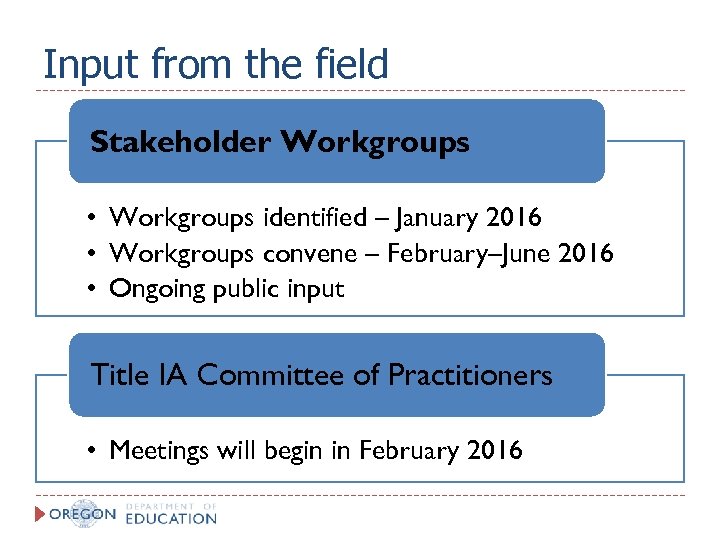
Input from the field Stakeholder Workgroups • Workgroups identified – January 2016 • Workgroups convene – February–June 2016 • Ongoing public input Title IA Committee of Practitioners • Meetings will begin in February 2016
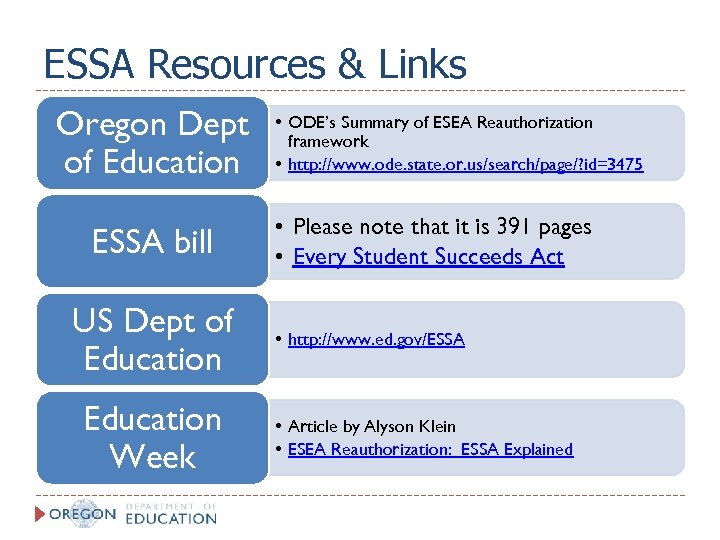
ESSA Resources & Links Oregon Dept of Education ESSA bill US Dept of Education Week • ODE’s Summary of ESEA Reauthorization framework • http: //www. ode. state. or. us/search/page/? id=3475 • Please note that it is 391 pages • Every Student Succeeds Act • http: //www. ed. gov/ESSA • Article by Alyson Klein • ESEA Reauthorization: ESSA Explained
Please send ESSA questions to the ODE Federal System Team Power. Point & Webinar will be posted at http: //www. ode. state. or. us/search/page/? i d=1939
Send Questions Theresa Richards (theresa. richards@state. or. us) Russ Sweet (russ. sweet@state. or. us) Melinda Bessner (melinda. bessner@state. or. us) Lisa Plumb (lisa. plumb@state. or. us)
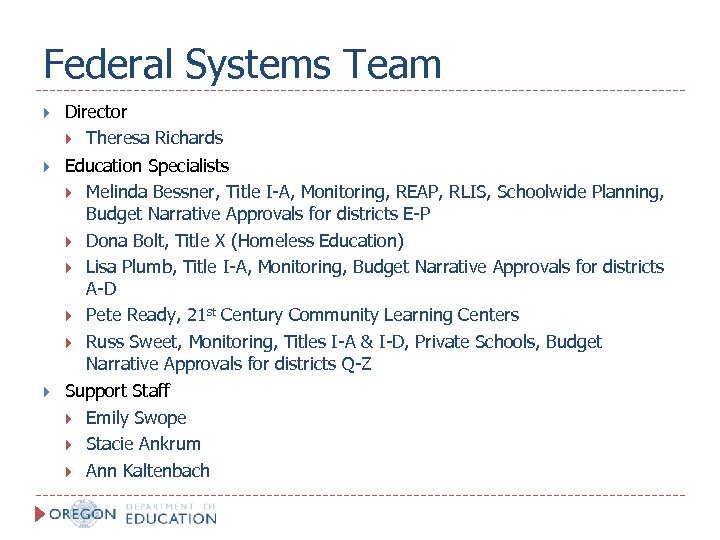
Federal Systems Team Director Theresa Richards Education Specialists Melinda Bessner, Title I-A, Monitoring, REAP, RLIS, Schoolwide Planning, Budget Narrative Approvals for districts E-P Dona Bolt, Title X (Homeless Education) Lisa Plumb, Title I-A, Monitoring, Budget Narrative Approvals for districts A-D Pete Ready, 21 st Century Community Learning Centers Russ Sweet, Monitoring, Titles I-A & I-D, Private Schools, Budget Narrative Approvals for districts Q-Z Support Staff Emily Swope Stacie Ankrum Ann Kaltenbach
Outside of ESSA Topics from Coordinators?
Скачать презентацию Title I-A Coordinators Conversation December 15 2015
6907fd30dc606f7e3082b2480f5b8790.ppt