 Скачать презентацию Title Arial 28 Stakeholder Engagement Workshop Subtitle Arial
1ae300526d4995c6ce913f3a6db57c42.ppt
- Количество слайдов: 36



Title Arial 28 Stakeholder Engagement Workshop Subtitle Arial Narrow 18 Care Arrangement Services November 2016 DRAFT Ben Whitehouse General Manager Strategy and Reform Rochelle Binks Assistant Director Strategy and Reform Amanda Mc. Curry Senior Contract and Grants Manager
Welcome • Acknowledgement of Country • Introduction 2
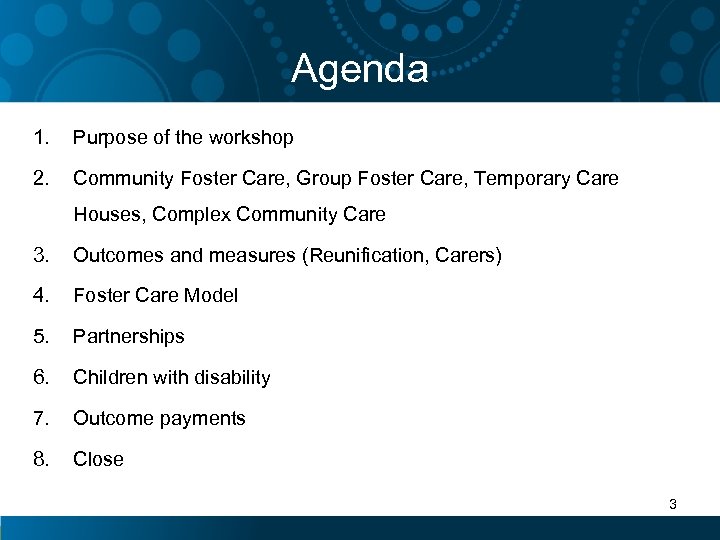
Agenda 1. Purpose of the workshop 2. Community Foster Care, Group Foster Care, Temporary Care Houses, Complex Community Care 3. Outcomes and measures (Reunification, Carers) 4. Foster Care Model 5. Partnerships 6. Children with disability 7. Outcome payments 8. Close 3
Purpose of workshop Purpose of Today: • Inform key stakeholders on draft preferences for market design, service system models and indicative costings for care arrangement services. • Engage with key stakeholders to further develop and refine service specifications, outcomes and measures for care arrangement services. • Consult on contract provisions and potential for outcome payments to be built into contracts 4
Why out-of-home care reform? Objectives of the out-of-home care reform • Better life outcomes for all children in out-ofhome care. • Early certainty and permanency for children in out-of-home care. • A more financially sustainable system. 5
Procurement - context setting • All out-of-home care funding has been aligned to be recontracted on or around January 2018. • Opportunity to consider the out-of-home care system as a whole. • Open tender process. • Needs Assessment Tool – December 2016 – February 2017. 6
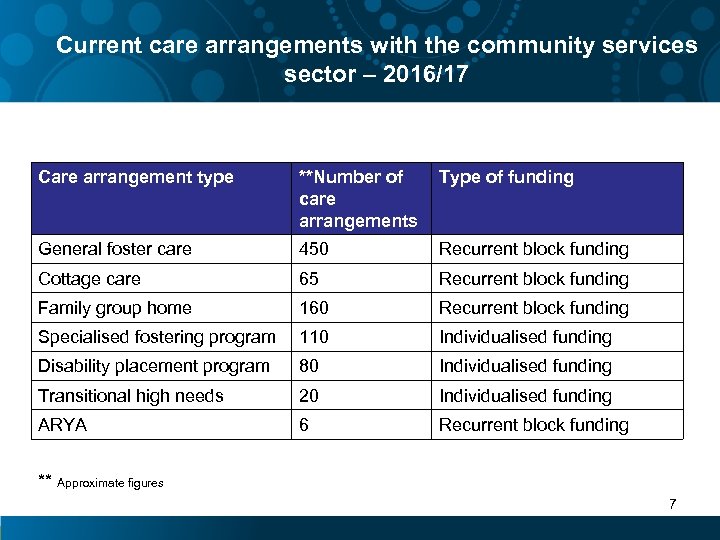
Current care arrangements with the community services sector – 2016/17 Care arrangement type **Number of care arrangements Type of funding General foster care 450 Recurrent block funding Cottage care 65 Recurrent block funding Family group home 160 Recurrent block funding Specialised fostering program 110 Individualised funding Disability placement program 80 Individualised funding Transitional high needs 20 Individualised funding ARYA 6 Recurrent block funding ** Approximate figures 7
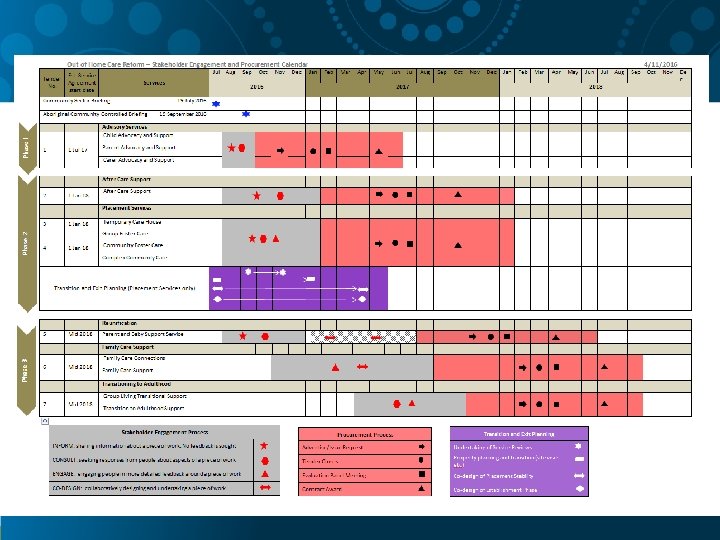
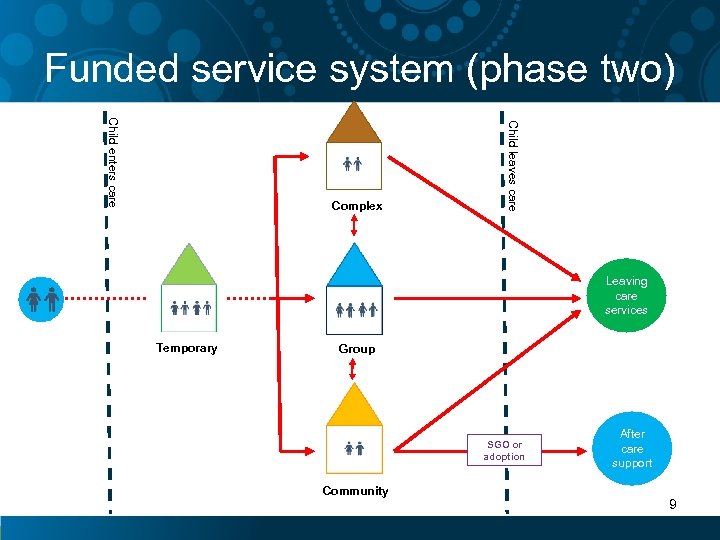
Funded service system (phase two) Child leaves care Child enters care Complex Leaving care services Temporary Group SGO or adoption Community After care support 9
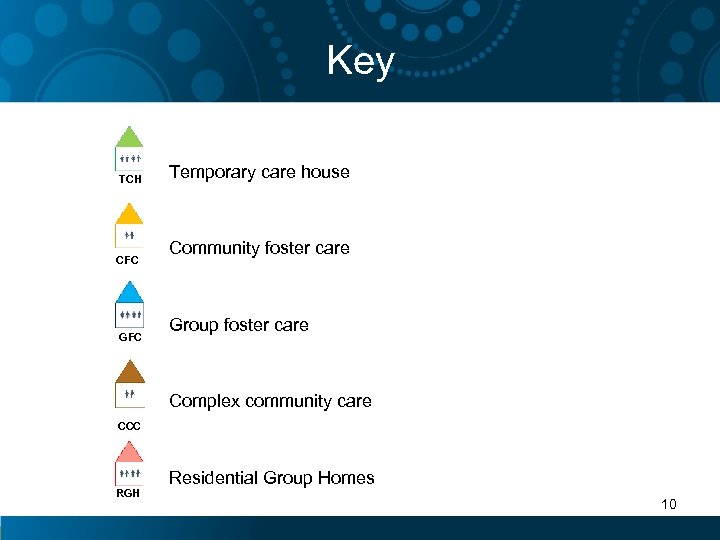
Key TCH CFC GFC Temporary care house Community foster care Group foster care Complex community care CCC RGH Residential Group Homes 10
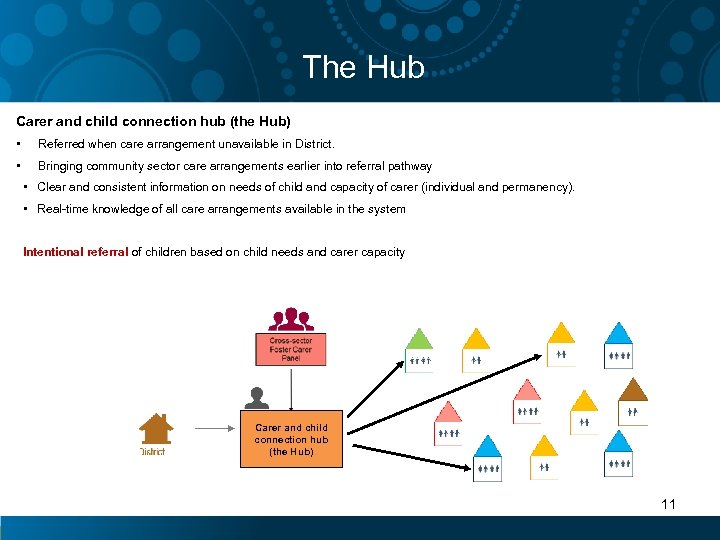
The Hub Carer and child connection hub (the Hub) • Referred when care arrangement unavailable in District. • Bringing community sector care arrangements earlier into referral pathway • Clear and consistent information on needs of child and capacity of carer (individual and permanency). • Real-time knowledge of all care arrangements available in the system Intentional referral of children based on child needs and carer capacity Carer and child connection hub (the Hub) 11
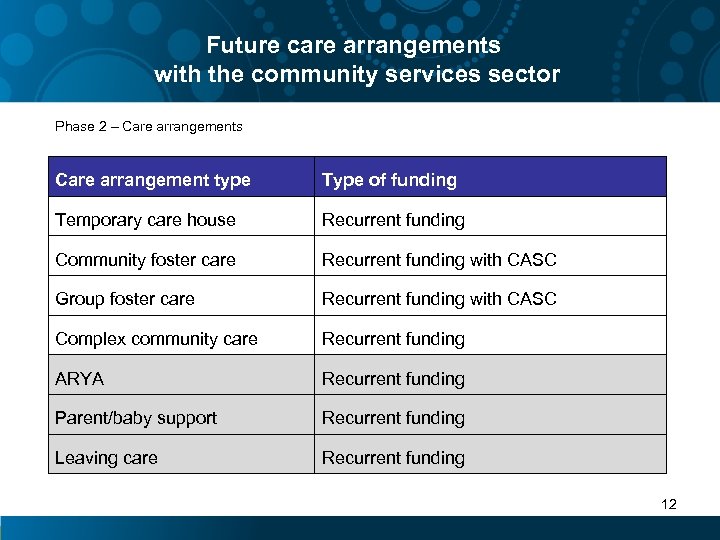
Future care arrangements with the community services sector Phase 2 – Care arrangements Care arrangement type Type of funding Temporary care house Recurrent funding Community foster care Recurrent funding with CASC Group foster care Recurrent funding with CASC Complex community care Recurrent funding ARYA Recurrent funding Parent/baby support Recurrent funding Leaving care Recurrent funding 12
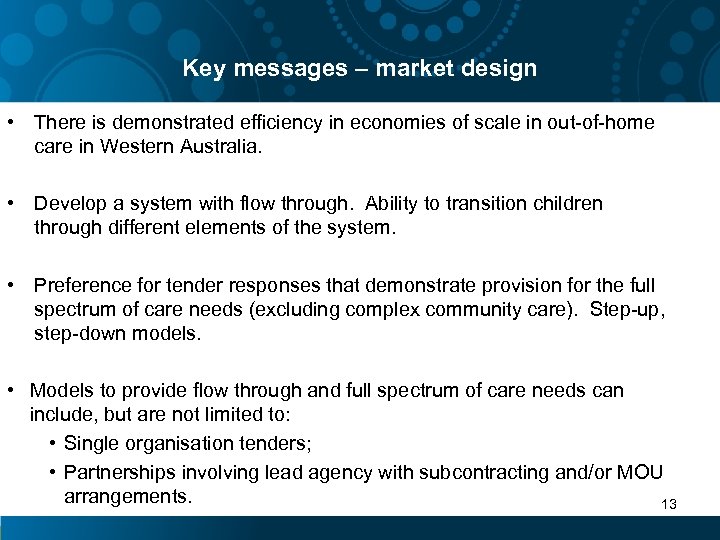
Key messages – market design • There is demonstrated efficiency in economies of scale in out-of-home care in Western Australia. • Develop a system with flow through. Ability to transition children through different elements of the system. • Preference for tender responses that demonstrate provision for the full spectrum of care needs (excluding complex community care). Step-up, step-down models. • Models to provide flow through and full spectrum of care needs can include, but are not limited to: • Single organisation tenders; • Partnerships involving lead agency with subcontracting and/or MOU arrangements. 13
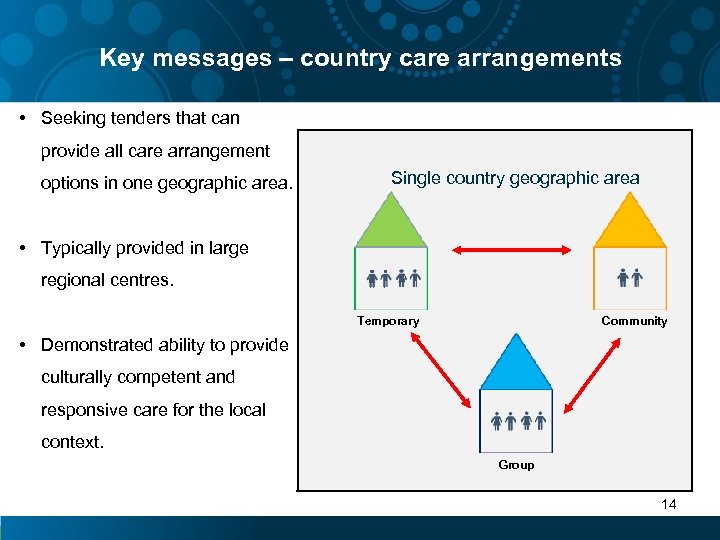
Key messages – country care arrangements • Seeking tenders that can provide all care arrangement options in one geographic area. Single country geographic area • Typically provided in large regional centres. Community Temporary • Demonstrated ability to provide culturally competent and responsive care for the local context. Group 14
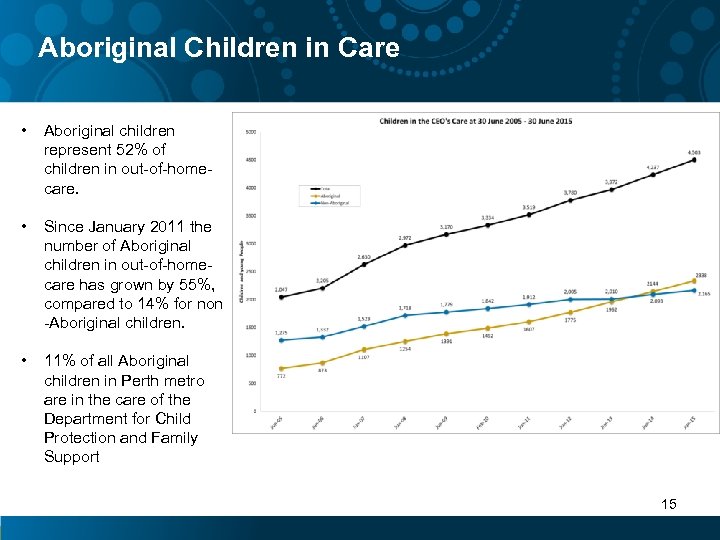
Aboriginal Children in Care • Aboriginal children represent 52% of children in out-of-homecare. • Since January 2011 the number of Aboriginal children in out-of-homecare has grown by 55%, compared to 14% for non -Aboriginal children. • 11% of all Aboriginal children in Perth metro are in the care of the Department for Child Protection and Family Support 15
Key messages Aboriginal children and families • Further developing a culturally competent and responsive system is a key priority. • Demonstrated ability to provide culturally competent and responsive care in the local context. • One method for demonstrating this is being, or working in partnership with an Aboriginal community controlled organisation (ACCO). Trauma-informed care • Responses must demonstrate the evidenced based trauma-informed therapeutic model of care they will use and how this complements the Department’s frameworks – Signs of Safety, Sanctuary Framework, Circle of Security etc 16
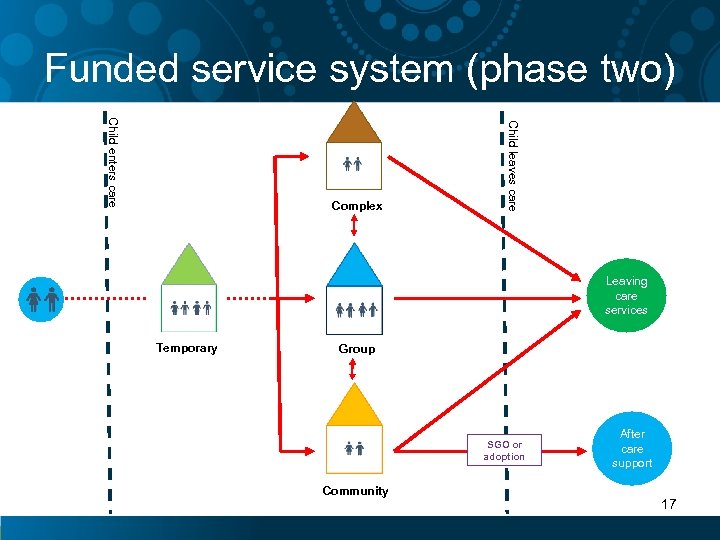
Funded service system (phase two) Child leaves care Child enters care Complex Leaving care services Temporary Group SGO or adoption Community After care support 17
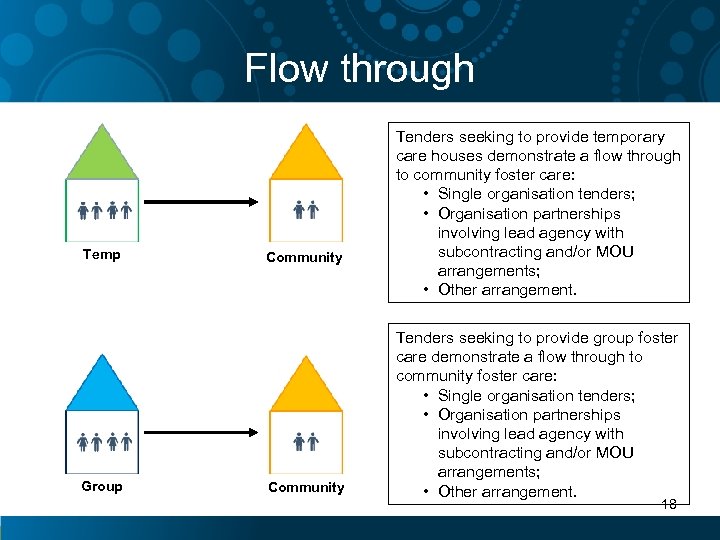
Flow through Temp Group Community Tenders seeking to provide temporary care houses demonstrate a flow through to community foster care: • Single organisation tenders; • Organisation partnerships involving lead agency with subcontracting and/or MOU arrangements; • Other arrangement. Tenders seeking to provide group foster care demonstrate a flow through to community foster care: • Single organisation tenders; • Organisation partnerships involving lead agency with subcontracting and/or MOU arrangements; • Other arrangement. 18
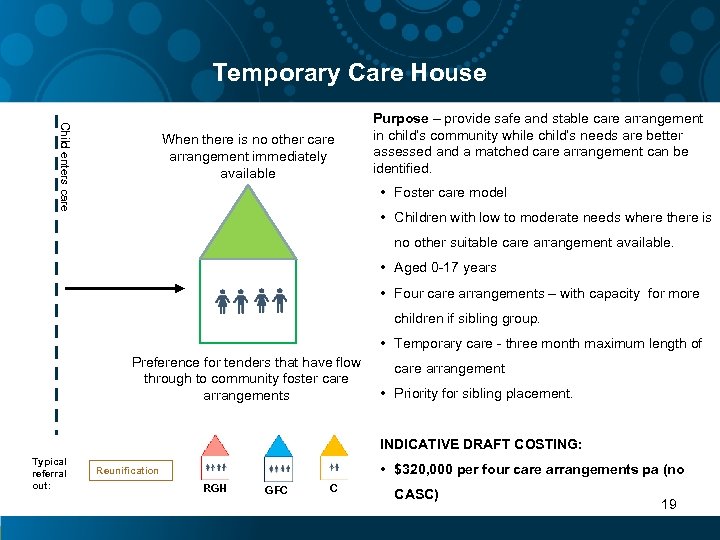
Temporary Care House Child enters care When there is no other care arrangement immediately available Purpose – provide safe and stable care arrangement in child’s community while child’s needs are better assessed and a matched care arrangement can be identified. • Foster care model • Children with low to moderate needs where there is no other suitable care arrangement available. • Aged 0 -17 years • Four care arrangements – with capacity for more children if sibling group. • Temporary care - three month maximum length of Preference for tenders that have flow through to community foster care arrangements care arrangement • Priority for sibling placement. INDICATIVE DRAFT COSTING: Typical referral out: • $320, 000 per four care arrangements pa (no Reunification RGH GFC C CASC) 19
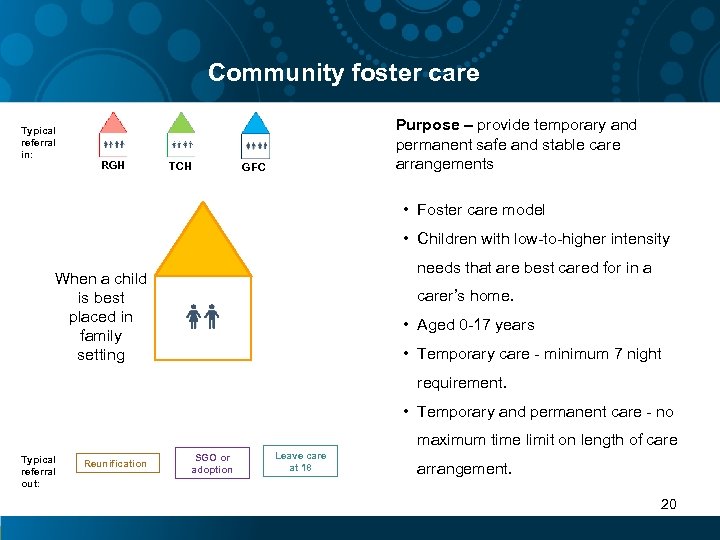
Community foster care Typical referral in: RGH TCH Purpose – provide temporary and permanent safe and stable care arrangements GFC • Foster care model • Children with low-to-higher intensity needs that are best cared for in a When a child is best placed in family setting carer’s home. • Aged 0 -17 years • Temporary care - minimum 7 night requirement. • Temporary and permanent care - no maximum time limit on length of care Typical referral out: Reunification SGO or adoption Leave care at 18 arrangement. 20
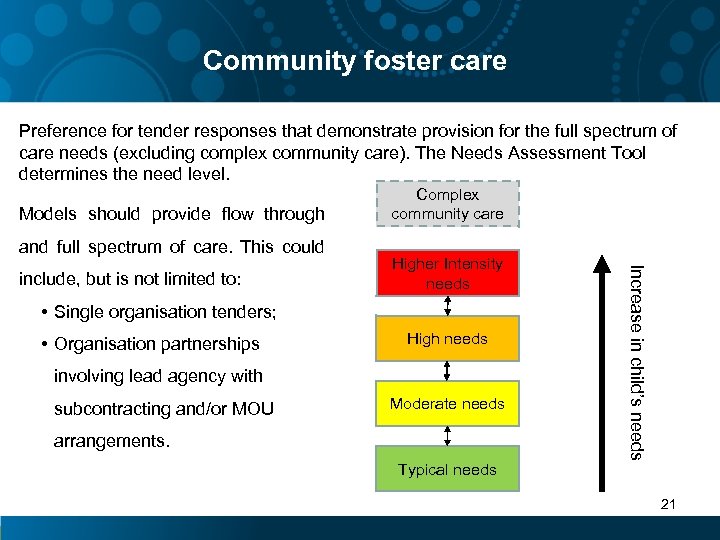
Community foster care Preference for tender responses that demonstrate provision for the full spectrum of care needs (excluding complex community care). The Needs Assessment Tool determines the need level. Models should provide flow through and full spectrum of care. This could Higher Intensity needs • Single organisation tenders; • Organisation partnerships High needs involving lead agency with subcontracting and/or MOU Moderate needs arrangements. Typical needs Increase in child’s needs include, but is not limited to: Complex community care 21
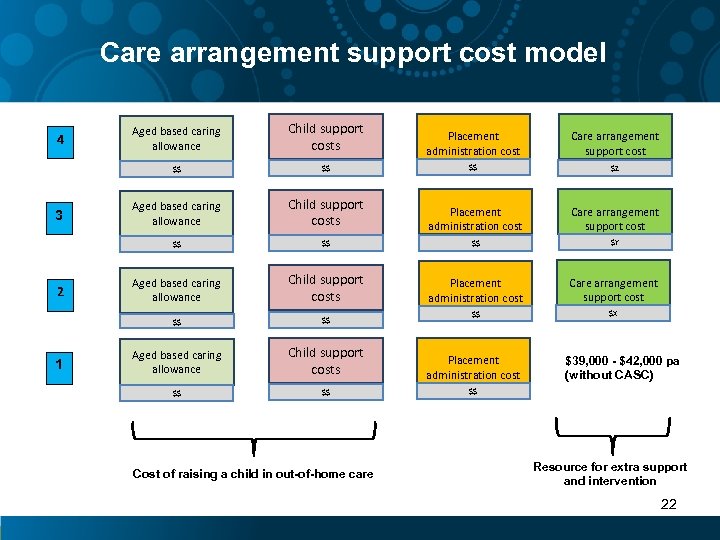
Care arrangement support cost model Aged based caring allowance Child support costs $$ $$ Aged based caring allowance Child support costs $$ 3 2 1 Placement administration cost Care arrangement support cost $$ $Z Placement administration cost Care arrangement support cost $$ $$ $Y Aged based caring allowance Child support costs Placement administration cost Care arrangement support cost $$ 4 $$ $$ $X Aged based caring allowance Child support costs $$ $$ Cost of raising a child in out-of-home care Placement administration cost $39, 000 - $42, 000 pa (without CASC) $$ Resource for extra support and intervention 22
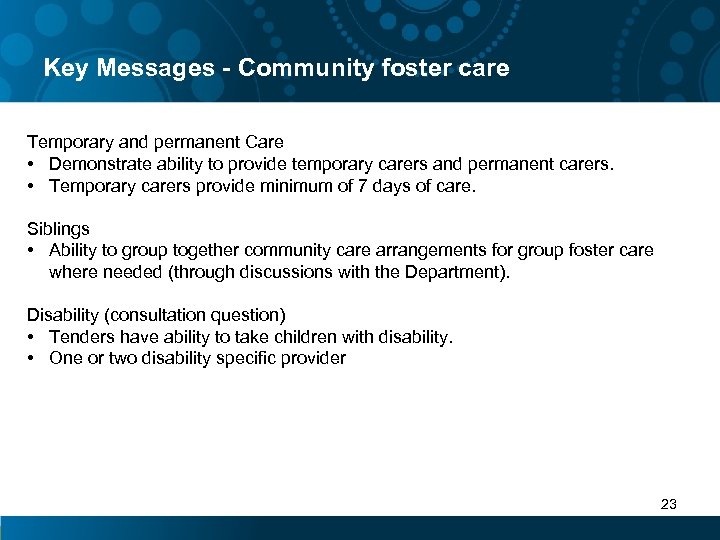
Key Messages - Community foster care Temporary and permanent Care • Demonstrate ability to provide temporary carers and permanent carers. • Temporary carers provide minimum of 7 days of care. Siblings • Ability to group together community care arrangements for group foster care where needed (through discussions with the Department). Disability (consultation question) • Tenders have ability to take children with disability. • One or two disability specific provider 23
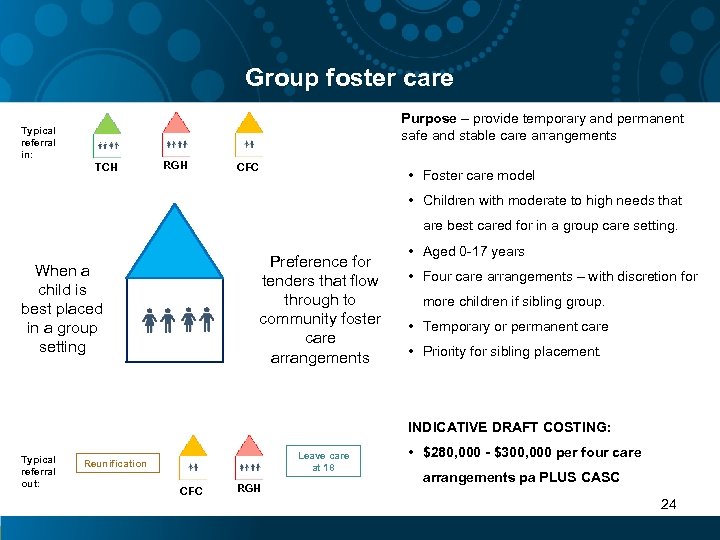
Group foster care Purpose – provide temporary and permanent safe and stable care arrangements Typical referral in: TCH RGH CFC • Foster care model • Children with moderate to high needs that are best cared for in a group care setting. Preference for tenders that flow through to community foster care arrangements When a child is best placed in a group setting • Aged 0 -17 years • Four care arrangements – with discretion for more children if sibling group. • Temporary or permanent care • Priority for sibling placement. INDICATIVE DRAFT COSTING: Typical referral out: Leave care at 18 Reunification CFC RGH • $280, 000 - $300, 000 per four care arrangements pa PLUS CASC 24
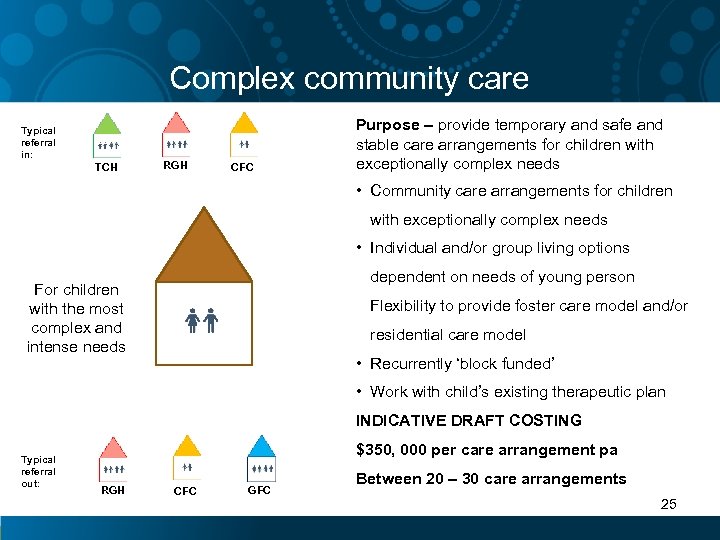
Complex community care Typical referral in: TCH RGH CFC Purpose – provide temporary and safe and stable care arrangements for children with exceptionally complex needs • Community care arrangements for children with exceptionally complex needs • Individual and/or group living options dependent on needs of young person For children with the most complex and intense needs Flexibility to provide foster care model and/or residential care model • Recurrently ‘block funded’ • Work with child’s existing therapeutic plan INDICATIVE DRAFT COSTING Typical referral out: $350, 000 per care arrangement pa RGH CFC GFC Between 20 – 30 care arrangements 25
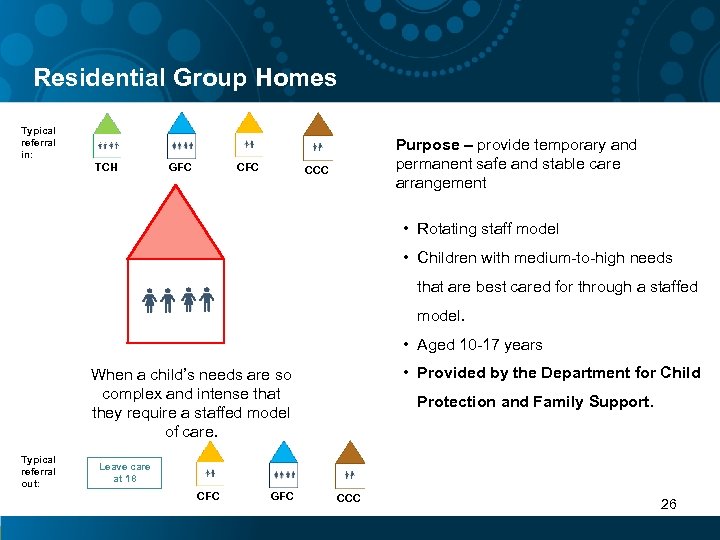
Residential Group Homes Typical referral in: TCH GFC CFC Purpose – provide temporary and permanent safe and stable care arrangement CCC • Rotating staff model • Children with medium-to-high needs that are best cared for through a staffed model. • Aged 10 -17 years • Provided by the Department for Child When a child’s needs are so complex and intense that they require a staffed model of care. Typical referral out: Protection and Family Support. Leave care at 18 CFC GFC CCC 26
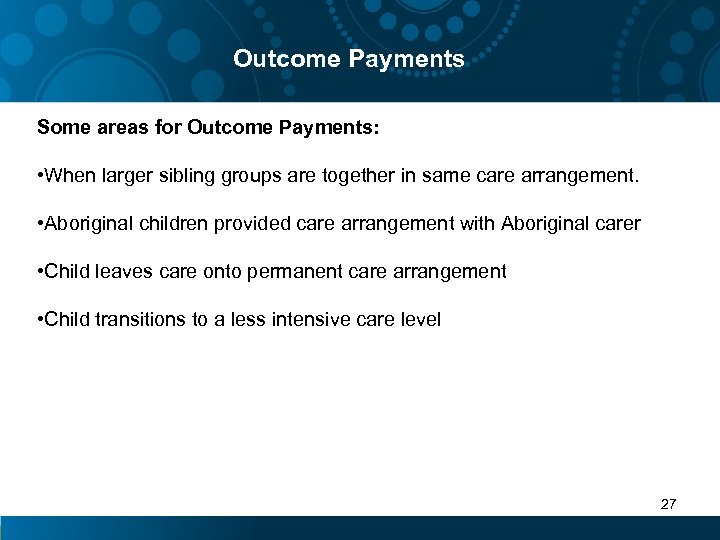
Outcome Payments Some areas for Outcome Payments: • When larger sibling groups are together in same care arrangement. • Aboriginal children provided care arrangement with Aboriginal carer • Child leaves care onto permanent care arrangement • Child transitions to a less intensive care level 27
Activities 28
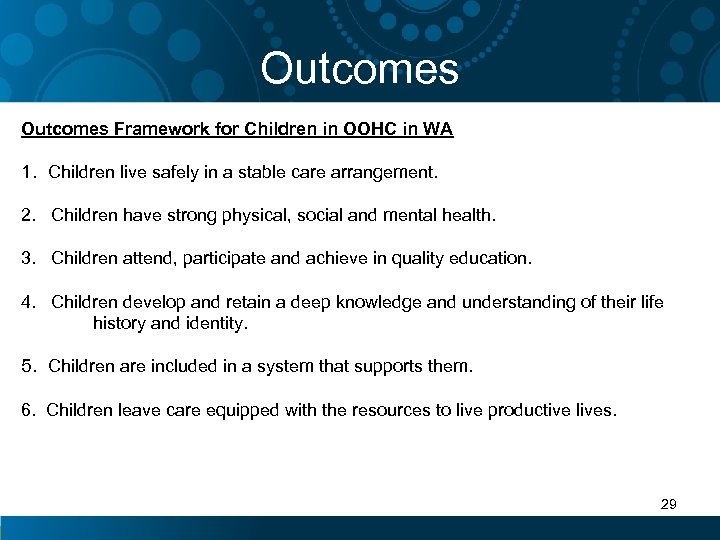
Outcomes Framework for Children in OOHC in WA 1. Children live safely in a stable care arrangement. 2. Children have strong physical, social and mental health. 3. Children attend, participate and achieve in quality education. 4. Children develop and retain a deep knowledge and understanding of their life history and identity. 5. Children are included in a system that supports them. 6. Children leave care equipped with the resources to live productive lives. 29
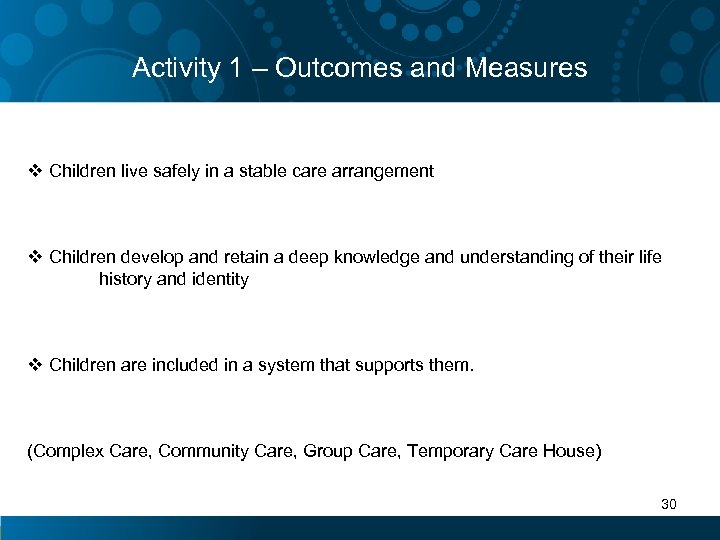
Activity 1 – Outcomes and Measures v Children live safely in a stable care arrangement v Children develop and retain a deep knowledge and understanding of their life history and identity v Children are included in a system that supports them. (Complex Care, Community Care, Group Care, Temporary Care House) 30
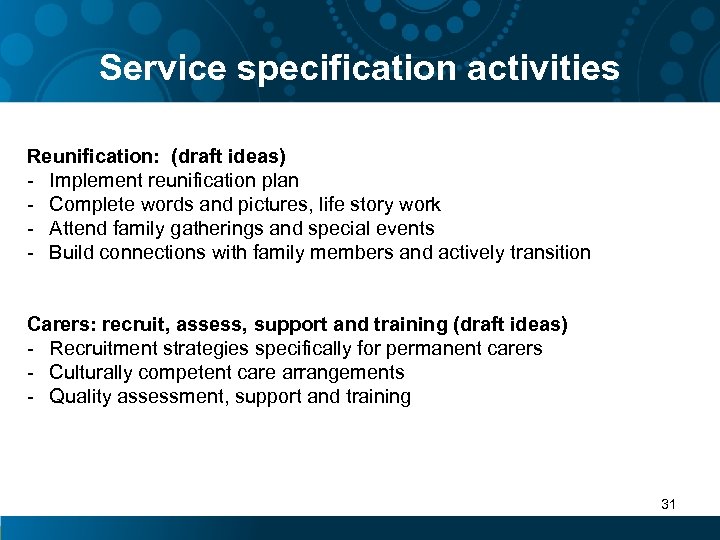
Service specification activities Reunification: (draft ideas) - Implement reunification plan - Complete words and pictures, life story work - Attend family gatherings and special events - Build connections with family members and actively transition Carers: recruit, assess, support and training (draft ideas) - Recruitment strategies specifically for permanent carers - Culturally competent care arrangements - Quality assessment, support and training 31
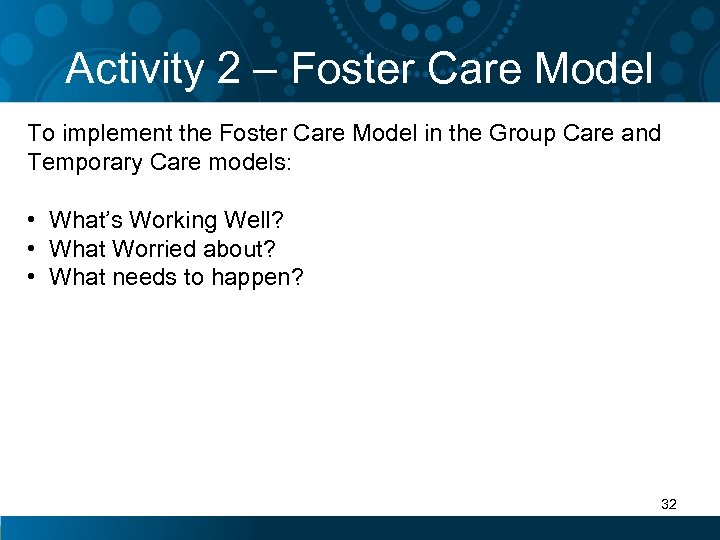
Activity 2 – Foster Care Model To implement the Foster Care Model in the Group Care and Temporary Care models: • What’s Working Well? • What Worried about? • What needs to happen? 32
Activity 3 - Partnerships Questions: What does a successful partnership look like? (one picture) Other pictures to show/tell story on how to achieve good partnerships Considering market design and key messages 1. Should there be a requirement to partner with an Aboriginal community controlled organisation (or a preference for this indicated)? What needs to be considered in this? What would each organisation bring to any partnership? 2. How could partnership arrangements be different for country and metro areas? How does this impact on local service provision? 3. What (if anything) would agencies need to support successful partnership arrangements? 4. What would be the positives and negatives of one service provider in each regional area? 33
Activity 4 - Children with Disabilities Questions: 1. What is the best way to contract care arrangements for this group of children? Possible options include? o One or two large providers only o One large provider who sub contracts to other providers o A large number of small providers o Opt in opt out within tender process for community care 2. What else needs to be considered to provide the best care options for this group of children? 34
Activity 5 – Outcome payments Consider the examples for potential outcome payments. 1. Are these the most appropriate elements to consider for outcome payments? What else? 2. What should the Department consider when implementing these provisions into contracts? 35
Next Steps Inform and Consult: • External workshops November • Service user focus groups Nov/Dec • Regional consults November Finalise service specifications Indicative Advertising Date: May 2017 36
Скачать презентацию Title Arial 28 Stakeholder Engagement Workshop Subtitle Arial
1ae300526d4995c6ce913f3a6db57c42.ppt