 Скачать презентацию Title Agenda Introduction Problem Alternatives By Team
6137825d30b8beb709acbc8523d69e19.ppt
- Количество слайдов: 26



Title Agenda Introduction Problem Alternatives By Team … Rating Conclusion
Title Agenda Introduction Problem Agenda § Introduction § Problem Statement § Alternatives § Ratings § Conclusion Alternatives Rating Conclusion
Title Agenda Introduction Problem Alternatives Rating Introduction § Atlanta, Georgia § Telecommunications Company – 1991 Annual Sales - $14. 4 billion – Income after taxes - $1. 5 billion • Ranked among top 25 U. S. Corporations § 1984 AT&T Breakup § Cellular Communications Conclusion
Title Agenda Introduction Problem Alternatives Rating Conclusion 1986 – Bell. South Enterprises Bell. South International • Legal aspects of foreign countries International Systems • Support with the installation of financial systems World Wide Wireless • Technical operations of cellular telecommunications
Title Agenda Introduction Problem Alternatives Rating Conclusion § Need for a billing system – Linking capacity of cellular phones – Large number of different billing plans – Different ways of doing business in countries
Title Agenda Introduction Problem Alternatives § Identification number – Inbound and Outbound calls – Exchange of billing information § Highly competitive industry – Variety of billing plans • Flat rate • Per minute Rating Conclusion
Title Agenda Introduction Problem Alternatives Rating § Bell. South in international markets – Uniform billing system • Languages • Currency • Business practices Conclusion
Title Agenda Introduction Problem Alternatives Rating Conclusion § Bell. South wanted to introduce a revolutionary software to cope with the complexities of all the different markets Bell. South had already entered or sought to enter. § Such technology was intended to give Bell. South a competitive advantage, and help the company enter new markets faster than the competition. § The company had several options in obtaining software that could handle cellular billing.
Title Agenda Introduction Problem Alternatives Rating Conclusion Options for a Solution 1) Outsource the billing system to a service bureau. - 1992: service bureaus weren’t operating in the cellular market. 2) Develop a software system using in-house programmers. - Lack of resources. - threat of computer technicians driving the project.
Title Agenda Introduction Problem Alternatives Rating Conclusion Options for a Solution 3) Purchase a software package. - Software available did not meet the requirements. 4) Contracting with a vendor to customize a product. - Traditional vendor-client relationship was not going to solve the companies problems.
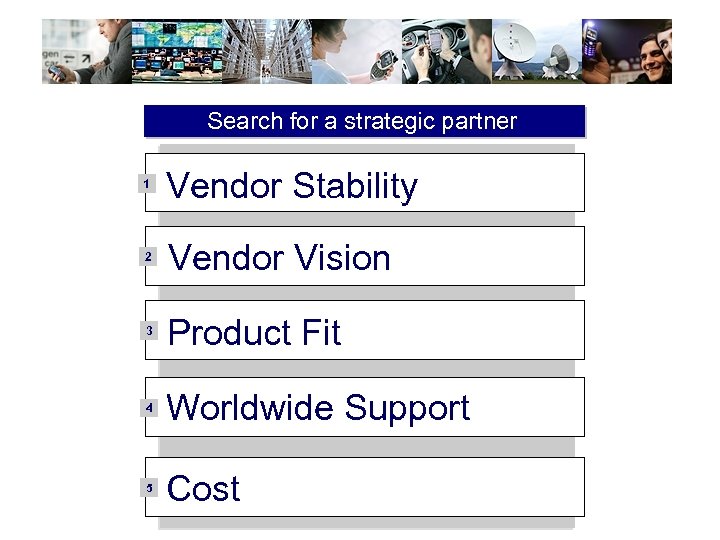
Search for a strategic partner 1 Vendor Stability 2 Vendor Vision 3 Product Fit 4 Worldwide Support 5 Cost
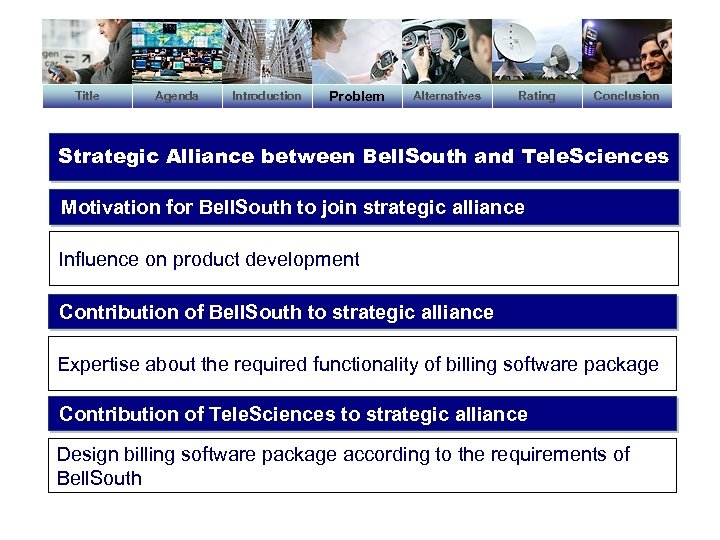
Title Agenda Introduction Problem Alternatives Rating Conclusion Strategic Alliance between Bell. South and Tele. Sciences Motivation for Bell. South to join strategic alliance Influence on product development Contribution of Bell. South to strategic alliance Expertise about the required functionality of billing software package Contribution of Tele. Sciences to strategic alliance Design billing software package according to the requirements of Bell. South
Title Agenda Introduction Problem Alternatives Rating Conclusion Interests are not congruent § Bell. South has committed to a deadline in New Zealand § The deadline is of little importance to Tele. Sciences since the company would be able to sell the product even if the deadline was not met § Contract does not provide for recourse against Tele. Sciences Unequal share of cost and benefits § Bell. South contributes its expertise in the early stages of the cooperation § Later, Bell. South is not allowed insight into the documentation of the product development
Title Agenda Introduction Problem Alternatives Rating Conclusion Lack of Communication § No direct input into the product development process by Bell. South § Tele. Sciences owns the product definition Instability of the alliance § Frequent management changes § Both parties can terminate the agreement on a 30 days notice at any time
Title Agenda Introduction Problem Alternatives Rating Conclusion Problem Statement It soon became obvious that the contractual details of the agreement between Bell. South and Tele. Sciences were not appropriate to facilitate a balanced long-term Driving forces for the formation of Joint Ventures business relationship
Title Agenda Introduction Problem Alternatives § Redesigned Contract – Must Support Long-Term • MOU and 30 -day termination – Long-Term Contract • Common Objective • Form of Strategic Alliance • Responsibilities of each party Rating Conclusion
Title Agenda Introduction Problem Alternatives Rating – Long-Term Contract Specifics • Contractual Penalties and Commitments – Support Common Objectives and Benefits • Risk Allocation – Clear Definition of Risks and Responsibilities • Communication and Party Changes – Quantity, Quality, and Form of Information – Consequences of Party Changes Conclusion
Title Agenda Introduction Problem Alternatives – Problems with Contract Redesign • Specifics hard to monitor • Free-Rider-Maximizing Benefits • Divergent Objectives Rating Conclusion
Title Agenda Introduction Problem Alternatives Rating Conclusion Definition: Joint Venture § A contractual agreement § Joining together two or more parties § Purpose of executing a particular business venture § All parties agree to share in the profits and losses of the enterprise Driving forces for the formation of Joint Ventures § Business expansion § Development of new products § Moving into new markets, particularly overseas
Title Agenda Introduction Problem Alternatives Rating Conclusion Advantages - generally § Sharing of risk with partner § More resources § Access to specialized staff and § Greater capacity technology § Increased technical expertise § Established distribution channels § Access to new markets Risks - generally § Objective of the Joint Venture is not absolutely clear § Objective of the Joint Venture is not communicated to all the staff involved § Different cultures and management styles can result in poor integration and cooperation between partners
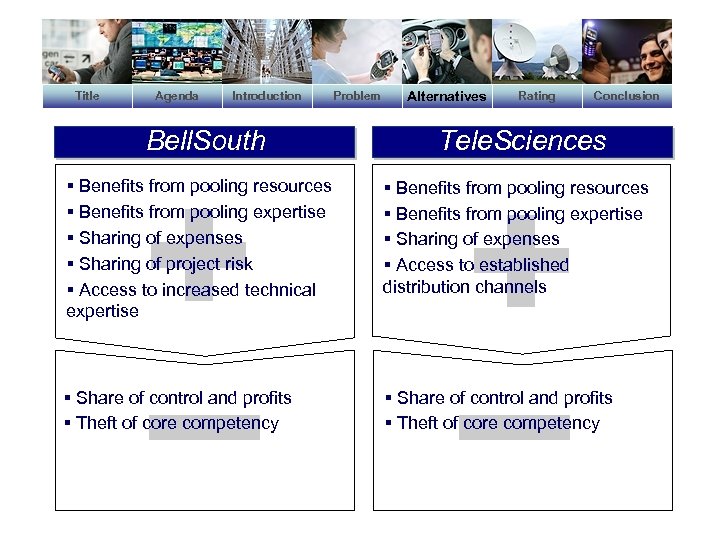
Title Agenda Introduction Problem Alternatives Bell. South Rating Conclusion Tele. Sciences § Benefits from pooling resources § Benefits from pooling expertise § Sharing of expenses § Sharing of project risk § Access to increased technical expertise § Benefits from pooling resources § Benefits from pooling expertise § Sharing of expenses § Access to established distribution channels § Share of control and profits § Theft of core competency §…
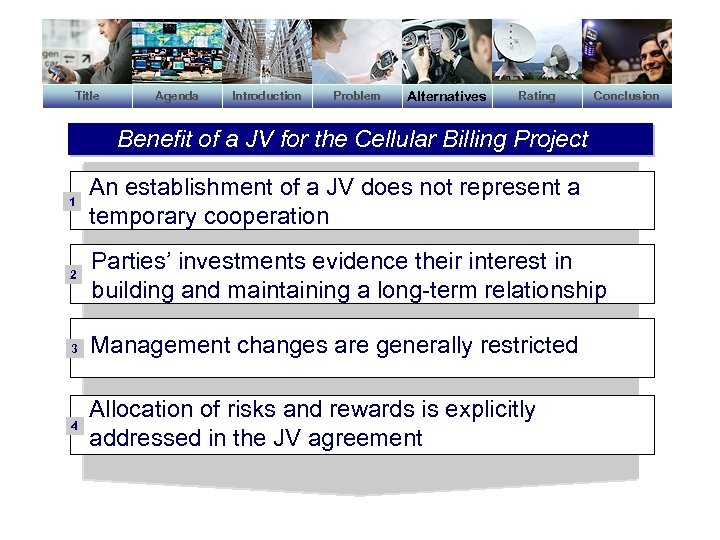
Title Agenda Introduction Problem Alternatives Rating Conclusion Benefit of a JV for the Cellular Billing Project 1 An establishment of a JV does not represent a temporary cooperation 2 Parties’ investments evidence their interest in building and maintaining a long-term relationship 3 Management changes are generally restricted 4 Allocation of risks and rewards is explicitly addressed in the JV agreement
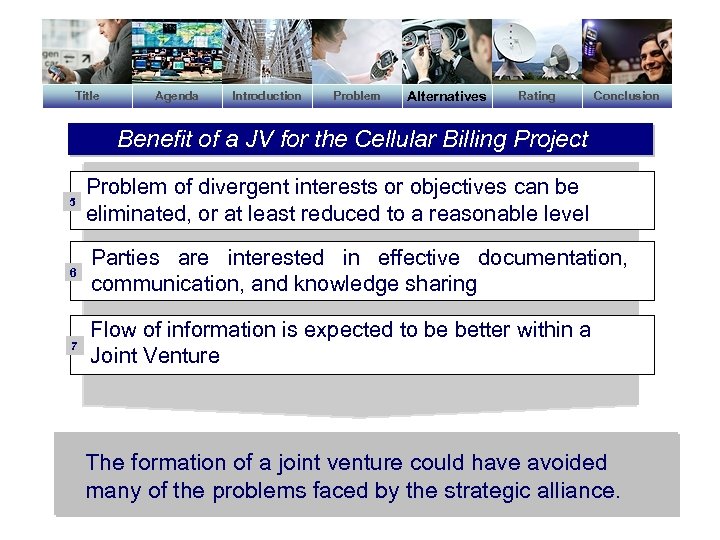
Title Agenda Introduction Problem Alternatives Rating Conclusion Benefit of a JV for the Cellular Billing Project 5 Problem of divergent interests or objectives can be eliminated, or at least reduced to a reasonable level 6 Parties are interested in effective documentation, communication, and knowledge sharing 7 Flow of information is expected to be better within a Joint Venture The formation of a joint venture could have avoided many of the problems faced by the strategic alliance.
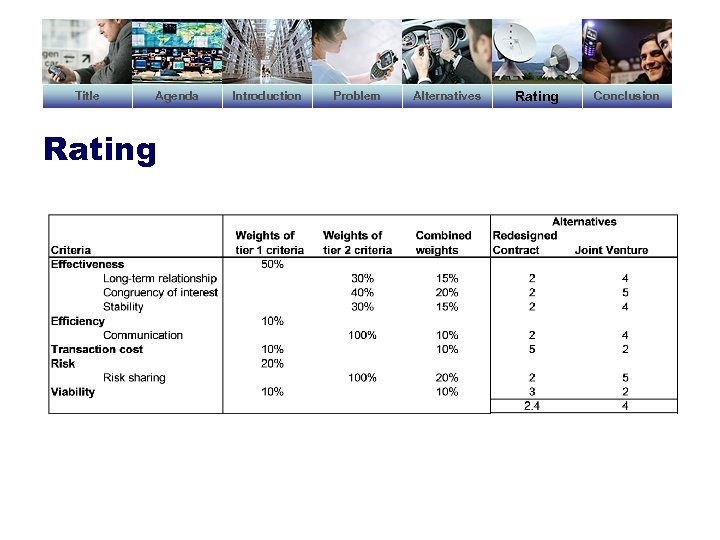
Title Agenda Rating Introduction Problem Alternatives Rating Conclusion
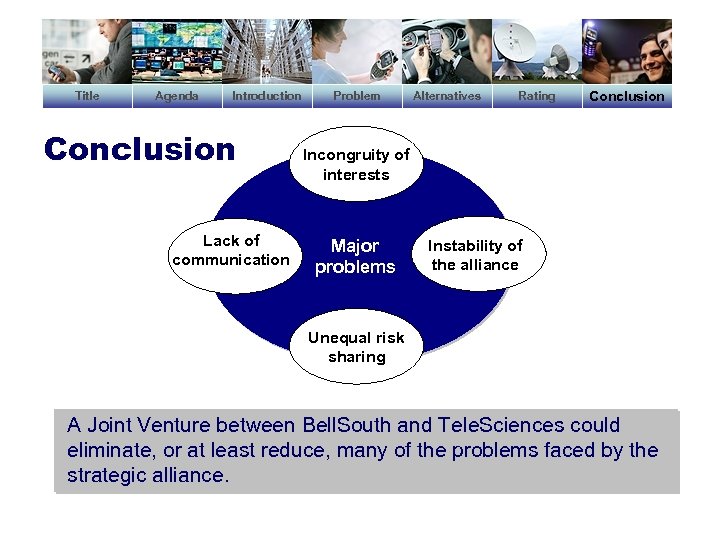
Title Agenda Introduction Conclusion Lack of communication Problem Alternatives Rating Conclusion Incongruity of interests Major problems Instability of the alliance Unequal risk sharing A Joint Venture between Bell. South and Tele. Sciences could eliminate, or at least reduce, many of the problems faced by the strategic alliance.

We thank you for your attention
Скачать презентацию Title Agenda Introduction Problem Alternatives By Team
6137825d30b8beb709acbc8523d69e19.ppt