 Скачать презентацию TIMS EEAA 2 nd Phase DJERBA FORUM —
044dba343793f0420aa6786573f01443.ppt
- Количество слайдов: 19



TIMS/EEAA 2 nd Phase – DJERBA FORUM - CD 4 CDM UNEP RISØ-APEX Egypt GHG Mitigation Potential Eng. Maher Aziz Energy & Environment Consultant (E&E) General Director of Environmental Studies, EEHC 1 DJERBA, Tunisia, 22 -24 September, 2004
TIMS/EEAA 2 nd Phase – DJERBA FORUM - CD 4 CDM UNEP RISØ-APEX 1. Introduction • The contribution of major sectors to the overall GHG emissions of Egypt serves as a first indicator on which sectors should be primarily targeted for identifying GHG mitigation projects. • The methodology used to develop and report the inventory was based on the IPCC guidelines published in 1995 and revised in 1996. • The inventory was estimated for the main three GHGs, namely CO 2, CH 4 and N 2 O. • The data for other GHGs such as NOx, CO and nonmethane VOCs is not available. 2 DJERBA, Tunisia, 22 -24 September, 2004
TIMS/EEAA 2 nd Phase – DJERBA FORUM - CD 4 CDM UNEP RISØ-APEX 2. GHG Emission Inventory by Sector • The total GHG emissions of Egypt in 1990 were 116, 708 Gg of CO 2 equivalent while the total GHG sinks in the land–use and forestry sector recorded 9, 900 Gg of CO 2 equivalent. • CO 2 is the main Greenhouse Gas in Egypt. It represents about 72% of the total GHG emissions in 1990. • The second important Greenhouse Gas is CH 4, which recorded 19% of the total GHG emissions and lastly N 2 O with 9%. 3 DJERBA, Tunisia, 22 -24 September, 2004
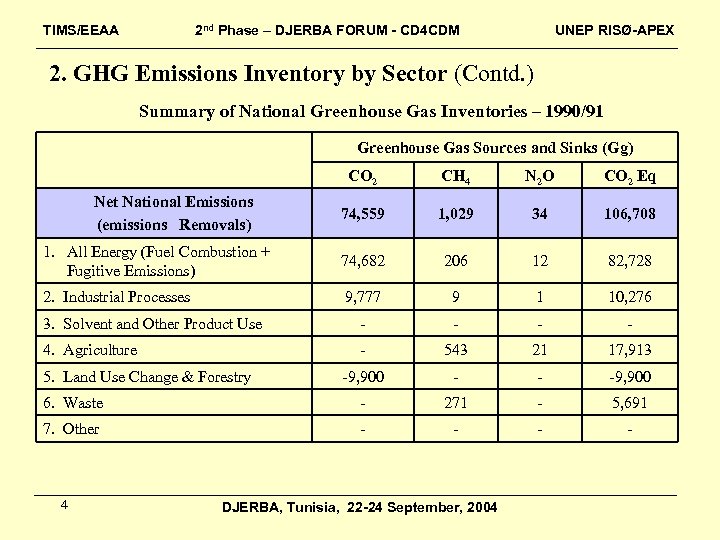
TIMS/EEAA 2 nd Phase – DJERBA FORUM - CD 4 CDM UNEP RISØ-APEX 2. GHG Emissions Inventory by Sector (Contd. ) Summary of National Greenhouse Gas Inventories – 1990/91 Greenhouse Gas Sources and Sinks (Gg) CO 2 CH 4 N 2 O CO 2 Eq 74, 559 1, 029 34 106, 708 1. All Energy (Fuel Combustion + Fugitive Emissions) 74, 682 206 12 82, 728 2. Industrial Processes 9, 777 9 1 10, 276 3. Solvent and Other Product Use - - 4. Agriculture - 543 21 17, 913 -9, 900 - - -9, 900 6. Waste - 271 - 5, 691 7. Other - - Net National Emissions (emissions Removals) 5. Land Use Change & Forestry 4 DJERBA, Tunisia, 22 -24 September, 2004
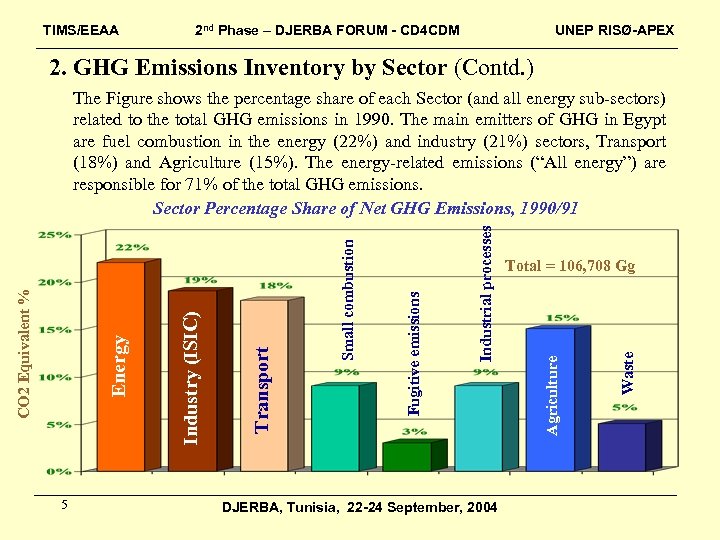
TIMS/EEAA 2 nd Phase – DJERBA FORUM - CD 4 CDM UNEP RISØ-APEX 2. GHG Emissions Inventory by Sector (Contd. ) 5 DJERBA, Tunisia, 22 -24 September, 2004 Waste Total = 106, 708 Gg Agriculture Industrial processes Fugitive emissions Small combustion Transport Industry (ISIC) Energy CO 2 Equivalent % The Figure shows the percentage share of each Sector (and all energy sub-sectors) related to the total GHG emissions in 1990. The main emitters of GHG in Egypt are fuel combustion in the energy (22%) and industry (21%) sectors, Transport (18%) and Agriculture (15%). The energy-related emissions (“All energy”) are responsible for 71% of the total GHG emissions. Sector Percentage Share of Net GHG Emissions, 1990/91
TIMS/EEAA 2 nd Phase – DJERBA FORUM - CD 4 CDM UNEP RISØ-APEX 3. Emissions from “ All Energy ” Sector (fuel combustion and fugitive emissions) • The main energy source of Egypt are oil, natural gas, and to a lesser extent hydropower (mainly generated from the high dam in Aswan). Coal, non-commercial fuels e. g. agriculture residues, firewood, dried livestock manure etc. ), wind and solar energies play only a minor role. • The electricity generation sector was the major consumer of fossil fuels in Egypt in 1990 (34%) followed by industry (27%), transport (23%), residential & commercial (13%), petroleum (2%) and finally agriculture (1%). • Dependency on petroleum as the primary energy source makes energy production the highest contributor to GHG emissions in Egypt. 6 DJERBA, Tunisia, 22 -24 September, 2004
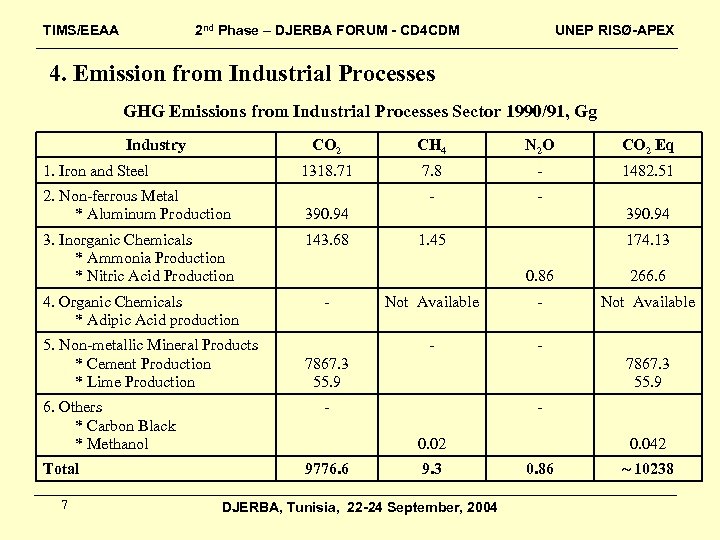
TIMS/EEAA 2 nd Phase – DJERBA FORUM - CD 4 CDM UNEP RISØ-APEX 4. Emission from Industrial Processes GHG Emissions from Industrial Processes Sector 1990/91, Gg Industry CO 2 2. Non-ferrous Metal * Aluminum Production N 2 O CO 2 Eq 1318. 71 1. Iron and Steel CH 4 7. 8 - 1482. 51 - - 390. 94 3. Inorganic Chemicals * Ammonia Production * Nitric Acid Production 143. 68 4. Organic Chemicals * Adipic Acid production - 5. Non-metallic Mineral Products * Cement Production * Lime Production 6. Others * Carbon Black * Methanol Total 7 390. 94 1. 45 174. 13 0. 86 266. 6 Not Available - - 7867. 3 55. 9 - 0. 02 9776. 6 9. 3 DJERBA, Tunisia, 22 -24 September, 2004 0. 042 0. 86 ~ 10238
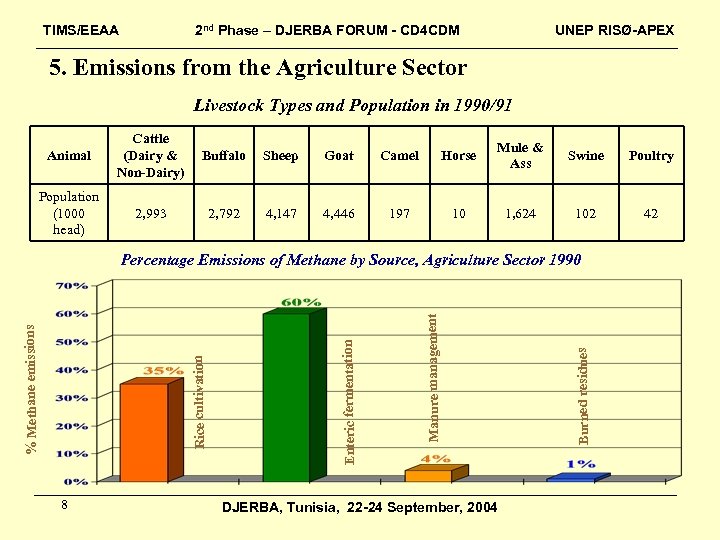
TIMS/EEAA 2 nd Phase – DJERBA FORUM - CD 4 CDM UNEP RISØ-APEX 5. Emissions from the Agriculture Sector Livestock Types and Population in 1990/91 Animal Cattle (Dairy & Non-Dairy) Buffalo Sheep Goat Camel Horse Mule & Ass Swine Poultry Population (1000 head) 2, 993 2, 792 4, 147 4, 446 197 10 1, 624 102 42 8 DJERBA, Tunisia, 22 -24 September, 2004 Burned residues Manure management Enteric fermentation Rice cultivation % Methane emissions Percentage Emissions of Methane by Source, Agriculture Sector 1990
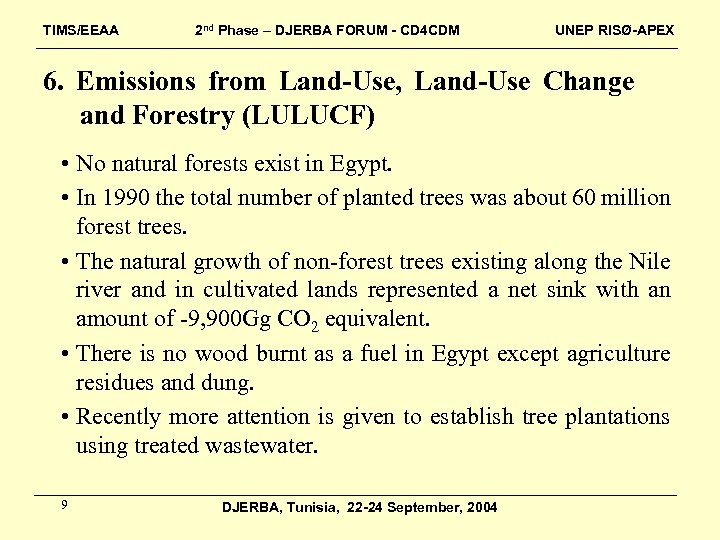
TIMS/EEAA 2 nd Phase – DJERBA FORUM - CD 4 CDM UNEP RISØ-APEX 6. Emissions from Land-Use, Land-Use Change and Forestry (LULUCF) • No natural forests exist in Egypt. • In 1990 the total number of planted trees was about 60 million forest trees. • The natural growth of non-forest trees existing along the Nile river and in cultivated lands represented a net sink with an amount of -9, 900 Gg CO 2 equivalent. • There is no wood burnt as a fuel in Egypt except agriculture residues and dung. • Recently more attention is given to establish tree plantations using treated wastewater. 9 DJERBA, Tunisia, 22 -24 September, 2004
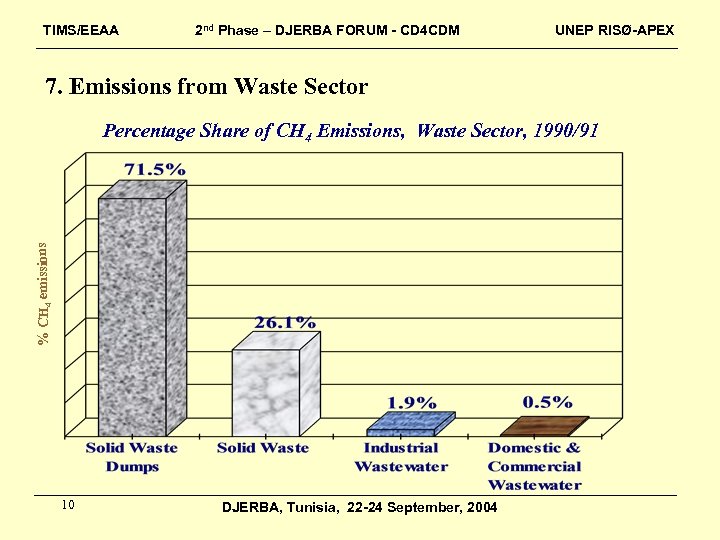
TIMS/EEAA 2 nd Phase – DJERBA FORUM - CD 4 CDM UNEP RISØ-APEX 7. Emissions from Waste Sector % CH 4 emissions Percentage Share of CH 4 Emissions, Waste Sector, 1990/91 10 DJERBA, Tunisia, 22 -24 September, 2004
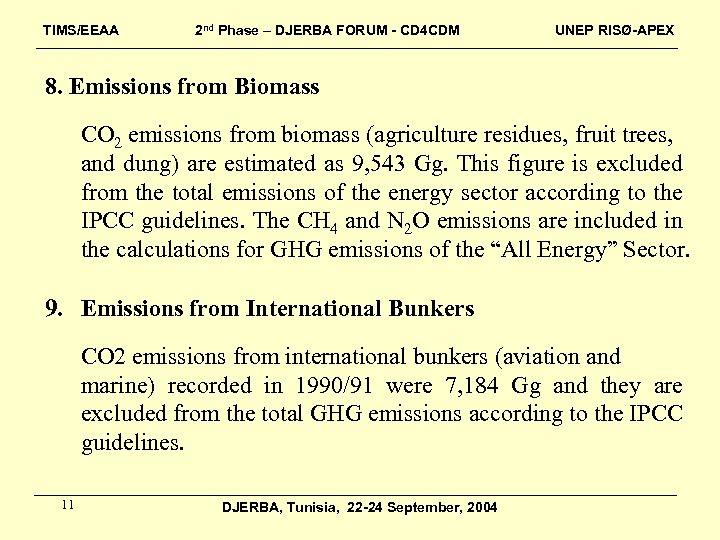
TIMS/EEAA 2 nd Phase – DJERBA FORUM - CD 4 CDM UNEP RISØ-APEX 8. Emissions from Biomass CO 2 emissions from biomass (agriculture residues, fruit trees, and dung) are estimated as 9, 543 Gg. This figure is excluded from the total emissions of the energy sector according to the IPCC guidelines. The CH 4 and N 2 O emissions are included in the calculations for GHG emissions of the “All Energy” Sector. 9. Emissions from International Bunkers CO 2 emissions from international bunkers (aviation and marine) recorded in 1990/91 were 7, 184 Gg and they are excluded from the total GHG emissions according to the IPCC guidelines. 11 DJERBA, Tunisia, 22 -24 September, 2004
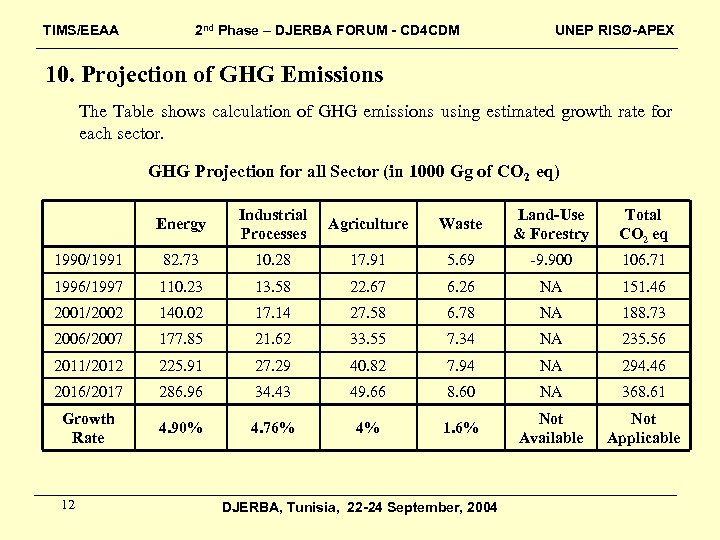
TIMS/EEAA 2 nd Phase – DJERBA FORUM - CD 4 CDM UNEP RISØ-APEX 10. Projection of GHG Emissions The Table shows calculation of GHG emissions using estimated growth rate for each sector. GHG Projection for all Sector (in 1000 Gg of CO 2 eq) Energy Industrial Processes Agriculture Waste Land-Use & Forestry Total CO 2 eq 1990/1991 82. 73 10. 28 17. 91 5. 69 -9. 900 106. 71 1996/1997 110. 23 13. 58 22. 67 6. 26 NA 151. 46 2001/2002 140. 02 17. 14 27. 58 6. 78 NA 188. 73 2006/2007 177. 85 21. 62 33. 55 7. 34 NA 235. 56 2011/2012 225. 91 27. 29 40. 82 7. 94 NA 294. 46 2016/2017 286. 96 34. 43 49. 66 8. 60 NA 368. 61 Growth Rate 4. 90% 4. 76% 4% 1. 6% Not Available Not Applicable 12 DJERBA, Tunisia, 22 -24 September, 2004
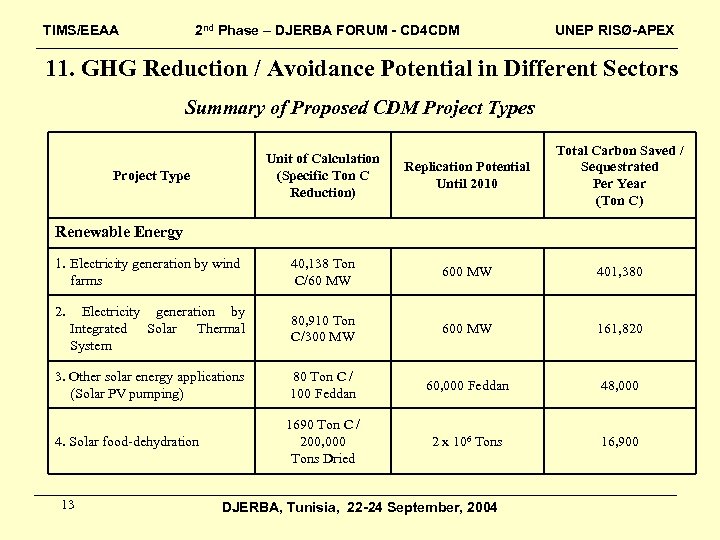
TIMS/EEAA 2 nd Phase – DJERBA FORUM - CD 4 CDM UNEP RISØ-APEX 11. GHG Reduction / Avoidance Potential in Different Sectors Summary of Proposed CDM Project Types Unit of Calculation (Specific Ton C Reduction) Replication Potential Until 2010 Total Carbon Saved / Sequestrated Per Year (Ton C) 40, 138 Ton C/60 MW 600 MW 401, 380 Electricity generation by Integrated Solar Thermal System 80, 910 Ton C/300 MW 600 MW 161, 820 3. Other solar energy applications (Solar PV pumping) 80 Ton C / 100 Feddan 60, 000 Feddan 48, 000 1690 Ton C / 200, 000 Tons Dried 2 x 10⁶ Tons 16, 900 Project Type Renewable Energy 1. Electricity generation by wind farms 2. 4. Solar food-dehydration 13 DJERBA, Tunisia, 22 -24 September, 2004
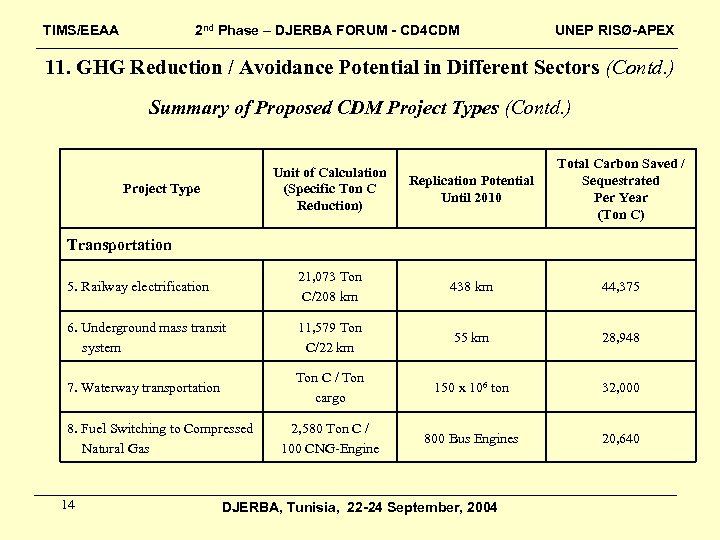
TIMS/EEAA 2 nd Phase – DJERBA FORUM - CD 4 CDM UNEP RISØ-APEX 11. GHG Reduction / Avoidance Potential in Different Sectors (Contd. ) Summary of Proposed CDM Project Types (Contd. ) Unit of Calculation (Specific Ton C Reduction) Replication Potential Until 2010 Total Carbon Saved / Sequestrated Per Year (Ton C) 5. Railway electrification 21, 073 Ton C/208 km 438 km 44, 375 6. Underground mass transit system 11, 579 Ton C/22 km 55 km 28, 948 7. Waterway transportation Ton C / Ton cargo 150 x 106 ton 32, 000 2, 580 Ton C / 100 CNG-Engine 800 Bus Engines 20, 640 Project Type Transportation 8. Fuel Switching to Compressed Natural Gas 14 DJERBA, Tunisia, 22 -24 September, 2004
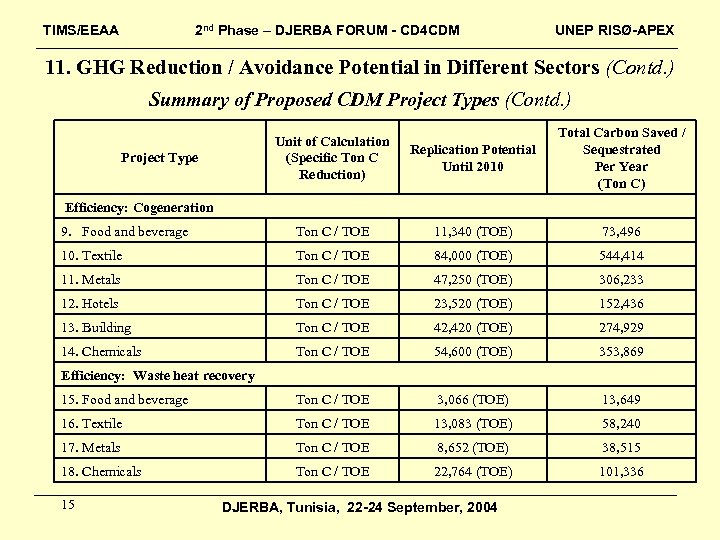
TIMS/EEAA 2 nd Phase – DJERBA FORUM - CD 4 CDM UNEP RISØ-APEX 11. GHG Reduction / Avoidance Potential in Different Sectors (Contd. ) Summary of Proposed CDM Project Types (Contd. ) Unit of Calculation (Specific Ton C Reduction) Replication Potential Until 2010 Total Carbon Saved / Sequestrated Per Year (Ton C) 9. Food and beverage Ton C / TOE 11, 340 (TOE) 73, 496 10. Textile Ton C / TOE 84, 000 (TOE) 544, 414 11. Metals Ton C / TOE 47, 250 (TOE) 306, 233 12. Hotels Ton C / TOE 23, 520 (TOE) 152, 436 13. Building Ton C / TOE 42, 420 (TOE) 274, 929 14. Chemicals Ton C / TOE 54, 600 (TOE) 353, 869 15. Food and beverage Ton C / TOE 3, 066 (TOE) 13, 649 16. Textile Ton C / TOE 13, 083 (TOE) 58, 240 17. Metals Ton C / TOE 8, 652 (TOE) 38, 515 18. Chemicals Ton C / TOE 22, 764 (TOE) 101, 336 Project Type Efficiency: Cogeneration Efficiency: Waste heat recovery 15 DJERBA, Tunisia, 22 -24 September, 2004
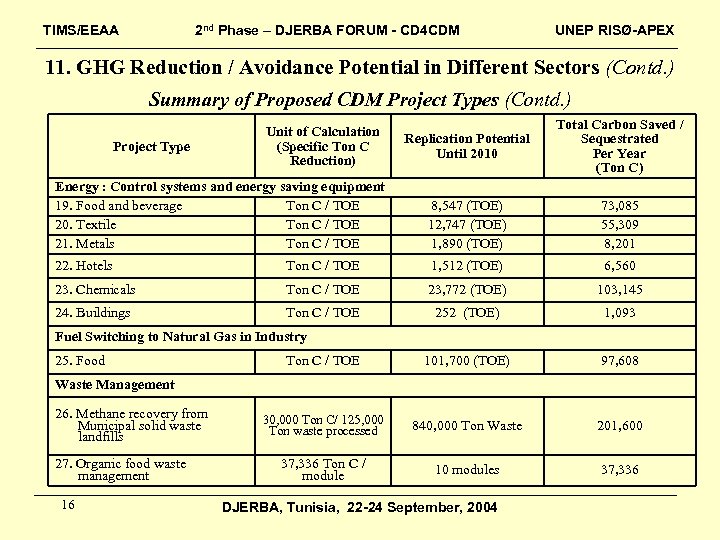
TIMS/EEAA 2 nd Phase – DJERBA FORUM - CD 4 CDM UNEP RISØ-APEX 11. GHG Reduction / Avoidance Potential in Different Sectors (Contd. ) Summary of Proposed CDM Project Types (Contd. ) Replication Potential Until 2010 Total Carbon Saved / Sequestrated Per Year (Ton C) Energy : Control systems and energy saving equipment 19. Food and beverage Ton C / TOE 20. Textile Ton C / TOE 21. Metals Ton C / TOE 8, 547 (TOE) 12, 747 (TOE) 1, 890 (TOE) 73, 085 55, 309 8, 201 22. Hotels Ton C / TOE 1, 512 (TOE) 6, 560 23. Chemicals Ton C / TOE 23, 772 (TOE) 103, 145 24. Buildings Ton C / TOE 252 (TOE) 1, 093 Ton C / TOE 101, 700 (TOE) 97, 608 30, 000 Ton C/ 125, 000 Ton waste processed 840, 000 Ton Waste 201, 600 37, 336 Ton C / module 10 modules 37, 336 Project Type Unit of Calculation (Specific Ton C Reduction) Fuel Switching to Natural Gas in Industry 25. Food Waste Management 26. Methane recovery from Municipal solid waste landfills 27. Organic food waste management 16 DJERBA, Tunisia, 22 -24 September, 2004
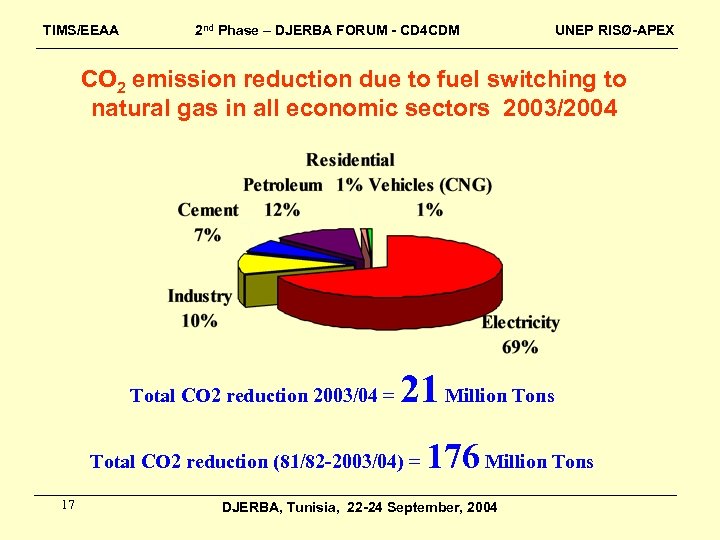
TIMS/EEAA 2 nd Phase – DJERBA FORUM - CD 4 CDM UNEP RISØ-APEX CO 2 emission reduction due to fuel switching to natural gas in all economic sectors 2003/2004 Total CO 2 reduction 2003/04 = 21 Million Tons Total CO 2 reduction (81/82 -2003/04) = 17 176 Million Tons DJERBA, Tunisia, 22 -24 September, 2004
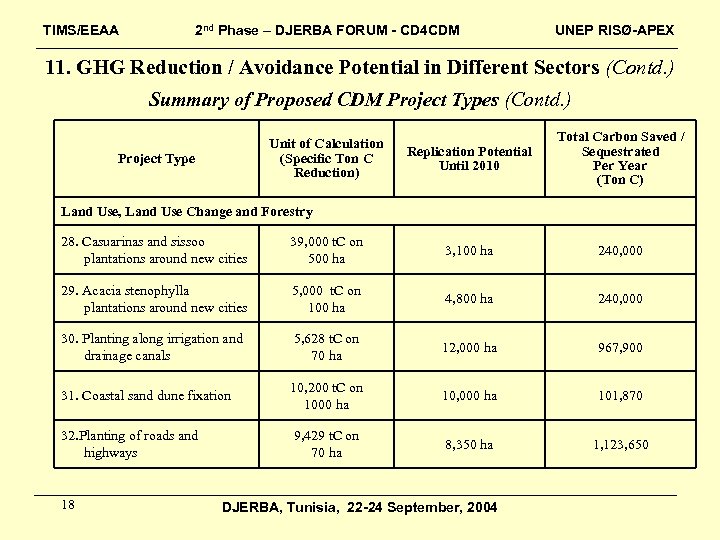
TIMS/EEAA 2 nd Phase – DJERBA FORUM - CD 4 CDM UNEP RISØ-APEX 11. GHG Reduction / Avoidance Potential in Different Sectors (Contd. ) Summary of Proposed CDM Project Types (Contd. ) Unit of Calculation (Specific Ton C Reduction) Project Type Replication Potential Until 2010 Total Carbon Saved / Sequestrated Per Year (Ton C) Land Use, Land Use Change and Forestry 28. Casuarinas and sissoo plantations around new cities 39, 000 t. C on 500 ha 3, 100 ha 240, 000 29. Acacia stenophylla plantations around new cities 5, 000 t. C on 100 ha 4, 800 ha 240, 000 30. Planting along irrigation and drainage canals 5, 628 t. C on 70 ha 12, 000 ha 967, 900 31. Coastal sand dune fixation 10, 200 t. C on 1000 ha 10, 000 ha 101, 870 32. Planting of roads and highways 9, 429 t. C on 70 ha 8, 350 ha 1, 123, 650 18 DJERBA, Tunisia, 22 -24 September, 2004
TIMS/EEAA 2 nd Phase – DJERBA FORUM - CD 4 CDM UNEP RISØ-APEX End of Presentation 19 DJERBA, Tunisia, 22 -24 September, 2004
Скачать презентацию TIMS EEAA 2 nd Phase DJERBA FORUM —
044dba343793f0420aa6786573f01443.ppt