


 Скачать презентацию Timing and localization of Spontaneous Intentional Goal
cde730a1897378b764070c67838cee9f.ppt
- Количество слайдов: 39
 Timing and localization of Spontaneous & Intentional Goal and Trait Inferences Frank Van Overwalle with Marijke Van Duynslaeger, Laurence Van der Cruyssen, Aisha Cortoos, & Ma Ning
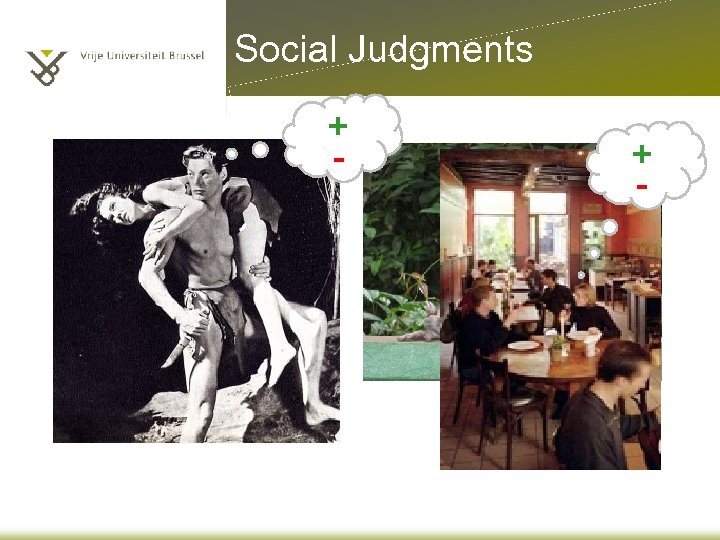 Social Judgments + - + -
 Social Judgments Alex Todorov Silvia Tomelleri ? ? Nigel Blackwood Anja Achtzinger David Turk Ian Apperly Iroise Dumontheil You shall not judge Sam Gilbert Neil Macrae Dana Samson Dean Mobbs Bruno Rossion
 The Social Brain • How is this computed in the brain? – Goals of single behaviors – Traits by integrating multiple behaviors • Results of recent meta-analysis (Van Overwalle, 2008, HBM)…
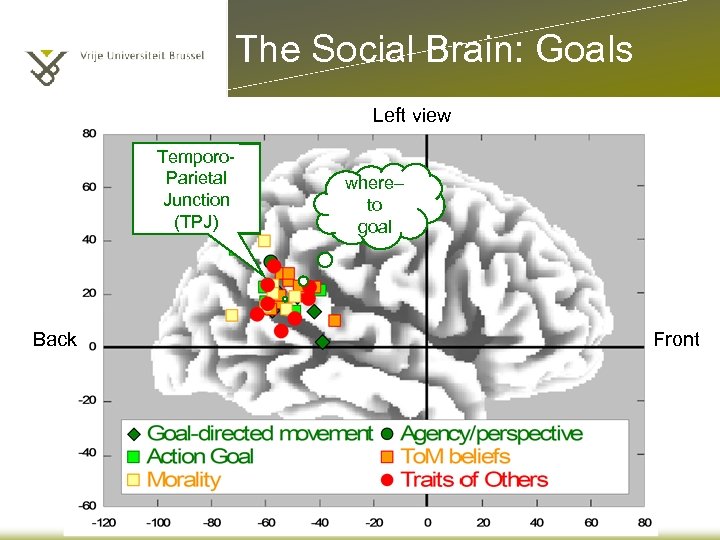 The Social Brain: Goals Left view Temporo. Parietal Junction (TPJ) Back where– to goal Front
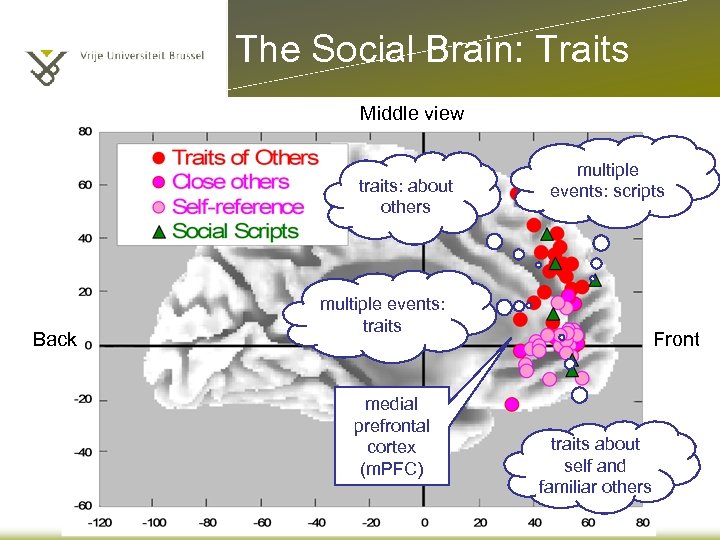 The Social Brain: Traits Middle view traits: about others Back multiple events: scripts multiple events: traits medial prefrontal cortex (m. PFC) Front traits about self and familiar others
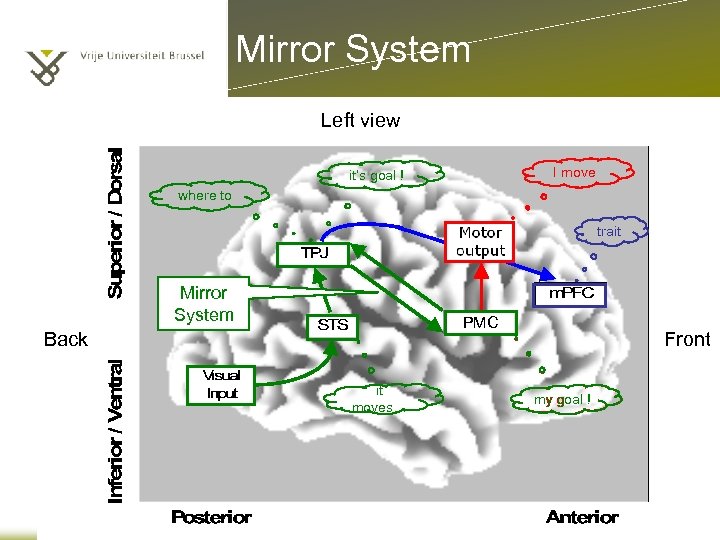 Mirror System Left view I move it’s goal ! where to trait Mirror System PMC Back it moves… Front my goal !
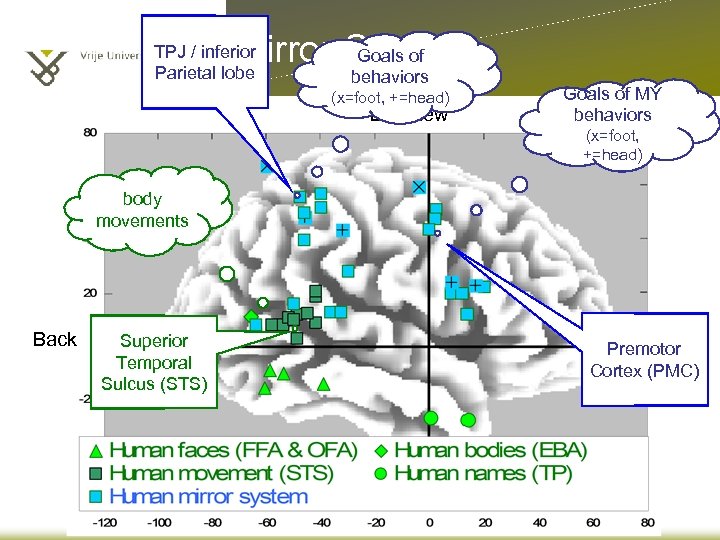 Goals of Mirror System TPJ / inferior Parietal lobe behaviors (x=foot, +=head) Left view Goals of MY behaviors (x=foot, +=head) body movements Back Superior Temporal Sulcus (STS) Front Premotor Cortex (PMC)
 How making Inferences? do I infer the right goal?
 How making Inferences? • The Mirror Theory assumes that Goal inferences are automatic (Keysers & Gazzola, 2007): – Vortram buys tons of soft drinks – Vortram installs some colorful spot lights. – Vortram phones all his good friends • What is the goal?
 How making Inferences? • Intentional (ISI): with clear intent and awareness - Most often used in earlier EEG & f. MRI studies • Spontaneous (SSI): without intention and little awareness that we are making them - Past social cognition research has shown that we often do this
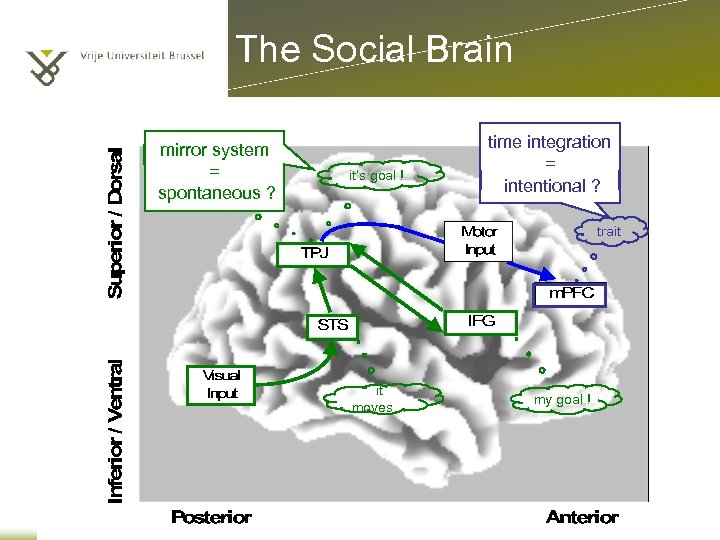 The Social Brain mirror system = spontaneous ? where to ? it’s goal ! time integration = intentional ? trait it moves… my goal !
 Research Inconsistent behavioral information paradigm: in a stream of consistent behaviors implying the same goal or trait, occasionally inconsistent behaviors are shown EEG is taken while reading these (in)consistent behaviors
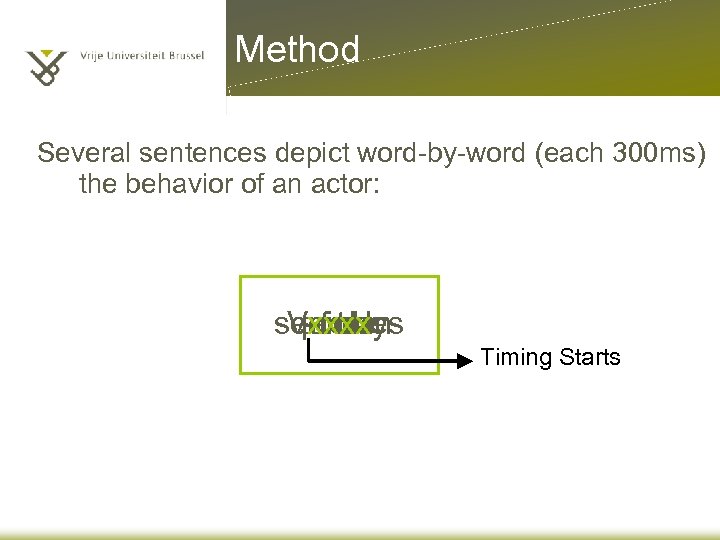 Method Several sentences depict word-by-word (each 300 ms) the behavior of an actor: searches Vortran quickly some xxxx for Timing Starts
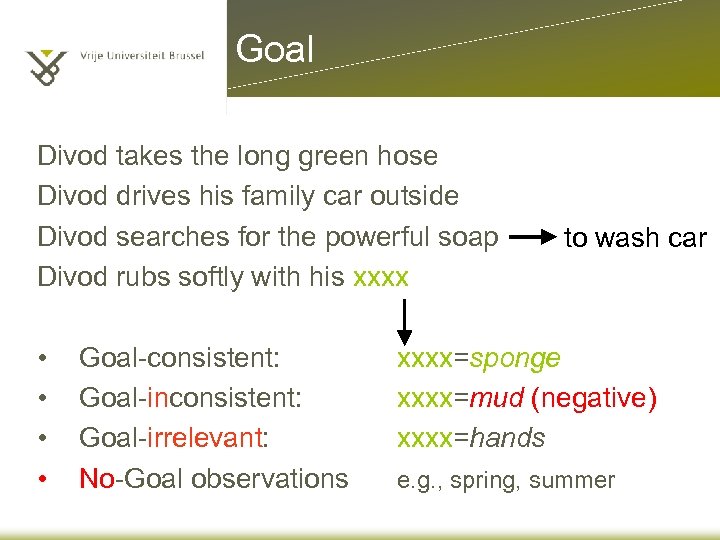 Goal Divod takes the long green hose Divod drives his family car outside Divod searches for the powerful soap Divod rubs softly with his xxxx • • Goal-consistent: Goal-inconsistent: Goal-irrelevant: No-Goal observations to wash car xxxx=sponge xxxx=mud (negative) xxxx=hands e. g. , spring, summer
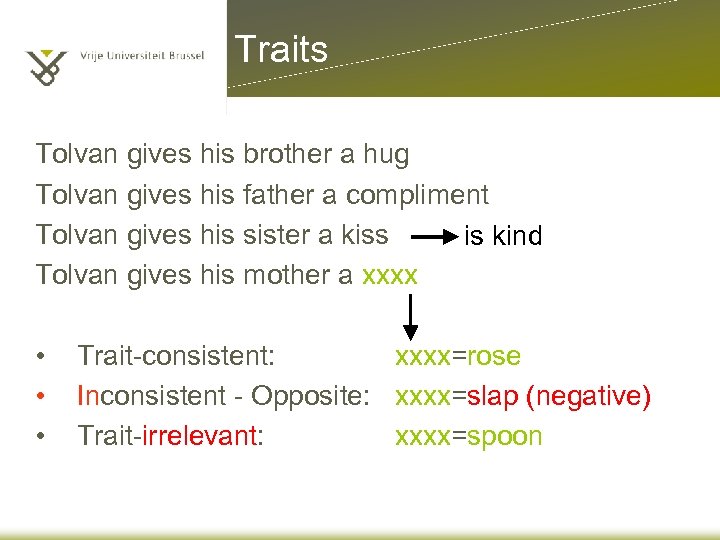 Traits Tolvan gives his brother a hug Tolvan gives his father a compliment Tolvan gives his sister a kiss is kind Tolvan gives his mother a xxxx • • • Trait-consistent: xxxx=rose Inconsistent - Opposite: xxxx=slap (negative) Trait-irrelevant: xxxx=spoon
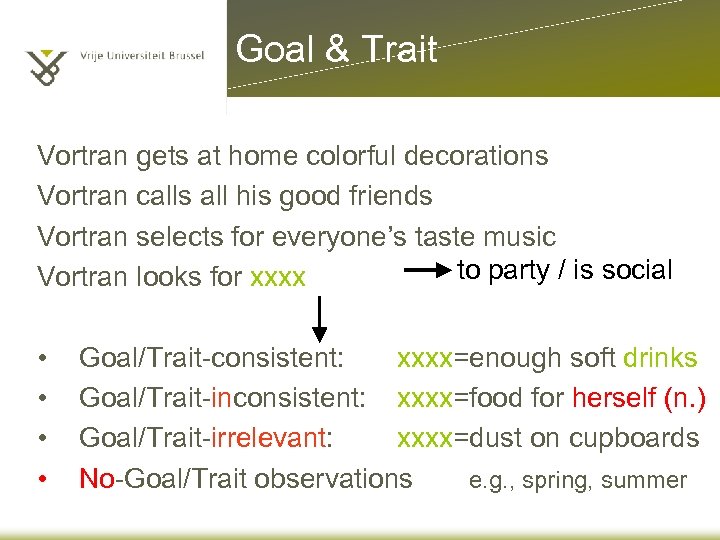 Goal & Trait Vortran gets at home colorful decorations Vortran calls all his good friends Vortran selects for everyone’s taste music to party / is social Vortran looks for xxxx • • Goal/Trait-consistent: xxxx=enough soft drinks Goal/Trait-inconsistent: xxxx=food for herself (n. ) Goal/Trait-irrelevant: xxxx=dust on cupboards No-Goal/Trait observations e. g. , spring, summer
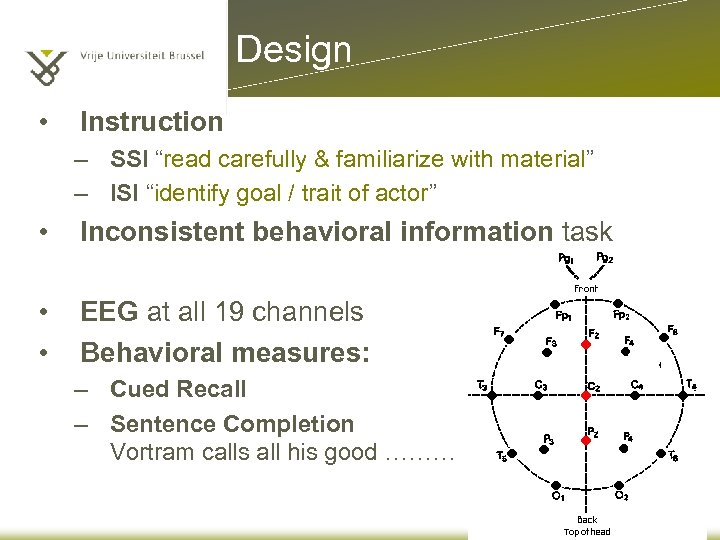 Design • Instruction – SSI “read carefully & familiarize with material” – ISI “identify goal / trait of actor” • Inconsistent behavioral information task • • EEG at all 19 channels Behavioral measures: – Cued Recall – Sentence Completion Vortram calls all his good ………
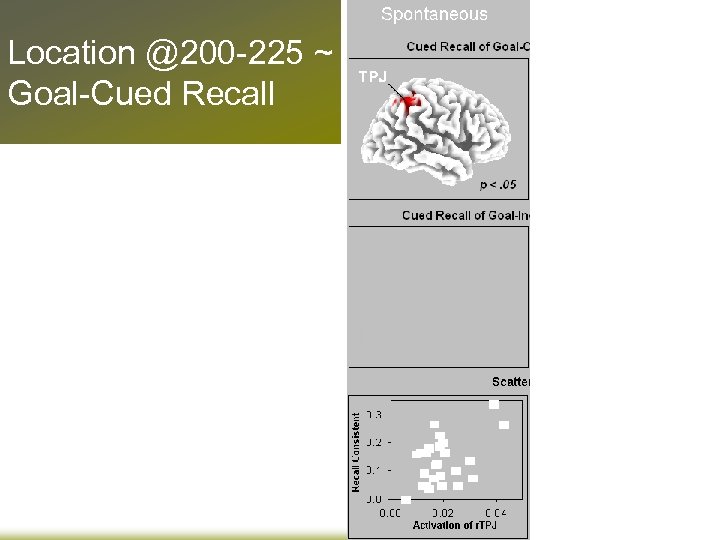
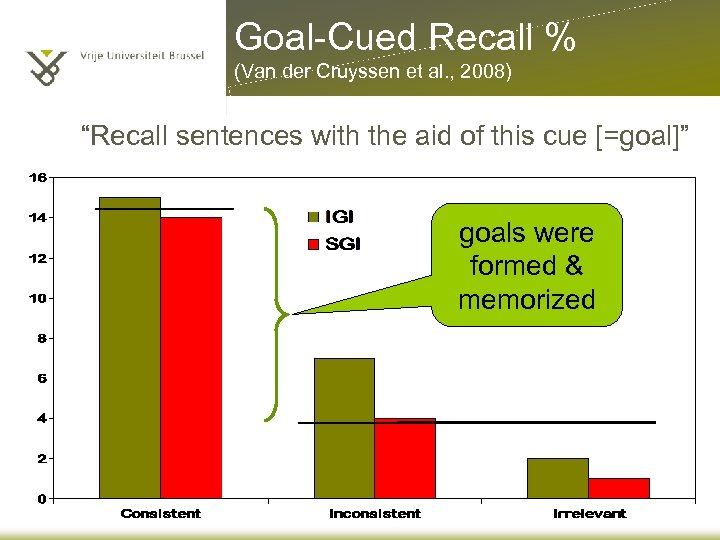 Goal-Cued Recall % (Van der Cruyssen et al. , 2008) “Recall sentences with the aid of this cue [=goal]” goals were formed & memorized
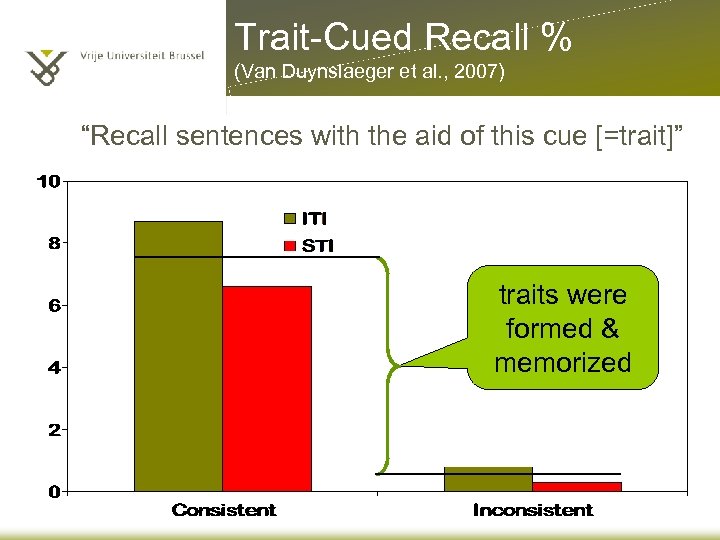 Trait-Cued Recall % (Van Duynslaeger et al. , 2007) “Recall sentences with the aid of this cue [=trait]” traits were formed & memorized
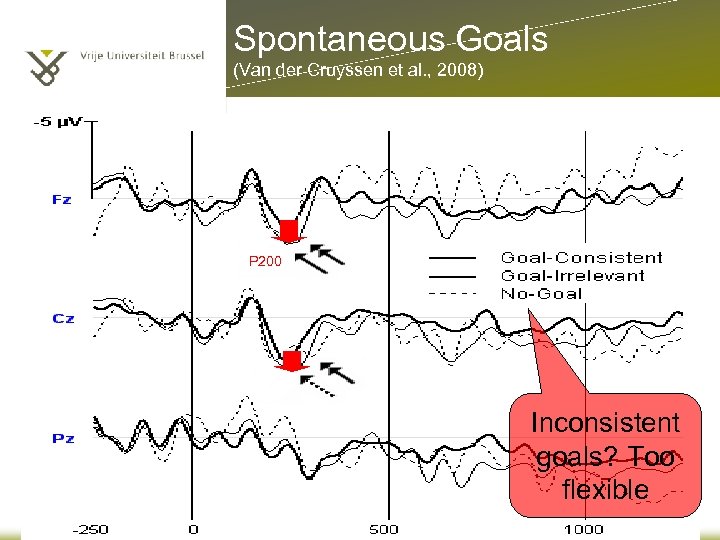
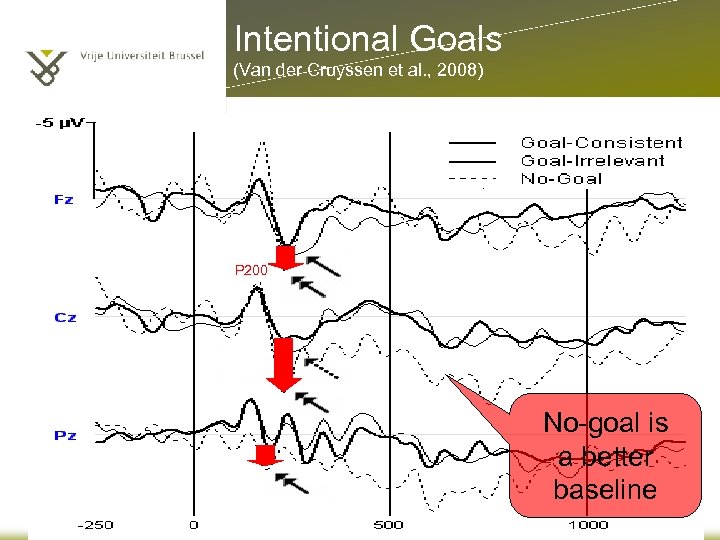
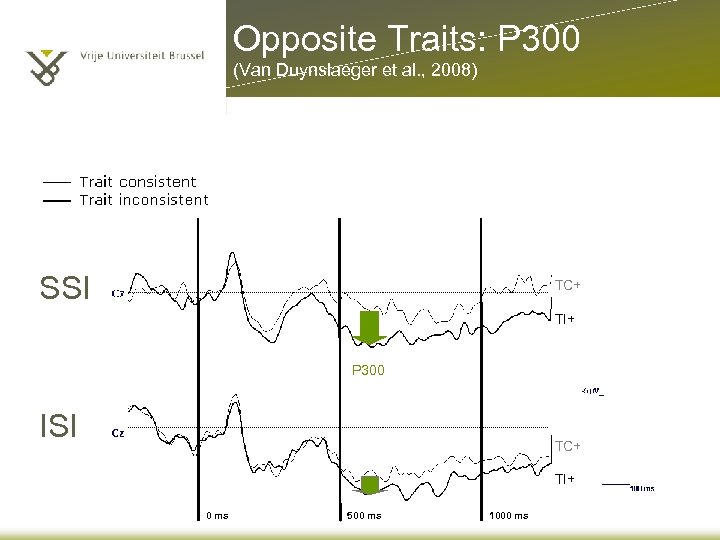
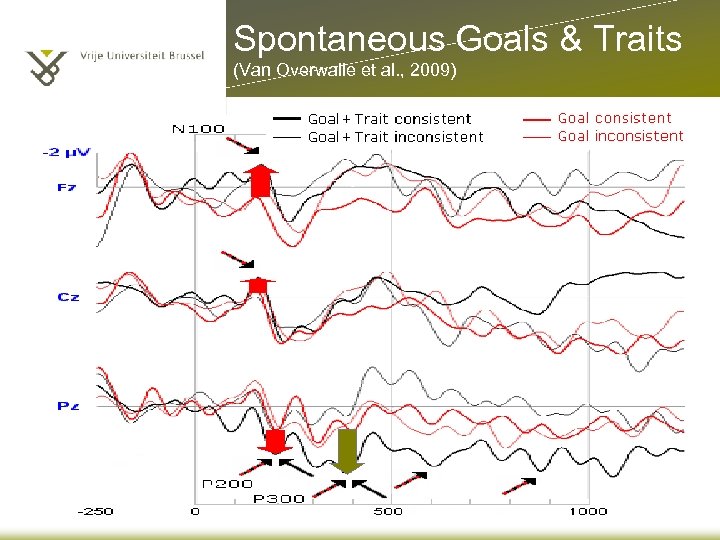
 Event-Related Potentials Event-related Potentials (ERP) are averaged EEG – reflecting processes in the brain – with millisecond accuracy N 100 -P 200 (negative-positive deflection at ~150 -200 ms) is seen after inconsistencies in perceptual features early = automatic P 300 (positive deflection at > 300 ms) is seen after inconsistencies in judgments late = reflective
 Spontaneous Goals (Van der Cruyssen et al. , 2008) P 200 Inconsistent goals? Too flexible
 Intentional Goals (Van der Cruyssen et al. , 2008) P 200 No-goal is a better baseline
 Opposite Traits: P 300 (Van Duynslaeger et al. , 2008) SSI TC+ TI+ P 300 ISI TC+ TI+ 0 ms 500 ms 1000 ms
 Spontaneous Goals & Traits (Van Overwalle et al. , 2009)
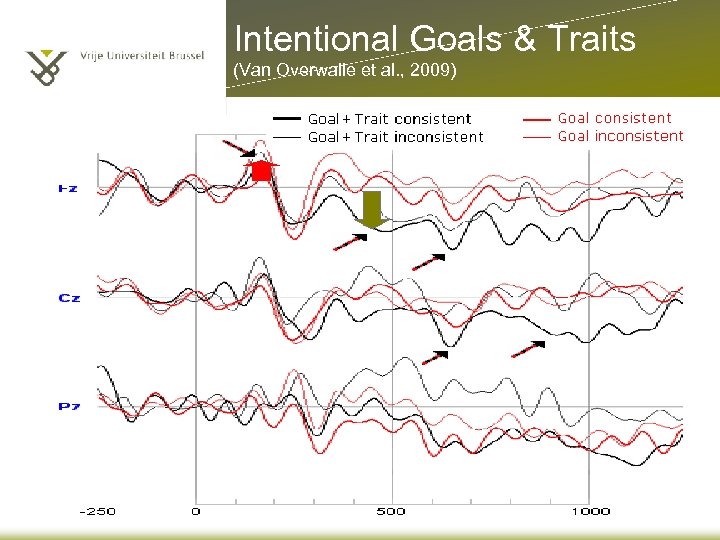 Intentional Goals & Traits (Van Overwalle et al. , 2009)
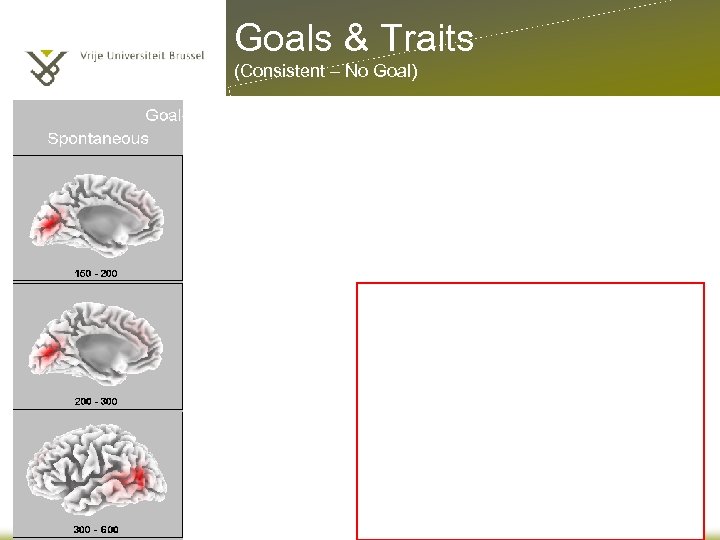
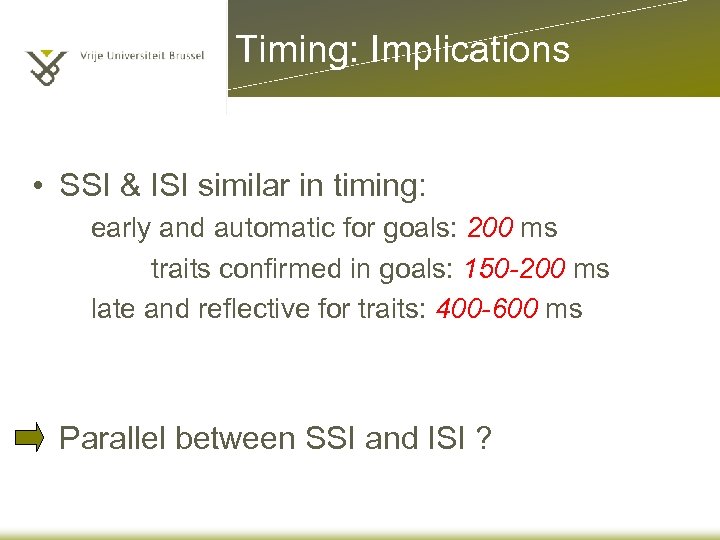 Timing: Implications • SSI & ISI similar in timing: early and automatic for goals: 200 ms traits confirmed in goals: 150 -200 ms late and reflective for traits: 400 -600 ms Parallel between SSI and ISI ?
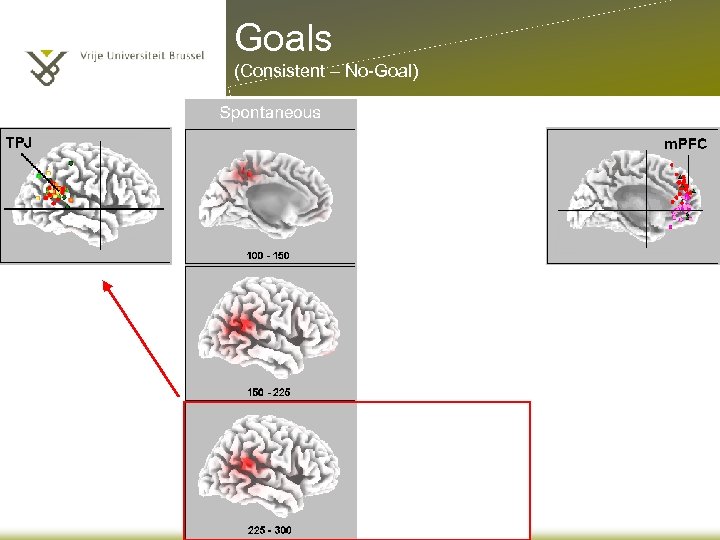 Goals (Consistent – No-Goal)
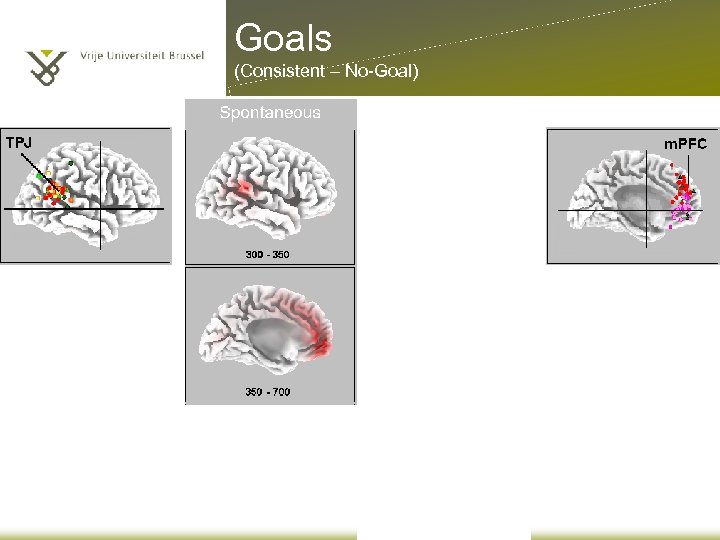 Goals (Consistent – No-Goal)
 Traits (Consistent - Irrelevant)
 Traits: Location @ 600 ms
 Goals & Traits (Consistent – No Goal)
 Location @200 -225 ~ Goal-Cued Recall
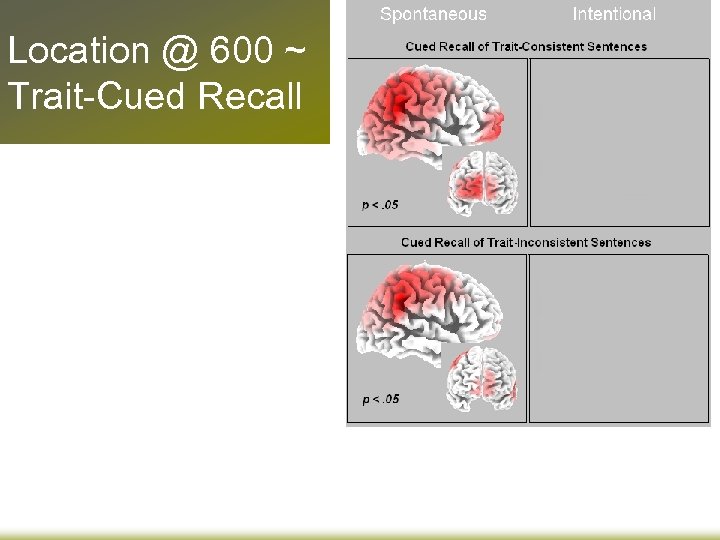 Location @ 600 ~ Trait-Cued Recall
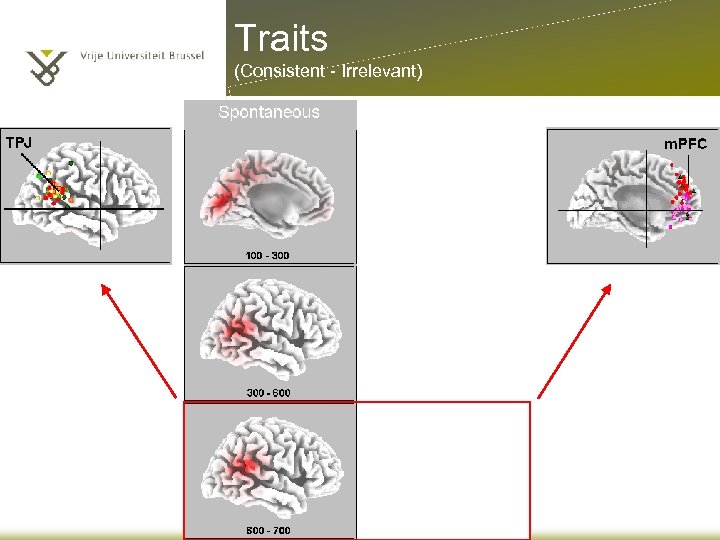
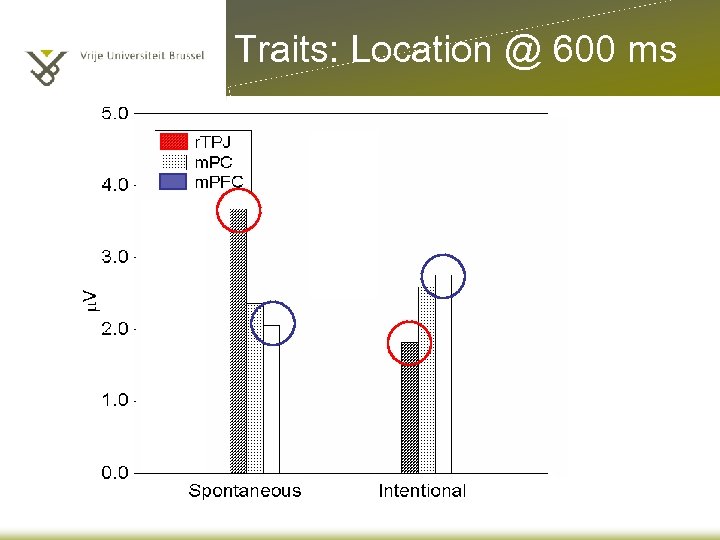
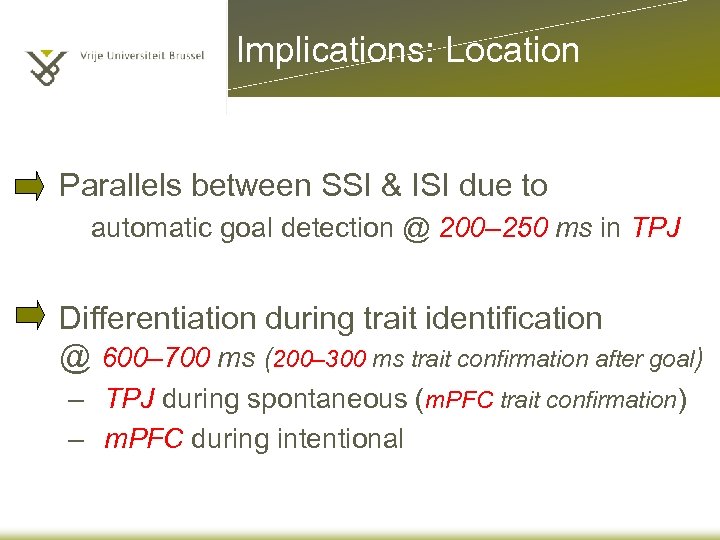 Implications: Location Parallels between SSI & ISI due to automatic goal detection @ 200– 250 ms in TPJ Differentiation during trait identification @ 600– 700 ms (200– 300 ms trait confirmation after goal) – TPJ during spontaneous (m. PFC trait confirmation) – m. PFC during intentional
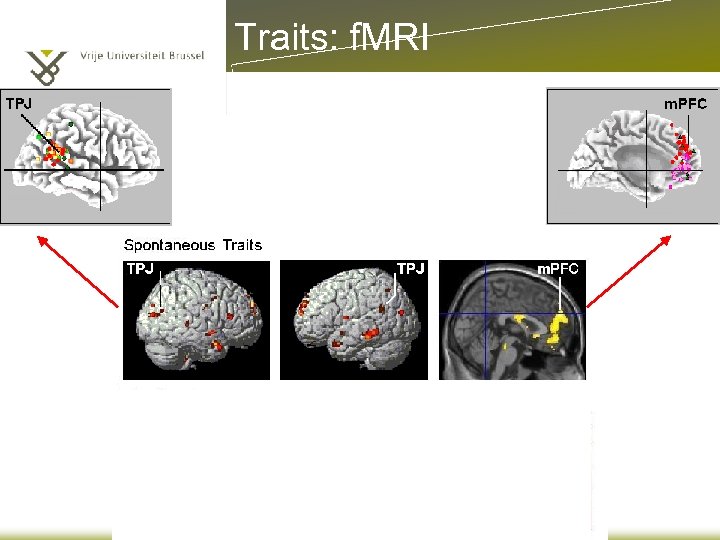 Traits: f. MRI
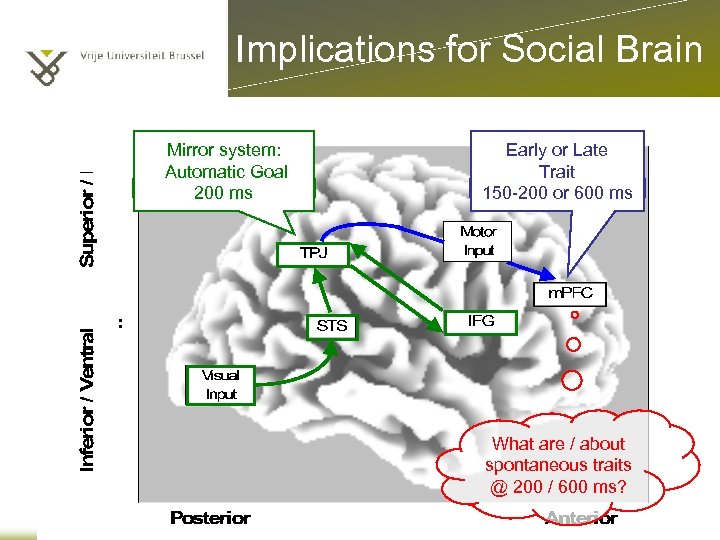 Implications for Social Brain Mirror system: Automatic Goal 200 ms Early or Late Trait 150 -200 or 600 ms What are / about spontaneous traits @ 200 / 600 ms?
 Questions for Future research • Spontaneous traits may also involve the m. PFC (but activated to a lesser extent – see also f. MRI)? • What is traits over and above goals? Traits identified so fast because confirmatory? • How to probe beliefs: Are they in fact causal inferences (which also occur spontaneously)? Saxe & Powel, 2006: Nicky knew that his sister’s flight from San Francisco was delayed ten hours. [Because] Only one flight was delayed so much that night, so when he got to the airport, he knew that flight was hers. Rob tied his dog’s leash to a lamppost while he went into a store to buy coffee. When he came out, his dog had run across the street. He guessed that [because] the leash had come untied.
 Thank you