


 Скачать презентацию Timed Automata Rajeev Alur University of Pennsylvania www
71b4c2c040a375bb08ef3fe30871fff1.ppt
- Количество слайдов: 54
 Timed Automata Rajeev Alur University of Pennsylvania www. cis. upenn. edu/~alur/ SFM-RT, Bertinoro, Sept 2004
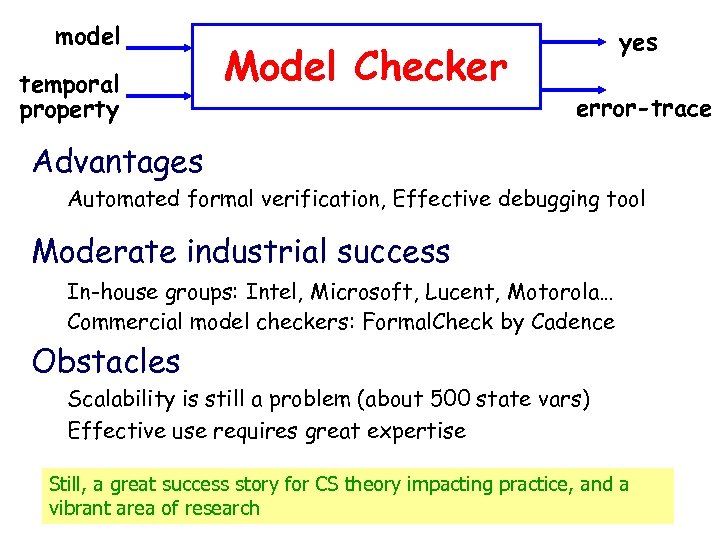 model temporal property Model Checker yes error-trace Advantages Automated formal verification, Effective debugging tool Moderate industrial success In-house groups: Intel, Microsoft, Lucent, Motorola… Commercial model checkers: Formal. Check by Cadence Obstacles Scalability is still a problem (about 500 state vars) Effective use requires great expertise Still, a great success story for CS theory impacting practice, and a vibrant area of research
 Automata in Model Checking q Automata Theory provides foundations for model checking § Automata / state machines to model components § Intersection, projection model operations § Verification is inclusion: is System contained in Spec? q Classical: Finite-state automata (regular languages) § Pushdown automata § Counter automata § Probabilistic automata …. q Timed automata as a foundation for real-time systems (automata + timing constraints
 Course Overview q Timed Automata Model q Reachability Preliminaries: Transition Systems and Equivalences Region Graph Construction Decidability Boundary q Timed Regular Languages Closure Properties and Complementation Deterministic and Two-way Automata Robustness Inclusion
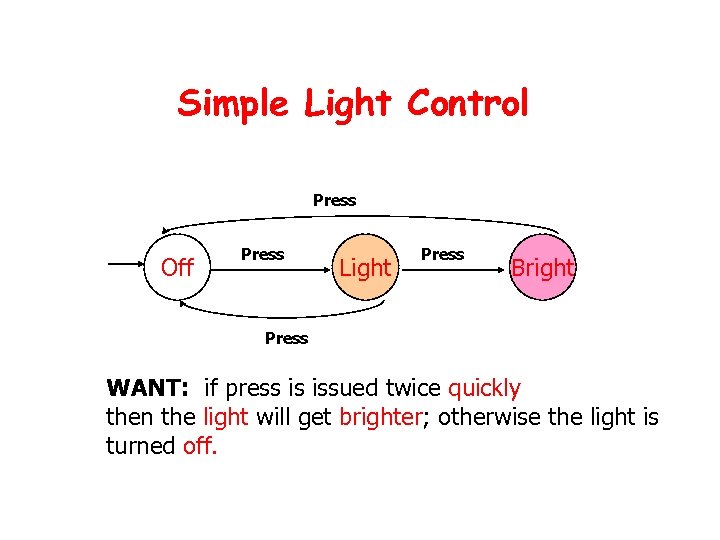 Simple Light Control Press Off Press Light Press Bright Press WANT: if press is issued twice quickly then the light will get brighter; otherwise the light is turned off.
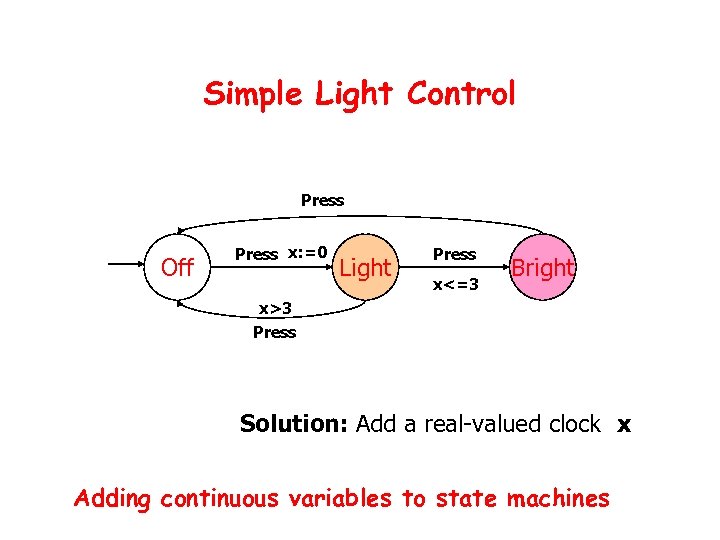 Simple Light Control Press Off Press x: =0 Light Press x<=3 Bright x>3 Press Solution: Add a real-valued clock x Adding continuous variables to state machines
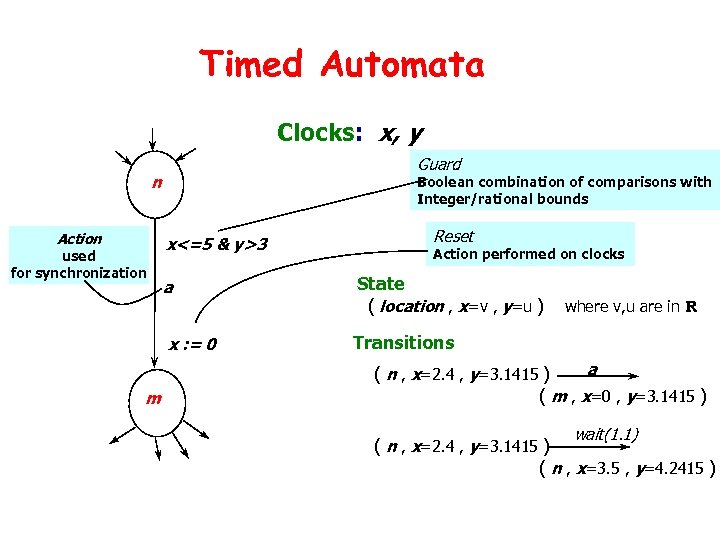 Timed Automata Clocks: x, y Guard n Action used for synchronization Boolean combination of comparisons with Integer/rational bounds x<=5 & y>3 Reset Action performed on clocks State ( location , x=v , y=u ) x : = 0 m a Transitions where v, u are in R a ( n , x=2. 4 , y=3. 1415 ) ( m , x=0 , y=3. 1415 ) wait(1. 1) ( n , x=2. 4 , y=3. 1415 ) ( n , x=3. 5 , y=4. 2415 )
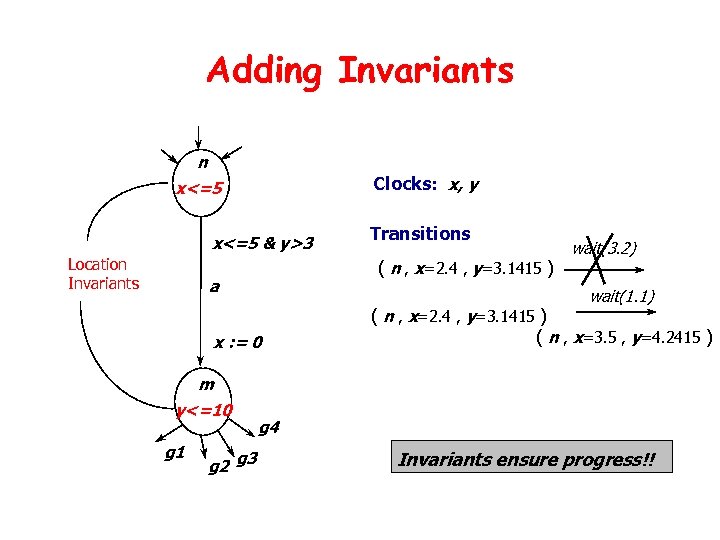 Adding Invariants n Clocks: x, y x<=5 & y>3 Location Invariants Transitions ( n , x=2. 4 , y=3. 1415 ) a wait(3. 2) wait(1. 1) x : = 0 ( n , x=2. 4 , y=3. 1415 ) ( n , x=3. 5 , y=4. 2415 ) m y<=10 g 1 g 2 g 3 g 4 Invariants ensure progress!!
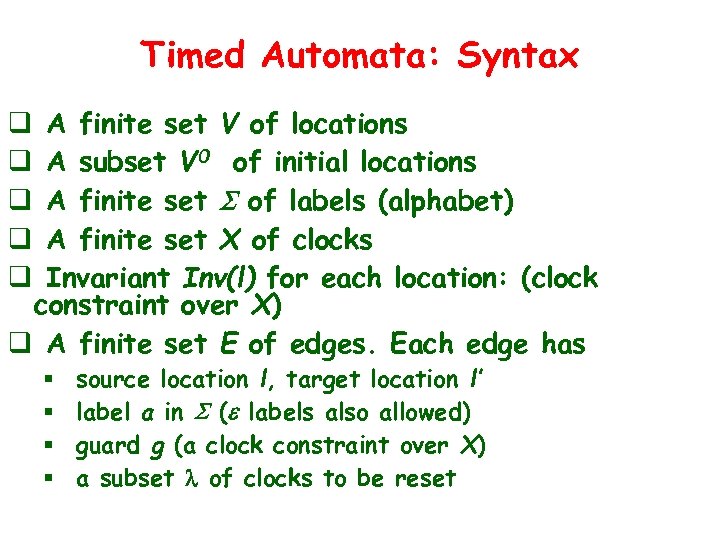 Timed Automata: Syntax A finite set V of locations A subset V 0 of initial locations A finite set S of labels (alphabet) A finite set X of clocks Invariant Inv(l) for each location: (clock constraint over X) q A finite set E of edges. Each edge has q q q § § source location l, target location l’ label a in S (e labels also allowed) guard g (a clock constraint over X) a subset l of clocks to be reset
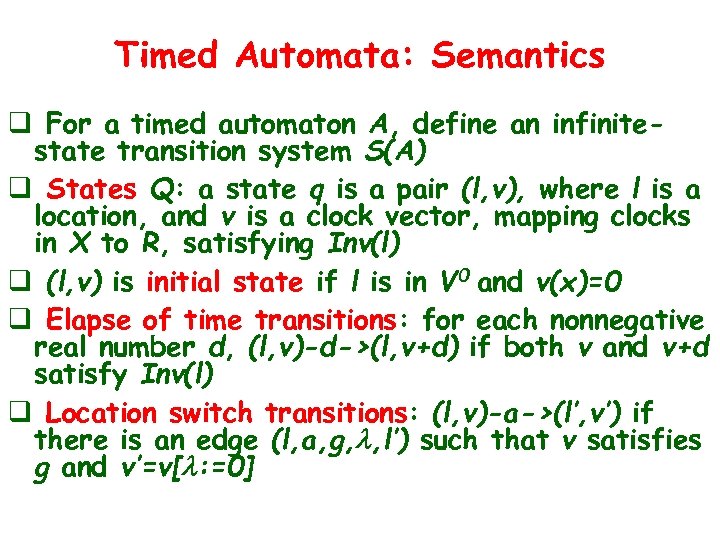 Timed Automata: Semantics q For a timed automaton A, define an infinitestate transition system S(A) q States Q: a state q is a pair (l, v), where l is a location, and v is a clock vector, mapping clocks in X to R, satisfying Inv(l) q (l, v) is initial state if l is in V 0 and v(x)=0 q Elapse of time transitions: for each nonnegative real number d, (l, v)-d->(l, v+d) if both v and v+d satisfy Inv(l) q Location switch transitions: (l, v)-a->(l’, v’) if there is an edge (l, a, g, l, l’) such that v satisfies g and v’=v[l: =0]
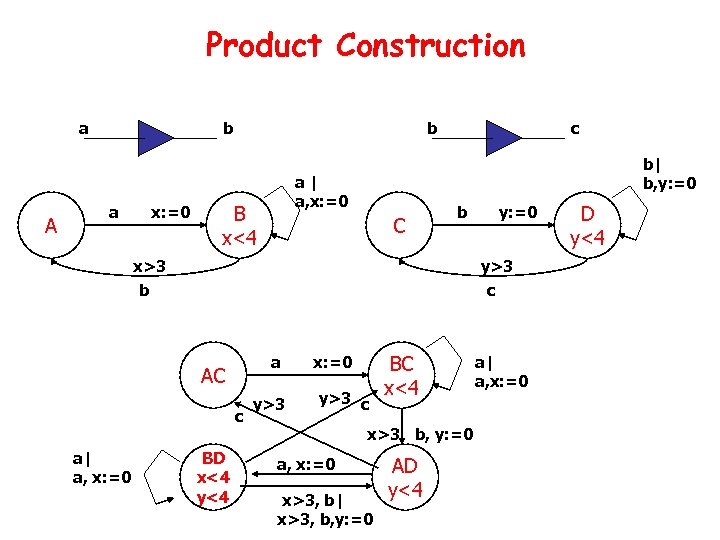 Product Construction a A b a x: =0 b b| b, y: =0 a| a, x: =0 B x<4 c C b x>3 b y>3 c a AC c a| a, x: =0 y: =0 BD x<4 y>3 x: =0 y>3 c BC x<4 x>3 b, y: =0 a, x: =0 x>3, b| x>3, b, y: =0 AD y<4 a| a, x: =0 D y<4
 Verification q System modeled as a product of timed automata q Verification problem reduced to reachability or to temporal logic model checking q Applications § Real-time controllers § Asynchronous timed circuits § Scheduling § Distributed timing-based algorithms
 Course Overview ü Timed Automata Model q Reachability Preliminaries: Transition Systems and Equivalences Region Graph Construction Decidability Boundary q Timed Regular Languages Closure Properties and Complementation Deterministic and two-way Automata Robustness Inclusion
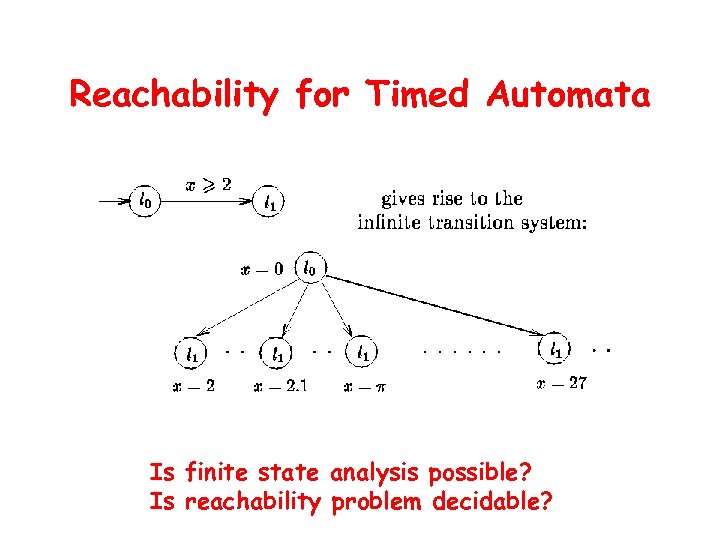 Reachability for Timed Automata Is finite state analysis possible? Is reachability problem decidable?
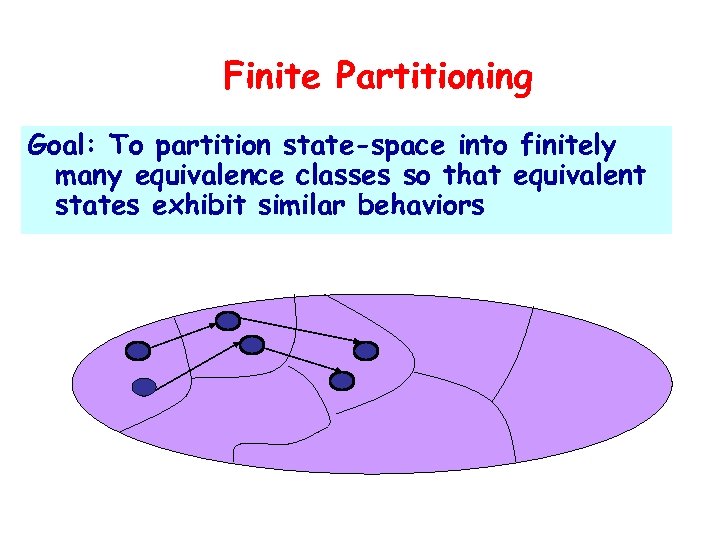 Finite Partitioning Goal: To partition state-space into finitely many equivalence classes so that equivalent states exhibit similar behaviors
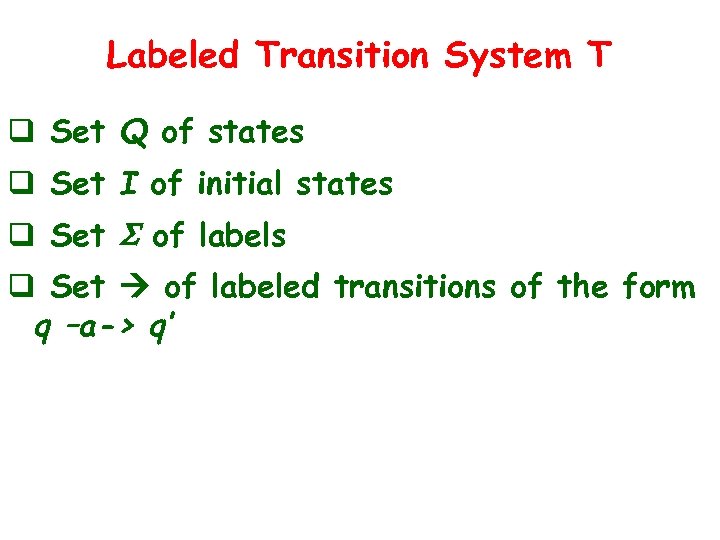 Labeled Transition System T q Set Q of states q Set I of initial states q Set S of labels q Set of labeled transitions of the form q –a-> q’
 Partitions and Quotients q Let T=(Q, I, S, ) be a transition system and @ be a partitioning of Q (i. e. an equivalence relation on Q) q Quotient T/ @ is transition system: 1. States are equivalence classes of @ 2. A state P is initial if it contains a state in I 3. Set of labels is S 4. Transitions: P –a-> P’ if q-a->q’ for some q in P and some q’ in P’
 Language Equivalence q Language of T: Set of possible finite strings over S that can be generated starting from initial states q T and T’ are language-equivalent iff they generate the same language q Roughly speaking, language equivalent systems satisfy the same set of “safety” properties
 Bisimulation q Relation @ on QXQ’ is a bisimulation iff whenever q @ q’ then if q-a->u then for some u’, u @ u’ and q’-a->u’, and if q’-a->u’ then for some u, u @ u’ and q-a->u. q Transition systems T and T’ are bisimilar if there exists bisimulation @ on QXQ’ such that For every q in I, there is q’ in I’, q @ q’ and vice versa q Many equivalent characterizations (e. g. game-theoretic) q Roughly speaking, bisimilar systems satisfy the same set of branching-time properties (including safety)
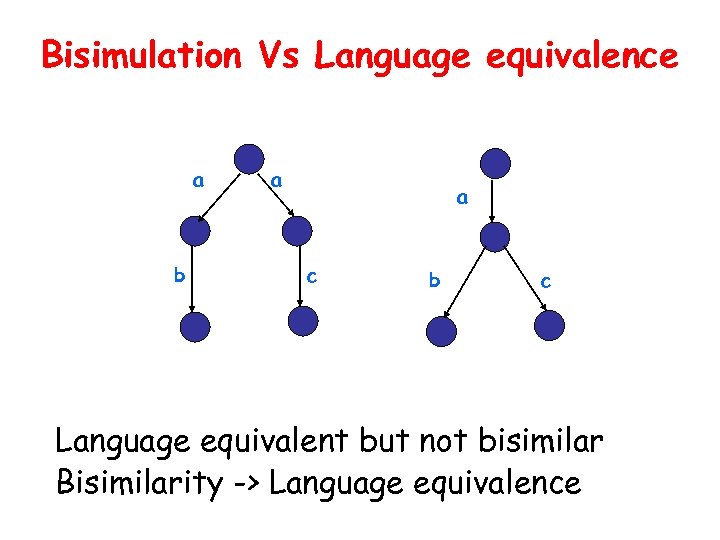 Bisimulation Vs Language equivalence a b a a c b c Language equivalent but not bisimilar Bisimilarity -> Language equivalence
 Timed Vs Time-Abstract Relations q Transition system associated with a timed automaton: • Labels on continuous steps are delays in R: Timed • Actual delays are suppressed (all continuous steps have same label): Time-abstract q Two versions of language equivalence and two versions of bisimulation q Time-abstract relations enough to capture untimed properties (e. g. reachability, safety)
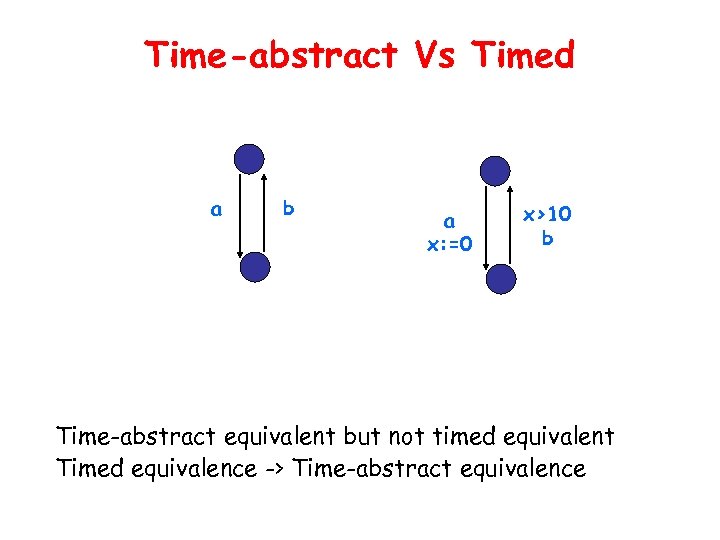 Time-abstract Vs Timed a b a x: =0 x>10 b Time-abstract equivalent but not timed equivalent Timed equivalence -> Time-abstract equivalence
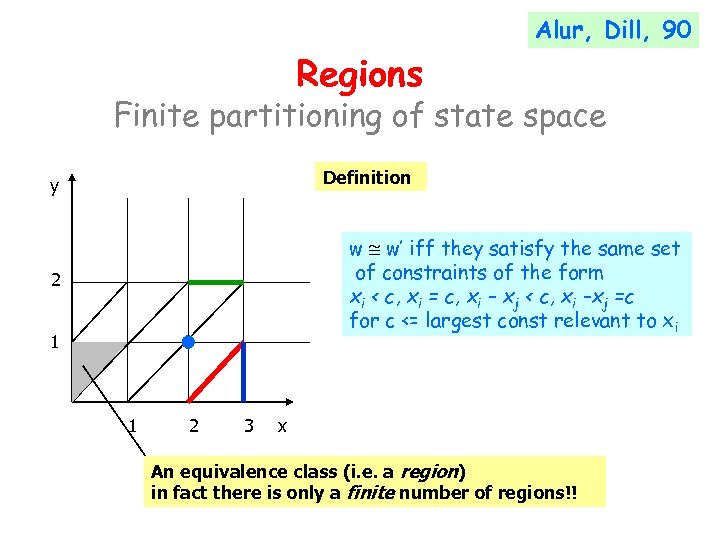 Alur, Dill, 90 Regions Finite partitioning of state space Definition y w @ w’ iff they satisfy the same set of constraints of the form xi < c, xi = c, xi – xj < c, xi –xj =c for c <= largest const relevant to xi 2 1 1 2 3 x An equivalence class (i. e. a region) in fact there is only a finite number of regions!!
![Region Operations y 2 1 r[x: =0] r r[y: =0] 1 Reset regions 2](https://present5.com/presentation/71b4c2c040a375bb08ef3fe30871fff1/image-24.jpg "Region Operations y 2 1 r[x: =0] r r[y: =0] 1 Reset regions 2") Region Operations y 2 1 r[x: =0] r r[y: =0] 1 Reset regions 2 3 x Successor regions, Succ(r) An equivalence class (i. e. a region)
Region Operations y 2 1 r[x: =0] r r[y: =0] 1 Reset regions 2 3 x Successor regions, Succ(r) An equivalence class (i. e. a region)
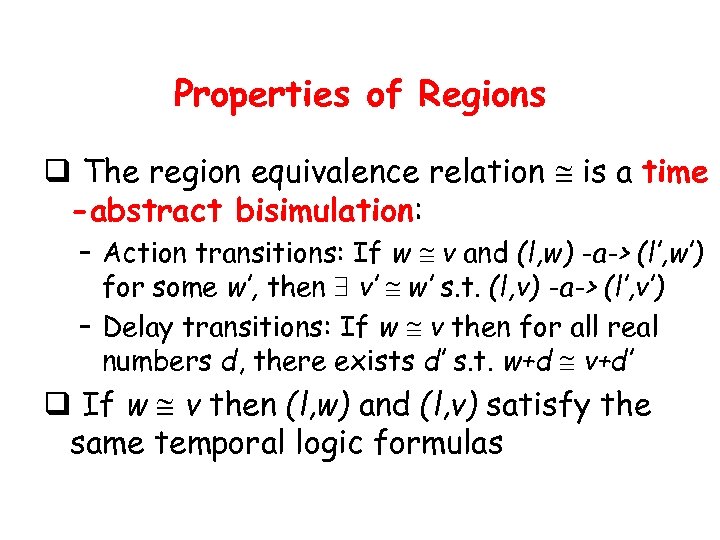 Properties of Regions q The region equivalence relation @ is a time -abstract bisimulation: – Action transitions: If w @ v and (l, w) -a-> (l’, w’) for some w’, then $ v’ @ w’ s. t. (l, v) -a-> (l’, v’) – Delay transitions: If w @ v then for all real numbers d, there exists d’ s. t. w+d @ v+d’ q If w @ v then (l, w) and (l, v) satisfy the same temporal logic formulas
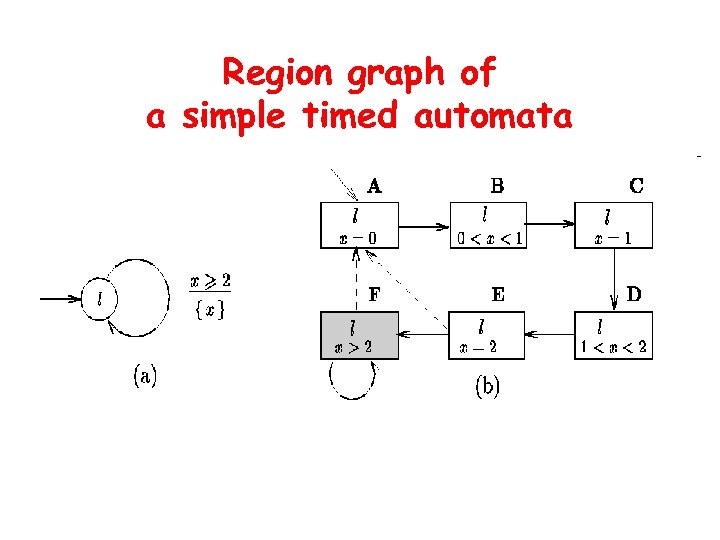 Region graph of a simple timed automata
 Region Graphs (Summary) q Finite quotient of timed automaton that is time-abstract bisimilar q Number of regions: (# of locations) times (product of all constants) times (factorial of number of clocks) q Precise complexity class of reachability problem: PSPACE (basically, exponential dependence of clocks/constants unavoidable) § PSPACE-hard even for bounded constants or for bounded number of clocks
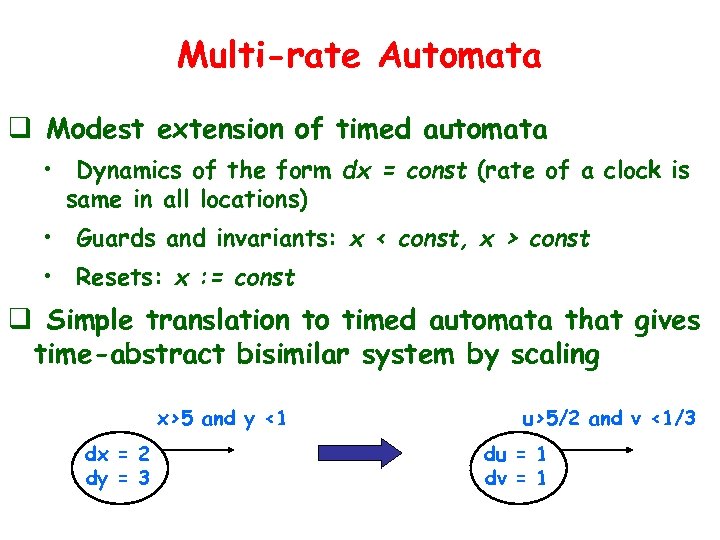 Multi-rate Automata q Modest extension of timed automata • Dynamics of the form dx = const (rate of a clock is same in all locations) • Guards and invariants: x < const, x > const • Resets: x : = const q Simple translation to timed automata that gives time-abstract bisimilar system by scaling x>5 and y <1 dx = 2 dy = 3 u>5/2 and v <1/3 du = 1 dv = 1
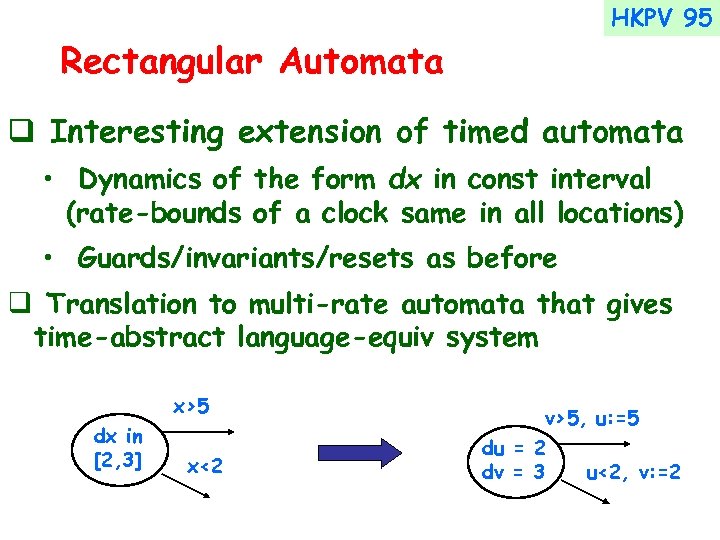 HKPV 95 Rectangular Automata q Interesting extension of timed automata • Dynamics of the form dx in const interval (rate-bounds of a clock same in all locations) • Guards/invariants/resets as before q Translation to multi-rate automata that gives time-abstract language-equiv system x>5 dx in [2, 3] x<2 v>5, u: =5 du = 2 dv = 3 u<2, v: =2
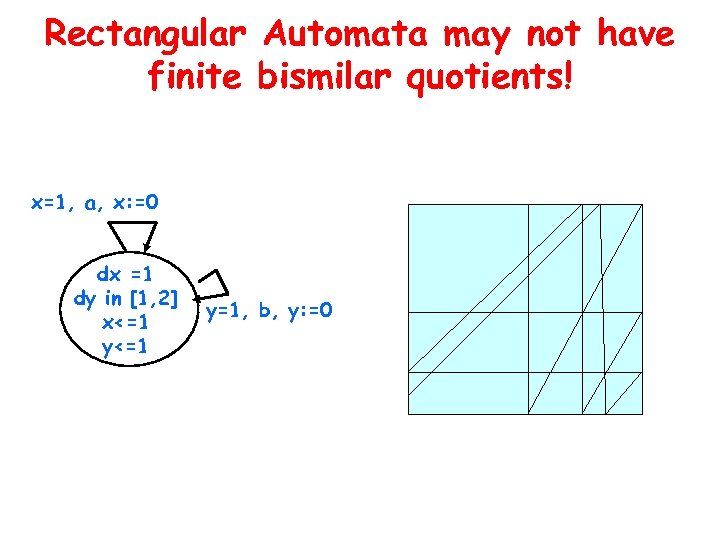 Rectangular Automata may not have finite bismilar quotients! x=1, a, x: =0 dx =1 dy in [1, 2] x<=1 y=1, b, y: =0
 Decidable Problems q Model checking branching-time properties (TCTL) of timed automata q Reachability in rectangular automata q Timed bisimilarity: are given two timed automata bisimilar? q Optimization: Compute shortest paths (e. g. minimum time reachability) in timed automata with costs on locations and edges q Controller synthesis: Computing winning strategies in timed automata with controllable and uncontrollable transitions
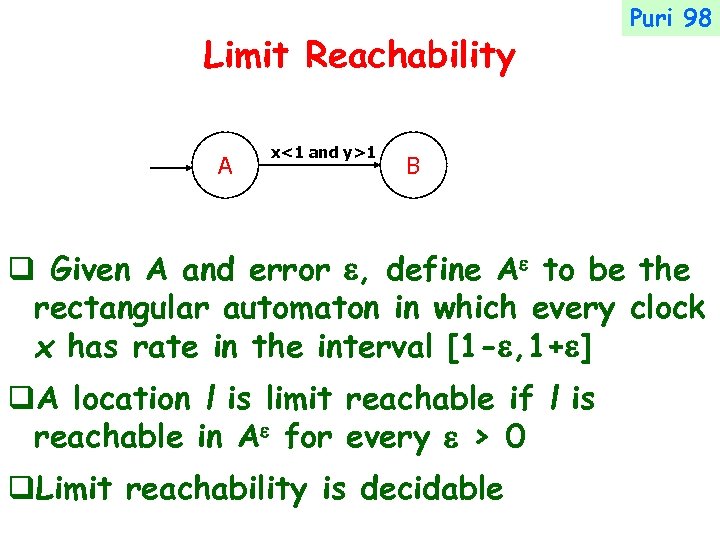 Limit Reachability A x<1 and y>1 Puri 98 B q Given A and error e, define Ae to be the rectangular automaton in which every clock x has rate in the interval [1 -e, 1+e] q. A location l is limit reachable if l is reachable in Ae for every e > 0 q. Limit reachability is decidable
 Undecidable Reachability Problems q Linear expressions as guards q Guards that compare clocks with irrational constants q Updates of the form x : = x-1 q Multi-rate automata with comparisons among clocks as guards q Timed automata + stop-watches (i. e. clocks that can have rates 0 or 1) Many such results Proofs by encoding Turing machines/2 -counter machines Sharp boundary for decidability understood
 Course Overview ü Timed Automata Model ü Reachability Preliminaries: Transition Systems and Equivalences Region Graph Construction Decidability Boundary q Timed Regular Languages Closure Properties and Complementation Deterministic and Two-way Automata Robustness Inclusion
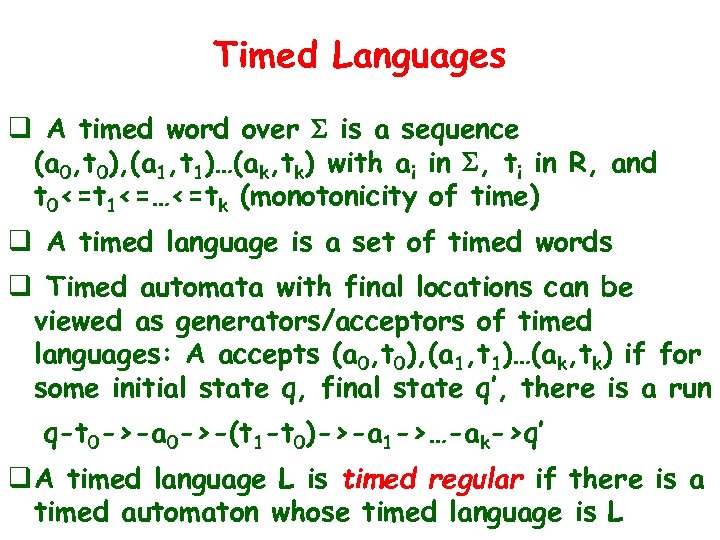 Timed Languages q A timed word over S is a sequence (a 0, t 0), (a 1, t 1)…(ak, tk) with ai in S, ti in R, and t 0<=t 1<=…<=tk (monotonicity of time) q A timed language is a set of timed words q Timed automata with final locations can be viewed as generators/acceptors of timed languages: A accepts (a 0, t 0), (a 1, t 1)…(ak, tk) if for some initial state q, final state q’, there is a run q-t 0 ->-a 0 ->-(t 1 -t 0)->-a 1 ->…-ak->q’ q A timed language L is timed regular if there is a timed automaton whose timed language is L
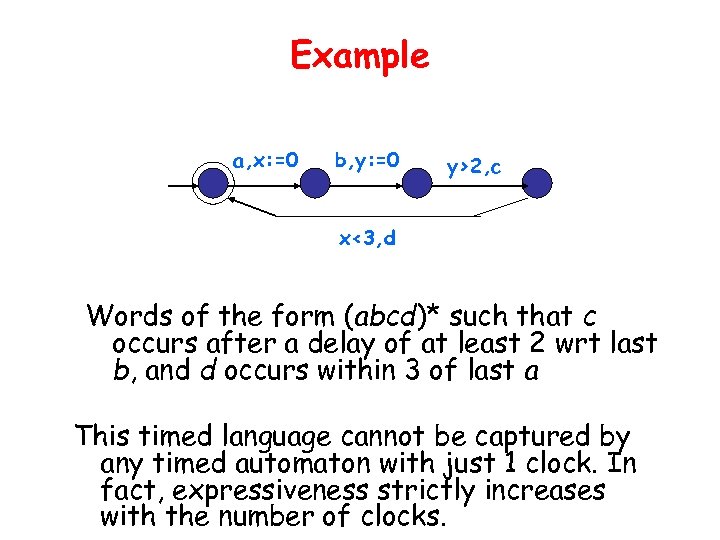 Example a, x: =0 b, y: =0 y>2, c x<3, d Words of the form (abcd)* such that c occurs after a delay of at least 2 wrt last b, and d occurs within 3 of last a This timed language cannot be captured by any timed automaton with just 1 clock. In fact, expressiveness strictly increases with the number of clocks.
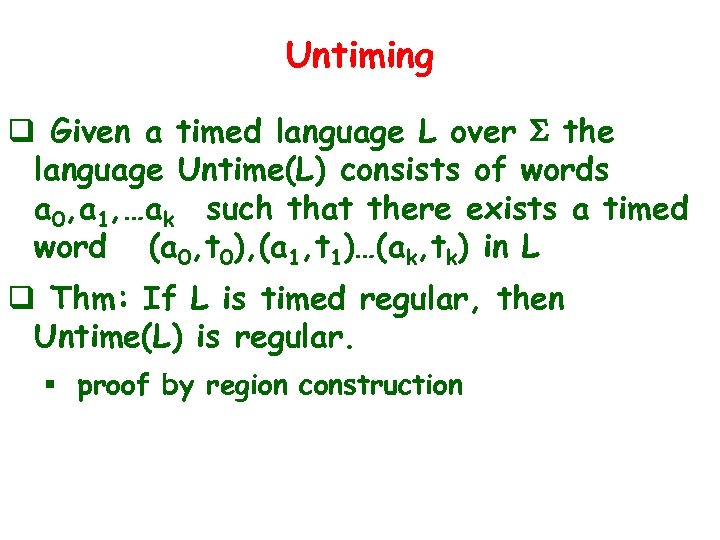 Untiming q Given a timed language L over S the language Untime(L) consists of words a 0, a 1, …ak such that there exists a timed word (a 0, t 0), (a 1, t 1)…(ak, tk) in L q Thm: If L is timed regular, then Untime(L) is regular. § proof by region construction
 Not timed regular q Delay between first and second event is the same as the delay between second and third. § Can compare delays only with constant bounds q Every a symbol is followed by some b symbol after a delay of 1 § Due to denseness, there can be unbounded number of a symbols in a unit interval § Complement of this language is timed regular q Untimed language is {anbn | n is an integer}
 Properties of Timed Regular languages q Set of timed regular languages is closed under union, intersection, but not under complementation q For every k, there is a timed regular language that cannot be expressed using only k clocks (strict hierarchy) q Epsilon-labeled switches contribute to expressive power § the language “symbols occur only at integer times” crucially uses epsilon-labeled edges
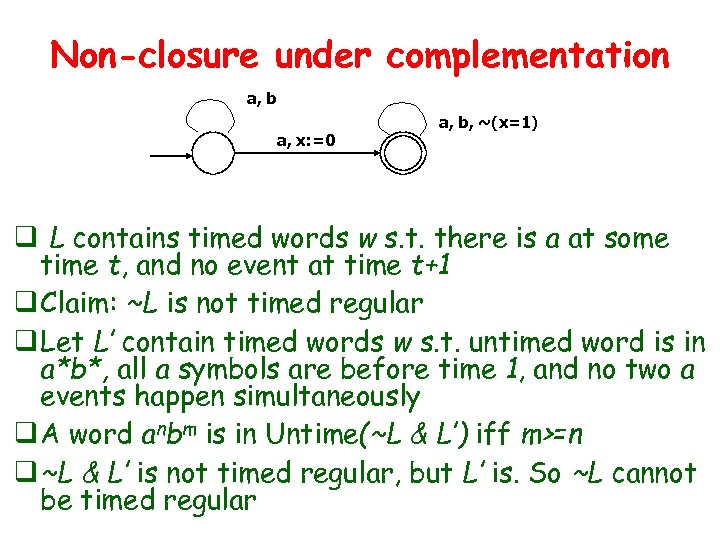 Non-closure under complementation a, b a, x: =0 a, b, ~(x=1) q L contains timed words w s. t. there is a at some time t, and no event at time t+1 q Claim: ~L is not timed regular q Let L’ contain timed words w s. t. untimed word is in a*b*, all a symbols are before time 1, and no two a events happen simultaneously q A word anbm is in Untime(~L & L’) iff m>=n q ~L & L’ is not timed regular, but L’ is. So ~L cannot be timed regular
 Undecidability q Universality problem (given a timed automaton A, does it accept all timed words) is undecidable § Proof by reduction from halting problem for 2 -counter machines § Symbols in time interval [k, k+1) encode the k-th configuration of a run of the machine § Denseness of time ensures configurations can be of unbounded lengths § Crux: how to relate successive configurations § Copying of a symbols: every a at time t in one interval has a matching a in the next interval at time t+1 § Absence of such copying can be guessed by a timed automaton
 Do we have the “right” class? q Corollary: Inclusion and Equivalence problems are undecidable for timed automata § Hierarchical verification using automata-theoretic setting not possible q Closed under union, intersection, projection, concatenation, but not complementation q Maybe the source of undecidability and non-closure under complementation is ability to model precise time constraints § some two a symbols are time 1 apart
 Search for a “better” class q Complementable subclasses § (Bounded two-way) Deterministic automata § (Recursive) Event-clock automata q. Semantics § (Inverse) Digitization, Open/closed automata § Robust timed automata q. Alternative characterizations § Timed regular expressions § Monadic second order theory + distance § Linear temporal logics with real-time
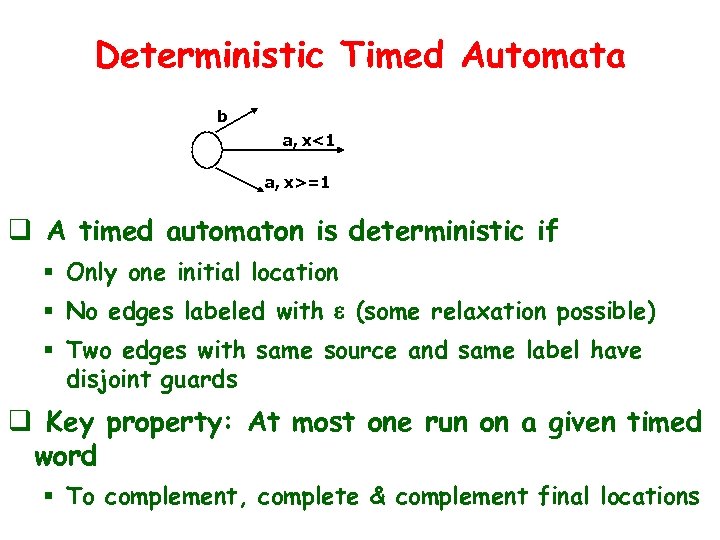 Deterministic Timed Automata b a, x<1 a, x>=1 q A timed automaton is deterministic if § Only one initial location § No edges labeled with e (some relaxation possible) § Two edges with same source and same label have disjoint guards q Key property: At most one run on a given timed word § To complement, complete & complement final locations
 Properties of DTA Languages q Closed under union, intersection, complement, but not projection q Emptiness, universality, inclusion, equivalence all decidable in PSPACE q Strictly less expressive than nondeterministic § There exists i and j s. t. tj=ti+1 q Open problem: Given a timed automaton A, is L(A) a DTA-language? (see Tripakis 00)
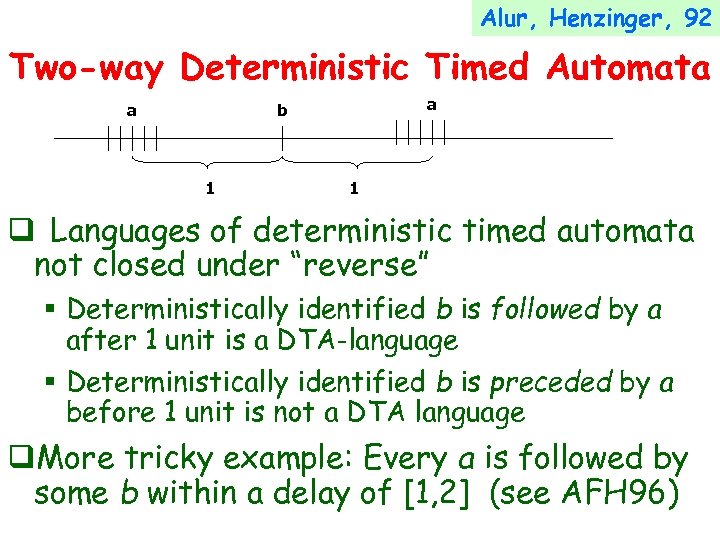 Alur, Henzinger, 92 Two-way Deterministic Timed Automata a a b 1 1 q Languages of deterministic timed automata not closed under “reverse” § Deterministically identified b is followed by a after 1 unit is a DTA-language § Deterministically identified b is preceded by a before 1 unit is not a DTA language q. More tricky example: Every a is followed by some b within a delay of [1, 2] (see AFH 96)
 Properties of two-way automata q Bounded reversal two-way timed automata: kbounded automaton visits any symbol at most k times q Every k-bounded automaton can be simulated by a forward non-deterministic one q DTAk: Languages of k-bounded deterministic timed automata q DTAk is closed under union, intersection, complementation, and has decidable inclusion/equivalence problems q DTAk forms a strict hierarchy with increasing k
 Robust Timed Automata GHJ 97 q Intuition: Rule out the ability to relate events “accurately” by forcing fuzziness in semantics q. Accept/reject a word only if a dense subset around it is accepted/rejected q. For two timed words w and w’ with same untimed word, d(w, w’)= maxi |ti-t’i| q. Use this metric to define open/closed sets q. Robust language of A is interior of the smallest closed set containing L(A)
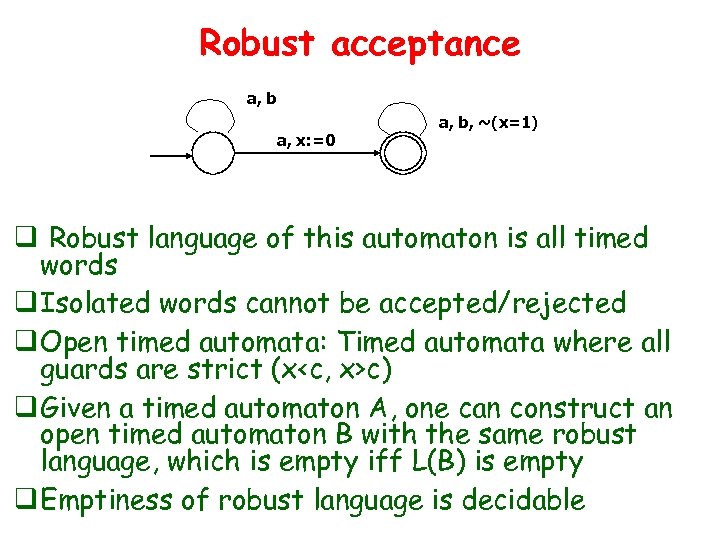 Robust acceptance a, b a, x: =0 a, b, ~(x=1) q Robust language of this automaton is all timed words q Isolated words cannot be accepted/rejected q Open timed automata: Timed automata where all guards are strict (x
 Robust timed automata q Robustness unfortunately does not solve non -complementability and undecidability of inclusion [HR 00] q. L contains timed words w s. t. untimed word is a*b*, and there exist consecutive a symbols at times t and t’ with no b in [t+1, t’+1] q. L is a robust timed language, but its complement is not q. Universality of robust timed automata is undecidable
 Ouaknine Lics’ 04 Back to Language Inclusion q Given timed automata A and B, checking if L(A) is contained in L(B) is decidable if § B has only 1 clock or § All constraints in B use the constant 0 q. B cannot be determinized, and one has to consider potentially unbounded copies of the clock of B, but termination uses well-founded ordering on the configurations q. Any relaxation on resources of B leads to undecidability
 Resource-bounded Inclusion q Critical resources of a timed automaton § Granularity 1/m (all constants are multiples of this granularity) § Number of clocks k q An observer C distinguishes automata A and B if L(A)&L(C) is non-empty but L(B)&L(C) is empty q Resource bounded inclusion: Given A, B, and resource bound (k, 1/m) check if there is an observer C with k clocks, granularity 1/m, and distinguishes A and B q Resource bounded inclusion is decidable
 Topics Not Covered q Timed w-languages q Linear/Branching-time real-time logics q Connections to monadic logics, regular expressions, circuits q Timed branching-time equivalences q Efficient implementations, tools, applications q Adding probabilities q Concurrency: Process algebras, Petri nets q Timed automata + Parameters q Games and controller synthesis
 Open Problems q There is no “final” answer to “what is the right class of timed languages” § Perturbation by adding drifts to clocks? q. Are there subclasses of timed automata for which reachability is less than PSPACE § Automata with “small” strongly-connected components q. Games on weighted timed graphs § See a recent paper ABM 04 [ICALP]