


 Скачать презентацию Time Value of Money Value of Time
cd8048cace5d80bc188502c5bb2aa7cc.ppt
- Количество слайдов: 79
 Time Value of Money Value of Time? ? ?
 Interest Rates § Why interest rates are positive? – People have ‘positive time preference’ § Behavior of human beings – Current resources have productive uses § Technology and natural process
 Simple vs. Compound Interest § Simple Interest – No interest is earned on interest money paid in the previous periods – Money grows at a slower rate § Compound Interest – Interest is earned on interest money paid in the previous periods – Money grows at a faster rate
 Simple Interest Example § $100 at 8% simple annual interest for 2 years – First year interest § 100 x (. 08) = $8 Total = 100 + 8 = $___ – Second year interest § 100 x (. 08) = $8 Total = 100 + 8 = $___ – Total Interest after 2 years: 8 + 8 = $__
 Another example § You deposit $5000 into a savings account that earns 13% simple annual interest. What is the amount in the account after 6 years? Answer: _____ § What is the total amount of interest earned? Answer: _____
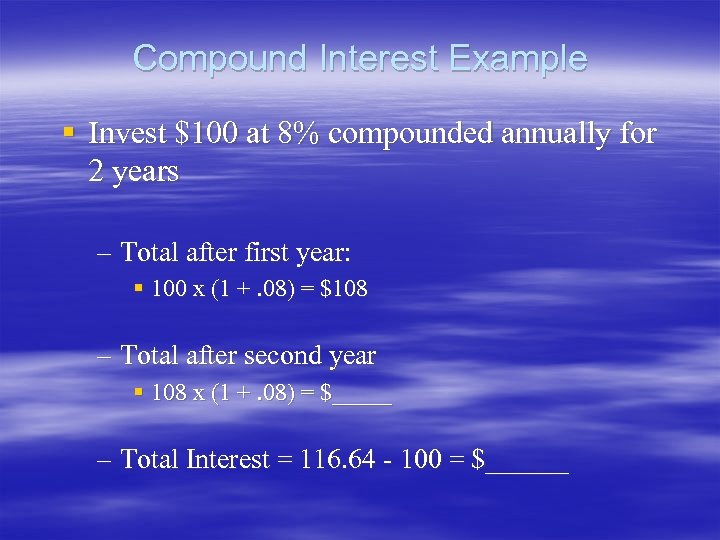 Compound Interest Example § Invest $100 at 8% compounded annually for 2 years – Total after first year: § 100 x (1 +. 08) = $108 – Total after second year § 108 x (1 +. 08) = $_____ – Total Interest = 116. 64 - 100 = $______
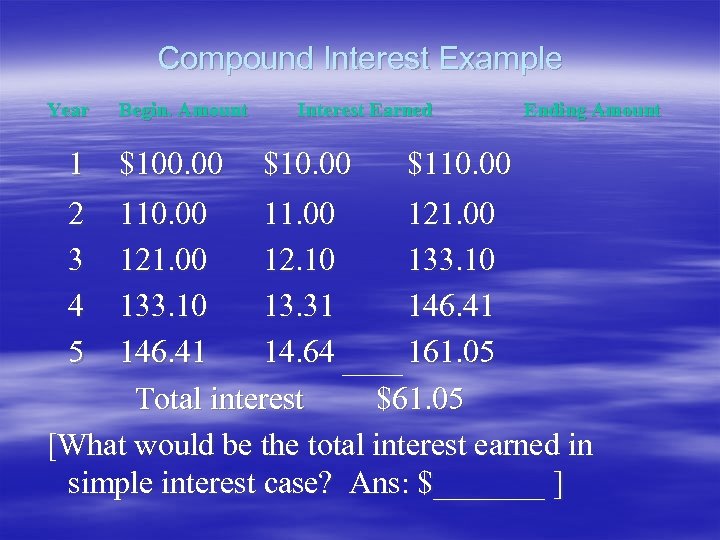 Compound Interest Example Year 1 2 3 4 5 Begin. Amount $100. 00 Interest Earned $10. 00 Ending Amount $110. 00 11. 00 121. 00 12. 10 133. 10 13. 31 146. 41 14. 64 161. 05 Total interest $61. 05 [What would be the total interest earned in simple interest case? Ans: $_______ ]
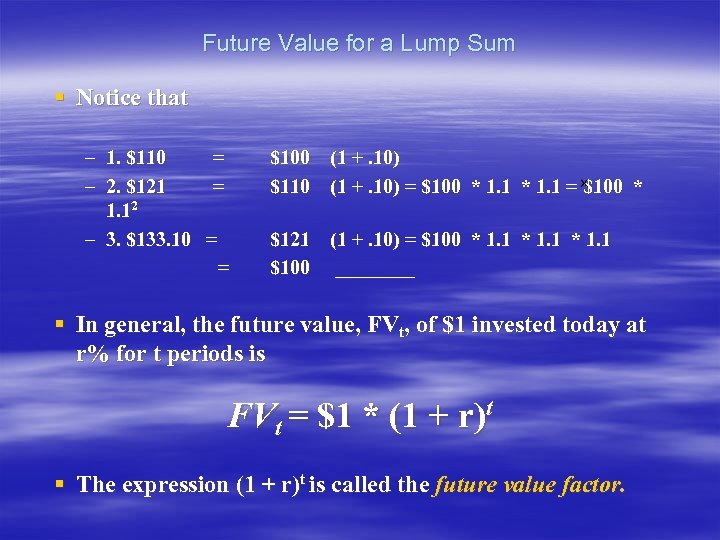 Future Value for a Lump Sum § Notice that – 1. $110 = – 2. $121 = 1. 12 – 3. $133. 10 = = $100 (1 +. 10) $110 (1 +. 10) = $100 * 1. 1 = $100 * $121 (1 +. 10) = $100 * 1. 1 $100 ____ § In general, the future value, FVt, of $1 invested today at r% for t periods is FVt = $1 * (1 + r)t § The expression (1 + r)t is called the future value factor.
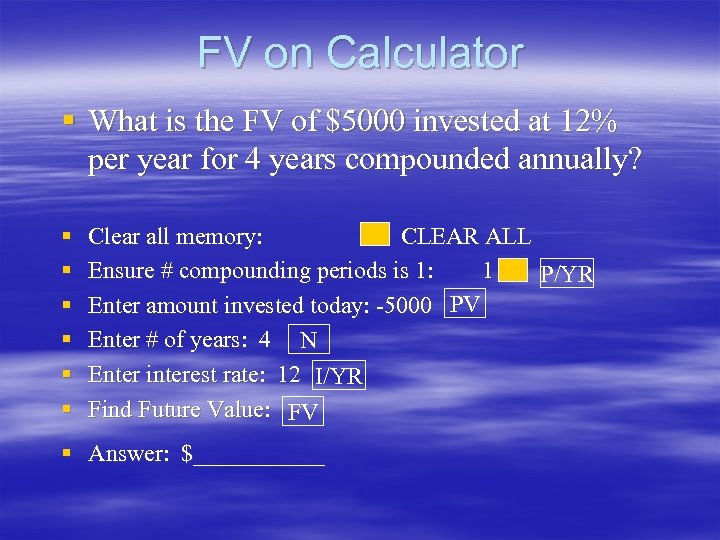 FV on Calculator § What is the FV of $5000 invested at 12% per year for 4 years compounded annually? § § § Clear all memory: CLEAR ALL Ensure # compounding periods is 1: 1 P/YR Enter amount invested today: -5000 PV Enter # of years: 4 N Enter interest rate: 12 I/YR Find Future Value: FV § Answer: $______
 Notice. . § You entered $5000 as a negative amount § You got FV answer as a positive amount § Why the negative sign? § It turns out that the calculator follows ‘cash flow convention’ – Cash outflow is negative (i. e. money going out) – Cash inflow is positive (i. e. money coming in)
 Another example § Calculate the future value of $500 invested today at 9% per year for 35 years § Answer: ____
 Present Values § Here you simply reverse the question § You are given – Future Value – Number of Periods – Interest Rate § and need to find the sum (PRESENT VALUE) needed today to achieve that FV
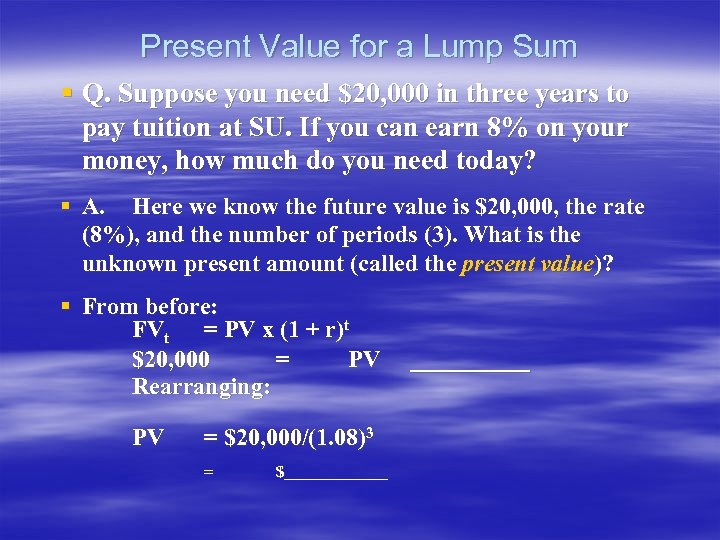 Present Value for a Lump Sum § Q. Suppose you need $20, 000 in three years to pay tuition at SU. If you can earn 8% on your money, how much do you need today? § A. Here we know the future value is $20, 000, the rate (8%), and the number of periods (3). What is the unknown present amount (called the present value)? § From before: FVt = PV x (1 + r)t $20, 000 = PV Rearranging: PV = $20, 000/(1. 08)3 = $_______
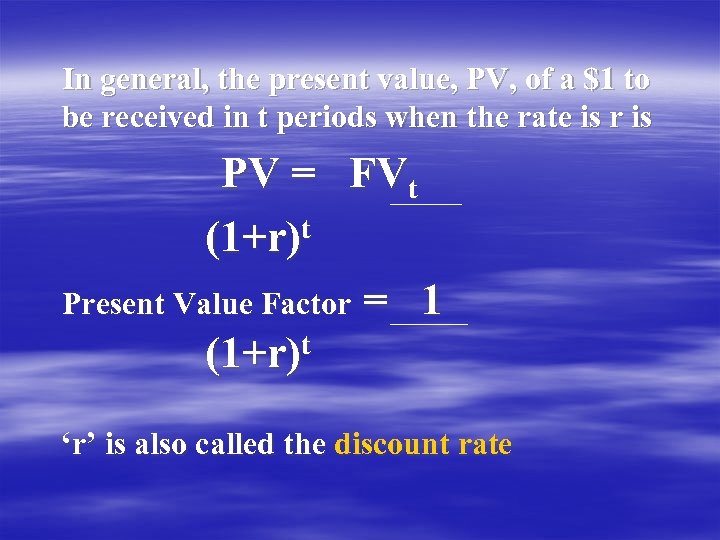 In general, the present value, PV, of a $1 to be received in t periods when the rate is r is PV = FVt (1+r)t Present Value Factor = 1 (1+r)t ‘r’ is also called the discount rate
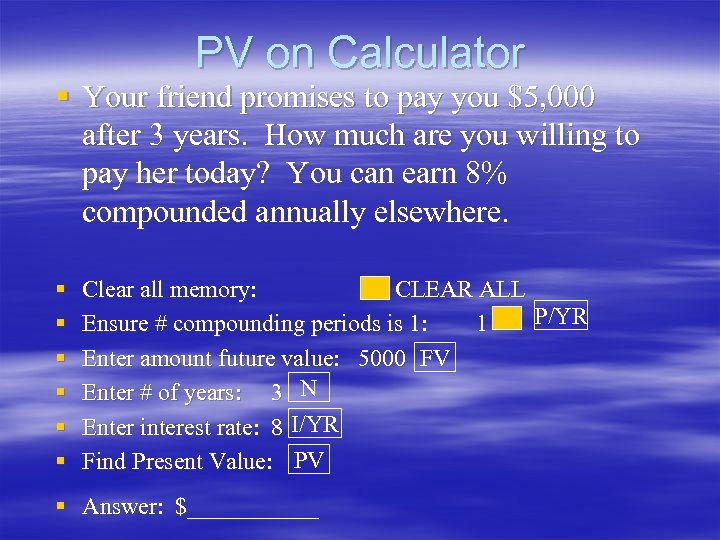 PV on Calculator § Your friend promises to pay you $5, 000 after 3 years. How much are you willing to pay her today? You can earn 8% compounded annually elsewhere. § § § Clear all memory: CLEAR ALL P/YR Ensure # compounding periods is 1: 1 Enter amount future value: 5000 FV Enter # of years: 3 N Enter interest rate: 8 I/YR Find Present Value: PV § Answer: $______
 Another PV example § Vincent van Gogh painted Portrait of Dr. Gachet in 1889. It sold in 1987 for $82. 5 million. How much should he have sold it in 1889 if annual interest rate over the period was 9%? § Answer: _______
 Vincent Van Gogh The Portrait of Dr Gachet
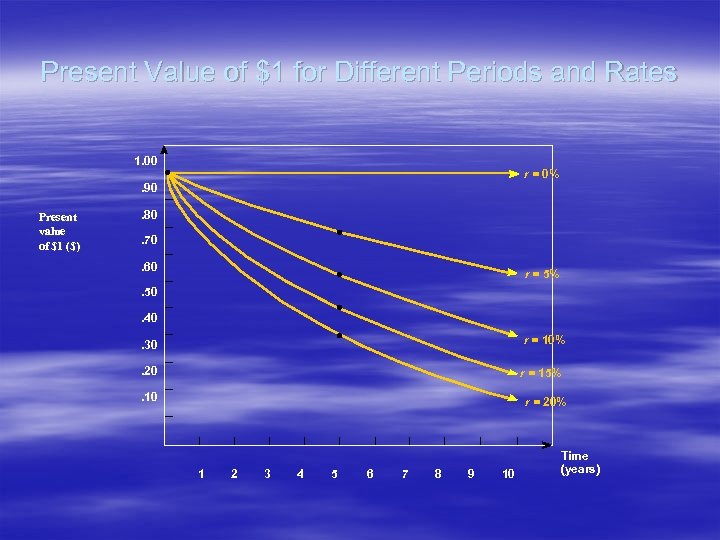 Present Value of $1 for Different Periods and Rates 1. 00 r = 0% . 90 Present value of $1 ($) . 80. 70. 60 r = 5% . 50. 40 r = 10% . 30. 20 r = 15% . 10 r = 20% 1 2 3 4 5 6 7 8 9 10 Time (years)
 Notice. . . § As time increases, present value declines § As interest rate increases, present value declines § The rate of decline is not a straight line!
 Notice Four Components § § Present Value (PV) Future Value at time t (FVt) Interest rate period (r) Number of periods (t) § Given any three, the fourth can be found
 Finding ‘r’ § You need $8, 000 after four years. You have $7, 000 today. What annual interest rate must you earn to have that sum in the future? Answer: _____
 Finding ‘t’ § How many years does it take to double your $100, 000 inheritance if you can invest the money earning 11% compounded annually? Answer: _____
 Note: § When calculating future value what you are doing is compounding a sum § When calculating present value, what you are doing is discounting a sum
 FV - Multiple Cash Flows § You deposit $100 in one year $200 in two years $300 in three years How much will you have in three years? r = 7% per year. § Answer: ______ § Draw a time line!!!
 PV - Multiple Cash Flows § An investment pays: $200 in year 1 $600 in year 3 $400 in year 2 $800 in year 4 You can earn 12% per year on similar investments. What is the most you are willing to pay now for this investment? § Answer: _____ § Draw time line!!!
 Important… § You can add cash flows ONLY if they are brought back (or taken forward) to the SAME point in time § Adding cash flows occurring at different points in time is like adding apples and oranges!
 Level Multiple Cash Flows § Examples of constant level cash flows for more than one period – Annuities – Perpetuities § Most of the time we assume that the cash flow occurs at the END of the period
 Examples of Annuities § § § Car loan payments Mortgage on a house Most other consumer loans Contributions to a retirement plan Retirement payments from a pension plan
 Saving a Fixed Sum § You save $450 in a retirement fund every month for the next 30 years. The interest rate earned is 10%. What is the accumulated balance at the end of 30 years? § This is Future Value of an Annuity
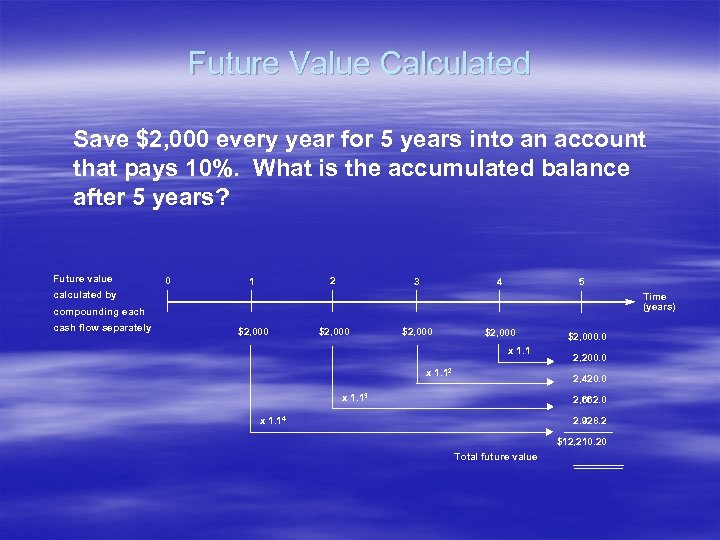 Future Value Calculated Save $2, 000 every year for 5 years into an account that pays 10%. What is the accumulated balance after 5 years? Future value 0 2 1 3 4 5 calculated by Time (years) compounding each cash flow separately $2, 000 x 1. 12 $2, 000. 0 2, 200. 0 2, 420. 0 x 1. 13 2, 662. 0 2. 928. 2 x 1. 14 $12, 210. 20 Total future value
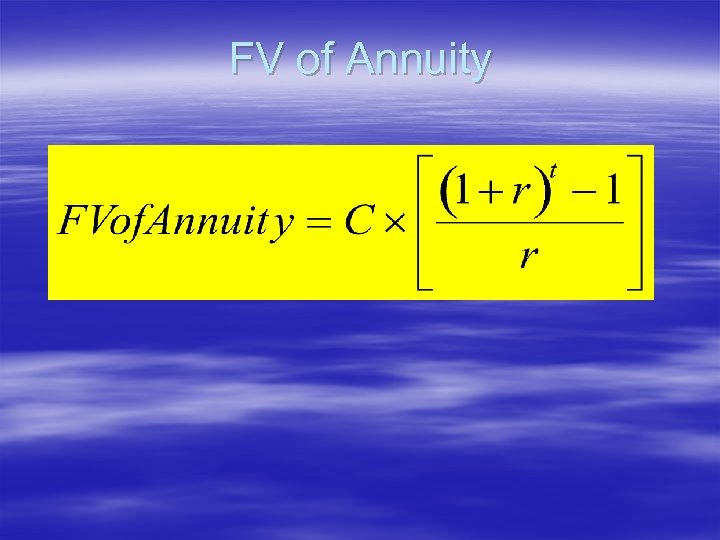 FV of Annuity
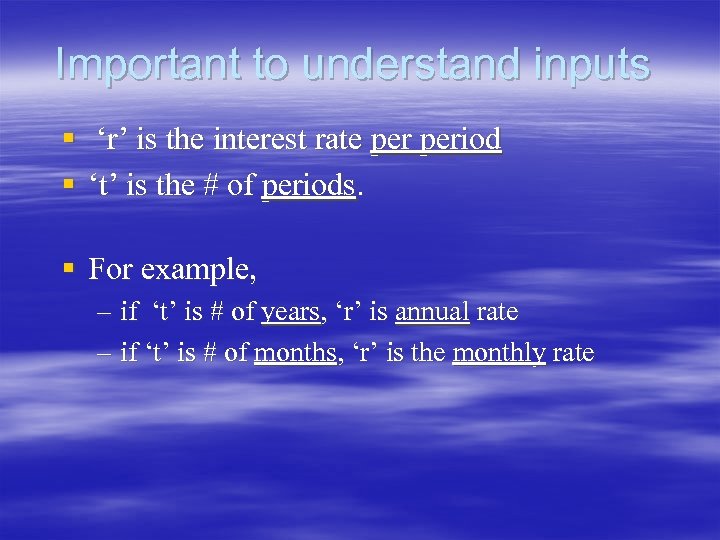 Important to understand inputs § ‘r’ is the interest rate period § ‘t’ is the # of periods. § For example, – if ‘t’ is # of years, ‘r’ is annual rate – if ‘t’ is # of months, ‘r’ is the monthly rate
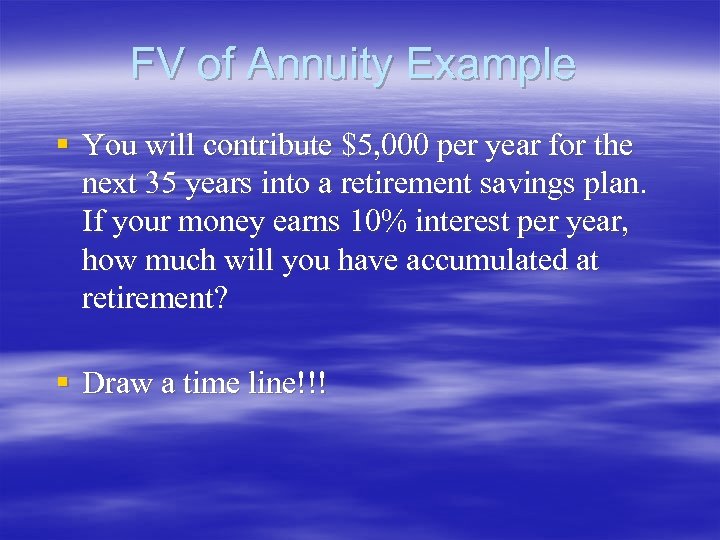 FV of Annuity Example § You will contribute $5, 000 per year for the next 35 years into a retirement savings plan. If your money earns 10% interest per year, how much will you have accumulated at retirement? § Draw a time line!!!
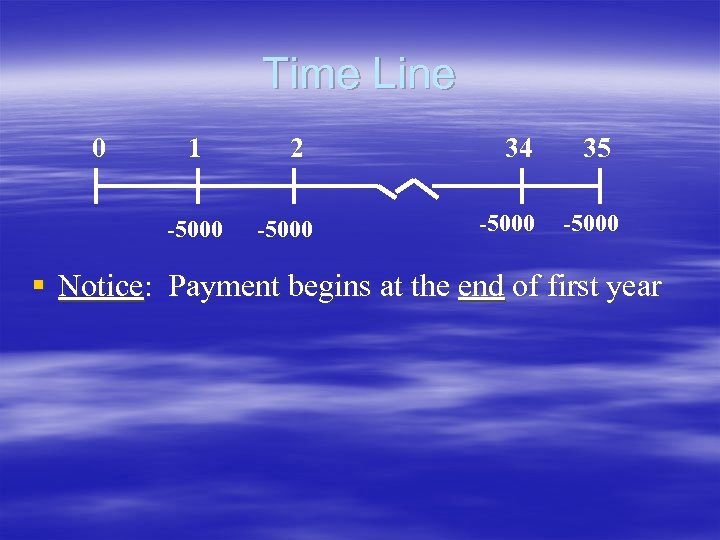 Time Line 0 1 -5000 2 -5000 34 -5000 35 -5000 § Notice: Payment begins at the end of first year
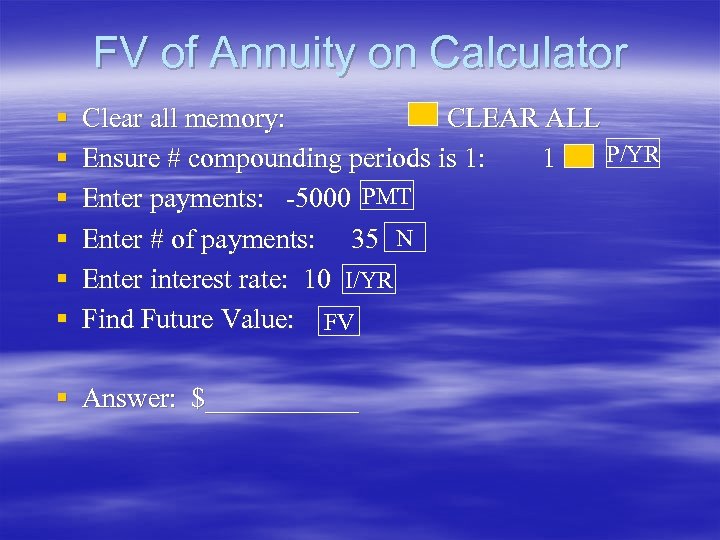 FV of Annuity on Calculator § § § Clear all memory: CLEAR ALL P/YR Ensure # compounding periods is 1: 1 Enter payments: -5000 PMT Enter # of payments: 35 N Enter interest rate: 10 I/YR Find Future Value: FV § Answer: $______
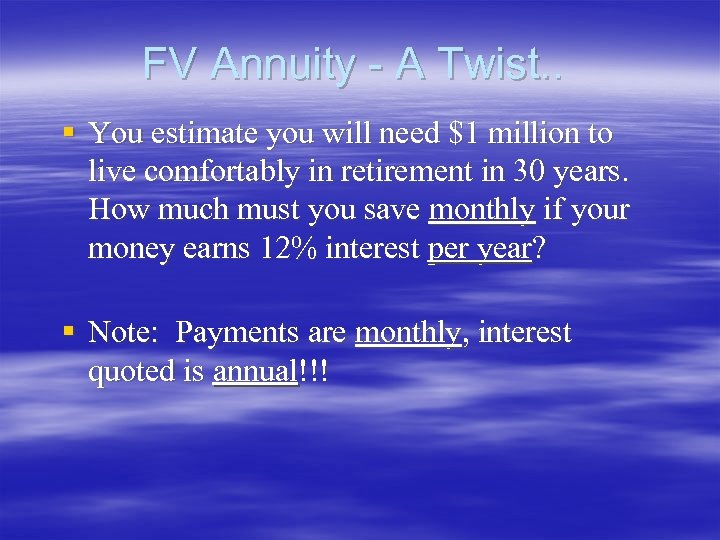 FV Annuity - A Twist. . § You estimate you will need $1 million to live comfortably in retirement in 30 years. How much must you save monthly if your money earns 12% interest per year? § Note: Payments are monthly, interest quoted is annual!!!
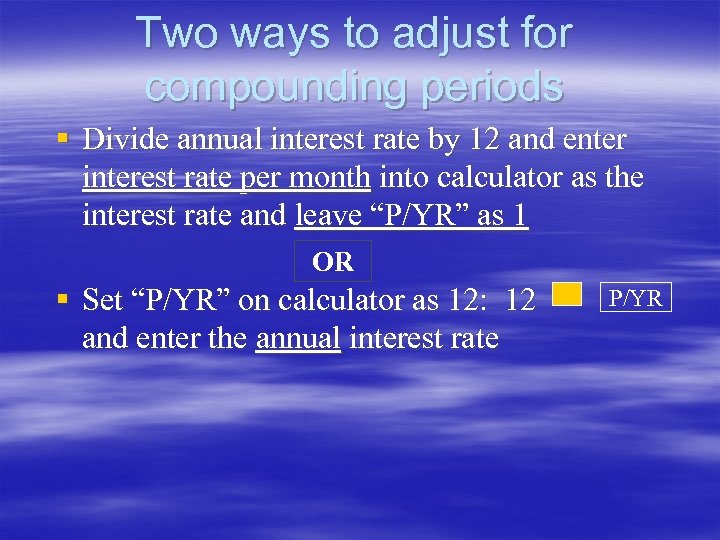 Two ways to adjust for compounding periods § Divide annual interest rate by 12 and enter interest rate per month into calculator as the interest rate and leave “P/YR” as 1 OR § Set “P/YR” on calculator as 12: 12 and enter the annual interest rate P/YR
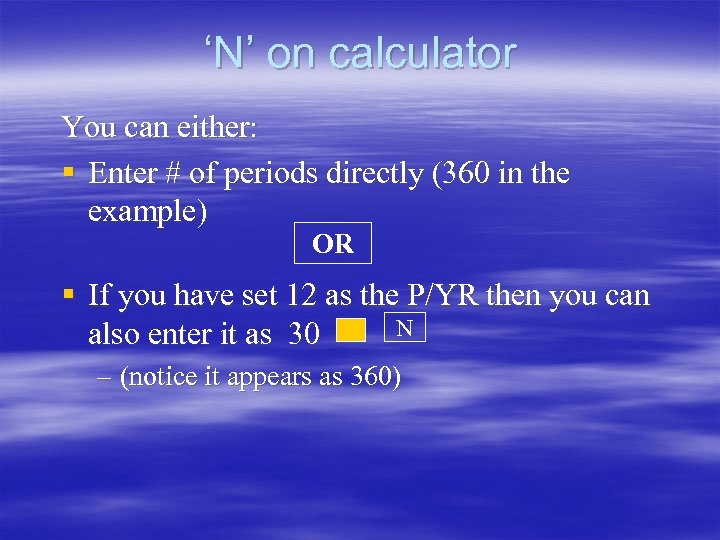 ‘N’ on calculator You can either: § Enter # of periods directly (360 in the example) OR § If you have set 12 as the P/YR then you can N also enter it as 30 – (notice it appears as 360)
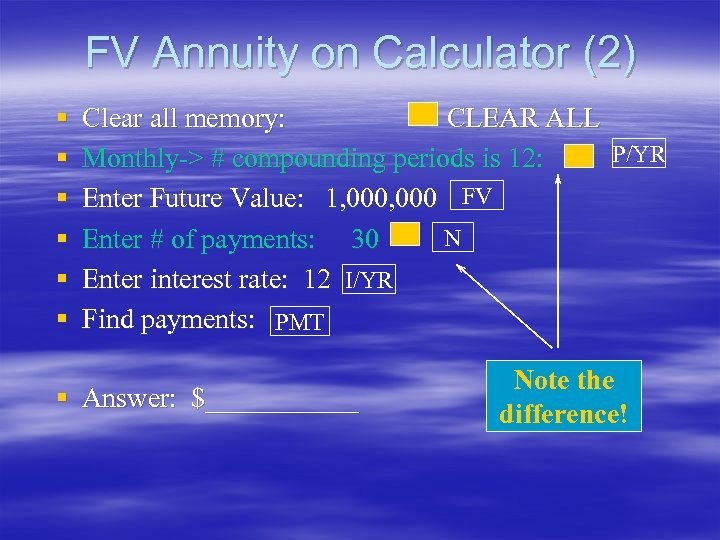 FV Annuity on Calculator (2) § § § Clear all memory: CLEAR ALL Monthly-> # compounding periods is 12: 12 P/YR Enter Future Value: 1, 000 FV N Enter # of payments: 30 Enter interest rate: 12 I/YR Find payments: PMT § Answer: $______ Note the difference!
 Present Value of Annuities § Here we bring multiple, level cash flows back to the present (year 0) § Typical examples are consumer loans where the loan amount is the PV and the fixed payments are the cash flows
 PV of Annuity Example § § Cash flow period (CFt) = $500 Number of periods (t) = 4 years Interest Rate (r) = 9% per year What is the present value (PV) = ? § ALWAYS DRAW A TIME LINE!!!
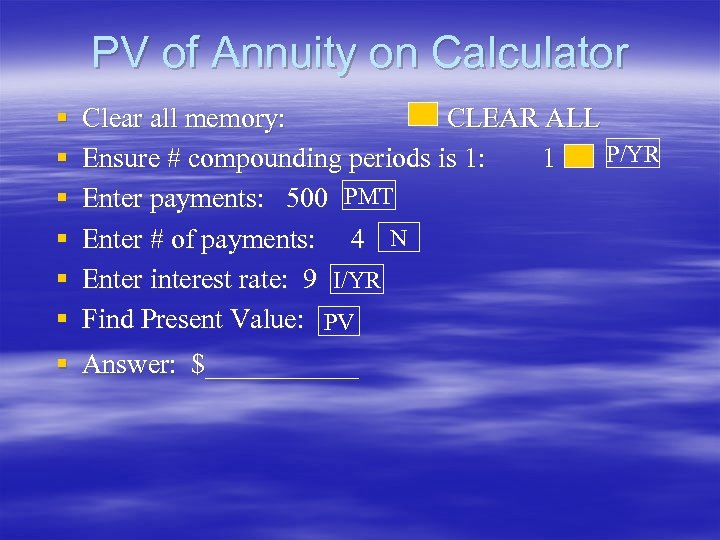 PV of Annuity on Calculator § § § Clear all memory: CLEAR ALL P/YR Ensure # compounding periods is 1: 1 Enter payments: 500 PMT Enter # of payments: 4 N Enter interest rate: 9 I/YR Find Present Value: PV § Answer: $______
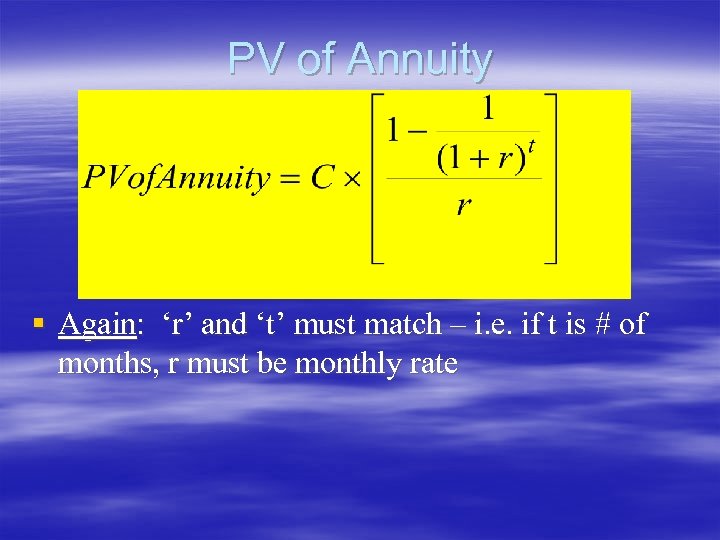 PV of Annuity § Again: ‘r’ and ‘t’ must match – i. e. if t is # of months, r must be monthly rate
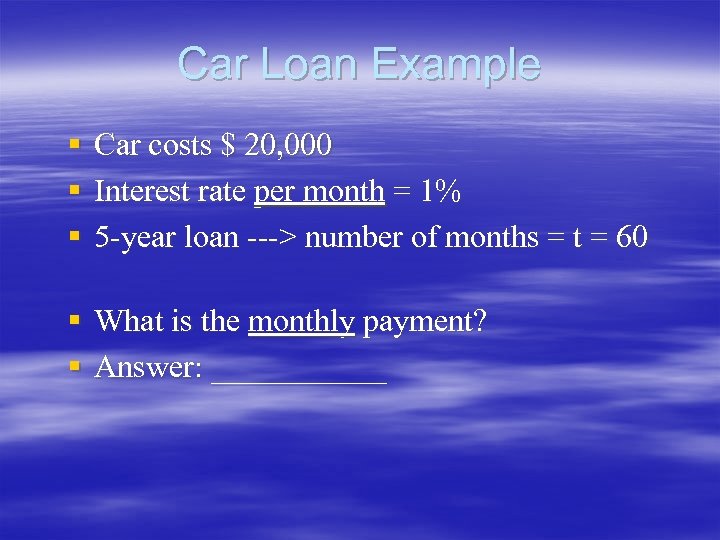 Car Loan Example § Car costs $ 20, 000 § Interest rate per month = 1% § 5 -year loan ---> number of months = t = 60 § What is the monthly payment? § Answer: ______
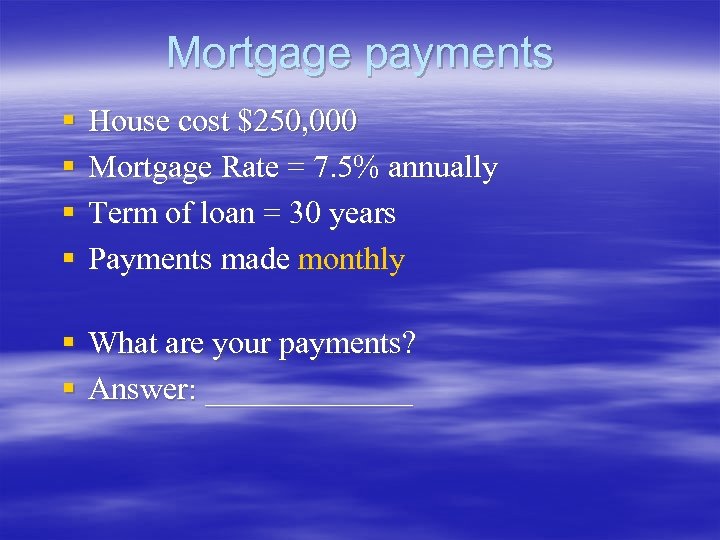 Mortgage payments § § House cost $250, 000 Mortgage Rate = 7. 5% annually Term of loan = 30 years Payments made monthly § What are your payments? § Answer: _______
 To Reiterate. . . § Be VERY careful about compounding periods § Problem can state annual interest rate, but the cash flows can be monthly, quarterly… § The convention is to state interest rate annually (Annual Percentage Rate)
 Perpetuity § Annuity forever § Examples: Preferred Stock, Consols
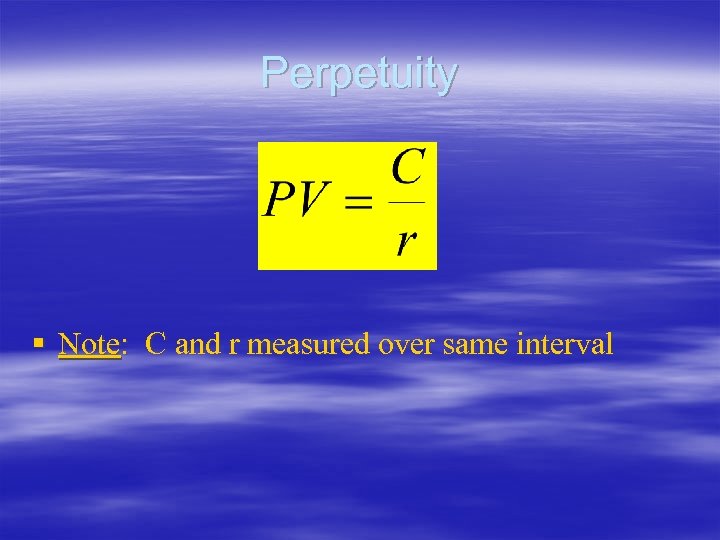 Perpetuity § Note: C and r measured over same interval
 Perpetuity Example § Preferred stock pays $1. 00 dividend per quarter. The required return, r, is 2. 5% per quarter. § What is the stock value?
 Perpetuity Example § Steve Forbes’s flat-tax proposal was expected to save him $500, 000 a year forever if passed. He spent $40, 000 of his own money for campaign § Charge: He was running for presidency for personal gain § Did the charge make sense
 Forbes continued. . . § What should be ‘r’ in the example? § At what ‘r’ would Forbes have gained from being a president and steamrolling flat-tax proposal?
 Compounding Periods § Interest can be compounded – Annually – Monthly - Semiannually - Daily - Continuously § Smaller the compounding period, faster is the growth of money § The same PV or FV formula can be used: BUT UNDERSTAND THE INPUTS!!
 Compounding example § Invest $5, 000 in a 5 -year CD § Quoted Annual Percentage Rate (APR) = 15% § Calculate FV 5 for annual, semi-annual, monthly and daily compounding § Key: Adjust “P/YR” on calculator
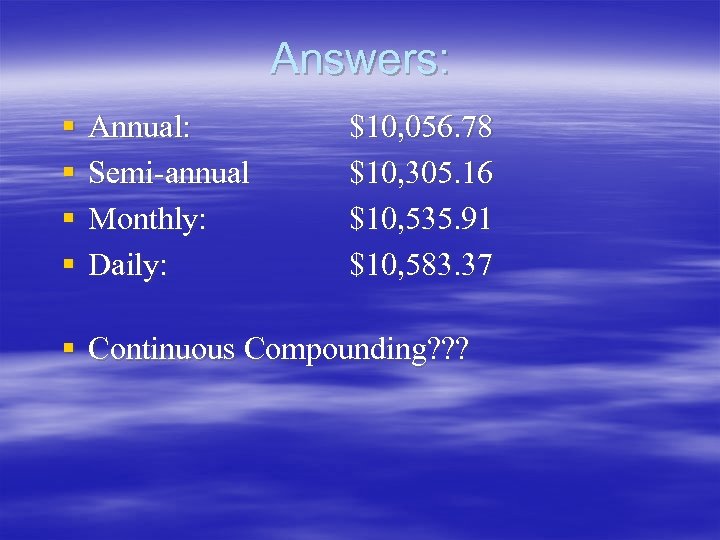 Answers: § § Annual: Semi-annual Monthly: Daily: $10, 056. 78 $10, 305. 16 $10, 535. 91 $10, 583. 37 § Continuous Compounding? ? ?
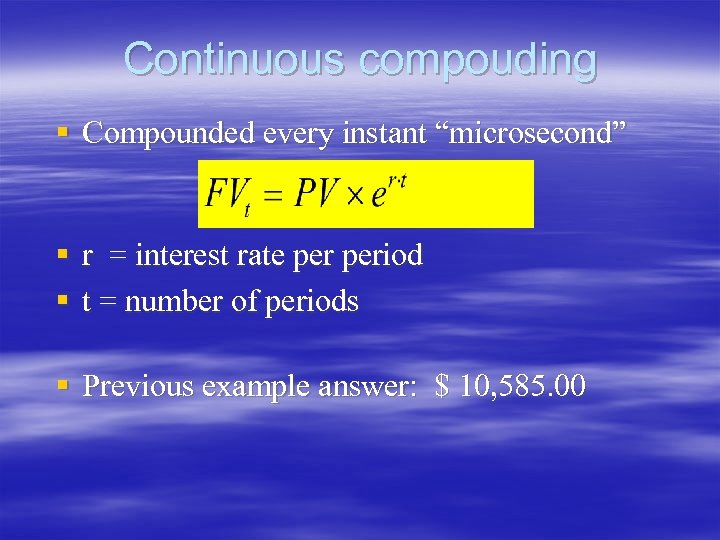 Continuous compouding § Compounded every instant “microsecond” § r = interest rate period § t = number of periods § Previous example answer: $ 10, 585. 00
 Continuous compounding example § Invest $4, 500 in an account paying 9. 5% compounded continuously § What is the balance after 4 years? Answer: _____
 Quoted vs. Effective Interest Rates § Quoted Rate: Usually stated annually along with compounding period (APR) – e. g. 10% compounded quarterly § Effective Annual Rate (EAR): Interest rate actually earned IF the compounding period were one year
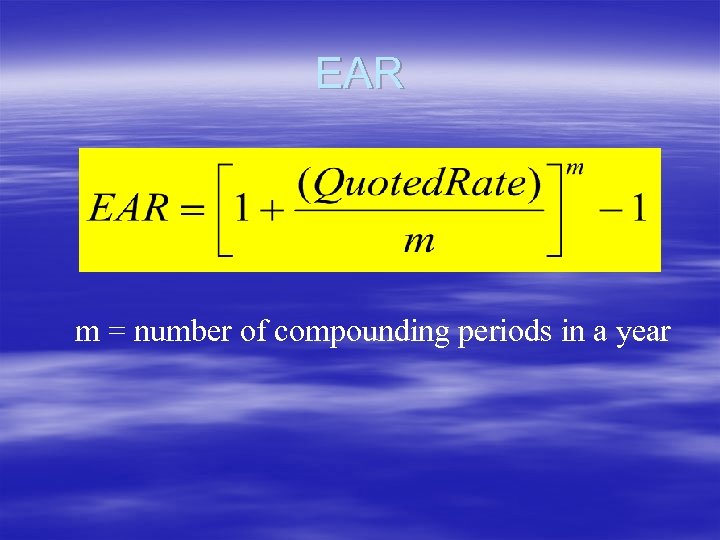 EAR m = number of compounding periods in a year
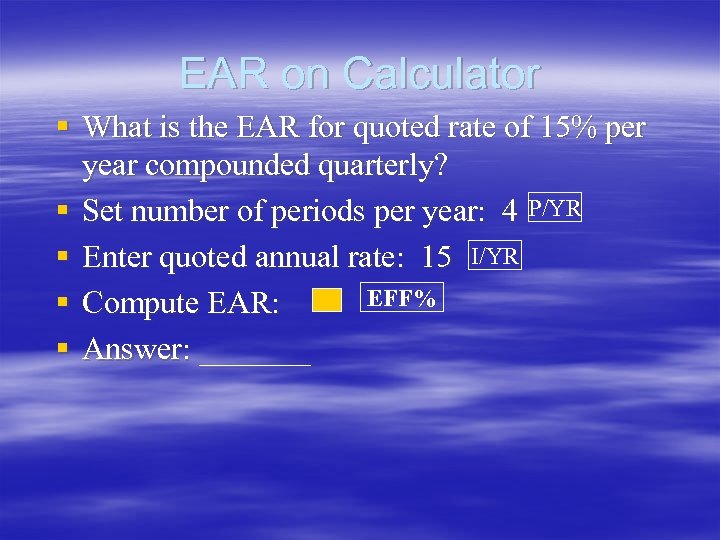 EAR on Calculator § What is the EAR for quoted rate of 15% per year compounded quarterly? § Set number of periods per year: 4 P/YR § Enter quoted annual rate: 15 I/YR EFF% § Compute EAR: § Answer: _______
 EAR Example § Compute EAR for 12% compounded – Annually – Quarterly – Monthly – Daily § Answers: ____ , ____
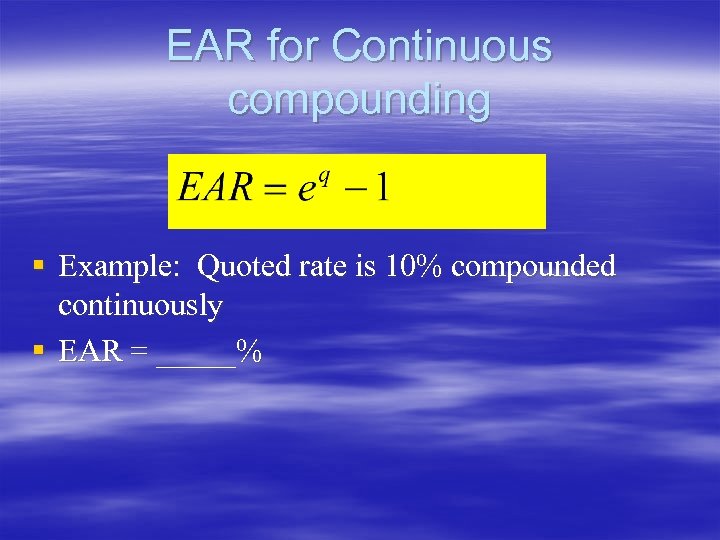 EAR for Continuous compounding § Example: Quoted rate is 10% compounded continuously § EAR = _____%
 Complicatons to TVM § When payments begin beyond year 1 § PV and FV combined § When payments begin in year 0 (Annuities Due)
 Payments beyond year 1 § A car dealer offers ‘no payments for next 12 months’ deal on a $15, 000 car. After that, you will pay monthly payments for the next 4 years. r = 10% APR. What are your monthly payments? § Answer: ______
 PV and FV combined § How much must you invest per year to have an amount in 20 years that will provide an annual income of $12, 000 per year for 5 years? r = 8% annually. § Answer: ______
 PV and FV combined 2 § You have 2 options: – Receive $100 for next 10 years only – Receive $100 forever beginning in year 11 § If r = 10% which one would you prefer? § At what interest rate are you indifferent between the two options?
 Annuities Due § Payments begin in year 0 – Ex. Rent/Lease Payments § Trick: § Adjust BEG/END on calculator to BEG OR § Leave to END, but multiply (1+r) for both PV and FV
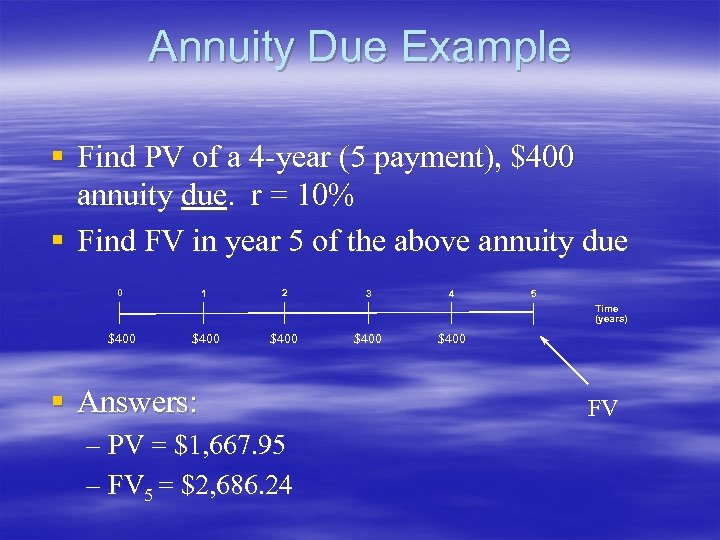 Annuity Due Example § Find PV of a 4 -year (5 payment), $400 annuity due. r = 10% § Find FV in year 5 of the above annuity due 0 1 2 3 4 5 Time (years) $400 § Answers: – PV = $1, 667. 95 – FV 5 = $2, 686. 24 $400 FV
 Another Example § You start to contribute $500 every month to your IRA account beginning immediately. How much will you accumulate at the end of first year? The return on your investment is 20% per year. § Note: ‘Return’ here is just another term for the interest rate § Answer: $_______
 Tricky but Legal. . . § Add-on Interest Called ‘add-on’ interest because interest is added on to the principal before the payments are calculated § Points on a Loan: Percentage of loan amount reduced up front – Used in home mortgages
 Example: Add-on Interest § You are offered the opportunity to borrow $1, 000 for 3 years at 12% ‘add-on’ interest. The lender calculates the payment as follows: Amt. owed in 3 years: $1000 x (1+. 12)3 = 1, 405 Monthly Payment = $1, 405 / 36 = $39 § § What is the effective annual rate (EAR)? Steps: – Calculate the APR interest (I/YR) – Use answer to calculate the EAR
 Add-on Example (2) § Calcuate the EAR on a 6 -year, $7, 000 loan at 13% ‘add-on’ interest. The payments are monthly. § Answer: ____
 Example: Points on a Loan § 1 -year loan of $100. r = 10% + 2 points [Note: 1 point = 1% of loan amount. Hence you pay upfront $2 to lender. Hence you are actually getting only $98, not $100] § What is the EAR? § $110 = $98 (1+r) r = 12. 24%
 Points on a loan (2) § Calculate the EAR on a 10 -year, $110, 000 mortgage when interest rate quoted is 7. 75% + 1 point. The payments are monthly § Answer: _____
 Balloon Payments § Amount on the loan outstanding after a certain number of payments have been made – Sometimes called ‘residual’ on a loan § e. g. when you want to pay off a loan early
 Balloon Example § You borrowed $90, 000 on a house for 30 years 10 years ago. The annual interest rate then was 17%. The payments are monthly. Since interest rate has fallen, you want to payoff the remaining amount on the loan and refinance it. What is the outstanding amount to be paid off? (Note: Payments are $1, 283. 11) § Answer: $_____
 Two ways to calculate Balloons § First calculate payments § Take the present value of the remaining (unpaid) payments OR § § § Use amortization function on calculator Enter the period : period INPUT AMORT , and then = = = Enter
 Another Example. . § What is the outstanding balance on a 5 year $19, 000 car loan at 11% interest after 2 -1/2 years have passed? The payments are monthly. § Answer: $______
 TVM TIPS § Draw time line! § Check & set BEG/END on calculator § Check & set P/YR on calculator § Check & set # of decimal places to 4
 TVM Tips Continued. . . § Clear all previously stored #’s in memory – Especially true when same problem requires multiple TVM calculations § Make sure that for FV and PV calculation, you have correctly signed (+/-) the cash flows